Your USMLE Step 2 CK percentile tells you one simple, crucial thing: where you stand compared to everyone else. It's the number that ranks your performance against other medical students, showing what percentage of test-takers you scored higher than. And now that Step 1 is pass/fail, this percentile has become a massive deal for residency applications.
Decoding Your Step 2 CK Percentile

Think of it like this: your three-digit Step 2 CK score is your raw power, but the percentile is your ranking on the leaderboard. It gives that score vital context. Scoring in the 80th percentile, for example, means you outperformed 80% of your peers who recently took the exam.
This comparison is exactly what residency program directors are looking for. With Step 1 no longer providing a score, your Step 2 CK performance has been thrust into the spotlight. It's now the main objective tool programs use to get a quick read on your clinical knowledge and reasoning skills. A high percentile can get your application a serious look, while a lower one might mean you'll need to really shine in other areas.
A Quick Competitive Benchmark
So, what do these numbers actually look like in the real world? While the exact score-to-percentile mapping shifts a bit each year, you can get a good feel for the competitive tiers.
For instance, a score of 255 often puts you around the 75th percentile, which is a strong, competitive score for most specialties. A score of 245, on the other hand, typically lands you near the 50th percentile—a solid, average performance.
If you're aiming for a top-tier score, our comprehensive USMLE Step 2 CK study guide is packed with strategies to help you get there: https://acemedboards.com/usmle-step-2-ck-study-guide/
Step 2 CK Score to Percentile Quick Reference
To give you an even clearer picture, here's a table mapping common score ranges to their estimated percentiles and what that generally means for your application's competitiveness. This is a great starting point for setting your own goals.
| Step 2 CK Score Range | Estimated Percentile Range | General Application Competitiveness |
|---|---|---|
| 265+ | ~90th+ percentile | Highly Competitive (Top Tier) |
| 255-264 | ~75th-89th percentile | Very Competitive (Strong Applicant) |
| 245-254 | ~50th-74th percentile | Competitive (Average to Above Average) |
| 235-244 | ~30th-49th percentile | Moderately Competitive |
| Below 235 | Below ~30th percentile | Less Competitive (May need to strengthen other areas) |
Keep this table in mind as you plan your study schedule and set your target score. It helps translate a number into a tangible competitive goal.
It’s easy to get this mixed up, so here’s a key point: your percentile is not the percentage of questions you got right. It’s a direct comparison of your performance against a very specific group of recent US and Canadian medical school test-takers, which is why it’s so powerful for standardizing how programs evaluate applicants.
This gives you the basic lay of the land. Now, let's dig deeper into how these numbers are calculated and what they truly mean for your residency match.
What Your Percentile Actually Represents
Your Step 2 CK percentile isn't just a grade; think of it as your national ranking in a massive academic competition. It's easy to get this number mixed up. For example, scoring in the 75th percentile doesn’t mean you got 75% of the questions right. What it really means is you performed better than 75% of the other medical students who took the test, landing you squarely in the top quarter of your peers.
That distinction is a big deal. Your three-digit score is a reflection of your individual performance on the exam, but the percentile is what gives that score context. It’s the number that tells residency program directors how you stack up against a very specific group of your future colleagues.
The Bell Curve And Your Position
Picture every recent Step 2 CK test-taker lined up according to their score, from lowest to highest. That distribution of scores will almost always form a classic bell curve. Your score simply places you somewhere on that curve, and your percentile is the percentage of people standing behind you.
Most scores are going to bunch up right in the middle of the curve, around the average. Because this area is so crowded, even a small increase in your raw score can make you jump ahead of a huge number of people.
This is a critical insight: A five or ten-point gain near the average score can lead to a massive leap in your USMLE Step 2 CK percentile. On the flip side, that same point increase way up at the top of the curve results in a much smaller percentile gain because there are just fewer people to pass.
Understanding this dynamic shows you why every single point matters, especially if your practice scores are hovering around the national mean.
Who Are You Being Compared Against?
When you get your score report, you’re not being compared to every medical student on the planet. The comparison group, known as the "norm group," is actually very specific and is updated periodically by the USMLE to stay relevant.
This group is mainly made up of:
- US and Canadian Medical Students: The primary comparison is against students from MD-granting medical schools in the United States and Canada.
- Recent Test-Takers: The data is pulled from a recent cohort of examinees, ensuring the comparison reflects the current landscape of medical education.
This standardized comparison is exactly why the percentile is so valuable to residency programs. It levels the playing field, allowing them to instantly see how you measure up against the main applicant pool they're considering. It cuts through the noise of different med school curriculums and grading systems.
Ultimately, your percentile gives a program director a quick, data-driven answer to their most fundamental question: "How does this applicant's clinical knowledge compare to their peers?" While knowing the USMLE Step 2 passing score is the first hurdle, aiming for a strong percentile is what truly makes your application stand out.
Why Percentiles Became The New Gold Standard
The residency application game changed forever when the USMLE Step 1 went pass/fail in January 2022. Almost overnight, the detailed, three-digit Step 2 CK score—and its percentile—went from being an important metric to the single most important academic filter for residency program directors.
Before this shift, programs leaned heavily on the Step 1 score to sift through thousands of applications. It was the first big academic hurdle that offered a straightforward, numerical way to compare candidates from all over the country. With that number gone, directors needed a new tool, and the Step 2 CK score was ready to take its place.
This seismic shift is why your USMLE Step 2 CK percentile now carries so much weight. It’s the primary way programs quickly assess your clinical knowledge against everyone else applying.
The New Differentiator In A Crowded Field
In today's residency match, a strong Step 2 CK percentile is what makes you stand out. Program directors are drowning in applications and need a fast, reliable way to find the best candidates for their limited interview spots. A high percentile is an immediate signal of academic excellence and clinical readiness.
This is especially true for hyper-competitive specialties like dermatology, orthopedic surgery, or plastic surgery. In these fields, applicants often have near-perfect records across the board. A top-tier percentile can be the one thing that moves an application from the "maybe" pile straight to the "must-interview" list.
For international medical graduates (IMGs), a killer Step 2 CK percentile is even more critical. It acts as objective, undeniable proof of their clinical skills, helping to level the playing field and show they can perform just as well as their U.S.- and Canadian-trained peers.
The move from a scored Step 1 to a pass/fail system fundamentally changed how students are evaluated. Program directors now see the Step 2 CK score not just as a test of knowledge, but as a strong predictor of a student's ability to hit the ground running on day one of residency.
This new reality demands a different mindset. Preparing for Step 2 CK isn't just about passing another test; it’s about building the central academic pillar of your residency application. That means your preparation has to be strategic, with a laser focus on earning the highest percentile you can.
What The Data Reveals About The Shift
The numbers since the change tell the full story. A high Step 2 CK percentile has always been a good sign, but now it's the linchpin of the residency match. Looking at past data, a score in the 260-264 range (placing you in the 75th to 90th percentile) makes an application significantly more competitive. In contrast, scores between 240-249 (roughly the 25th to 50th percentile) might close doors in more competitive fields. You can learn more about how these score percentiles impact specialty success on elitemedicalprep.com.
Thinking about the old system helps put this in context. The USMLE Step 1 pass rate shows why simply passing is no longer enough; a high Step 2 percentile is the new standard of excellence.
At the end of the day, your performance on this one exam has a direct and massive impact on the number of interview invitations you’ll get. It sets the tone for your entire academic story before a program director ever reads your personal statement or recommendation letters. This makes nailing your Step 2 CK a non-negotiable priority.
Navigating The Latest Score And Percentile Data
To hit your Step 2 CK goals, you first need to understand the playing field. The scoring landscape for this exam isn't static; for years, we've seen a trend called "score creep," where the average score slowly but consistently inches upward.
What does this mean for you? It means hitting a top-tier percentile is tougher now than it was just a few years ago. Aiming for what used to be a "good" score might land you in a lower percentile bracket today. Getting a handle on the most recent data is absolutely critical to positioning yourself competitively.
With Step 1 now pass/fail, residency program directors have shifted their focus, making your Step 2 CK score more important than ever.
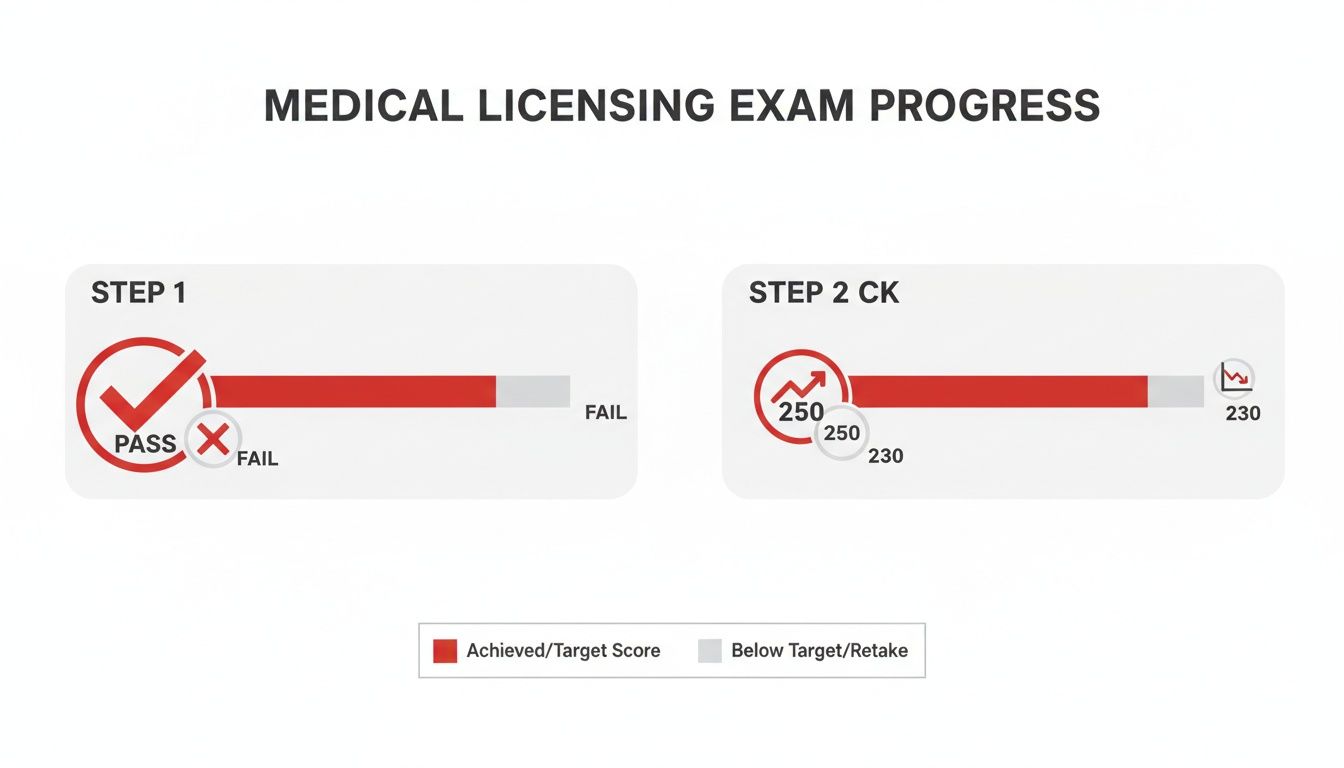
This visual drives home the point: your three-digit Step 2 CK score and its corresponding percentile have become the single most important academic metric for getting your foot in the door.
Understanding Current Score Benchmarks
So, what numbers should you really be aiming for? While the official data shifts slightly each year, we can look at recent trends to set some reliable benchmarks.
Lately, the average Step 2 CK score has been hovering around 248. The 25th percentile is typically near 237, and the 75th percentile is up around 259. Scoring a 240, for example, now places you somewhere between the 24th and 40th percentile, meaning you've only outperformed about a third of your peers.
This upward trend means you can't just aim for average anymore. To truly stand out, you need to set a goal that significantly surpasses it. This requires not just knowing the material inside and out, but also mastering how to translate that knowledge into points on test day. Gauging your progress with official practice tests is key—make sure you know how to best use the NBME Step 2 CK practice exams to get an accurate read on where you stand.
To give you a clearer picture, here’s a breakdown of what recent Step 2 CK scores mean in terms of percentile rank.
USMLE Step 2 CK Percentile Data by Score
This table provides a snapshot of recent approximate percentile equivalents for key scores, based on performance data for US/Canadian test-takers.
| Step 2 CK Score | Approximate Percentile Rank | Interpretation |
|---|---|---|
| 265 | ~90th percentile | An elite score that opens doors to the most competitive specialties and programs. |
| 255 | ~75th percentile | A very strong score that makes you a highly competitive applicant for most specialties. |
| 245 | ~50th percentile | A solid, average score that meets the benchmark for many less competitive programs. |
| 235 | ~25th percentile | A score that may be screened out by more competitive programs; your other application areas must be strong. |
Use these numbers to set a concrete, data-driven goal for your study plan.
Setting Your Sights Beyond the Average
With the average score climbing, simply aiming for the middle of the pack is a risky strategy, especially if you're targeting a competitive field. Program directors are dealing with thousands of applications, and a high percentile is one of the quickest ways for them to filter the pile.
A score in the 75th percentile or higher doesn't just look good—it signals to residency committees that you possess a superior level of clinical knowledge compared to the vast majority of your peers. This can be the deciding factor that earns you an interview invitation.
Your goal should be to land in a percentile that makes your application impossible to ignore. For most candidates, this means targeting a score well above the 50th percentile. By setting your sights on the 75th percentile or higher, you build a buffer and significantly increase your chances of matching into your desired specialty. This transforms your study plan from a vague hope into a precise mission.
Setting Target Percentiles For Your Specialty
Your USMLE Step 2 CK percentile isn’t just some abstract number on a score report. Think of it as a strategic key that can unlock the door to your dream residency. To use it right, you have to connect that percentile to a real, concrete score target for the specialty you want.
The truth is, the goal isn't just to "score high." It's to score competitively for the specific field you're aiming for.
Different specialties have wildly different expectations. A score that makes you a standout candidate for family medicine might not even get your application past the initial filter for dermatology or orthopedic surgery. This is where the data from the National Resident Matching Program (NRMP) becomes your best friend, showing you exactly what scores the people who successfully matched had.
With that data, you can work backward. Find the average Step 2 CK score for your target specialty, and you'll know the USMLE Step 2 CK percentile you need to shoot for. This simple exercise turns a vague goal like "do well" into a precise mission: "I need to hit a score of 255 to be competitive."
Benchmarks For Highly Competitive Specialties
For the most sought-after residency spots, the academic bar is set incredibly high. These fields are packed with applicants who have stellar board scores, making a top-tier percentile a non-negotiable part of your application.
Here’s a look at some of the toughest fields and the typical scores of U.S. MD seniors who successfully matched:
- Dermatology: Average Step 2 CK Score of 257
- Orthopedic Surgery: Average Step 2 CK Score of 257
- Plastic Surgery: Average Step 2 CK Score of 256
- Otolaryngology (ENT): Average Step 2 CK Score of 256
Scoring in this range—256 or higher—puts you comfortably above the 75th percentile. For these specialties, that percentile is your ticket to an interview. It proves to program directors that you have the exceptional clinical knowledge needed to thrive in a demanding environment.
Targets For Competitive And Less Competitive Fields
While the top-tier fields are intense, many other specialties are still very competitive and demand impressive scores. Think about fields like diagnostic radiology, emergency medicine, and general surgery. To match into these programs, you'll want a score that places you well above the national average.
On the other hand, specialties focused on primary care—like family medicine, pediatrics, and psychiatry—tend to have a broader range of accepted scores. A high score is always a plus, but a score closer to the national average can still make you a very strong contender.
The most important takeaway is that your target percentile needs to be dynamic and based entirely on your career goals. A score near the 50th percentile (around 245-250) is a solid benchmark for many excellent specialties. But aiming for the 75th percentile gives you a serious competitive edge, no matter where you apply.
Here’s a simplified breakdown to help you set some realistic goals:
| Specialty Tier | Example Specialties | Target Score Range | Approximate Percentile Goal |
|---|---|---|---|
| Highly Competitive | Dermatology, Orthopedics | 255+ | 75th percentile and above |
| Competitive | Radiology, Anesthesiology | 250-255 | 60th – 75th percentile |
| Less Competitive | Family Medicine, Pediatrics | 240-250 | 40th – 60th percentile |
This data-driven strategy is the foundation of a smart study plan. To see exactly how scores line up with specific programs, check out our detailed breakdown of Step 2 scores by specialty. When you set a clear, informed target, you give every single study session a purpose, moving you one step closer to a successful Match Day.
How to Actually Raise Your Percentile Score

Knowing your target percentile is one thing, but actually hitting it? That takes a smart, focused plan. Moving your score up a bracket isn’t about cramming more facts; it’s about mastering clinical reasoning and sharpening your test-taking instincts.
Let's get into the practical, battle-tested methods that actually move the needle. The foundation of a high score is a study schedule built around high-yield topics and active learning. Passively reading your notes won’t get you there. You need to spend your time applying knowledge, mostly through practice questions that feel just as complex and grueling as the real exam. This is how you build the mental stamina and diagnostic skills you need to win.
Master The Art Of The Question Bank
Your question bank, especially UWorld, is the most powerful tool you have. The goal isn't just to plow through thousands of questions. The real magic happens when you squeeze every drop of learning out of each one—especially the ones you get wrong.
For every single question, you should be able to explain:
- Why the right answer is right: Don't just recognize it. Articulate the clinical logic, the specific pathophysiology, and the key signs that point straight to that conclusion.
- Why every wrong answer is wrong: This is the most important part. You need to pinpoint the exact flaw in each distractor. Is it the wrong diagnosis for these symptoms? An inappropriate next step? A finding that’s completely irrelevant?
This deep-dive approach turns practice questions from a simple quiz into a powerful learning engine. It’s how you build the web of connected knowledge needed to handle the tricky clinical scenarios on Step 2 CK.
Simply doing a Qbank is a task; analyzing every single answer choice is a skill. The latter is what directly boosts your USMLE Step 2 CK percentile because you're training your brain to spot patterns and tell apart similar-looking diagnoses under pressure.
Build on Your Clinical Year Foundation
Think of your third-year Shelf exams as the warm-up act for Step 2 CK. They aren't just boxes to check; they're the building blocks of your prep. All that knowledge from Internal Medicine, Surgery, Peds, and OB/GYN is coming back for the main event. A strong showing on your Shelves gives you a massive head start.
If you still have rotations left, treat each Shelf exam like a mini-Step 2. If you’re done with them, pull out your score reports and look for your weak spots. Did cardiology questions on the Medicine Shelf consistently trip you up? Great. Now you know exactly where to start your Step 2 studying. This way, you’re patching up your weaknesses from day one, turning old struggles into new strengths.
Sharpen Your Test Day Execution
On exam day, your score is just as much about strategy and staying cool as it is about what you know. A brilliant student can easily underperform because of bad time management or test anxiety. You need to practice these skills until they're automatic.
Here are the key techniques to nail down:
- Timed Block Practice: Always, always, always do your practice questions in timed, random blocks of 40. This perfectly simulates the real exam's pace and forces your brain to switch gears constantly. The goal is to finish each block with a few minutes left over for review.
- Develop a Question Attack Plan: Create a system for breaking down vignettes. Maybe you read the last sentence first to see what they're asking, then scan the answers before reading the full stem. Find a rhythm that works for you and use it every single time.
- Manage Your Nerves: High stakes mean high stress. Practice simple breathing exercises or mindfulness during your study blocks. Knowing how to calm down and refocus after a tough question can save you from a downward spiral and preserve precious points.
When you pair deep content knowledge with sharp execution, you give yourself the best shot at performing at your peak and landing a percentile that truly reflects all your hard work.
Common Questions About Step 2 CK Percentiles
Let's wrap up by tackling some of the most frequent questions I hear from students about Step 2 CK percentiles. These are the quick, practical answers you need to clear up any lingering confusion.
How Much Does My Percentile Matter as an IMG?
For an International Medical Graduate (IMG), your percentile isn't just a number—it's a critical tool for leveling the playing field. It acts as a standardized, objective measure of your clinical knowledge, showing residency programs that you can perform right alongside your US and Canadian peers.
Pushing your score above the 75th percentile is a game-changer. It can significantly strengthen your application, often making the difference in securing those all-important interview invitations.
Do Programs Use Hard Score Cutoffs?
Yes, many still do. With thousands of applications to review, programs often use score cutoffs as an initial screening filter. It's a blunt instrument, but it helps them manage the sheer volume.
While this is slowly changing, a score that falls below a program's threshold (often hovering around the 25th-30th percentile) might mean your application gets automatically filtered out, especially at more competitive institutions. This is exactly why simply "passing" isn't enough; you need a strategic buffer.
A strong percentile doesn't guarantee an interview, but a low one can sometimes prevent your application from ever being reviewed by a human. It's the key that gets you past the first gate.
What Is a Good Score for a Less Competitive Specialty?
If you're aiming for a specialty like family medicine or pediatrics, you have a bit more breathing room. While a sky-high percentile is always a plus, a score around the 50th percentile (which is roughly a 245-250) typically makes you a very solid candidate.
This demonstrates strong clinical knowledge and checks the box for a huge number of excellent programs, all without the immense pressure of chasing a 90th-percentile score.
How Should I Address a Lower-Than-Expected Score?
If your score isn't what you hoped for, the key is to shift the narrative. Your mission becomes making every other part of your application absolutely stellar. This means getting outstanding letters of recommendation, crafting a powerful personal statement, and making sure your research or leadership experiences shine.
If it comes up in an interview, have a concise and mature response ready. Acknowledge it briefly, then pivot to what you learned from the experience. Show them your resilience and commitment to growth, not excuses.
Navigating the complexities of board exams requires a strategic approach. Ace Med Boards offers personalized tutoring to help you build a study plan that targets your weaknesses and maximizes your scoring potential.
Book a free consultation to start building your path to a top percentile