If you're gearing up for Step 3, there's one resource that's practically non-negotiable: UWorld. It's the undisputed heavyweight champ for a reason. UWorld for Step 3 isn't just a study tool; it's a complete training environment built around a massive multiple-choice question bank (Qbank) and interactive Computer-based Case Simulations (CCS).
Think of it as the flight simulator for your final hurdle to medical licensure. You wouldn't want to fly a plane without simulator training, and you don't want to face Step 3 without mastering UWorld.
Why UWorld Is Your Key to USMLE Step 3 Success

The USMLE Step 3 exam is a different beast altogether. It's a two-day marathon designed to test your ability to function as an independent physician, bridging that critical gap between supervised residency and unsupervised practice. To pass, you need a resource built for that exact transition. That’s where UWorld truly shines.
It’s not just another question bank; it’s an integrated system engineered to build the clinical reasoning skills you’ll actually use on the floor. Its gold-standard reputation isn't just hype—it's built on years of resident success stories and an uncanny alignment with the real exam’s format and feel.
The proof is in the numbers. Pass rates for first-time takers from US and Canadian schools are consistently sky-high. In one recent cycle, a staggering 97% of US allopathic graduates passed on their first try, with international medical graduates (IMGs) also hitting an impressive 89% pass rate. These stats show just how doable this exam is with the right prep.
Understanding the Core Components
The magic of UWorld Step 3 lies in its two-pronged attack, which perfectly mirrors the two days of the exam. You absolutely need to master both parts.
- The Qbank (Question Bank): This is your bread and butter for content review. It’s packed with thousands of high-yield, vignette-style multiple-choice questions that look and feel just like the real thing.
- CCS Cases (Computer-based Case Simulations): This is where you put your knowledge into action. The interactive software throws you into simulated patient encounters where you have to take a history, order tests, make a diagnosis, and manage treatment in a dynamic, real-time environment.
At its core, UWorld provides a simulated clinical environment. The Qbank tests your diagnostic knowledge, while the CCS cases test your management skills. Mastering both is non-negotiable for success.
This dual structure is what makes it so effective. One of the most common mistakes residents make is focusing too much on the Qbank and neglecting the CCS cases, which can be devastating on Day 2. Understanding the purpose of each component helps you build a balanced, knockout study plan from day one. It's also a good idea to understand the USMLE Step 3 average score to set a realistic target for yourself.
Here’s a quick breakdown of how these two critical pieces fit together.
UWorld Step 3 Core Components at a Glance
This table breaks down the two main features of the UWorld Step 3 package, explaining what each component is and why it is critical for exam preparation.
| Component | Description | Relevance to Step 3 Exam |
|---|---|---|
| Qbank | A massive database of multiple-choice questions with incredibly detailed explanations for every single answer choice, correct or not. | Prepares you for the entirety of Day 1 and the multiple-choice sections of Day 2, covering the full spectrum of clinical science. |
| CCS Cases | An interactive simulation platform where you manage virtual patients by ordering tests, prescribing treatments, and advancing the clock. | Absolutely crucial for mastering Day 2 of the exam, which heavily weights your performance on these patient management simulations. |
Bottom line: The Qbank builds your knowledge base, and the CCS cases teach you how to apply it under pressure. Together, they give you the comprehensive preparation needed to walk into the testing center with confidence.
Digging Into the UWorld Qbank and CCS Cases
Alright, let's get past the basics and into the real meat of your UWorld Step 3 prep: the Qbank and the Computer-based Case Simulations (CCS). It's a mistake to see these as separate tools. Think of them as two sides of the same coin—one builds your raw clinical knowledge, and the other teaches you how to apply it when the clock is ticking.
You absolutely have to master both. The Qbank gives you the building blocks—the facts, the clinical associations, the diagnostic criteria. The CCS cases, on the other hand, are where you learn to put it all together to manage a patient from the moment they walk in until they're discharged.
Breaking Down the UWorld Step 3 Qbank
The UWorld Qbank is so much more than a list of practice questions. It’s an entire learning environment built to perfectly mirror the first day of the Step 3 exam, which is all multiple-choice questions. With over 1,600 questions, it covers the huge range of advanced clinical medicine and foundational science that you’re expected to have down cold.
Every single question is a carefully written clinical vignette designed to test your ability to take in patient info, build a differential diagnosis, and figure out the next best step. The real magic, though, is in the explanations. They are legendary for their detail, often packing more high-yield information into a single paragraph than you'd find in a whole textbook chapter.
So many residents treat the Qbank like a test, blazing through questions just to get a score. Big mistake. Your Qbank should be your primary textbook. The goal isn't just getting the right answer; it's understanding precisely why every other option is wrong.
This is active learning at its best. You wrestle with a clinical problem and then get immediate, in-depth feedback. That’s what makes complex ideas stick and builds the kind of recall you need on exam day.
Getting a Handle on the Computer-Based Case Simulations
The CCS portion is, without a doubt, the most nerve-wracking part of Step 3 for most people. And for good reason—it’s a totally different beast that tests your real-time clinical management skills. This is where UWorld’s simulation software becomes your most critical training partner.
Think of it as a flight simulator for patient care. You're given a patient, and you have to:
- Take a focused history and perform a physical.
- Order the right diagnostic tests (labs, imaging, you name it).
- Start initial treatments and keep an eye on how the patient responds.
- Advance the clock to see how the case unfolds over minutes, hours, or days.
UWorld gives you over 100 CCS cases to work through, including 40 fully interactive cases and 70+ practice cases. These cover the bread-and-butter clinical scenarios you'll definitely see, along with urgent situations. The software does a great job of mimicking the real exam's clunky interface, which is a huge advantage. You get comfortable with the mechanics of placing orders, counseling, and managing time long before you sit for the real thing.
Want to really dive deep on this format? Check out our complete guide to USMLE Step 3 CCS cases.
Don't Forget the Biostats Review and Self-Assessments
Beyond the core Qbank and CCS tools, UWorld has two other features that a surprising number of residents skip over. These are designed to patch up common weak spots and give you a realistic gut check on your progress.
1. Biostatistics Subject Review
Step 3 is notorious for being heavy on biostats, analyzing abstracts, and interpreting medical literature. UWorld's biostatistics review is a short, high-yield module that makes these intimidating topics much more manageable. Honestly, it's an absolute must-do.
2. Self-Assessment Exams (UWSA 1 & 2)
These are two full-length practice exams that simulate the real test-day experience. They give you a predicted score range, which is incredibly valuable for tracking how you're doing and finding any lingering knowledge gaps.
Here’s the best way to use them:
- UWSA 1: Take this around the halfway point of your study period. Use it as a diagnostic to figure out which areas need more of your attention.
- UWSA 2: Save this for 1-2 weeks before your actual exam. It’s widely seen as a pretty accurate predictor of your final score and can give you a final shot of confidence.
By weaving the Qbank, CCS cases, biostats review, and self-assessments into a single strategy, you're using everything UWorld offers. You'll leave no stone unturned on your way to passing Step 3.
Building Your High-Yield UWorld Study Plan
Turning that UWorld Step 3 subscription into a passing score takes more than just logging in—it demands a smart, structured plan. Every resident's schedule is a unique puzzle of long shifts, clinic days, and precious slivers of personal time. A one-size-fits-all approach just doesn't cut it. Your study plan has to be adaptable, efficient, and built around proven learning principles.
The whole idea is to move beyond passive review. Simply reading explanations won't forge the deep clinical connections you need for Step 3. True mastery comes from active learning: questioning your own assumptions, making flashcards from your incorrects, and even trying to teach the concepts back to yourself.
To really make your UWorld prep count, you'll want to incorporate some scientifically proven study methods. Techniques like spaced repetition and active recall are perfect for tackling the sheer volume of information in the Qbank.
Crafting Your Timeline: 4 Weeks vs. 3 Months
Your personal timeline is the biggest factor in how you structure your prep. Are you on a lighter rotation with chunks of dedicated study time, or are you trying to squeeze in questions between chaotic call shifts?
- The 4-Week Intensive Sprint: This is for residents with a dedicated study block. Think of it as a full-time job requiring serious discipline, often meaning 4-6 hours of focused study every single day.
- The 3-Month Marathon: This is the reality for most busy residents. It’s all about consistency over intensity, weaving UWorld into your daily routine to make steady progress without burning out.
Here’s a visual to help you map out the key phases of your UWorld journey, from the initial Qbank grind to your final self-assessments.
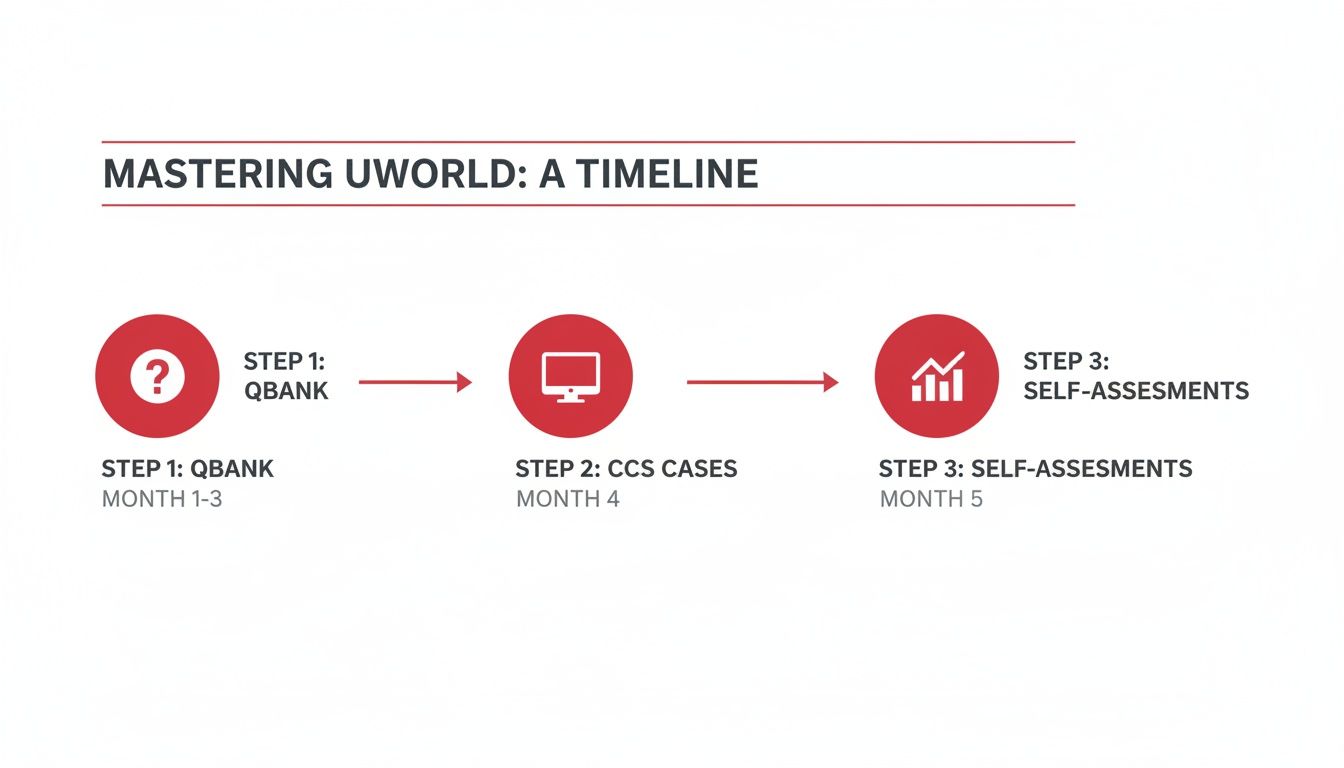
This timeline highlights a logical progression, making a key point: start integrating CCS cases early. Don't leave them for the very end.
To give you a clearer picture, here’s a breakdown of how these two different timelines might look in practice.
Sample UWorld Step 3 Study Schedules
| Study Period | 4-Week Intensive Plan (Daily Goals) | 3-Month Extended Plan (Weekly Goals) |
|---|---|---|
| Qbank Questions | Complete 80 questions (two 40-question timed blocks) to build exam stamina. | Complete 100-150 questions. Focus on timed 40-question blocks during weekends. |
| Qbank Review | Dedicate at least 3 hours to a deep review of every single question. | Thoroughly review every question completed, focusing on incorrects and flagged items. |
| CCS Cases | Complete 2-3 interactive cases to get comfortable with the interface and timing. | Complete 5-7 cases to steadily build case management skills. |
| Self-Assessments | UWSA 1 at the end of Week 2. UWSA 2 one week before the exam. | UWSA 1 at the 6-week mark. UWSA 2 one to two weeks before the exam. |
These are just frameworks, of course. The most important thing is to pick a lane and stick to it, adjusting as you get a better feel for your own pace.
Using Self-Assessments as Your Guide
UWorld’s Self-Assessment (UWSA) exams aren't just practice tests; they are powerful diagnostic tools. Using them strategically can completely reshape the final, critical weeks of your prep.
A common mistake is just looking at the UWSA score as a pass/fail indicator. The real gold is in the data. Think of it as a detailed map showing you exactly where your remaining knowledge gaps are.
Here’s the right way to use them:
- Take UWSA 1 about halfway through your study period. After you finish, block out an entire day to review it. Pinpoint your weakest subjects and then tweak the rest of your study plan to hammer those areas.
- Take UWSA 2 roughly one week before your exam date. This one is widely considered to be a solid predictor of your final score. It’s your final check-up and a great confidence booster.
By creating a structured timeline, setting goals you can actually hit, and using the self-assessments to guide you, you transform UWorld from just a Qbank into your own personalized, high-yield study system. You can explore more options by checking out our guide on https://acemedboards.com/step-3-study-plan/.
Avoiding Common UWorld Step 3 Mistakes

Knowing what to do during your UWorld Step 3 prep is only half the battle. Just as critical is understanding the common traps that can derail even the most diligent residents. Sidestepping these mistakes ensures your study time is effective, sustainable, and actually translates to a passing score.
One of the most frequent errors is treating the Qbank like a race to the finish line. The goal isn't just to complete all 1,600+ questions; it's to deeply understand the clinical reasoning behind each one. Simply blasting through blocks to see a high completion percentage is a classic recipe for superficial learning and eventual burnout.
This approach often leads to another major pitfall: recognizing question patterns instead of mastering the underlying medical concepts. UWorld is an excellent tool, but you're not studying to pass UWorld—you're studying to pass Step 3. Memorizing the specific way UWorld phrases a clue for vasculitis is far less valuable than truly understanding the pathophysiology that leads to the diagnosis.
Resisting UWorld Burnout
The intense pressure of residency combined with a grueling study schedule makes "UWorld burnout" a very real threat. It’s that state of mental exhaustion where you find yourself just going through the motions without actually absorbing anything. If you're staring at the screen, rereading the same question stem five times, and feeling zero motivation, you're likely there.
To fight this, you have to prioritize quality over sheer quantity. It is far more productive to complete one 40-question block with a thorough, three-hour review than it is to rush through three blocks with minimal analysis.
Here’s how to build a sustainable pace:
- Set Realistic Daily Goals: Don’t try to hammer out 120 questions on a heavy call day. Adjust your targets to fit the reality of your clinical schedule.
- Schedule Real Breaks: Take legitimate, screen-free breaks during your study sessions. Step away and let your brain actually reset.
- Protect Your Sleep: Sacrificing sleep for a few extra questions is always a bad trade. A well-rested mind learns and retains information far more effectively.
The Critical Error of Neglecting CCS Cases
Perhaps the single biggest mistake a resident can make is saving the Computer-based Case Simulations (CCS) for the last few weeks. The CCS portion of the exam is a unique skill that requires dedicated practice to master. Unlike multiple-choice questions, it tests your ability to manage a patient over time, which involves a completely different workflow and mindset.
Leaving CCS cases until the end is like trying to learn how to swim the week before a triathlon. You need time to get comfortable with the interface, develop a systematic approach, and build the muscle memory for ordering common tests and treatments.
Start integrating CCS cases into your routine early, ideally after you’ve completed the first 25% of the Qbank. Begin with just a few cases per week to learn the software, then ramp up as your exam date gets closer.
Reframing Low Scores as Learning Tools
Seeing a low score on your first few UWorld blocks can be incredibly discouraging. It's easy to fall into the trap of thinking you're not cut out for this exam or that you've forgotten everything from medical school. This is a psychological hurdle you absolutely must overcome.
Your initial UWorld percentages are not predictive of your final Step 3 score. They are diagnostic tools that brilliantly illuminate your knowledge gaps. A low score isn't a failure; it’s a detailed road map showing you exactly where you need to focus your attention. Embrace these early "failures" as the valuable learning opportunities they are. For more on this, learning how to improve test-taking skills can help build this kind of resilience.
When to Get Help Beyond UWorld
UWorld for Step 3 is an incredible self-study resource. Frankly, it's the most powerful tool you have. Think of it as an expertly drawn map of the entire Step 3 territory.
But even the best map can be hard to read when you're stuck in a dense forest, feeling lost and unsure which path to take next. This is exactly where many residents find themselves—staring at performance data, scratching their heads, and wondering how to turn those numbers into real progress.
While UWorld gives you the questions and the answers, it doesn't always teach you how to think like a top test-taker. It can't diagnose a flawed question-answering strategy, hold you accountable when your motivation sinks during a brutal rotation, or craft a custom plan to fix a deeply ingrained weakness. UWorld provides the "what," but sometimes you need a guide for the "how" and the "why."
Realizing you need support isn't a sign of weakness. It’s a strategic decision to optimize your prep and make sure you pass this final, career-defining exam.
Identifying the Signs You Need a Guide
So, when does it make sense to look for help beyond UWorld's excellent explanations? It often comes down to hitting a wall. You’re putting in the hours, grinding through blocks, and reviewing answers, but your scores are stubbornly stuck in place. That’s a classic sign that your current study method has hit its ceiling.
See if any of these scenarios feel familiar:
- Stagnant Scores: Despite weeks of consistent work, your UWorld block percentages just won't budge.
- Persistent Weaknesses: You keep missing questions on the same topics—like biostats or ethics—no matter how many times you review them.
- CCS Case Anxiety: The open-ended nature of the CCS cases feels overwhelming. You struggle with time management or just don’t have a systematic workflow.
- Time Management Issues: You're constantly running out of time on timed blocks, signaling a problem with your pacing or how you process questions.
- Lack of Accountability: Juggling residency and studying is incredibly tough. Without some external structure, it's way too easy for your study plan to fall apart.
If you're nodding along, you are not alone. These are the exact moments where a targeted, one-on-one approach can make all the difference.
How Tutoring Elevates Your UWorld Prep
Imagine a resident—we'll call her Dr. Chen. She's consistently scoring in the low 60s on her UWorld blocks. She knows the medicine, but she struggles to translate that knowledge into correct answers under pressure.
A tutor doesn't just re-teach her cardiology. They sit down with her and dissect her thought process, question by question, on a tough block. The tutor quickly sees that Dr. Chen fixates on distracting details in the vignette, missing the key data points that scream the correct diagnosis. Together, they build a systematic approach to breaking down question stems—a high-yield strategy that you won't find in any UWorld explanation.
Expert tutoring acts as a performance amplifier for your UWorld efforts. It doesn't replace UWorld; it makes every hour you spend on the platform more efficient and effective by providing targeted feedback and personalized strategies.
This kind of guidance is even more critical for CCS cases. A tutor can watch you manage a case in real-time, pointing out missed orders or inefficient workflows that would cost you major points on exam day. They help you master the subtle art of advancing the clock and scheduling follow-ups—nuances the software alone can't teach you.
This kind of personalized coaching turns specific weaknesses into reliable strengths. If you feel like this targeted support is what you're missing, exploring a dedicated USMLE Step 3 tutor can provide the personalized strategy and accountability needed to not just pass, but excel.
Frequently Asked Questions About UWorld Step 3
Even with a rock-solid study plan, practical questions always pop up when you're in the thick of UWorld Step 3 prep. Let's tackle some of the most common ones residents ask so you can use this powerhouse resource with confidence.
Is UWorld Alone Enough to Pass Step 3
For most residents, the short answer is yes. If you built a strong clinical foundation during med school and your intern year, UWorld is often all you need to pass Step 3. It's designed to be a comprehensive, all-in-one tool, covering the vast majority of testable material in its Qbank and providing the essential simulation practice with its CCS cases.
But here’s the catch: its effectiveness depends entirely on how you use it. Simply grinding through questions to check them off a list is a recipe for disappointment. Real success comes from deeply and actively reviewing every single explanation—for questions you got right and wrong. That’s where the learning happens.
If you start hitting a wall and your scores are stagnating despite diligent review, it might be time to bring in reinforcements. Are you consistently bombing biostats? Do you freeze up during CCS cases? These are signs that a more focused approach is needed.
Think of UWorld as the high-quality lumber and blueprints for building your house. For most, that's enough. But if you're struggling to frame a wall correctly, bringing in an expert carpenter for an afternoon can teach you the technique you need to finish the job right.
In those situations, personalized tutoring can zero in on that weak spot and give you the strategy you need to turn it into a strength.
When Should I Start My UWorld Step 3 Subscription
Timing is everything. Kicking off your UWorld subscription at the right moment can make or break your study period. The ideal window for most residents is 3 to 6 months before your planned exam date.
This timeframe is the sweet spot. It gives you enough time to get through the entire Qbank and all the CCS cases at a sane, manageable pace, preventing the burnout that comes from intense cramming. It also means the material you studied at the beginning is still fresh when you walk into the testing center.
Here’s how to think about your timeline:
- 3-6 Months: This is perfect for the typical resident juggling demanding rotations. It allows for steady, consistent progress without the panic.
- 1-2 Months: This aggressive timeline can work, but usually only if you have a dedicated study block or a string of lighter rotations with predictable hours.
- More Than 6 Months: Starting too early is a common mistake. You risk forgetting early material, losing momentum, and having your subscription run out before you even start your dedicated review.
The best move is to look at your residency schedule, pick a realistic test date, and then buy the UWorld subscription that fits that plan.
Should I Use Timed Mode or Tutor Mode
This is the classic debate, but the answer isn't "one or the other." The smartest strategy is a deliberate combination of both, because each mode serves a critical—and different—purpose.
You absolutely should start your studies in Tutor Mode. In the beginning, this is non-negotiable. Tutor mode gives you immediate feedback, letting you review the detailed explanation right after you answer a question. This instant reinforcement is how you build your core clinical knowledge and truly understand the "why" behind every answer.
Then, as your test date gets closer—usually in the last 4 to 6 weeks—it's time to shift gears. Start doing full 40-question blocks in Timed Mode. This is crucial for several reasons:
- Builds Stamina: It trains your brain to stay focused for an entire block, just like on the real exam.
- Improves Pacing: You learn how to manage the clock so you don't get stuck on one killer question.
- Simulates Exam Pressure: It gets you comfortable with performing under the stress of a ticking clock.
But the work isn't done after the timer goes off. You still have to block out time to review every single question in that set, just like you did in Tutor Mode. This hybrid approach ensures you master both the content and the test-taking skills you need to succeed.
How Should I Approach the UWorld CCS Cases
Whatever you do, don't save the UWorld CCS cases for the last minute. This is one of the biggest and most common mistakes residents make. The CCS format is its own unique skill, and mastering it takes dedicated, consistent practice over time.
Start mixing CCS cases into your study plan early on. A good rule of thumb is to begin practicing them after you've worked through about 25% of the Qbank. By then, you'll have a decent knowledge base to pull from when managing your simulated patients.
Begin with the cases in untimed mode. Your first goal isn't speed; it's developing a systematic, repeatable workflow. Focus on mastering the software and building a mental checklist: run through the history and physical, order the right initial tests, start stabilizing treatments, and know when to advance the clock to see how your patient responds.
Once that systematic approach feels like second nature, switch to timed mode to mimic the real exam environment. Your ultimate goal is to get through all the interactive UWorld CCS cases at least once. Practice them early and often, and you'll turn what feels like an intimidating section into one of your biggest strengths.
Feeling stuck or overwhelmed by the sheer volume of UWorld Step 3? The expert tutors at Ace Med Boards can help you create a personalized study plan, dissect your toughest blocks, and master your CCS strategy. Start with a free consultation today!