Getting into medical school can feel like a high-stakes, incredibly complex puzzle. It’s intensely competitive, and frankly, it demands a lot more than just good grades. This guide is designed to give you practical medical school application help, breaking down the three core pillars of any standout application: your academic record, the quality of your experiences, and the unique story you tell about yourself.
Your Strategic Roadmap for Medical School Admissions

Let's be clear: securing a spot in medical school is one of the toughest academic challenges you can take on. The whole process is a marathon, not a sprint. It takes years of dedication, careful planning, and a real understanding of what admissions committees are actually looking for.
It's a journey that goes way beyond just checking off prerequisite courses. You're building a cohesive narrative that proves you have the resilience, empathy, and intellectual curiosity to become a great physician.
This guide is your strategic partner. We’re moving past the generic checklists to give you actionable advice for every single stage. The goal is to demystify the entire cycle, giving you the clarity to not just get through the process, but to own it.
Understanding the Competitive Landscape
The numbers don't lie—getting accepted is tough. For the 2025 cycle, the landscape is as competitive as ever. While the overall acceptance rate for allopathic (MD) programs hovers around 44.5%, that number is misleading.
The brutal reality is that at individual schools, the average acceptance rate is a staggering 4.23%. To put that in perspective, six elite programs have acceptance rates under 1%, including Stanford's razor-thin 1.4%. Only 18 schools in the entire country accept more than 7% of their applicants. It’s a high-stakes numbers game.
This level of competition means every piece of your application has to be meticulously crafted. Everything, from your MCAT score to how you describe a simple volunteer experience, contributes to the bigger picture you're painting for the admissions committee.
Your application is more than just a list of stats and activities. It’s the story of your journey and your argument for why you deserve a seat. The goal is to make that argument undeniable.
Three Pillars of a Standout Application
To build that undeniable argument, we need to focus on the three pillars that form the foundation of any successful application. They all require a different approach, but they must work together to create a powerful, unified impression.
- Academic Horsepower: This is your quantitative proof. It’s your GPA, the difficulty of your science courses, and, of course, your MCAT score. We’ll dig into how to frame your academic record to play to your strengths.
- Depth of Experience: This is your qualitative proof. It covers everything from clinical exposure and research to volunteering and leadership roles. The key here is to show meaningful engagement, not just a long list of activities.
- A Compelling Narrative: This is the story that ties it all together. Through your personal statement and secondary essays, you articulate why you want to be a doctor, using your experiences as the evidence. This is your chance to show them what medical schools look for in a person, not just a student.
Building Your Academic Foundation for Success

Let’s be honest: your GPA and MCAT score are the first things an admissions committee (AdCom) will look at. While these numbers don't tell your whole story, they function as the initial gatekeepers in an incredibly competitive field. Strong scores get your foot in the door, making sure the rest of your carefully crafted application actually gets read.
Think of these metrics as proof of your readiness for the grueling medical school curriculum. They’re tangible evidence that you have the discipline, knowledge, and critical thinking skills to hit the ground running from day one.
Strategizing Your GPA for Maximum Impact
Your GPA is far more than a single number—it’s a narrative of your academic journey. AdComs are trained to read between the lines; they don't just see the final figure, but the story it tells about your growth and resilience.
An upward trend can be a game-changer. A shaky start in your freshman year followed by consistently strong grades in tough, upper-level science courses speaks volumes. That kind of trajectory often tells a more compelling story than a GPA that’s high but flat.
To craft a powerful academic narrative, you’ll want to focus on a few key areas:
- Tackle Challenging Science Courses: Don't just check the boxes. Acing classes like biochemistry, genetics, and physiology is direct evidence you can handle the rigors of medical-level science.
- Guard Your BCPM GPA: Your GPA in Biology, Chemistry, Physics, and Math (BCPM) is often looked at separately. Keeping this "science GPA" high is non-negotiable, as it’s the clearest indicator of your aptitude for the core curriculum. Our guide on prerequisites for medical school breaks down exactly what counts.
- Show You Can Handle the Workload: A semester with 15-18 credits of difficult science courses and a high GPA sends a powerful message. It proves you can manage a heavy workload, which is exactly what you'll face in medical school.
Conquering the MCAT with a Realistic Plan
The MCAT is a marathon, not a sprint. A score above 511 puts you in a great position, but getting there requires a smart, structured plan. Just trying to cram for a few weeks is a surefire way to burn out and fall short.
Your timeline has to work for you. A student on a gap year might dedicate 4-6 months to full-time study. A full-time student, on the other hand, might need to spread their prep over 6-9 months, putting in 15-20 hours a week.
Key Insight: The MCAT isn't about memorizing facts; it's about applying concepts. Your study plan has to prioritize critical thinking and passage-based reasoning from the very start.
Full-length practice exams are the backbone of any good prep plan. Period. Take a diagnostic test early to see where you stand, then use timed exams to build stamina and pinpoint your weaknesses. Plan to complete at least 6-8 full-length practice tests from high-quality sources like the AAMC.
Tackling Real-World Academic Dilemmas
So, what if your academic record has a few blemishes? It happens to more students than you think. What matters is how you respond.
Take an MCAT retake, for instance. If a lower-than-expected score is holding back an otherwise solid application, a second attempt can make all the difference. But only retake it if you’re confident you can see a significant jump—ideally 3-5 points or more. This means you need to diagnose what went wrong the first time and adopt a totally new study strategy.
Ultimately, building strong study habits is what will carry you through. Managing the sheer volume of information in med school lectures is a skill in itself. Learning how to create effective video lecture notes for medical students is a great example of a targeted skill that improves both retention and efficiency, and it's this kind of focused help that can give you a real edge.
Crafting Your Narrative with Impactful Essays
If your GPA and MCAT are the black-and-white data of your academic ability, your essays are the full-color story of who you are. This is where you leap off the page. It's your chance to transform from a set of numbers into a three-dimensional person an admissions committee genuinely wants to meet.
Think of your essays as the narrative thread that weaves all your experiences—shadowing, research, volunteering—into a coherent and compelling story. They provide crucial context, answering the single most important question on every adcom member’s mind: Why you?
The Heart of Your Application: The Personal Statement
Your personal statement is, without a doubt, the most critical piece of writing you'll produce for your application. It’s far more than just a long-form essay; it’s the very soul of your narrative. So many applicants fall into the trap of just listing their accomplishments or leaning on tired clichés about wanting to "help people."
A powerful personal statement does something entirely different. It tells a story.
Instead of just saying you're compassionate, you show it through a vivid anecdote about a patient interaction that shifted your entire perspective. Rather than simply stating your resilience, you walk the reader through a specific challenge you overcame and what it taught you about yourself. The real goal is to make the admissions officer feel something and connect with you on a human level.
A great way to begin is by brainstorming some of the pivotal moments in your journey so far.
- What was the real spark that first made you consider a life in medicine?
- Pinpoint a specific clinical or research experience where you felt completely absorbed. What did you see? How did it change you?
- Think back to a time you faced a serious obstacle. How did you navigate it, and how did that experience forge your character?
Key Takeaway: Your personal statement isn't a summary of your resume. It's a reflective story that uses specific, personal examples as evidence to showcase your core values—like empathy, curiosity, and perseverance.
Avoiding the Cliché Trap
Admissions committees read thousands of essays every single cycle. They've seen it all. The secret to standing out isn't having the most dramatic story, but offering a fresh, authentic perspective on your own journey.
Here are a few common clichés to steer clear of:
- The classic "I've wanted to be a doctor since I was five" opening.
- Vague, generic statements like "I love science and want to help people."
- Recounting a personal or family illness without any deep reflection on what you actually learned from the experience.
The issue isn't that these topics are inherently bad; it’s that they are often presented without any unique insight. If you do write about a family member's illness, the focus should be less on the medical drama and more on how that experience revealed something new about your own character, your grasp of the patient experience, or your vision for your future role as a physician. Our guide on how to write a personal statement dives much deeper into strategies for finding and framing your unique angle.
Decoding and Conquering Secondary Essays
Just when you breathe a sigh of relief after submitting your primary, the secondary applications start flooding your inbox. These school-specific essays are a critical—and often exhausting—part of the process. They can range from direct questions ("Why our school?") to more abstract prompts ("Describe a time you failed.").
Secondaries have two main functions: they test your specific interest in their program and they gauge your endurance. Firing off a generic, copy-paste answer is the quickest ticket to the rejection pile.
Your strategy here needs to be a blend of efficiency and deep customization.
- Group Similar Prompts: You'll quickly notice that many schools ask variations of the same questions (think diversity, leadership, challenges, etc.). Start by crafting well-thought-out core answers for these common themes.
- Tailor Every Single Response: For the "Why Us?" essay, you absolutely have to do your homework. Go beyond their homepage. Name specific research labs, unique clinical programs, faculty members whose work excites you, or student organizations that align perfectly with your passions. Show them you've put in the effort.
- Reflect the School's Mission: Take a few minutes to read and digest the school's mission statement. If they emphasize serving rural and underserved communities, connect that directly to a specific volunteer experience you had. If they're a research powerhouse, make sure you highlight your time in the lab.
This is a step where so many applicants stumble. By putting in the work to personalize each secondary, you're signaling a genuine, informed interest that makes your application infinitely more compelling.
Assembling a Polished and Professional Application
This is where the rubber meets the road. You’ve spent years building your narrative through coursework, research, and volunteering; now it’s time to package it all with absolute precision. Think of this phase less as creating new material and more as presenting your story flawlessly.
Every single detail matters. The application portals—AMCAS for MD programs, AACOMAS for DO, and TMDSAS for Texas public medical schools—are notoriously complex. A simple typo or formatting error can signal a lack of attention to detail, a major red flag for admissions committees. This is your chance to show them you’re meticulous and professional.
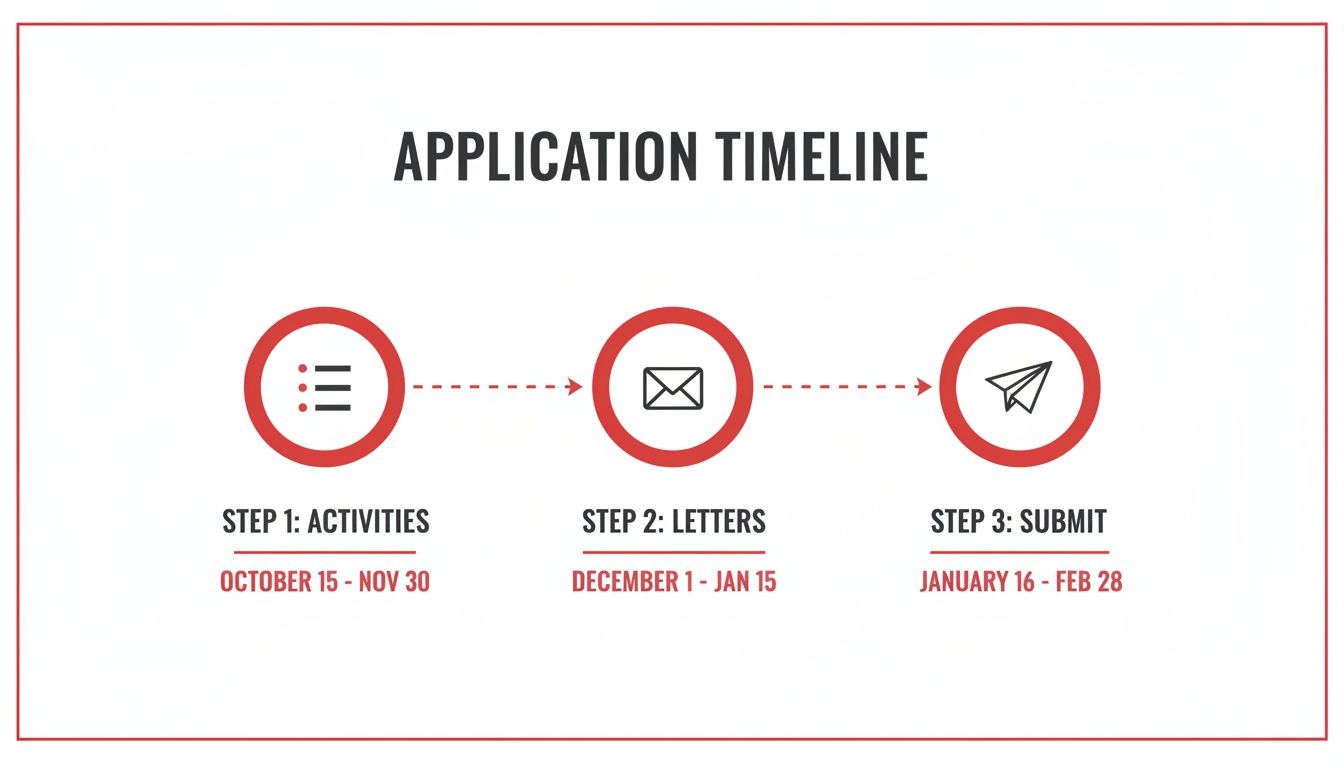
The image above breaks it down into three core pillars: activities, letters, and submission. The real challenge, of course, is juggling all three simultaneously over several months without letting anything slip through the cracks.
For a clearer, bird's-eye view, here's how a typical application cycle unfolds.
Medical School Application Timeline Overview
This table provides a high-level look at the major milestones and the actions you should be taking at each stage to stay on track.
| Timeframe | Key Milestones | Recommended Actions |
|---|---|---|
| January – April | Pre-Application Prep | Finalize MCAT prep. Request LORs. Start drafting your personal statement and activities descriptions. |
| May – June | Primary Application Submission | AMCAS/AACOMAS/TMDSAS applications open. Submit as early as possible after they open for verification. |
| July – September | Secondary Applications | Receive and complete secondary applications, ideally within 1-2 weeks of receipt. |
| August – March | Interview Season | Prepare for and attend interviews (both traditional and MMI). Send updates and letters of interest if needed. |
| October – May | Admissions Decisions | Receive acceptance, waitlist, or rejection notifications. Navigate waitlists and make final decisions. |
Remember, this timeline is a guide. Your personal journey might vary, but adhering to these general deadlines is crucial for a competitive application.
Transforming Your Work and Activities Section
The Work and Activities section is one of the most underestimated parts of the application. Too many applicants treat it like a boring résumé, just listing duties. That’s a massive missed opportunity.
This isn’t just about what you did; it’s about what you learned, how you grew, and the impact you made. You have a very limited character count, so every word needs to pull its weight to showcase reflection and maturity.
For instance, a forgettable entry might read:
Scribe at a local hospital. Documented patient encounters in the EMR.
Now, let’s reframe that into something powerful:
"Witnessed firsthand the diagnostic process for complex cases, improving my understanding of clinical reasoning. Learned to navigate sensitive patient conversations, which deepened my commitment to compassionate care."
See the difference? The second version doesn't just list a task—it tells a story of personal growth. You're connecting the dots for the admissions committee, showing them exactly how that experience shaped you into a future physician.
The Art of Securing Powerful Letters of Recommendation
Your Letters of Recommendation (LORs) are your third-party validation. They’re critical because they offer an outside perspective on your character, work ethic, and potential as a medical student. A set of glowing letters can elevate your entire application, while lukewarm ones can sink it.
Choosing your writers is a strategic move. You need a diverse group of advocates who can speak to different facets of who you are.
- Science Professors: Aim for at least two letters from science faculty who taught you in a class. Pick professors from courses where you really engaged and earned a strong grade.
- Non-Science Professor: A letter from a humanities or social sciences professor is a great way to show intellectual breadth and communication skills beyond the hard sciences.
- Meaningful Experience Supervisor: This could be your research PI, a volunteer coordinator, or a physician you shadowed for a significant period. This letter provides crucial, real-world insight into your professionalism.
Expert Tip: Never ask, "Can you write me a good letter?" That puts the writer in an awkward position. Instead, ask, "Do you feel you know me well enough to write me a strong letter of recommendation?" This gives them a graceful out if they can't wholeheartedly endorse you.
Once a writer agrees, make their job as easy as possible. Arm them with a "brag packet" containing your CV, personal statement draft, and a summary of key experiences. This isn't about telling them what to write; it's about refreshing their memory so they can craft a detailed, personal letter. For more tips on putting these materials together, check out our guide on crafting a compelling medical school CV.
This entire assembly process is far more than just filling out forms. It’s about presenting a cohesive, polished, and error-free package that screams commitment and professionalism. Take your time, proofread everything until you’re sick of it, and then submit with confidence.
Mastering Your Medical School Interviews
Getting an interview invitation is a massive win. It means that on paper, you've already made the cut—your grades, MCAT score, and experiences were strong enough to get you through the door.
Now, the admissions committee wants to see the person behind the application. This is your chance to show them the maturity, empathy, and communication skills that a transcript simply can't capture. They're looking to see if you're a good fit for their community and the profession.
This stage is less about proving your academic prowess and more about revealing your human side. Adcoms want to see how you think on your feet, articulate your motivations, and whether you genuinely possess the personal qualities of a future physician.
Navigating Different Interview Formats
Medical schools throw a few different interview styles at applicants, and you need to be ready for whatever comes your way. The two big ones are the traditional interview and the Multiple Mini Interview (MMI), each designed to test a different set of skills.
Traditional Interviews: This is what most people picture—a one-on-one or two-on-one chat with a faculty member, a current student, or an adcom officer. The questions are usually open-ended, digging into why you want to pursue medicine, your personal experiences, and why you're interested in their school. The goal here is a genuine, flowing conversation.
Multiple Mini Interviews (MMI): The MMI is a completely different beast. Think of it like speed dating with ethical dilemmas. You'll rotate through several short stations, each presenting a unique scenario or question that you have to tackle within a tight time limit, usually around 6-8 minutes. These are designed to test your critical thinking, problem-solving, and ethical reasoning under pressure, not your pre-existing knowledge.
While the formats feel worlds apart, the goal is the same: to figure out if you have what it takes to be a great doctor. Don't let the MMI intimidate you; it's just a different way for them to see how you think. For a deeper dive into both formats, our detailed guide on medical school interview tips has you covered.
Structuring Your Answers for Maximum Impact
No matter the question, your answers need to be thoughtful and well-structured. A rambling, disorganized response can quickly sink even the most impressive experiences. This is where a simple framework can be a total lifesaver.
The STAR method is a classic for a reason. It helps you transform a simple answer into a memorable story:
- Situation: Briefly set the scene. Where were you? What was the context?
- Task: What was your specific goal or responsibility in that situation?
- Action: Detail the specific steps you took to handle the task. This is the core of your story, so be specific about your contributions.
- Result: What was the outcome? Crucially, what did you learn from it all, and how did it shape you?
A great interview answer doesn't just describe an event; it reflects on its significance. Always tie your experiences back to your personal growth and your journey toward medicine.
For instance, instead of just saying, "I volunteered at a clinic," use the STAR method. Talk about a specific patient you connected with, the challenge they faced, the small steps you took to help them, and what that moment taught you about compassionate care. That's a story they'll remember.
Beyond the Questions: Professional Etiquette
How you present yourself is just as important as what you say. Professionalism is a core competency in medicine, and the interview is your first real test. This means sweating the small stuff that leaves a big impression.
- Dress Professionally: A conservative suit is the standard for a reason. It signals that you're taking this opportunity seriously.
- Ask Insightful Questions: When they inevitably ask, "Do you have any questions for us?" be ready. Ask about student life, specific research opportunities, or the school's culture. Avoid anything you could have easily found on their website.
- Send a Thank-You Note: Within 24 hours, send a brief, personalized thank-you email to your interviewers. Make sure to mention a specific point from your conversation to jog their memory and show you were engaged.
To really nail the high-stakes environment of medical school interviews, you'll want to continuously improve your interview skills with proven strategies. This kind of dedicated practice isn't just helpful; it's a critical piece of your overall medical school application help.
Answering Your Toughest Medical School Application Questions
It's completely normal to feel like you're navigating a minefield of questions and doubts during the application process. Am I making the right choice? Is this good enough? Every single applicant has been there.
Let's cut through the noise and tackle some of the most common dilemmas head-on. These aren't just simple answers; this is the strategic advice you need to build confidence and move forward.
How Do I Address a Low GPA or MCAT Score?
First, take a deep breath. A blemish on your academic record isn't an automatic rejection, but how you handle it is absolutely critical. The single worst thing you can do is pretend it isn't there and just hope admissions committees (adcoms) won't notice. Trust me, they will.
Your best tools here are honesty and, more importantly, showing you've grown from the experience.
If a specific event—a serious illness, a family emergency—caused your grades to dip for a semester, it's worth mentioning briefly. The right place for this is a short, factual explanation in a secondary essay or an optional addendum. Don't make it sound like an excuse. Frame it around how you overcame that challenge.
But the most powerful response is always action.
For a low GPA: Nothing speaks louder than a strong upward trend. If you struggled early on but then crushed difficult, upper-level science courses in your junior and senior years, that sends a powerful message of resilience. For bigger GPA issues, a post-baccalaureate program or a Special Master's Program (SMP) is the gold standard for proving you have the academic horsepower for med school.
For a low MCAT score: A retake can be a great move, but only if you're ready to commit to a completely different study plan. Just repeating what you did before won't cut it. Adcoms take notice when they see a significant score increase—think a jump of 5-7 points or more.
Key Insight: Admissions committees love a comeback story. Proving you can bounce back from an academic setback is often far more impressive than a flawless record. It shows character and grit, two things every future doctor needs.
How Many Medical Schools Should I Apply To?
There's no magic number here, and quality will always beat quantity. While the national average hovers around 16-18 schools, the right number for you depends entirely on your stats, your story, and your budget.
Spreading yourself too thin by applying to 30+ schools is a classic mistake. It almost always leads to "application fatigue," and the quality of your all-important secondary essays will inevitably suffer. You just can't write that many unique, compelling essays.
The smart play is to build a balanced, strategic list.
- Reach Schools: A few dream programs where your stats are a little below their median.
- Target Schools: This is the core of your list—schools where your GPA and MCAT are right in their sweet spot.
- Safer Schools: A handful of programs where your numbers are comfortably above their median.
This tiered approach maximizes your chances of getting that acceptance letter without causing total burnout or breaking the bank.
Is Taking a Gap Year a Good Idea?
Let's clear this up: the old stigma around gap years is completely gone. In fact, most admissions committees now see them as a huge positive, if they are used productively.
A purposeful gap year can take a good application and make it truly great. It's so much better to wait a year and apply with a stellar, well-rounded profile than to rush an application that's just "okay."
This is your golden opportunity to fill any holes in your application and gain experiences that genuinely confirm your commitment to medicine.
- Get more hands-on clinical hours (scribing or working as an EMT are fantastic).
- Dedicate serious time to a research project you're passionate about.
- Pursue a unique life experience that makes you a more interesting, mature applicant.
Taking a gap year shows you're thoughtful and strategic about your journey—qualities adcoms look for in future physicians.
Navigating these big questions requires a clear head and a solid strategy. For personalized guidance tailored to your unique situation, the experts at Ace Med Boards offer comprehensive admissions consulting to help you put your best foot forward. Find out more at https://acemedboards.com.