The residency interview is the final, most crucial step in securing your spot in a top program. It's where your application comes to life, allowing program directors to assess your personality, communication skills, and professional fit beyond your CV. While your scores and letters of recommendation opened the door, your interview performance will ultimately determine where you match. A strong interview can elevate a good application to an exceptional one, while a poor performance can overshadow even the most impressive credentials.
This guide provides a comprehensive breakdown of the 10 most common and critical residency interview questions you will face. We move beyond generic advice, offering structured answer frameworks, real-world examples, and actionable tips for each question. Our goal is to equip you with the strategies needed to articulate your story, demonstrate your strengths, and connect authentically with your interviewers.
As you prepare to "Master the Match," remember that your online presence is often scrutinized before you even step into the interview room. It is wise to ensure your digital footprint aligns with your professional aspirations. Review these crucial online reputation management tips to present the most polished version of yourself, both in person and online.
This listicle will help you transform interview anxiety into confident preparation, ensuring you leave a memorable and positive impression. We will cover everything from foundational questions about your motivations to complex behavioral scenarios, providing you with the tools to handle anything that comes your way. Let’s dive in.
1. Tell me about yourself and why you're interested in this specialty
This classic opener is more than a simple icebreaker; it’s your first and best chance to frame your entire candidacy. Program directors ask this foundational question to gauge your communication skills, self-awareness, and the authenticity of your commitment to the specialty. A strong answer establishes a compelling narrative that connects your past experiences to your future aspirations within their program.

Crafting Your Narrative
Your goal is to deliver a concise, 2-3 minute story that is both professional and personal. Start with a brief overview of who you are, then smoothly transition into the "why" behind your specialty choice. Avoid simply listing your CV; instead, select key experiences that illustrate your journey and dedication.
Key Insight: A memorable "tell me about yourself" answer is a story, not a list. It should have a clear beginning (your initial interest), middle (experiences that solidified that interest), and end (why you are pursuing it at this program).
Example Answer Framework
A powerful response often follows this structure:
- The Spark: "My interest in internal medicine began during a preclinical volunteer experience at a community clinic, where I was struck by the diagnostician's role in solving complex patient puzzles."
- The Confirmation: "This initial curiosity was solidified during my third-year clerkship. I vividly remember managing a patient with multifactorial hyponatremia, and the intellectual challenge of synthesizing data from different organ systems was incredibly rewarding."
- The Future: "I pursued research in nephrology to deepen this interest and now I am eager to bring my passion for complex diagnostics to a program like yours, known for its rigorous academic environment and diverse patient pathology."
Actionable Tips for Success
- Be Specific: Instead of saying you "enjoyed" a rotation, describe a specific patient case or clinical problem that captivated you.
- Connect to the Program: Conclude by briefly mentioning why their specific program is the ideal next step in your story. This shows you've done your homework.
- Practice, Don't Memorize: Rehearse your answer until it sounds natural, not robotic. Practicing with experienced advisors, like the residency consultants at Ace Med Boards, can help you refine your narrative and delivery for maximum impact.
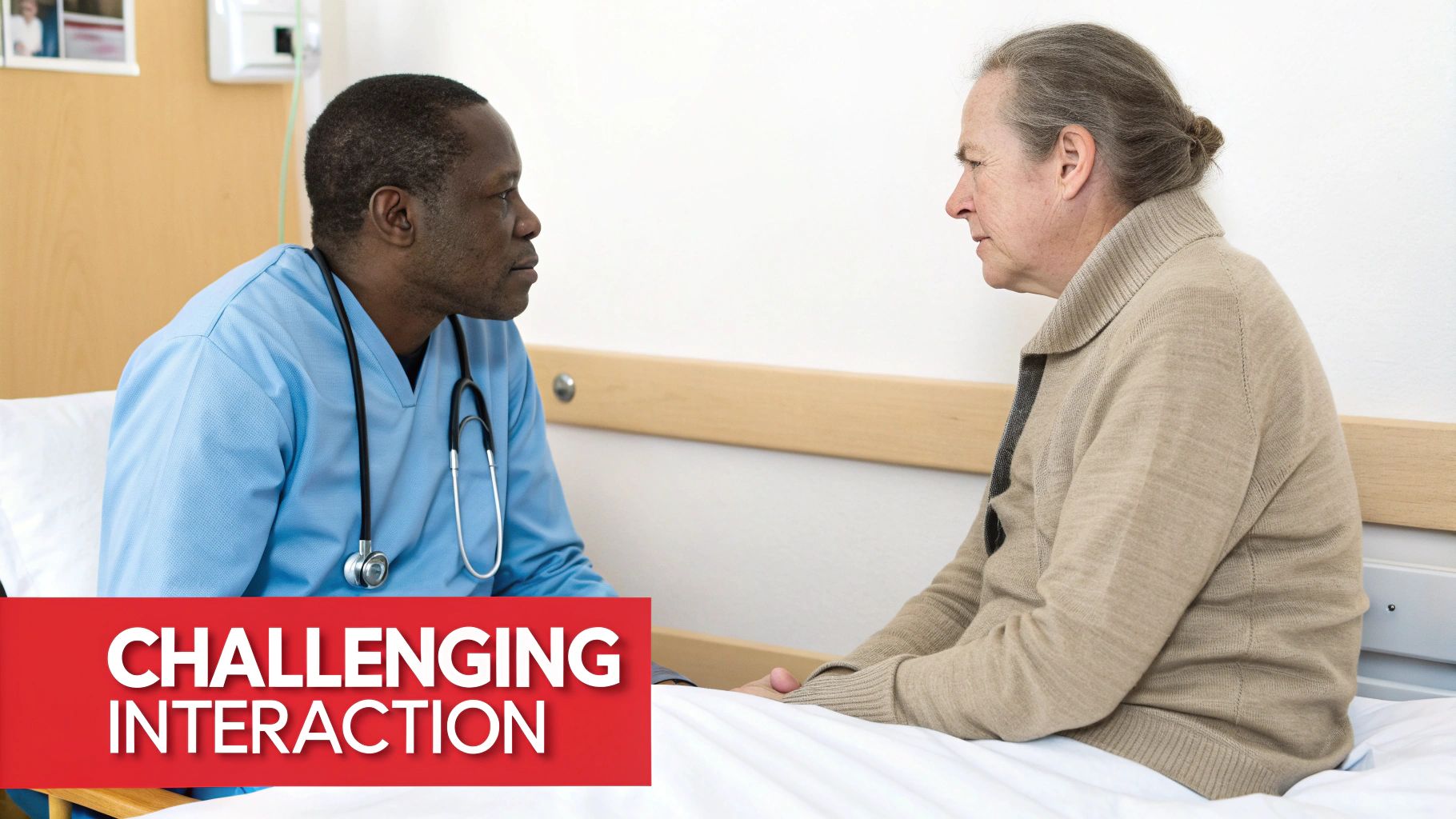
2. Describe a challenging patient interaction and how you handled it
This behavioral question is a cornerstone of residency interview questions, designed to probe your emotional intelligence, communication skills, and professionalism under pressure. Interviewers want to see how you navigate conflict, demonstrate empathy, and maintain composure in difficult clinical scenarios. Your ability to reflect on a challenging experience reveals your maturity and capacity for growth as a future resident.
Crafting Your Narrative
The key to a successful answer is structured storytelling. The STAR method (Situation, Task, Action, Result) provides a clear framework to guide your response, ensuring you cover all essential points without rambling. Choose a real, impactful clinical example that showcases your problem-solving abilities rather than a simple disagreement.
Key Insight: The focus of your answer should be less on the "challenge" itself and more on your thoughtful actions and professional reflection. Interviewers are evaluating your process, not just the outcome.
Example Answer Framework
Using the STAR method helps organize your thoughts into a compelling narrative:
- Situation: "During my family medicine rotation, I was caring for an elderly patient who was consistently non-adherent with his hypertension medication, leading to multiple ED visits."
- Task: "My goal was to understand the root cause of his non-adherence and develop a plan to improve his blood pressure control while respecting his autonomy."
- Action: "I sat down with him and used open-ended questions to listen to his concerns. He revealed he was struggling with the cost and complex dosing schedule. I collaborated with the social worker to find a patient assistance program and worked with the pharmacist to simplify his regimen to a single daily pill."
- Result: "At his follow-up visit, he was taking his medication as prescribed, and his blood pressure had significantly improved. Most importantly, he expressed feeling heard and involved in his own care. This taught me the value of addressing social determinants of health."
Actionable Tips for Success
- Show, Don't Tell: Instead of saying you are empathetic, describe the actions you took that demonstrate empathy, like active listening or validating a patient's feelings.
- Own Your Role: Focus on your specific actions and contributions. Avoid placing blame on the patient, family members, or other team members.
- Highlight the Lesson: Conclude by summarizing what you learned from the experience and how it will make you a better resident in their program. This demonstrates self-awareness and a commitment to continuous improvement.
3. What are your strengths and weaknesses?
This quintessential interview question is designed to evaluate your self-awareness, humility, and commitment to lifelong learning. Program directors are not looking for perfection; they want to see that you can accurately assess your own abilities and have a concrete plan for growth. Your answer reveals your maturity and capacity to receive and act on feedback, a critical skill for any resident.
Crafting Your Narrative
The key is to present a balanced, honest, and thoughtful self-assessment. Choose a genuine strength that is highly relevant to the specialty and a real weakness that you are actively working to improve. Frame your weakness not as a fatal flaw but as an area of development, demonstrating a proactive mindset.
Key Insight: The most effective "weakness" is one that shows insight and is paired with a clear, actionable plan for improvement. Avoid clichéd answers like "I'm a perfectionist" or "I work too hard."
Example Answer Framework
A well-structured response will address both parts of the question with specific evidence:
- The Strength: "I consider one of my primary strengths to be my ability to build rapport and communicate effectively with patients from diverse backgrounds. For example, during my family medicine rotation, I worked with a non-English-speaking patient who was hesitant about their new diabetes diagnosis. By using a translator app and simple diagrams, I was able to explain their care plan in a way they understood, which ultimately improved their adherence."
- The Weakness: "An area I am actively developing is the efficiency of my clinical documentation. Early in my clerkships, I tended to be overly detailed, which slowed me down."
- The Action Plan: "To address this, I started using dot phrases and templates, and I regularly ask for feedback from senior residents on my notes. I have already seen a significant improvement in my speed without sacrificing quality, and I am committed to continuing this practice in residency."
Actionable Tips for Success
- Be Relevant: Connect your stated strength directly to the skills required for the specialty you are applying to.
- Be Authentic: Choose a real weakness. Interviewers can spot a disingenuous answer, which undermines your credibility.
- Focus on Growth: The most important part of your weakness answer is the "what I'm doing about it" component. It shows initiative and coachability.
- Practice Your Delivery: Your tone should be confident when discussing strengths and reflective, not apologetic, when discussing weaknesses. Professional guidance from advisors at Ace Med Boards can help you strike the perfect balance.
4. Why do you want to train at our program specifically?
This question moves beyond your general interest in a specialty to assess your specific interest in this particular institution. It is a critical test of your preparation and genuine desire to be there. Program directors use this question to separate candidates who have done their homework from those who are simply mass-applying, looking for applicants who are a deliberate and thoughtful fit for their unique culture, mission, and training environment.

Crafting Your Narrative
Your answer must demonstrate a deep and specific understanding of what makes the program unique. Generic praise about "excellent reputation" or "great location" is insufficient. Instead, you need to connect specific, tangible aspects of the program directly to your own career goals, clinical interests, and learning style. The goal is to show them you aren't just looking for any residency; you are looking for their residency.
Key Insight: The best answers create a bridge between a specific feature of their program and a specific aspect of your candidacy. This demonstrates not just interest, but true alignment.
Example Answer Framework
A well-researched response should integrate several specific points:
- Curriculum & Training: "I was particularly drawn to your longitudinal primary care track. My experience in a student-run free clinic showed me the value of continuity of care, and I am excited by the opportunity to follow my own patient panel over three years."
- Faculty & Research: "Furthermore, I've closely followed Dr. Jane Smith's research on diabetic nephropathy. Her work aligns perfectly with my own research background, and the prospect of learning from her is a significant reason I am so interested in your program."
- Community & Mission: "Finally, your program’s commitment to serving the city’s underserved populations resonates with my long-term goal of practicing in a community health setting. I believe my background in health advocacy would be a strong fit for your mission."
Actionable Tips for Success
- Go Beyond the Homepage: Dig into faculty bios, recent publications, and resident testimonials to find unique details that resonate with you.
- Name Names: Mentioning 1-2 faculty members whose work you admire shows a high level of interest and initiative.
- Connect the Dots: For every program feature you mention, explain why it matters to you and your future career.
- Seek Expert Guidance: Tailoring your response for each of your top programs is crucial. The expert advisors at Ace Med Boards can help you identify unique program strengths and articulate how they align with your personal and professional aspirations.
5. Tell me about your research experience and its impact
This question assesses your scholarly aptitude, intellectual curiosity, and potential to contribute to the field's evidence base. Especially critical for research-heavy and competitive specialties, your answer demonstrates your ability to design, execute, and communicate scientific work. Program directors want to see if you can think critically and explain complex topics clearly.
Crafting Your Narrative
Prepare a concise, 2-3 minute summary of your most significant research project. The goal is to make it accessible to a non-specialist, focusing on the "so what" rather than getting lost in technical jargon. Your response should highlight your specific role and the broader implications of the findings.
Key Insight: Frame your research as a story with a clear question, method, and conclusion. Emphasize your personal contribution and the project's impact, whether it was a publication, a change in clinical practice, or a new line of inquiry.
Example Answer Framework
A well-structured answer will guide the interviewer through your scientific journey:
- The Question: "During my surgery rotation, I noticed significant variability in post-operative opioid prescribing. This led me to investigate whether a standardized protocol could reduce excess prescriptions without compromising pain control."
- Your Role & Method: "I led the retrospective chart review, designing the data collection tool and analyzing prescribing patterns for 200 cholecystectomy patients. My role involved identifying key outcome measures and performing the statistical analysis."
- The Impact: "Our findings showed the protocol reduced the average morphine milligram equivalents prescribed by 40%, which we presented at a regional conference and published. This work reinforced my commitment to evidence-based practice, a core value I know is emphasized here."
Actionable Tips for Success
- Own Your Contribution: Clearly state what you did. Instead of "we found," say "I analyzed the data that revealed…"
- Connect to Your Goals: Explicitly link your research skills or findings to your interest in the specialty and your future career aspirations.
- Prepare for Follow-ups: Be ready to discuss the project's limitations, what you would do differently, and what the next logical research step would be.
- Explain it Simply: Practice explaining your project to someone outside of medicine. If they can understand the basics, you've successfully distilled the core concepts.
6. How do you handle stress and maintain work-life balance?
This question assesses your resilience, self-awareness, and proactive approach to wellbeing. Programs are increasingly focused on preventing physician burnout and want to recruit residents who have already developed healthy coping mechanisms. Your answer demonstrates maturity and an understanding that personal wellness is critical for professional longevity and high-quality patient care.
Crafting Your Narrative
Your response should be honest, specific, and grounded in your actual experiences. Avoid generic statements like "I like to relax." Instead, describe the concrete activities and mindsets you use to decompress and recharge. The goal is to show that you are prepared for the rigors of residency and have a sustainable plan to thrive, not just survive. Demonstrating how you approach managing work stress for a healthier work-life balance is crucial for showing your resilience and self-awareness.
Key Insight: A strong answer provides a portfolio of wellness strategies. It shows you have multiple tools to rely on, from physical activities and hobbies to social support systems and mindfulness practices.
Example Answer Framework
A well-rounded response can be structured like this:
- Acknowledge the Challenge: "I recognize that residency is incredibly demanding, and I've been intentional about developing sustainable stress management habits throughout medical school."
- Provide Specific Strategies: "For physical wellness, I prioritize my weekly running schedule, which helps clear my head. For mental and social wellbeing, I make sure to call my family regularly and protect time for my hobby, which is landscape photography. It allows me to engage a different part of my brain."
- Connect to Professionalism: "These practices are not just for me; they enable me to be more present, focused, and compassionate with my patients. I believe that taking care of myself is a prerequisite to providing the best possible care for others."
Actionable Tips for Success
- Be Authentic: Share strategies you genuinely use. Your sincerity will be more impactful than a perfectly curated but impersonal answer.
- Focus on Action, Not Aspiration: Talk about what you do, not what you plan to do. Mentioning how you maintained these habits during tough rotations adds credibility.
- Show Insight: Briefly explain why these activities work for you. This demonstrates self-awareness about your personal needs and what it takes for you to function at your best.
7. Describe your experience with [specialty-specific procedure or skill]
This question directly assesses your technical readiness and clinical exposure relevant to the specialty. For procedure-heavy fields like surgery, emergency medicine, or ob/gyn, programs need to know that you have a foundational understanding and a realistic view of the skills you'll be expected to master. Your answer reveals your honesty, your ability to articulate technical experience, and your eagerness to learn.
Crafting Your Narrative
Your goal is to provide a clear, honest, and concise summary of your relevant procedural experience. Quantify your involvement whenever possible and focus on what you learned, rather than just what you did. This is not the time to embellish; programs value self-awareness and a commitment to growth over an inflated logbook.
Key Insight: Honesty is paramount. It is far better to accurately describe limited experience and show enthusiasm for learning than to exaggerate your skills and be unable to answer follow-up questions.
Example Answer Framework
A strong response will clearly define your role, the context, and your key takeaways.
- The Context: "During my surgery rotation at a high-volume trauma center, I had the opportunity to assist with approximately 15 laparoscopic cholecystectomies."
- The Role: "Initially, my role was primarily observation and retraction. However, by the end of the rotation, under direct supervision, I was responsible for camera navigation and assisting with port placement. I also had the chance to practice foundational suturing on the skin for closure."
- The Future: "This experience solidified my manual dexterity and understanding of laparoscopic principles. I am acutely aware that this is just the first step, and I am incredibly eager to build upon this foundation in a program like yours that emphasizes early, hands-on surgical training."
Actionable Tips for Success
- Quantify Your Experience: Be specific. Instead of "I saw some central lines," say "I observed five and assisted with two subclavian central line placements under direct attending supervision."
- Describe Your Role: Clearly state if you observed, assisted, or performed a procedure with supervision. This demonstrates honesty and a clear understanding of your position as a student.
- Show Eagerness to Learn: If your experience is limited, frame it as a starting point. Emphasize your proactive approach to learning, such as practicing on simulators or seeking out opportunities, and express your excitement to develop these skills in residency.
8. What are your career goals and long-term aspirations?
This question assesses your foresight, ambition, and whether your professional trajectory aligns with what the program can offer. Interviewers use it to understand if you have a thoughtful, realistic vision for your future in medicine. They want to see that you are motivated beyond simply matching and that your goals are congruent with the program's mission and training philosophy.
Crafting Your Narrative
Your answer should articulate a clear 5 to 10-year vision that feels both authentic and achievable. This isn't about having your entire life mapped out, but about demonstrating strategic thinking and a deep commitment to the specialty. Show that you view residency as a critical, foundational step toward these larger goals, not just a box to check.
Key Insight: A strong answer connects your aspirations directly to the program's specific strengths. It demonstrates that you've chosen them not just for a residency spot, but as a strategic partner in your career development.
Example Answer Framework
A compelling response often includes both short-term and long-term components:
- Short-Term (Residency Goals): "During residency, my primary goal is to build a robust foundation in clinical pediatrics. I'm particularly excited to engage with your advocacy track to learn how to effectively serve vulnerable patient populations, which is a core part of my long-term vision."
- Mid-Term (Post-Residency): "Following residency, I plan to pursue a fellowship in pediatric critical care. I'm drawn to the high-acuity environment and the opportunity to manage complex physiology."
- Long-Term (Career Vision): "Ultimately, I aspire to a hybrid career as an academic pediatric intensivist. I want to combine clinical practice with medical education, mentoring future residents, and contributing to research on sedation protocols. Your program's strong fellowship match rates and opportunities for residents to teach medical students are precisely why I believe it's the ideal place to begin this journey."
Actionable Tips for Success
- Be Authentic: Your goals should reflect your genuine interests. If you're not sure about a fellowship, it's okay to say you're exploring options like hospital medicine or primary care.
- Reference Program Resources: Mention specific faculty, research opportunities, or unique rotations that align with your stated goals. This proves your interest is genuine.
- Balance Ambition and Humility: Show ambition but also acknowledge that residency is a formative time and you remain open to new paths your training might reveal.
- Prepare for Follow-Ups: Be ready to answer "What steps have you taken so far to pursue this goal?" or "How will our program specifically help you get there?"
9. Tell me about a time you failed or made a significant mistake
This question is a direct probe into your maturity, self-awareness, and resilience. Interviewers aren't looking for perfection; they want to see if you can take accountability, learn from your errors, and grow as a physician. How you handle this question reveals your character, humility, and the growth mindset essential for patient safety and success in the demanding environment of residency.
Crafting Your Narrative
Your goal is to demonstrate insight, not to confess a catastrophic error that questions your core competence. Choose a genuine mistake with tangible consequences from which you learned a valuable lesson. The focus should be less on the mistake itself and more on the process of reflection, correction, and positive change that followed.
Key Insight: The power of this answer lies in the "so what" factor. The mistake is just the setup; the real story is how you analyzed the failure and implemented specific, lasting changes to your practice.
Example Answer Framework
A strong response will guide the interviewer through a clear, structured narrative:
- Set the Scene: "During my surgery rotation, I was tasked with presenting a patient's overnight events. I overlooked a subtle but significant drop in urine output, attributing it to routine postoperative variation."
- The Mistake & Impact: "My attending physician quickly identified this as a sign of early renal dysfunction. While the patient was managed appropriately without harm, I recognized my failure in clinical reasoning and its potential to have delayed necessary intervention."
- The Lesson & Change: "This experience taught me the critical importance of systematic assessment. I developed a new personal checklist for all postoperative handoffs, which includes a specific review of hourly I/Os and lab trends. This methodical approach now ensures I don't overlook subtle but critical data points."
Actionable Tips for Success
- Own It: Take clear responsibility without making excuses or blaming others. Use "I" statements to show accountability.
- Focus on Growth: Dedicate most of your answer to what you learned and the concrete steps you took to prevent a similar error from happening again.
- Practice Your Delivery: Discussing failure can be uncomfortable. Rehearsing your story with an advisor ensures you can convey vulnerability and growth with confidence and composure.
10. Do you have any questions for me or the program?
This question, often asked at the end of the interview, is far more than a polite formality. It is a critical opportunity to demonstrate your genuine interest, level of preparation, and what you value in a training environment. Your questions reveal your priorities and can transform the interview from a one-sided evaluation into a memorable, two-way conversation.
Crafting Your Narrative
Your goal is to ask insightful, program-specific questions that cannot be easily answered by browsing the program’s website. This shows you've done your homework and are thoughtfully considering your fit. Prepare a list of 5-7 questions in advance, and tailor them to your interviewer, whether they are the program director, a faculty member, or a current resident.
Key Insight: Asking thoughtful questions is a non-negotiable part of a successful residency interview. It's your final chance to reinforce your interest and leave a lasting, positive impression of a curious and engaged candidate.
Example Answer Framework
A powerful set of questions often falls into these categories:
- Culture & Mentorship: "Could you describe the mentorship culture here? Specifically, how are new residents paired with faculty advisors, and what does that relationship look like in practice?"
- Curriculum & Growth: "I was intrigued by the [specific track, e.g., 'Clinician-Educator Track'] mentioned on your website. What opportunities are available for residents to develop their teaching skills throughout their training?"
- Program Development: "What recent changes have you implemented based on resident feedback, and what future developments are you most excited about for the program?"
Actionable Tips for Success
- Be Specific: Instead of asking "What are the research opportunities?", ask "I noticed Dr. Smith's work on [specific topic]. Are there opportunities for residents to get involved with that specific line of research?"
- Connect to the Conversation: If possible, link your question to something discussed earlier. "You mentioned the program's focus on community outreach. Could you tell me more about the specific partnerships residents engage with?"
- Avoid Red Flags: Do not ask about salary, vacation time, or other information easily found online. Save logistical questions for the program coordinator or second-look day.
- Practice Active Listening: Pay close attention to the answers. Engaging with the interviewer’s response can lead to a more organic and impactful conversation.
Residency Interview Questions: 10-Point Comparison
| Question | 🔄 Implementation complexity | ⚡ Resource requirements | 📊 Expected outcomes | 💡 Ideal use cases | ⭐ Key advantages |
|---|---|---|---|---|---|
| Tell me about yourself and why you're interested in this specialty | Low–Medium — open-ended, needs structure | Low — 10–30 min prep; practice aloud | High — quick-fit signal; sets interview tone | Opening question; general fit assessment | Highlights motivation, communication, and fit |
| Describe a challenging patient interaction and how you handled it | Medium — requires STAR structure, tact | Medium — select 2–3 examples and rehearse | High — reveals EI, conflict resolution | Behavioral evaluation of interpersonal skills | Demonstrates problem-solving, empathy, learning |
| What are your strengths and weaknesses? | Medium — balance authenticity and relevance | Low–Medium — prepare frank examples + improvements | Medium–High — shows self-awareness and growth | Assessing maturity and candidness | Signals honesty, development plan, humility |
| Why do you want to train at our program specifically? | High — needs tailored research per program | High — 30–45 min per program; faculty review | High — differentiates genuine applicants | Distinguishing sincere interest; ranking decisions | Demonstrates fit, commitment, and preparation |
| Tell me about your research experience and its impact | Medium–High — simplify technical work for audience | Medium — craft 30s/2min/5min pitches; gather outputs | High for academic/competitive specialties; medium otherwise | Competitive specialties; academic career paths | Differentiates candidates; shows scholarly ability |
| How do you handle stress and maintain work-life balance? | Low–Medium — honest, concrete examples needed | Low — articulate actual routines and supports | Medium — assesses resilience and sustainability | Programs prioritizing wellness; burnout prevention | Shows self-care, realistic expectations, resilience |
| Describe your experience with [specialty-specific procedure or skill] | High — must be precise, quantify role | Medium–High — inventory procedures, numbers, roles | High in procedural fields; validates readiness | Procedural specialties; technical competence checks | Confirms skill level, honesty, and preparedness |
| What are your career goals and long-term aspirations? | Medium — requires cohesive, realistic vision | Medium — map 1/5/10 year plan and link to program | Medium–High — signals ambition and alignment | Candidates with fellowship/academic/leadership aims | Demonstrates strategic thinking and fit for resources |
| Tell me about a time you failed or made a significant mistake | Medium–High — vulnerability with clear accountability | Medium — choose example, show remediation and growth | High — strong signal of maturity and learning | Assessing accountability, resilience, patient safety | Shows responsibility, change implementation, humility |
| Do you have any questions for me or the program? | Low — prepared bank plus active listening | Low — prepare 5–7 tailored questions per interview | High — final impression; gauges genuine interest | Closing the interview; building rapport | Demonstrates curiosity, engagement, and listening |
Your Next Steps: Turning Preparation into Your Perfect Match
You've just navigated a comprehensive blueprint of the most critical residency interview questions you're likely to encounter. This guide isn't a script to be memorized; it's a strategic framework designed to help you build authentic, compelling narratives that showcase your true potential. The journey from applicant to resident hinges on your ability to articulate your experiences, motivations, and suitability for a program with confidence and clarity.
The core takeaway is this: preparation transforms anxiety into assurance. By deconstructing each question, understanding its underlying purpose, and practicing your delivery, you move beyond rote recitation. You learn to connect your personal journey to the specific values and goals of each program you interview with, turning a formal Q&A into a genuine, memorable conversation.
Mastering the Art of the Interview
True mastery isn’t about having a perfect answer for every single one of the hundreds of possible residency interview questions. Instead, it's about internalizing the frameworks and principles that allow you to adapt to any question thrown your way.
Here are the most vital concepts to carry forward:
- Storytelling Over Statements: Don’t just tell an interviewer you are compassionate; share a story about a challenging patient interaction that shows your compassion in action. The STAR method (Situation, Task, Action, Result) is your most powerful tool for structuring these impactful narratives.
- Authenticity is Your Anchor: Programs aren't looking for a flawless candidate. They are looking for a genuine, self-aware, and teachable future colleague. Your "weaknesses" and "failures" are not traps; they are invitations to demonstrate your capacity for reflection, growth, and resilience.
- Specificity Sells: Vague answers are forgettable. A generic response to "Why our program?" sounds insincere. A specific answer that mentions a particular faculty member's research, a unique clinical rotation, or a community outreach initiative you admire proves you've done your homework and are truly invested.
Your Action Plan for Success
Knowledge without action is just potential. It's time to translate the insights from this article into a concrete preparation plan. Your next steps should be methodical and deliberate.
- Curate Your Core Stories: Identify 5-7 key experiences from your medical school journey. These should cover a range of competencies: teamwork, leadership, conflict resolution, clinical challenges, and personal growth. Practice telling these stories using the STAR framework until they are concise and powerful.
- Conduct Deep Program Research: For each interview, create a one-page summary document. Note the program's mission, key faculty, unique curriculum features, and recent publications. Use this to tailor your answers, especially for the "Why our program?" and "What questions do you have for us?" prompts.
- Initiate Mock Interview Sessions: Rehearsal is non-negotiable. Practice with peers, mentors, or faculty advisors. Record yourself to analyze your body language, pacing, and use of filler words like "um" or "like." The goal is to become so comfortable with your material that you can deliver it naturally.
Ultimately, your residency interview is the final, crucial step in a marathon you've been running for years. It’s your opportunity to give a voice to the dedication, hard work, and passion detailed in your ERAS application. By investing in deliberate practice and thoughtful self-reflection, you can walk into every interview not as a nervous applicant, but as a confident, capable physician-in-training ready to prove you are the perfect match.
Feeling overwhelmed or want to ensure your interview performance is flawless? The expert consultants at Ace Med Boards specialize in personalized mock interviews and strategic feedback to help you master the most challenging residency interview questions. Let us help you refine your stories and build the unshakeable confidence needed to secure your top-choice program. Ace Med Boards