Navigating the AMCAS application can feel like trying to run a marathon without knowing where the finish line is. If you're feeling that anxiety, you're not alone. The ideal timeline starts with prep work in January, aims for submission in late May or early June, tackles secondaries in July, and dives into interviews from August all the way through next spring.
This guide will give you a strategic roadmap, turning that marathon into a well-planned race where each step builds momentum for the next.
Why Your AMCAS Application Timeline Matters
The single most important concept you need to burn into your brain is rolling admissions. Everything else hinges on this.
Think of it like trying to get tickets to a wildly popular concert. The moment they go on sale, the best seats get snapped up first. The longer you wait, the fewer good options are left. Medical schools operate the same way. They review applications and send out interview invitations as they come in.
Submitting your verified application early means you're competing for the largest number of available interview slots and, ultimately, seats in the class. This is why a smart, well-managed timeline is one of the most powerful tools you have.
The competition is no joke. For the 2024 entering class, a staggering 53,030 applicants were vying for just 23,105 spots. That's a 43.5% acceptance rate, which is why savvy applicants do everything they can to submit early and maximize their odds.
To give you a bird's-eye view of the journey ahead, here’s a high-level look at the main stages.
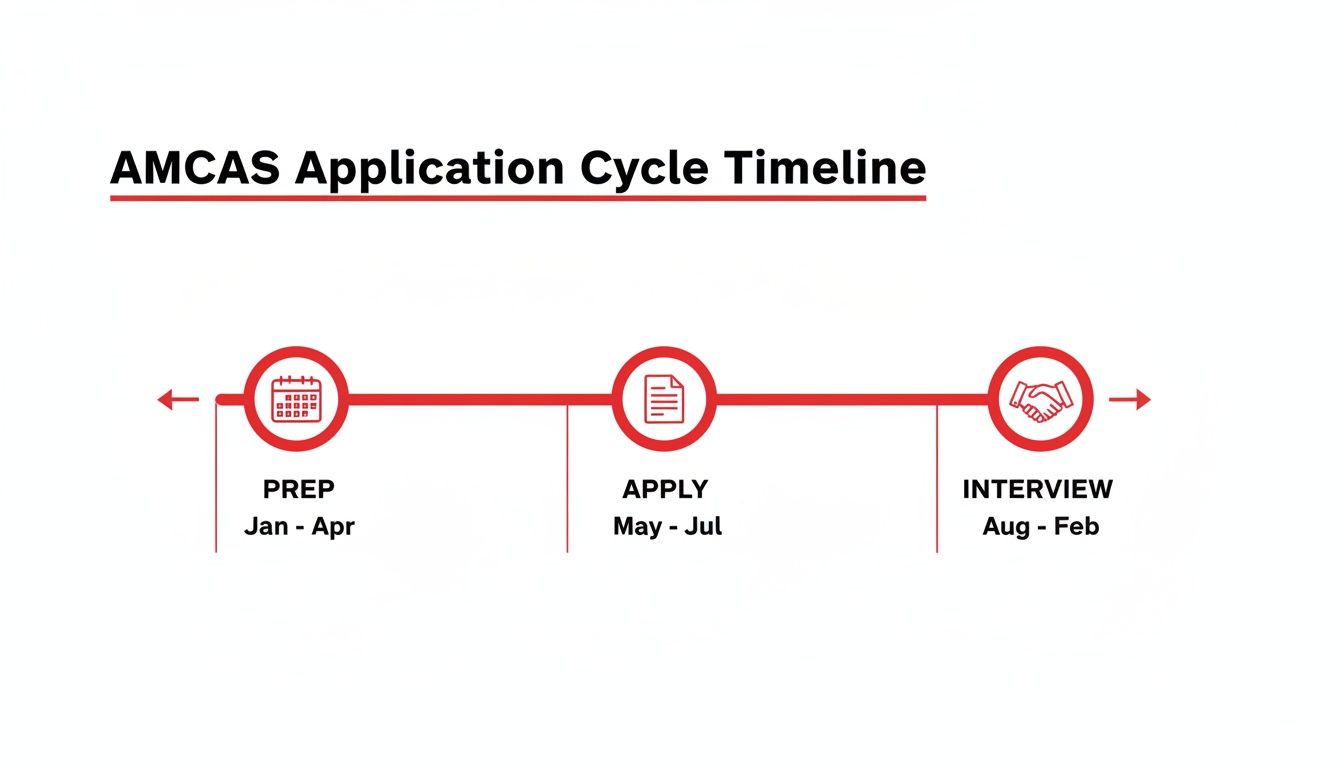
As you can see, this isn't a sprint; it's a year-long commitment broken down into distinct phases for preparation, application, and interviews. Each phase needs your full attention to stay on track.
To help you stay organized, here's a quick overview of the key phases and when you should be tackling them.
AMCAS Application Cycle Key Phases and Recommended Timing
| Application Phase | Key Action Items | Ideal Timeframe |
|---|---|---|
| Phase 1: Preparation | Gather transcripts, request letters of recommendation, study for/take the MCAT, write personal statement and work/activities descriptions. | January – May |
| Phase 2: Primary Application | Complete and submit the AMCAS application. AAMC verification begins. | Late May – June |
| Phase 3: Secondary Applications | Receive and complete school-specific secondary applications. | July – September |
| Phase 4: Interviews | Receive and attend medical school interviews (virtual or in-person). | August – March |
| Phase 5: Decisions & Waitlists | Receive acceptance, rejection, or waitlist notifications. Manage waitlist updates and letters of interest. | October – May |
This table provides a great framework, but success lies in the details and the mindset you bring to each phase.
Key Principles of an Effective Timeline
Before we jump into the month-by-month breakdown, let's internalize the core principles that separate a successful application from a frantic one. A great timeline isn’t just about hitting deadlines; it’s about putting yourself in the best possible position from day one.
- Proactive Preparation: The smartest applicants I've seen start getting their ducks in a row months—sometimes even a full year—before the application even opens.
- Submission Speed: Your goal should be to hit "submit" on your primary application within the first two weeks after the window opens in late May.
- Secondary Application Turnaround: When those secondaries start rolling in, you need to be ready. Aim to complete and return them within 7-14 days.
Adopting these principles means you stop reacting to the timeline and start controlling it. Truly understanding how to get into medical school goes far beyond good grades; it demands sharp planning and flawless execution.
Now, let's break down exactly what that looks like.
Building Your Foundation: September to April
This nine-month stretch is where the smartest applicants win the race before the starting gun even fires. Think of the AMCAS application timeline like building a house. You can't just show up in May and start framing walls without having poured a solid foundation months earlier. September through April is your time to gather the materials, draft the blueprints, and lay the concrete.
This period is all about proactive preparation, not panicked, last-minute reactions. By methodically tackling the big components now, you dodge the immense stress and careless mistakes that come with rushing later. The goal is simple: arrive at the application opening in May with your most critical assets already polished and ready to go.
Crafting Your Personal Narrative
Your application is ultimately a story, and this is your time to write the first draft. The two main pieces of this story are your Personal Statement and your Work & Activities section. Don't ever underestimate how long these take to get right.
The Personal Statement is your one chance to answer the big question: "Why do you really want to be a doctor?" This requires deep introspection and multiple, sometimes painful, revisions. Start now by just brainstorming the key experiences that actually shaped your motivation.
At the same time, you should begin outlining your Work & Activities section. You can list up to 15 experiences, and you'll get to designate three of them as your "most meaningful."
- Brainstorm: Dump everything onto a page—every job, volunteer gig, research position, and significant hobby. No filter.
- Reflect: For each one, jot down what you did, what you learned, and how it pushed you toward a career in medicine.
- Draft: Write concise, impactful descriptions. This isn't just a resume where you list duties; it's a narrative that shows your growth.
Learning how to write a personal statement that wins admissions is a critical skill, so give this process the time it deserves. A compelling story can absolutely set you apart from a sea of high-stat applicants.
Securing Powerful Letters of Recommendation
Strong letters of recommendation are completely non-negotiable, and they require you to plan ahead. Your letter writers are busy professionals. Asking them early is a sign of respect and, more practically, it ensures they have time to write a thoughtful, detailed letter instead of a rushed, generic one.
Go ahead and identify potential writers from science faculty, non-science faculty, and mentors from your most significant experiences (like research or clinical volunteering). You should aim to have 3-5 strong letters in your corner.
Pro Tip: When you make the request, hand your writers a packet of helpful info. Include a draft of your personal statement, your CV, a list of schools you're applying to, and a gentle reminder of specific projects or classes where you stood out. This makes their job easier and helps them write a specific and powerful letter for you.
Use a service like Interfolio to collect your letters. This is a game-changer. It allows your writers to upload their letter just once, and then you can send it to AMCAS electronically when the application opens. It streamlines the whole process and takes a ton of pressure off your recommenders.
Conquering the MCAT
The MCAT is a massive hurdle in the AMCAS timeline, and it demands a dedicated study plan. Most students find they need a solid 3-6 months of consistent prep.
You should target a test date no later than April or early May of your application year. This timing is strategic for a few key reasons.
- Know Your Score: You get your score back before you hit submit on your primary application. This lets you finalize your school list with total confidence, not guesswork.
- Time for a Retake: If the score isn't what you hoped for, this timeline leaves a small window for a potential retake without torpedoing your application timeline.
- Focus: It allows you to put all your mental energy into your primary application essays in May and June, without the MCAT hanging over your head.
For a more comprehensive look at all the moving parts, check out a detailed medical school application checklist to make sure no small but crucial details fall through the cracks during this prep phase.
By the time April rolls around, your foundational work should be nearly done. Your essays should be in their final drafting stages, your letters requested (and hopefully submitted!), and your MCAT score in hand. You'll be ready to transition smoothly into the next, more intense phase of the application cycle.
Navigating the Primary Application Window: May to June

Welcome to the two most important months of your entire application journey. If the last nine months were about gathering your materials, May and June are when you assemble everything—quickly, accurately, and without a single mistake. This is when the starting gun fires. All your preparation is about to pay off.
This primary application window isn't just a period with a deadline; it's a race against thousands of other applicants. The single most important concept to grasp right now is the AMCAS verification queue.
Think of it like getting in line for a sold-out concert. The earlier you get there, the faster you get through the gates. Submitting your application officially places you in this queue. For every single day you delay, thousands of other applicants jump in line ahead of you.
Understanding the Verification Queue
So, what is verification? It’s the process where AMCAS staff meticulously compare the coursework you entered in your application against your official transcripts. It's a necessary step, but it can turn into a massive bottleneck.
Submit in late May or early June, and the line is short. Verification might take just one to two weeks. But if you wait until late June or July? That wait can balloon to four, five, or even six weeks.
This delay is a huge deal because medical schools won't even see your application—they won't even know you applied—until it's officially verified. An early submission gets your file to admissions committees by late June. This puts you at the front of the line for secondary application invitations and, eventually, interview spots. Submit late, and your application might not be seen until August, putting you at a major disadvantage in a rolling admissions process.
The Bottom Line: Your goal is to get verified as close to the initial transmission date as possible (usually the last week of June). This ensures your application is in the very first batch that admissions committees review for the entire cycle.
Your Submission Day Checklist
Hitting "submit" should be a moment of relief, not panic. A simple mistake, like a typo in your coursework or a missing transcript, can get your application returned. If that happens, you have to correct it and go to the very back of the verification line. It's a catastrophic, and completely avoidable, error.
To prevent this, run through this checklist in the days before you submit:
- Finalize Your Narrative: This is your last chance to polish your personal statement and Work & Activities descriptions. Read them out loud to catch awkward phrasing. Have a trusted advisor or mentor give them one final look. You can find excellent guidance by reviewing a strong sample personal statement for medical school.
- Confirm Transcripts Are Received: Log into your AMCAS portal and check your transcript status. Do not submit your application until every single transcript is marked as "Received."
- Triple-Check Coursework Entry: This is where most errors happen. Go through your coursework entry line-by-line, comparing it directly with an official copy of your transcript. Make sure every course name, number, and grade is 100% accurate.
- Verify Letter of Recommendation Entries: Double-check that you've entered all your letter writers correctly and assigned them to the right schools. While the letters themselves can arrive after you submit, the entries for them must be created beforehand.
- Finalize Your School List: Make sure you’ve added all the medical schools you plan to apply to. You can add more later, but it's best to have your initial list ready to go.
The application landscape is always competitive. Even though the AAMC reported a 1.2% drop in total applicants for the 2024-25 cycle—the lowest since 2017-18—the process is as demanding as ever. This trend just highlights how crucial a well-timed, flawless submission really is.
By following this checklist and understanding how the verification queue works, you can navigate May and June with confidence. Submitting early and error-free is the single best strategy you have to maximize your chances in the AMCAS timeline.
Conquering Secondaries and Interviews: July to January

Just when you think you can finally catch your breath, the next wave hits. Secondary applications—the school-specific essays that land in your inbox right after your primary is verified—are where the real test of endurance begins. This phase, stretching from July all the way to January, is a marathon of writing, strategic thinking, and intense preparation.
Think of it this way: your primary application was the general resume you sent everywhere. It showcased your core qualifications. Secondaries, on the other hand, are the tailored cover letters. This is where you have to prove to each individual program why you’re the perfect fit for their unique mission, culture, and community. It demands a whole new level of focus.
The Secondary Application Tsunami
Once your application is transmitted to schools in late June or early July, the floodgates open. It’s no exaggeration to say you might receive 5, 10, or even 15 secondary requests in a single week. Each one arrives with its own set of prompts, unique word counts, and, of course, a fee.
The key to surviving this deluge isn't to start writing when they arrive. The secret is to have started weeks—or even months—before.
The single most effective strategy is to pre-write your essays. Schools often reuse or slightly tweak their prompts from year to year, and you can easily find previous cycles' questions online with a quick search. By drafting thoughtful answers to common themes, you can build a bank of high-quality content that's ready to be adapted and polished.
Most secondary prompts fall into a few common archetypes:
- The "Why Our School?" Essay: This is where your research shines. You need to go deep into the school's curriculum, specific research labs, and unique student programs.
- The Adversity Essay: Get ready to describe a significant challenge you overcame and, more importantly, what you learned from it.
- The Diversity Essay: Explain how your unique background, experiences, or perspectives will enrich the incoming class.
- The Leadership Essay: Detail a time you took initiative, motivated a team, or guided a group toward a shared goal.
Crucial Takeaway: Your goal for every single secondary application should be a two-week turnaround. Submitting within 7-14 days signals strong, genuine interest and keeps you competitive in the rolling admissions game. A delayed secondary can be just as damaging as a late primary.
To manage this, you need a system. A simple schedule can keep you on track and prevent the overwhelm that sinks many applicants.
Sample Secondary Application Turnaround Schedule
| Week | Received Secondaries (Example Schools) | Submission Deadline (2 Weeks) | Drafting/Editing Focus |
|---|---|---|---|
| Week 1 | UCSF, UCLA, Stanford, Keck (USC) | UCSF, UCLA | Adapt "Why Our School?" & "Diversity" essays for UCSF and UCLA. Final proofread and submit. |
| Week 2 | Johns Hopkins, Harvard, Mayo, Pitt | Stanford, Keck (USC) | Adapt pre-written essays for Stanford and Keck. Begin drafting for Johns Hopkins. |
| Week 3 | Vanderbilt, Emory, Northwestern | Johns Hopkins, Harvard | Finalize and submit Johns Hopkins and Harvard. Begin drafting for Mayo and Pitt. |
| Week 4 | Duke, Cornell, Brown | Mayo, Pitt | Finalize and submit Mayo and Pitt. Adapt pre-written essays for Vanderbilt and Emory. |
This kind of structured approach transforms a chaotic process into a manageable workflow, ensuring you hit that critical two-week window for every school.
Transitioning to Interview Season
If you navigate the secondary onslaught successfully, you’ll earn a spot in the final and most personal stage of the AMCAS timeline: the interview. Invitations can start rolling in as early as August and continue well into the following spring.
If your primary app was the resume and secondaries were the cover letters, the interview is the final meeting where you close the deal.
This is your chance to bring your application to life and connect with the admissions committee on a human level. Preparation is everything. To really stand out from the crowd, it's vital to master your communication skills for interviews.
Medical schools mainly use two interview formats:
- Traditional Interviews: This is usually a one-on-one or small panel conversation. It’s often relaxed and conversational, giving you the space to elaborate on your experiences and motivations.
- Multiple Mini-Interview (MMI): This format is a circuit of short, timed stations. Each station presents a different scenario designed to assess specific qualities like ethical reasoning, empathy, and on-the-spot problem-solving.
Leveraging Update Letters and Letters of Intent
The time between submitting secondaries and hearing back—and between interviewing and getting a decision—can feel agonizingly long. But you're not entirely powerless. This is where strategic communication can make a real difference.
An update letter is a short, professional document you send to schools to inform them of significant new accomplishments since you first applied. This could be a new publication, a promotion to a leadership role, or a major new clinical experience.
A letter of intent is a much more powerful tool that you should use only after an interview. You send this letter to your absolute, number-one, top-choice school. In it, you explicitly state that if they offer you a seat, you will 100% accept. It’s a powerful signal of commitment that can sometimes tip the scales in your favor, especially if you're on the waitlist.
For more in-depth strategies on how to ace your interviews and follow-ups, our guide has some great medical school interview tips to help you prepare.
This entire July-to-January period is a marathon of writing, waiting, and preparing. By pre-writing your secondaries, practicing relentlessly for interviews, and using strategic updates, you can maintain your momentum and position yourself for a successful outcome.
Managing Decisions and Next Steps: October to May
Welcome to the final leg of the AMCAS marathon. This part of the journey, stretching from October all the way to May, can feel like the most grueling. You've poured months into writing, prepping, and interviewing. Now comes the waiting game, a phase that will test your patience like nothing else.
The very first wave of acceptances can start rolling in as early as mid-October for schools with rolling admissions. But don't get discouraged if you don't hear back right away. This is just the beginning of a long decision period that stretches well into the following summer.
Understanding the Different Outcomes
During this long window, you'll eventually receive one of three possible decisions from the schools where you interviewed. It's critical to understand what each one means and how you should respond.
- Acceptance: This is it—the news you've been working toward! You'll get an official offer, usually via email or a portal update, which is often followed by a celebratory package in the mail.
- Waitlist: A waitlist offer means the admissions committee sees you as a fantastic, qualified candidate, but all the seats are currently full. Getting off the waitlist depends entirely on other accepted students declining their offers.
- Rejection: While it stings, a rejection is a definitive answer. It frees you up to focus your energy and emotional bandwidth on the other schools still considering your application.
Getting a mix of these outcomes is completely normal. The real skill is managing each decision strategically without letting emotion take the driver's seat.
Navigating the Waitlist Strategically
Being waitlisted can be frustrating, but it is absolutely not a rejection. Think of it as one last opportunity to reinforce your interest and show the admissions committee that you're still all in.
Your primary tool here is a well-timed and thoughtfully written update letter. This isn't a time for pleading; it's a professional communication that details significant, new achievements you've made since your interview.
An effective update letter focuses on tangible accomplishments. Did you present new research at a conference? Were you promoted to a leadership position at work? Did you begin a significant new clinical volunteering role? These are the updates that can make a real difference.
Beyond a general update, a letter of intent is a much more powerful, and specific, tool. You should only send this to your absolute, number-one top choice school, and only if you are 100% certain you would attend if they accepted you. This letter explicitly states your commitment and can sometimes be the tie-breaker for an admissions committee choosing between two very similar candidates.
Managing Acceptances and Final Decisions
If you're fortunate enough to receive multiple acceptances, you'll need to handle them gracefully. It's perfectly fine to hold onto more than one offer while you make up your mind. However, you must stay aware of the key AAMC traffic rules and deadlines.
The "Plan to Enroll" option in the AMCAS portal opens up in February. This lets you signal your top choice to one school without making a binding commitment.
But starting April 30, the game changes. On this date, you are expected to narrow your choices down to a single school by selecting "Commit to Enroll."
This action signals your final decision and automatically withdraws your application from all other medical schools. Following these protocols is crucial. It's a matter of professionalism and helps the entire, complex admissions process run smoothly for everyone involved.
Adapting Your Timeline for Special Scenarios
The perfect AMCAS timeline is a great goal, but let's be realistic—life happens. Maybe your MCAT score came in later than planned, a personal challenge threw a wrench in your schedule, or you simply realized you needed more time to build a stronger application.
Whatever the reason, an altered timeline isn't a failed one. It's just a different path that requires a smarter, more adaptive strategy. This isn't about panicking because you missed the early June submission window. It’s about making calculated moves that maximize your odds, no matter when you officially join the application race.
Applying Later in the Cycle
Submitting your primary application in August or later means you're already behind a huge chunk of applicants. Thanks to rolling admissions, many interview spots are already filling up. Think of it like showing up to a concert after the opening acts are done—the headliner is on, but the best spots in the crowd are already taken. Your job isn't just to push through the crowd; it's to be so compelling that people make a space for you.
To counteract the disadvantage, you have to shift your game plan in two major ways:
- Broaden Your School List: This is not the time to be hyper-selective. You need to apply to a wider range of schools, including programs where your stats are comfortably above the median. This mathematically increases your chances of finding a school that still has interview slots available.
- Your Application Must Be Flawless: A late submission leaves absolutely zero room for error. Your personal statement needs to be unforgettable, your activity descriptions must pop, and your secondary essays have to be turned around with lightning speed. Seriously, aim to submit them within a week to show you are incredibly serious.
For a late applicant, the goal is to present an application so polished and powerful that an admissions committee is willing to make room for you, even when their interview calendar is already looking full.
The Re-applicant Timeline
Deciding to re-apply is a strategic move, not a sign of failure. It's your chance to turn an application that was "good" into one that is truly undeniable. A re-applicant's timeline is completely different because the entire focus shifts to one thing: demonstrating significant, measurable growth. Just hitting "submit" on the same application a year later is a recipe for getting the same rejection letter.
The heart of the re-applicant's journey is the gap year. And to be clear, this isn't a year off—it's a year on. This is your opportunity to directly fix the weak spots in your last application and build a much stronger story. For some great ideas on how to make this time count, check out our guide on planning a gap year before medical school.
Your re-application timeline needs to be built around these key goals:
- Pinpoint the Weaknesses: Do a brutally honest audit of your last application. Was it a low MCAT score? Not enough hands-on clinical hours? A personal statement that just didn't connect? You have to know exactly what went wrong.
- Execute a Growth Plan: Spend the year actively fixing those problems. That might mean retaking the MCAT after intensive prep, working full-time as an EMT or scribe, acing some upper-level science courses, or diving deep into a meaningful research project.
- Rewrite Your Narrative: Your new application must tell a story of transformation. Your updated personal statement and new activity descriptions should clearly show what you've learned and how you’ve matured since you last applied.
At the end of the day, both late applicants and re-applicants can find success by being incredibly intentional. A late timeline demands a flawless application to compensate for timing, while a re-applicant timeline requires a powerful story of improvement. By adapting your approach, you can turn a non-traditional path into a successful journey to your white coat.
Common Questions About the AMCAS Timeline
It's natural to have a million questions spinning in your head as you stare down the AMCAS timeline. Let's tackle some of the most common ones that trip up applicants every year, so you can move forward with clarity.
What Is the Best Time to Take the MCAT?
The ideal window to take your MCAT is no later than April or early May of the year you apply. This isn't an arbitrary date—it's strategic.
Taking the exam in this window means you'll have your score in hand before the first AMCAS submission date in late May. Knowing where you stand allows you to build a smart, realistic school list based on your actual score, not just a guess. It also gives you a critical buffer; if the worst happens and you need a retake, you still have a narrow window to do so without torpedoing your entire application timeline.
Aiming for this sweet spot lets you put the MCAT behind you and focus 100% of your energy on writing killer primary application essays during that crucial month of June.
How Does a Late Application Truly Impact My Chances?
Submitting late is probably the single biggest unforced error you can make in a rolling admissions system. Think of it like this: for every week you delay submitting after early June, thousands of other applications are getting in the verification queue ahead of yours.
This sets off a painful domino effect. A late primary application means you get secondaries later. Getting secondaries later means your file isn't complete and ready for review until much later. By then, you’re competing for a rapidly shrinking pool of interview slots.
While a truly phenomenal application might overcome a slight delay, submitting in August or later requires a flawless, near-perfect profile just to stay in the game.
The Hard Truth: Applying late doesn't just mean your application gets looked at later. It means you are competing for fewer and fewer seats as the cycle goes on. Getting your application in early is the single greatest strategic advantage you have.
What if a Letter of Recommendation Is Late?
A late letter is stressful, but it doesn't have to derail your application. You can—and absolutely should—submit your primary AMCAS application even if a letter is still pending.
The AMCAS verification process only cares about your transcripts and coursework. It's completely independent of your recommendation letters. Submitting your primary gets you into that all-important verification line early. While medical schools won't review your file until it's "complete" (which includes all required letters), getting verified and working on secondaries in the meantime is paramount.
Send a polite follow-up to your letter writer, but do not hold up your primary submission while you wait for them. Get it in.
Navigating the complexities of the AMCAS timeline and board exams requires a strategic partner. Ace Med Boards offers expert tutoring and admissions consulting to help you craft a competitive application and excel on every test. Start with a free consultation and build your path to success.