
Staring at your Step 2 CK score can feel like trying to read a map in a foreign language. That three-digit number is only half the story. The real meaning lies in your USMLE Step 2 CK percentile, which shows you exactly where you stand among your peers. This is the context residency programs use to quickly size up your performance.
Your Guide to Navigating USMLE Step 2 CK Percentiles

With Step 1 now pass/fail, the entire residency application landscape has shifted. Program directors no longer have that three-digit Step 1 score to differentiate candidates, which has put an immense amount of weight on the Step 2 CK score. It’s not just another checkpoint; it's now the primary quantitative filter for many programs.
So what does a score of 250, 260, or even 270 really mean? Without context, it’s just a number. This is where percentiles come in. They act as a translator, turning your raw score into a clear, comparative metric that everyone understands.
Understanding the Role of Percentiles
Think of your Step 2 CK score like a runner’s marathon time. Finishing in 3 hours and 30 minutes sounds good, but a percentile tells you that your time was faster than 80% of all other runners. Suddenly, your performance is framed within a competitive field. A percentile does the exact same thing for your exam score, showing how you stacked up against thousands of other medical students.
This guide is designed to be your translator. We'll demystify how USMLE Step 2 CK percentiles work and explain why they've become so critical in the current residency match.
Program directors are swamped with applications. Your Step 2 CK percentile is a rapid sorting tool, giving them a first-glance assessment of your clinical knowledge base compared to the entire applicant pool.
What This Guide Will Cover
We'll give you a clear, actionable framework to understand and use this vital metric. By the end of this article, you’ll have a solid grasp of:
- The Meaning of Your Score: Learn how to look beyond the three-digit number and interpret what your percentile truly says about your performance.
- Specialty-Specific Targets: Discover how different medical specialties view scores and what percentile you should be aiming for to be competitive.
- Strategic Goal Setting: Use percentile data to set realistic yet ambitious score goals for your dedicated study period. For a deeper dive into planning, check out our comprehensive USMLE Step 2 CK study guide.
- Application Competitiveness: See how program directors use these scores as an initial filter and how your percentile impacts your chances of landing interviews.
Let's cut through the anxiety and confusion. It’s time to get equipped with the knowledge to navigate your Step 2 CK score with confidence and build a stronger, more competitive residency application.
Thinking in Percentiles, Not Just Points
Your three-digit Step 2 CK score is a big deal, but on its own, it’s just a number. To really grasp what it means for your residency application, you have to shift your thinking from raw points to relative performance. This is where USMLE Step 2 CK percentiles become the most important metric you can track.
Think of it like running a marathon. Clocking in at 3 hours and 30 minutes is a fantastic personal achievement, but what does that time actually say about you in the context of the race? A percentile answers that question. It tells you that your time was faster than, say, 80% of the other runners. Suddenly, your performance isn't just a number; it's a direct comparison against everyone you competed with.
From a Score to a Story
Your Step 2 CK percentile does the exact same thing. It takes your raw score and translates it into a powerful story about where you stand among your peers—the highly competitive group of first-time test-takers from US and Canadian medical schools. A score of 255 isn't just 255; it means you performed better than approximately 63% of this group.
That context is everything to program directors. They’re sifting through thousands of applications and need a quick, reliable way to gauge an applicant's clinical knowledge. A high percentile sends an immediate signal: this candidate has a stronger command of the material than most of the national applicant pool.
Why Small Point Gains Can Lead to Huge Percentile Jumps
The distribution of Step 2 CK scores isn’t a flat line—it’s a classic bell curve. Most students' scores cluster right around the average. This creates a fascinating and crucial dynamic: a small increase in your raw score right in that crowded middle can launch you past a massive chunk of the competition.
For example, pushing your score from a 240 to a 255 is much more than a 15-point gain. It’s a leap from the 24th percentile all the way to the 63rd. With what seems like a modest score improvement, you’ve just leapfrogged nearly 40% of other test-takers. If you want to get a better feel for these statistical concepts, the median is simply the 50th percentile, and this median calculator is a great tool for exploring that.
A percentile doesn't just measure what you know; it measures how your knowledge compares. For program directors, this comparison is far more revealing than a raw score alone.
This is exactly why understanding USMLE Step 2 CK percentiles is so critical for setting your study goals. Focusing on turning just a few of your weaknesses into strengths can dramatically boost your standing. You can learn more about what makes a competitive score by checking out our guide on what is a good USMLE Step 2 score. In the end, it’s not just about the points you earn, but about how many of your peers you outperform.
Mapping Your Score to Its Percentile Rank
So, you've got a three-digit Step 2 CK score. Now what? That number is just data until you translate it into a percentile. This is the moment your score goes from being a standalone figure to a powerful statement about where you stand among your peers nationwide.
The Step 2 CK score distribution isn't a straight line—it’s a classic bell curve where most students cluster around the average. This is great news for you. It means that even small improvements in your score, especially around the middle of the pack, can rocket you up the percentile ladder. Moving from average to just slightly above average isn't a small step; it's a giant leap in the eyes of a residency program director.
Why Context Is Everything
Understanding where these big jumps happen is critical when you're looking at your practice exam scores and setting a target for the real deal. A 15-point gain means something totally different depending on where you are on that curve.
For example, climbing from a 240 to a 255 isn't just about bagging an extra 15 points. It's about transforming your performance from the 24th percentile all the way to the 63rd. Think about that. With that one push, you've suddenly outperformed an additional 39% of all other test-takers. That’s the kind of improvement that can fundamentally change how residency programs see your application.
This breakdown shows exactly how your score, percentile, and competitive context all come together to tell the complete story of your performance.
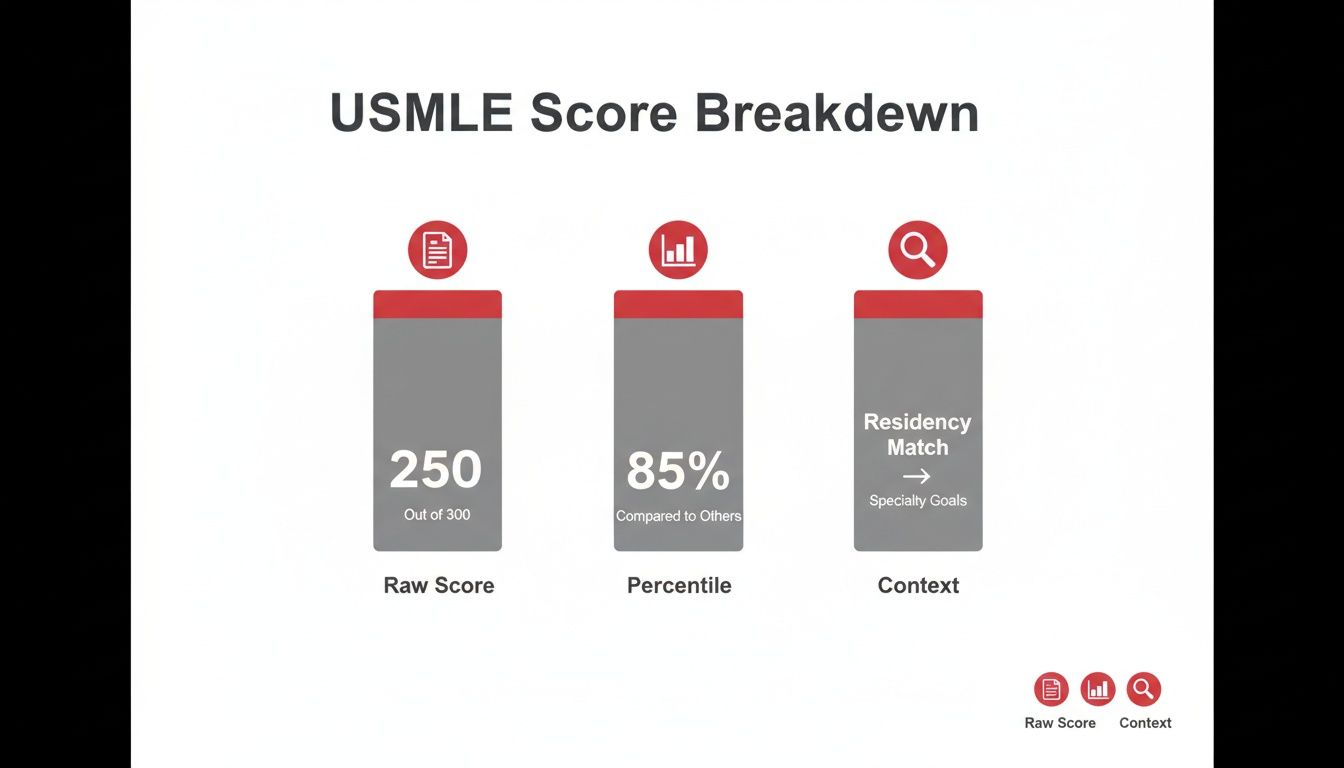
As you can see, the final number is just one piece of the puzzle. It’s the percentile rank and what that means for the residency match that really matters.
USMLE Step 2 CK Score to Percentile Conversion
To give you a concrete idea of what this looks like, here’s a table that maps specific Step 2 CK scores to their approximate percentile ranks. This data is based on recent performance for first-time takers from US and Canadian medical schools. Keep in mind, this is your direct comparison against a very specific, high-achieving group of your peers—the exact metric program directors use to see how you stack up.
| Step 2 CK Score | Approximate Percentile Rank |
|---|---|
| 270+ | 96th+ |
| 260 | 82nd |
| 255 | 63rd |
| 245 | 37th |
| 240 | 24th |
| 230 | 17th |
Note: These percentiles are based on performance data for first-time examinees from US/Canadian medical schools and are subject to change with new USMLE updates.
This table is your strategic guide. You can use it to interpret your scores from practice exams and set a clear, motivating target for test day. A fantastic way to measure where you are is by taking practice tests, and you can learn how to interpret those scores in our deep dive on NBME practice exams for Step 2.
Once you internalize this data, your study plan becomes much more than just "getting through the material." It becomes a strategic mission. Knowing that just a few more correct questions could launch you past thousands of other applicants is a powerful motivator. It reframes every study session not as a chore, but as a chance to gain a real, measurable edge.
How Percentiles Shape Your Residency Match Prospects

Your Step 2 CK score report doesn't just sit in a vacuum. The moment you hit 'submit' on your residency application, that three-digit number becomes a critical data point in an intensely competitive arena. Imagine being a program director staring at a mountain of applications from incredibly qualified students. How do they even begin to sort through them?
This is where your USMLE Step 2 CK percentile comes into play. It’s not a secret that many programs use score filters as a first pass. While that might sound a little scary, it's just a practical reality. Think of a high percentile as a green light—it signals a strong clinical knowledge base and often gets your application a much closer look from the get-go.
It’s not simply about getting past a certain cutoff. It's about understanding and meeting the unspoken expectations for the specialty you're aiming for, because the competitive landscape changes dramatically from one field to the next.
Finding the Right Target for Your Specialty
Think about it like this: the training regimen for a world-class marathon runner looks nothing like the one for an Olympic weightlifter. They're both elite athletes, but their benchmarks are completely different. The same logic applies to medicine. The Step 2 CK score that’s considered competitive for family medicine is worlds away from what's expected for dermatology or neurosurgery.
For the most competitive specialties, it's common to see average Step 2 CK scores for matched applicants pushing into the 250s and 260s. Data from the National Resident Matching Program (NRMP) consistently shows that fields like plastic surgery, dermatology, and orthopaedic surgery have some of the highest score averages for matched US seniors.
Now, this doesn't mean you need a 260 to have a successful match. Far from it. Plenty of fantastic specialties have average scores much closer to the national mean. The real key is doing your homework. Research the expectations for the specific specialties on your list. This data-driven approach lets you set a score goal that’s both realistic for you and ambitious enough for your dream career. You can dig deeper with a detailed breakdown of Step 2 scores by specialty.
Your Step 2 CK percentile isn't a final judgment on your potential as a doctor. It’s a strategic tool program directors use to manage the sheer volume of applications and quickly spot candidates who have demonstrated a certain level of performance on a standardized test.
To give you a clearer picture, here’s a look at the average Step 2 CK scores across a few different specialties. Use this table not as a list of rigid cutoffs, but as a guide to understand the competitive environment you’re stepping into.
Average Step 2 CK Scores for Matched US Seniors by Specialty
A look at the average Step 2 CK scores for matched applicants across a range of medical specialties, providing a benchmark for setting performance goals.
| Specialty | Average Matched Step 2 CK Score |
|---|---|
| Plastic Surgery | 256 |
| Dermatology | 257 |
| Orthopaedic Surgery | 257 |
| Diagnostic Radiology | 256 |
| Emergency Medicine | 248 |
| Internal Medicine | 251 |
| Pediatrics | 248 |
| Family Medicine | 241 |
Note: Data is based on recent NRMP reports for US MD Seniors and can change annually.
As you can see, the score expectations vary quite a bit. Setting a goal to score at or above the average for your chosen field is a smart move that can really strengthen your application.
But remember—and this is critical—your Step 2 CK score is just one piece of a very large puzzle. Program directors look at the whole picture. Your clinical grades, letters of recommendation, research, and personal statement all come together to tell your unique story. A strong percentile can get your foot in the door, but it’s the rest of your application that convinces them to invite you for an interview. Use this information not to stress out, but to strategize.
Using Data to Build Your Study Strategy
Understanding what USMLE Step 2 CK percentiles mean is the first step. The real game-changer is using that knowledge to build a powerful and efficient study plan. Your goal isn't just to memorize facts; it's to strategically turn what you know into points that put you ahead of your peers. This is where you transform raw data into real action.
The starting line is setting a clear, data-informed target score. This shouldn't be a random number you pull out of thin air. It has to be a calculated goal based on two critical factors: the average scores for your dream specialty and your own starting point on practice exams.
Set Your Target Score
First things first, dig into the data on average Step 2 CK scores for matched applicants in the specialties you're considering. If you have your heart set on a competitive field like dermatology or orthopaedic surgery, your target score needs to be high—likely in the 255-260+ range. That puts you between the 63rd and 82nd percentile, right where you need to be.
On the other hand, if your interests are in fields like family medicine or pediatrics, a score closer to the national average can be perfectly competitive. The key is to be both realistic and strategic about where you're aiming.
Once you have a target percentile in mind, take a baseline NBME practice exam to see exactly where you stand today. The gap between your baseline score and your goal score is the ground your study plan needs to cover. For a deep dive into structuring your prep, check out this excellent Step 2 CK study schedule.
Reverse Engineer Your Study Plan
With a target score locked in, you can work backward to create your plan. Let's say your baseline is a 240 (around the 24th percentile) and your goal is a 255 (the 63rd percentile). That 15-point jump doesn't sound like much, but it represents a massive leap of nearly 40 percentile points. Your study plan must be laser-focused on achieving that specific outcome.
This means breaking down your prep into a few core components:
- Identify Your Weak Areas: Your practice exam report is a goldmine. Analyze it to pinpoint the subjects where you're bleeding the most points. Your biggest score gains will come from turning weaknesses into strengths, not just polishing what you already know.
- Focus on High-Yield Topics: Not all topics are created equal on Step 2. You have to prioritize the systems and concepts that show up most frequently. Use your question bank data to identify these high-yield areas and dedicate the majority of your time and energy there.
- Refine Your Test-Taking Strategy: Sometimes, the problem isn't a knowledge gap—it's how you apply that knowledge under pressure. Are you running out of time? Misreading question stems? You need to practice timed question blocks relentlessly to build your stamina and perfect your pacing.
A study plan without a clear score goal is like a road trip without a destination. By using percentile data, you create a clear roadmap that guides every decision you make during your dedicated study period.
Make Your Progress Measurable
Your study strategy can't be set in stone; it needs to be a living, breathing plan that adapts. Use regular practice exams—every 1-2 weeks is a good cadence—to track your progress and make adjustments on the fly.
If you see that your cardiology score is stagnating, it’s a signal to change your approach. Maybe it's time to watch some review videos, hammer out more practice questions, or make flashcards for key drug mechanisms. Conversely, if you're consistently crushing a particular subject, you can afford to shift some of that focus to a weaker area.
This cycle of testing, analyzing, and adapting is what ensures you’re always spending your limited study time in the most effective way possible. It’s how you turn your target score from a wish into a reality.
Adapting to the New USMLE Scoring Landscape
The whole game has changed. With Step 1 now pass/fail, your Step 2 CK score isn't just another important number—it's become the single most critical score on your entire residency application. Program directors, who used to rely on Step 1 to quickly sift through thousands of applicants, are now leaning heavily on Step 2 CK to measure clinical knowledge and readiness.
This shift puts a massive amount of pressure on this one exam. It’s no longer just about proving you’re competent; it’s about standing out in a sea of applicants where every single point on your score report carries more weight than ever before. This new reality makes a smart, well-planned prep strategy absolutely essential.
The Bar for Passing Just Got Higher
As if the pressure wasn't enough, the USMLE has also raised the stakes. The passing standard for Step 2 CK recently jumped from 214 to 218. This four-point bump might not sound like a lot, but it’s a clear signal that the baseline expectations for medical students are climbing. You can get more details on this change and what it means for test-takers trying to understand the average USMLE Step 2 CK score on TrueLearn.
This isn't just some random adjustment. It’s a direct response to Step 2 CK’s new starring role in the residency selection process, where it's now the primary standardized score used to compare candidates.
In this new landscape, your Step 2 CK score does more than just check a box. It sets the initial tone for your entire application, influencing interview invitations and your overall competitiveness.
What This Means for Your Application
So, how does all this affect you, whether you're a US student or an International Medical Graduate (IMG)? The takeaway is straightforward: you need a proactive plan.
- For US Students: The competition is more focused now. A stellar Step 2 CK score is one of the best ways to set yourself apart, especially if you’re aiming for a competitive specialty or a top-tier program.
- For IMGs: The challenge has definitely intensified. A high Step 2 CK score is absolutely crucial for demonstrating your clinical abilities and overcoming potential biases. A strong performance is more vital than ever for landing a residency spot.
This isn't meant to scare you, but to highlight a new reality. The ground has shifted, and your preparation has to shift with it. Every point you earn on Step 2 CK directly shapes how your application is seen. Understanding this context is the first step toward building a study plan that doesn’t just aim for a pass, but targets a percentile that will open the doors to the specialty you want.
Burning Questions About Step 2 CK Percentiles
Let's be honest, the whole system of USMLE scoring and percentiles can feel a bit like a black box. You've got questions, and getting straight answers is key to building a smart residency match strategy. Let's tackle some of the most common ones.
How Often Are USMLE Percentiles Updated?
The NBME doesn't set the percentile data in stone; they refresh it every few years to match the performance of recent test-takers. Think of it as recalibrating the scale to make sure it's an accurate snapshot of the current applicant pool.
This is why you absolutely must use the most current data. Grabbing an old chart from a forum or a senior who took the exam three years ago can give you a completely skewed sense of where you stand. It could lead to a false sense of security or, just as bad, a ton of unnecessary anxiety. Always hunt down the latest official performance data directly from the USMLE.
Should I Postpone My Exam to Get a Higher Score?
This is the million-dollar question, and there’s no easy "yes" or "no." It's a high-stakes strategic call. Pushing back your exam could give you that extra month you need to turn a 245 into a 255, potentially jumping you up a whole tier in the eyes of competitive programs.
But here's the trade-off: application timelines. If you delay too long, your score might not be back when programs start sending out their first wave of interview invites. You risk being overlooked simply because your data wasn't in the system. It's a classic risk-reward scenario. The best move is to have a frank conversation with a faculty advisor who knows you and your specialty of interest. They can help you weigh your practice scores against program deadlines and make a call that’s right for you.
Your official USMLE transcript only shows your three-digit score, not the percentile. But don't be fooled—program directors are experts at this. They’re mentally converting your score to a percentile to instantly see where you rank.
Do Residency Programs See My Percentile or Just My Score?
When programs pull up your application in ERAS (Electronic Residency Application Service), they see your three-digit score on the official transcript. The percentile rank itself isn't explicitly listed.
But honestly, that's just a technicality. Program directors and admissions committees live and breathe this stuff. They are so familiar with the score distributions that they know exactly what a 250, 260, or 270 means. In their heads, they are instantly converting that score into a percentile to gauge your performance against the thousands of other applicants they're reviewing. A high score speaks for itself because they know it represents a top-tier percentile.
At Ace Med Boards, we specialize in turning this complex data into a personalized action plan. Our expert tutors can help you set a strategic score goal and build a study schedule to achieve it. Book a free consultation today to see how we can help you stand out.