Getting clinical experience is all about putting yourself in a healthcare setting where you can interact with patients or see how care is delivered. This isn't just a passive activity; it means actively participating. Think volunteering at a hospital, shadowing a physician, or landing a paid role like a medical scribe or certified nursing assistant (CNA).
Why Clinical Experience Is Your Most Important Asset
Before we get into the "how," we need to talk about the "why." Because if you think clinical experience is just another box to check for your medical school or residency application, you're missing the point entirely.
This is where you figure out if medicine is truly for you. It’s the process that tests your grit in tough situations and builds the kind of empathy that separates a good doctor from a great one. Admissions committees aren't just counting your hours; they're looking for a compelling story of your commitment and self-discovery.
This hands-on exposure is where textbook knowledge starts to feel real. It's one thing to read about a disease, but it’s a whole different world to see how it impacts a person's life, their family, and their emotional state. These are the moments that build your bedside manner and sharpen your clinical reasoning.
Proving Your Commitment Beyond Grades
Killer grades and a high MCAT score? Great. That tells admissions you can handle the academic side of medicine. But it doesn't tell them the whole story.
Clinical experience is your proof that you’ve seen what healthcare is really like—the amazing parts, the challenging parts, and the emotionally draining parts—and you still want in. It shows your motivation is genuine, not some idealized fantasy you saw on TV.
Admissions committees use clinical experience as a primary indicator of an applicant's maturity and informed decision to enter the medical field. It separates serious candidates from those who may be less prepared for the profession's demands.
And the data doesn't lie. According to a massive survey by the Association of American Medical Colleges (AAMC), 73% of medical schools either highly recommend or flat-out require applicants to have experience observing clinical practices.
Even more telling? A staggering 87% said that a lack of clinical experience puts an applicant at a significant disadvantage. In other words, your application might get tossed without it. You can see the full breakdown on the importance of clinical experience in medical school admissions.
Building Your Personal Narrative
Every patient you talk to, every conversation you have with a doctor, and every challenge you face becomes a piece of your story. These experiences are the raw material for your personal statement and interviews.
They provide the authentic, memorable moments that show admissions committees who you really are and what drives you. Whether you're a pre-med student working on your AMCAS application or an IMG proving you're ready for the US healthcare system, a rich clinical background is your single most powerful asset.
Finding the Right Clinical Pathway for You
Trying to figure out how to get clinical experience can feel like a huge task, but here's the secret: there isn't one "best" way to do it. The right choice is the one that fits your goals, your schedule, and what you're genuinely curious about. This is all about finding an opportunity that adds a meaningful chapter to your story and gives you the kind of patient exposure that admissions committees are really looking for.
Think of each pathway as a different lens for viewing the world of medicine. Shadowing gives you one perspective, while working as an EMT offers a completely different one. Your mission is to pick the lens that brings your future in healthcare into the clearest focus.
This flowchart pretty much sums up a core truth of the application process. Clinical experience isn't just a nice-to-have; it's a non-negotiable part of a strong application.
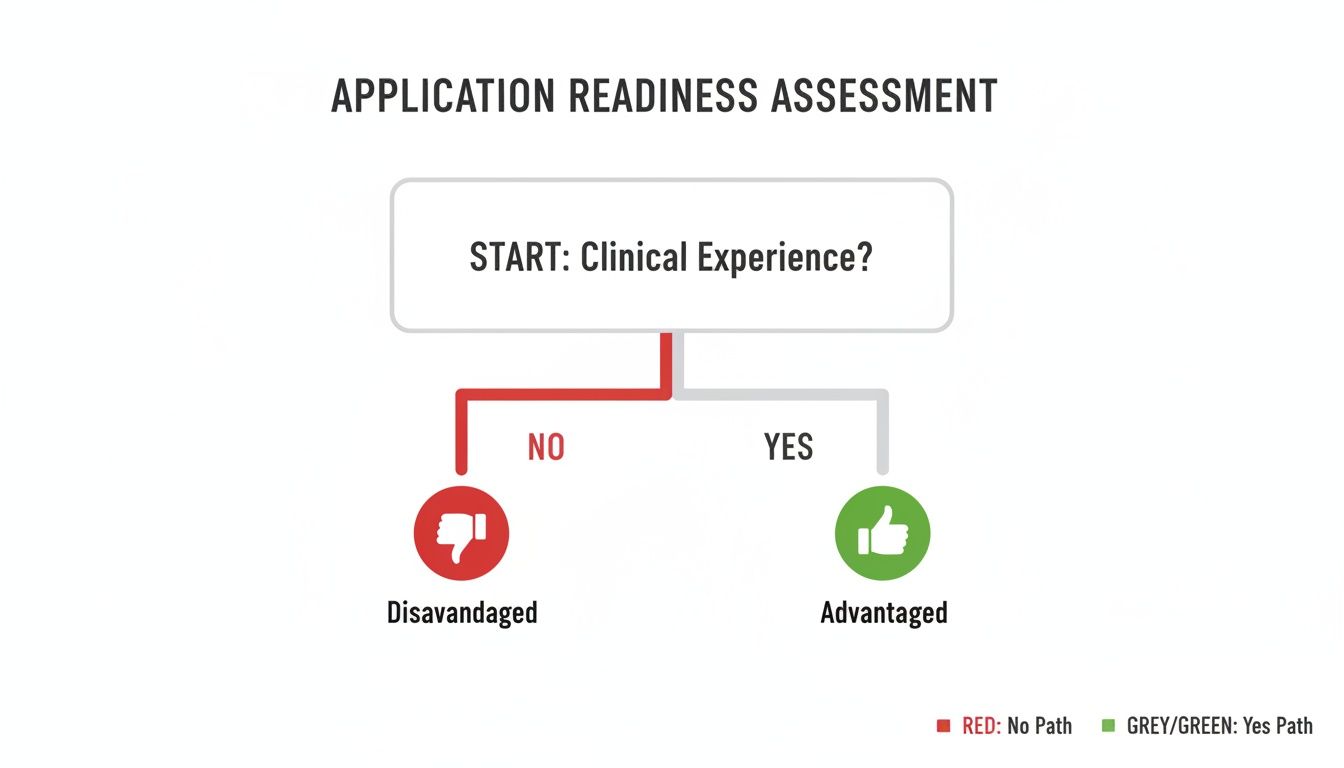
As you can see, having this experience puts you in the advantaged lane right away. Lacking it? That's a significant hurdle. So, let’s dive into the most effective ways to build that advantage.
This table breaks down the most common types of clinical experience, comparing them on key factors like typical time commitment, level of patient interaction, and potential for paid employment to help you decide which path is right for you.
Comparing Clinical Experience Pathways
| Experience Type | Patient Interaction Level | Typical Time Commitment | Paid Opportunity | Best For |
|---|---|---|---|---|
| Shadowing | Primarily Observational | Flexible; short-term (20-100 hours) | No | Exploring specialties, understanding a physician's daily life, confirming interest in medicine. |
| Clinical Volunteering | Low to Moderate (often non-medical) | Consistent; often 4-8 hours/week for months | No | Developing empathy, seeing the healthcare system from a non-provider view, demonstrating altruism. |
| Medical Scribe | High (documentation-focused) | Significant; often part-time or full-time | Yes | Learning medical terminology and decision-making, gaining deep insight into a physician's thought process. |
| CNA / MA | High (direct hands-on care) | Significant; requires certification + regular shifts | Yes | Mastering fundamental bedside manner, gaining comfort with direct patient care, developing strong patient relationships. |
| EMT | High (acute, autonomous care) | Significant; requires certification + shifts | Yes | Developing leadership, learning to make critical decisions under pressure, gaining pre-hospital experience. |
Each of these paths offers a unique window into medicine. The key is to find the one—or the combination—that aligns with your personal and professional goals.
Shadowing Physicians for Direct Insight
Shadowing a physician is the classic starting point, and for good reason. It’s your chance to be a fly on the wall, following a doctor through their day as they see patients, make diagnoses, and work with their team. You get an unfiltered look at what a particular specialty is really like.
The real value here isn't about doing hands-on tasks—it's about absorbing everything. You’ll start to understand the physician's thought process, see the pressures they face, and appreciate the subtle communication skills needed to build trust with patients.
- How to Make it Count: Don't just stand there silently. With permission, take discreet notes. Ask thoughtful questions when there's downtime between patients. Later, reflect on what you saw. Why did the doctor choose that specific test? How did they navigate that tough conversation with a family member?
- Finding Opportunities: Your personal network is the best place to start. Think about your own family doctor or specialists you know. Your university’s pre-health advising office is another goldmine. And don't shy away from sending a polite, professional cold email to local doctors—explaining your goals can open more doors than you think.
Shadowing is a fantastic way to test the waters and confirm that medicine is right for you. It's also perfect for exploring different fields, from the controlled chaos of the ER to the long-term relationships of primary care.
High-Impact Volunteering Roles
Clinical volunteering puts you right in the middle of a patient-care setting, often with more direct interaction than shadowing (even if it's non-medical). These roles are absolutely critical for building empathy and seeing the healthcare system from a completely different perspective.
Working in hospice care, for instance, can teach you profound lessons about compassion and end-of-life conversations. Volunteering in a hospital ER might mean comforting an anxious family member or helping restock supplies in a high-stakes environment.
Meaningful volunteering isn't about the tasks you do. It's about the human connections you make and the side of medicine you witness that can't be taught in a classroom. Admissions committees want to see the reflection and growth that come from these experiences.
Community health clinics, especially those serving uninsured or underserved populations, offer a raw, frontline view of health disparities. These experiences are invaluable for building cultural competency and understanding the real-world challenges many patients face.
Paid Positions That Build Core Skills
If you're ready for a deep dive and want to earn some money along the way, getting a paid clinical job is one of the best moves you can make. These roles usually require some training or certification, but the hands-on experience you get in return is unmatched.
Medical Scribe
- The Role: You're the physician's right hand, documenting every detail of patient visits directly into the electronic health record (EHR). You'll learn medical terminology, how doctors form differential diagnoses, and the logic behind treatment plans at lightning speed.
- The Advantage: This is probably the closest you can get to climbing inside a physician’s brain before medical school. You learn the language and the logic of medicine from the inside.
Certified Nursing Assistant (CNA)
- The Role: As a CNA, you’re on the front lines of basic patient care—helping with bathing, eating, and moving around. You often spend more time with patients than anyone else on the team, building real rapport and observing their condition day in and day out.
- The Advantage: Nothing teaches you bedside manner and fundamental patient care like being a CNA. You learn empathy on a visceral level and become truly comfortable with the physical and emotional realities of being sick.
Emergency Medical Technician (EMT)
- The Role: EMTs are first responders, providing emergency care before a patient ever reaches the hospital. You learn how to assess patients quickly, manage medical crises, and make critical decisions under immense pressure.
- The Advantage: The level of responsibility and autonomy you get as an EMT is incredible. You develop leadership skills and learn to stay cool and systematic in chaotic situations—an essential trait for any future doctor.
These jobs are more than just line items on a resume; they're transformative experiences that provide powerful stories for your application. They are also just one piece of a well-rounded profile. Learn more about how these roles fit into the bigger picture by exploring our guide to extracurricular activities for medical school.
Ultimately, your goal is to build a portfolio of experiences that shows your commitment and gives you real insight. The numbers matter: while there's no magic number, most successful applicants have 100-500 hours of meaningful clinical engagement. For 2025 applications, 150-200 hours is a good competitive baseline, but many applicants have far more. The best approach is often a mix—maybe you shadow in a few different specialties and combine that with a long-term commitment as a volunteer or CNA. This shows both the breadth of your exploration and the depth of your dedication.
How to Secure Opportunities and Build Connections
Knowing what kind of clinical experience you want is one thing, but actually landing it is the real test. Moving from an aspiring applicant to a valued team member takes a specific playbook. This is where persistence, professionalism, and a bit of strategy come together to turn your interest into tangible hours on your application. It really all boils down to knowing where to look and who to ask.
Here's the thing: many of the best opportunities aren't just sitting on a public job board. They're found through proactive outreach and good old-fashioned networking. Your mission is to connect with the right people who can open doors, whether that’s a volunteer coordinator, a clinic manager, or a physician in a specialty that fascinates you.
Leveraging Your Resources and Network
Your first stop should always be your university’s pre-health or career services office. These advisors have done the legwork for you. They’ve built relationships with local hospitals and clinics and often keep lists of physicians who are happy to have students shadow them. Tapping into their network can save you countless hours of cold searching.
Next, think about your personal network. This includes your family doctor, any specialists you've seen, friends already in medical school, or even family members working in healthcare. A warm introduction, even a casual one, is infinitely more powerful than a cold email.
Finally, don't be afraid to go straight to the source. Most hospitals have a dedicated volunteer services department with a clear application process right on their website. For smaller private clinics, a polite phone call to the office manager is often the most direct and effective approach.
Crafting the Perfect Outreach Email
When you do need to make a cold approach, a well-crafted email is your most critical tool. It has to be concise, professional, and show that you've done your homework. Busy professionals are experts at ignoring vague, generic messages.
A simple structure that gets results looks something like this:
- A Clear Subject Line: Get straight to the point. Something like "Pre-Med Student Seeking Shadowing Opportunity" or "Inquiry Regarding Clinical Volunteering" works perfectly.
- A Brief Introduction: State who you are (e.g., a sophomore pre-med student at X University), what you're asking for, and—most importantly—why you are contacting them. Mentioning their specialty or a specific paper they published shows genuine interest.
- Show Flexibility and Respect for Their Time: Acknowledge their packed schedule and offer to be as flexible as possible. It's also a good idea to attach your resume or a concise https://acemedboards.com/medical-school-cv/ to give them more context without cluttering the email.
- A Clear Call to Action: End with a simple, easy request. Ask for a brief phone call or the chance to shadow for just a few hours. Make it incredibly easy for them to say yes.
Pro Tip: Always follow up. If you don't hear back in a week or two, send a brief, polite follow-up email. Persistence often pays off; your first message might have just gotten lost in a crowded inbox.
Acing the Interview for Paid Roles
Landing a paid position like a medical scribe or CNA almost always involves a formal interview. This is your chance to connect your existing skills to the demands of patient care. Don't discount your non-medical experience! Skills from retail or customer service jobs—like communication, reliability, and teamwork—are highly relevant.
To really stand out, show that you're thinking ahead about the practical side of the job. Understanding how technology supports daily operations can be a huge advantage. For instance, you could explore how transcription is used in medical healthcare and mention it. This demonstrates that you’re not just looking for a job, but that you're already thinking about how to be a competent team member.
Be ready to answer questions about why you want to work in healthcare, how you handle stress, and what you hope to learn. Back up your answers with specific examples from your past. This turns a standard interview into a compelling demonstration of your readiness to contribute from day one.
A Guide for IMGs and Nontraditional Applicants
The path to medicine isn’t a straight line for everyone. If you’re an International Medical Graduate (IMG) or a nontraditional applicant changing careers, your journey to gain clinical experience will look a little different—and that’s a huge strength.
Your unique background just means you need a more targeted strategy to prove you’re ready for the rigors of medicine.
For IMGs, the mission is crystal clear: secure US Clinical Experience (USCE). This isn't just about logging hours; it's about proving you can thrive within the American healthcare system. Program directors see USCE as a critical sign of your adaptability, communication skills, and grasp of clinical protocols in the United States.
Without it, your application is facing a serious uphill battle. Meaningful USCE is how you get strong, recent Letters of Recommendation (LoRs) from US physicians, which carry immense weight in the residency match process.
The IMG's Path to USCE
As an IMG, your focus has to be on gaining experience that mirrors the responsibilities of a US medical student or resident. Whenever possible, that means prioritizing hands-on roles over just watching from the sidelines.
Your best bets include:
- Hands-on Externships and Clerkships: These are the gold standard. You’ll get involved in direct patient care under supervision—taking histories, performing physical exams, and helping build patient management plans. Plenty of hospitals and private services offer these specifically for IMGs.
- Observerships: While less interactive, observerships are a fantastic way to get your foot in the door. You'll shadow physicians, learn the workflow of a US hospital or clinic, and start building your professional network. Use this time to show your knowledge and professionalism, and you can still walk away with a strong LoR.
- Clinical Research with Patient Contact: Don't overlook roles like a clinical research assistant or coordinator. If the position involves interacting with study participants—like consenting patients or collecting clinical data—it absolutely counts as valuable patient exposure.
The need for USCE can't be overstated. It directly answers a program director’s biggest questions about an IMG applicant: Can they communicate effectively with American patients? Do they understand the medical culture and team dynamics here?
While your international clinical experiences are powerful, they are not a substitute for US-based rotations. Research shows that US IMGs who study abroad often face steeper hurdles, partly because less US clinical exposure leads to weaker letters from US clinicians and lower match rates. You can read the full research about these challenges and their career implications for a deeper look.
Leveraging Your Past as a Nontraditional Applicant
Coming to medicine from another career? It’s easy to feel like you’re starting from scratch. But the reality is, your past experience is a powerful asset, not a liability. Your job is to reframe those skills in a clinical context.
Did you work in project management? Then you’re an expert at organization and teamwork—essential skills for a physician. Were you a teacher? You excel at communication and breaking down complex information, which is the core of patient education.
Your unique journey gives you a level of maturity and real-world perspective that younger applicants just don’t have. Don't hide it; highlight it.
When you're looking for clinical roles, connect your past responsibilities to the needs of the position:
- Customer Service Excellence: Frame your background as "patient relations." You know how to handle tense situations and make people feel heard.
- Leadership and Teamwork: Translate your experience managing a team into your ability to collaborate within a complex healthcare setting.
- Problem-Solving: Use concrete examples of how you tackled tough challenges in your old career to showcase your analytical skills.
For both IMGs and nontraditional applicants, the goal is the same: build a compelling story that proves you are prepared, dedicated, and uniquely qualified for a career in medicine. For a deeper dive into navigating this process, check out our complete USMLE guide for international medical graduates.
Turning Your Hours Into a Compelling Application Story
Racking up clinical hours is a huge milestone, but let's be honest—the hours themselves are just numbers on a page. The real magic happens when you turn that raw data into a powerful story that shows an admissions committee who you are and why you're ready for medicine. Getting the experience is only half the job. Knowing how to talk about it is what makes you stand out.
This whole process starts way before you even think about opening an application portal. It begins with being intentional and reflective while you’re still in the trenches, logging those hours. The key is to document your journey not as a list of tasks you checked off, but as a collection of moments that actually meant something to you.

Keep a Reflection Journal
Trust me on this: your memory will fail you. After hundreds of hours and what feels like a million patient interactions, the specific details that made an experience profound will start to get fuzzy. A reflection journal is your single best tool for capturing these moments while they're still fresh.
This isn’t just a log of your shifts. For every entry, you need to dig deeper and ask yourself some tough questions:
- What was the hardest part of my day, and what made it so challenging?
- Did I see a moment of incredible compassion or communication? What did I learn from it?
- How did one specific patient interaction completely change my view on healthcare?
- What did I learn about teamwork, resilience, or just how the system works (or doesn't work) today?
These journal entries will become an absolute goldmine of authentic material when it's time to write your personal statement and prep for interviews. You’ll have powerful, specific stories ready to go instead of trying to recall vague generalities.
Writing Impactful Application Descriptions
When you finally sit down to fill out your AMCAS, AACOMAS, or ERAS application, your mantra should be show, don't tell. A classic mistake is just listing out your duties. Admissions committees know what a CNA or a scribe does; what they don't know is what you got out of it and how you grew from that experience.
The secret to turning clinical hours into a compelling story is mastering listing experience on a resume effectively, where you focus on your growth and accomplishments, not just your daily grind.
Let’s look at a quick before-and-after.
Before (Just Telling):
"As a hospital volunteer, I was responsible for stocking supply closets, transporting patients via wheelchair, and delivering lab specimens."
This is accurate, sure, but it's completely forgettable. It's a list of tasks that reveals nothing about you.
After (Actually Showing):
"Transported patients to and from surgical procedures, learning to provide comfort and reassurance during moments of high anxiety. Developed strong communication skills by serving as a liaison between nursing staff and patient families, ensuring their questions were heard. Gained insight into the importance of systemic efficiency by managing supply logistics for a 30-bed unit."
See the difference? This version transforms boring tasks into skills and insights. It demonstrates empathy, communication, and a much deeper understanding of the healthcare environment. For more help weaving these kinds of stories into your main application, check out our guide on building a personal statement outline.
Key Takeaway: Every single description you write needs to answer the question, "So what?" Connect every task you did to a quality that makes you a stronger medical school candidate—whether that’s empathy, problem-solving, or resilience. This simple shift turns your experience from a list of hours into undeniable proof that you’re ready for a career in medicine.
Your Clinical Experience Questions, Answered
As you start piecing together your clinical experience, questions are going to pop up. It's totally normal to wonder if you're on the right track or if you're hitting the kind of milestones that admissions committees want to see.
This section is all about cutting through the noise. We're tackling the most common and pressing questions we hear from aspiring doctors. Let's get you some clear, direct answers so you can move forward with confidence and focus on what really matters: getting great experience.
How Many Clinical Hours Do I Actually Need?
This is the big one, but the answer isn't some magic number. Instead of obsessing over a specific target, shift your focus to quality and consistency. As a solid baseline, you should aim for a minimum of 100-150 quality hours.
Now, if you're aiming for highly competitive programs, you'll see successful applicants with 200-500 hours, sometimes even more. But here’s the critical part: admissions committees value sustained commitment far more than a last-minute scramble to rack up hours.
Admissions teams would much rather see you dedicate four hours a week for a full year at one location than see 200 hours crammed into a single summer. Long-term engagement demonstrates reliability, passion, and a deeper understanding of the role, which speaks volumes more than just a high number.
At the end of the day, it's your reflection on the experience that truly counts. Being able to talk about what you learned and how it shaped you is infinitely more powerful than the final number on your application.
Does Virtual Shadowing Count Toward My Hours?
Yes, it absolutely counts. Virtual shadowing has become a widely accepted way to gain clinical exposure, and for good reason. While it’s not a one-to-one replacement for being physically present, it shows you're adaptable and genuinely committed to learning, especially when in-person options are tough to find.
The AAMC has even confirmed that most medical schools are on board with alternative experiences, acknowledging that the healthcare landscape is changing. Virtual shadowing can be a brilliant tool to:
- Explore diverse specialties that might not be available in your immediate area.
- Get a front-row seat to telehealth, a field that's exploding in modern medicine.
- Understand the digital side of patient care, from electronic health records to virtual communication tools.
When you log these hours, get specific. Don't just say "virtual shadowing." Describe what you learned about building patient rapport over a screen, the unique challenges of remote diagnostics, and how technology is shaping the future of care. The best approach is to blend virtual opportunities with traditional, in-person roles for a well-rounded and proactive application.
What Is the Difference Between Clinical and Non-Clinical Volunteering?
Getting this distinction right is crucial for building a balanced application. Both types of volunteering are important, but they show off different—and equally valuable—parts of your character.
Clinical volunteering puts you in direct contact with patients inside a healthcare setting. You're either observing or, in some small way, participating in the patient care journey.
- Think: Handing out water in a hospital, comforting anxious family members in the ER, or helping with intake at a free health clinic.
- What it proves: You've tested your interest in medicine and are comfortable in the clinical environment.
Non-clinical volunteering is community service that happens outside of a patient-care context. It’s all about serving your community in a broader sense.
- Think: Tutoring kids, building homes with Habitat for Humanity, or serving meals at a local shelter.
- What it proves: Your altruism, compassion, and dedication to helping others—qualities that are the bedrock of a great physician.
A strong application has a healthy mix of both. Clinical experience proves you know what you’re getting into, while non-clinical service shows you have the heart for it. They work together to paint a complete picture of who you are.
Navigating the path to medical school is a challenge, but you don't have to do it alone. At Ace Med Boards, we provide expert tutoring and admissions consulting to help you build a standout application and excel on your exams. Schedule a free consultation today to see how our personalized guidance can help you achieve your dreams.