Think of USMLE practice exams less like a test and more like a dress rehearsal for opening night. They're your single most powerful tool for diagnosing weaknesses, building up insane mental stamina, and walking into the real exam with the confidence that you've already seen it all. Getting a handle on these simulations is the key to knowing exactly where you stand for Step 1, Step 2 CK, and Step 3.
Your Blueprint for Acing the USMLE with Practice Exams

Prepping for the USMLE isn’t like cramming for a final—it’s like training for a marathon. You wouldn’t show up to run 26.2 miles without having done a single timed practice run, would you? The same logic applies here. You can't just walk into an eight-hour board exam without having gone through several full-length simulations.
USMLE practice exams are your personal performance analytics engine. They give you critical data that goes way beyond a simple three-digit score.
These exams are built to mimic the grueling, mentally draining conditions of the actual test day. This helps you build the sheer endurance needed to stay sharp from the first question block to the last. But more importantly, each exam acts like a diagnostic X-ray, showing you exactly where the hidden fractures are in your knowledge base.
The Core Philosophy of Practice Exams
Success isn't about who takes the most practice exams. It’s about who extracts the most meaningful data from each one. This guide is all about shifting your mindset away from the dreaded "What score did I get?" to the much more powerful question: "What did this test just teach me?"
This approach breaks down into a few key steps:
- Establishing a Baseline: Your very first practice test is not about getting a good score. Not at all. It’s about planting a flag in the ground to mark your starting point. Every bit of progress from here on out will be measured against this initial baseline.
- Identifying Weaknesses: The detailed performance report is gold. It will tell you precisely which subjects—like cardiology or biostatistics—are holding you back and need some serious, focused attention.
- Mastering Question Patterns: You’ll quickly learn to spot how the exam writers test certain concepts. It’s about decoding those long, complicated vignettes and learning to sidestep the common traps they love to set.
The core philosophy is simple: success isn't about taking more exams, but about using the data from each one to build a smarter, more targeted study plan.
When you're putting your master plan together, don't forget to mix in different ways of learning. For instance, understanding some basic social learning strategies can make your study group sessions way more effective, which is a great supplement to all the solo work you'll be doing.
Ultimately, this guide is your roadmap, taking you from that first scary diagnostic test all the way to your final confidence-boosting exam before the real deal. You can plug these strategies directly into a structured timeline using a dedicated exam preparation planner to map out your entire study block, making sure every single practice test serves a specific, strategic purpose.
Choosing Your Tools: Decoding the Major Practice Exams
Navigating the crowded world of USMLE prep materials can feel like trying to choose the right prescription without a diagnosis. With so many options, how do you know which USMLE practice exams are right for you? The key isn't to use every tool available, but to understand what each one is designed to do—and deploy it at the right time.
Think of your preparation as building a high-performance race car. You need different tools for different jobs. Some are for diagnostics, others for fine-tuning the engine, and a final set for simulating race day conditions. The major practice exams fall into these distinct categories.
The Gold Standard: NBME Self-Assessments
The National Board of Medical Examiners (NBME) self-assessments are the undisputed gold standard for score prediction. These exams, officially called Comprehensive Basic Science Self-Assessments (CBSSA) for Step 1 and Comprehensive Clinical Science Self-Assessments (CCSSA) for Step 2, are your official scrimmages.
Why are they so trusted? It's simple: they are created by the same organization that makes the actual USMLE and use retired official exam questions. This means the question style, length, and topic distribution are the closest you'll get to the real thing. Taking an NBME isn't just a practice run; it’s like getting a sneak peek from the test-makers themselves.
Over the past decade, using these assessments has become nearly universal. Tutoring services report that almost all serious candidates for Step 1 or Step 2 complete at least one. This trend intensified after Step 1 shifted to pass/fail in January 2022, as students began relying more on predicted pass probabilities than on chasing a specific score.
The Step 1 NBME forms consist of 200 questions in 4 blocks of 50, mirroring the real exam's structure. They provide a Total Equated Percent Correct Score (TEPCS) and a modeled probability of passing within a week, which is widely considered one of the most reliable indicators of readiness. Because these exams are built using the same robust psychometric principles as the actual USMLE, a score from a CBSSA taken within 1–2 weeks of your test date is often a very close approximation of your real performance. You can read more about the interpretive guide to NBME practice exams to better understand your results.
The Ultimate Learning Tool: UWorld Self-Assessments
If NBMEs are for prediction, UWorld Self-Assessments (UWSAs) are for learning. While they also provide a three-digit score prediction, their primary value lies in their incredibly detailed, high-yield explanations. Many students find UWSA questions to be slightly more difficult or complex than the real exam, which makes them an outstanding training tool.
Think of a UWSA as an intense, high-level coaching session. It pushes your clinical reasoning to its limits and then meticulously breaks down every answer choice—both correct and incorrect—to teach you the underlying pathophysiology and clinical logic. This focus on the "why" is what makes them indispensable.
Taking a UWSA is less about finding out your score and more about deepening your understanding. The review process afterward is where the real magic happens, turning every mistake into a powerful learning opportunity.
To help you decide which tools to integrate into your study plan, here's a quick comparison of the top platforms.
At-a-Glance Comparison of USMLE Practice Exam Platforms
Use this table to quickly compare the features, accuracy, and best use cases of the top USMLE practice exams to build a powerful study plan.
| Practice Exam | Question Source and Style | Score Prediction Accuracy | Best Used For | Key Feature |
|---|---|---|---|---|
| NBME CBSSA/CCSSA | Retired official USMLE questions | Very High (the gold standard) | Baseline assessment, final readiness check, and score prediction. | Mirrors the real exam's style, format, and difficulty curve perfectly. |
| UWorld UWSA | UWorld-written, clinically complex questions | High (often slightly under-predicts) | Deep learning, identifying knowledge gaps, and practicing clinical reasoning. | Unmatched answer explanations that teach core concepts thoroughly. |
| AMBOSS Self-Assessment | AMBOSS-written, often challenging questions | Moderate to High | Identifying weaknesses, especially in advanced topics, and getting another data point. | Integrated library allows for seamless review of concepts during analysis. |
| Kaplan Practice Exams | Kaplan-written, content-focused questions | Variable | Building stamina early on and identifying broad content knowledge gaps. | Full-length simulations are good for conditioning in the initial study phases. |
| Free 120 (USMLE) | Official USMLE questions | N/A (not a scored exam) | Familiarizing yourself with the official exam interface and question style. | An exact replica of the software you'll use on test day. A must-do. |
Each of these tools has a specific job. Mixing and matching them based on your study timeline and goals is the smartest way to prepare.
Other Key Players in the Field
While NBME and UWorld are the heavyweights, other platforms offer valuable resources that can supplement your core preparation.
- AMBOSS Self-Assessment: Typically offered for free once a year, this is a fantastic opportunity to get another data point on your performance. AMBOSS is known for its challenging questions and an integrated library that makes reviewing concepts seamless.
- Kaplan Practice Exams: Kaplan offers full-length simulations that are great for building stamina early in your study period. While their predictive accuracy can be variable, they are effective for identifying broad knowledge gaps.
- The Free 120: This is a set of 120 official questions released by the USMLE. It is an absolute must-do in the final week before your exam. Its purpose is less about scoring and more about getting comfortable with the exact interface and question style you'll see on test day.
Ultimately, a balanced approach is best. Use a combination of a powerful question bank and various self-assessments. You can explore a detailed breakdown of the best USMLE Step 1 question banks to build the foundation of your study plan. By combining the predictive power of NBMEs with the deep learning from UWSAs, you create a well-rounded strategy that prepares you for anything the USMLE can throw at you.
Building Your Practice Exam Timeline
Knowing when to take your USMLE practice exams is just as critical as choosing which ones to use. If you just take them randomly, they're little more than score checks. But with a well-structured timeline, these assessments become powerful strategic tools that actually guide your prep.
The key is to stop thinking of your study period as one long, miserable slog. Instead, break it down into distinct phases, each with a specific assessment goal.
This visual journey splits the process into three core stages: diagnostic, training, and prediction.
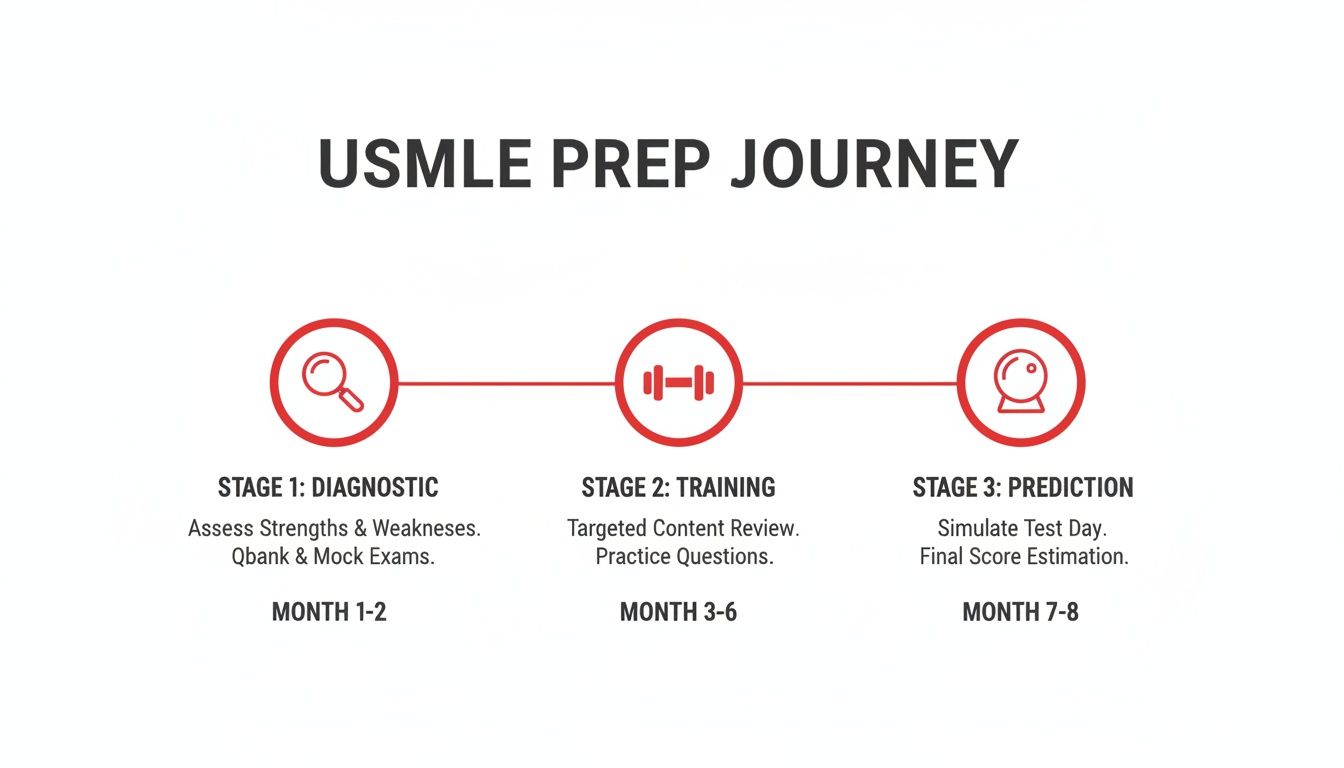
This approach shows you how to properly space out your exams, giving you enough runway for thorough review and targeted remediation between each test.
The Diagnostic Phase: Your Starting Point
Your journey has to start with a baseline. About one week into your dedicated study period, it's time to take your first practice exam. Forget about getting a high score—that's not the point here. The purpose is purely diagnostic.
Think of it like a pre-operative assessment before a major surgery. You need to know exactly what you're up against before you start cutting.
- Which Exam to Use: An older NBME form is perfect for this. It will give you an honest, accurate starting point without burning one of the more predictive newer forms you’ll want to save for the home stretch.
- The Goal: Pinpoint your weakest subjects and just get a feel for the exam's brutal timing and format. The data from this single exam will shape the entire first few weeks of your study schedule.
The Training Phase: Building Strength and Stamina
Once you have your baseline, you enter the training phase. This is the main grind, making up the bulk of your study time. During this period, plan to take a practice exam roughly every 10–14 days.
This spacing is non-negotiable. It gives you enough time to meticulously review your last exam, hammer away at your weak areas, and actually see measurable improvement. Taking exams too close together just leads to burnout and score fluctuations that don't reflect real progress. It's like trying to measure muscle growth the day after a workout—it just doesn't work.
A huge mistake I see students make is taking practice exams too frequently. Spacing them 10-14 days apart allows for meaningful growth and prevents burnout. It ensures you're learning from your mistakes, not just repeating them.
During this phase, it’s a great idea to alternate between different types of exams. For example, follow an NBME with a UWorld Self-Assessment (UWSA). This strategy gives you both a solid predictive data point (NBME) and a high-yield, intensive learning experience (UWSA).
The Prediction Phase: Final Readiness Check
The final two weeks before your test date are all about one thing: prediction. This is when you bring out the big guns—your most valuable and predictive assets—to build confidence and get a final, clear picture of where you stand.
- Newest NBME Forms (2 Weeks Out): Take one of the most recently released NBME self-assessments. These are widely considered the gold standard for predicting your final score.
- Free 120 (3-5 Days Out): This is absolutely essential. The Free 120 is a set of official USMLE questions that lets you get comfortable with the exact software interface and question style you'll see on test day. Getting through it is a massive confidence booster.
- Final UWSA or NBME (Optional): Some students like to take a final UWSA about a week out for one last high-yield review session. Others prefer to use their last remaining NBME as the final check-in.
Mapping all this out is a game-changer. If you need help seeing how this fits into the bigger picture, our complete guide to scheduling your USMLE Steps can help you plan your entire medical school timeline.
By strategically scheduling your practice exams, you create a powerful feedback loop that constantly refines your study plan. You start by diagnosing your weaknesses, train methodically to fix them, and finish by confirming your readiness with the most predictive tools available. This transforms your prep from a guessing game into a data-driven path to success.
How to Interpret Your Practice Exam Scores
Getting your practice exam score back is a nerve-wracking moment. But that three-digit number you’re staring at is just one piece of a much larger puzzle. The real magic happens when you turn that number into an action plan. Learning to correctly interpret your performance is what separates passively taking a test from actively learning from it.
It’s easy to get bogged down in the different metrics. You'll see a percent correct, a three-digit scaled score, and a percentile rank. Think of them as different tools in your diagnostic kit.
- Percent Correct: This is the raw data—how many questions you nailed. It's great for tracking your own progress from one test to the next, but it's not the best for measuring yourself against the competition.
- Three-Digit Score: This is the main event. It’s a scaled score that’s been adjusted for the difficulty of the specific test form you took. This makes it the most reliable predictor of how you'll perform on the real deal.
- Percentile Rank: This tells you where you stand in the pack. A 75th percentile score means you did better than 75% of the other students in the comparison group.
Getting a handle on these distinctions is your first step to making your practice exam data work for you.
From Raw Numbers to a Real Prediction
Looking at a single score won't give you the full picture. You need to understand its predictive power—and its limitations. While the NBME and UWorld Self-Assessments (UWSAs) are the gold standard for this, they aren't crystal balls.
Fluctuations are completely normal. You might feel like you’re on track for a 250 but then get a 230 on a bad day. That kind of variance is expected. Why? Because each exam is just a sample from a massive ocean of content. One test might hit all your strengths, while the next one seems designed to expose every single weakness. Instead of panicking over one low score, focus on the trend across multiple exams.
Your goal isn't a perfect score on every single practice test. It's about seeing a consistent upward trend and understanding the story your performance data is telling you over time.
Many students use online calculators to turn their NBME percent correct into a predicted three-digit score. These can be useful for a ballpark estimate, but always take them with a grain of salt. The official score report from the NBME is your most reliable source of truth. For a more sophisticated analysis, a dedicated USMLE Step 1 score predictor can offer deeper insights by pulling in data from several of your assessments.
Why Step 2 CK Scores Are a Critical Differentiator
With Step 1 now pass/fail, your Step 2 CK score has become a massive deal-maker (or breaker) for residency applications. This is where interpreting your practice exam performance becomes incredibly high-stakes. A "good" score isn't just about passing anymore; it's about standing out from the crowd.
The official data from the USMLE shows just how much every point matters. For first-time takers from U.S. and Canadian schools between mid-2022 and mid-2025, the mean Step 2 CK score is around 248–250 with a standard deviation of 15. This means a score of 240, which sounds pretty decent, actually lands you at the 24th percentile. Put another way, roughly 76% of your peers scored higher. You can dig into the numbers yourself in the official USMLE score interpretation guidelines to see the benchmarks for different specialties.
This is also where you need to pay attention to confidence intervals. An NBME practice exam for Step 2 CK (a CCSSA) will give you a predicted score with a confidence range, usually ±9 points. This range is the NBME's way of acknowledging the built-in variability of testing. It gives you a much more realistic window of your likely performance. Understanding this helps you make the tough calls—like whether you’re truly ready to sit for the exam or if delaying a few weeks to lock in a higher score is the smarter strategic move. Your practice tests hold the answer.
The Art of Review: Turning Mistakes into Points

Here’s the biggest mistake I see students make: they finish a grueling USMLE practice exam, peek at their score, and immediately jump back into another block of UWorld questions. It's a missed opportunity.
The real learning doesn't happen during those eight hours of testing. It happens in the meticulous, often tedious, hours of review that follow. This is where you transform every single error into a future point on the real deal.
A good rule of thumb? Spend at least as much time reviewing the exam as you did taking it. Yes, if the test took eight hours, your review should take eight hours—or even more. It sounds like a lot, but this deep dive is hands-down the highest-yield activity in your entire study period. You start to see the exam through the test-maker's eyes.
Your review needs to be an active, systematic process. It’s not about passively scrolling through explanations. The goal is to dissect every question and squeeze every last drop of learning out of it.
Creating a Powerful Error Log
To truly learn from your mistakes, you have to track them. A simple spreadsheet is perfect for this. This isn't just about listing the topic you missed; it's about diagnosing the real reason you got it wrong.
From what I've seen, nearly every mistake falls into one of four buckets:
- True Knowledge Gap: The most straightforward error. You just didn't know the material. The fix is simple: targeted content review.
- Misread the Question: You knew the answer but tripped over the question stem. Maybe you missed a critical word like "except" or "least likely." This is a sign to slow down and work on your question-dissection strategy.
- Timing Error: You felt the clock ticking, rushed, and made a careless mistake. This tells you that you need more timed practice blocks to build up your pacing and endurance.
- Overthinking or Second-Guessing: This one is painful. You had the right answer initially but talked yourself out of it. It’s a classic sign of shaky confidence in your foundational knowledge.
When you start tracking these patterns, you’ll get incredible insights. You might discover that 60% of your errors aren't because you don't know the material, but because you consistently misread complex clinical vignettes under pressure. That realization is a game-changer—it tells you to focus on strategy, not just brute-force memorization.
The All-Questions Review Method
Don't stop at your incorrects. To really master this material, you need to analyze every single question on the exam—the ones you got right, the ones you got wrong, and the ones you flagged.
Here’s a workflow that works:
- Incorrects: For every wrong answer, diagnose why you got it wrong using your error log categories. Then, in your own words, explain why the correct answer is right and, just as importantly, why every other distractor is wrong.
- Flagged Questions: These are the ones you weren't totally sure about, even if you guessed correctly. Treat them with the same intensity as your incorrects. This is how you turn shaky knowledge into rock-solid confidence.
- Corrects: Give your correct answers a quick review. Was your reasoning solid, or did you get lucky? Sometimes you pick the right answer for the wrong reason. A quick pass helps reinforce the correct thought process.
The most effective review sessions are all about understanding the logic of the test-maker. By analyzing why each distractor is incorrect, you start to see the patterns in how questions are built. You become a much savvier test-taker.
Think about it this way: mastering the USMLE is a lot like understanding the principles of effective educational content; it's about building deep comprehension, not just surface-level recognition.
This active review process connects your performance data to a concrete study plan. The final step is making sure these hard-won lessons actually stick. The best way to do that is by integrating them into a spaced repetition system. Our guide on spaced repetition and Anki shows you how to turn the insights from your practice exams into knowledge that you'll retain long-term, transforming weaknesses into strengths one concept at a time.
Common Practice Exam Pitfalls and How to Avoid Them
Even the sharpest students can sabotage their own progress by falling into a few common traps with their USMLE practice exams. These tests are incredible tools for growth, but only if you know how to use them. Spotting these pitfalls early is the first step to building a smarter, less stressful prep strategy.
One of the biggest mistakes? Panicking after a single bad score. It’s so easy to let a lower-than-expected number shatter your confidence, but remember that score fluctuation is completely normal. One test is just a snapshot in time, not a final verdict on your abilities. You might have hit a brutal question set or just had an off day. It happens.
Instead of freaking out, zoom out and look at the trend across multiple assessments. The goal isn't a perfect score every single time—it's a steady upward climb over several weeks.
Taking Exams in Unrealistic Conditions
Another classic error is failing to mimic real test-day conditions. If you take a practice exam with extra-long breaks, in a noisy coffee shop, or without a strict timer, you’re invalidating the data you get back. You aren't just testing your medical knowledge; you're building the mental and physical endurance for an eight-hour marathon.
To sidestep this, treat every full-length practice exam like the real deal:
- Start on time in the morning, just like you will on test day.
- Stick rigidly to the official break schedule. No exceptions.
- Put your phone away and create a bubble free of all distractions.
This level of discipline ensures your score is an honest reflection of how you'll perform under pressure, giving you a much more accurate benchmark of where you truly stand.
The Dangers of Assessment Burnout
Here's a hard truth: more is not always better. Hammering out practice exams every few days is a fast track to burnout. This approach leaves you with almost no time for the most important part of the whole process: digging deep into your review and fixing your weak spots. You end up just measuring your performance over and over without actually improving it.
Spacing your practice exams 10–14 days apart is a proven strategy. This rhythm gives you enough runway to thoroughly review mistakes, shore up weak concepts, and see real knowledge growth before you sit for the next one.
The stakes for getting this right are high. Just look at the USMLE statistics—they consistently show a major drop-off in pass rates for people repeating the exam versus first-timers. For instance, recent data shows first-time Step 1 pass rates for U.S. medical students hovering around 96–97%. For repeat takers, that number often dips into the 85–90% range, which underscores just how critical a solid first attempt is. By avoiding these common traps, you get the maximum value out of your practice exams and build a much stronger foundation for success. You can explore more data-driven strategies for understanding the importance of USMLE pass rates on AceMedBoards.com.
Your USMLE Practice Exam Questions Answered
Even with the best study plan, you're going to have questions. It’s a natural part of the intense USMLE prep journey. This section tackles some of the most common things students ask about practice exams, giving you clear, straightforward answers to help you make your final study decisions.
Let's cut through the noise and get you the clarity you need to move forward.
Which NBME Forms Are Most Predictive?
While every recent NBME form has its place, the medical student community consistently finds that the newest forms are the most predictive of your actual Step score. This makes sense—they’re built on the most current exam blueprint and reflect the types of questions you're most likely to see.
For Step 1, this means forms 25-31 are your gold standard. For Step 2 CK, you'll want to focus on forms 9 and higher.
A smart move is to save these heavy hitters for the end of your dedicated study period. Taking one within the final two weeks before your test gives you the sharpest, most accurate snapshot of where you stand.
How Should I Use the Free 120?
Think of the Free 120 as your final dress rehearsal. It’s an absolute must-do in the last 3-5 days before your exam. You'll work through 120 questions, broken into three blocks of 40, pulled directly from the official USMLE question pool. The interface, the timing, the question style—it’s all identical to the real thing.
The real magic of the Free 120 isn’t about predicting your score. It’s about deep familiarization. By completing it under timed conditions, you walk into the testing center feeling like you’ve already been there. It turns the unfamiliar into the routine, which is one of the best ways to crush test-day anxiety.
What Should I Do If My Practice Scores Have Plateaued?
Hitting a score plateau is incredibly common—and incredibly frustrating. It’s usually a sign that your current study habits have taken you as far as they can, and it's time for a strategic shift. Don't panic. Instead, get analytical.
Start by doing a deep dive into your last few USMLE practice exams. Are you consistently missing questions in one subject, or are your errors scattered all over the place? More importantly, why are you missing them? Is it a true knowledge gap, or is it a test-taking issue like running out of time or misreading the question stem?
A plateau isn't a dead end. It’s a signal to get a fresh perspective on your performance data and find a more targeted way to break through to the next level.
If you feel stuck on a score plateau or just want to build an optimized study plan from day one, Ace Med Boards is here to help. Our tutors specialize in analyzing performance data to craft personalized strategies that get results. See how our targeted one-on-one guidance can elevate your score at https://acemedboards.com.