The game has changed for the personal statement eras requires, and your strategy needs a serious update. Gone are the days when a generic, feel-good story about your journey to medicine would cut it. Today's program directors are drowning in applications and they’re looking for specific, concrete evidence that you have what it takes: resilience, teamwork, and clinical chops. Grasping this shift is the first step to writing an essay that actually gets you noticed in a sea of qualified applicants.
Why Your Personal Statement Strategy Needs An Update

If you're dusting off advice from a few years ago, you're preparing for a residency application process that no longer exists. The entire landscape has been reshaped by two massive forces: a huge spike in the number of applicants and the move toward holistic reviews. This potent combination means the personal statement that worked for your senior residents probably won’t work for you.
The Impact of a Crowded Field
The sheer volume of applications has forced program directors to become triage experts. They simply don't have time to leisurely read every life story. As the applicant pool exploded—the total number of U.S. medical school applicants jumped by nearly 50% between 1980 and 2022—the classic narrative essay gave way to something more direct and competency-driven.
Committees now spend just a few minutes scanning each essay. They’re hunting for clear, consistent markers that prove you’re a good fit for their program.
Your personal statement today isn't just a story; it's a strategic document. Its job is to quickly and powerfully demonstrate that you possess the specific qualities a program is screening for—things like resilience, teamwork, and a real-world understanding of the specialty.
This reality check changes everything. It's no longer enough to just tell a heartfelt story about why you chose medicine. That story must now serve a purpose, acting as the vehicle to showcase the core competencies programs desperately need. Getting a solid handle on what programs look at for ERAS will give you a major advantage here.
Shifting from Metrics to Mission
At the same time, programs are looking past the numbers. With the rise of holistic review, they’re digging deeper to find applicants who truly align with their specific mission and culture. They want to know if you'll be a positive force on their team and for their patients, not just if you can ace an exam.
Your personal statement is your single best tool to prove that alignment. It needs to scream:
- Self-Awareness: You know your strengths and, more importantly, how they map directly to the demands of their specialty.
- Resilience: You can provide real evidence of overcoming challenges, not just a highlight reel of your successes.
- Teamwork: You have concrete examples that prove you're a collaborator who thrives in a clinical setting.
- Commitment: Your passion for the field is genuine, thoughtful, and backed by experience.
If your essay doesn't hit these points, you're missing a golden opportunity to connect with the admissions committee on the level that matters most now. For more on these trends, you can find some great insights from the parakeet-ai blog. By modernizing your approach, you can transform your personal statement from a checkbox item into your most powerful tool for advocacy.
Uncovering Your Core Narrative And Themes

Before you even think about writing a single sentence of your draft, you need to find your story. This isn't about manufacturing some dramatic origin story or inflating your accomplishments. It’s about digging deep to find the genuine, impactful moments from your journey that show who you really are and why you belong in your chosen specialty.
So many applicants make the classic mistake of turning their CV into prose, just listing achievements without any real context or emotion. Program directors already have your CV. Your personal statement needs to do something entirely different—it has to connect the dots, weaving your experiences into a narrative that’s both authentic and memorable.
The real goal here is to shift from what you did to why it mattered. A powerful story is built on reflection, so it's a good idea to get comfortable with the process. Exploring some tips for self-discovery and becoming more self-aware can be a great starting point before you dive in.
Initiating The Brainstorming Process
Forget about staring at a blank screen, waiting for inspiration. The best brainstorming starts with targeted questions that force you to recall specific anecdotes. Set aside some real, uninterrupted time to think through these prompts, and try to go beyond the surface-level details.
Here are a few questions to get the ball rolling:
- Patient Encounters: Which patient interaction fundamentally changed how you see medicine or your specialty? Describe that specific moment—the patient, the setting, and what you learned about yourself.
- Clinical Challenges: When did you feel completely out of your depth on a rotation? How did you navigate that pressure, and what did it teach you about resilience or being a team player?
- Research Moments: Think about a research project that frustrated you. What was the biggest roadblock you hit? How did you have to adapt your problem-solving to get past it?
- Personal Growth: What non-medical experience shaped your character in a way that’s relevant to being a doctor? This could be anything from a leadership role in a club to a personal hardship you overcame.
Just get it all down on paper without judging or filtering. Right now, you're just mining for the raw material. Quantity over quality is the name of the game at this stage.
Identifying Your Core Themes
Once you have a collection of meaningful moments, it's time to find the common threads. Read through all your brainstormed notes and look for patterns. Do a lot of your stories point to a passion for patient advocacy? Do they consistently show a knack for staying calm and leading in chaotic situations?
Your themes are the pillars holding up your personal statement. They are the core messages that tie your individual stories into one cohesive narrative. Try to lock in on two to three central themes that truly represent you.
For instance, an aspiring surgeon might land on themes like precision under pressure and empathy in difficult conversations. Their stories could include an anecdote about mastering a complex suturing technique and another about compassionately explaining a poor prognosis to a family. Together, these themes paint a much more complete picture.
A solid structure is the key to making these ideas work. For a great guide on organizing your thoughts before you write, this personal statement outline can help you turn your brainstormed themes into a coherent framework.
Selecting Your Signature Stories
With your themes in place, you can now cherry-pick the strongest anecdotes to back them up. A "signature story" is a detailed, specific account of an experience that vividly brings one of your core themes to life. It should be a story that only you can tell.
Don't just say, "I am a resilient person." Tell the story of the research project that failed three times before you found a flaw in the methodology, showing your resilience through action.
Instead of stating, "I am committed to serving rural communities," describe a specific patient you worked with during a rural rotation whose case highlighted the unique healthcare gaps you want to help close.
Grounding your personal statement in these concrete, personal stories is what makes your narrative believable and compelling. It's this foundation of authentic anecdotes that will make your personal statement eras stand out and truly connect with program directors.
Structuring Your Statement For Maximum Impact
A powerful story falls flat without a solid structure. Think of your ERAS personal statement as a carefully built argument for your candidacy, where each paragraph logically builds on the last to make a compelling case. The real goal is to guide the program director through your journey so effortlessly that your value becomes obvious.
Your structure has to do more than just list facts; it needs to create a narrative. A jumbled or disorganized essay screams "disorganized thought process," which is the last impression you want to give a residency program. You have to make your story easy to follow for someone who might be reading dozens of essays in a single sitting.
This is especially critical now that programs are leaning into a "holistic review" approach. With the fading prestige of national rankings, medical schools are focusing more on non-academic competencies like cultural humility and teamwork. Your personal statement has become the prime real estate to show you align with a program's deepest values.
Crafting An Unforgettable Opening
Your first paragraph is your only shot to hook the reader. You absolutely must avoid clichés like, "Ever since I was a child…" or "I have always been fascinated by the human body." Program directors have seen these a thousand times, and they’re an instant red flag for a generic essay.
Instead, drop the reader right into a specific, engaging moment from your journey. Start with a powerful anecdote or a vivid image that sets the scene.
- Bad Example: "My passion for internal medicine stems from my third-year rotation, where I learned the importance of diagnostic reasoning."
- Good Example: "The fluorescent lights of the ICU hummed as I tried to piece together the puzzle of Mr. Henderson’s worsening hypoxia. It wasn't just a test of my clinical knowledge; it was a profound lesson in the art of listening to the details a patient's story can tell."
The second one works because it's sensory and specific. It immediately introduces a theme of diagnostic curiosity and patient-centered care. It makes the reader lean in and wonder what happened next. Your opening needs to set the stage for the core themes you'll unpack in the rest of your personal statement eras draft.
Building The Narrative With Body Paragraphs
This is where you connect the dots between your past experiences and your future in your chosen specialty. Each body paragraph should serve a distinct purpose, ideally zeroing in on a single theme or core competency you flagged during your brainstorming. The key is to show, not just tell.
A classic mistake is to just rehash your CV in paragraph form. A better way to frame your stories is by using the STAR method (Situation, Task, Action, Result) as a mental guide.
- Situation: Quickly set the scene. (e.g., "During my surgery rotation, I was assigned to a complex trauma case…")
- Task: Explain the challenge or your role. (…where the team had to manage multiple critical injuries at once.)
- Action: Describe what you specifically did. (My role was to communicate updates to the anxious family, which meant translating complex medical jargon with empathy and clarity.)
- Result: End with the outcome and what you learned. (That experience cemented for me that surgical excellence goes beyond the OR; it demands profound compassion and communication.)
This framework helps keep your anecdotes concise, impactful, and directly tied to the qualities of a great resident. Every single paragraph has to earn its spot, especially since you're working with a tight word count. For more specifics on that, our article on the ideal ERAS personal statement length can help you trim the fat.
The Art Of A Powerful Conclusion
Your conclusion’s job is to tie everything together and leave a lasting impression. This is not the time to introduce new stories or ideas. The most effective conclusions skillfully circle back to the themes or the opening anecdote you started with, giving the essay a satisfying sense of closure.
Your final paragraph is your closing argument. It should summarize your key strengths and reiterate your commitment to the specialty, leaving the reader with a clear and confident sense of who you are and why you are a perfect fit for their program.
Finish on a forward-looking note. Briefly mention your career goals and explain how their specific program will help you get there. This demonstrates that you’ve done your homework and are genuinely invested in what they have to offer. Ditch the generic platitudes and end with confidence and purpose. Make your statement one they’ll remember.
How To Tailor Your Personal Statement
Submitting the same generic personal statement to every residency program is one of the fastest tickets to the rejection pile. Program directors have read thousands of these things, and they can spot a cookie-cutter essay from a mile away.
What they're really looking for is genuine interest in their program and their specialty. Tailoring your essay is the most direct way to prove you’ve done your homework and are making an intentional choice, not just blasting out applications and hoping something sticks. This extra effort shows a level of professionalism that makes you stand out.
Start With A Master Statement
Now, tailoring doesn't mean you need to write a dozen completely different essays from scratch. That's a recipe for burnout. The smartest approach is to create one strong, versatile "master" statement first.
This core document will be your foundation. It should contain your most powerful stories, highlight your key strengths, and clearly map out your journey into medicine. Once you have this version polished, you can use it as your base. The bulk of your essay—about 80%—will stay the same across most applications.
The real magic happens in the other 20%. This is where you strategically customize your introduction and, most importantly, your conclusion to speak directly to a specific program or specialty.
Your master statement is your core narrative. It captures the universal truths about your journey. The tailored sections are where you connect that personal narrative to the specific values and opportunities of an individual program.
This method saves a ton of time while making sure each application feels personal and targeted. You maintain a consistent brand while showing programs the respect of a personalized application. For a deeper look at how this fits into your overall strategy, check out our guide on ERAS application strategy and personal statement optimization.
This flowchart shows how much admissions essays have changed, moving from simple stories to the competency-focused, holistic reviews used today.
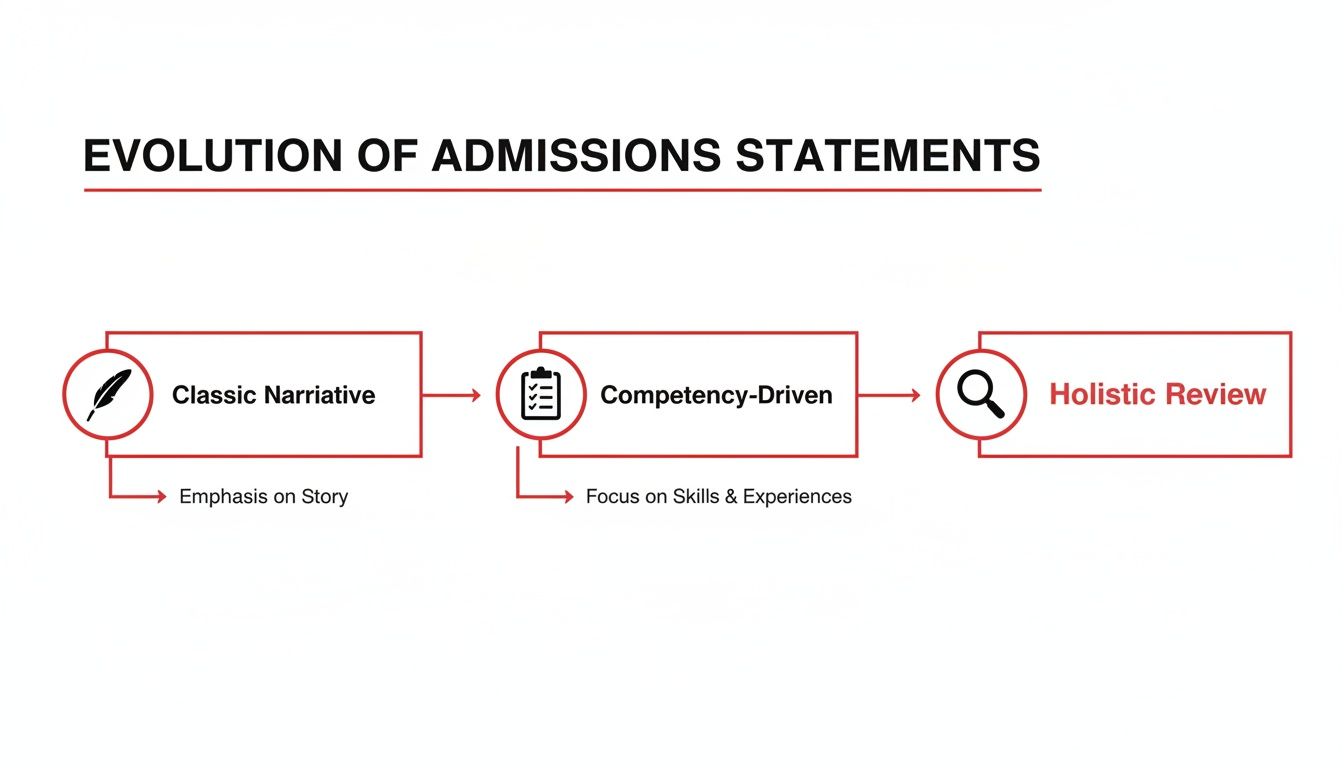
This shift is precisely why tailoring is so critical now. Holistic review isn't just about proving you're competent; it's about showing you're a perfect fit for a program's unique mission and culture.
Customizing For Different Specialties
Your personal statement has to speak the language of the specialty you're applying to. What makes a rockstar surgeon isn't necessarily what makes an incredible pediatrician. You need to angle your narrative to highlight the right traits.
The table below offers a starting point for connecting your personal stories with the values different specialties are looking for.
Aligning Themes With Medical Specialties
| Specialty | Core Values And Keywords | Example Theme To Emphasize |
|---|---|---|
| Surgery | Precision, resilience, leadership, teamwork, composure under pressure | A story about calmly managing a chaotic trauma case or mastering a technically demanding procedure. |
| Pediatrics | Empathy, advocacy, family communication, patience, building trust | An anecdote about connecting with a scared child or explaining a complex diagnosis to worried parents. |
| Internal Medicine | Diagnostic reasoning, intellectual curiosity, continuity of care, collaboration | A narrative focused on solving a complex medical puzzle by piecing together subtle clues over time. |
| Emergency Medicine | Decisiveness, adaptability, multitasking, calm under chaos | A story about rapidly triaging multiple patients or making a critical decision with limited information. |
| Psychiatry | Compassion, active listening, non-judgmental approach, building rapport | An experience where you built a therapeutic alliance with a patient struggling with mental health. |
Think about your experiences through the lens of your chosen field. The same clinical rotation could produce a story about diagnostic skill for an internal medicine application or a story about patient advocacy for a pediatrics essay. It's all about the angle.
Tailoring For Specific Programs
For the programs at the top of your list, you need to go one step further. Customizing your conclusion is your chance to show the program director you aren't just another name in the pile—you're an applicant who wants to be there, specifically.
Do your research. Dig into each program's website, find their mission statement, and look for unique opportunities that genuinely excite you. Then, connect those specifics to your own goals.
- Mention a specific research opportunity: "I was particularly drawn to Dr. Smith's research on cardiometabolic health, as it directly aligns with my own work on preventive cardiology."
- Reference a unique clinical rotation or track: "The opportunity to participate in your global health track in Peru would allow me to build upon my experience serving rural communities."
- Connect with their mission: "Your program's stated commitment to community outreach in underserved neighborhoods resonates deeply with my volunteer work at the free clinic."
This level of detail transforms your personal statement from good to unforgettable. It's that final, polished touch that screams "I'm the perfect fit," and it makes a compelling case that you belong in their program.
Common Personal Statement Pitfalls To Avoid

Crafting a memorable personal statement for ERAS is as much about avoiding common traps as it is about highlighting your strengths. Even the most qualified applicant can inadvertently raise red flags with a few simple missteps in their essay. Believe me, program directors have seen it all, and they're experts at spotting the subtle mistakes that suggest a lack of self-awareness or professionalism.
This goes way beyond catching typos. We're talking about the kinds of blunders that can undermine your entire narrative. Let’s walk through the most common pitfalls I see year after year and how you can sidestep them.
Turning Your CV Into Prose
This is probably the single most frequent mistake applicants make: they just rehash their CV in paragraph form. Program directors already have a detailed list of your publications, awards, and experiences. Your personal statement isn't meant to be a long-form version of that list.
Its real job is to connect the dots. It’s your chance to provide the story and personal reflection that your CV can't. Think of it as answering the "why" behind the "what" on your application.
- Before: "I worked in a cardiology research lab for two years where I was responsible for data collection and analysis. I also volunteered at a local free clinic and was president of the student interest group."
- After: "My two years in a cardiology lab taught me the methodical patience required for discovery, but it was my time volunteering at the free clinic—seeing the direct impact of care—that truly solidified my desire to translate research into compassionate, patient-centered practice."
See the difference? The second example doesn’t just list activities; it weaves them together to reveal a deeper motivation and shows genuine personal growth.
Sounding Arrogant Or Pompous
There is a razor-thin line between confidence and arrogance, and your personal statement needs to stay on the right side of it. Avoid making sweeping claims about your abilities or presenting yourself as a finished product who has nothing left to learn. Residency is, after all, a training program. Humility and a genuine desire to grow are critical.
A strong personal statement conveys confidence through specific, grounded examples of your actions and their outcomes. It avoids making sweeping, unsupported declarations about your abilities or character.
Show your skills through compelling stories. Don't just tell the reader you're a great leader; describe a time you led a team through a challenge. Let your experiences do the talking.
Making Excuses For Red Flags
If there's a gap in your education or a board score you're not proud of, the personal statement is almost never the place to address it. Using this valuable real estate to make excuses can sound defensive and often just shines a brighter spotlight on the very weakness you're trying to downplay.
Most application elements that need an explanation can be briefly addressed elsewhere in the ERAS application. Your personal statement should be a positive, forward-looking document that stays focused on your passion for the specialty.
Using Clichés And Overused Phrases
Program directors read hundreds, sometimes thousands, of these essays. They are all too familiar with the tired, old tropes.
- "Ever since I was a child, I knew I wanted to be a doctor."
- "I have always had a passion for science and helping people."
- "The dictionary defines a physician as…"
These openings feel generic and do absolutely nothing to make you stand out. Instead, jump right into the action. Start with a specific, engaging anecdote that drops the reader directly into a meaningful moment in your journey. A unique opening is far more likely to grab their attention and make your essay memorable from the very first sentence.
Answering Your ERAS Personal Statement Questions
As you get closer to the finish line, a dozen small but surprisingly stressful questions about the ERAS personal statement can pop up. This is that moment where tiny details start to feel massive. Let’s clear the air and give you direct, practical answers to the most common questions we hear from applicants, so you can feel confident when you finally hit submit.
Think of this as your go-to FAQ for those final, nagging doubts. We'll cover everything from hard formatting rules to the tricky nuances of handling sensitive topics.
What Is The Ideal Personal Statement Length?
ERAS gives you a massive 28,000-character limit, but you should absolutely not use all that space. The universally accepted wisdom is that your personal statement should be about one single-spaced page.
This usually comes out to between 600 and 800 words. A statement that’s a lot shorter might look underdeveloped, while anything spilling onto a second page risks losing your reader's attention. Program directors are incredibly busy people; a concise, powerful, and easy-to-read statement will always win.
How Should I Format My Personal Statement?
The ERAS application system is notoriously finicky with formatting. When you paste your text from a word processor into the ERAS text box, nearly all of your special formatting—like italics, bolding, or unique fonts—will disappear. It's frustrating, but you have to work within their system.
To avoid any unwelcome surprises, just stick to these simple rules:
- Font and Size: Draft your statement using a standard, readable font like Times New Roman or Arial in size 12. ERAS will convert this to its own format, but this gives you the best way to accurately gauge the length.
- Spacing: Use single spacing within paragraphs. To create clean visual breaks, add a single blank line between each paragraph.
- Indentation: Don't use the tab key to indent paragraphs. The blank line between them is the modern, accepted way to format this kind of document.
- Special Characters: Steer clear of special characters or symbols. They often don't transfer correctly into the ERAS system and can look like errors.
A great pro-tip is to write your final draft in a simple text editor (like Notepad on Windows or TextEdit on Mac). This strips away all hidden formatting and shows you exactly what the plain text will look like, which is very close to how it will appear in ERAS. To get a better feel for the final presentation, you can also review a sample ERAS application.
Can I Mention A Specific Program By Name?
Yes, you can, but you have to be strategic about it. The best place to name a specific program is in a tailored conclusion. If you have a few top-choice programs, it's absolutely worth creating a slightly different version of your personal statement for each one.
Naming a program shows genuine, specific interest. When you mention a unique research opportunity, a faculty member you admire, or a clinical track that perfectly aligns with your goals, it proves you’ve done your homework. It shows you're a serious candidate, not just someone casting a wide net.
But be incredibly careful. Accidentally sending a statement that names Program X to Program Y is a critical mistake that screams carelessness. If you do this, you need a meticulous organization system to keep track of which version goes where.
How Do I Address A Leave Of Absence Or Gap?
This is a delicate but very common question. Your personal statement needs to be a positive, forward-looking document. That’s why it is generally not the best place to explain a leave of absence, a failed exam, or any other potential "red flag."
Bringing these issues up in your main narrative can sound defensive and distracts from your strengths and your passion for the specialty. The ERAS application gives you other places, like the "Experience" section or sometimes a dedicated supplemental section, where you can add a brief, factual explanation for any gaps.
Keep your statement focused on your journey, your skills, and why you are an excellent fit for their program. Let your positive story be the main event.
What Should I Do If I Changed My Specialty Choice?
Changing your mind about a specialty is completely normal, and program directors get it. The key is to frame your journey as one of discovery and maturation, not indecisiveness.
Instead of dwelling on why you left your old interest, focus on what pulled you toward your new one.
- Show, Don't Just Tell: Use a specific story from a rotation or clinical experience that cemented your decision. Make it real for the reader.
- Connect Your Skills: Highlight how skills you picked up while exploring another field are transferable and actually make you a stronger candidate now. For example, the diagnostic rigor you learned while considering internal medicine is incredibly valuable in radiology.
Your story is one of evolution. Present your final choice as the logical and passionate end-point of your medical school journey. It shows self-awareness and thoughtful decision-making, which are traits every program wants.