Welcome to the most important, challenging, and rewarding years of your medical education. The leap from preclinical studies to the hospital wards is huge, but this guide is your roadmap.
Think of your medical student clerkships as more than just a series of rotations. This is where you finally start to think, act, and feel like a physician. You'll be at the bedside, learning the art and science of medicine firsthand—from the fast-paced decisions in surgery to the complex diagnostic puzzles of internal medicine.
Your performance here is a massive predictor of your future. The evaluations you earn, the skills you master, and the connections you build will directly shape your residency match and the entire path of your career. This guide will give you actionable strategies to turn this demanding period into a launchpad for success.
From Textbooks to Patient Care
The journey through clerkships is all about turning years of book knowledge into real-world clinical skills. It's a huge transition, and this timeline breaks down the major phases—from learning the basics on the wards to applying for residency and, finally, matching.
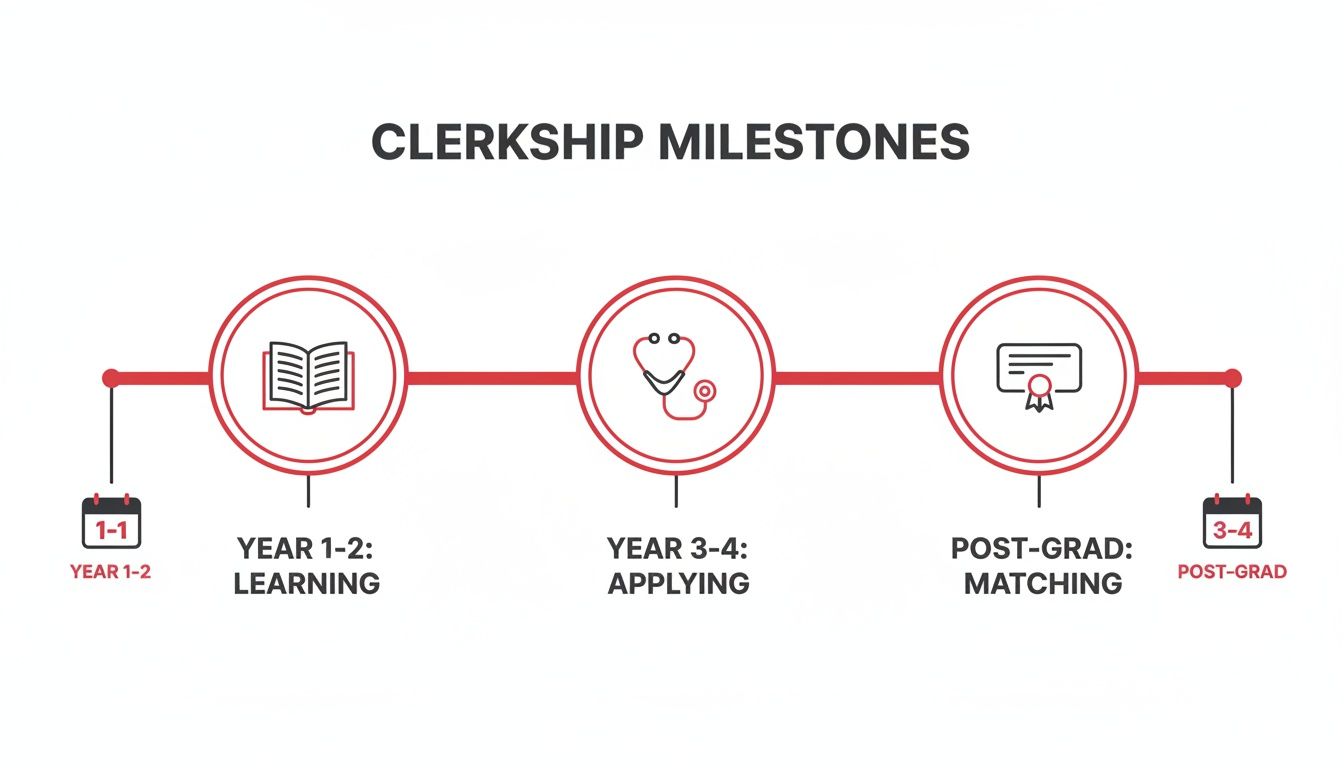
As you can see, each phase builds directly on the last. A successful Match Day really begins with the strong foundation you build during your core rotations.
The Role of Rotations in Your Career Path
Each rotation is more than just clinical experience; it’s a trial run for different career paths and a chance to discover what you’re truly passionate about. Many students use this time to test the waters in specialties they’re considering for residency. A huge part of this is doing "audition" rotations to work at an institution you hope to match into.
Clerkships are your first, best chance to make a lasting impression on potential residency programs. Every patient presentation, every note you write, and every interaction with the team contributes to the professional reputation you are building.
In fact, away rotations have become a critical part of the process. In the Class of 2025, over 50% of U.S. medical students did at least one clinical away rotation to immerse themselves in new programs and show residency directors what they can do. You can explore more trends and statistics from the AAMC's graduating class data.
To give you a clear overview, this table outlines the key milestones you'll encounter during your clerkship years. It breaks down the main goals of each stage and what you should aim to achieve.
Key Milestones of Medical Student Clerkships
| Milestone | Primary Objective | Key Outcome |
|---|---|---|
| Core Rotations | Gain foundational clinical skills and exposure to major specialties. | Solid clinical knowledge base and initial career exploration. |
| Shelf Exams | Demonstrate mastery of the core knowledge for each specialty. | Strong exam scores that contribute to final grades. |
| USMLE/COMLEX Step 2 | Pass the critical board exam required for licensure. | A competitive score for residency applications. |
| Electives & Sub-I's | Explore niche interests and gain in-depth experience in a chosen field. | Strong letters of recommendation and a confirmed specialty choice. |
| Residency Application | Secure interviews at desired residency programs. | A competitive ERAS application and interview offers. |
| The Match | Match into a residency program. | Securing a post-graduate training position. |
Each of these steps is a building block for the next, highlighting how crucial it is to start strong and stay consistent throughout your clinical years.
So, what’s next? This guide will walk you through:
- Navigating Core Rotations: A deep dive into the 'Big Six' specialties, including daily workflows and what attendings expect.
- Excelling on the Wards: Proven strategies to earn honors and get powerful letters of recommendation.
- Conquering Exams: Smart methods for acing your Shelf exams and USMLE Step 2.
- Strategic Planning: How to pick the right electives and audition rotations to set you up for residency success.
Mastering your clerkship years is completely achievable with the right game plan. Let's get started.
Navigating the Core Clinical Rotations
Alright, you’ve made it through the preclinical years. Now, the real fun begins. Transitioning to the wards means leaving the lecture hall behind and stepping into a series of intense, hands-on apprenticeships known as the core clinical rotations.
These rotations are your first real taste of what it's like to be a doctor. Each one is a totally different world with its own culture, pace, and set of expectations. Your job is to dive in, learn the language, and figure out how to be a valuable member of the team.
The "Big Six" rotations are the non-negotiable pillars of your third year, and pretty much every medical school in the country requires them. They’re designed to give you a broad, foundational understanding of medicine.
- Internal Medicine
- Surgery
- Pediatrics
- Obstetrics & Gynecology (OB/GYN)
- Psychiatry
- Family Medicine
Think of it like learning six different languages in a year. The language of surgery is all about swift action, anatomical precision, and getting things done. In internal medicine, the language is one of deep diagnostic reasoning, piecing together complex puzzles, and managing chronic conditions. Success during your medical student clerkships means becoming fluent in each one.
A Glimpse into Daily Life on the Wards
Be prepared for your daily routine to get thrown into a blender with every new rotation. The fast-paced, high-energy rhythm of a surgical service is a world away from the slower, more reflective pace you'll find in a psychiatry clinic. You have to be a chameleon.
On a Surgery rotation, your alarm might go off at 4:30 AM. That's for "pre-rounding"—sneaking into the hospital to gather overnight vitals and new lab results on your patients before the real team arrives. Most of your day will be spent in the operating room, where you'll learn to maintain a sterile field, practice your first sutures, and hold a retractor for hours on end. Decisions are made fast, and efficiency is king.
Compare that to Internal Medicine, which is more of a cerebral marathon. Mornings kick off with incredibly detailed patient presentations on rounds. Afternoons are spent writing progress notes, calling consults, and digging deep into diagnostic rabbit holes. You’re a medical detective, putting together clues from the history, physical exam, and lab data to solve the case.
Each rotation is a full-immersion experience into a distinct medical culture. Your ability to pick up on the unwritten rules—how to present a patient on that service, when to speak up, what the team values most—is just as crucial as your textbook knowledge.
Understanding Key Expectations and Patient Cases
On day one, you're not expected to be an expert. But success in each clerkship means quickly figuring out what skills you need to master. Your responsibilities will grow as you prove you're competent and earn the trust of your residents and attending.
Here’s a quick look at what you can expect to see and do:
| Rotation | Common Patient Cases | Key Skills to Master |
|---|---|---|
| Pediatrics | Well-child checks, asthma attacks, newborn jaundice. | Performing a gentle pediatric physical exam, calculating medication dosages for tiny bodies, communicating with anxious parents. |
| OB/GYN | Prenatal visits, labor and delivery, routine gynecological exams. | Assisting in deliveries, performing pelvic exams with sensitivity, and understanding the squiggly lines of a fetal heart monitor. |
| Psychiatry | Major depressive disorder, schizophrenia, substance use disorders. | Conducting sensitive patient interviews, performing a mental status exam, and mastering therapeutic communication. |
| Family Medicine | Managing hypertension and diabetes, acute sinus infections, preventive care. | Building long-term patient rapport, juggling multiple chronic conditions, and performing simple office-based procedures. |
At the end of each rotation, you’ll face a Shelf exam—a standardized national test of your knowledge in that specific field. Don’t panic. Your clinical experiences are the best prep you can get, as the patients you care for on the wards are the prototypes for the questions you'll see. Nailing down a solid study plan is critical, and our complete guide to Shelf exam preparation has everything you need to get started.
The Unwritten Rules of Each Specialty
Beyond the formal curriculum, every specialty has its own hidden culture. Learning these unspoken expectations is often what separates an average student from a truly excellent one.
Be Prepared, Always. In surgery, this means knowing the patient's anatomy and the key steps of the operation before you even walk into the OR. For internal medicine, it means showing up to rounds with a well-reasoned differential diagnosis for your patient's problem.
Understand Your Role. Your primary job is to make the team run smoother, not create more work. Sometimes that means hunting down a missing lab result, printing the patient list, or just being an enthusiastic, reliable presence who is eager to help.
Know Your Patients Best. Here's your superpower as a medical student: you have more time than anyone else. Use it to sit down and really talk to your patients. A deep understanding of their story can uncover valuable insights that a busy resident or attending might have missed.
Navigating the core rotations isn't just about survival; it's about finding your footing and starting to thrive. By embracing the unique demands of each specialty and being proactive, you'll build a killer clinical foundation, earn evaluations that will open doors, and maybe—just maybe—discover the part of medicine you can't live without.
How to Excel and Stand Out on the Wards

Crushing your medical student clerkships goes way beyond nailing your Shelf exams. The wards are where you prove you have what it takes to be a physician. It's about demonstrating professionalism, showing real initiative, and figuring out how to be a valuable part of a complex team.
This is your shot to earn honors and get the kind of powerful letters of recommendation that make residency programs sit up and take notice.
Think of yourself less like a student and more like an apprentice physician. The real goal is to move from just doing what you're told to taking genuine ownership of your patients. That mental shift is what separates the students who just pass from those who truly shine.
Take Ownership of Your Patients
The single most powerful way to stand out is to become the team’s undisputed expert on your patients. Your residents and attendings are juggling a dozen things at once, but you have the luxury of time. Use it.
Know every single detail: their entire medical history, why they're on each medication, the latest lab trends, what the family is worried about. This deep knowledge lets you think one step ahead.
Instead of waiting for instructions, you can proactively suggest the next step, check on that pending consult, or give the family a quick update. This kind of initiative screams that you’re engaged, reliable, and already thinking like a doctor.
True ownership means your patient’s progress becomes your personal responsibility. When the team has a question about that patient, you should be the first person with the answer, demonstrating a commitment that goes far beyond just getting a grade.
Master the Art of Communication
Medicine runs on clear communication. Whether you're presenting a patient on rounds or writing a daily progress note, you have to be clear and efficient. Rambling presentations waste everyone's time and make it seem like your clinical reasoning is fuzzy.
Your daily patient presentations should be a masterclass in concise storytelling. Practice getting it down to a focused, one-minute summary that hits all the key points without any fluff. Start with a sharp one-liner, cover overnight events, and finish with a solid assessment and plan.
Likewise, your notes are a window into your brain. They need to be organized and insightful. As you get the hang of writing notes, understanding tools like medical voice charting can be a huge help, making you faster and more accurate. A well-structured note shows you can pull together complex information and add real value to the patient's record.
Become an Indispensable Team Player
Medicine is a team sport. Your job is to figure out how to fit into the team, which means being helpful without getting in the way and asking smart questions without derailing the workflow. It's a delicate dance you learn by watching and listening.
Here are three habits that will make you a five-star team player:
- Be Proactively Helpful: Don't wait to be asked. Offer to do the small things that make your resident's life easier—printing the patient list, grabbing supplies, calling another department for records. It shows you're invested in the team's success, not just your own.
- Ask Smart Questions: Never ask a question you could answer with a two-second Google search. Instead, ask the "why" questions that dig into clinical reasoning. For example, "I saw we chose this antibiotic over another; could you walk me through the thought process?" This shows you're curious and want to learn. Asking these types of questions is a key part of strong clinical reasoning, and you can learn more about what is clinical reasoning in our detailed guide.
- Embrace Feedback Gracefully: You're going to get a lot of constructive criticism. See it for what it is—a gift—not a personal attack. Say thank you, actually work on the suggestion, and never, ever get defensive. This shows maturity and a desire to improve, two of the most important qualities any program director looks for.
Conquering Your Shelf Exams and USMLE Step 2

Success during your medical student clerkships feels a bit like fighting a two-front war. On one side, you have the daily grind of clinical duties on the wards. On the other, you have a relentless series of high-stakes standardized exams that will define your grades and shape your residency options. Learning to master both is the central challenge of third year.
This is where the National Board of Medical Examiners (NBME) Subject Examinations—better known as Shelf exams—come into play. Think of each Shelf as the final boss battle for a specific rotation. It’s a comprehensive, nationally standardized test designed to measure your knowledge in that specialty, and your score is a massive component of your final grade.
But these exams are far more than just a final hurdle for your clerkship. They are, in fact, the most effective training ground for the main event: the USMLE Step 2 CK. Strong performance on your Shelf exams is one of the best predictors of a high Step 2 score, making them an absolutely essential part of your long-term board preparation.
Decoding the Shelf Exams
Every core rotation ends with its own Shelf exam. While they all stick to a multiple-choice format, each one has its own distinct flavor. The Surgery Shelf, for instance, is notoriously heavy on "next-best-step" management questions, while the Internal Medicine Shelf is a diagnostic marathon that tests your clinical reasoning.
Figuring out the unique focus of each test is the key to studying efficiently. You have to adapt your approach based on the high-yield topics and question styles unique to each specialty.
- Internal Medicine: Expect broad, case-based questions that cover the entire spectrum of adult medicine, from cardiology to endocrinology.
- Surgery: The focus here is almost entirely on pre-operative, intra-operative, and post-operative management decisions.
- Pediatrics: This exam tests your grasp of developmental milestones, congenital conditions, and common childhood illnesses.
- OB/GYN: You'll be tested on everything from routine prenatal care and labor complications to complex gynecological issues.
- Psychiatry: The content heavily emphasizes diagnostic criteria (DSM-5), psychopharmacology, and therapeutic principles.
Think of your Shelf prep as marathon training. You can't just cram for it the week before. Consistent, daily effort—even just 30-60 minutes squeezed in—builds the knowledge and stamina you need to excel on exam day and beyond.
Building a Sustainable Study Plan
Trying to balance 12-hour hospital shifts with effective studying requires a smart, sustainable strategy. Your plan has to be woven directly into your daily workflow, not treated as some separate, overwhelming task you dread at the end of the day. The secret is leveraging the small pockets of downtime that pop up constantly.
Your most powerful weapon will be a high-quality question bank (Qbank), like UWorld. It’s the gold standard for a reason. Doing practice questions is the single most effective way to learn, as it forces active recall and shows you exactly how concepts are tested.
Here's a simple, effective framework that works:
- Daily Questions: Aim for a small, manageable block of questions every day (10-20 questions is perfect). Do them during your lunch break, between cases in the OR, or while you're waiting for lab results to come back.
- Rotation-Specific Focus: Make sure you're always using the Qbank section that matches your current rotation. This directly reinforces what you’re seeing on the wards and prepares you for that specific Shelf exam.
- Thorough Review: This is critical. Never just check the right answer and move on. You need to read every single explanation—for both the correct and incorrect answer choices—to truly solidify your understanding.
- Spaced Repetition: Use a flashcard app like Anki for high-yield facts, drug mechanisms, and diagnostic criteria you need to have down cold. It's perfect for quick review sessions on the go.
This consistent, integrated approach turns studying from a chore into a daily habit. Interestingly, your clinical environment can also play a big role. For example, getting exposure to diverse settings like rural or away rotations has been shown to improve exam scores. A 2023 study found that 84.3% of students in general practice clerkships at non-tertiary sites improved their C-CEP scores, which underscores the value of varied clinical experience. You can see the full findings on clerkship impact from this research for more detail.
Connecting Shelf Success to Step 2 CK
Every single question you do for a Shelf exam is a direct deposit into your Step 2 CK knowledge bank. The content overlap is huge. By the time you’ve worked your way through all your Shelf exams, you will have systematically studied every major topic that will show up on Step 2.
This foundation is absolutely invaluable. Instead of starting from scratch, your dedicated Step 2 prep period becomes a time for review, consolidation, and targeted practice on your weaker areas. This is your chance to refine your test-taking strategies and build the endurance needed for that grueling 9-hour exam. To get a head start, you can check out our guide on how to study for Step 2 CK for a detailed breakdown.
By treating each Shelf exam with the seriousness it deserves, you're doing more than just aiming for a good grade on one rotation. You're strategically building the broad clinical knowledge base that will carry you through Step 2 and prepare you for day one of residency.
Strategizing Your Fourth Year and Audition Rotations

Your final year of medical school is a whole different ballgame. The broad exposure of third year is over; now, it’s all about targeted strategy. After finishing your core medical student clerkships, the fourth year is your opportunity to lock in your specialty choice, patch up any knowledge gaps, and forge a powerful residency application through a hand-picked schedule of electives and sub-internships (Sub-Is).
Think of a Sub-I as the ultimate audition. It’s a demanding, month-long rotation where you're expected to perform at the level of a first-year resident. This isn't just shadowing—you'll carry your own patients, write orders that get co-signed, and take first call.
This is your shot to show a residency program you're ready to hit the ground running on day one. A stellar performance can absolutely lead directly to an interview offer and a high spot on that program's rank list.
Designing Your Fourth-Year Schedule
Building the perfect fourth-year schedule is a balancing act between going deep in your chosen field and rounding out your skills as a physician. You need rotations that make you a can't-miss applicant for your specialty, but also electives that will make you a more competent doctor, period.
A strong schedule typically mixes these elements:
- Sub-Internships in Your Specialty: Plan on at least one Sub-I at your home institution. Then, add one or two "away" rotations at programs sitting high on your rank list.
- Specialty-Adjacent Electives: If you're going into surgery, a rotation in the surgical ICU, anesthesia, or radiology isn't just helpful—it's a smart move that shows commitment and broadens your perspective.
- "Lifestyle" or Skill-Building Electives: Think about rotations that teach you practical skills you won't get elsewhere, like dermatology or radiology. You can also use this time for a research block or to schedule a lighter rotation before interview season kicks into high gear.
Your fourth-year schedule has two main jobs: securing the residency you want and building the confidence you need to thrive once you get there. Every single elective you choose should serve one of those two purposes.
Making an Impact on Audition Rotations
An away rotation is, without a doubt, a month-long job interview. Showing up prepared and enthusiastic is just the price of admission. To truly stand out, you have to adopt the mindset of an intern, not a student. That means taking complete ownership of your patients and becoming an indispensable part of the team.
Here's a simple game plan for success:
- Arrive Early, Stay Late: Be the first person on the floor to pre-round on your patients and the last to head home after making sure all your work is buttoned up.
- Know Your Patients Inside and Out: Become the undisputed expert on your patients. You should be able to recite every lab value, imaging result, and consultant recommendation without fumbling for your notes.
- Think One Step Ahead: Don't just present data; anticipate what comes next. Come in each morning with a clear plan for your patients and be ready to back up your clinical reasoning.
- Be a Team Player: Look for ways to help your interns and residents. A student who actively tries to lighten the team's load is always remembered in the best way possible.
The competition for residency is fierce and growing. The 2025 Main Residency Match offered a record-breaking 43,237 PGY-1 positions, a jump of 4.2% from the year before, which just underscores how crucial a strong application is. You can see more about the latest Match Day numbers from the AMA. Well-planned audition rotations are one of the most powerful tools you have to secure one of those coveted spots.
Turning Clerkship Challenges into Career Triumphs
Your clerkship year is more than just a series of rotations—it's the marathon that forges you into a physician. This is the year where the textbook knowledge finally meets the real world, testing your intellect, your character, and your resilience. It's tough, no doubt about it. But the challenges you overcome are exactly what build the foundation for your entire medical career.
Success isn't accidental. It boils down to nailing three key areas. First, you have to achieve clinical excellence on the wards by truly owning your patients' care. Second, you need to put in the consistent, daily grind to crush your Shelf exams and Step 2. And finally, you have to be smart about planning your fourth year to build a residency application that gets you where you want to go.
Your Final Checklist for Success
As you move forward, keep these core principles front and center. Think of them as the high-yield takeaways designed to turn this incredibly demanding year into a launchpad for your future.
- Own Your Role: Don't just be a student; become an indispensable part of the team. Know your patients inside and out, anticipate what the team will need next, and learn to communicate with absolute clarity.
- Study Smarter, Not Harder: Squeeze in Qbank questions and spaced repetition during those small pockets of downtime. A little bit every day goes a lot further than cramming all weekend.
- Be Strategic with Your Fourth Year: Pick audition rotations at programs high on your list. Use your other electives to either go deep in your chosen specialty or build practical skills that will serve you for your entire career.
The physician you are becoming is forged in the crucible of your clerkship year. Every long night, every challenging patient case, and every moment of feedback is a building block for your future success in residency and beyond.
Beyond the clinics and the exams, you have to take care of yourself. This year will push you to your limits, so exploring effective strategies for caring for your mental health isn't optional—it's a critical professional skill. Your ability to manage stress and stay grounded will make you a better doctor.
Embrace the difficulty, learn from every single patient, and never forget what a privilege it is to be in this role. By putting the principles from this guide into practice, you’re not just trying to survive clerkships—you’re setting yourself up to land the residency of your dreams and build a career you can be proud of.
Frequently Asked Questions About Medical Student Clerkships
It’s completely normal to have a million questions spinning through your head as you head into clerkships. How do you study for Shelf exams while working hospital hours? How do you ask for that crucial letter of recommendation without feeling awkward? What do clerkship grades really mean for the Match?
Let's cut through the noise. Here are some straightforward, no-nonsense answers to the most pressing questions medical students face during their clinical years. Think of this as your playbook for turning uncertainty into a solid game plan.
How Do I Balance Studying for Shelf Exams with Long Hours on Rotations?
This is the million-dollar question of third year. The answer isn't about finding more hours in the day—it's about being ruthlessly efficient with the time you already have. Your study plan has to weave into your clinical day, not be some monster you have to wrestle with every night when you're already exhausted.
The trick is to master the art of using small pockets of downtime. Got 15 minutes between patients? Do a few practice questions on your phone. Waiting for a case to start? Review a flashcard deck. Then, protect a small chunk of time each evening—even just 60-90 minutes—for focused Qbank review. A little bit of consistent, daily effort blows binge-studying on the weekends out of the water.
The students who crush their Shelf exams treat studying like a daily habit, not a major event. Doing a small number of questions every single day builds your knowledge and mental stamina without leading to burnout, which is the real enemy on long, demanding rotations.
What Is the Best Way to Ask for a Letter of Recommendation?
Getting a great letter of recommendation is all about being proactive and professional. First, you need to identify an attending physician or senior resident who has actually worked with you closely and seen you at your best. Don't make the mistake of waiting until your last day to pop the question.
About halfway through the rotation, find a moment to express your interest in their specialty and ask for some direct feedback on your performance so far. This does two things: it signals your commitment and gives them a reason to pay closer attention to your work.
When you're nearing the end of your time on the service, schedule a quick, in-person meeting to make the formal request. Be prepared. Bring your CV, a draft of your personal statement, and whatever letter request forms your school requires.
Here’s the golden phrase to use: "Do you feel you know me well enough to write a strong letter of recommendation for me?" This gives the writer an easy and graceful way out if they don't think they can write you a glowing letter, ensuring you only collect enthusiastic endorsements.
How Much Do Clerkship Grades Actually Matter for the Residency Match?
They matter—a lot. You could argue they matter more than anything else besides your board scores. For a residency program director, your clerkship grades and the narrative evaluations that come with them are the single best window into your clinical skills, work ethic, and professionalism.
A pattern of honors grades, especially in your intended specialty and the big core rotations like Internal Medicine and Surgery, sends a powerful signal. The comments from your attendings are often quoted directly in your Medical Student Performance Evaluation (MSPE), also known as the "Dean's Letter."
Bottom line: Strong clerkship performance is your best chance to prove you have what it takes to be an excellent resident from day one.
At Ace Med Boards, we specialize in helping students turn the challenges of clerkships into residency match success. From acing your Shelf exams to crushing USMLE Step 2, our expert tutors provide the one-on-one guidance you need to stand out. Schedule your free consultation today.