
The MCAT runs on a predictable annual schedule, with test dates offered from late January through early September each year. This gives you a nice, wide window to find a time that works for you and your study plan.
Knowing this rhythm is the first step in mapping out your path to med school.
Your Quick Reference to the Annual MCAT Schedule

The AAMC typically offers over 25 testing dates every year, so you have plenty of options. These dates aren't random; they're strategically planned around the medical school application cycle.
For example, the testing dates in late spring and early summer are always the most popular. That’s because taking the exam then allows your scores to be released just in time for primary application submissions.
At-a-Glance MCAT Testing Seasons
To make it easier to visualize, here's a breakdown of the typical testing seasons and who they're best suited for. This can help you start thinking about where you might fit in.
| Testing Period | Key Months | Best Suited For Applicants Who… |
|---|---|---|
| Early Season | January – March | …want their score back well before applications open, often allowing for a retake if needed. Great for those who studied over winter break. |
| Peak Season | April – June | …are timing their test to align perfectly with the primary application cycle. These are the most competitive dates to book. |
| Late Season | July – September | …are applying in the current cycle but need more study time, or for those planning to apply in the next cycle and want the test done early. |
Ultimately, the best date is the one that gives you enough time to prepare without feeling rushed. You can find these test dates at hundreds of Pearson VUE centers around the world, making the exam accessible no matter where you are. And if you're just starting your planning, it's a good idea to get a feel for the exam's structure by checking out our guide on how long the MCAT is.
Navigating the Official AAMC Calendar
When you're trying to figure out "when are MCATs offered?", the only place to get the definitive answer is the official Association of American Medical Colleges (AAMC) website. Every fall, the AAMC drops the entire testing calendar for the next year, giving you a full breakdown of test dates, registration deadlines, and when you can expect your scores.
Getting registered isn't just about picking a date, though. You have to get familiar with the AAMC's tiered registration system, which directly impacts how much you pay and how much flexibility you have to make changes.
Understanding Registration Zones
The AAMC uses three registration "zones" that are tied to specific deadlines leading up to your test date. Where you fall on this timeline dictates the cost and what you’re allowed to change.
- Gold Zone: This is your best bet. It's the earliest deadline, usually about a month before your test, and comes with the lowest fees for rescheduling or canceling if your plans change.
- Silver Zone: This deadline typically lands about two weeks before the test. The fees for any changes are noticeably higher than in the Gold Zone.
- Bronze Zone: This is the last call, closing about one week before the test. Once you're in this zone, you're locked in—you cannot make any changes or cancel your registration.
Here’s a snapshot of what the official AAMC calendar interface looks like. You can see how it lays out the specific dates for each of these zones.
As you can see, missing a deadline like the one for the Silver Zone means you lose the option to cancel your exam entirely. A little bit of planning goes a long way in avoiding extra costs. For a deeper dive into specific dates and how they fit into your timeline, check out our detailed MCAT test dates guide.
And don't forget about the AAMC’s testing limits. You can take the MCAT three times in a single year, four times over two consecutive years, and a total of seven times in your lifetime.
Decoding Key Registration and Score Release Timelines
Knowing when the MCAT is offered is one thing, but truly understanding the timelines for registration and score releases is what separates a smooth application cycle from a stressful one. This whole process, from the day you sign up to the day you see your score, demands careful planning to make sure it lines up perfectly with your medical school application goals.
Let's be clear: the most popular test dates, especially those in late spring, fill up incredibly fast—sometimes months in advance. To snag your preferred spot, you absolutely have to be ready to register the day it opens. This is typically in October for the next year's January-June dates and again in February for the July-September dates. Getting this done early prevents that last-minute scramble for a test day that doesn't really work for you.
Score Release and Application Timing
Once you've finished the exam, the waiting game begins. You can expect your scores to be released approximately 30-35 days after your test date. This month-long delay is a massive factor in your planning.
The single most common scheduling mistake I see is underestimating this score release window. Forgetting to budget for that 30-day delay can push back your entire application review, which can be a real disadvantage in rolling admissions.
This timeline gives you a great visual of how the registration zones affect your scheduling options and what you'll pay.
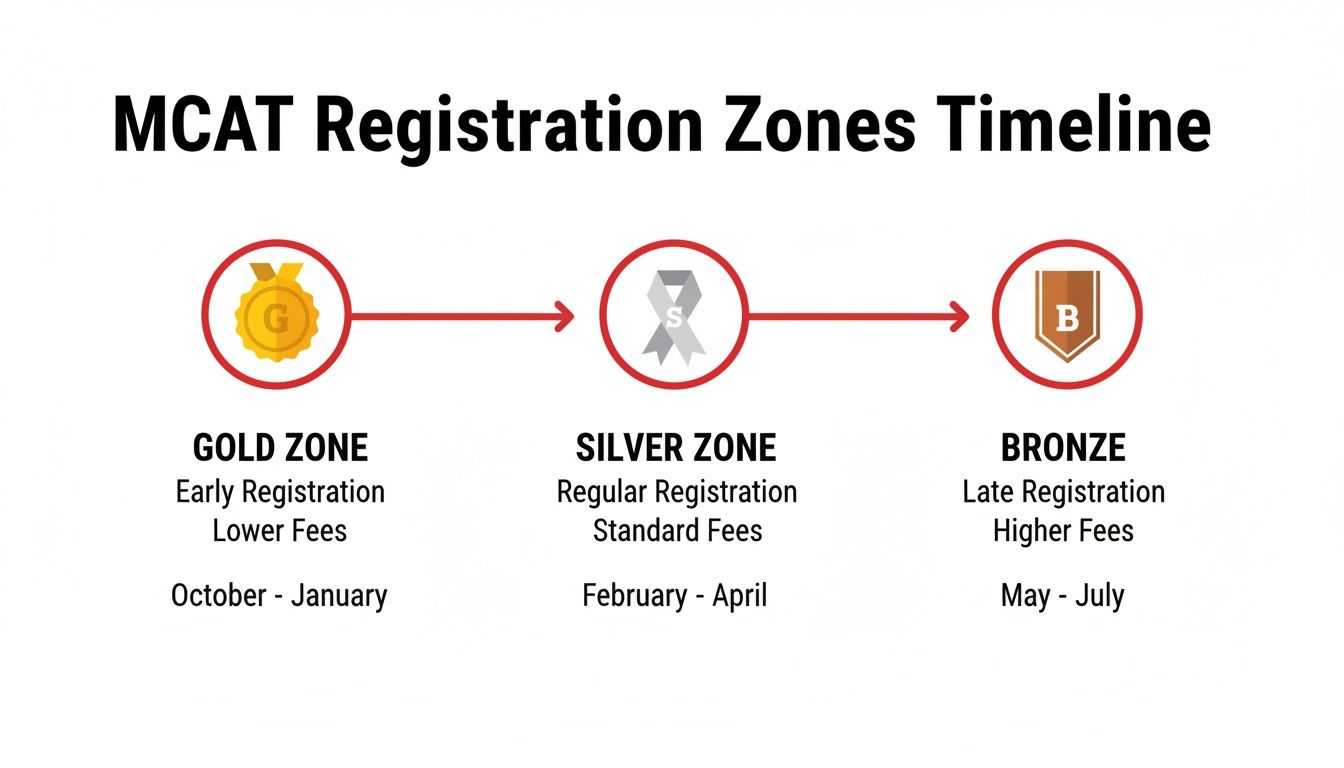
As you can see, registering early in the Gold Zone gives you the most flexibility and the lowest fees. Waiting until the Bronze Zone locks you into your test date with no wiggle room.
The best strategy is to work backward from your primary application submission deadline, which is usually in late May or early June. For example, if you want your scores ready by June 1st, you need to test no later than late April. Getting a handle on the complete MCAT test time breakdown can also help you feel more prepared for the big day itself.
How to Choose Your Optimal Test Date

Picking your MCAT test date is one of the first big strategic decisions you'll make on your path to medical school. It’s about much more than just finding an open slot on the calendar. The best date for you will depend entirely on your study habits, academic schedule, and overall application timeline.
For a traditional student heading straight to med school after college, taking the MCAT in the spring of your junior year is often the sweet spot. This timing lets you get your score back and submit your application bright and early in the cycle, which is a huge advantage.
If you're planning a gap year, you have a lot more breathing room. You could test during the summer or fall right after you graduate, giving you a chance to study full-time without juggling classes. For those retaking the exam, the goal is to schedule it early enough—think winter or early spring—to get your new score well before application deadlines.
Key Factors for Your Decision
The real challenge is balancing your MCAT prep with everything else on your plate. Acing this exam requires dedicated focus, so before you lock in a date, be brutally honest with yourself about these factors:
- Academic Load: Don't even think about testing during a semester when you're loaded up with tough science courses or a major capstone project. You'll stretch yourself too thin.
- Extracurriculars: Look at your calendar. Do you have a major research presentation, a volunteer trip, or a leadership conference coming up? Make sure your study schedule accounts for these commitments.
- Study Time: How much time do you realistically need? Be sure to map out a detailed preparation timeline. We break down exactly how to do this in our article on when you should start studying for the MCAT.
The January MCAT dates are an incredibly popular option for undergrads planning to apply 18 months down the line. It's a smart move in a field where only 36% of applicants end up matriculating each year. You can see the full schedule on the official AAMC testing calendar.
As you lay out your study plan, it helps to have a solid system in place. Brushing up on effective calendar management and scheduling tips can give you a great framework for staying organized and on track.
Finding MCAT Dates For International Students

If you're applying from outside North America, figuring out when and where to take the MCAT requires some extra legwork. While the exam is offered in many countries, international test dates are far less common than those in the United States and Canada.
This scarcity means you absolutely have to plan ahead. You'll need to pinpoint your closest testing center and lock in your spot as early as possible. In some countries, the MCAT might only be offered a handful of times per year, so being decisive is key.
Key Considerations For International Testers
Registering for an international MCAT isn't just about picking a date; it's a logistical puzzle. You have to think about potential travel, visa requirements, and other hurdles that domestic students don't face.
Here are a few things to keep firmly in mind:
- Limited Locations: Testing centers are usually only in major cities. You might find yourself needing to travel to another city—or even a different country—to sit for the exam.
- Time Zone Differences: This is a big one. Pay close attention to time zones when registration opens. In-demand international seats can vanish just as quickly as they do in the U.S.
- Fewer Dates: The international testing calendar is much shorter, typically running only from April through September in most locations.
Pro Tip: A common and costly mistake is miscalculating the registration time. The AAMC website lists everything in Eastern Time (ET), so be sure to convert that to your local time so you don't miss the window.
To give you a better sense of the landscape, here is a sample of international locations and how their testing frequency generally compares to the U.S.
Sample International MCAT Testing Locations
| Country/Region | Typical Testing Months | Frequency Compared to U.S. |
|---|---|---|
| Australia | April – September | Significantly fewer dates, concentrated in major cities. |
| United Kingdom | April – September | Limited offerings, primarily in London. |
| Hong Kong | May – August | Very few dates offered per year. |
| Singapore | April – September | More options than some regions, but still limited. |
| South Africa | April – September | A small number of dates available in key cities. |
| Qatar | May – August | Infrequent; requires meticulous planning. |
As you can see, the options are much more constrained. This makes early research and having a backup plan essential. If navigating these complexities feels overwhelming, getting structured support can make a huge difference. Exploring options from the 12 best MCAT prep courses for 2025 can give you a major advantage in your preparation journey.
Frequently Asked Questions About MCAT Scheduling
Figuring out the MCAT schedule often brings up a lot of nagging questions. Let’s tackle some of the most common ones that trip up pre-meds, so you can feel confident about your registration and test day plan.
What Happens If My Preferred Test Date Is Full?
Don’t panic if your first-choice test date is already booked solid. Your first move should be to check other testing centers, even if they're a bit of a drive. An hour or two on the road is often a small price to pay for locking in the perfect date that fits your study schedule.
Another great strategy is to sign up for email notifications directly from the AAMC. Spots open up from cancellations more often than you'd think, especially as the test date gets closer. Getting that instant alert can help you snag a seat that just became available.
Can I Reschedule My MCAT Exam?
Yes, you absolutely can reschedule, but how much it costs and how easily you can do it depends entirely on when you make the change. The AAMC uses a deadline-based "zone" system that you need to understand.
- Gold Zone: This is your best bet for changes. If you reschedule 30+ days out, the fee is lowest and the process is simple.
- Silver Zone: Making a change between 15-29 days before your test date puts you in the Silver Zone, where you'll face a higher rescheduling fee.
- Bronze Zone: This is the point of no return. Roughly 10 days before the exam, the Bronze Zone deadline hits, and you can no longer make any changes to your registration.
A classic mistake is putting off a decision until it's too late and missing the Silver Zone deadline. If you're locked in at that point, you risk forfeiting your entire registration fee. Always keep these deadlines on your radar.
When Is the Best Time to Register for the MCAT?
The single best time to register is on the day registration opens. Seats for the most popular dates and locations can disappear within hours, so being ready to book your spot the second the system goes live is your only real guarantee.
The AAMC typically opens registration in two big waves:
- October: Registration opens for the January through June dates of the upcoming year.
- February: Registration opens for the July through September dates.
If you’re aiming for a high-demand slot, like those in April and May, you have to be prepared. Procrastination here almost always leads to stress and settling for a less-than-ideal test date.
Planning your MCAT is a huge undertaking, and the right guidance can make all the difference. At Ace Med Boards, we provide personalized tutoring and admissions consulting to help you build a winning strategy from day one. Book a free consultation today to see how our experts can help you hit your target score and secure a spot in medical school.

