
Let's get straight to the point: the MCAT is scored on a scale from 472 to 528. Your total score is a combination of your performance in four individual sections, each of which is scored from 118 to 132.
Think of 500 as the exact midpoint—it represents the average score among all test-takers.
How Your Total MCAT Score Comes Together
Your final MCAT score isn't just one single grade; it's the sum of four distinct parts. Each section—from Chemical and Physical Foundations to CARS—contributes equally to that final number. This structure is intentional, ensuring that your overall performance reflects a balanced and well-rounded skill set, not just excellence in one area.
This scoring system gives medical schools a detailed picture of your academic readiness. It’s not just about hitting a high number; it’s about demonstrating consistent strength across all the core scientific and reasoning disciplines that form the foundation of medical education. For instance, a strong score in the Biological and Biochemical Foundations section signals you have a solid grasp of the life sciences, which is absolutely essential for your first year of med school.
The total score is calculated by simply adding the scaled scores from the four sections together. There is no penalty for incorrect answers, so it's always in your best interest to answer every single question.
To help you visualize how it all fits together, here’s a quick breakdown of the numbers.
MCAT Score Breakdown At A Glance
This table provides a simple summary of the score range for each of the four MCAT sections and the total composite score.
| MCAT Section | Score Range |
|---|---|
| Chemical and Physical Foundations | 118–132 |
| Critical Analysis and Reasoning Skills (CARS) | 118–132 |
| Biological and Biochemical Foundations | 118–132 |
| Psychological, Social, and Biological Foundations | 118–132 |
| Total MCAT Score | 472–528 |
These numbers are just the beginning, of course. To learn more about how admissions committees interpret the complete MCAT score range, check out our detailed guide.
How Your Correct Answers Become A Scaled Score
Have you ever wondered how the number of questions you get right turns into that official three-digit score you see on your report? It’s not a simple curve like in a college class. Instead, the AAMC uses a sophisticated process called scaling to make sure every test is graded fairly, no matter which day you take it.
Think of it like a professional photographer adjusting for different lighting conditions. A photo taken on a bright, sunny day might need different camera settings than one taken on a cloudy afternoon, but the goal is the same: to produce a perfectly exposed, high-quality image. The AAMC does something similar with a process called equating.
Equating adjusts the scoring scale to account for the specific difficulty of your version of the MCAT. This is why you never see your "raw score"—the simple count of correct answers. It's not the metric that matters.
The whole point of scaling is to ensure a 510 earned in May represents the exact same level of mastery as a 510 earned in August. It levels the playing field.
From Raw To Scaled
The AAMC takes your raw score for each of the four sections and converts it into a scaled score that falls somewhere between 118 and 132. This statistical conversion is what balances out any minor differences in difficulty between test versions. So, if your exam happened to be a little tougher, you might need slightly fewer correct answers to hit a certain scaled score compared to someone who took a slightly easier version.
This visual gives a clear breakdown of how each section's score builds up to your total.
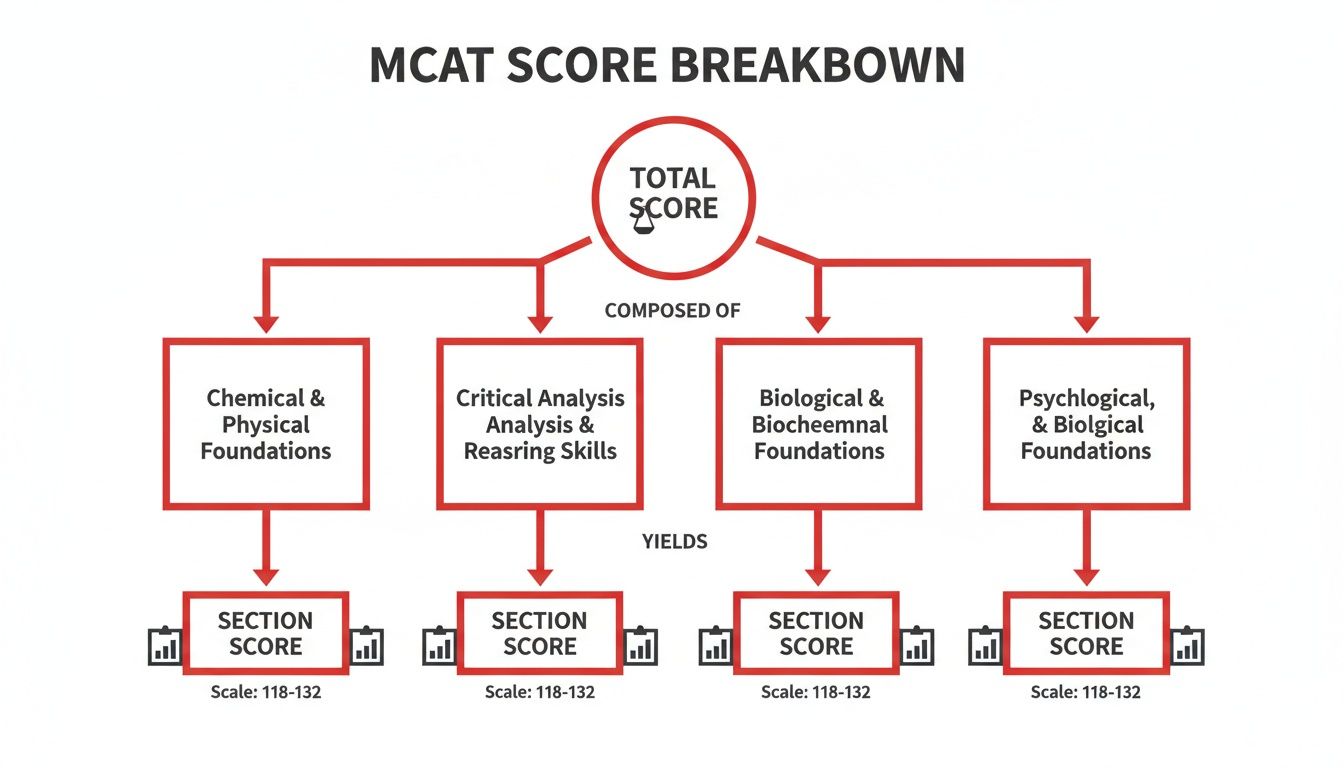
As you can see, your final MCAT score is simply the sum of the four scaled section scores, which is how you end up with that final number out of a possible 528.
Why The Scaled Score Matters Most
At the end of the day, medical school admissions committees only see your scaled scores and their corresponding percentile ranks. These are the numbers they use to compare you fairly against thousands of other applicants.
The scaling process ensures that adcoms are evaluating your knowledge and critical thinking skills on a consistent, standardized yardstick. Of course, getting to a high raw score in the first place is crucial, which is why understanding the MCAT test time breakdown is so important—effective time management is your first step toward earning a score that scales well.
What Your MCAT Score Percentile Really Means
Getting a scaled score of 515 feels great, but what does that number actually mean when you're up against thousands of other aspiring doctors? This is where percentile ranks come in—they provide the essential context for your score.
A percentile rank shows you exactly how you stacked up against every other person who took the test on a given day.
Think of it like running a race. Knowing you finished in 45 minutes is useful information. But knowing you finished faster than 90% of the other runners? That tells a much more compelling story to anyone watching. In the same way, if your MCAT score is in the 90th percentile, it means you performed better than 90% of all other test-takers.
For admissions committees, percentiles are a quick and effective sorting tool. They instantly reveal where you fall in a sea of highly qualified applicants.

Translating Scores Into Competitiveness
A high percentile sends a clear message: you haven't just learned the material, you've mastered it better than the vast majority of your peers. This statistical proof is incredibly valuable to adcoms sifting through stacks of applications, helping them quickly pinpoint candidates who have what it takes to excel.
Your percentile rank is what turns your score from an abstract number into a powerful statement about your competitiveness. It answers the crucial question, "So, how good is this score, really?"
To give you a clearer picture, the table below shows how specific MCAT scores translate into percentile ranks based on recent AAMC data. You'll notice how even a small jump in points can dramatically shift your standing in the applicant pool. For a deeper look into this, check out our guide on what is a good MCAT score.
Sample MCAT Scaled Scores And Percentile Ranks
This table shows examples of total MCAT scores and their associated percentile ranks to illustrate how performance is measured against other test-takers.
| Total MCAT Score | Corresponding Percentile Rank |
|---|---|
| 524–528 | 100th |
| 517 | 94th |
| 511 | 81st |
| 505 | 67th |
| 500 | 50th |
| 490 | 21st |
| 472 | <1st |
As you can see, a score of 511 puts you ahead of 81% of test-takers, while a score of 500 places you right in the middle of the pack. This context is exactly what admissions committees use to gauge your academic readiness for medical school.
How Admissions Committees Actually Use Your Score
Your MCAT score isn't just a number on a page—it’s one of the first data points an admissions committee (adcom) uses to gauge your readiness for the rigors of medical school. With thousands of applications to sift through, that total score often serves as an initial filter.
But the real evaluation goes much deeper than that. Adcoms don't just look at your 515; they break it down. Each section score tells a different part of your story. A stellar CARS score, for instance, signals the kind of sharp critical thinking and reasoning skills every great physician needs. Likewise, consistently high scores across the science sections show you’ve built the solid foundation required to handle a demanding curriculum.
Think of it this way: a high total score gets your application through the door. The individual section scores tell the committee who you are once you’re inside. They’re looking for both overall academic strength and specific competencies.
A Holistic But Data-Driven Approach
It’s incredibly important to remember that your score is almost always viewed within the context of a holistic review. This means it sits alongside your GPA, research experience, personal essays, and letters of recommendation. The MCAT’s power lies in its standardization—it's the one metric that allows adcoms to compare every single applicant on a level playing field.
That said, how a school weighs your score often depends on its mission and focus.
- Research-Intensive Schools: These programs might zoom in on your Chem/Phys and Bio/Biochem scores. They see strong performance here as a good indicator that you can handle a curriculum heavy on basic sciences and research.
- Primary Care-Focused Schools: These institutions may pay closer attention to your Psych/Soc score, as it reflects an understanding of the social and behavioral factors that are so critical in patient care.
At the end of the day, your MCAT score is a major piece of your application puzzle, but it’s still just one piece. To see how it fits into the bigger picture, check out our detailed guide on what medical schools look for.
Navigating The Post-Test Waiting Game
You've finished the MCAT. Take a deep breath. Now comes the part that can feel just as tough as the test itself—the waiting. It’s natural to feel anxious, but knowing the timeline can make the next month a lot more bearable.
Typically, you’ll get your scores about 30-35 days after your test date. You don't need to spend that time glued to your computer, hitting refresh. The AAMC makes it easy by sending an email notification right when your results are available. From there, you just log into their portal to see your official score report. If you want to pinpoint the exact date for your specific test, you can check a detailed schedule of MCAT score release dates for the whole year.

Understanding Your Score Report
When you finally open that report, you'll see it's much more than just a single number. Think of it as a detailed diagnostic tool designed to give you a comprehensive look at your performance.
The score report includes not only your scaled section scores and total score but also percentile ranks and 'confidence bands.' These bands provide a range where your true score likely lies, acknowledging the statistical nature of standardized testing.
This level of detail is incredibly valuable. It helps you pinpoint your strengths and weaknesses with real data, which is crucial as you prepare for the next step: sending your scores to medical schools. By understanding every piece of the report, you can move forward with a clear, strategic plan.
A Look Back At The History Of MCAT Scoring
To really get a feel for today's MCAT scoring, it helps to understand where it came from. The exam wasn't born yesterday; it's been evolving for decades, constantly being tweaked to better predict who has the right stuff for the grueling world of medical school. And no, it wasn't always scored out of 528.
The whole thing kicked off back in 1928 with a test that might ring a bell for anyone who remembers the old SAT. Initially called the Scholastic Aptitude Test for Medical Students, it used a familiar total score range of 200 to 800 points. You can dig into some fascinating historical overviews of the test to see how these early versions shaped what we have today.
The Shift To A New Scale
The first massive change happened between 1977 and 1991. This is the version many practicing doctors today probably remember sweating over. The scoring scale was completely different and, honestly, a bit strange by today's standards.
During this era, the total score was crunched down into a tiny 3-45 point range. This number was simply the sum of three sections—verbal reasoning, biological sciences, and physical sciences—each scored from 1 to 15.
Why does this history lesson matter? Because it reveals a clear pattern. The AAMC has always been pushing the MCAT away from pure memorization and more towards the critical thinking and analytical skills that actually make a good doctor. Understanding this journey makes it much clearer why the modern test is designed the way it is.
Your Top MCAT Score Questions, Answered
Once you've tackled the MCAT, you're bound to have questions about what comes next. Let's cut through the noise and get straight to what pre-meds really want to know about their scores.
What Is a Good MCAT Score?
Honestly, a "good" score is all about where you want to go. The real answer depends entirely on the medical schools on your list.
That said, a score of 511+ generally puts you in a very competitive position for most MD programs. Hitting that number means you’ve landed in the top 20% of everyone who took the test. If you're aiming for the most selective, top-tier medical schools, admissions committees are often looking for scores north of 515.
For Doctor of Osteopathic Medicine (DO) programs, the competitive landscape looks a bit different. A score around 505 is often considered a strong number that will make your application stand out. The best strategy is always to research the average scores of students who actually got into the specific schools you're applying to and set your personal goal from there.
Should I Retake The MCAT?
This is a huge decision, and you shouldn’t take it lightly. Yes, you can retake the exam, but the AAMC has some firm limits: you get three shots in a single year and only seven attempts over your entire lifetime.
Medical schools see all of your scores, not just the best one. You should only plan a retake if you are absolutely confident you can make a significant jump. While most schools will consider your highest or most recent score, their policies can vary, so it's a bit of a gamble if you don't improve.
How Long Are MCAT Scores Valid?
For the most part, medical schools will accept MCAT scores that are two to three years old.
For example, if you're applying during the 2025 application cycle, a score from an exam you took back in 2022 would likely still be valid. But—and this is a big but—it’s absolutely critical to check the specific policy for every single school you apply to. Don't let an expired score catch you by surprise.
Navigating the path to medical school requires a solid strategy for every exam. At Ace Med Boards, we provide personalized tutoring to help you master the MCAT and achieve your target score. Learn how our expert tutors can help you succeed.

