If you've ever heard the term Osteopathic Manipulative Treatment (OMT), you might wonder what it actually is. In short, it’s a collection of hands-on techniques that Doctors of Osteopathic Medicine (DOs) use to diagnose, treat, and even prevent illness. Using methods like targeted stretching, gentle pressure, and subtle resistance, a DO can help restore your body’s motion and improve its overall function.
Defining Osteopathic Manipulative Treatment

The best way to think about OMT is to picture your body as an incredibly complex, interconnected machine. When one part—a joint, a muscle, or even a nerve—gets stuck or knocked out of alignment, it creates a ripple effect that can cause pain and problems in seemingly unrelated areas.
OMT is the art and science of finding and fixing these structural roadblocks to get the entire system running smoothly again. This approach is grounded in a philosophy that treats the person, not just the symptom. It’s all built on the fundamental belief that the body has a powerful, innate ability to heal itself. The goal of a DO using OMT is simply to remove the barriers standing in the way of that natural healing process.
The Foundation of OMT
So, what are the core ideas guiding OMT? Understanding these principles makes it clear why a DO might treat your lower back to fix your hip pain or work on your ribs to help you breathe better. It all comes down to a few key concepts.
To make this easier to digest, here's a quick overview of the pillars of osteopathic philosophy.
OMT At a Glance
This table breaks down the core principles of OMT, showing how these foundational ideas translate into real-world patient care and specific treatments. It's a great way to quickly connect the philosophy to the practice.
| Core Principle | What It Means for Patients | Example Application |
|---|---|---|
| Structure Governs Function | How your body is built directly impacts how it works. A structural problem will always lead to a functional problem. | A misaligned pelvis (structure) can cause an abnormal gait and hip pain (function). OMT realigns the pelvis to restore normal walking. |
| The Body is a Single Unit | Your physical, mental, and spiritual health are all woven together. Stress can cause physical pain, and vice versa. | A DO might address neck tension (physical) in a patient with stress-induced headaches (mental/emotional link). |
| The Body is Capable of Self-Healing | Your body is designed to fight off disease and repair itself. The goal is to support this natural ability. | Lymphatic drainage techniques are used to reduce swelling and clear toxins, enhancing the body’s own recovery mechanisms. |
By keeping these principles in mind, the hands-on approach of OMT makes perfect sense. It’s not just about chasing pain; it’s about restoring the body's fundamental balance so it can do what it does best—heal.
This hands-on approach is not just about alleviating immediate pain; it's about re-establishing the body's natural balance. By improving mobility and circulation, OMT helps ensure all parts of the body receive the necessary resources to function correctly and heal effectively.
What This Means in Practice
Instead of just zeroing in on where it hurts, a DO will perform a thorough structural exam to hunt down the root cause of the problem. That nagging headache, for instance, might not be a "head" problem at all. It could easily stem from years of built-up tension and restriction in the muscles and joints of your neck and upper back.
By finding and correcting these hidden structural imbalances, osteopathic manipulative treatment offers a path toward real, lasting relief. This patient-first approach makes OMT an incredibly versatile tool, whether it’s used on its own or alongside other medical treatments to help you get back to feeling your best.
The Four Principles That Guide OMT
To really get what osteopathic manipulative treatment is all about, you have to look past the individual techniques and dive into the philosophy that drives them. This entire approach to medicine is built on four core principles laid out by its founder, Dr. Andrew Taylor Still, more than a century ago. These aren't just dusty old ideas; they're the rules of the road that a Doctor of Osteopathic Medicine (DO) uses every single day to figure out what's wrong and how to help.
Think of these principles as the operating system running in the background. They inform every decision, from the first physical exam to the specific hands-on treatments chosen for a patient. Let's break down what each one actually means in practice.
The Body Is a Complete and Dynamic Unit
First up: the body is a single, integrated unit of mind, body, and spirit. This means nothing in your body works in a vacuum. Your physical health, your mental state, and your emotional well-being are all tangled up together.
For example, that nagging headache you've had for weeks? It might be fueled by the prolonged emotional stress causing physical tension in your neck and shoulders. On the flip side, a painful physical injury can easily take a toll on your mental health. A DO sees this powerful connection and treats the whole person, not just the symptom. It's why a treatment plan for back pain might also include talking about stress management or other lifestyle factors.
"A patient reported that OMT helped him feel not only more connected to his body, but also to his emotions, his spirituality, and his solidarity."
This big-picture view is what sets the osteopathic approach apart. It recognizes that real healing has to address every part of a patient's experience.
The Body Possesses Self-Regulating Mechanisms
The second principle is that the body has an inherent ability to heal and regulate itself. Your body is a finely tuned machine, constantly working to keep you healthy. It fights off germs, mends broken tissues, and maintains balance (homeostasis) without you ever having to think about it.
Understanding basic physiological processes, like the definition of tissue perfusion, really highlights the body's incredible capacity to take care of itself—a central pillar of osteopathic medicine. When your body's structure is working correctly, these natural healing mechanisms can do their job at full capacity.
The goal of OMT isn't to "force" the body into healing. It's about removing the physical roadblocks—like restricted joints or overly tight muscles—that are getting in the way. It’s all about working with the body's own powerful systems to get you back on track.
Structure and Function Are Reciprocally Interrelated
The third principle is probably the most famous one in osteopathy: structure and function are directly and reciprocally related. This is the bedrock of OMT. Put simply, the way your body is built (structure) directly affects how it works (function). And vice-versa.
Think about a car with misaligned wheels. The structure (the wheel alignment) is off, which messes with the function (the car pulls to one side and wears its tires out unevenly). The same thing happens in the human body:
- A misaligned rib (structure) can make it harder to take a full, deep breath (function).
- Tightness in your hip muscles (structure) can change the way you walk, leading to knee pain (function).
OMT is all about finding and fixing these structural problems, which we call somatic dysfunctions, to restore normal function and get rid of the symptoms they cause.
Rational Treatment Is Based on These Principles
Finally, the fourth principle ties everything together: rational treatment is based on an understanding and application of the first three principles. This just means that a DO uses their knowledge of the body as a self-healing, interconnected unit—where structure and function are two sides of the same coin—to build a logical treatment plan. This framework makes OMT a thoughtful, patient-centered, and scientific approach to medicine.
A Practical Guide to Common OMT Techniques
Now that we’ve covered the core philosophy behind osteopathic medicine, let’s get into the hands-on part—the "how." Think of a Doctor of Osteopathic Medicine (DO) as having a versatile toolkit. Inside are dozens of techniques, each designed for a specific purpose.
Some are incredibly gentle, others more direct. The one a DO chooses depends entirely on you, the specific problem, and what they’re trying to achieve. Let's walk through some of the most common OMT techniques you'll encounter in the clinic and on your board exams.
This visual is a great reminder of the principles that underpin every single one of these techniques.
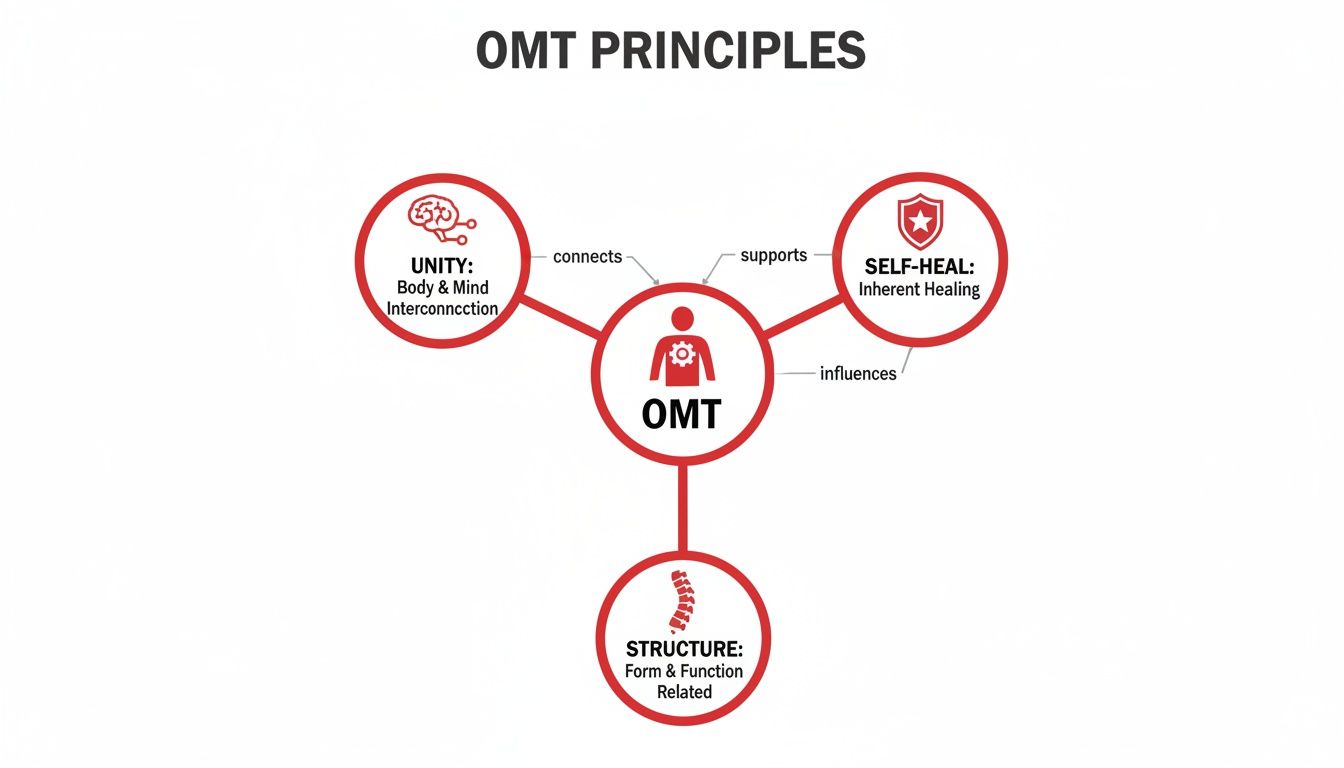
Whether the technique is active or passive, it always comes back to the unity of the body, its ability to self-heal, and the undeniable link between how we're built and how we move.
Muscle Energy Technique
Muscle Energy Technique (MET) is an active method, which means you, the patient, are a key player. It’s a perfect example of putting the structure-function relationship into practice.
Here’s how it works: Your DO will guide a part of your body—say, your neck or leg—to a specific barrier. Then, they'll ask you to gently contract a muscle against their steady counterforce. This isn't a power struggle; it’s a controlled, isometric contraction that lasts just a few seconds, followed by complete relaxation.
This simple cycle of contracting and relaxing is designed to:
- Lengthen tight, shortened muscles that cause pain and restrict movement.
- Mobilize a stiff joint by activating the muscles surrounding it.
- Help rebalance a joint by strengthening weaker muscles.
Think of it like trying to free a stuck door. Instead of just yanking it open, MET is like gently pushing and pulling against the resistance, using the door's own structure to gradually work the hinge free.
Myofascial Release
Myofascial Release is all about addressing the fascia—the thin, tough, web-like connective tissue that wraps around every single muscle, bone, nerve, and organ in your body. When injury, inflammation, or chronic stress cause this web to tighten up, it can squeeze sensitive structures, leading to pain and stiffness.
During this technique, the physician applies gentle, sustained pressure to the restricted area and waits for the tissue to soften and "unwind." It’s not a deep massage; it feels more like a slow, deep stretch. The goal is to release these fascial adhesions, restoring fluid movement and improving circulation. It's a go-to for chronic pain conditions driven by widespread muscle tension.
Counterstrain
If you’re looking for one of the most gentle OMT techniques, this is it. Counterstrain is a passive technique that works by finding a position of maximum comfort to resolve a small, tender point in a muscle.
The process is surprisingly simple from the patient's end:
- The DO finds a specific "tenderpoint" by gently pressing on the muscle.
- They then move your body into a position that completely slackens that muscle, taking all the strain off of it.
- This position of ultimate ease is held for about 90 seconds.
- Finally, you are slowly brought back to a neutral position.
By holding the muscle in this comfortable, slackened state, the technique is thought to reset the confused nerve endings that were telling it to stay tight. You're essentially rebooting a faulty sensor. It's fantastic for acute muscle spasms or for patients who are too tender for more direct methods.
High-Velocity Low-Amplitude (HVLA)
This is the technique most people picture when they think of manual therapy. High-Velocity Low-Amplitude (HVLA) involves a quick, precise thrust to a restricted joint to restore its normal motion. Yes, this is often where you'll hear a "pop" or "crack"—that's just the release of gas from the joint fluid, no different from cracking your knuckles.
Don't let the name fool you. When done correctly, it’s not a forceful or aggressive maneuver. High-velocity refers to the speed of the thrust, while low-amplitude means the movement is very short and controlled. The physician first moves the joint to its motion barrier before applying the quick, gentle impulse.
Practitioners often use essential tools like goniometers for measuring joint angles to objectively measure joint motion before and after an HVLA treatment. This technique is highly effective for "stuck" joints that cause sharp, localized pain.
Lymphatic Techniques
Your lymphatic system is your body’s internal sanitation department. It clears out cellular waste, toxins, and excess fluid. When it gets congested from illness, surgery, or injury, you can end up with swelling, inflammation, and a sluggish recovery.
Lymphatic techniques use gentle, rhythmic motions to encourage the flow of lymphatic fluid. A classic example is the "thoracic pump," where a physician applies rhythmic pressure to the rib cage to enhance fluid drainage from the chest.
These techniques are incredibly useful for:
- Reducing swelling (edema) after an injury or surgery.
- Boosting the immune response during an infection like pneumonia.
- Improving overall fluid balance and circulation.
For medical students hitting the books, knowing the mechanics, indications, and contraindications of these techniques is pure gold for board exams. If you’re building your study plan, this guide to OMM preparation for the COMLEX offers a great framework for mastering these high-yield concepts.
The Real-World Impact and Benefits of OMT
Understanding the theory behind Osteopathic Manipulative Treatment (OMT) is one thing, but seeing it change lives is something else entirely. The real value of OMT becomes crystal clear when you see its tangible effects on the common, debilitating conditions that millions of people struggle with every day.
At its core, OMT aims to restore the body’s natural ability to function and heal. Its benefits are most powerfully demonstrated in the world of musculoskeletal pain—especially low back pain, neck pain, and certain types of headaches.
The clinical evidence here is strong and growing. Research consistently shows these hands-on techniques can significantly lower pain levels, reduce reliance on medication, and improve a patient's ability to get back to their life. For many, that means a return to daily activities without the constant shadow of discomfort.
Alleviating Chronic Low Back Pain
Chronic low back pain is one of the top reasons people walk into a doctor's office, and it's an area where OMT truly shines. Instead of just focusing on the spot that hurts, an osteopathic physician (DO) uses OMT to look at the entire kinetic chain—from your feet all the way up your spine—to find and correct the underlying imbalances causing the problem.
Techniques like muscle energy and myofascial release are used to unwind tight muscles, while methods like HVLA can restore motion to stiff, restricted spinal joints. The result is often a remarkable improvement in both pain and flexibility.
This hands-on approach offers a powerful alternative to just prescribing pills. It empowers the body to heal itself by addressing the root structural issues, creating a path toward lasting relief instead of just masking symptoms.
Osteopathic Manipulative Treatment isn't just about chasing pain; it's about re-establishing the body's structural integrity. This helps patients feel more connected to their bodies and more in control of their own healing.
A Case Study in Pain Relief
The power of OMT is especially striking in communities with limited healthcare access, where non-drug solutions for pain are critical. A pilot study in rural Guatemala offers a compelling glimpse of what osteopathic manipulative treatment can do for people with severe chronic low back pain.
In this community, where most people had never even heard of OMT, the results were incredible. Before treatment, a staggering 62.5% of participants reported severe pain. After just a single OMT session, 75% of them reported their pain was cut by more than half. One person even became completely pain-free. You can learn more about this powerful research on OMT’s role in underserved communities.
Expanding Applications Beyond the Spine
While its effectiveness for back and neck pain is well-established, OMT’s reach extends far beyond the spine. Because osteopathic philosophy sees the body as a single, interconnected unit, these techniques are used to address a huge variety of health issues.
You'll commonly see OMT used for:
- Headaches: OMT can bring relief from tension and migraine headaches by releasing the tight muscles in the neck and upper back that often act as triggers.
- Joint Pain: It’s frequently used to improve range of motion and decrease pain in shoulders, hips, and knees.
- Respiratory Conditions: Lymphatic techniques can help improve fluid drainage and chest wall mobility for patients with conditions like asthma or pneumonia.
- TMJ Disorders: OMT helps address jaw pain and clicking by treating muscular imbalances in the jaw and neck.
The hands-on diagnosis and treatment at the heart of osteopathy allow physicians to find and fix structural problems that contribute to a wide range of medical conditions, cementing its role as a versatile and invaluable part of modern healthcare.
Challenges and the Future of Osteopathic Care
If OMT works so well for common problems like back pain, you might be wondering: why isn’t it everywhere? It’s a great question, and the answer has more to do with the realities of our healthcare system than the treatment itself.
The modern medical clinic is built for speed. Appointment slots are short, and the pressure is on to see as many patients as possible. A thorough osteopathic structural exam and the hands-on treatment that follows just don't fit neatly into a standard 15-minute office visit. This time crunch is probably the single biggest hurdle for DOs who want to make OMT a regular part of their practice.
Barriers to Broader Adoption
Beyond the ticking clock, other real-world obstacles get in the way. A general lack of awareness—from both patients and even other healthcare providers—means people don't know to ask for it, and referrals don't always happen. This can trickle up to a lack of institutional support, making it tough for DOs to get the dedicated space, tables, or flexible scheduling they need.
This isn't just anecdotal. Research backs it up. One qualitative study found that even though DOs valued OMT as a powerful tool for managing pain without drugs, many used it rarely, if at all. The big culprits were:
- Time Constraints: Not nearly enough time in a standard appointment.
- Scheduling Complexity: It’s hard to book the longer, dedicated slots needed for OMT.
- Limited Patient Awareness: Many patients have never even heard of OMT.
- Lack of Institutional Support: Hospitals and clinics often aren’t set up to facilitate hands-on treatment.
As one physician in the study put it, "Too much demand, not enough supply." The system just isn't built to deliver it effectively, despite the clear need. You can dive deeper into these practical hurdles in the full study on practice barriers.
The Promising Future of OMT
Despite these challenges, the future for osteopathic manipulative treatment looks incredibly bright. Why? Because patients are demanding it. There's a powerful and growing movement of people looking for effective, non-drug solutions for their pain. As patients actively seek alternatives to opioids and other medications, OMT is perfectly positioned to meet that demand.
The core principles of osteopathic care—treating the whole person, empowering the body’s innate healing, and focusing on structural integrity—align perfectly with the modern movement toward patient-centered, holistic healthcare.
This patient-driven demand is the engine for change. The more people experience the benefits of a hands-on approach, the more awareness will spread, pushing institutions to finally integrate OMT into their standard services. Its power to reduce pain, improve function, and lower our reliance on pills makes it not just a valuable tool, but a necessary part of the future of medicine. The path forward is about clearing the logistical hurdles to meet a very real and growing patient need.
How to Prepare for Your First OMT Appointment

Walking into your first Osteopathic Manipulative Treatment (OMT) appointment might feel a bit like a mystery if you’ve never been before. Don't worry. Preparing is straightforward, and the visit itself is a partnership between you and your Doctor of Osteopathic Medicine (DO). The main goal is to figure out what makes your body unique to get to the real source of your symptoms.
Unlike a typical check-up, a huge part of your OMT appointment is a physical and structural evaluation. Your DO won’t just focus on where it hurts. They’ll watch your posture, see how you walk, and check the range of motion in different joints, all based on the core osteopathic belief that the body’s structure and its function are deeply connected.
What to Expect During the Session
Your first visit will kick off with a detailed chat about your medical history, current issues, and what you hope to achieve with your health. It’s important to be open here—even old injuries that seem totally unrelated can play a role in what you’re feeling today. Osteopathic medicine is all about treating the whole person, not just a symptom in isolation.
After you talk, your DO will begin the osteopathic structural exam. This involves gentle palpation, which is just a technical term for using their hands to feel for tightness, tenderness, or asymmetry in your muscles and joints. This hands-on diagnostic process is what really sets what is osteopathic manipulative treatment apart.
Using what they find, your DO will then start the hands-on treatment, picking the OMT techniques that are right for you. Think of it as an interactive experience. Your doctor will explain what they’re doing, and you should always feel comfortable sharing what you’re feeling. Communication is everything.
Practical Tips for a Great First Visit
A little prep work can make your appointment go much smoother and be far more effective. Just a few simple things, like bringing the right information and wearing the right clothes, can make a world of difference.
Here are a few tips to get you started:
- Wear comfortable clothing: Think loose, flexible clothes like you’d wear to the gym. Shorts and a t-shirt are perfect. This lets your DO move your body freely without your clothes getting in the way.
- Compile your medical history: Jot down a list of major illnesses, surgeries, big injuries (like car accidents or bad falls), and any medications you’re currently taking.
- Think about your symptoms: Be ready to describe your pain. When did it start? What makes it better or worse? The more details, the better.
The most important part of your first visit is open dialogue. Your DO is your partner in health, and the more information they have, the better they can tailor a treatment plan that addresses the true source of your discomfort.
For medical students, watching these interactions is incredibly valuable. If you're studying for your boards, getting specialized help can be a game-changer; finding a top-tier COMLEX tutor can help you master these osteopathic exam concepts. Your first OMT appointment is the first step toward getting your body back to its natural state of balance and function.
Common Questions About OMT
Diving into any new medical treatment naturally brings up questions. To help clear things up and put your mind at ease, we've gathered some of the most common things people ask about osteopathic manipulative treatment.
Think of this as your quick guide to the practical side of OMT. The goal is to give you clear, direct answers so you feel confident and informed from the get-go.
Is OMT a Safe Treatment Option?
Absolutely. When performed by a licensed Doctor of Osteopathic Medicine (DO), OMT is widely considered a very safe treatment. DOs go through extensive training in both general medicine and the specific hands-on techniques of OMT, so they know exactly when and how to apply them safely.
Of course, like any medical procedure, it isn't the perfect fit for every single condition. Your DO will always start with a thorough medical history and physical exam to make sure you're a good candidate. Some people report mild soreness afterward—much like the feeling after a good workout—which usually fades within a day or two.
How Many OMT Sessions Will I Need?
This is probably the most common question, and the honest answer is: there’s no magic number. The frequency and length of your treatment plan are built entirely around you and your specific health needs.
Several key factors will shape your treatment plan:
- The nature of your condition: A recent, acute injury might clear up in just a few visits. A chronic, long-standing issue will likely need more consistent treatment over time.
- Your body’s response: Everyone heals at their own pace. Your DO will constantly track your progress and adjust the plan as you go.
- Your overall health goals: The plan is built around what you want to achieve, whether that’s getting out of pain quickly or improving your function for the long haul.
The number of sessions is a collaborative decision between you and your physician. The focus is always on getting you the best possible results in a way that aligns with your body’s unique healing process, not on sticking to a rigid schedule.
For osteopathic medical students, learning to develop these personalized treatment plans is a core part of training. Nailing down an effective COMLEX Level 1 study schedule is crucial for mastering the clinical reasoning behind these patient-centered decisions.
Does Health Insurance Typically Cover OMT?
Coverage for OMT can vary quite a bit from one insurance plan to another. The good news is that because OMT is a medical service performed by a fully licensed physician (a DO), it is frequently covered by many insurance policies.
However, the specifics—like co-pays, deductibles, or the number of covered visits—depend entirely on your individual plan. The best way to find out for sure is to call your insurance provider directly and ask about your benefits for OMT. They can give you the exact details you need before you even schedule your first appointment.
At Ace Med Boards, we're committed to helping you master complex medical concepts like OMT so you can excel on your board exams and in your future practice. Learn more about our personalized tutoring for USMLE and COMLEX at https://acemedboards.com.

