
Getting started with UWorld for Step 2 CK is arguably the single biggest move you'll make in your exam prep. This QBank is the gold standard for a reason—more than 90% of med students use it, and your performance directly correlates with your final score. The trick is to start smart with a setup that actually matches where you are in your study journey.
Your Blueprint for Dominating UWorld Step 2
Jumping into the massive UWorld Step 2 question bank without a game plan is a classic mistake. The choices you make right at the beginning—which mode to use, what subjects to select—set the stage for your entire study period. A random approach just leads to wasted time and early burnout. The goal isn't to just do questions; it's to build a system that forces you to retain information and sharpen your clinical reasoning from day one.
And this matters, a lot. UWorld has earned its reputation with over 4,000 high-yield vignettes that feel just like the real exam. A strong performance here is a great predictor of success on test day. Students who consistently score in the 70-80% range on UWorld blocks often land well above the national average, which hovered around 249 for first-time takers between July 2021 and June 2024. You can dig into more of these performance metrics on the official USMLE website.
Timed vs. Tutor Mode: The Strategic Choice
One of the first decisions you have to make is whether to use timed mode or tutor mode. Neither one is "better"—their value completely depends on what you're trying to accomplish at that moment.
Tutor Mode: This is your best friend at the start of your prep or when you're studying during clinical rotations. You get immediate feedback, letting you break down the explanation right after you answer. It helps you build your knowledge base and really understand the "why" behind each answer without the pressure of a ticking clock.
Timed Mode: This is non-negotiable for building test-day stamina and simulating real exam conditions. As you get closer to your dedicated study period, you have to switch to mostly timed blocks. This is how you train yourself to manage the clock, make decisions under pressure, and find a rhythm for the grueling 9-hour exam.
Most people find a blended approach works best. For instance, during your surgery clerkship, you might do a 20-question tutor-mode block on surgery topics to lock in what you're seeing on the wards. But later, during your dedicated period, you’ll be doing full 40-question timed blocks to perfectly mirror the actual Step 2 CK format.
Random vs. Subject-Specific Blocks
Next up is whether to tackle random blocks with everything mixed together or to focus on specific systems. Just like with the modes, the right choice depends entirely on your study timeline.
Subject-specific blocks are perfect for syncing your UWorld prep with your clerkships. If you're on your pediatrics rotation, doing peds questions helps you look sharp on the wards and prepares you for the shelf exam at the same time. It creates this powerful feedback loop where what you see in the clinic reinforces your QBank knowledge, and vice versa.
The real magic of UWorld for Step 2 isn't just memorizing facts; it's learning to spot clinical patterns that cross different specialties. Random blocks force you to make those connections.
Once you hit your dedicated study period, switching to random, timed blocks is an absolute must. The Step 2 CK exam is a jumbled mix of questions from every single specialty. Practicing with random blocks forces your brain to rapidly switch gears from cardiology to OB/GYN, then to psychiatry—a skill that is absolutely critical for doing well on test day. This is the ultimate test of your integrated knowledge and the best way to prepare for the marathon.
Before we move on, let's crystallize these setup strategies. Your approach during the long game of clerkships is very different from the focused sprint of your dedicated study block.
Strategic UWorld Setup Based on Your Study Phase
This table breaks down the optimal settings to use depending on whether you're studying alongside your rotations or grinding during dedicated.
| Setting Feature | During Clinical Rotations (Longitudinal Prep) | During Dedicated Study Period (Intensive Prep) |
|---|---|---|
| Primary Goal | Content mastery & shelf exam prep | Stamina building & knowledge integration |
| Question Mode | Tutor Mode (80%) Timed Mode (20%) | Timed Mode (90%) Tutor Mode (10%, for weak areas) |
| Block Type | Subject-Specific (Aligned with current rotation) | Random (All subjects mixed) |
| Block Size | 10-20 questions (Fits into a busy clinical day) | 40 questions (Simulates the real exam block) |
| Pacing | Focus on deep understanding of explanations | Focus on timing, rhythm, and endurance |
Using this framework helps you adapt your UWorld strategy as your preparation evolves, ensuring you're always using the QBank in the most effective way for your current goals. It’s all about being intentional.
Crafting a Realistic and High-Yield Study Schedule
A powerful tool like the UWorld Step 2 QBank is only as good as the plan you build around it. Just diving in and randomly doing questions is a fast track to burnout and surprisingly low returns on your effort. The secret is designing a schedule that’s both ambitious and adaptable, one that fits whether you're deep in clerkships or grinding through a dedicated study period.
The core of your study day should revolve around question blocks and, more importantly, the review of those blocks. A classic mistake is budgeting an hour for a 40-question block but only 30 minutes to review it. That’s backward. The review is where the real learning happens, and it should take you at least 1.5 to 2 times as long as it took to answer the questions. A one-hour block easily requires two or more hours of focused, active review.
The Dedicated Study Period Model
Once you hit your dedicated study period—usually four to six weeks—the game changes. Your schedule gets intense. The goal shifts from just learning new things to integrating concepts, building exam stamina, and mastering your timing. A sustainable daily structure is everything; it’s what keeps you from hitting a wall.
A high-yield day during dedicated might look something like this:
- Morning: Knock out two 40-question, timed, random UWorld blocks back-to-back. This mimics the feel of the real exam's morning session and gets the hardest work done while your brain is fresh.
- Afternoon: Settle in for a deep, active review of the 80 questions you just finished. This should be your main learning activity for the day.
- Late Afternoon/Evening: Tackle one more 40-question block. You can do this timed or in tutor mode, depending on your energy levels. Follow it up with a thorough review, or use this time to zero in on weak topics you've identified from your performance data.
This approach adds up to 120 questions per day, which is a solid, effective volume for most students in their dedicated block. It’s tough, for sure, but it’s manageable and ensures you can get through a huge chunk of the QBank.
Remember, consistency trumps intensity. A day with 80 well-reviewed questions is far more valuable than a day with 160 questions you barely had time to skim. Adjust your daily goal based on how you feel.
This visual timeline breaks down how your UWorld focus shifts from your clinical rotations through your dedicated study period and up to exam day.
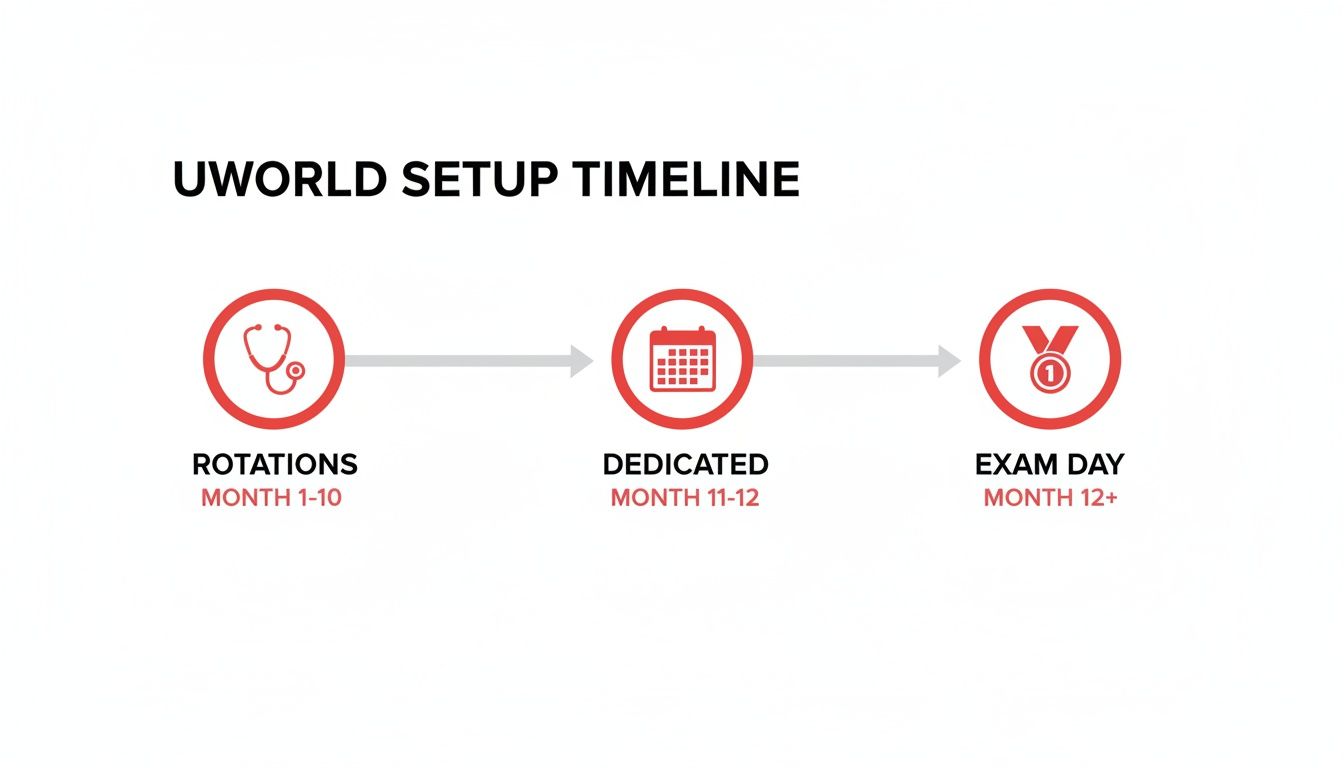
As the graphic shows, there's a clear progression from foundational learning during clerkships to intensive, exam-focused prep during dedicated, all designed to have you peaking on test day.
The Longitudinal Clerkship Schedule
Studying for Step 2 during your third year is a marathon, not a sprint. Your schedule has to be flexible enough to survive long hours on the wards, shelf exam prep, and having some semblance of a personal life. The goal here is steady, consistent progress—not daily exhaustion.
During your rotations, try to get through 20 to 40 questions per day in tutor mode, focusing on the specific clerkship you're currently on. This creates an amazing synergy. You’re not just studying for Step 2; you’re crushing your shelf exam and becoming a better clinical student all at once. For example, doing a block of OB/GYN questions after a long day of deliveries helps cement the concepts you just saw in real life.
Integrating Practice Exams and Days Off
No study schedule is complete without planned breaks and assessment milestones. You need to strategically place NBME practice exams and UWorld Self-Assessments (UWSAs) every one to two weeks during your dedicated period. These are absolutely crucial for tracking your progress, pinpointing weaknesses, and getting used to the mental fatigue of the real 9-hour exam.
Treat your practice exam days like the real deal. Start at the same time, take your scheduled breaks, and spend the next day reviewing it in detail. Just as important is scheduling one full day or at least a half-day off each week. This isn't a luxury; it’s a necessity. It prevents burnout and gives your brain the downtime it needs to consolidate all that information.
If you're looking for more detailed templates, exploring a well-structured Step 2 CK study schedule can be a fantastic starting point to customize for your own needs. Building a schedule that actually works for you is the first real step toward conquering this exam.
The Art of Active Review and UWorld Explanations
Answering a 40-question block in UWorld Step 2 is just the warm-up. The real workout—where you actually build the mental muscle for a top score—happens during the review.
One of the most common and damaging mistakes I see students make is just passively reading the explanations. You have to shift your mindset from being a passive consumer of information to an active investigator. Your job is to dissect every single question to get to the core of the clinical reasoning.
This isn't just about seeing why the right answer was right. It’s about methodically breaking down why every single incorrect option was wrong. This is the secret to moving from basic fact recognition to true clinical pattern recognition, which is the heart and soul of the Step 2 CK exam.
Dissecting Questions The Right Way
You need a systematic approach for every single question you review, whether you nailed it or completely missed it. If you got it right, you have to prove to yourself it wasn't just a lucky guess. If you got it wrong, your mission is to find the exact point where your thinking went off the rails.
A solid review framework for each question should look something like this:
- What was the core concept being tested? First, identify the main diagnosis or management principle the question is really about.
- Why was the correct answer definitively right? Pinpoint the specific details in the vignette—patient demographics, symptoms, lab values—that made this option the undeniable winner.
- Why were the incorrect answers definitively wrong? For each distractor, you must be able to articulate exactly why it was the wrong choice. Maybe a key symptom was missing, or a lab value was totally inconsistent with that diagnosis.
This meticulous breakdown forces you to engage with the material on a much deeper level. You’ll start to see how the exam writers craft their questions and learn to spot those subtle clues you might have skimmed over under pressure.
From Annotations to Long-Term Retention
As you review, your goal is to pull out the most high-yield learning points and store them in a way you can actually revisit. Let’s be real: simply highlighting text inside UWorld isn't going to cut it for long-term retention. You need a system.
One of the most effective methods is creating a "mistake journal." This could be a physical notebook, a simple Word doc, or a spreadsheet. For each question you miss, or for concepts you find tricky, write down a concise summary of the key takeaway. Critically, don't just copy and paste the explanation; rephrase it entirely in your own words.
Key Takeaway: The goal of a mistake journal isn't to create a second textbook. It's to build a personalized, high-yield guide to your specific weaknesses. Reviewing this journal weekly is far more efficient than trying to re-read hundreds of UWorld explanations.
For an even bigger impact, integrate your review with a spaced repetition system like Anki. This is a game-changer. For complex concepts, create a few focused flashcards. One card might ask for the diagnostic criteria for a disease, while another could test the mechanism of a specific drug. This system automates your review schedule, making sure you see your weakest concepts at just the right intervals to hammer them into your long-term memory.
Using Performance Analytics to Guide Your Study
Don't ignore the "Performance" tab in UWorld. It’s more than just a way to track your overall percentage; it's a powerful diagnostic tool that can reveal hidden patterns in your errors and sharpen your study plan.
Make it a habit to regularly check your scores broken down by subject and system. If you notice your cardiology score is lagging, that’s your signal to do a few focused, tutor-mode blocks on that topic. This data-driven approach ensures you’re spending your valuable time shoring up your weakest areas instead of just practicing things you already have down.
This kind of targeted prep is absolutely crucial. The USMLE Step 2 CK pass rate trends show a huge gap between first-time and repeat test-takers, and it almost always comes down to the effectiveness of their preparation. Recent data for first-time U.S./Canadian MDs showed an 89% pass rate, but that number drops to just 60% for repeaters—a clear sign that a structured approach makes all the difference.
What’s more, students scoring 65% or higher on UWorld are predicted to have a 95% probability of passing Step 2 CK. This is a vital statistic to keep in mind, especially as the passing score increases to 218 effective July 1, 2025. You can get more details on USMLE score percentiles and their implications to see where you stand.
Ultimately, all these review strategies are designed to reinforce one core principle: active recall. Simply reading or highlighting is passive. Forcing your brain to retrieve information without looking is what builds strong, reliable neural pathways. If you want to dive deeper into this, our guide on how to use active recall as a medical student offers more actionable techniques. Beyond just reviewing UWorld, consistently improving note-taking skills will also help solidify your understanding and recall. A systematic review process turns every single question block into a powerful learning event, moving you one step closer to your goal score.
Integrating NBMEs and Shelf Prep for Maximum Impact
Your UWorld Step 2 prep doesn't happen in a bubble. It's part of a much bigger ecosystem that includes your shelf exams and the all-important NBME practice tests. The real secret to a top score is making these resources work together, rather than treating them like separate, competing chores.
When you get this right, you create a powerful feedback loop where each piece of your prep strengthens the others.
The goal is to stop thinking, "I need to study for my surgery shelf and for Step 2." Instead, your mindset should be, "My surgery shelf prep is my Step 2 prep." This shift is absolutely critical for staying efficient and sane during your third year.
Using UWorld to Dominate Your Shelf Exams
The most straightforward way to integrate your resources is to align your UWorld question blocks with your current clinical rotation. When you're on your pediatrics clerkship, all of your daily QBank time should be spent on pediatrics questions, probably in tutor mode. This tactic is a game-changer for two big reasons.
First, it’s direct, high-yield prep for the NBME shelf exam, which is basically a "mini-Step 2" focused on a single specialty. If you can master the UWorld questions for that subject, you're covering the exact material that's most likely to show up.
Second, it reinforces what you’re seeing on the wards every single day. When you see a patient with Kawasaki disease in the morning and then do three UWorld questions on it that night, that information cements itself in your brain on a much deeper level. This synergy between clinical experience and active QBank review is one of the most powerful learning tools you have.
The Role and Timing of NBME Practice Exams
Think of your NBME self-assessments as progress checkpoints. They offer the most accurate snapshot of where you stand and are essential for tracking your improvement, especially during your dedicated study block. But their timing is crucial.
Don’t burn an NBME practice exam too early. Taking one before you have a solid content foundation is more likely to cause a full-blown panic attack than provide useful data. Wait until you've made a real dent in the UWorld QBank.
Here’s what a well-paced schedule for your practice exams should look like:
- Baseline (Start of Dedicated): Take an older NBME or a UWorld Self-Assessment (UWSA) to get a starting point. This initial score is great for identifying your biggest weak spots right out of the gate.
- Mid-Prep Check-ins: Schedule an NBME every 1-2 weeks during your dedicated period. These are your progress markers.
- Final Weeks: In the last two weeks before your real exam, take UWSA 2 and the Free 120. These are widely considered the most predictive assessments of your final Step 2 CK score.
After every single practice exam, block off an entire day just for review. This is just as important, if not more so, than doing your UWorld blocks. You need to analyze every question to understand not just what you got wrong, but why. For a deeper look at this process, our guide to using NBME practice exams for Step 2 will help you squeeze every last drop of value from each assessment.
By treating UWorld, shelf prep, and NBMEs as interconnected parts of a single strategy, you make every hour you study that much more productive.
Common UWorld Pitfalls and How to Steer Clear
Even the most disciplined students can hit roadblocks on their UWorld Step 2 journey. It's a marathon, and knowing the common traps is the best way to sidestep them and keep your momentum strong. This isn't about aiming for perfection from day one; it's about studying smart and staying resilient.
One of the first and most common mistakes is getting fixated on your percentage correct. Seeing a low number, especially when you're just starting out, can feel like a punch to the gut. But here’s the thing: your initial UWorld score is just a baseline. It's a diagnostic tool, not a judgment of your potential. Its only job is to show you where your knowledge gaps are hiding.
When you obsess over the percentage, you create this performance anxiety that gets in the way of actual learning. The real gold in UWorld isn't in acing every question; it's in figuring out precisely why you got one wrong.
The Black Hole of Inefficient Review
Another huge hurdle is spending either way too much or way too little time on review. Some students get stuck in analysis paralysis, spending an hour dissecting a single question and tumbling down a rabbit hole of obscure details. On the flip side, others blaze through the explanations just to feel the satisfaction of finishing another block—a strategy that offers almost zero long-term benefit.
So, what's the sweet spot? Aim to spend about 1.5 to 2 times as long reviewing a block as you did answering the questions. If you spent an hour on a 40-question block, you should be planning for at least 90 minutes of focused, active review. This pace is fast enough to keep you moving but slow enough to let you truly break down each answer choice.
Finding this balance is more critical than ever, especially since the Step 2 CK score has become a massive factor for residency matching after Step 1 went pass/fail. Your UWorld performance is a direct predictor of these high-stakes scores. For the 2025 match cycle, applicants who matched into Dermatology averaged a 257, and Neurosurgery was right behind at 255.
Data from over 69,000 first-time test-takers revealed that students who used UWorld were 25% more likely to hit these competitive scores. Top-tier programs are often looking for scores north of 260, which generally correlates to maintaining an 80% or higher accuracy in UWorld. You can read more about the USMLE's updated passing standards and how they’re shaping residency applications.
Dodging the Burnout Bullet
"UWorld burnout" is a real, tangible thing. The daily grind of tackling hundreds of dense, complex clinical vignettes is mentally draining. Trying to push through when your tank is empty just leads to diminishing returns—you'll find yourself just clicking through answers without really absorbing a single concept.
The only way to fight this is to build breaks into your schedule and fiercely protect your time off. Your brain absolutely needs downtime to consolidate all the information you're throwing at it. Ignoring this simple fact will torpedo both your performance and your morale.
Here are a few proven strategies to keep burnout at bay:
- Set Sane Daily Goals: Don't try to be a hero. Stick to a number of questions you can actually manage. For most people, 80-120 questions per day during a dedicated study period is the sweet spot for effectiveness and sustainability.
- Schedule a Real Day Off: Seriously, take at least one half-day or even a full day off every single week. This isn't laziness; it's a strategic move that’s part of any successful study plan.
- Mix It Up: Your brain craves variety. Don't just pound UWorld questions all day. Weave in other resources like videos, review your notes, or run through some flashcards to keep your mind engaged in different ways.
Burnout isn't a sign of weakness—it's a sign that your study plan isn't working for you. Listen to your body and mind. Don't be afraid to pull back and adjust your schedule when you feel the overwhelm setting in.
The Allure of the Premature Reset Button
As students get closer to finishing their first pass of the QBank, a sense of panic can set in. Many rush to hit the reset button, hoping a second pass will magically inflate their score. This is a huge mistake.
Resetting UWorld too early, before you've actually learned from your first pass, means you're just recognizing questions from memory. You're not actually solving them from a place of true understanding.
A much, much better approach is to finish your entire first pass, focusing on learning from every single question—right or wrong. Then, instead of a full reset, create new blocks using only your "incorrects" and "marked" questions. This effectively creates a custom-made QBank that’s perfectly tailored to your specific weaknesses, making your second pass incredibly efficient and high-yield.
Troubleshooting Your UWorld Step 2 Preparation
Navigating the UWorld QBank can feel like a rollercoaster. Some days you feel like you're on top of the world, and other days you question everything. Recognizing a problem early is the first step to fixing it.
This table is designed to be your quick-reference guide. Use it to identify common struggles, spot the warning signs in your own study routine, and implement an immediate, actionable solution to get yourself back on track.
| Common Pitfall | Symptoms to Watch For | Actionable Solution |
|---|---|---|
| Percentage Fixation | Constantly checking your overall percentage; feeling demoralized by low scores; avoiding weak subjects to keep your score up. | Hide the overall percentage. Focus on the learning objective of each question. Track your progress in 10-block averages instead of daily scores to see broader trends. |
| Inefficient Review | Spending >3 hours on a single 40-question block; rushing through explanations in <1 hour; not understanding why wrong answers are wrong. | Time your review sessions. Stick to the 1.5-2x rule (e.g., 90-120 mins for a 1-hour block). For every question, force yourself to explain why the correct answer is right and the others are wrong. |
| Passive Learning | Re-reading explanations without retaining information; recognizing questions on a second pass but not the underlying concepts. | Implement active review. Create Anki cards for incorrects, draw out pathways on a whiteboard, or explain the concept to an imaginary student. |
| UWorld Burnout | Feeling mentally exhausted; seeing your block scores steadily decline; loss of motivation; making silly mistakes from fatigue. | Schedule a mandatory half-day or full day off each week. Mix up study methods (e.g., UWorld in the morning, videos in the afternoon). Ensure you're getting 7-8 hours of sleep. |
| Premature Reset | Feeling anxious about "wasting" questions; wanting to reset before finishing your first pass or reviewing all incorrects. | Complete the entire first pass. Then, do a dedicated pass of all your "incorrect" and "marked" questions first. This targets your weaknesses far more effectively than a random second pass. |
Think of this table not as a list of failures, but as a proactive toolkit. Every medical student faces these challenges. The ones who succeed are those who recognize the signs and adjust their strategy without losing momentum. Stay flexible, be honest with yourself, and keep moving forward.
Your UWorld Step 2 Questions Answered
As you get deeper into the UWorld QBank for Step 2, the questions start piling up—and I don't just mean the ones on the screen. Am I on track? Is my percentage any good? Should I do a second pass? It's easy to get bogged down by uncertainty.
Let’s cut through the noise. Here are direct, no-fluff answers to the most common questions students ask, based on years of helping people just like you crush this exam.
When Should I Finish My First Pass of UWorld?
This is probably the biggest strategic question you'll face. Ideally, you want to complete your first full pass of the QBank about four to six weeks before your exam date.
Why this specific window? It gives you a solid chunk of time to dive deep into your incorrects and weak areas without the panic of a looming deadline. Finishing too early means you risk forgetting early material, but finishing too late leaves zero time for that crucial, high-yield targeted review. That 4-6 week buffer is your sweet spot.
How Should I Interpret My UWorld Percentage?
It’s so easy to get obsessed with your overall percentage, but you have to put it in context. In the beginning, seeing scores in the 50s or 60s is completely normal. I repeat: completely normal.
At this stage, UWorld is a learning tool, not an assessment. Your job is to learn from the explanations, not chase a score. As you move through your prep, you should see a slow but steady upward trend. By the time you're in your dedicated study period, most students who score well on the real deal are consistently hitting 70-80% or higher on random, timed blocks. Look for the trend, not just the number.
Your UWorld percentage is a compass, not a final grade. Use it to find direction and identify your weak areas, but don't let it define your entire prep. A downward trend for a few days might just signal burnout, not a lack of knowledge.
Should I Do a Second Pass of UWorld?
Yes, but not in the way you might think. Just hitting the reset button and starting the whole QBank from scratch is a massive waste of time. You'll fly through concepts you've already mastered, and your brain will start recognizing question patterns instead of using true clinical reasoning.
A much smarter "second pass" is to create a custom QBank of only your incorrect and marked questions. This is a personalized, high-yield review laser-focused on your specific weaknesses. This is where the real points are gained, as you're actively fixing the gaps that could trip you up on exam day.
What Is a Good UWorld Self-Assessment Score?
The UWorld Self-Assessments (UWSAs) are a different beast. Unlike your running QBank percentage, these are built to be predictive. They’re your best glimpse into your potential final score, especially UWSA 2.
Here’s how to think about them:
- UWSA 1: Usually taken a few weeks out, a score above 230-240 on UWSA 1 is a great sign. It can sometimes overpredict, so use it mainly as a gut check to see how your knowledge base is holding up.
- UWSA 2: This is the big one, typically taken about a week before your test. A score above 245 here is a very strong indicator that you’re ready to perform well.
Most students find their final Step 2 score lands within +/- 10 points of their UWSA 2. Treat these as your final checkpoints to build confidence and make any last-minute tweaks.
How Many Questions Should I Do Per Day?
The magic number depends entirely on where you are in your prep journey.
During your clinical rotations, trying to do 80 questions a day is a recipe for burnout. A more realistic and effective goal is 20-40 questions per day. It’s enough to keep the information fresh and practice your test-taking skills without falling behind on your clinical duties.
Once you hit your dedicated study period, it's time to ramp up. The goal should be 80-120 questions per day, usually split into two or three 40-question blocks. This volume simulates the rhythm of the real exam and exposes you to enough content, but it's still manageable enough that you can review every single question properly. Don't forget, the learning happens in the review.
Feeling overwhelmed by your UWorld prep or struggling to turn your QBank scores into real progress? The expert tutors at Ace Med Boards specialize in creating personalized study plans that work. We can help you break down complex questions, master high-yield topics, and build the confidence you need for exam day. Book your free consultation to learn how one-on-one guidance can transform your Step 2 score.

