
The official USMLE Step 2 passing score is now 218, a jump up from the previous score of 214. This new standard will apply to everyone taking the exam on or after July 1, 2025. This isn't just a random increase; it’s a calculated adjustment that reflects evolving standards in medical education and how students have been performing.
Understanding The New Step 2 Passing Score

For a long time, the target for passing Step 2 was a fixed number that every medical student knew. But the world of board exams is always adapting. The USMLE Management Committee doesn't just set a score and forget it; they periodically dive into performance data to make sure the exam accurately reflects the minimum competency needed for safe and effective patient care.
This recent four-point increase is the direct result of one of those reviews. It might not sound like a huge leap, but it has some serious implications for how you should be prepping for Step 2 CK. It’s a clear signal that the bar for entry-level competence is rising, especially now that Step 1 has gone pass/fail.
USMLE Step 2 CK Passing Score at a Glance
To make this change crystal clear, here’s a quick table breaking down the old standard versus the new one. This is the essential info you need as you map out your study schedule and set your goals.
| Metric | Score/Date |
|---|---|
| Previous Passing Score | 214 |
| New Passing Score | 218 |
| Effective Date | July 1, 2025 |
What this shift really means is that the study strategies that were just enough to pass before might need a serious overhaul. The margin for error has shrunk, making a structured and efficient preparation plan more critical than ever.
The change from 214 to 218 isn't just a number—it’s a clear message that expectations are rising. Your goal should be to comfortably exceed this new minimum, not just scrape by.
Ultimately, knowing the new USMLE Step 2 passing score is just the first step. The real goal is to aim much higher. To get a better feel for what residency programs are actually looking for, you can learn more about what constitutes a good USMLE Step 2 score in our detailed guide. Think of 218 as your starting line, not your finish line.
Decoding the Reason Behind the Score Change
The recent bump in the USMLE Step 2 passing score wasn't a random decision pulled out of a hat. It’s a direct response to a major shakeup in medical education: rising student performance and, more importantly, the strategic shift after the Step 1 exam went pass/fail.
Think of the USMLE exams as a balanced scale. For years, Step 1 carried the heavy weight of a numeric score, making it the primary filter for residency applications. When that weight was removed in 2022, the scale tipped hard. Suddenly, Step 2 CK became the single most important number for program directors to compare applicants.
The Ripple Effect of a Pass/Fail Step 1
This change had a predictable, cascading effect. With Step 1 no longer a way to stand out, medical students started pouring all their focus, energy, and study resources into crushing Step 2. This intensified preparation naturally led to a steady climb in average scores across the board.
The USMLE Management Committee keeps a close eye on this performance data. Their job is to make sure the passing standard actually reflects what a competent medical school graduate should know today. When they see a clear upward trend in scores, they have to adjust the minimum cutoff to protect the exam's integrity.
This decision is really all about recalibration. As the collective performance of test-takers gets better, the minimum standard has to evolve to accurately represent the baseline competency needed to practice medicine safely.
This ensures that a "pass" on Step 2 CK continues to mean something real about a student's clinical abilities.
Maintaining Exam Rigor and Standards
The USMLE Management Committee's recent decision confirmed this exact logic. The official USMLE Step 2 CK passing score will increase from 214 to 218, effective July 1, 2025. This change is a direct reflection of their effort to keep the exam aligned with both evolving standards and the simple fact that students are performing better. You can dig into the numbers yourself by exploring the performance data trends on the USMLE website.
This adjustment really serves two purposes:
- It aligns with improved preparation: The new score acknowledges that today's students are, on average, coming into the exam better prepared than ever.
- It upholds clinical standards: It reinforces the exam's role as a rigorous test of the clinical skills you absolutely need to have before starting residency.
Understanding this context is key. The score increase isn't meant to be a punishment; it's a logical adaptation to a new reality. The intense pressure on Step 2 CK is a direct consequence of Step 1 losing its numeric score. To get the full picture, check out our guide on the USMLE Step 1 passing score and how that change set the stage for everything we're seeing now.
Ultimately, this all points to one simple truth: aiming well above the new 218 threshold isn't just a good idea—it's a necessary strategy for building a competitive residency application.
Looking Beyond a Simple Pass or Fail
Hitting the minimum USMLE Step 2 passing score is a huge relief, but in the grand scheme of your medical career, it's just the starting line. The real story is what your three-digit score tells residency programs about you. Think of it as the GPA for your clinical knowledge—it’s a quick, powerful signal of your readiness for specialized training.
This mindset is more important now than ever. With Step 1 now graded as pass/fail, your Step 2 CK score has become the single most important number that programs use to stack up applicants. This shift has everyone doubling down on their Step 2 prep, and we're seeing average scores creep up year after year as a result.
Why Your Score Matters More Than Just Passing
The new passing score of 218 is the floor, not the ceiling you should be aiming for. The actual goal is to land a score that gets you past the automatic filters and makes a program director want to take a closer look at your application. Every specialty has different expectations, and your score can either open doors or close them before anyone even reads your personal statement.
Since the Step 1 pass/fail change took effect in 2022, the average scores for U.S. and Canadian first-timers have steadily climbed, now hovering between 248 and 250. It might not seem like a huge jump, but this consistent upward trend shows that students are pouring all their energy into Step 2. What used to be a great score is now just competitive, pushing truly standout performances into the 260s and beyond. You can explore more insights into these score trends to get a better feel for the new landscape.
This chart breaks down how different score ranges are generally seen in the residency match.
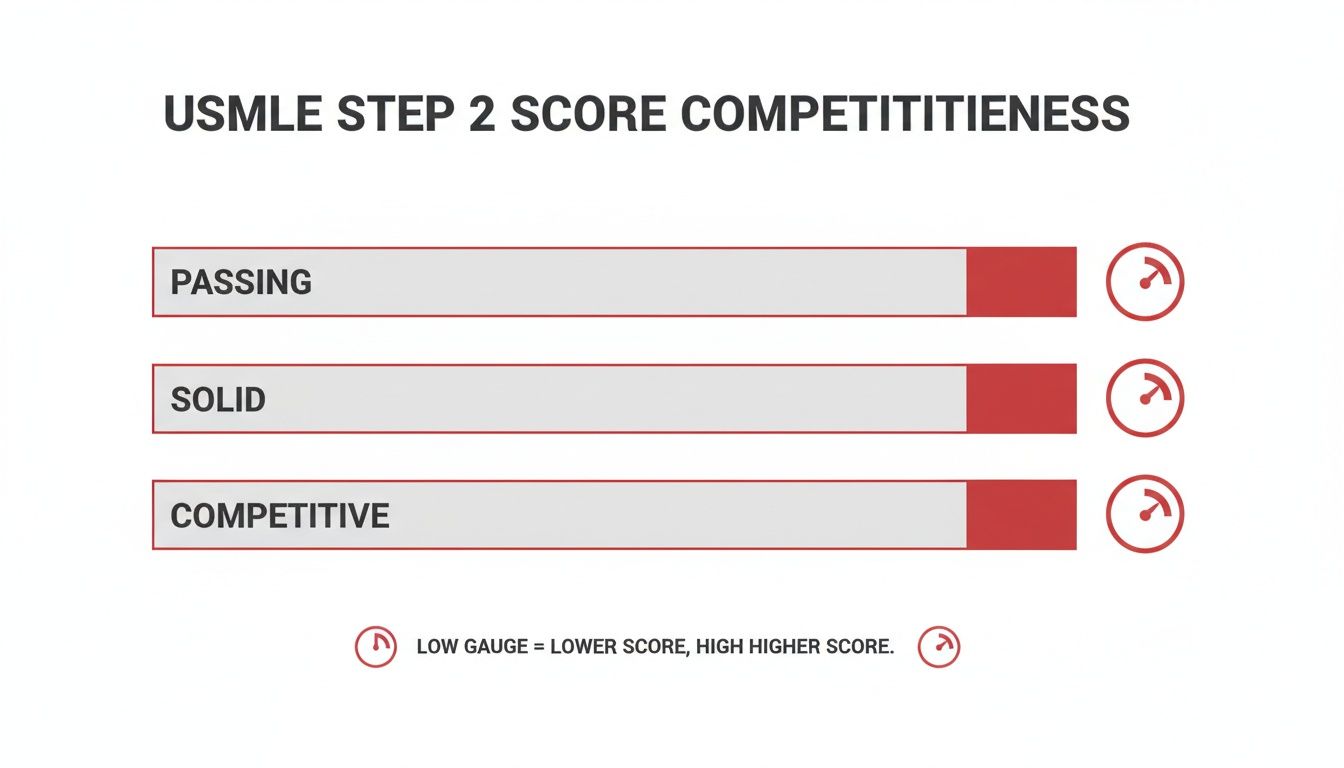
As you can see, getting a pass is mandatory, but hitting that "Solid" or "Competitive" tier is what truly sets you up for success.
Understanding Score Ranges and Percentiles
Your three-digit score isn’t just a number; it places you in a national percentile, showing exactly how you performed compared to everyone else. A higher percentile means you outscored a larger chunk of your peers, which naturally makes your application stand out.
Here’s a practical overview of how different Step 2 CK scores correlate to national percentile rankings, which can help you set realistic yet ambitious targets.
Step 2 CK Score Ranges and Estimated Percentiles
| Score Range | Estimated Percentile | General Competitiveness Level |
|---|---|---|
| 218-229 | Approx. 15th – 30th | Passing: Meets the minimum requirement but may be screened out by competitive programs. |
| 230-244 | Approx. 30th – 60th | Solid: A good score that is often sufficient for less competitive specialties. |
| 245-259 | Approx. 60th – 85th | Competitive: A strong score that makes you a viable candidate for most specialties. |
| 260+ | Approx. 85th – 99th | Exceptional: A top-tier score that makes you a highly sought-after applicant for any specialty. |
This table helps illustrate that your target score should be a direct reflection of your career goals.
It's a complete mindset shift. You're not just studying to pass an exam; you're making a strategic investment in your future.
Your target score should be a direct reflection of your career ambitions. It's not just about passing an exam; it's about making a strategic investment in your future medical specialty.
This approach transforms your study sessions from a simple pass/fail chore into a targeted mission. Every extra point you earn is a direct investment in your career, widening your options and boosting your chances of matching into the program you really want.
How Residency Programs Interpret Your Step 2 Score
After you pour your heart into your residency application and hit "submit," your Step 2 score is often the very first thing a program director sees. With thousands of talented applicants vying for a limited number of spots, that three-digit number becomes a quick, efficient tool for managing the sheer volume. Think of it as the gatekeeper.
In fact, many competitive programs set a score cutoff before they even start digging into the details of an application. If your score doesn't meet that initial threshold, your file might get automatically filtered out. That means your compelling personal statement and glowing letters of recommendation might never even get a look. It’s a harsh reality, but it highlights that your score isn't just a test result—it's your ticket to getting a full, holistic review.
Your Score in the Context of Specialty Choice
Not all specialties view your Step 2 score through the same lens. Its importance can swing dramatically depending on how competitive your chosen field is. For hyper-competitive fields like dermatology, plastic surgery, or orthopedic surgery, a stellar score is practically a non-negotiable prerequisite just to get in the door.
On the other hand, specialties like family medicine or pediatrics tend to place a more balanced emphasis on other parts of your application, like your clinical experiences, volunteer work, and personal character. But don't be mistaken—even in these fields, a strong Step 2 score gives your application a serious boost and helps you stand out from a crowded field of qualified candidates.
To really understand what you should be aiming for, it’s essential to look at the data on average Step 2 scores by specialty. This gives you a data-driven, realistic target that aligns with your specific career goals.
From Score Filters to Interview Invitations
Meeting the minimum USMLE Step 2 passing score is the first hurdle, but securing interviews means clearing a much higher bar. Program directors are looking for concrete evidence that you can handle the academic rigor of their residency. A high Step 2 score is one of the most powerful ways to provide that proof.
According to a 2024 NRMP survey of program directors, 83% said they consider applicants' Step 2 CK scores as a key factor when deciding who to invite for an interview.
This statistic makes it crystal clear: your performance on this one exam has a direct and massive impact on your interview prospects. The hard work you put in now translates directly into more opportunities down the road.
Ultimately, a strong score does more than just help you avoid an automated rejection filter. It actively works for you, earning you a seat at the interview table where you can finally showcase the rest of what makes you a great future resident.
Creating a Comeback Plan If You Fail Step 2 CK
Getting a failing score on Step 2 CK feels like a punch to the gut. It's a massive setback, no question. But it is absolutely not the end of your medical career. Your first task is to process the result without letting it define you. Think of it as a single, tough data point in a very long journey—and with the right strategy, you can turn this challenge into a powerful comeback story.
The USMLE program gives you a safety net, permitting a total of four attempts to pass each Step exam. After a failed attempt, you have to wait until the first day of the next calendar month to re-register, and you can only take the exam a maximum of three times within a 12-month period. This structure actually forces you to take a crucial pause, analyze what went wrong, and rebuild your approach from the ground up.
Analyzing Your Performance Report
Right now, your score report is the most valuable tool you have. It contains a performance profile that breaks down your strengths and weaknesses by physician task (like Diagnosis or Management) and by discipline. This isn't just a list of things you got wrong; it's a diagnostic map pointing to exactly where your knowledge gaps are.
Simply re-reading the same books or grinding through the same question banks again is a recipe for the same result. The goal here is to spot patterns. Did you consistently miss questions related to "Diagnosis"? Or did a specific system like "Cardiovascular" trip you up repeatedly? A deep, honest analysis of this report is the foundation of a new, targeted study plan.
A failed attempt doesn't reflect your potential as a physician. It's a sign that your previous preparation strategy was misaligned with the exam's demands. Use this as an opportunity to build a smarter, more effective plan.
Building a Resilient New Strategy
Your comeback plan needs a complete shift in both mindset and methodology. Falling back on old study habits will likely produce the same outcome. Instead, you need to actively change your approach. If you're looking for a structured way to map out this improvement, exploring professional development plan templates can provide a solid framework.
Consider these key actions for your new plan:
- Targeted Content Review: Forget a general review. Focus with laser-like intensity on the weak areas your score report flagged.
- Active Recall: Ditch passive reading for good. Implement active learning techniques like making your own flashcards or teaching complex concepts out loud to an empty room.
- Seek Expert Guidance: Working with a tutor can provide a much-needed fresh perspective. An expert can help identify blind spots you can't see and equip you with superior test-taking strategies you haven't considered.
If you need a detailed guide on how to structure this new game plan, our in-depth article on developing a USMLE retake strategy offers a comprehensive roadmap. Remember, resilience and a smarter plan are your greatest assets in overcoming this hurdle.
Strategies for Reaching Your Target Score

Knowing the numbers is one thing. Actually hitting your target score? That's a whole different ballgame.
Success on Step 2 CK means ditching the "just pass" mentality. You need a real strategy, one laser-focused on scoring competitively. The bedrock of this approach is a personalized study plan built around your unique strengths, weaknesses, and timeline. A generic plan simply won't cut it.
You need to start with a diagnostic self-assessment to pinpoint your weakest subjects. This lets you allocate study time with surgical precision, pouring your energy where it will make the biggest difference. It’s not just about reviewing old content; it’s about mastering the high-yield concepts that show up again and again on the real exam.
Mastering Question Analysis
Let's be clear: Excelling on Step 2 requires way more than just memorizing facts. You have to develop razor-sharp question-analysis skills to dissect complex clinical vignettes, spot the distractors, and land on the best answer—fast. This skill is only built through deliberate, focused practice.
- Deconstruct Every Question: Before you even glance at the answer choices, break down each practice question into its core components—patient presentation, labs, imaging.
- Justify Your Answer: You need to be able to explain exactly why your chosen answer is correct. Just as important, you need to articulate why every other option is wrong.
- Review Explanations Obsessively: Spend serious time on the explanations for questions you got right and wrong. This process is where the real learning happens, solidifying your understanding and exposing subtle knowledge gaps.
This systematic approach transforms your question bank from a simple quiz into your most powerful learning engine.
Think of your study period as clinical training for the exam itself. Your goal is not just to know the information but to develop the diagnostic reasoning needed to apply it under pressure.
Whether you're aiming for a solid 245 or an exceptional 260+, these strategies provide a clear framework for success. For a more detailed breakdown, you can explore our complete guide on how to study for Step 2 CK.
Ultimately, connecting your daily grind to a well-defined strategy is what turns all that hard work into a score that opens the right doors for your residency match.
Frequently Asked Questions About the Step 2 Score
Alright, let's clear up some of the common questions and anxieties that pop up around the Step 2 score. These are the practical, "what if" scenarios that can keep you up at night, so let's tackle them head-on.
Your Step 2 CK score report isn't just a number; it's a key piece of your professional profile that has a surprisingly long shelf life. For residency applications, your score is generally considered valid for seven years. That said, it's always a smart move to double-check with the specific state medical boards you might apply to down the road, as their individual rules can sometimes differ.
Score Reporting and Exam Attempts
One of the biggest sources of stress is how past attempts look to residency programs. When you apply through ERAS, your entire USMLE transcript gets sent. That means program directors see everything—all your attempts, including any failures.
So, what looks better to a program director?
- Scenario A: A clean, first-time pass with a respectable, but not stellar, score.
- Scenario B: A much higher score, but one that you got on your second try.
Almost every time, residency programs are going to prefer Scenario A. A first-time pass, even with a lower score, signals that you were prepared and competent when it counted. While bouncing back with a high score on a retake shows resilience, it also introduces a question mark about your initial knowledge base and test-taking skills. Your number one goal should always be to pass on the first try.
Your USMLE transcript tells a story. A clean, first-attempt pass is the most straightforward and compelling narrative you can offer program directors. It signals reliability and preparedness right from the start.
Understanding these details helps you build the right strategy from day one. Aiming for a strong, decisive pass on your first attempt is the best way to present a competitive, reassuring profile to your top-choice residency programs.
Navigating the road to Step 2 CK requires more than just memorizing facts—it demands a smart, personalized strategy. The expert tutors at Ace Med Boards work with you to build confidence, sharpen your test-taking instincts, and help you earn a score that opens doors. Start with a free consultation and build your path to success.

