
Cracking the USMLE Step 2 CK isn't what it used to be. With Step 1 now pass/fail, your Step 2 CK score has become the single most important academic metric residency programs use to filter and rank applicants. A well-thought-out, strategic study plan is no longer just a good idea—it's absolutely critical.
Why Your Step 2 CK Prep Needs a Major Overhaul
The entire landscape of medical board exams has shifted. Gone are the days when a stellar Step 1 score could bail you out of a mediocre Step 2 performance. Now, your Step 2 CK result is the main objective measure of your clinical knowledge and decision-making skills that program directors see. This isn't just a small change; it’s a new reality that demands a different way of preparing.
This shift means your study plan has to be intentional and laser-focused on application, not just cramming facts. It's about developing the clinical judgment to truly excel, moving beyond knowing what to understanding how to apply it in complex patient scenarios. The exam is designed to test your ability to think like a physician—prioritizing the next best step, interpreting subtle clinical clues, and managing patient care.
The Bar Has Been Raised
Adding to the pressure, the standards for just getting by are getting higher. In a pretty significant move, the USMLE Management Committee decided to increase the passing standard from 214 to 218 for anyone testing on or after July 1, 2025. This wasn't a random decision; it followed a deep dive into performance data and input from experienced physician panels. You can read the official announcement about the change to the Step 2 CK passing standard directly on their website.
This change is happening while average scores are already creeping up. In just the last three years, the average score for first-time takers from US and Canadian med schools climbed from 248 to 250. With so much riding on this exam, students are putting in more time and smarter effort, and it's showing in the results.
What does this all mean for you? It creates a hyper-competitive environment where an "average" score might not cut it for your dream specialty. Your prep has to account for both a tougher passing mark and a stronger field of applicants.
You can't just study harder; you have to study smarter and more efficiently. Building a solid foundation for your USMLE Step 2 CK preparation really boils down to a few key things:
- Developing rock-solid clinical reasoning: You have to get obsessed with the "why" behind every diagnosis and management plan, not just memorizing the "what."
- Creating an adaptable framework: Whether you have a dedicated six-week block or you're juggling prep with rotations, your plan needs to bend without breaking.
- Prioritizing high-yield topics: Not all content is created equal. A high score depends on strategically focusing on the concepts that show up again and again.
This guide is built to give you that framework. We're cutting through the generic advice to provide actionable strategies you can use to build a study plan that actually gets results.
Designing a Study Plan That Fits Your Life
Let’s be honest: a generic, one-size-fits-all study plan is one of the fastest routes to burnout. Your life, learning style, and clinical schedule are unique—your Step 2 CK prep needs to reflect that. The real key is building a schedule that gives you structure but isn't so rigid that it shatters the moment a rotation gets hectic.
The most successful plans I've seen all start by working backward. Pinpoint your target test date and then map out your prep from there. This simple trick, often called 'reverse planning,' turns what feels like a mountain of content into a series of achievable weekly goals, making the whole process feel much less daunting.
Dedicated Versus Longitudinal Study Plans
Your first big decision is your timeline. Are you lucky enough to have a protected block of time, or will you be weaving studying into your clinical duties? Both paths can lead to a great score, but they demand completely different strategies.
A dedicated study period, usually lasting 6–12 weeks, allows for total immersion. It's a high-intensity sprint perfect for deep-diving into your weak areas and building up that critical test-taking stamina without clinicals getting in the way. The main advantage is pure focus; your only job is to prep for this exam.
On the other hand, a longitudinal plan (spanning 6+ months) is a marathon. This approach means fitting study sessions into your regular schedule during clerkships. Its biggest strength is the immediate application of knowledge. You can literally connect a UWorld question about acute cholecystitis to a patient you saw in the ED that morning, which reinforces concepts in a powerful, real-world way.
With Step 1 now pass/fail, your Step 2 CK score has become the single most important academic data point for residency programs. This isn't just an exam; it's a critical part of your application.
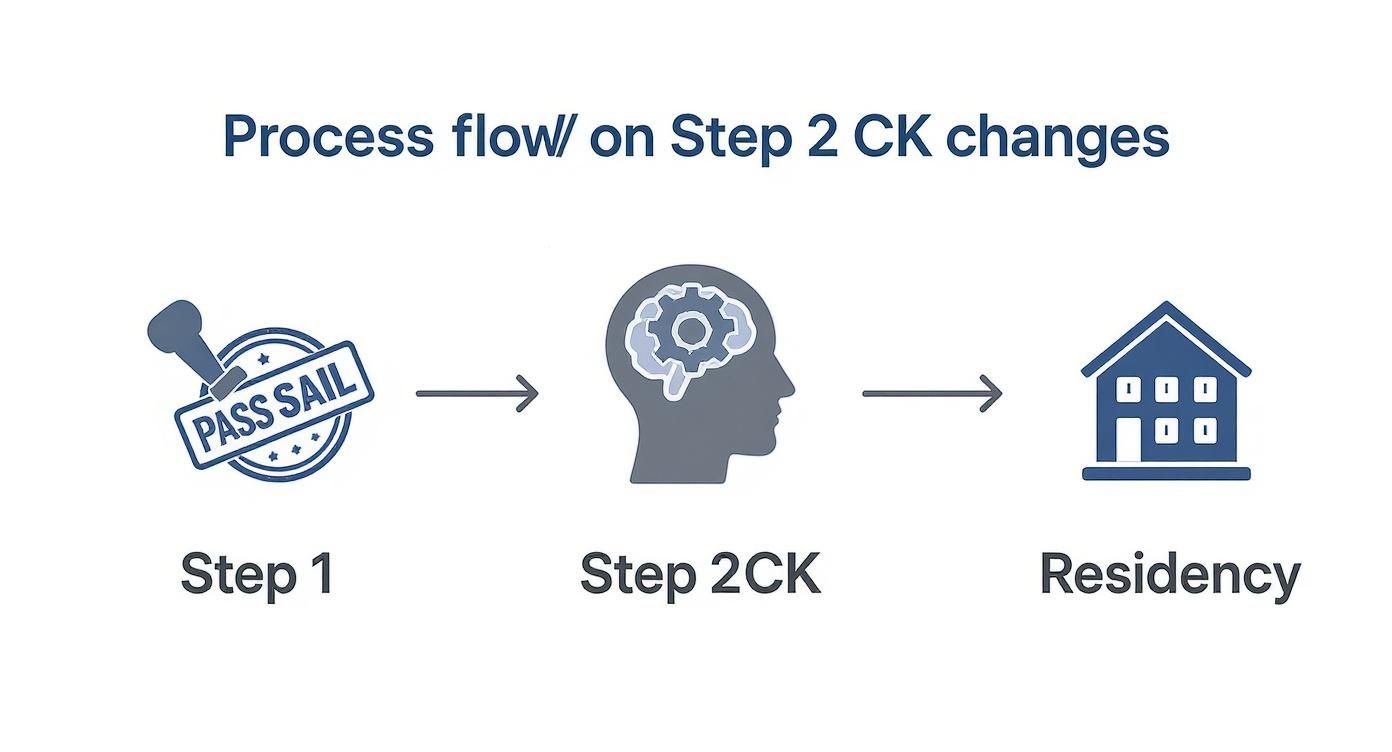
This simple visual makes it clear: your performance on Step 2 CK is now front and center for program directors.
Deciding between these two popular approaches can be tough. The table below breaks down the core differences to help you figure out which one aligns best with your circumstances.
Comparison of Dedicated vs. Longitudinal Study Plans
| Feature | Dedicated Plan (6-12 Weeks) | Longitudinal Plan (6+ Months) |
|---|---|---|
| Intensity | High-intensity sprint; full-time study (8-10 hours/day). | Low-to-moderate intensity marathon; part-time study integrated with clerkships. |
| Focus | Undivided attention on exam prep. No competing clinical duties. | Divided attention between rotations and studying. |
| Knowledge Application | Relies on recalling past clinical experiences. | Direct, real-time application of knowledge from patient care to questions. |
| Flexibility | Less flexible. Requires a protected block of time off from rotations. | Highly flexible. Adapts to the ebbs and flows of different clerkships. |
| Burnout Risk | High risk due to intense daily schedule and isolation. | Moderate risk; requires strong discipline over a long period. |
| Best For | Students with a protected study block, those needing significant score improvement, or IMGs. | Students without a dedicated block, those who learn best by integrating theory and practice. |
Ultimately, the best plan is the one you can realistically stick with. A perfectly designed dedicated plan is useless if you can't get the time off, just as a longitudinal plan will fail without consistent discipline.
Crafting Your Weekly Schedule
No matter which timeline you pick, a balanced weekly schedule is non-negotiable. You need to juggle three core activities: learning new content (doing question blocks), reviewing that content, and assessing your progress with practice exams. If your plan is lopsided, you'll end up with either knowledge gaps or poor test-taking mechanics.
Here’s what this looks like in practice.
Sample 8-Week Dedicated Plan (Weekly Structure)
- Morning (4 hours): Knock out two 40-question UWorld blocks, timed and on random mode. This is crucial for simulating the real exam and building endurance.
- Afternoon (4-5 hours): This is for deep review. Go through every question from the morning—correct and incorrect. Make flashcards for high-yield concepts that tripped you up.
- Evening (1-2 hours): Keep it light. Review your new flashcards or watch a video on a weak topic from a resource like Online MedEd or Boards & Beyond.
- Weekend: Take a full-length NBME self-assessment every other Saturday. Use Sunday for a detailed, honest review. On the off-weekends, focus on lighter review and, most importantly, rest.
A huge pitfall is spending way too much time passively watching videos and not enough time actively doing questions. Your QBank should be your primary learning tool. Other resources are just there to fill in the gaps your QBank performance reveals.
Sample Longitudinal Plan (Integrated with Rotations)
- Daily Goal: Your target should be one 40-question UWorld block each day. This might mean doing 20 questions during downtime at the hospital and the other 20 in the evening.
- System-Based Focus: Align your UWorld blocks with your current rotation. If you're on Surgery, focus on surgery questions. This synergy between your clinical work and test prep is incredibly effective.
- Weekend Deep Dive: Use your weekends to catch up on question reviews, maybe do an extra block or two, and take a practice exam every 4-6 weeks to track your progress over the long haul.
The longitudinal path demands serious discipline; it's so easy to let a busy rotation throw you off track. But the constant reinforcement from seeing patients can make studying feel less like a chore and more like a direct extension of your education.
For students trying to navigate this tricky balance, getting personalized guidance can be a game-changer. Services like Ace Med Boards provide the structure and accountability needed to stay on course. Our one-on-one sessions are designed to help you integrate a solid study plan directly into a hectic clinical schedule, ensuring no time is wasted.
How to Use Your Core Study Resources Effectively

Simply having subscriptions to UWorld, AMBOSS, or a stack of NBME self-assessments doesn’t automatically lead to a great score. The real game-changer in your USMLE Step 2 CK preparation is how you use these powerhouse resources. It's about shifting from just doing questions to actively dissecting them to build bulletproof clinical reasoning.
Your mission isn't just to churn through thousands of questions. It's to wring every last drop of learning out of each one. That takes a systematic approach—one that forces you to analyze your thought process, spot patterns in your mistakes, and hammer high-yield concepts until they're second nature.
Mastering UWorld: Your Primary Learning Tool
Think of UWorld as your central learning hub, not just a question bank. A big debate is always "random" vs. "system-wise" blocks. The truth is, the best strategy is a hybrid one that adapts to where you are in your study plan.
When you're still in rotations, doing questions by system is incredibly effective. Tackling cardiology questions while on your cardiology rotation creates a powerful synergy that makes concepts stick. You're seeing the diseases on the wards and then immediately applying that knowledge to board-style questions.
Once you hit your dedicated study period, it's time to switch gears. Moving to timed, random blocks is non-negotiable. This is what simulates the real exam, training your brain to rapidly pivot from a question on OB/GYN to one on surgery. During this first pass, remember your main goal is learning, not assessment. A low percentage doesn't matter yet. Focus on the why.
Your UWorld percentage is a learning metric, not a final judgment. The biggest score jumps happen when you meticulously review what you got wrong—and just as importantly, why you got something right. Guessing correctly is a liability if you don't understand the underlying reasoning.
This is where the real work begins. After you finish a block, your review should be intense. Don't just read the explanation for the right answer. You need to:
- Dissect the wrong answers: Why were these options incorrect? What tiny detail in the vignette made one answer superior? This is how you build your differential diagnosis skills.
- Create targeted notes or flashcards: Every question that exposes a weak spot should generate a concise note. Focus on diagrams, algorithms, and key differentiating features.
- Track your errors: Dive into UWorld's analytics. Are you consistently bombing questions on nephritic syndromes or sepsis management? That data is gold—it tells you exactly where to aim your content review.
Strategically Scheduling NBME Practice Exams
The NBME self-assessments are your reality checks. They provide the most accurate snapshot of your potential score and are crucial for tracking your progress. But taking them too often creates needless anxiety, and taking them too late gives you no time to pivot your strategy.
For a dedicated study period, you want to space them out to measure your growth and find those stubborn weak areas.
Sample NBME Timeline (8-Week Dedicated)
- Baseline (Start of Week 1): Take an early form (like Form 9 or 10) to see where you stand. This gives you a starting score and highlights the big-picture topics you need to work on.
- Midpoint Check (End of Week 4): Use another form (e.g., Form 11 or 12). This test shows you if your study methods are working and pinpoints the topics that are still tripping you up.
- Final Assessment (1-2 Weeks Before Exam): Use a newer form (like 13 or 14) or a UWSA to get a final prediction. This last exam is a confidence builder and helps you sharpen your focus for the home stretch.
Reviewing an NBME is an all-day event. Don't just glance at the score. Go through every single question, log your errors by subject, and then spend the next couple of days hammering those specific weaknesses.
Leveraging AMBOSS for Targeted Weakness Training
While UWorld is your foundation, AMBOSS is your surgical instrument. It excels at reinforcing specific weak areas identified by your NBMEs or UWorld analytics.
Let's say your practice exam review shows you're struggling with obstetric emergencies. Instead of doing random UWorld blocks and just hoping for relevant questions, you can jump into AMBOSS and create a custom session focused exclusively on topics like postpartum hemorrhage, eclampsia, and amniotic fluid embolism.
The AMBOSS library is another huge asset. The articles are crisp, high-yield, and perfect for shoring up knowledge after a targeted Qbank session. For true long-term retention, pairing these focused reviews with a system like spaced repetition is a game-changer. You can learn more about this powerful memory technique by exploring the fundamentals of using Anki for spaced repetition in medical school. This method ensures the critical facts you learn don't fade away, cementing them in your brain for exam day.
Sharpening Your Clinical Reasoning and Test-Taking Skills

Let's be clear: Step 2 CK is a thinking exam, not a memorization test. Success hinges on your ability to process complex clinical scenarios and make sound judgment calls, just like a resident juggling multiple patients on a busy ward. You have to move beyond just knowing the facts and learn how to apply them under pressure.
The biggest hurdle for most students is the sheer length and detail of the clinical vignettes. It's incredibly easy to get bogged down in a sea of lab values, patient history, and physical exam findings. The trick is to train yourself to slice through the noise and zero in on the "money" phrases—those critical pieces of information that point directly to the right answer.
Deconstructing the Clinical Vignette
Before you even think about looking at the answer choices, you need to build a mental framework for the question. This is non-negotiable. Why? Because it stops you from getting distracted by those tempting (but wrong) options the test-makers love to throw in.
Start by identifying the basics: chief complaint, patient's age and sex, and the acuity of their presentation. Is this a chronic issue or an emergency?
From there, you're hunting for the classic "illness script." For example, if the stem describes a young woman with a history of recurrent DVTs who now presents with a stroke, your brain should scream antiphospholipid syndrome. As you read, mentally highlight the key positives and pertinent negatives that either support or argue against your initial hypothesis.
By the time you finish reading the question stem, you should have a primary diagnosis and at least one or two differential diagnoses in mind. This proactive approach turns multiple-choice questions into a confirmation exercise rather than a guessing game.
Navigating Common Question Traps
The USMLE is notorious for testing your ability to distinguish between similar-looking conditions and to pick the most appropriate next step, not just a correct one. Knowing their playbook is a huge part of effective USMLE Step 2 CK preparation.
Watch out for these classic traps:
- "Most Likely Diagnosis" vs. "Next Best Step": Read the actual question carefully. A vignette might scream acute cholecystitis, but if the question asks for the next best step, the answer is probably IV fluids and antibiotics, not rushing to a cholecystectomy.
- Distinguishing Look-Alikes: The exam loves to put two similar conditions head-to-head, like Crohn's disease versus ulcerative colitis, or different types of nephritic syndromes. You have to train your eye for the subtle clues—extraintestinal manifestations, specific lab markers, or key biopsy findings.
- The "Do Nothing" Option: Sometimes, the right answer is simply observation or reassurance. This is especially common in pediatrics (think physiologic jaundice) or with self-limiting viral illnesses. Don't feel pressured to always intervene.
As you work on honing these skills, remember that confidence is key. Many students struggle with feelings of inadequacy despite their knowledge. It can be incredibly helpful to work on addressing imposter syndrome as part of your overall prep.
Mastering Time Management and Exam Stamina
The nine-hour test day is a beast. It's an ultramarathon for your brain, and poor pacing can sink even the most prepared student. To build that kind of endurance, you absolutely must simulate exam conditions throughout your prep.
This means doing all your UWorld blocks in timed mode—no exceptions. And you have to take full-length practice exams to get your mind and body used to the grind. Our guide on NBME practice exams for Step 2 breaks down how to schedule these critical assessments for maximum benefit.
Use the flagging feature, but use it strategically. If a question has you completely stumped for more than 90 seconds, make your best-educated guess, flag it, and move on. Burning five minutes on one monster question could mean you don't have time to answer three easier ones at the end of the block.
Your goal is to get through every question once, then use whatever time is left to circle back to your flagged items. And please, take your scheduled breaks. Use them to refuel, stretch, and clear your head. This isn't a sprint; it's about maintaining peak cognitive performance all day long.
Setting Realistic Score Goals for Your Target Specialty
A target score without context is just a number. To make your Step 2 CK prep truly effective, you have to connect that number to your residency dreams. The score you need for a hyper-competitive field like Dermatology is a completely different ballgame than what's typical for Family Medicine.
Knowing where the goalposts are is the first step in strategic planning. While the national median Step 2 CK score hovers around 250, the top specialties demand much more.
For example, recent data shows averages sitting at 257 for Dermatology and 256 for Diagnostic Radiology. Compare that to Family Medicine, which averages 244. These numbers aren't just statistics; they're the reality of the competitive landscape and give you a concrete benchmark to aim for.
Why You Should Aim Higher Than the Average
Here’s a critical piece of advice: simply hitting the average score for your chosen field might not be enough. This is especially true if you’re aiming for a top-tier academic program.
From what we've seen, these highly competitive institutions often look for candidates with scores 5–10 points above their specialty's average. A score north of 260 is generally seen as excellent and will put you in a strong position for nearly any program.
Your first attempt at Step 2 CK is your only attempt that really matters. Data consistently shows that success rates for repeat takers drop off a cliff, making a strong performance out of the gate absolutely essential for your residency application.
This isn't meant to stress you out—it's meant to empower you. Use these data points to build a study plan that’s both realistic and ambitious. A well-defined goal will keep you motivated and laser-focused on the high-yield areas that will actually move the needle on your score. For a deeper dive, check out our guide on Step 2 scores by specialty to really fine-tune your target.
As you get your score goals in order, don't forget that a strong residency application needs more than just a great score. You'll also need a polished medical resume. Finding excellent medical resume examples and templates can be a huge help as you prepare for the next steps in your career.
Answering Your Top Step 2 CK Questions
When it comes to prepping for Step 2 CK, a lot of questions pop up. From timelines to study strategies, getting solid answers can be the difference between feeling confident and feeling completely overwhelmed. Let's tackle some of the most common concerns I hear from students.
One of the biggest anxieties is just how much the exam has changed since Step 1 became pass/fail. The shift was a seismic one, placing an enormous amount of weight on your Step 2 CK score for residency applications. Naturally, this has ramped up the intensity of preparation for everyone.
How Much Does My First Attempt Really Matter?
Your first attempt is, statistically speaking, your best shot at success. It's not just a cliché. When Step 1 went pass/fail back in 2022, it completely changed the game for Step 2 CK. Residency programs now dissect this score with a fine-toothed comb, making your performance on that first try more critical than ever.
While the first-time pass rate for US MD students is a reassuring 98%, that number doesn't tell the whole story. For international medical graduates (IMGs), that figure is a lower 89%. And for those who have to repeat the exam? The rates plummet to 74% for US students and a startling 61% for IMGs. You can dig into more of this data on the official USMLE performance data site.
These numbers drive home a crucial point: it’s far, far easier to put in the work for a strong first performance than it is to recover from a failure.
Can I Actually Study While on Rotations?
You absolutely can, but forget about a traditional "dedicated" study period. A longitudinal plan means weaving your prep into your daily clinical life, and it demands a completely different mindset.
- Align your studying with your rotation. This is a no-brainer. If you're on your surgery clerkship, you should be hammering surgery questions in UWorld. This makes the material you see on the wards directly reinforce your board prep.
- Set a non-negotiable daily goal. Aim for one 40-question block every single day. You might have to split it up—20 questions during a lunch break, 20 more before bed—but get it done.
- Use your weekends strategically. Weekends aren't just for catching up on sleep. They're your prime time for reviewing the week's questions and taking periodic practice exams to see where you stand.
A successful longitudinal plan is all about consistency. Think of it as a marathon, not a sprint. Falling behind for even a week can create a deficit that's incredibly hard to make up. Don't let one brutal rotation derail your entire schedule.
At the end of the day, crushing USMLE Step 2 CK preparation comes down to having a realistic, well-designed plan that prioritizes active learning and adapts to your real life.
If you're feeling stuck or just want a second pair of expert eyes on your study plan, the tutors at Ace Med Boards are here to help. We build one-on-one strategies from the ground up that are designed to fit your schedule and attack your specific weaknesses. Learn more about our customized USMLE tutoring plans and see how we can help you hit your goal score.

