Let's get right to it: the magic number you need to know for the USMLE Step 2 CK is 214. This is the current minimum passing score, the absolute baseline you have to cross to keep your medical licensing journey moving forward.
What the Official Passing Score Really Means

Think of that 214 as the entry ticket—it gets you into the game, but it doesn't guarantee you a spot on the team. Hitting this score means you've demonstrated the minimum level of clinical knowledge and skill required to practice medicine safely under supervision.
It’s a fixed bar. Your performance is measured against a set standard of competence, not graded on a curve against the person sitting next to you.
Why This Number Matters (And When It Changes)
Seeing "Pass" on your score report is a huge relief, confirming you've met this fundamental requirement. But don't get too comfortable with the number itself; it isn't set in stone. The USMLE program periodically reviews and adjusts the passing standard to keep up with the ever-evolving landscape of medical education and patient care.
A perfect example of this happened on March 26, 2022, when the USMLE Management Committee raised the passing score from 209 to the current 214. That five-point jump was a clear signal that expectations for graduating medical students were increasing.
Passing is not the same as being competitive. A passing score opens the door to residency applications, but it’s the higher, competitive scores that make program directors sit up and take notice.
The Bottom Line for You
Every medical student gearing up for Step 2 CK needs to have this number burned into their brain. It’s the first hurdle to clear. To make it crystal clear, here’s a quick summary of the essential information.
USMLE Step 2 CK Passing Score at a Glance
| Metric | Score/Status | Effective Date |
|---|---|---|
| Minimum Passing Score | 214 | March 26, 2022 |
| Official Result | Pass/Fail | N/A |
But just knowing the passing score is only step one. The real story is in how your score stacks up against your peers and what residency programs are looking for. To get the full picture, check out our complete guide on Step 2 CK scores and percentiles. This context is crucial for setting goals that are both realistic and ambitious enough to land you in your dream residency program.
How Your Step 2 CK Score Is Actually Calculated

That three-digit number on your score report isn’t just a raw tally of how many questions you got right. It's a much smarter, more nuanced metric called a scaled score. This score, typically falling between 1 and 300, is the USMLE's way of ensuring every test-taker gets a fair shake, no matter which version of the exam they sit for.
Think of it like this: the USMLE has many different versions, or "forms," of the Step 2 CK exam in circulation. Some might be a tiny bit harder or easier than others. The scaling process converts your raw performance into a standardized three-digit score that accounts for these subtle differences.
This means a 245 earned on a Tuesday in May reflects the exact same level of mastery as a 245 earned on a Friday in September. Your final score is a true measure of your knowledge, not a reflection of the specific questions you happened to get.
It's this scaled score that determines whether you pass. If you hit or exceed the minimum passing score—which is currently 214—you've officially cleared the hurdle. But for most students, that's just the beginning of the story.
Understanding Your Score with Percentiles
To really understand where you stand, you have to look beyond the three-digit number and find your percentile rank. This is where your score gets its competitive context.
A percentile rank tells you the percentage of other test-takers you scored higher than. It transforms your individual score from a static number into a dynamic measure of your competitiveness.
Your score report will show how you stack up against a recent cohort of US/Canadian first-time test-takers. For instance, a score of 245 might land you in the 50th percentile. This tells residency programs that you performed better than half of that specific group—a powerful piece of data. You can learn more directly from the USMLE about how they report these valuable metrics.
From Raw Data to Residency Insight
Ultimately, the scoring system gives you two critical pieces of information:
- Your Scaled Score: This tells you (and programs) if you’ve met the fundamental standard required to pass the exam.
- Your Percentile Rank: This shows programs how you performed compared to your peers, which is a huge factor in their selection process.
Getting a handle on this dual system is crucial. As you prepare, using tools like the best NBME practice exams for Step 2 will help you move beyond just aiming for a pass and start targeting a score that makes your residency application truly stand out.
Why a Passing Score Is Not a Competitive Score
Here’s a hard truth every medical student needs to wrap their head around: hitting the USMLE Step 2 CK passing score is not the same thing as being a competitive applicant. While a 214 gets you a “Pass” on your score report, it’s rarely the number that lands your application in the "interview" pile at your dream residency programs.
Think of it like running a marathon. Just crossing the finish line is a massive achievement and, of course, a non-negotiable part of completing the race. But if you want to stand on the podium and get a medal, you have to perform in a completely different league.
The Residency Application Filter
Residency program directors are absolutely swamped with applications every single cycle. To even begin to manage the flood of files, they have to rely on objective metrics to screen candidates. With Step 1 now pass/fail, your Step 2 CK score has become one of the most critical filters they use.
A score hovering near the passing mark might squeak by an initial automated screening, but it's unlikely to grab the attention of a program director. It’s the higher scores that really signal a deep grasp of clinical knowledge and a readiness to hit the ground running on day one of residency.
Program directors use scores as a primary screening tool. A low pass might prevent your application from ever being seen by a human, regardless of how strong your other qualifications are.
This is exactly why a simple pass can't be the goal. Your real objective is to earn a score that keeps your application in the game, especially if you're aiming for a sought-after specialty.
Moving from Passing to Competing
So, what does a competitive score actually look like? The answer really depends on your career goals, but in general, scores in the 240s, 250s, and beyond are what make a tangible difference. These numbers don't just look good on paper; they actively work to keep your application in serious contention.
Here’s a practical way to think about the different tiers:
- Passing Score (214): This confirms you’ve met the minimum standard required for medical licensure. It's the ticket to entry, nothing more.
- Competitive Score (245+): This demonstrates you've performed well above average compared to your peers, signaling to programs that you're a strong candidate.
- Exceptional Score (255+): This puts you in the top tier of applicants, opening doors to the most competitive specialties and prestigious institutions.
Understanding what makes a good score is the first step toward setting a realistic and effective study goal. For a deeper dive, you can learn more about what is a good USMLE Step 2 score in our detailed guide.
Special Considerations for IMGs
For International Medical Graduates (IMGs), this distinction is even more critical. Because of the sheer volume of applicants and the intense competition for U.S. residency spots, IMGs often need to aim significantly higher than their U.S. counterparts. A score that’s considered "good" for a U.S. senior might be viewed as just "okay" for an IMG.
This means aiming for a score that is not just competitive, but truly exceptional, becomes a strategic necessity to level the playing field. Your score is your most powerful tool for showcasing your ability to excel in a U.S. residency program.
Targeting Your Score for Different Medical Specialties
Let's get one thing straight: your target Step 2 CK score isn't a single magic number. It's a strategic goal that shifts entirely based on your career ambitions. While 214 is the score you need to pass, the score you need to be a competitive residency applicant can be dramatically different depending on the field you're aiming for.
Think of it like applying to college. The requirements to get into a local community college are worlds away from what it takes to get into an Ivy League school. It's the same principle here. A score that makes you a fantastic candidate for Family Medicine might not even get your application looked at for a hyper-competitive specialty like Plastic Surgery. Program directors in those top-tier fields use high scores as a first-pass filter to manage the thousands of applications they receive.
So, to set a meaningful goal, you have to look beyond just passing. You need to focus on the average scores for your specific specialty. This turns your study plan from a vague effort into a targeted mission, all built around hitting data-driven benchmarks.
The image below really drives home the difference between simply clearing the bar and achieving a score that makes residency programs sit up and take notice.
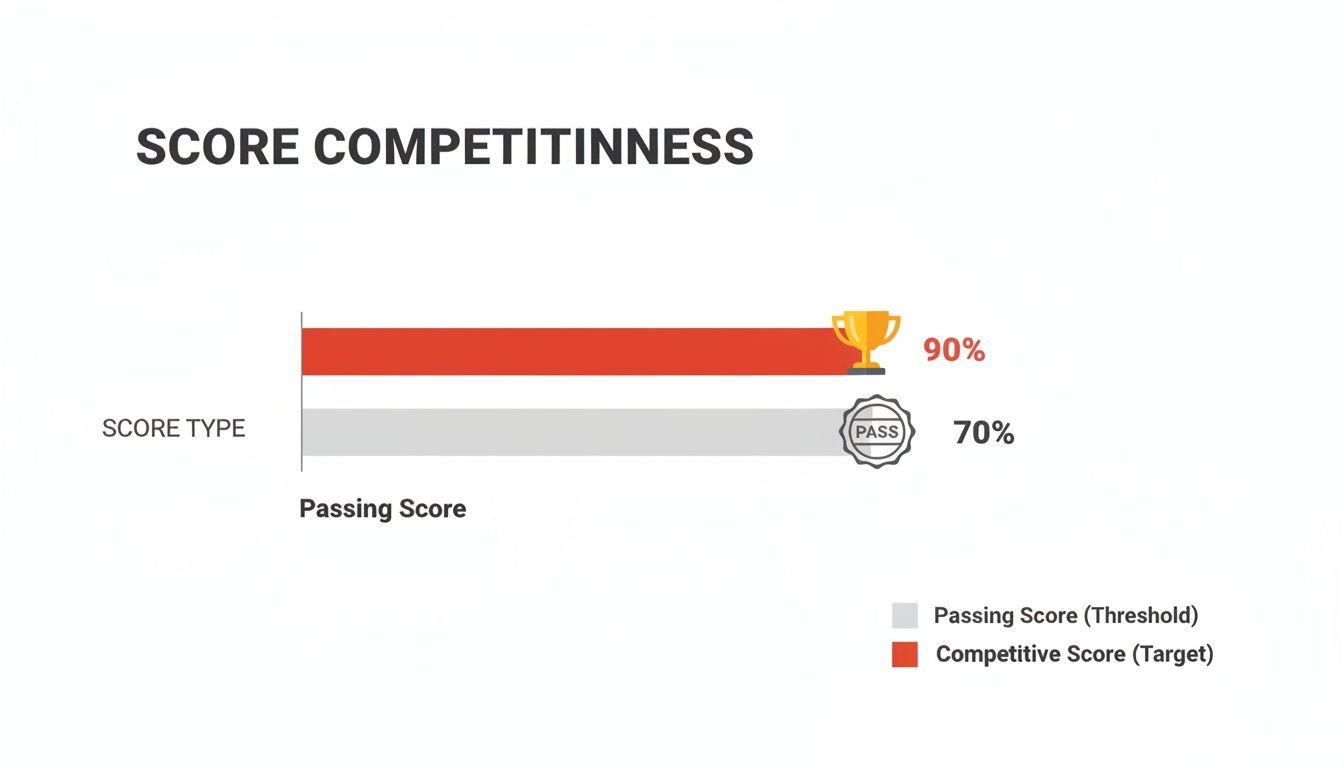
As you can see, just passing is the absolute baseline. A truly competitive score—the kind that opens doors to top opportunities—requires a much higher level of performance.
Benchmarking with Real-World Data
So what numbers should you really be aiming for? The best place to look is the data from the National Resident Matching Program (NRMP). It gives us a crystal-clear picture of what it takes to match.
For the 2022 Main Residency Match, the average Step 2 CK score for U.S. MD seniors who successfully matched was 247. But that's just an average. The numbers swing wildly by specialty. For instance, ultra-competitive fields like Plastic Surgery and Dermatology saw average scores of 256 and 251, respectively. On the other hand, specialties like Family Medicine and Psychiatry had averages closer to 238 and 241.
This data is your roadmap. It helps you set a target score that is both realistic and ambitious, giving you a concrete number to work toward.
A competitive score isn't just about being "above average." It's about being above the average for your desired specialty. Knowing this number is the first step toward building a successful match strategy.
To get a feel for where your goals fit into the broader landscape, you can take a deeper dive into the numbers with a more detailed analysis of Step 2 scores by specialty.
The table below provides a snapshot of the average scores for matched US MD seniors across various fields, illustrating just how much the competitive landscape can change from one specialty to another.
Average Step 2 CK Scores by Medical Specialty (Matched US MD Seniors)
| Specialty | Average Step 2 CK Score |
|---|---|
| Plastic Surgery | 256 |
| Dermatology | 251 |
| Orthopedic Surgery | 256 |
| Emergency Medicine | 247 |
| Internal Medicine | 248 |
| General Surgery | 250 |
| Anesthesiology | 245 |
| Pediatrics | 243 |
| Psychiatry | 241 |
| Family Medicine | 238 |
As you can see, the difference between what's needed for Family Medicine versus Orthopedic Surgery is significant. This is why a one-size-fits-all score goal simply doesn't work.
The IMG Consideration: A Higher Bar
For International Medical Graduates (IMGs), the strategic importance of a high Step 2 CK score gets dialed up even more. Competition for U.S. residency spots is fierce, and IMGs often need to score higher than their U.S. counterparts to be considered on equal footing for the same position.
A good rule of thumb for IMGs is to aim for a score 10-15 points higher than the average for U.S. seniors in your target specialty. This buffer helps to offset potential biases and serves as powerful proof of your clinical knowledge and readiness to excel in the U.S. healthcare system.
Ultimately, your target score should be a calculated decision based on:
- The competitiveness of your chosen specialty.
- Your applicant status (U.S. senior vs. IMG).
- The prestige of the programs you are targeting.
By weighing these factors, you can define a clear, personalized score goal that aligns with your professional dreams and gives you the best possible shot at matching.
How Your Step 2 CK Score Predicts Your Future Success
It’s easy to think of your Step 2 CK score as just another hurdle to clear on the path to residency. But its importance goes way beyond that—it’s a surprisingly powerful indicator of your future performance as a physician. Don't see it as just a test; view it as the clinical foundation you're building for your entire career.
A great score on this exam doesn’t just prove you can memorize facts. It shows you have a deep, integrated grasp of clinical science, the exact knowledge you'll pull from every single day in residency and for years afterward. That’s why aiming for your personal best is so critical.
The Clear Link to Board Certification
The connection between a strong Step 2 CK score and future success isn't just a theory; it's backed by solid evidence. The exam has been shown to have strong predictive validity for how you'll perform on your specialty board certification exams later on.
This means the sweat and effort you put in now pay off for years to come. Doing well on Step 2 CK is a direct investment in your future clinical competence, paving the way for a smoother journey through the final stages of medical credentialing.
Research really hammers this point home, showing that a high score dramatically boosts your chances of passing your specialty boards on the first try. For example, some studies suggest that a 10-point increase in your Step 2 CK score can make you 2.31 times more likely to pass your board certification exams. You can dig into the specifics and learn more about this research on clinical success predictors.
Why a Higher Score Matters in the Long Run
This statistical link reveals something crucial: the knowledge and critical thinking skills you sharpen for Step 2 CK are built to last. They don't just get you through one exam; they become the bedrock of your clinical reasoning for the rest of your career.
A higher score on Step 2 CK isn't just about winning a residency spot. It’s about building a deep, lasting foundation of medical knowledge that will serve you—and your patients—for your entire career.
When you start seeing your prep this way, the goal shifts. It's no longer about just hitting a passing number. It’s about achieving a score that proves you’ve truly mastered the material. This mindset transforms your studying from cramming into a quest for deep understanding of concepts that will stay relevant for decades.
This durable knowledge base directly impacts how effective and confident you'll be as a resident and, eventually, as an attending physician. It means you'll be better prepared to tackle complex cases, make sound clinical judgments, and deliver the highest standard of care. Put simply, a higher score is a strong signal that a physician is ready for the real-world challenges of modern medicine.
Creating A Comeback Plan for a Low Score
Getting a disappointing Step 2 CK score report can feel like hitting a brick wall. It’s a gut punch, no doubt, but it is absolutely not the end of your medical career. Your first move isn't to panic; it's to take a deep breath and start building a smart, resilient plan to move forward.

Before you do anything else, give yourself a moment to process the news. Making rash decisions fueled by emotion is a recipe for another misstep. When you're ready, it's time for an honest, objective look at your performance report. Pinpoint the specific content areas or question types that tripped you up. This data isn't a judgment—it's your roadmap for what comes next.
If You Did Not Pass The Exam
If your score came in below the USMLE Step 2 CK passing score of 214, your immediate focus needs to be on the retake policies. The USMLE program has a hard limit: you can only take the same Step exam a total of four times. That’s it. After a fourth failed attempt, you become ineligible to reapply for that Step, so every single attempt has to count.
Simply re-reading the same books or re-watching the same videos won't cut it. Your comeback requires a completely different study approach. Repeating the same strategy is almost guaranteed to produce the same result. This is the time to consider getting expert guidance to rebuild your plan from the ground up.
If You Received a Low Pass
Getting a score that's technically passing but lower than you'd hoped for presents a different kind of challenge. You've cleared the minimum hurdle, which is great, but now the game shifts. Your new mission is to make every other part of your residency application absolutely shine.
This is your chance to build a narrative of resilience and prove you're more than a test score.
A low score doesn't define you, but how you respond to it can. Proactively strengthening other areas of your application demonstrates maturity and determination to program directors.
To offset a score that doesn't reflect your true potential, pour your energy into these key areas:
- Secure Stellar Letters of Recommendation: Connect with attending physicians who can speak directly to your clinical skills, work ethic, and professional character. A glowing LoR from a respected source carries immense weight.
- Highlight Research and Extracurriculars: Now is the time to showcase your publications, presentations, or any significant leadership roles. These demonstrate your passion and unique talents outside of standardized tests.
- Craft a Compelling Personal Statement: Use this space to tell your story. A well-written personal statement can frame your journey, highlight what you've learned from challenges, and express your unwavering commitment to medicine.
Whether you're gearing up for a retake or reinforcing a low pass, a detailed, actionable plan is non-negotiable. For those planning a second attempt, a well-structured approach is the only way to succeed. For more in-depth advice, check out our complete guide on creating a USMLE retake strategy to make sure your next step is a huge step forward.
FAQs: Your Step 2 CK Score Questions, Answered
Let's clear up a few common questions that pop up after we've gone through the numbers. Getting these details straight can help solidify your understanding and ease some of that post-exam anxiety.
Is the USMLE Step 2 CK Graded on a Curve?
Nope, it’s not. This is a common misconception, but your score isn't curved against the other students who took the test on the same day as you.
The exam is standardized. Your performance is measured against a fixed, predetermined standard—that magic usmle step 2 ck passing score of 214. This means your success depends entirely on your own performance, not how others did.
When Do Step 2 CK Scores Expire?
For the purpose of getting your medical license, most state boards want you to have all your USMLE Steps done and dusted within a seven-year window.
But here’s the key takeaway: residency programs can set their own rules. Some might be stricter and prefer more recent scores, so it’s always smart to check the specific requirements for the programs you’re targeting.
Remember this: Programs receive your entire USMLE transcript—every attempt, both passing and failing. Don't try to hide a past failure. Instead, focus on showing growth and improvement. That’s a story directors respect.
Feeling like you need a better game plan for your medical board exams? Ace Med Boards provides expert one-on-one tutoring to build a study strategy that gets you the score you need for your dream residency. Find out how we can help at https://acemedboards.com.

