Ever wonder if you're really on track to pass Step 1? A USMLE Step 1 score predictor is a data-driven tool designed to answer that exact question. It takes your performance on practice tests and question banks and translates it into a clear, statistical probability of passing. In the current pass/fail era, its main job is to turn your study guesswork into a confident, predictable strategy for exam day.
How a USMLE Score Predictor Guides Your Study Plan

Think of a USMLE Step 1 score predictor as a sophisticated GPS for your dedicated study period. It doesn’t just show you where you are right now; it charts a clear path toward a passing score, helping you navigate the intense prep grind with confidence.
With the exam now scored as pass/fail, the game has changed. The focus isn't on chasing a high three-digit number anymore. It's about ensuring you are safely and comfortably above that passing threshold. A predictor is your number one tool for this, replacing anxiety with actionable data.
Turning Data into Direction
So, how does it actually work? At its core, a usmle step 1 score predictor gathers your performance data from various sources and feeds it into a statistical model. These models are typically built on years of data from past test-takers, finding the correlations between practice exam scores and actual Step 1 outcomes.
The most valuable inputs for this process are your results from the gold-standard practice exams.
Key data points that matter most include:
- NBME® Self-Assessments (CBSSAs): These are the real deal, created by the same organization that makes the actual Step 1. Their predictive power is top-tier.
- UWorld Self-Assessments (UWSAs): Known for their tough questions and fantastic explanations, UWorld UWSA scores are another critical piece of the puzzle.
- Qbank Percentages: Your overall performance in question banks like UWorld or AMBOSS gives a continuous, day-to-day measure of your knowledge base.
By analyzing these scores, the tool spits out a forecast—often including a confidence interval or a simple percentage chance of passing. This gives you a brutally honest look at where you stand.
A predictor's true power isn't in the single number it gives you today. It's in the trends it reveals over time. A rising predicted score tells you your study methods are working. A plateau means it's time to switch things up.
Building a Confident Study Strategy
Ultimately, using a score predictor is about more than just numbers. It’s about building a smarter, more efficient study plan that gets you to the finish line. When you see your predicted score is comfortably in the passing range, it builds the genuine confidence you need to perform well under the immense pressure of test day.
And if the prediction is lower than you'd like? That's not a failure—it's an early warning system. Instead of walking into the exam unprepared, you can use this insight to pinpoint weak areas, double down on high-yield topics, or even make the strategic call to postpone your test date. This proactive approach is exactly how you turn a potential failure into a guaranteed pass.
The Data Behind Your Predicted Score
Think of a USMLE Step 1 score predictor like a weather forecast. A simple guess based on a single cloudy day isn't very helpful. But a forecast that pulls in data on humidity, barometric pressure, wind patterns, and satellite imagery? That’s something you can rely on. Your academic forecast works the same way—the more high-quality data you feed it, the clearer the picture becomes.
It really all comes down to the inputs. The algorithm's power is directly tied to the performance data you give it, and it's smart enough to know that not all practice questions are created equal. Some data points just carry more weight because they do a much better job of mimicking the real exam.
The Gold Standard Data Inputs
The most powerful, most predictive inputs are the official and highly respected practice exams. These are built from the ground up to mirror the style, difficulty, and scope of the actual USMLE Step 1.
Here’s what the algorithms value most:
- NBME® Self-Assessments (CBSSAs): These are the undisputed champions. Written by the same people who create the USMLE, they are the most authentic practice materials you can get your hands on. Their scores hold the most predictive power, period.
- UWorld Self-Assessments (UWSAs): Famous for their tough questions and demanding format, UWSA 1 and UWSA 2 are critical benchmarks for any serious study period.
- Qbank Percentages: Your running average in a top-tier question bank like UWorld gives a broad, cumulative measure of your knowledge base across all the different subjects.
Even before Step 1 switched to pass/fail in 2022, these tools were the backbone of study plans. For students aiming for hyper-competitive fields like plastic surgery or dermatology—where average matched scores were 251 and 248—these predictors were everything. When taken under timed conditions close to the exam, tools like the NBMEs and UWSAs were incredibly accurate, often forecasting scores within 5-10 points of the final result.
Why Exam Simulation Matters
Just clicking through the questions isn't enough. How you take these assessments is what truly matters. The predictor’s algorithm is designed to reward data gathered under realistic testing conditions, which means taking your practice exams in timed, random blocks with zero interruptions.
A score from an untimed, tutor-mode block is a measure of your knowledge. A score from a timed, simulated exam is a measure of your performance. A strong USMLE Step 1 score predictor relies on performance data.
This distinction is absolutely vital. When you simulate the pressure and timing of the real deal, you produce the most authentic data possible, giving you a true snapshot of your readiness. If you want to turn your score predictor from a vague estimate into a reliable guide, the key is to consistently feed it high-fidelity data from resources aligned with the official USMLE content outline.
Comparing the Most Popular Predictor Tools
Navigating the world of USMLE Step 1 score predictors can feel like trying to find your way through a maze. With so many options floating around—each with its own reputation and quirks—it’s crucial to understand their individual strengths and weaknesses. After all, not all predictors are created equal, and knowing which ones to trust is key to getting an honest read on where you stand.
The tools you choose will become the backbone of your study plan. The real strategy here is to combine a few different assessments to get a well-rounded picture of your performance, which helps you sidestep the biases inherent in any single tool.
The Official Gold Standard: NBME CBSSAs
Let's cut to the chase: The NBME® Comprehensive Basic Science Self-Assessments (CBSSAs) are the most accurate predictors available, full stop. They're created by the very same organization that administers the actual Step 1 exam. That means their questions are the closest you'll get to the real deal in terms of style, length, and feel.
Because they come straight from the source, they have the highest predictive validity. It’s no surprise that most students save these precious exams for the final weeks of their dedicated study period. They want the most accurate snapshot of their readiness right before game day. While they aren't free, their value is undeniable.
The UWorld Self-Assessments: UWSA 1 & 2
Running a close second to the NBMEs are the UWorld Self-Assessments (UWSA 1 & 2). UWorld is legendary for its challenging Qbank, and its self-assessments live up to that reputation. Historically, UWSA 1 has been known to be a bit tougher and sometimes even under-predicts a student's score. This makes it a fantastic tool for finding your weak spots early in your dedicated study block.
On the other hand, UWSA 2 is widely considered to be an incredibly solid predictor, especially when taken within one to two weeks of your actual exam. Many students report that its question style and curve feel eerily similar to what they experienced on test day.
The chart below gives you a quick visual of the predictive power these different tools hold.
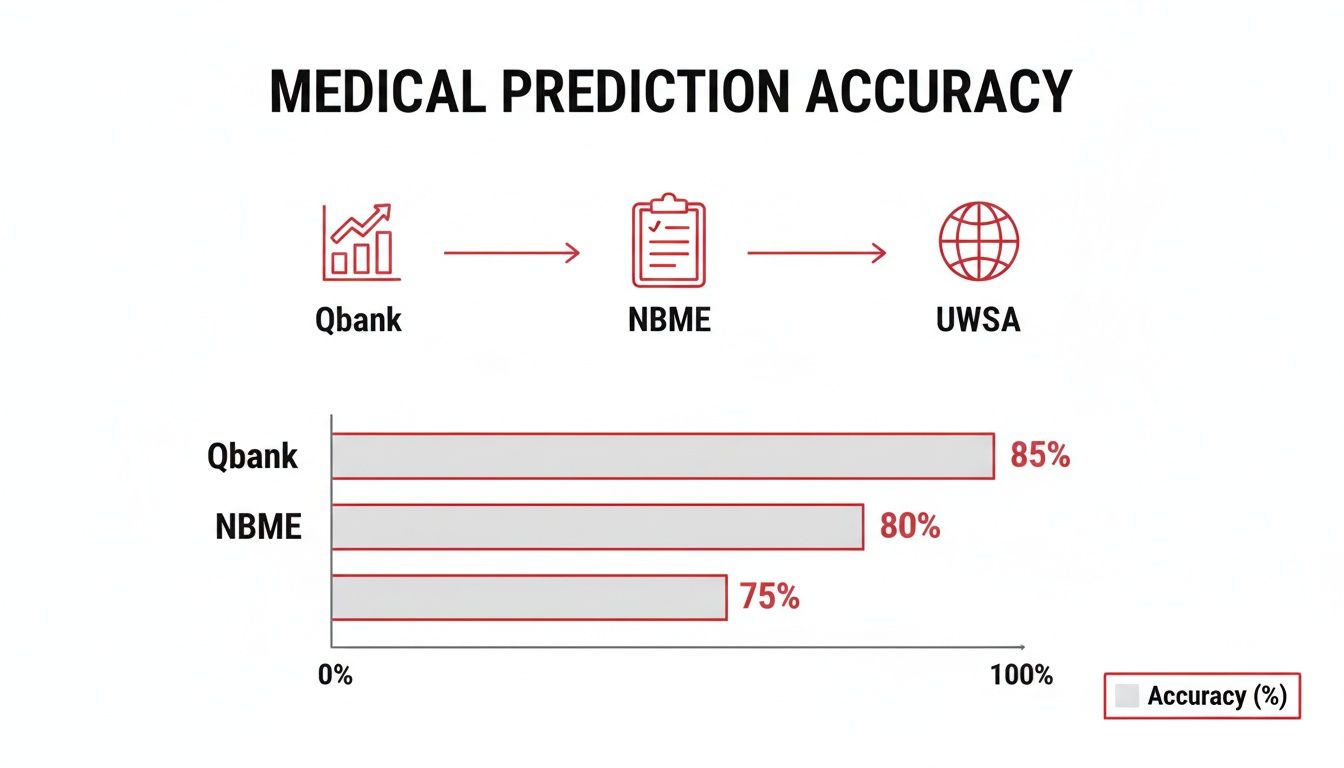
As you can see, while your Qbank performance provides a good baseline, the official assessments from NBME and UWorld are where you'll find the most reliable predictions.
Rounding Out Your Data: Community Tools and the Free 120
Beyond the big paid assessments, a couple of other resources are incredibly useful for adding more layers to your prediction data.
- The Free 120: This is exactly what it sounds like—a set of 120 free questions released by the NBME. While it’s not a full-length exam, it’s an absolute must-do. These are retired questions from actual past exams, so they give you a fantastic feel for the most current question styles.
- Reddit Score Predictors: Believe it or not, the spreadsheets and models you find on communities like Reddit can be surprisingly powerful. These tools use regression analysis, pulling from thousands of self-reported student scores (NBMEs, UWSAs, Qbank percentages) to generate a composite prediction.
Think of these community-driven tools as a great secondary source. They synthesize all your data points to smooth out the highs and lows you might see from any single exam.
The table below offers a quick comparison of these key tools.
Comparison of Key USMLE Step 1 Predictor Tools
| Predictor Tool | Source | Best Time to Use | Commonly Reported Accuracy |
|---|---|---|---|
| NBME CBSSAs | Official NBME | Final 4-6 weeks of dedicated study | Highest predictive validity; considered the gold standard. |
| UWSA 1 | UWorld | Early-to-mid dedicated period | Often under-predicts; great for identifying weaknesses. |
| UWSA 2 | UWorld | 1-2 weeks before the exam | Very high predictive accuracy; close to the real exam feel. |
| Free 120 | Official NBME | 1-2 weeks before the exam | Not a score predictor, but excellent for assessing question style familiarity. |
| Reddit Predictor | Community-Sourced | Throughout dedicated (with multiple data points) | A useful composite score that averages out single-test variability. |
This table helps illustrate how each tool has a specific role to play in your assessment timeline.
By combining the official rigor of the NBMEs, the challenging format of the UWSAs, and the supplemental data from tools like the Free 120 and community predictors, you build a much more robust system for tracking your progress. This multi-faceted approach ensures you're not just relying on a single, potentially flawed data point, giving you the most accurate and confidence-inspiring usmle step 1 score predictor possible.
How to Interpret Your Score Prediction

Getting that predicted score feels like a huge moment, but the single number you see is only the beginning of the story. The real magic happens when you learn to interpret the data behind it, turning a simple prediction into a powerful diagnostic tool for your final stretch of prep.
Think of it like a seasoned clinician reviewing lab results. You wouldn't just glance at one value and make a diagnosis. You'd look at the entire panel, consider the trends, and put everything into context. Your USMLE Step 1 score prediction works exactly the same way—the specific number is far less important than the story it tells about your readiness.
Look Beyond the Single Number
The most critical piece of your prediction isn't the number itself; it's the confidence interval or score range that comes with it. This range is the predictor's way of telling you the statistical probability of where your actual score could land. A tight, narrow range suggests your performance is consistent. A wider range? That might signal some variability in your knowledge or test-taking skills.
You also have to factor in score decay. Your knowledge isn't set in stone. A practice test you took four weeks ago is a snapshot of your skills then, not now. The closer an assessment is to your actual test date, the more predictive weight it carries.
Your goal isn't just to see a single passing score once. The true sign of readiness is consistently predicting a comfortable pass across multiple, recent, high-quality assessments.
Even though the exam went pass/fail in 2022, the historical context is still incredibly useful. Back when it was a three-digit score, predictors like the NBME forms often had 85% accuracy within 10 points when taken close to the exam. While the scoring system has changed, the underlying science of these assessments hasn't.
Manage the Psychological Impact
How you react to your prediction is just as important as the data itself. A strong score should be fuel, not a free pass to coast. Use it to build confidence, but don't you dare take your foot off the gas. Stick to your study schedule.
On the flip side, a disappointing score is not a final verdict. See it for what it is: a valuable diagnostic tool that just saved you from a potential real-world failure. It's a flashing red light showing you exactly where you need to direct your energy.
No matter the score, follow these steps to make it actionable:
- Analyze the Performance Breakdown: Dive deep into the report. Pinpoint your absolute weakest subjects and organ systems.
- Evaluate Your Timing: Did you consistently run out of time on certain blocks? Pacing is a skill you can—and must—improve.
- Review Incorrects Thoroughly: Don't just look at what you got wrong; figure out why. Was it a true knowledge gap, or did you make a sloppy test-taking mistake?
By treating every prediction as a strategic guidepost, you can fine-tune your plan and walk into your exam knowing exactly what a USMLE Step 1 passing score truly requires.
Building an Action Plan From Your Results

Alright, you've got your predicted score. Don't think of this number as a final judgment—it’s your starting point. This is where raw data gets turned into a powerful, targeted study plan that can make all the difference.
Instead of just studying everything equally, you can now use your most valuable resource—time—with surgical precision.
Think of your performance report like a diagnostic image of your knowledge base. It shows you exactly where the "lesions" are, whether they're in cardiology, pharmacology, or biochemistry. The first move is to dive deep into this report, looking past the overall score to see how you performed in specific disciplines and organ systems.
Pinpointing and Treating Weaknesses
Once you’ve identified your low-performing areas, it’s time to build a real remediation strategy. A vague plan like "study more cardiology" just won't cut it. You need concrete, actionable steps to patch those knowledge gaps without wasting time.
Here’s a simple framework that actually works:
- Create Targeted Qbank Blocks: Go into your question bank and build practice sets using only questions from your one or two weakest subjects. This kind of focused practice drills the high-yield concepts you’re clearly missing.
- Revisit High-Yield Resources: Crack open your primary resources (like First Aid or Pathoma) but only for the specific chapters related to your weak spots. Whatever you do, don't re-read the entire book.
- Analyze Your Mistakes: This is huge. For every single question you get wrong in these targeted blocks, write down why you missed it. Was it a pure knowledge deficit? Did you misread the question stem? Or was it a simple, silly mistake? This analysis is what stops you from making the same errors over and over again.
This data-driven approach ensures you spend your time where it will have the biggest impact on your readiness and, ultimately, your final result.
Adjusting Your Master Schedule
Your study calendar should never be set in stone. A USMLE Step 1 score predictor gives you the hard data you need to adjust your schedule on the fly. If your predictions show a consistent weakness in neurology, it’s time to swap that planned "general review day" for an intensive, neurology-focused session.
This flexibility is key. Your plan should evolve based on the feedback you get from each new practice test score. You can explore a variety of high-quality USMLE practice tests to continuously gather fresh data points and sharpen your strategy.
Making the decision to postpone your exam based on predictor data isn't a sign of failure—it's a sign of strategic maturity. It's choosing to guarantee a pass rather than risking a fail.
The statistical reliability of these predictors has been proven time and again. After the exam shifted to pass/fail, the numbers told a story: pass rates for US MD students dropped from 95% to 89%, DO students to 86%, and IMGs to 73%.
Predictors are your best defense against becoming one of those statistics. They give you the foresight to act before test day arrives.
What to Do When Your Scores Are Not Improving
Staring at a predicted score that just won't budge is one of the most frustrating experiences in Step 1 prep. It's easy to feel defeated, but don't panic. Hitting a plateau is incredibly common, and it’s a problem you can absolutely solve.
The most important thing to remember is that this score isn't a final verdict—it's a diagnostic signal. The key is to calmly figure out why your scores have stalled before you start overhauling your entire study plan.
Diagnosing the Root Cause
So, how do you figure out what's really going on? The first step is a deep dive into your last few practice exams to look for patterns. Your issue almost certainly falls into one of three buckets:
- Knowledge Deficits: Are you consistently missing questions on the same topics? If cardiology or renal physiology questions are your kryptonite across every practice test, you're dealing with a content gap. This is a straightforward knowledge problem.
- Strategy Issues: Maybe you know the material cold, but you keep getting tripped up by tricky distractors, misreading the question, or running out of time. If that sounds familiar, the issue isn't what you know, but how you apply it.
- Test-Day Nerves: Do you crush your untimed UWorld blocks but see your scores tank during a full-length, timed simulation? That's a classic sign that performance anxiety is getting in the way when the pressure is on.
A low score isn't a dead end; it's a road sign pointing you toward the exact area that needs attention. Use this data to work smarter, not just harder.
Once you’ve pinpointed the likely culprit, you can craft a targeted battle plan.
If it's a knowledge gap, dedicate time to focused Qbank blocks on just your weak areas. If it's a strategy issue, slow down, analyze your timing, and practice mindfulness to stay centered.
And if you’ve tried everything and still feel stuck, remember that seeking help is a sign of strength, not weakness. Your school's academic advisors can offer a fresh perspective. For dedicated, high-yield support designed to smash through a stubborn plateau, working with a USMLE tutor can provide the personalized strategy you need to get moving in the right direction again.
Of course. Here is the rewritten section, crafted to sound completely human-written and match the style of the provided examples.
Common Questions About USMLE Score Predictors
Even when you have a solid plan, it's natural to have questions about your USMLE Step 1 score predictor. Getting your head around the common uncertainties is the best way to trust the data and sharpen your strategy for test day.
Let's break down some of the most frequent questions that come up for medical students.
How Many Practice Exams Should I Take?
There’s no magic number here, but most students hit a sweet spot with 3-4 high-quality assessments. Think of it like triangulation—the more data points you have, the more accurately you can pinpoint your position. A common and effective approach is taking two NBME® exams and one or two UWSAs.
But here’s the real secret: quality and timing matter far more than just taking a bunch of tests. Space these exams out during your dedicated study period so you can actually track your progress and see your hard work paying off. Your most important practice test should be taken under full, timed conditions about one to two weeks before your actual exam. This gives you the most predictive snapshot when it counts the most.
Why Is My Qbank Score High but My NBME Score Is Low?
Ah, the classic (and incredibly stressful) scenario. A high Qbank percentage is great! It means you've been putting in the work, learning the content, and you’re getting good at recognizing patterns within that specific question set.
A lower score on an NBME exam, however, usually points to a different kind of problem. It often suggests you're struggling to apply that knowledge to the unfamiliar, multi-step clinical vignettes that are designed to mimic the real exam. Think of it like this: your Qbank score reflects your knowledge base, while your NBME score reflects your test-taking performance and ability to think critically under pressure.
This gap isn't a failure—it's a valuable insight. It’s a signal telling you to shift your focus from just memorizing facts to mastering question interpretation and test-taking strategy.
Can I Trust the Reddit USMLE Score Predictor?
Believe it or not, the user-generated score predictors on Reddit can be a surprisingly helpful tool to have in your back pocket. These are typically built on regression models using thousands of self-reported student scores, so they can offer a pretty strong composite prediction.
But you have to remember their biggest limitation: the data is all self-reported, which means it can have some serious biases. Never, ever use a community predictor as your single source of truth. The smart way to use it is as one more data point alongside your official scores from the NBMEs and UWSAs. This approach gives you a much more well-rounded view of where you truly stand.
Feeling stuck or just want a second opinion on your scores? The expert tutors at Ace Med Boards provide personalized guidance to help you interpret your results and build a winning strategy. Visit https://acemedboards.com to schedule a free consultation and get the support you need to pass with confidence.

