
The most effective study methods aren't about brute force—they're about working with your brain's natural learning processes. Active, evidence-based strategies like active recall and spaced repetition consistently blow passive techniques like re-reading or highlighting out of the water.
Building your study plan around these powerhouse methods is the absolute foundation for success on high-stakes medical exams.
Your Blueprint for High-Stakes Exam Memorization
For medical students staring down the barrel of USMLE or COMLEX, time is your most precious, non-renewable resource. Wasting hours on inefficient study habits isn’t just frustrating; it's a direct threat to your score.
The old-school approach of re-reading lecture notes or highlighting textbooks feels productive. But cognitive science has shown this creates a dangerous illusion of competence—a false sense of familiarity, not true, durable knowledge. It's like trying to build a house on sand. The structure looks okay at first, but it will absolutely collapse under the pressure of a board-style exam.
To build a rock-solid foundation of medical knowledge, you need a blueprint based on how memory actually works. This guide gives you that blueprint. We're going to move beyond surface-level tips and get into the powerful, evidence-based memorization methods that top-performing students swear by.
This isn't about studying harder; it's about studying smarter by aligning your efforts with your brain's design. For a broader look at sharpening your learning skills, platforms like Shortgenius offer interesting approaches to efficient knowledge acquisition.
Prioritizing High-Utility Techniques
The first step in upgrading your study plan is learning to tell the difference between high-utility and low-utility methods. Let's be clear: not all study techniques are created equal. Knowing where to invest your energy is critical.
High-Utility Methods: These are the heavy hitters backed by extensive research. They deliver significant, long-term memory benefits. We're talking about active recall (testing yourself), spaced repetition (reviewing at increasing intervals), and interleaving (mixing different topics in a single session).
Low-Utility Methods: These are the popular, comfortable methods that unfortunately provide minimal long-term benefits. This list includes re-reading, highlighting, summarizing text as you read it, and cramming the night before an exam. They might feel helpful in the moment, but they rarely lead to the deep, flexible knowledge required to crush board-style questions.
Making the shift from passive review to active engagement is the single most important change you can make to your study habits. It's the difference between being a spectator and being the star player in your own learning.
By using the right strategies from the start, you create a system that compounds over time. Every concept you learn using active recall becomes a stronger, more accessible piece of your mental library. To get help structuring your schedule around these methods, check out our guide on creating a personalized study schedule with our https://acemedboards.com/exam-preparation-planner/.
This kind of structured approach ensures you’re not just covering material, but truly mastering it for exam day.
High-Utility vs Low-Utility Memorization Techniques
To make this crystal clear, let's compare the most common study techniques. This table breaks down what works, what doesn't, and why, helping you focus your limited time on the strategies that will actually move the needle on your score.
| Technique | Utility Level | Why It Works (Or Doesn't) | Best For |
|---|---|---|---|
| Active Recall (Practice Testing) | High | Forces your brain to retrieve information, which strengthens neural pathways. It's like lifting weights for your memory. | Solidifying facts, understanding concepts deeply, identifying knowledge gaps. |
| Spaced Repetition | High | Interrupts the natural forgetting curve by scheduling reviews at optimal intervals, moving info to long-term memory. | Long-term retention of large volumes of information (e.g., pharmacology, microbiology). |
| Interleaving | High | Mixing different but related topics forces your brain to distinguish between concepts, leading to more flexible knowledge. | Developing problem-solving skills and applying knowledge to varied clinical vignettes. |
| Dual Coding | High | Combining words and visuals (e.g., diagrams, charts) creates two distinct memory pathways, making recall easier. | Complex processes like pathophysiology, biochemical pathways, and anatomy. |
| Re-reading | Low | Creates a false sense of fluency without building strong memory traces. It's passive and inefficient. | A quick, initial exposure to a topic, but not for deep learning or retention. |
| Highlighting/Underlining | Low | Feels productive but often leads to mindless marking without real comprehension. It doesn't require cognitive effort. | Pinpointing key sentences after you already understand the material. |
| Summarizing (as you read) | Low | Can be useful, but most students do it passively, simply rephrasing sentences without true synthesis or understanding. | It becomes a high-utility method only when done from memory (a form of active recall). |
| Cramming | Low | Overloads short-term memory, which is highly volatile. Information is quickly forgotten after the exam. | A last-ditch effort for short-term recall, but terrible for long-term board preparation. |
The evidence is overwhelming. Focusing your energy on the "High" utility techniques is non-negotiable for anyone serious about excelling on their medical board exams. The following sections will break down exactly how to implement these powerhouse methods into your daily study routine.
How Your Brain Actually Learns and Remembers
To really nail the best study methods, you first have to understand why they work. So, let’s take a quick look under the hood at how your brain handles the mountains of information you need for medical exams. Forget the dense neuroscience—just think of your brain as a massive library and your memory as the librarian in charge.
Every single new fact you encounter, from a drug's mechanism of action to an obscure anatomical structure, is like a new book arriving at the library. This isn't magic; it's a simple three-step system: encoding, storage, and retrieval.
From Sensory Input to Stored Knowledge
First up is encoding. This is the process of getting the book into the library's system. Your brain takes the information from your senses—what you see in a textbook or hear in a lecture—and converts it into a format it can actually file away. The more actively you engage with the material during this stage, the better the book gets cataloged.
Next comes storage. This is where the librarian decides where the book goes. Will it be dumped on a temporary cart near the entrance, or carefully placed on a permanent, organized shelf for the long haul? This distinction is absolutely critical for board exam prep.
Short-Term (Working) Memory: This is the temporary cart. It holds a tiny amount of information for a very short time. All-night cram sessions overload this cart, but the books never get properly shelved.
Long-Term Memory: This is the library's permanent, organized shelving system. Information moved here is durable and accessible later. The whole point of effective studying is to make sure every high-yield fact makes it onto these shelves.
Finally, there's retrieval—the act of finding the book right when you need it, like during a timed USMLE block. If a book was properly encoded and stored with clear connections to other topics (like shelving a cardiology drug next to relevant pathophysiology texts), finding it is quick and efficient. If it was just tossed onto the temporary cart, retrieval is slow, unreliable, or flat-out impossible.
Why Your Brain Prefers a Challenge
This library analogy perfectly explains why passive study techniques are a waste of time. Simply re-reading a chapter is like glancing at a book cover without ever checking it in. The librarian barely even registers its existence. Your brain needs a good reason to put in the effort to properly shelve that information.
This is where the concept of desirable difficulties comes into play. Cognitive scientists have discovered that making the learning process a bit harder actually strengthens the encoding and retrieval processes, leading to much better long-term retention.
This principle is the foundation of every truly effective study method. Techniques like active recall are "desirable difficulties" because they force your brain to actively search the shelves, strengthening the path to that information for the next time you need it.
Understanding this core concept is a crucial first step in learning how to improve memory retention for your exams. It’s not about making studying impossible; it’s about choosing the right kind of challenging activities that build knowledge that actually lasts.
Spaced Repetition and Active Recall: The Power Duo
If you’re looking for the two most foundational pillars of evidence-based studying, look no further than spaced repetition and active recall. While each is incredibly effective on its own, their true magic lies in how they work together. Think of them as a synergistic pair that builds durable, long-term knowledge—the kind that holds up under the pressure of USMLE or COMLEX.
Let's use a simple analogy: building muscle at the gym.
Active recall is the heavy lifting. It’s that difficult, sweaty, effortful act of pulling an answer from deep within your brain without glancing at your notes. Spaced repetition, on the other hand, is the perfectly timed recovery schedule that allows the muscle—your memory—to repair and grow back stronger than before.
If you skip the active recall, you're just passively staring at the weights. It feels like you're doing something, but no real growth happens. And without spaced repetition, you're either lifting the same weight every single day (leading to burnout) or waiting too long between workouts (leading to atrophy). You have to get the timing right.
This power duo directly optimizes the brain's natural process for memory: encoding information, storing it away, and retrieving it when needed.
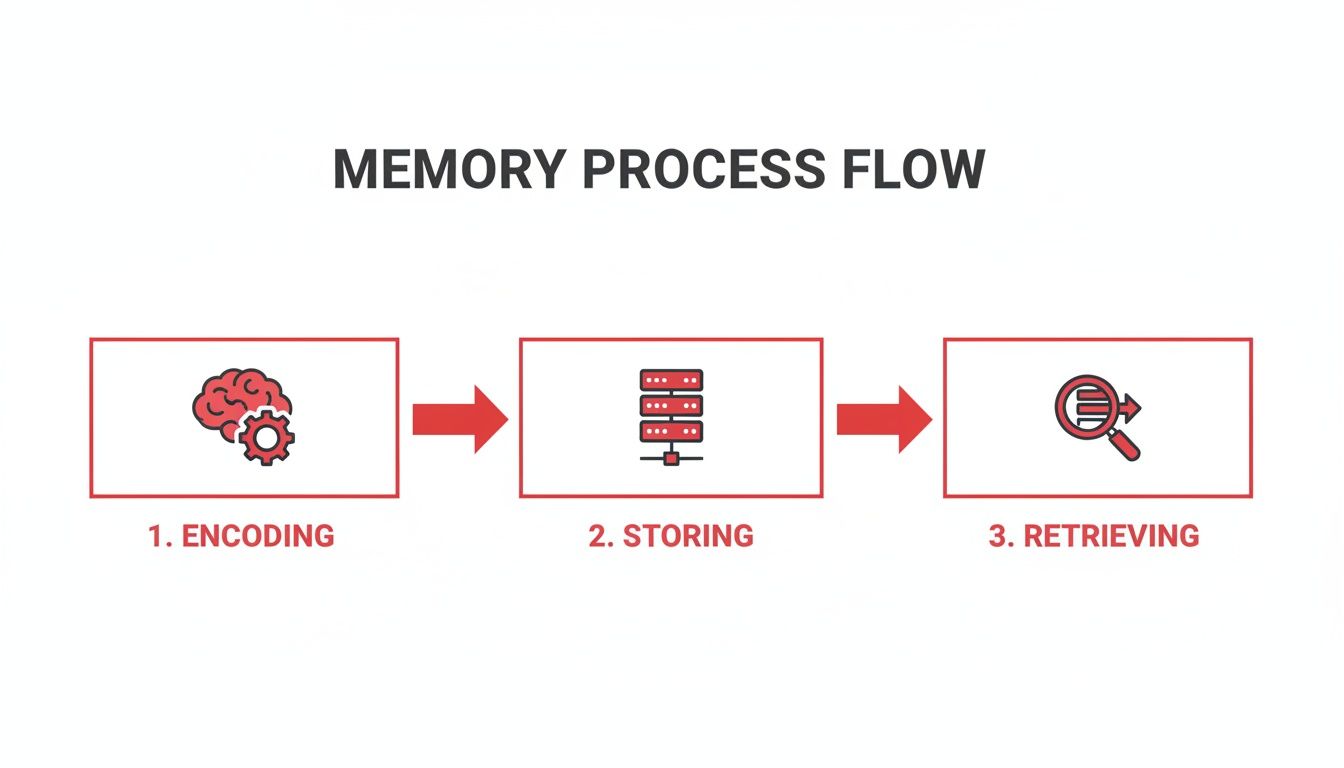
Every time you engage in active recall, you strengthen that retrieval pathway, making it faster and more reliable for exam day.
Mastering Active Recall for Medical Boards
At its core, active recall is just the art of self-testing. It forces a critical shift in your thinking. Instead of asking your brain, "Do I recognize this?" you demand an answer to, "Can I explain this concept from scratch, right now?" That simple switch from passive recognition to active retrieval is the secret to deep, lasting comprehension.
For med students, the best active recall tools are likely already in your study plan:
Question Banks (Q-banks): Resources like UWorld and Amboss are active recall goldmines. Every single question forces you to retrieve knowledge and apply it to a clinical vignette. Don't just blaze through questions; analyze every answer choice—especially the wrong ones—to truly understand the underlying principles.
Flashcards (The Right Way): Your flashcards should demand a real answer, not just a simple head-nod of recognition. Instead of a card that says, "What is the mechanism of Metformin?", try something that forces a deeper explanation, like, "Explain the primary mechanism, major side effects, and key contraindications of Metformin."
The Feynman Technique: Pick a complex topic—say, the renin-angiotensin-aldosterone system—and try explaining it out loud to an imaginary five-year-old. This exercise is brilliant because it forces you to simplify complex ideas and instantly reveals any gaps in your own understanding.
Implementing Spaced Repetition Systems
Spaced repetition is a beautifully simple concept that works with your brain's natural forgetting curve instead of fighting against it. By reviewing information at increasing intervals—right at the moment you’re about to forget it—you send a powerful signal to your brain: "Hey, this is important. Move it to long-term storage."
This is known as the Spacing Effect, a well-documented cognitive phenomenon. It’s why studying for a total of eight hours spread across two weeks leads to massively better retention than cramming for eight hours straight the night before an exam.
The most practical way to put this into action is with a Spaced Repetition System (SRS). The undisputed champion in this space is the software Anki. For a complete walkthrough, check out our guide on https://acemedboards.com/spaced-repetition-anki/ for medical exams.
Anki automates the entire scheduling process. After you answer a flashcard, you tell the program how difficult it was. Anki's algorithm then calculates the perfect time to show you that card again—whether it's in one day, ten days, or three months.
This data-driven approach ensures you spend more time on the material you struggle with and waste less time on concepts you’ve already mastered. It’s easily one of the most efficient study methods out there. For a broader look at similar techniques, explore these science-backed methods to memorize vocabulary.
Building Your Mental Palace with Mnemonic Devices
Let's be honest. When you’re staring down a list of the cranial nerves, Krebs cycle intermediates, or drug side effects, rote memorization feels like trying to build a sandcastle against an incoming tide. It's frustrating and, frankly, not very effective. This is exactly where mnemonic devices come to the rescue. Think of them as mental scaffolding, helping you transform abstract, disconnected information into concrete, unforgettable stories.
While most of us learned basic acronyms in school, those are just the tip of the iceberg. The most powerful mnemonic systems tap into your brain's incredible wiring for spatial and visual memory. By creating vivid, bizarre, or even humorous mental images, you forge connections that are far stronger and more durable than any simple list of words.
This approach flips the script on studying. It turns learning from a passive chore into an active, creative process. Instead of just reading a fact and hoping it sticks, you're actively building a mental story around it, making that information uniquely yours and much easier to pull up under pressure.
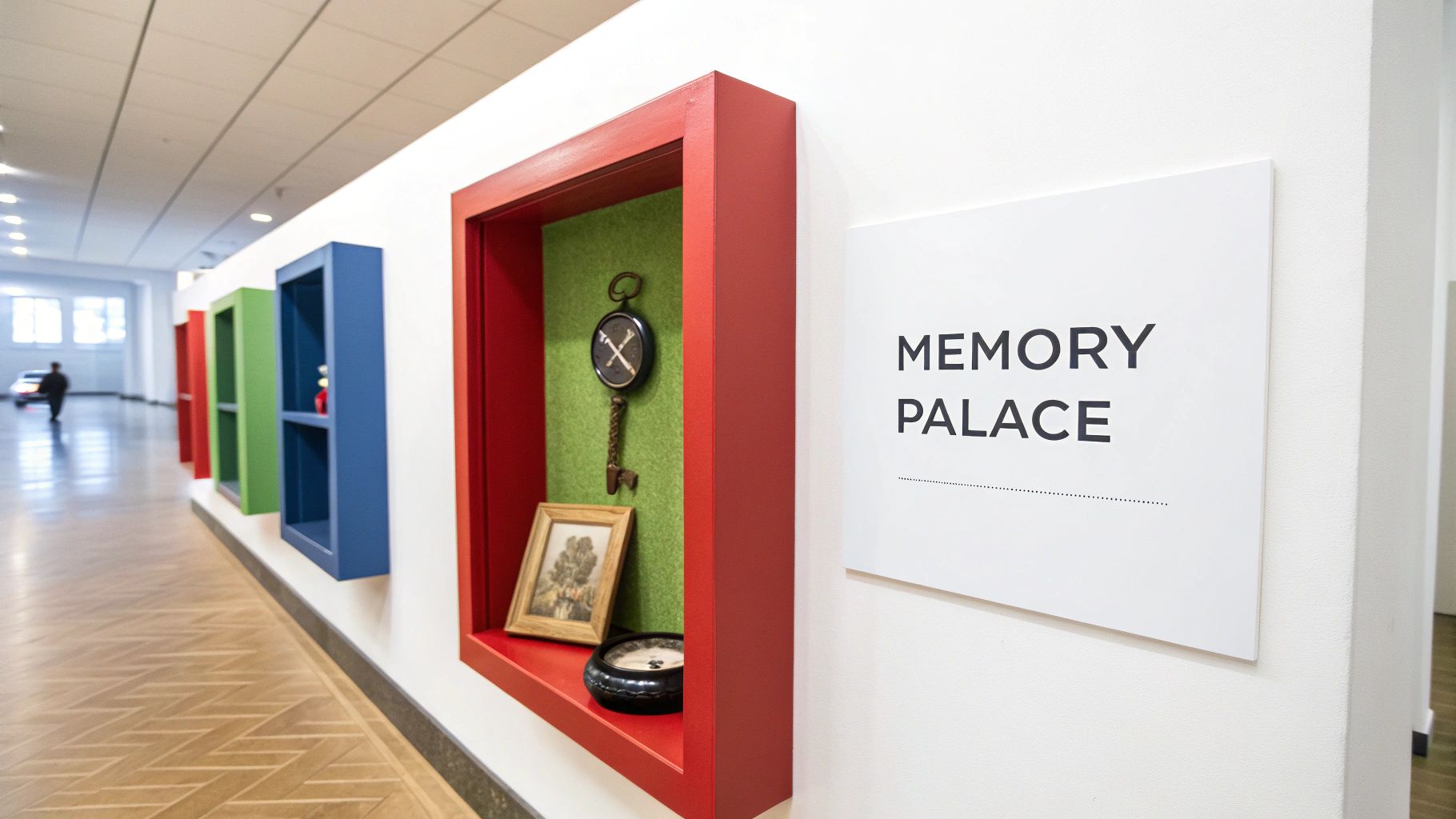
Unlocking the Method of Loci
The undisputed king of these techniques is the Method of Loci, famously known as the "memory palace." This ancient Greek method is surprisingly simple in concept: you visualize a physical space you know intimately—like your childhood home or your daily walk to class—and "place" the information you need to remember at specific points (loci) along that mental route.
The power here isn't just anecdotal; modern science backs it up. A landmark 2017 Stanford study revealed that training in the Method of Loci could actually reshape a novice's brain to match the connectivity patterns of world-class memory champions. After just six weeks of training, participants could recall an average of nearly 71 out of 72 words after 20 minutes—a massive leap from the average of 40 in the control group. This proves a powerful point: a superior memory isn't a gift, it's a trainable skill. You can learn more about how this ancient tool bulks up brain connections from the Stanford study findings.
To build your own memory palace, you just need to mentally walk through your chosen location and link each piece of information to a specific object or spot. The secret? The more absurd, multi-sensory, and ridiculous the image, the better it will stick.
A Practical Example: Conquering the Brachial Plexus
Let’s put this to the test with a notoriously tough topic for med students: the brachial plexus (Roots, Trunks, Divisions, Cords, Branches). We’ll use a simple memory palace—the rooms of a house you know well.
Roots (C5-T1) – The Mudroom/Entrance: Picture yourself opening your front door, only to find five giant, dirty tree roots (for C5) blocking the way. A frantic cat is tangled in them, making a huge mess. You grab a towel (for T1) to start cleaning up.
Trunks (Superior, Middle, Inferior) – The Living Room: You finally get inside and walk into the living room. On the couch, a king with a crown sits in a superior position, looking down on everything. In the middle of the floor, a standard-issue army trunk is wide open. And below the window, in an inferior spot, is a small, old footlocker.
Divisions (Anterior, Posterior) – The Kitchen: Next, you head to the kitchen. For some reason, every single cabinet door has been split in half. The front (anterior) half of each door is painted a bright, obnoxious green, while the back (posterior) half is a dark, shadowy blue.
Cords (Lateral, Medial, Posterior) – The Bedroom: You go to your bedroom and find a massive electrical cord snaking around the room. It climbs up the lateral wall, runs across the ceiling directly in the middle (medial), and then drops down the posterior wall right behind your bed.
Branches (Major Nerves) – The Bathroom: Finally, you enter the bathroom, and it's pure chaos. A Musketeer (Musculocutaneous) is flexing dramatically in the mirror. An Ax-wielding lumberjack (Axillary) is chopping at the door. A yellow Median stripe is painted down the middle of the floor. A disgusting Ulcer (Ulnar) is growing on the sink. And a Radio (Radial) is blasting music at full volume from inside the shower.
This story is completely bizarre, but that’s precisely why it works. You've just transformed a dry anatomical list into a memorable journey through a familiar space. This is just one of many advanced memorization techniques for med school you can add to your toolkit.
Once you've got a handle on active recall and spaced repetition, it's time to layer in some more advanced memory techniques. Think of interleaving and dual coding as performance enhancers. They're designed to push your brain beyond simple fact recall and into building the flexible, deeply connected knowledge base you need for tough clinical vignettes on board exams.
These strategies are what separate the students who can list symptoms from those who can diagnose a complex patient presentation. They help you break through learning plateaus and start seeing how all the pieces of medicine fit together.
Supercharge Your Practice with Interleaving
Imagine a baseball player who only practices hitting fastballs. They'll get great at hitting fastballs, no doubt. But what happens when the pitcher throws a curveball? They’ll be completely lost.
Interleaving is the training fix for this exact problem. It’s the simple but powerful practice of mixing up different (but related) topics within a single study session.
Instead of grinding through cardiology questions for four hours straight—a method called "blocking"—an interleaved session might look like this: one hour of cardiology, followed by an hour of pulmonology, an hour of renal, and then maybe swinging back to cardiology.
This constant switching feels harder. It feels less productive. That's because it is harder, but this "desirable difficulty" is exactly why it works so well. Your brain is forced to constantly unload one mental model and fire up another, forcing you to discriminate between problem types and select the right framework every single time.
Studies consistently show that while blocking might feel better during the practice session, interleaving leads to significantly better long-term retention and much higher scores on the actual exam. It builds the mental agility you need to nail a diagnosis when multiple organ systems are in play.
This method is a direct simulation of the USMLE and COMLEX. You won't get a neat block of 40 cardiology questions. You'll jump from chest pain to shortness of breath to acute kidney injury, all within a few minutes. Interleaving prepares you for that reality.
How to Implement Interleaving in Your Study Plan
Putting this into practice is pretty straightforward. The main challenge is fighting the urge to "master" one topic before moving on. You have to embrace the jumbled-up practice.
- Mixed Q-Bank Blocks: This is the easiest way. When using UWorld or Amboss, create timed, random blocks with questions from several subjects you've covered recently. It’s the most direct way to simulate the exam and get the benefits of interleaving.
- Rotate Your Flashcards: Instead of powering through your entire cardiology Anki deck, set up a custom study session that pulls cards from three or four different organ system decks at once. This forces you to switch mental contexts with every single card.
- Vary Your Subjects Daily: Structure your days to cover two or three different subjects. A morning on pharmacology, an afternoon on microbiology, and an evening review of pathology is far more effective for long-term memory than spending a whole day on just one of those topics.
By making your brain work harder to pull up information, you're building stronger, more adaptable neural pathways. It's one of the best ways to prepare for the random, unpredictable nature of board exams.
Double Your Memory Pathways with Dual Coding
The second advanced strategy, dual coding, is built on a simple premise: our brains process words and images through two separate channels. When you combine them, you create two distinct pathways to the same piece of information, essentially doubling your chances of recalling it under pressure.
Think about it. When you try to remember the Krebs cycle, are you just recalling the names of the enzymes, or do you also see a mental picture of the diagram from your textbook? For most of us, that visual component is a powerful anchor. Dual coding is about intentionally creating that synergy.
This means any time you can pair a verbal concept with a visual one, you're cementing that memory. It's why drawing out the coagulation cascade while saying each step aloud is exponentially more effective than just reading about it. The physical act of drawing (visual-motor) combined with explaining it (verbal) encodes the information through multiple channels.
Here are a few practical ways to use dual coding:
- Draw diagrams from memory for things like anatomical structures, physiological loops, or biochemical pathways.
- Create simple charts or tables to compare and contrast different drugs, bugs, or diseases.
- Use visual mnemonics, like the ones found in popular resources such as SketchyMedical.
- Watch animated videos explaining a topic, then try to replicate the drawings and the narration on your own whiteboard.
By actively creating both a verbal and a visual hook for every concept, you’re giving your future self more ways to find that information when the clock is ticking on exam day.
Putting It All Together: Your Personalized USMLE Study Plan
All these powerful study techniques are great in theory, but they're useless without a solid plan to put them into action. Knowing about spaced repetition is one thing; actually doing it every day is what moves the needle on your USMLE or COMLEX score. This is where we turn these evidence-based concepts into a practical, personalized roadmap that actually works for you.
A good plan isn't a rigid prison. Think of it as a flexible framework that accounts for your unique strengths, weaknesses, and how you learn best. It’s about strategically weaving active recall, spaced repetition, and dual coding into a weekly schedule you can actually stick to. You’re essentially building a training regimen like an elite athlete—every session has a purpose, all aimed at peak performance on exam day.

Building Your Weekly Study Blocks
The heart of your plan is dedicating specific blocks of time to the techniques that give you the biggest bang for your buck. A classic med student mistake is to just "study" for hours on end without a clear goal. Instead, every block of your day should have a specific purpose tied to a proven memorization method.
Your schedule needs to be built on a few key pillars. First, make active recall with question banks your top priority—this should be the bulk of your active study time. Second, put your spaced repetition on autopilot with a tool like Anki so you never fall behind on reviews. Finally, block out some dedicated time for more creative learning, like sketching out pathways or building mnemonics.
It's incredibly helpful to know what your peers are actually doing. In a large survey, 92.4% of medical students said they rely on lecture slides and their own notes as their main study tool. This was followed closely by 74.8% who used old exam questions for active recall, which just goes to show that practice testing is a non-negotiable part of modern exam prep. You can discover more about medical student study habits in the full study.
A Sample Weekly Schedule Framework
Treat this as a starting point, not a prescription. Adjust the hours, topics, and timing to fit your life and energy levels. If you need a more detailed guide, we have an entire resource dedicated to helping you create a custom USMLE Step 1 study plan on our site.
Monday – Friday:
- Morning (3-4 hours): Active Recall. Kick things off with a 40-question, timed, random block from UWorld or Amboss. Use the rest of this time to do a deep-dive review of every question—even the ones you got right.
- Afternoon (2-3 hours): New Content & Dual Coding. Watch videos or read chapters on a new topic. As you go, actively create diagrams, flowcharts, or simple mind maps to lock in the information visually.
- Throughout the Day: Spaced Repetition. Knock out your daily Anki reviews. It’s much easier to break this up into a few 20-minute sessions during breaks than to face a mountain of cards at the end of the day.
Saturday:
- Morning (4 hours): Weakness Review & Interleaving. Hit another mixed question block, but this time, zero in on the subjects that are consistently tripping you up.
- Afternoon (2 hours): Mnemonic Creation. Set aside a focused block to build memory palaces or other mnemonics for those brutal, hard-to-memorize lists like drug side effects or microbiology classifications.
Sunday:
- Rest & Light Review: This is crucial. Take at least half the day completely off to prevent burnout. If you feel up to it in the evening, you can do a quick, low-stress run-through of your Anki cards or glance over the diagrams you made during the week.
Frequently Asked Questions About Memorization
Even when you’re using all the right study methods, practical questions always pop up. Let's tackle some of the most common ones I hear from medical students so you can fine-tune your study plan and lock in that knowledge for your board exams.
How Many Times Should I Review a Topic?
Forget about finding a magic number of reviews. The real goal isn't to cram a topic ten times in one day; it's to review it at the exact moment your brain is about to forget it. This is the core principle of spaced repetition.
For brand new material, a good starting point is to review it after one day, then three days, then one week, gradually extending the time between each review. This process strengthens the neural pathways, moving information out of fragile short-term memory and into durable long-term storage.
A tool like Anki automates this beautifully. It keeps track of how well you know each flashcard and calculates the perfect time for your next review, making sure you’re spending your energy exactly where it’s needed most. It’s far more efficient than trying to track this yourself.
Is It Better to Study One Subject All Day?
It might feel more productive to spend an entire day on cardiology, but mixing things up is almost always a better strategy for long-term recall. This technique is called interleaving, and while it feels harder in the moment, the research is clear: it leads to better performance on exam day.
Why? Because it forces your brain to work harder to switch between different concepts and pull information from memory, which builds stronger, more flexible connections.
So, instead of an eight-hour marathon on cardiology, a much better plan would be to study two hours each of cardiology, pulmonology, renal, and endocrinology. This mixed-up practice actually simulates the random nature of the USMLE and builds a knowledge base you can apply more effectively.
Can I Improve My Memory or Is It Fixed?
Memory is a skill, not a fixed trait you're born with. You can absolutely train your ability to memorize and recall enormous amounts of information by consistently using the right evidence-based strategies. Think of your memory as a muscle—it gets stronger with the right kind of training.
Techniques like the Method of Loci, active recall, and spaced repetition are trainable skills. In fact, a Stanford study showed that when novices trained in these methods, their brain connectivity patterns started to look like those of world-class memory champions. It’s not about having a “good” or “bad” memory; it’s about using the right tools consistently.
At Ace Med Boards, we specialize in helping you build these powerful strategies into a personalized study plan that works for you. Our expert tutors provide one-on-one guidance to pinpoint your weaknesses and develop the skills you need to crush the USMLE, COMLEX, and Shelf exams. Book a free consultation to see how we can help you hit your target score.

