
Let's be honest: the best study guide for USMLE Step 1 isn't some generic template you download. It's a personalized plan you build from the ground up, starting with a realistic timeline and a clear-eyed view of your own strengths and weaknesses. True success begins before you even crack open First Aid, by creating a solid foundation that targets your weak points from day one.
Building Your Foundation for Step 1 Success
Think of your Step 1 prep as a marathon, not a sprint. A strong start is everything. Before diving into the deep end of content review, you need to lay the groundwork. This is about building a study architecture that works for you, and it all starts with an honest look at your preclinical knowledge.
A huge piece of that foundation is simply speaking the language. You can't connect complex physiological concepts if you're stumbling over basic definitions. Nailing down an effective medical terminology study guide early on is an indispensable first move.
Conduct a Brutally Honest Self-Assessment
You can't fix what you don't acknowledge. Start by taking a hard look at your performance in your preclinical courses. Which subjects made you sweat? Was it the tangled pathways of biochemistry or the endless classifications in microbiology?
To get a real, data-driven picture, try this:
- Dig up old exams: Look for patterns in your mistakes. Were they simple recall errors, or did you consistently miss questions that required you to apply a concept?
- Take a diagnostic test: Fire up an NBME or do a random, timed block of UWorld questions. The score doesn't matter right now. What matters is the data—it will give you an objective baseline across all subjects.
- Rank your confidence: Make a list of all the major Step 1 subjects (pathology, pharmacology, etc.) and rank them from "I got this" to "Help me." This gut check, combined with your objective test data, creates a powerful roadmap. A detailed breakdown of USMLE Step 1 subjects can help you organize this list.
Set Goals Tailored to the Pass/Fail System
Now that Step 1 is pass/fail, the game has changed. Your goal isn't to chase a specific three-digit score but to build a knowledge base so solid that you're consistently and comfortably performing above the passing line.
Don't mistake pass/fail for "easy." When the change happened in 2022, the overall pass rate actually dropped to a historic low of 82%. This was partly because the passing threshold was raised to match the increased rigor of the exam.
That statistic should tell you everything you need to know about the importance of a solid plan. While recent pass rates have stabilized a bit, the initial drop proves you can't afford to wing it. Your goal is to make passing feel like a foregone conclusion, not a source of constant anxiety.
Design a Master Schedule That Protects You
Burnout is the single biggest enemy of your dedicated study period. A smart schedule isn't just about what you'll study; it's about when you'll rest, recharge, and live your life.
Before you slot in a single UWorld block, map out your non-negotiables: sleep, meals, exercise, and at least one protected day off each week. Once those are in place, you can block out your study time into focused, manageable chunks.
Maybe that looks like two 2-hour content review sessions in the morning, a question block after lunch, and a quick review in the evening, leaving your late evenings totally free. This kind of structure is a lifesaver—it crushes decision fatigue and makes an overwhelming task feel achievable, one day at a time.
A well-structured timeline is your best defense against burnout. Here’s a blueprint you can adapt to build your own schedule, adjusting the focus as you move through your dedicated period.
Your Personalized Study Timeline Blueprint
| Time Block | Early Phase (Weeks 1-3) | Mid Phase (Weeks 4-6) | Late Phase (Weeks 7-8) |
|---|---|---|---|
| 8:00 AM – 10:00 AM | Content Review (Weakest Subject First) | Content Review (Mixed Subjects) | Review of NBME incorrects / High-Yield Topics |
| 10:00 AM – 12:00 PM | 40-Question UWorld Block (Tutor Mode) | 40-Question UWorld Block (Timed, Random) | Full 40-Question NBME-style Block (Timed) |
| 12:00 PM – 1:00 PM | Lunch & Complete Break (No studying!) | Lunch & Light Walk | Lunch & Mental Rest |
| 1:00 PM – 3:00 PM | Detailed Review of Morning Qbank | Detailed Review of Morning Qbank | Review of Morning Block incorrects |
| 3:00 PM – 5:00 PM | Content Review (Second Subject) | 40-Question UWorld Block (Timed, System-based) | Targeted Content Review (Weakest Areas) |
| 5:00 PM – 6:00 PM | Anki / Spaced Repetition Review | Review of Afternoon Qbank | Anki / Review of "Marked" UWorld Qs |
| Evening | Protected Time Off (Exercise, Hobbies, Social) | Protected Time Off | Protected Time Off |
This blueprint isn't meant to be a rigid mandate, but a flexible framework. The key is the shift in focus: from building knowledge early on, to honing test-taking skills and stamina in the middle, and finally to targeted refinement in the home stretch. Your job is to plug in the specific subjects and resources that align with your self-assessment.
Choosing and Mastering Your Core Study Resources
Feeling overwhelmed by the sheer volume of Step 1 study aids is a rite of passage for every medical student. The key isn't to use everything you can find, but to master a select few high-yield tools. A focused approach is your best defense against resource overload and ensures you're spending your precious time on what truly moves the needle.
For years, the undisputed gold standard for Step 1 prep has been the trio of UWorld, First Aid, and Pathoma. We call it "UFAP," and for good reason. These three resources create a powerful, synergistic system that covers the exam from every angle—foundational concepts, clinical application, and high-yield fact consolidation.
Honestly, resisting the temptation to add a dozen other resources is your first major victory. Stick with the proven winners.
The Unbeatable Trio: Why UFAP Works
Each part of UFAP serves a distinct, critical purpose. Think of them as a three-legged stool—remove one, and the whole thing collapses. They aren't interchangeable; they're designed to be used together.
- First Aid (FA): This is your framework. It's the high-yield syllabus for the entire exam, organizing an insane number of facts into a digestible format. It tells you what you need to know.
- Pathoma: This is your foundation for understanding disease. Dr. Sattar’s videos build the conceptual understanding of pathology, which makes up a huge chunk of the exam. It explains why the facts in First Aid are true.
- UWorld (UW): This is your active learning engine. The question bank forces you to apply concepts from FA and Pathoma to clinical vignettes, just like the real exam. It tests how you apply what you know.
Mastering the interplay between these three is the core of any effective study guide for usmle step 1.
Turning UWorld Into Your Main Learning Engine
So many students make the mistake of seeing UWorld as just an assessment tool—something to save for the final weeks to see where they stand. This is a massive tactical error. UWorld should be your primary learning tool from the get-go.
The real gold in UWorld isn't your block percentage; it's the explanations. Each one is a mini-lecture that clarifies not only why the right answer is right but, just as importantly, why the wrong answers are wrong. This is where the deep learning happens.
To really get the most out of it, you need to shift your strategy:
- Start Early. Jump into UWorld at the beginning of your dedicated study period, even if your scores are humbling at first. Use "tutor mode" to review explanations immediately after each question.
- Use Small, Focused Blocks. Forget 100-question marathons. Start with smaller, system-based blocks of 20-40 questions. This lets you dive deep into the review without completely burning out.
- Master the Review. Your review of a 40-question block should take 2-3 times longer than it took to do the questions. For every single question—right or wrong—ask yourself, "Could I teach this concept to a classmate?"
The goal isn't just to get questions right. It's to understand the underlying pathophysiology so thoroughly that you could handle any variation of that question the exam might throw at you.
This methodical approach transforms every single question into a powerful learning opportunity, sharpening your clinical reasoning skills with every block you complete.
Making First Aid Your Personal High-Yield Bible
If your copy of First Aid is pristine and unmarked at the end of your study period, you've missed a huge opportunity. Your goal is to turn it from a generic textbook into a personalized, consolidated review guide packed with your own insights.
How? By actively annotating it with knowledge you gain from UWorld.
When a UWorld question clarifies a tough concept, presents a classic vignette, or gives you a brilliant mnemonic, add that pearl directly into the relevant section in First Aid.
Imagine you miss a question on Cushing's syndrome because you mixed up the screening and confirmatory tests. After reading the UWorld explanation, you’d flip to the endocrinology chapter in First Aid and jot a quick note next to the Cushing's section: "UW: Low-dose dex = screen. High-dose = confirms pituitary vs. ectopic ACTH."
This simple act connects an abstract fact in a book to a concrete clinical scenario you've already wrestled with. Over weeks of studying, your First Aid becomes a rich, interwoven document of high-yield facts and hard-won insights, making your final review incredibly efficient.
Your Actionable Week-by-Week Study Plan
Alright, you’ve got your resources lined up and a solid knowledge base. Now, it's time to turn that pile of books and subscriptions into a real, moving plan. A top-tier study guide for usmle step 1 isn’t just a checklist of topics; it’s a living, breathing schedule that adapts as you get closer to the big day. We'll slice a typical 8-week dedicated study period into three distinct phases, each with its own mission.
This phased approach is your best defense against feeling overwhelmed. Think of it as a series of sprints rather than one long, grueling marathon. You’ll start by building your foundation, then move to simulating the real deal, and finish with razor-sharp refinement. Every week will build on the last.
Phase 1: Weeks 1-3 — Building Your Knowledge Base
The first three weeks are all about deep immersion, system by system. The goal here is simple but intense: get through your first pass of UWorld and Pathoma while actively making First Aid your own. Forget about random question blocks for now; this is about focused, foundational learning.
A typical day in this phase should have a clear rhythm:
- Morning: Fire up Pathoma videos for a specific system (let's say, Cardiology). Immediately follow that with a 40-question, system-specific UWorld block on tutor mode.
- Afternoon: This is where the real learning happens. Spend 2-3 hours dissecting that question block. Don’t just look at what you got wrong; read every single explanation. This is gold. As you pull out key concepts, annotate them directly into your copy of First Aid.
- Evening: Circle back to First Aid for a quick review of the same system to cement the day's learning. Then, knock out your Anki reviews to keep old information fresh.
The magic word here is integration. You’re not just passively reading First Aid. You’re actively constructing your personal Step 1 bible, beefing it up with clinical pearls from UWorld and pathological frameworks from Pathoma.
Phase 2: Weeks 4-6 — Simulating the Exam and Deepening Recall
Time to switch gears. You’ve been building knowledge; now it's time to work on application and endurance. Phase 2 is all about getting as close to the real exam experience as possible. This means ditching the comfort of system-specific, tutor-mode questions and diving into random, timed 40-question blocks. It’s a crucial shift that trains your brain to rapidly switch from pharmacology to biochemistry to anatomy, just like you'll have to on test day.
Your review process also needs to evolve. It's no longer enough to just know the right answer. You have to dig into the why behind every mistake. Was it a flat-out knowledge gap? Did you misread the question stem? Or did you just panic under the timer? Keeping a simple spreadsheet to log your incorrects and the reason for the error can reveal some eye-opening patterns.
This is the phase where you hammer high-yield areas. Dedicate specific blocks of time to reviewing pharmacology and microbiology, as these subjects are memorization-heavy and account for a significant portion of the exam.
By the end of week 6, you should be wrapping up your first pass of UWorld. This is also the perfect time to take your first full-length NBME self-assessment to get a real, honest baseline of where you stand.
Phase 3: Weeks 7-8 — Consolidation and Peak Performance
Welcome to the home stretch. These final two weeks are about sharpening your skills, building confidence, and making sure you peak at exactly the right moment. Your schedule will now revolve around taking full-length practice exams (NBMEs and UWSAs) and then doing targeted, laser-focused review based on how you performed.
Here’s what a practice test day should look like:
- Morning (8 AM – 3 PM): Treat it like the real thing. Take a full-length practice exam under strict, timed conditions. Yes, that includes taking the scheduled breaks. You're training your stamina as much as your knowledge.
- Evening: You’re done. Seriously. Shut the books, close the laptop, and let your brain recover.
- The Next 1-2 Days: Go through that exam with a fine-tooth comb. Review every single question—correct and incorrect. Understand why the right answer was right and, just as importantly, why every wrong answer was wrong.
Understanding performance trends can also give you a strategic edge. For instance, data consistently shows that US students from LCME-accredited schools have pass rates around 96-97%, while DO students are right behind at 94-95%. In contrast, international medical graduates (IMGs) face a tougher climb, with pass rates closer to 75-80%. This doesn't mean one group is smarter; it highlights how a structured, dedicated prep period focused on shoring up weaknesses—a strategy that top-performing students master—is incredibly effective. Discover more insights about these USMLE Step 1 trends.
In your final week, it's time to taper. Your heavy lifting is done. Focus on quick-hitting reviews of high-yield charts, formulas, and your own notes. The day before your exam? No studying. Period. Trust the work you’ve put in. Go for a walk, see a movie, and get a good night's sleep. You want to walk into that testing center feeling rested and confident, not fried from a last-minute cram session.
Active Learning Techniques That Actually Stick
Passive reading is the absolute enemy of effective Step 1 prep. We’ve all been there—highlighting entire pages of First Aid or re-watching lecture videos, feeling productive. But that feeling is often a false sense of security. The information feels familiar, but it hasn't actually moved into your long-term memory where you can access it under pressure.
An effective study plan has to be built on active learning. This means forcing your brain to retrieve information, not just passively absorb it. It’s the difference between feeling confident on exam day and just hoping the right facts surface when you need them most.
This timeline gives you a bird's-eye view of how a well-structured plan shifts over time, moving from building your knowledge base to peak performance for the real deal.
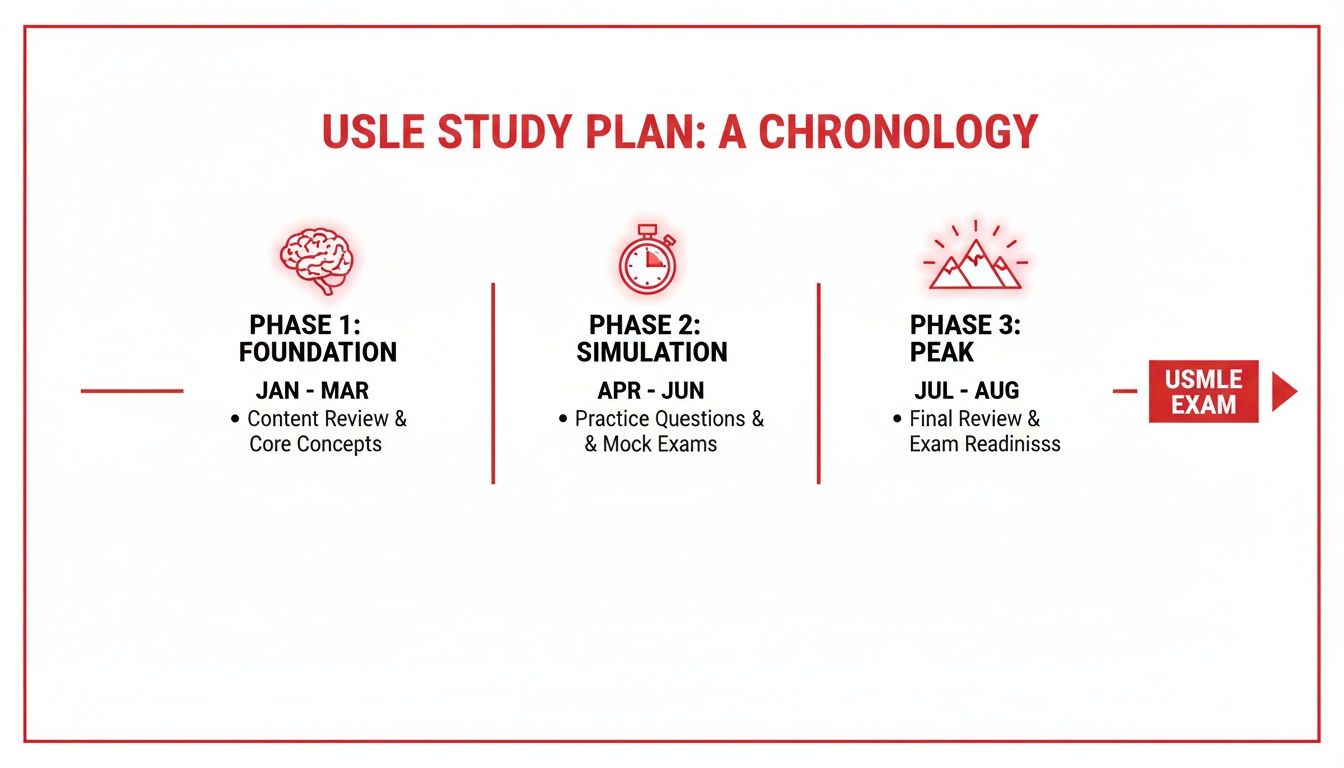
As you can see, the process moves from content-heavy learning to intense simulation and refinement. Active recall is what powers that transition.
From UWorld Incorrects to Powerful Flashcards
Every single incorrect answer in UWorld is a golden opportunity. Don't just read the explanation and move on. That’s a huge mistake. Instead, turn your mistakes into powerful, personalized flashcards. This transforms a moment of weakness into a future strength.
Let’s say you miss a question on metformin’s mechanism of action. Here’s how to handle it:
- Pinpoint the gap: You forgot it primarily inhibits hepatic gluconeogenesis.
- Make a targeted card: Don't just copy-paste the whole UWorld explanation. Keep it simple and direct. Front: "Primary MOA of metformin?" Back: "Inhibits hepatic gluconeogenesis (via AMPK activation)."
- Add high-yield context: Maybe add a quick note like, "First-line for T2DM, doesn't cause hypoglycemia."
This forces you to re-engage with the concept and boil it down to its essential parts. It embeds the information far more effectively than just reading an explanation ever could.
Master Anki Without It Taking Over Your Day
Anki is, without a doubt, one of the most powerful tools for spaced repetition. But if you’re not careful, it can quickly become a time-sucking monster that dominates your entire day. Efficiency is the name of the game.
The magic of Anki is the "testing effect." The mental effort of trying to recall an answer is what actually strengthens the memory trace. It’s not about just seeing the card; it’s the struggle to retrieve the information that builds long-term connections.
To keep Anki from running your life, be selective. Only create new cards for your most difficult concepts and the highest-yield facts. You absolutely do not need a card for every detail in First Aid. Focus on things like pharmacology, micro bugs and drugs, and specific pathology findings. For a deeper dive, check out our guide on using Anki for spaced repetition.
The Feynman Technique for Complex Pathways
If you can't explain a concept simply, you don't really get it. That's the whole idea behind the Feynman Technique, and it's perfect for conquering beasts like the coagulation cascade or the RAAS pathway.
The process is simple but incredibly powerful:
- Grab a blank whiteboard or piece of paper.
- Write the name of the concept at the top (e.g., "Glycolysis").
- Explain the entire process out loud in your own simple words, as if you were teaching it to a friend who isn't in med school.
- Pay close attention to where you get stuck, hesitate, or have to use jargon you can't easily define. That's your knowledge gap.
- Go back to your resources, fill that specific gap, and then try your simplified explanation again.
This technique is a fantastic diagnostic tool. It quickly shines a spotlight on the weak links in your understanding and forces you to build a solid conceptual framework, making the information stick for good.
Using Practice Exams to Conquer Test Day
Practice exams are your ultimate dress rehearsal for the real thing. They're far more than just a progress check; they are sophisticated diagnostic tools that simulate the mental and physical demands of the actual 7-hour USMLE Step 1. Using them correctly is a non-negotiable part of any serious study plan.
The two main players you'll be dealing with are the National Board of Medical Examiners (NBME) Self-Assessments and the UWorld Self-Assessments (UWSAs). Both are engineered to mirror the style, interface, and difficulty of the actual exam, giving you invaluable experience and predictive data on where you stand.
Your Strategic Practice Exam Schedule
Timing is everything. Take a practice exam too early, and a low score can be seriously discouraging. Wait too long, and you won't have enough time to act on the crucial feedback it gives you. The sweet spot is a well-paced schedule that lets you track progress and make meaningful adjustments without burning out.
For a student in an 8-week dedicated study period, here’s a battle-tested schedule that works:
- End of Week 4: Take your first NBME. Think of this as your initial baseline. The score itself is less important than the data it provides on your foundational knowledge across all subjects.
- End of Week 6: Take a second NBME. You should see a noticeable jump from your baseline. This is your mid-point check-in to make sure your study strategies are paying off.
- End of Week 7: Take UWSA 1. Many students find the UWSAs to be a bit more challenging, which makes them excellent preparation for those complex, multi-step questions.
- 5-7 Days Before Exam: Take UWSA 2 or the Free 120. This is your final "dress rehearsal." It’s all about building confidence and simulating the test-day experience one last time.
This rhythm provides regular checkpoints without overwhelming you with constant testing.
Properly scheduling and interpreting your practice exams is a cornerstone of a successful Step 1 prep. The table below outlines a common schedule and the goal scores that suggest you're on the right track.
Recommended Practice Exam Schedule and Goal Scores
| Week of Study | Recommended Exam | Purpose & Target Score (% Correct) |
|---|---|---|
| Week 4 | Baseline NBME | Establish an initial baseline. Don't stress the score; focus on identifying major weak areas. Target: >55% |
| Week 6 | Mid-Point NBME | Track progress and refine your study plan. You should see significant improvement. Target: >65% |
| Week 7 | UWSA 1 | Assess performance on more complex, multi-step questions and build endurance. Target: >65-70% |
| 1 Week Out | UWSA 2 or Free 120 | Final confidence builder and test-day simulation. This score is highly predictive. Target: >70% (indicates high likelihood of passing) |
Remember, these are guidelines. The real value isn't just the score, but how you use the data to guide the remainder of your study time.
From Raw Score to Actionable Insights
Getting your score back is just the beginning. The real magic happens when you dig into your performance report to figure out why you missed certain questions. Every mistake you make will fall into one of three buckets. Identifying your personal pattern is the key to unlocking targeted improvement.
So, was your mistake due to a…
- Knowledge Gap? You just flat-out didn't know the fact, the pathway, or the bug/drug association. This is the easiest problem to fix—it simply means you need to hit the books for some targeted content review.
- Question Interpretation Error? You knew the material but completely misread the question stem. Maybe you missed a keyword like "except" or "least likely," or you got thrown off by the clinical vignette. This is a clear signal to slow down and practice more careful, methodical reading.
- Pacing or Stamina Issue? You started making sloppy mistakes late in a block or felt mentally fried by the end of the exam. This tells you that you need more timed-block practice to build up your test-taking endurance.
Create a simple log or spreadsheet of your incorrects and categorize them this way. It can reveal some powerful trends. If you discover that 60% of your errors are from misinterpreting the question, you know your problem is technique, not just a lack of content knowledge.
For a comprehensive look at all the different assessments out there, check out our guide on USMLE practice tests, which offers a more detailed breakdown.
The Final Week and Test Day Logistics
Your final week is about consolidation, not cramming. The heavy lifting is done. Now, your focus needs to shift to light review, mental prep, and getting your logistics squared away.
- Final Review: Gently go over your personalized notes, high-yield charts in First Aid, and any tricky concepts from your incorrects log. This is not the time to learn brand-new material.
- Simulate Test Day: A day or two before your exam, do a dry run. Drive to your Prometric testing center so you know the route, the parking situation, and where the building is. This tiny step can eliminate a massive source of day-of anxiety.
- Pack Your Bag: The night before, get everything ready: your ID, scheduling permit, snacks (think protein-rich to avoid sugar crashes), water, and any other approved comfort items.
- The Day Before: Do absolutely nothing related to Step 1. Seriously. Trust your preparation. Go for a walk, watch a movie, and get a full night of sleep.
On exam day, be smart about your break time. Step away from the computer, stretch, use the restroom, and have a snack. Managing your energy over a 7-hour marathon is a skill in itself, and your practice tests were the perfect training ground. Walk in there confident, stay focused one block at a time, and go conquer the test you've worked so hard for.
Answering Your Top USMLE Step 1 Questions
As you get closer to exam day, the practical questions start piling up. It's easy to get lost in all the conflicting advice online, so let's clear the air. Here are some straightforward answers to the questions we hear most often from students in the final stretch.
How Many Hours a Day Should I Actually Study?
There's no magic number here, but the sweet spot for most students lands in the 8-10 focused hours per day range, about six days a week. And the key word is focused. An 8-hour day of true, active learning beats a distracted 12-hour day of passive reading every single time.
What’s even more important is protecting your downtime. You have to schedule breaks and take one full day off each week. Seriously. This isn’t a luxury—it’s a non-negotiable strategy to prevent burnout, which is the single biggest threat to your performance on test day.
Should I Reset UWorld for a Second Pass?
This is the classic UWorld dilemma. A second pass can be a game-changer, but only if you have the time and do it the right way.
A second pass might be a good idea if:
- You have 3 or more weeks left in your dedicated study period.
- You’ve already finished your first pass and have gone through all your incorrects.
- Your first run-through revealed major knowledge gaps across a bunch of different systems.
But if you’re short on time, a full second pass is a waste. Your energy is much better spent hammering your incorrect and marked questions, creating targeted reviews for your weak spots, and taking more NBME practice exams to get your timing and stamina down.
What Is a Good Score on an NBME Practice Exam?
Now that Step 1 is pass/fail, the goal has shifted. You're no longer chasing a specific three-digit score; you're aiming for consistent performance well above the passing line. One single score doesn't matter nearly as much as the trend.
Most advisors will tell you to aim for a 95% or higher probability of passing on your last two practice exams, whether it’s an NBME or a UWSA. This usually means you’re scoring above 65-70% correct.
Focus on seeing that score creep up over time. If you see steady improvement and you’re landing in that high-probability zone on your final practice tests, you can walk into Prometric feeling confident.
How Should I Use First Aid Effectively?
Stop thinking of First Aid as a textbook you need to read from cover to cover. It’s not. Think of it as your personal, high-yield scrapbook—the skeleton you build on throughout your prep.
Every time you do a UWorld block or watch a Pathoma video, open up First Aid and annotate it. Jot down key insights, draw diagrams from the UWorld explanations, and add mnemonics that click for you. This process transforms it from a generic book into your customized, high-yield bible for those final, critical weeks. And while you're deep in Step 1 prep, it doesn't hurt to think ahead; tools like the top dictation software for medical professionals can make a huge difference in your efficiency down the road.
Feeling like your study plan is stuck in a rut or you just can't seem to master a tough, high-yield topic? A one-on-one session with an expert tutor can completely change your trajectory. Ace Med Boards offers personalized guidance to help you build a clear strategy and conquer Step 1 with confidence. Book your free consultation today at https://acemedboards.com.

