
Feeling lost in a sea of numbers after your shelf exam? You’re not alone. When you get that score report back, your eyes probably jump to one number first: the percentile.
Think of it like your finishing position in a national marathon. It’s not about how fast you ran (your raw score), but where you placed compared to the thousands of other medical students running the same race nationwide. A score in the 75th percentile means you performed better than 75% of that national group—placing you firmly in the top quarter of test-takers for that clerkship.
This single number is far more than just a score; it's a powerful indicator of your clinical knowledge that often accounts for 30% to 50% of your final clerkship grade.
So, What Do These Percentiles Actually Mean?
Beyond just passing your clerkship, a pattern of strong shelf percentiles sends a clear signal to residency programs about your competency and readiness for advanced training. A high percentile in a relevant specialty can absolutely make your application stand out.
While every medical school has its own grading scale, there are some generally accepted benchmarks that can help you gauge your performance.
Here’s a general overview of what different percentile ranges typically signify for clerkship grading across most medical schools.
Shelf Exam Percentile Benchmarks at a Glance
| Percentile Range | Typical Clerkship Grade | General Interpretation |
|---|---|---|
| >90th | High Honors | Exceptional performance, demonstrating mastery of the material. A huge boost for residency applications in that specialty. |
| 80th-89th | Honors | Excellent performance, clearly in the top tier of students nationally. Often the cutoff for earning Honors. |
| 60th-79th | High Pass | Strong, above-average performance. You have a solid grasp of the core concepts. |
| 20th-59th | Pass | Average performance. You met the standard expectations and have a foundational knowledge base. |
| <10th-19th | Marginal/Low Pass | Below-average performance. This is often the zone where you might be required to do remediation. |
| <10th | Fail | Indicates a significant knowledge gap. Most schools set their failing threshold around the 5th-10th percentile. |
These are just general guidelines, but they give you a solid frame of reference for interpreting your score report and understanding where you stand.
A common mistake is to get fixated on the raw score, but the percentile is what truly matters. A raw score of 75 might be average on one exam but exceptional on another, all depending on how your peers performed nationally on that specific test version.
This guide will demystify this critical metric, breaking down how your performance is calculated and what it means for your academic and professional future. If you want to explore this concept further in the context of board exams, you can also learn more about USMLE Step 1 score percentiles in our related article.
We’ll dig into the nuances of scoring, what to watch out for when interpreting your results, and most importantly, how to set yourself up for success.
How Shelf Exam Scores Are Really Calculated
Ever stare at your shelf exam report, wondering how the number of questions you got right turned into that all-important final percentile? It’s not a simple curve like in your preclinical classes. The NBME uses a much more robust standardized scoring system to give you a stable, national benchmark of your performance.
First, your raw score—the simple count of correct answers—gets converted into a scaled score. This is a crucial step that accounts for tiny differences in difficulty between different versions of the exam. If your test happened to be a bit tougher than average, this adjustment gives your score a slight bump to keep things fair for everyone.
From there, this scaled score is compared against the performance of a huge national reference group, which is how your final percentile is generated.
From Scaled Score to National Percentile
The NBME doesn’t just curve the exam based on who took it with you on test day. Instead, they use rolling three-year averages of student performance data to build stable percentile tables. This approach smooths out any minor year-to-year blips, making your shelf exam percentile a seriously reliable indicator of where you truly stand on a national level.
Here’s a critical point that trips up a lot of students: the original scoring scale was set way back in the 1990s with a mean of 70 and a standard deviation of 8. But guess what? Performance has been creeping up for decades. A score of 70 today is definitely not "average" anymore.
For instance, the national average for the Family Medicine shelf often sits around 75, a full five points above that old mean. For Internal Medicine, scores can start around 73 early in the academic year and climb to 76 later on as students gain more clinical experience.
This infographic breaks down how different percentile ranges often translate into your final clerkship grades.
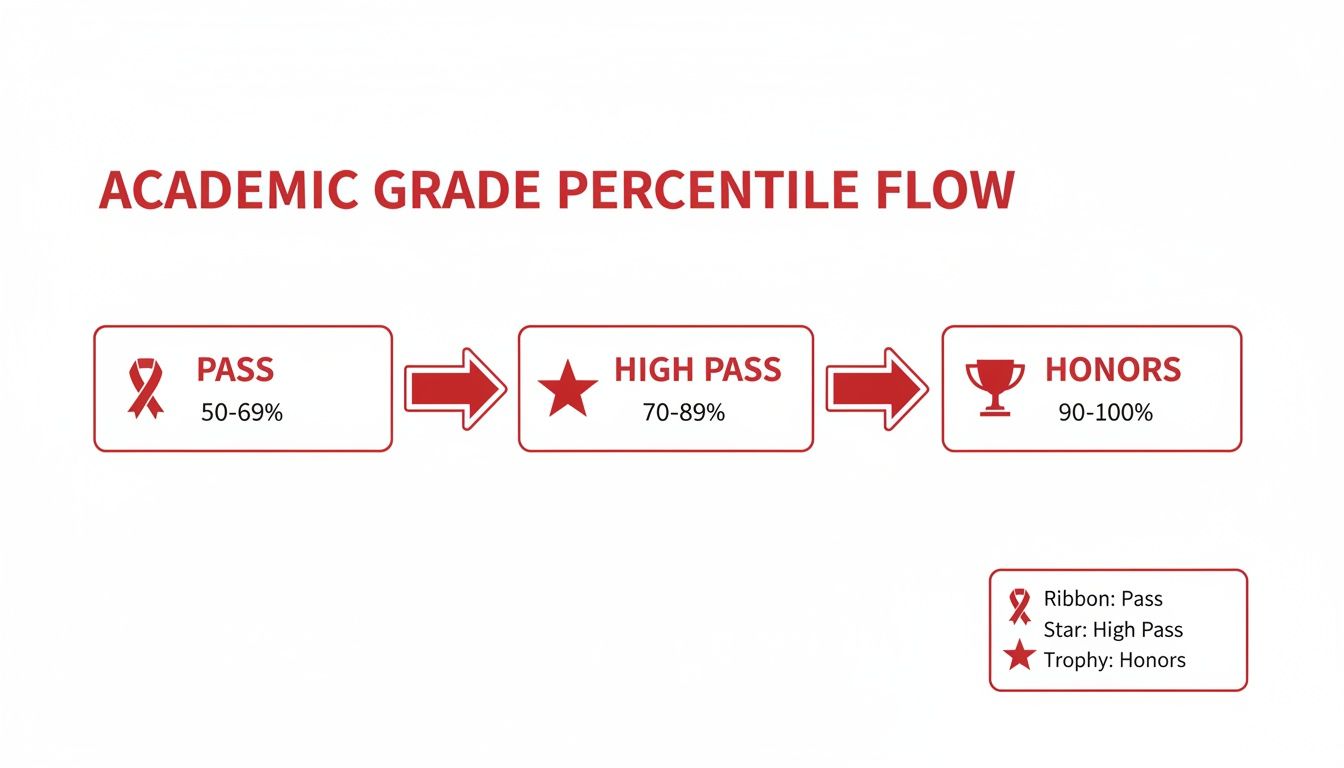
As you can see, hitting that Honors range means you need to perform well above the national average, placing you in the top tier of your peers nationwide.
The bottom line is your score isn't just a snapshot of one day. It’s a carefully calculated placement against thousands of other medical students over several years, making your percentile a powerful and consistent measure of your clinical knowledge.
Understanding how this works helps you put your own performance in context and build a smarter study plan. If you want to turn this knowledge into a better score, check out our guide on how to approach NBME practice shelf exams for more targeted prep.
The Real Benchmarks for Passing and Earning Honors
Okay, so you’ve got your shelf exam percentile. Now what? Knowing your score is one thing, but understanding what it actually means for your final clerkship grade is a completely different ballgame.
While every medical school has its own official rulebook, there’s a clear national pattern for what it takes to pass, get a high pass, or lock in that coveted honors designation. These are the unofficial rules of the road for your third year.

The National Board of Medical Examiners (NBME) does provide a baseline recommendation for passing each shelf exam, which is typically set at the 5th percentile of all national test-takers. Think of this as the absolute minimum safety net to demonstrate basic competency.
But let’s be real—just squeaking by this low bar is rarely enough. Most schools set their own passing thresholds quite a bit higher.
The reality is that "passing" is the floor, not the ceiling. The real goal for most students is to land comfortably in the high pass or honors range, which sends a strong signal to residency program directors.
What It Takes to Get Honors
Securing honors in a clerkship is a massive win, and your shelf exam score is almost always the key that unlocks it. Clinical performance is important, of course, but a top-tier exam score is non-negotiable for that top grade.
So, what numbers should you be aiming for? Based on trends across US medical schools, here’s a general breakdown:
- Honors: You'll typically need a score at or above the 75th to 80th percentile. For really competitive clerkships or top-tier schools, this can easily push closer to the 90th percentile.
- High Pass: This grade usually goes to students with scores between the 60th and 79th percentiles, signaling a solid, above-average performance.
- Pass: A standard pass generally corresponds to scores falling between the 10th and 59th percentiles.
Remember, these are just general guidelines. Your school's clerkship syllabus is the final authority, so always check it for the exact grading breakdown. For a deeper dive into how these exams work, you can learn more about medical school shelf exams in our detailed guide.
To give you a better sense of the baseline, the NBME provides recommended minimum passing scores that correspond to that 5th percentile mark. These scores highlight how the difficulty and score distribution can vary between subjects.
NBME Minimum Passing Scores by Clerkship (Based on 5th Percentile Norms)
This table shows the recommended minimum passing scaled scores for core clerkships based on the 5th percentile of recent NBME data, illustrating subject-specific difficulty and scoring distributions.
| Clerkship | Minimum Passing Scaled Score (5th Percentile) |
|---|---|
| Family Medicine | 58 |
| Medicine | 59 |
| Neurology | 59 |
| Obstetrics/Gynecology | 58 |
| Pediatrics | 59 |
| Psychiatry | 59 |
| Surgery | 59 |
Note: These are NBME recommendations; your school's passing score may be higher.
As you can see, the minimums are quite low. This reinforces the idea that your school’s own benchmarks for Pass, High Pass, and Honors are the numbers that truly matter.
The Problem of Grade Inflation
In recent years, the race for honors has gotten even tougher due to a phenomenon called grade inflation. As more students perform at a high level—thanks to better prep resources and study strategies—the percentile needed to stand out has slowly crept upward.
One study looking at data from 2015 to 2022 found that the median percentage of students receiving honors rose significantly in core clerkships like Surgery and Medicine. To keep the "honors" grade meaningful, schools have had to raise the bar.
This trend means that to secure honors today, you often need to score squarely in that 75th to 90th percentile range. It makes understanding and improving your shelf exam performance more critical than ever. It's not just about passing anymore; it's about strategically positioning yourself to be a competitive applicant for the residency you want.
Why Your Score Varies Between Specialties
Here’s a classic third-year puzzle: you score a solid 75 on your Surgery shelf, landing in the 65th percentile and feeling pretty good about it. Fast forward a few months, you get the exact same 75 on your Psychiatry shelf… only to find yourself barely cracking the 20th percentile. What gives?
The answer is that each specialty’s shelf exam has its own unique performance curve. The national group of medical students simply performs differently on each one, and your percentile is a direct reflection of where you fall within that specific group.
Think of each exam as a race. The distance is always the same (110 questions), but the terrain and the competitors change dramatically. For some races, the pack of runners is really spread out. For others, everyone is bunched up tightly at the finish line, making it incredibly hard to stand out.
The Notorious Psychiatry Shelf Exam
The Psychiatry shelf is famous—or maybe infamous—for having a highly compressed scoring distribution. On this exam, the national average score is way higher than on other shelf exams. A huge number of students do extremely well, clustering together at the top of the score range.
This means a tiny difference in your raw score, even just one or two missed questions, can cause a massive plummet in your percentile.
For the Psychiatry shelf, scoring an 80 might only land you somewhere between the 25th to 49th percentile. In sharp contrast, that same 80 on the Surgery or Internal Medicine shelf could easily put you in the 70th percentile or higher—often deep into honors territory.
This doesn't mean the Psychiatry exam is "easier." It just means the national performance is so strong that you need something close to a perfect score to really pull away from the pack. It’s a perfect illustration of why you can't compare a scaled score from one shelf directly to another.
Broader vs. Tighter Score Distributions
While Psychiatry is known for its tight scoring curve, other exams have a much wider spread.
- Surgery and Internal Medicine: These exams typically have a broader distribution of scores. The material is so vast and challenging that it naturally creates more variability in student performance. This gives you more room to differentiate yourself, meaning a good—but not perfect—score can still earn you a very high percentile.
- Pediatrics and OB/GYN: These often land somewhere in the middle. The score distributions are usually tighter than Surgery but not nearly as compressed as Psychiatry.
On top of that, performance trends shift throughout the academic year. As a group, students taking exams later in the year tend to score higher simply because they have more clinical experience under their belts. This is why a score of 75 in August might be the 60th percentile, while that same 75 in May could drop you to the 50th.
Understanding these nuances is the key to setting realistic, specialty-specific goals. Instead of chasing a specific scaled score, your focus should be on hitting a target percentile. For those aiming to excel on one of the most critical clerkships, our guide to the Internal Medicine shelf review offers more targeted advice.
Proven Strategies to Raise Your Shelf Exam Percentile
Knowing your percentile is one thing; making it climb is another. Pushing your score from the middle of the pack to the top of the curve doesn't happen with last-minute cramming. It takes a smart, consistent strategy that weaves high-yield studying into the chaos of your clinical rotations.

The cornerstone of a higher percentile is a focused study plan. Forget trying to read every textbook cover-to-cover. Zero in on high-yield resources. A question bank like UWorld is absolutely non-negotiable—it’s the single best way to learn pattern recognition and think like the test makers. Back that up with a solid, clerkship-specific text or video series.
Build a Sustainable Study Habit
In the marathon of medical school, consistency crushes intensity every single time. The real secret is finding those small, overlooked pockets of time to get some studying done. Even 15-20 minutes of questions on a lunch break or listening to a review lecture during your commute adds up massively over a four- or six-week rotation.
A sustainable rhythm might look something like this:
- Daily Goal: Knock out a small block of questions (10-20) every single day. No excuses.
- Weekly Goal: Get through at least one full NBME practice exam to build your test-day stamina.
- Review Method: Spend just as much time reviewing your incorrect and correct answers as you did answering them. You need to understand the "why" behind every single option, not just the right one.
This brick-by-brick approach builds your knowledge base without leading to burnout. It ensures you’re prepared when the final week rolls around.
The single biggest mistake students make is saving the bulk of their studying for the last week of the rotation. Spaced repetition—reviewing material at increasing intervals—is a far more effective method for long-term retention and peak performance on exam day.
Master the Art of Question Analysis
A top-tier shelf exam percentile isn't just about what you know; it's about how you apply it under pressure. This is where mastering question analysis becomes an absolute game-changer. Every time you tackle a practice question, run it through a systematic breakdown.
- Identify the Core Task: What is this question really asking? Is it a diagnosis question? A mechanism of action? The next best step in management?
- Highlight Key Information: Mentally (or physically) pull out the critical vital signs, weird lab values, and "buzzword" descriptions from the clinical vignette.
- Eliminate Incorrect Answers: Actively prove to yourself why each wrong answer is wrong. This is how you deepen your understanding and stop falling for the NBME's favorite traps.
This process turns passive learning into an active, repeatable skill. It sharpens the exact clinical reasoning muscles the shelf exams are designed to test. For more clerkship-specific tactics, check out our comprehensive guide on how to study for shelf exams.
Why Pushing for a High Percentile Matters More Than Ever
In an increasingly competitive residency match, shelf exam scores are under more scrutiny than ever. While hitting the 70th percentile is a solid performance, students targeting honors or competitive specialties like Internal Medicine or Surgery are often aiming for the 90th percentile or higher.
Keep in mind that these thresholds aren't static. For example, hitting the 90th percentile on the Surgery shelf requires a stronger raw performance than it does on the Psychiatry shelf, where scores tend to be more compressed at the top.
If you’re finding it tough to break through a percentile plateau and need a personalized game plan, the expert tutors at Ace Med Boards can help. We specialize in one-on-one guidance, helping you master high-yield content and build the test-taking strategies you need to hit your target score.
Common Questions About Shelf Exam Percentiles
Even after you get the hang of how percentiles work, a few common questions always seem to pop up during third year. Let's tackle some of the ones we hear most often.
Does My Percentile Change Depending on When I Take the Test?
Yes, it can, but usually not by a huge amount. The NBME uses a standardized scoring scale that doesn't change, but the national percentile data it provides is based on a reference group that evolves over the academic year.
Students taking exams later in the year—say, in May versus August—have more clinical experience under their belts and often post higher raw scores. This means you might need to score a little higher in the spring to hit the same percentile you would have at the beginning of the year. Schools know this, though, and often use three-year rolling averages to smooth out these seasonal bumps.
The real takeaway here is that your performance is always relative. A strong score is a strong score, but the exact percentile it translates to can shift slightly depending on how the national cohort is performing at that time.
How Do Shelf Percentiles Impact My Step 2 CK Score?
Think of your shelf exams as training camp for Step 2 CK. There's an incredibly strong, direct link between how you do on your shelves and how you'll perform on the boards.
The content, especially from core clerkships like Internal Medicine, Surgery, and Pediatrics, has massive overlap with Step 2. Consistently scoring well on your shelf exams is one of the most reliable signs that you're building the deep clinical knowledge base needed to crush the boards. High shelf percentiles are a fantastic predictor of a high Step 2 score.
What Is a Good Percentile for a Competitive Specialty?
This is the big one. For hyper-competitive fields like Dermatology, Neurosurgery, or Orthopedic Surgery, residency programs are looking for clear evidence of excellence. While there's no official cutoff, you should be aiming high.
Consistently scoring in the 80th percentile or higher is a major green flag for these programs. To really stand out, aiming for scores above the 90th percentile shows true mastery of the material. Earning "Honors" in a clerkship, which is almost always tied to a top-quartile shelf performance, is practically a soft requirement for many of the most sought-after residency spots.
Struggling to hit the shelf exam percentiles you need for your target specialty? The expert tutors at Ace Med Boards provide personalized, one-on-one guidance to help you master high-yield content and build winning test-taking strategies. Schedule your free consultation today and start building a plan for success.

