A well-written letter of intent for residency can be the one thing that pushes you up a program's rank list. After the interview, it’s your last, most personal pitch to show you're serious and solidify your spot as their ideal candidate.
Why Your Residency Letter of Intent Actually Matters
Let's kill a common myth right now: the idea that a Letter of Intent (LOI) is just a formality is flat-out wrong, and believing it can cost you a spot. You're competing in a sea of high-achievers with nearly identical scores and CVs. Your LOI is your final chance to make a real, personal connection.
It's the tool that transforms your application from a pile of statistics into a compelling story, reminding the program director who you are and why you belong with them.

Think about it from their perspective. After interviewing dozens of fantastic applicants, program directors have a long list of qualified people. A powerful LOI is a signal of genuine, specific interest that brings your name and your conversation back to the top of their mind. It reinforces that you're an excellent fit for their specific culture and mission.
The Data Behind the Impact
Anyone who tells you these letters don't matter is ignoring the evidence. Program directors consistently rate an applicant's "perceived interest in the program" as a major factor when building their rank list. This isn't just a feeling; it's a key metric they use.
When you look at the numbers, you'll see just how much it matters. The table below, based on NRMP Program Director Survey data, shows that 'Perceived Interest' is right up there with other critical factors.
LOI Impact vs Other Ranking Factors
| Ranking Factor | Usage by Program Directors | Mean Importance (1-5 Scale) |
|---|---|---|
| Perceived Interest in Program | 78% | 4.2 |
| Interview | 98% | 4.8 |
| Letters of Recommendation | 91% | 4.3 |
| USMLE Step 2 CK Score | 83% | 4.1 |
| Personal Statement | 84% | 4.1 |
Source: Adapted from NRMP Program Director Survey data.
As you can see, a staggering 78% of PDs use this metric, and they give it a 4.2 importance score—on par with your Step 2 score and LORs. For a candidate on the bubble, a well-crafted, believable LOI can absolutely be the thing that bumps them up the rank list and secures them a position.
This single document does more than just state your intentions. It proves your professionalism, your follow-through, and your deep understanding of what makes their program unique. It’s your opportunity to connect the dots for them.
Key Takeaway: A letter of intent isn't just a courtesy. It's a strategic move that proves you've done your homework and are genuinely invested in becoming part of that specific program.
Humanizing Your Application
Beyond the data, an LOI adds a critical human element. Your ERAS application tells them what you’ve done—your scores, your research, your volunteer work. An LOI tells them why—why this program, why this city, and why you are the person they should invest in for the next three-plus years. You can get a better sense of this by understanding what do programs look at for eras.
This personal touch is invaluable. It’s all part of presenting the most polished, professional version of yourself. For some, ensuring crystal-clear communication might even involve services like accent reduction for doctors to make sure every interaction, written or spoken, is as effective as possible.
The Anatomy of a High-Impact Residency LOI
A powerful Letter of Intent is far more than a simple thank-you note; it's a strategic document built with distinct, interlocking parts. Forget generic templates. A high-impact LOI follows a blueprint designed to be memorable, personal, and persuasive, moving way beyond the information already sitting in your ERAS application.
Each component serves a specific purpose, and they all work together to build a compelling final argument for your candidacy. Think of it as constructing a bridge between your interview performance and the program's final rank list. This section breaks down that blueprint, piece by piece.

Crafting a Personalized Opening Hook
Your opening sentence has one job: to immediately separate your letter from the dozens of others a program director will read. The goal is to jog their memory and establish a personal connection right away. A generic opener like "I am writing to express my interest…" is a huge missed opportunity.
Instead, reference a specific, positive moment from your interview day. This could be a memorable conversation you had, a unique aspect of the program you discussed, or even an insightful question you asked.
- Weak Opening: "Following my interview on January 15th, I am confirming my strong interest in your General Surgery residency."
- Strong Opening: "Thank you again for a wonderful interview day on January 15th. I especially enjoyed my conversation with Dr. Evans about the new robotics curriculum, which solidified my interest in your General Surgery program."
This simple shift changes the entire dynamic. The second example is specific, personal, and reminds the PD of a real conversation. It makes your letter feel less like a form letter and more like a continuation of a dialogue.
Showcasing Concrete Evidence of Fit
The body of your letter is where you connect the dots for the program director. This isn't the time to simply restate your CV. You have to explicitly link your unique skills, experiences, and career goals to what their program specifically offers.
Your task is to prove why you fit, not just state that you do. Did you discuss a particular research track during your interview? Mention it, and connect it directly to your past research experience. Are you passionate about serving the program's unique patient population? Explain how your volunteer work has prepared you for exactly that.
A common mistake is to write a letter that could be sent to any program. Your goal is to write a letter that could only be sent to this program. Specificity is your greatest asset.
Getting these specific thoughts down can be a hurdle. To make the process a bit smoother, you can even use modern tools to brainstorm out loud. For example, speech to text software can help you get your ideas out naturally, letting you focus on the substance of your argument before you start polishing the wording.
Highlighting Your Unique Value Proposition
Okay, so you've established fit. Now what? You need to articulate what you, as an individual, bring to the table that others might not. What unique perspective or skill set do you offer their incoming class of residents? This is your chance to stand out from other highly qualified applicants.
Think about what makes you different:
- Unique Background: Do you have experience in another field, like engineering or teaching, that gives you a different way of thinking about problems?
- Specific Skills: Have you developed advanced procedural skills, or maybe you led a significant quality improvement project that got real results?
- Personal Qualities: Can you provide a brief, concrete example that demonstrates your resilience, leadership, or exceptional teamwork abilities?
By clearly stating your unique contribution, you help the program envision you not just as another trainee, but as an active and valuable member of their community. This part of your LOI should really echo the core narrative you built in your first application, a topic we cover extensively in our guide on how to write a personal statement for residency.
Delivering a Clear and Confident Closing
Your closing has to be unambiguous and professional. If the program is your number one choice, you need to state it clearly and confidently. There is zero room for vague language here.
- Vague Closing: "Your program is ranked very highly on my list."
- Confident Closing: "After completing my interviews, I can say with confidence that your program is my #1 choice, and I will be ranking it as such."
That direct statement is a powerful signal to the program director. You should end by thanking them again for their time and consideration. This reinforces your professionalism and your sincere enthusiasm for the chance to train at their institution.
Finding Your Voice, Tone, and Specialty Nuances
You can have the perfect structure, but if the tone is off, the whole letter falls flat. This is where your letter of intent truly comes to life—or dies a quiet death. Your goal is to find that sweet spot between unwavering professionalism and genuine passion.
So many applicants get this wrong. They accidentally come across as arrogant, desperate, or just plain robotic. Think of your letter's tone as its personality. You want to sound confident but not boastful, enthusiastic but not over-the-top. Most importantly, it has to sound like you.
Striking the Right Balance
Finding this balance really comes down to word choice. Certain phrases can weaken your message or make you sound exactly like every other applicant in the pile. You need to be direct, confident, and incredibly specific.
Look at the difference in impact here:
- Weak Language: "I feel that my skills would be a good addition to your program."
- Strong Language: "My experience in [Specific Skill] aligns directly with your program's [Specific Initiative], and I am confident I can contribute from day one."
The first one is passive and wishy-washy. The second is active, specific, and full of confidence. It doesn't just say you're a good fit; it shows exactly how and proves you've done your homework.
Key Insight: Professionalism isn't about being stiff or using a thesaurus on every word. It's about clear, respectful, and confident communication that shows you are serious about this program and your future specialty.
Aligning Your Tone with Your Specialty
Just like different specialties attract different personalities, they also have their own cultural tones. A generic, one-size-fits-all approach is a huge missed opportunity to show a program director that you get their world.
Your letter needs to subtly reflect the culture of your chosen field without sounding fake. This isn't about pretending to be someone you're not—it's about speaking the same professional language.
Here’s how you might subtly shift your tone:
- Surgery or Emergency Medicine: These are fast-paced, no-nonsense fields. Your communication should be more direct and action-oriented. Focus on efficiency, teamwork under pressure, and decisive action.
- Family Medicine or Pediatrics: These specialties are built on communication and long-term relationships. Your tone can be warmer, highlighting empathy, patient advocacy, and your commitment to community-based care.
- Internal Medicine or Neurology: These fields are often seen as more academic and analytical. Here, your tone can be more inquisitive and intellectually curious. You can showcase a passion for solving complex puzzles and a dedication to lifelong learning.
This isn't an exact science, but here’s a quick breakdown:
| Specialty Type | Primary Tone | Keywords to Emphasize |
|---|---|---|
| Procedural/Acute Care (e.g., Surgery) | Confident, Direct, Action-Oriented | Efficiency, teamwork, resilience, procedural skill |
| Relationship-Based (e.g., Family Med) | Empathetic, Collaborative, Patient-Centered | Communication, advocacy, continuity of care, community |
| Diagnostic/Academic (e.g., IM) | Inquisitive, Analytical, Thoughtful | Problem-solving, research, evidence-based medicine |
Ultimately, the best tone is one that is authentically yours, just filtered through the lens of your chosen specialty. Let your genuine excitement for that specific field shine through in a way that resonates with the program director. This kind of thoughtful customization shows a level of insight that a generic sample letter of intent for residency simply can't match.
Real-World LOI Samples and Strategic Breakdowns
Theory is great, but seeing how it works in practice is where the real learning kicks in. To help you get this right, I’ve put together several full-length sample letters of intent, each designed for a common—and often tricky—applicant scenario.
Think of these less as templates and more as strategic documents. We're going to break down each one, paragraph by paragraph, so you can see the “why” behind every sentence. You’ll see exactly how to frame your letter for your dream program, how an International Medical Graduate (IMG) can turn their background into a major asset, and how a reapplicant can showcase impressive growth.
Sample 1: The Top-Choice Declaration
This is the classic LOI. It's the one you send to one program—and only one—to state with total confidence that they are your #1. The goal here is clarity, sincerity, and unwavering commitment.
Subject Line: Expressing My Sincere Intent – [Your Name], [AAMC ID]
Dear Dr. [Program Director's Last Name],
Thank you again for the opportunity to interview with the Internal Medicine residency program at [Program Name] on January 20th. My conversation with Dr. Chen about the clinician-educator track was particularly inspiring and confirmed that your program’s dedication to medical education is a perfect match for my career aspirations.
Breakdown: This opening gets straight to the point but does it with specifics. Mentioning the date, a specific faculty member, and a unique program track instantly jogs the PD’s memory. It proves you're not just blasting out a generic email.
Following my interview, I have had the chance to reflect on the unique strengths of each program I visited. It became clear that your program offers the ideal environment for me. The balance between rigorous clinical training at your high-volume academic center and the supportive, resident-led teaching initiatives is exactly what I am looking for.
Breakdown: This paragraph delivers the "why." It shows you’ve actually thought this through. By pointing to two concrete features (clinical volume, resident teaching), you’re showing the PD what specifically won you over.
My experience developing a near-peer tutoring curriculum for M2 students aligns directly with the goals of your residents-as-teachers initiative. I am confident that my background in curriculum design would allow me to contribute meaningfully to this program from day one, while also learning from your expert faculty.
Breakdown: Here's where you connect the dots for them. You're not just saying you're a good fit; you're proving it by linking a past experience directly to a program initiative. This is your unique value proposition in action.
After careful consideration of all my options, I am writing to inform you that I will be ranking [Program Name] as my #1 choice. Your program is the absolute best fit for my personal and professional goals, and I would be honored to train with you.
Breakdown: This is the money line. It’s direct, confident, and leaves no room for doubt. No wishy-washy language here—just a clear, powerful declaration.
Thank you once more for your time and consideration. I am incredibly enthusiastic about the prospect of joining your team at [Program Name].
Sincerely,
[Your Name]
[AAMC ID]
[Contact Information]
Sample 2: The International Medical Graduate (IMG) Letter
For IMGs, the LOI is a golden opportunity to frame your global perspective as a unique strength and proactively answer any questions a program director might have. This sample letter of intent for residency is all about turning international experience into a competitive edge.
Subject Line: Following Up – [Your Name], [AAMC ID] – IMG Applicant
Dear Dr. [Program Director's Last Name],
I am writing to express my sincere and continued interest in the Family Medicine residency at [Program Name] following my interview on January 22nd. I was particularly impressed by your clinic’s integrated behavioral health services, a model I believe is essential for holistic patient care.
Breakdown: The applicant immediately shows they've done their homework by highlighting a specific, advanced aspect of the program. This demonstrates a sophisticated understanding of modern care delivery, not just a surface-level interest.
As an International Medical Graduate from [Country], my clinical training in a resource-limited setting provided me with a unique foundation in diagnostic reasoning and patient management. For example, I led a community health project focused on diabetes education that increased patient compliance by 40% in six months. This experience has prepared me to effectively serve diverse and underserved patient populations, a cornerstone of your program's mission.
Breakdown: This is the key paragraph. Notice how the applicant doesn't just mention their IMG status—they frame it as a strength. They back it up with a concrete example that has a measurable outcome (40% increase) and tie it directly to the program’s mission.
My global health background has given me a deep appreciation for culturally competent care, and I was energized to see this value reflected in my conversations with your current residents. I am confident that my perspective would add a valuable dimension to your incoming class and contribute to the rich learning environment at [Program Name].
Breakdown: This reinforces their unique value. The applicant connects their background to the program's culture and explicitly states how they will be a contributor to the team, not just another trainee.
Thank you for your consideration. Your program remains my top choice, and I am incredibly enthusiastic about the possibility of continuing my medical journey with you. For a comprehensive look at my qualifications, you may find it helpful to review my full profile, similar to a sample eras application, which details my clinical and research experiences.
Sincerely,
[Your Name]
[AAMC ID]
[Contact Information]
Sample 3: The Reapplicant Letter
If you're reapplying, your LOI has to do two things: express genuine, continued interest and, most importantly, demonstrate significant growth. This letter needs to be confident and positive, focusing squarely on what you've accomplished since the last cycle.
Subject Line: Reapplicant – Strong Interest in [Specialty] – [Your Name], [AAMC ID]
Dear Dr. [Program Director's Last Name],
Thank you for the opportunity to interview with you again for the Pediatrics residency at [Program Name]. It was wonderful to reconnect with your team, and my conversation with Dr. Lee about the advances in your advocacy rotation was especially motivating.
Breakdown: The opening acknowledges the reapplicant status in a positive, confident way. It shows you’re still engaged and have kept up with what’s new at the program.
Since the last Match cycle, I have focused on strengthening my clinical skills and research experience. I completed a one-year pediatric urgent care fellowship where I independently managed over 1,500 patient encounters. Additionally, my research on asthma management in urban pediatric populations was recently accepted for publication in the [Journal Name].
Breakdown: This is the most critical part of the entire letter. The reapplicant provides hard evidence of what they’ve been up to, using specific numbers (1,500 encounters) and a major achievement (publication). It directly answers the unasked question: "So, what's different this year?"
This past year has solidified my commitment to pediatrics and has better prepared me for the rigors of your residency program. My enhanced clinical confidence and new research skills would allow me to be a more effective and contributing member of your team.
Breakdown: This paragraph connects the new experiences to residency readiness. It's not just a list of accomplishments; it shows maturity and self-awareness by explaining how those activities made you a stronger candidate.
Your program’s commitment to community advocacy and resident wellness makes it my number one choice. I am confident that I am a much stronger candidate this year, and I will be ranking your program #1.
Breakdown: The closing is confident and direct. It reiterates the #1 ranking while subtly reminding the PD that they're looking at an upgraded version of an applicant they already liked enough to interview.
Thank you for your time and for this second opportunity.
Sincerely,
[Your Name]
[AAMC ID]
[Contact Information]
Nailing Your Timing and Delivery Strategy
You've poured your heart and soul into crafting the perfect letter. But a brilliant letter sent at the wrong time or to the wrong person is a massive wasted opportunity. The final steps—timing and delivery—are just as critical as the words you write. Getting the logistics right ensures your letter lands with maximum impact, reinforcing your professionalism and genuine interest.
The sweet spot for sending your Letter of Intent is usually between late January and early February. There's a strategy behind this window. By then, you’ve likely finished all your interviews and had some real time to reflect. This makes your declaration of a #1 choice feel credible and well-considered, not like a premature or impulsive move.
If you send it too early, you might seem hasty. Send it too late (think mid-to-late February), and you risk it arriving after the program has already started finalizing its rank list.
This timeline lays out the ideal flow, from finishing your interviews to sending that final, definitive letter.
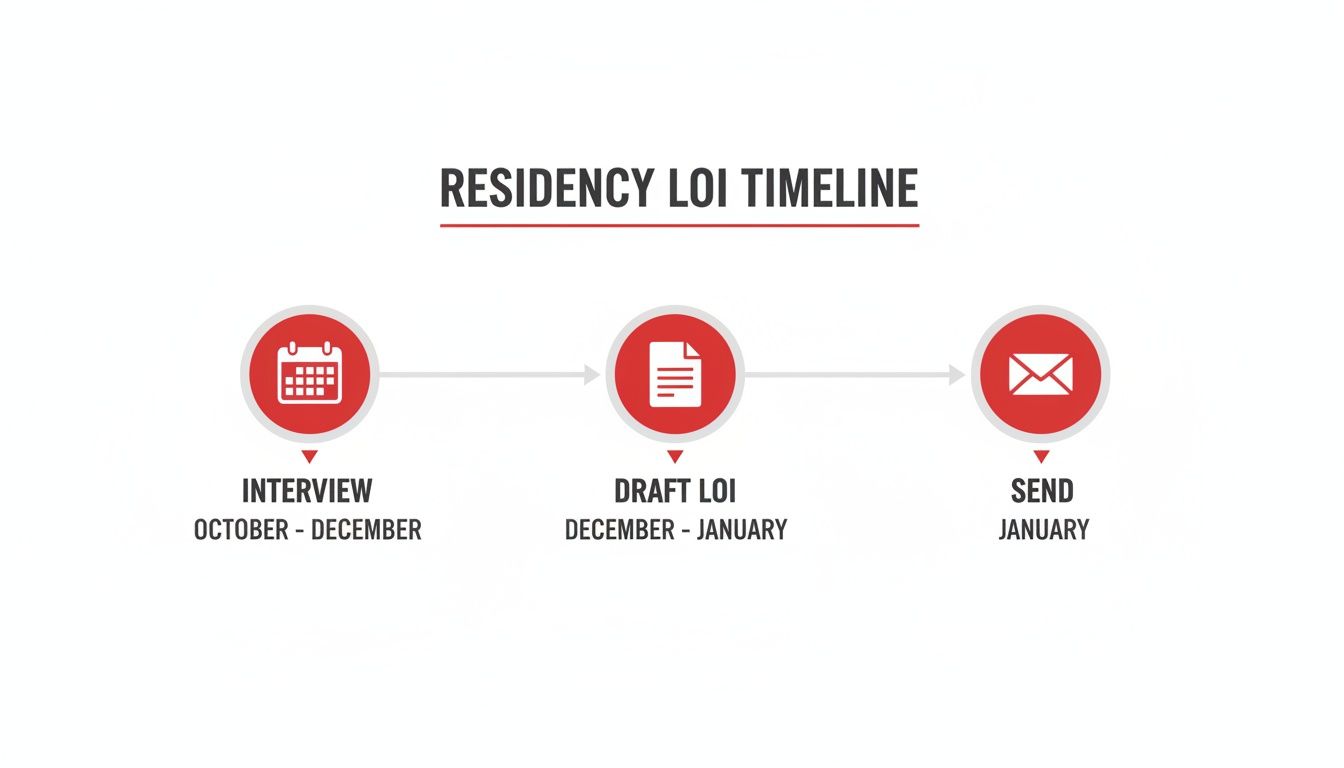
As you can see, the post-interview period is all about thoughtful reflection, not rushing. This deliberate timing is a small but important part of the entire application cycle. For a broader look at the whole process, this ERAS application timeline is an excellent resource.
Who to Address and How to Send It
Precision is everything here. Your email must be addressed directly to the Program Director (PD). They are the ultimate decision-maker, and your letter is a personal piece of communication intended for them.
But there's a crucial second step: CC the Program Coordinator. Coordinators are the organizational backbone of every single residency program. They manage applicant files, track correspondence, and make sure everything is in order. CC'ing them guarantees your letter gets officially filed with your application. Forgetting the coordinator is a common mistake that can lead to your carefully crafted letter getting lost in the shuffle.
The email subject line is the first thing a busy Program Director will see in their flooded inbox. Make it impossible to ignore.
A vague subject like "Following up" or "Checking in" is practically begging to be overlooked. You need something clear, professional, and easy to search for. The best format includes your name, your AAMC ID, and the purpose of the email.
- Weak Subject: Checking In
- Strong Subject: Letter of Intent – Jane Doe, AAMC ID: 12345678
- Strong Subject: My #1 Choice – John Smith, AAMC ID: 87654321
Residency LOI Submission Timeline and Checklist
To keep things straightforward, here’s a simple checklist to guide you through the final steps of sending your LOI. Following this timeline helps ensure your letter arrives at the most impactful moment.
| Timeframe | Action Item | Key Consideration |
|---|---|---|
| Mid-to-Late January | Finalize Your #1 Choice. | Be absolutely certain. This decision should come after all interviews and careful reflection on program fit. |
| Late January | Draft and Refine Your LOI. | Personalize it heavily. Reference specific interviewers, unique program features, and your personal connection. |
| Late Jan to Early Feb | Send the Email. | Address it to the Program Director and CC the Program Coordinator. Use a clear, professional subject line. |
| After Sending | Do Not Follow Up. | Trust that it has been received. Multiple emails can appear unprofessional or desperate. Your work is done. |
This structured approach removes any guesswork and positions you as a thoughtful, organized, and decisive applicant right when it matters most.
The Art of the Follow-Up: Don't Do It
Once you hit "send," your job is officially done. The urge to follow up if you don’t get a reply can be incredibly strong, but you have to resist it.
Program directors and coordinators are absolutely swamped during rank season. To maintain fairness for all applicants, most programs have a policy of not replying to these letters.
One perfectly crafted, well-timed letter is infinitely more powerful than multiple pestering emails. Sending another message can come across as insecure or even annoying, which could undermine the fantastic impression you've worked so hard to build. Trust that your letter was received and has done its job. Your quiet professionalism in this final phase speaks volumes.
Answering Your Most Pressing LOI Questions
Let's be honest: the whole process of writing and sending a Letter of Intent can feel like walking a tightrope. One wrong move and you're worried it could all come crashing down. It's totally normal to stress over the details. This is where we tackle those big, anxiety-inducing questions head-on with clear, straightforward advice to help you move forward with confidence.
Can I Tell Multiple Programs They're My Number One?
I'm going to be blunt here: absolutely not. This is the cardinal sin of the residency application process. Sending a "#1" letter to more than one program might feel like a savvy way to hedge your bets, but it's a move that can seriously backfire and tarnish your professional reputation before your career even begins.
You have to remember that the world of medicine, especially within a specialty, is small. Program directors talk. They see each other at conferences, sit on the same national committees, and pick up the phone to call colleagues. If PD #1 mentions that you're ranking them number one, and PD #2 says you told them the same thing… you're caught. It's that simple.
The fallout can be swift and severe. Best case scenario? You lose offers from both programs. Worst case? You get labeled as a dishonest applicant, and that's a reputation that can shadow you for years. Your integrity is everything in this field.
The Golden Rule of LOIs: Your "#1" declaration is a professional promise. It should only go to your single, genuine top-choice program. If you have other programs you're highly interested in, send a "letter of high interest." This conveys genuine enthusiasm without making a ranking claim you can't back up.
What If I Don't Hear Anything Back After Sending My Letter?
You've polished your letter, hit send, and now… crickets. The silence can be deafening, and it's easy to jump to the worst conclusion. But take a deep breath—a lack of response is completely normal and almost never a bad sign. In fact, it's the most likely outcome.
Most programs have a strict internal policy against replying to LOIs or any post-interview communication. This isn't personal. It's a measure to ensure fairness for every applicant and to avoid any message that could be misinterpreted as a guarantee or, worse, a violation of NRMP rules.
Whatever you do, don't send a follow-up email asking if they received your letter. It can come across as needy or insecure. Have faith in the process. Your well-written LOI was delivered, it was added to your file, and it did its job. Let your confident, professional silence speak for itself.
My Interview Went Great. Do I Still Need to Send an LOI?
Yes. A thousand times, yes. A fantastic interview is a huge win, but an LOI accomplishes something different and just as important. It serves as a deliberate, post-interview confirmation of your interest after you've had time to see all your options and reflect.
Think about it from the program's perspective. Dozens of other highly qualified candidates also had great interviews. Your LOI is the final touchpoint that reinforces the amazing impression you made. It tells the program director, "Even after interviewing at other top-tier programs, yours is the one that truly stands out as the perfect fit for me."
It's still essential because it:
- Reaffirms Your Interest: It takes your in-the-moment enthusiasm from the interview and turns it into a considered, final decision.
- Keeps You Top of Mind: It brings your name and face back to the forefront right when the rank list is being finalized.
- Shows Professionalism: It demonstrates excellent follow-through and a serious, organized approach to this major career choice.
How Specific Should I Get with Personal Details?
Specificity is what gives an LOI its punch, but you have to walk a fine line between personalizing and oversharing. The goal isn't to tell your life story; it's to provide concrete evidence of why you're a perfect match for the program.
Every detail should serve that purpose. Instead of a generic line like, "I really liked the city," you could mention your excitement to work with the city's large refugee population, tying it to your previous volunteer work in a similar clinic. Don't just say you're interested in research; reference a specific project by a faculty member and explain how it connects with your own undergraduate thesis. This is a principle that also applies to getting strong letters of recommendation for residency programs, where concrete examples are king.
Keep it relevant, professional, and laser-focused on the "why them, why me" question.
Can an LOI Ever Hurt My Chances?
A sincere, well-written, and strategically timed letter will almost never hurt you. But a poorly executed one? That can absolutely do more harm than good.
Here are the mistakes that can turn your LOI into a liability:
- The Multiple "#1s" Lie: As we covered, this is the fastest way to get your application tossed.
- Using an Obvious Template: A generic letter filled with clichés screams a lack of genuine interest. If it could be sent to any program, it shouldn't be sent to your top one.
- Typos and Grammatical Errors: This suggests carelessness and a poor attention to detail—two qualities no one wants in a resident. Proofread it three times.
- Bad Timing: Sending it too early looks impulsive. Sending it after rank lists are certified is pointless.
- An Unprofessional Tone: Coming across as arrogant, demanding, or desperate will leave a lasting bad taste.
Steer clear of these pitfalls, and your letter will do exactly what it's supposed to: serve as a final, powerful, and professional endorsement of your candidacy.

