Picking the right MCAT books can feel like a huge, overwhelming decision. The secret isn't finding one "best" set, but matching a publisher's philosophy to your specific starting point.
Think of it this way: Kaplan is fantastic for students who need a deep, comprehensive content review, especially if it's been a few years since you took the prereqs. On the other hand, The Princeton Review shines when it comes to test-taking strategy, making it ideal for students who feel solid on the science but need to master the MCAT's unique question style. Your first move is an honest self-assessment to figure out which camp you're in.
How to Choose the Right MCAT Prep Books
Choosing your MCAT prep books is the first real strategic decision you'll make on this journey. It’s about more than just grabbing a highly-rated box set; it’s about building a personalized toolkit that fits your academic background, how you learn best, and what score you’re aiming for.
The market for these materials is massive. Medical education publishing was valued at around USD 5.6 billion in 2024 and is only expected to grow, which tells you one thing: publishers are pouring serious money into developing these resources. This is great for you, as it means you have distinct, powerful options to choose from. Your job is to pick the one that fills your specific knowledge gaps, not one that just wastes your time.
Assessing Your Starting Point
Before you even look at a book cover, you need to be brutally honest with yourself. Are you fresh out of your science prerequisites with the Krebs cycle still burned into your memory? Or has it been a few years, and you're feeling a bit rusty?
A student needing a fundamental content refresh is going to thrive with a completely different set of books than someone who just needs to master passage-based reasoning and test strategy. This initial self-check is the single most important step in building an effective study library.
This flowchart breaks down that first big decision: do you need to focus on what you know (content) or how you apply it (strategy)?
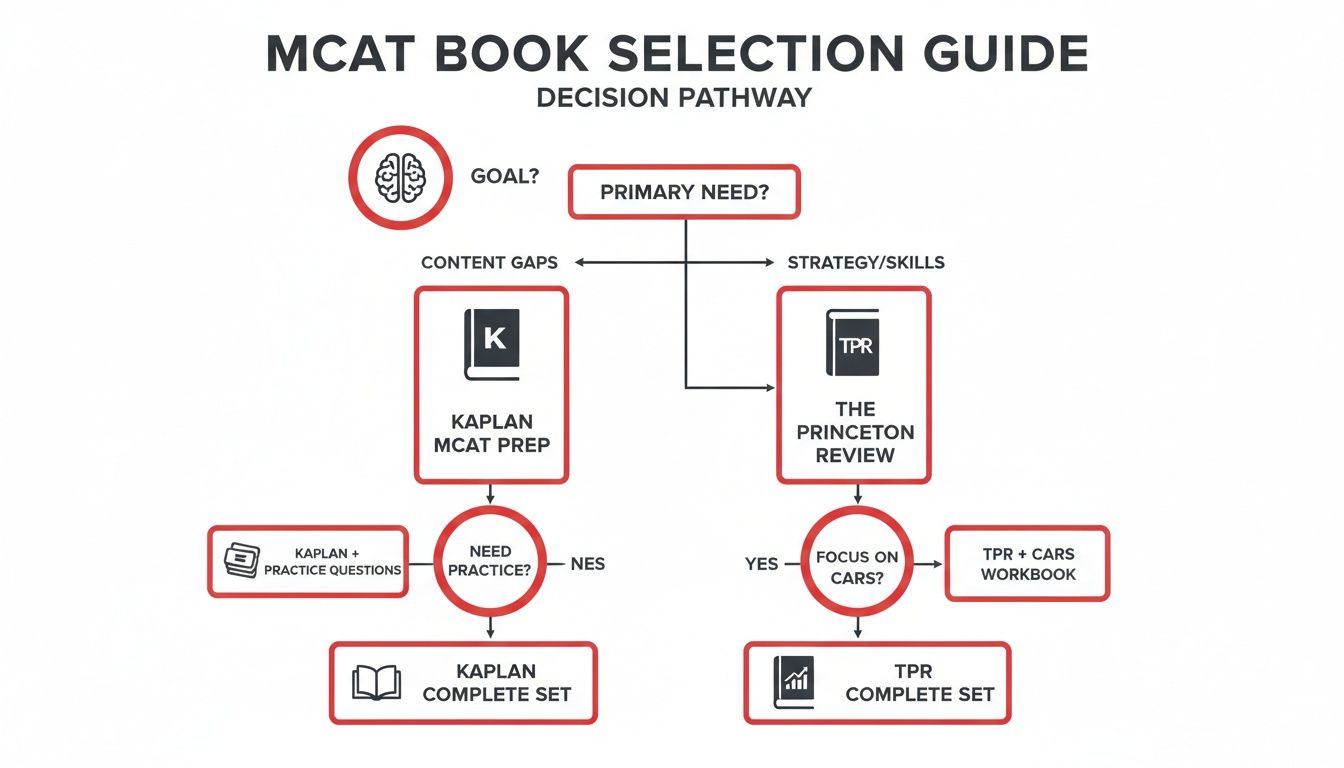
Use this to simplify your choice. Figure out if your main hurdle is mastering the scientific concepts themselves or learning to apply them under the pressure of the clock.
At-a-Glance Comparison of Leading MCAT Book Sets
To give you a clearer view of the landscape, the table below offers a quick rundown of the major players in the MCAT prep world. Use this as your starting point for matching a publisher’s core strengths to your learning style.
As you weigh your options, don't forget to look for ways to make your prep more affordable. When you're buying your main materials, it's a good idea to see if you can get discounts on other academic resources through platforms like those offering a Perlego student discount. And for a deeper dive into all the tools available, check out our comprehensive guide on the best MCAT study materials at https://acemedboards.com/best-mcat-study-materials/.
| Provider | Ideal Student Profile | Core Strength | Includes Online Resources? |
|---|---|---|---|
| Kaplan | Needs thorough content review; several years removed from prereqs | Exhaustive scientific detail and clarity in explanations | Yes, extensive Qbank and practice tests |
| The Princeton Review | Strong content base; needs to improve strategy and test-taking skills | Passage-based reasoning and critical thinking strategies | Yes, includes practice tests and online drills |
| Exam Krackers | Prefers a concise, high-yield approach; limited study time | Focused content and frequent, short practice exams | Yes, but less extensive than Kaplan or TPR |
| AAMC | All students, especially in the final months of preparation | Official questions and logic from the test makers | Yes, the definitive source for practice exams |
This table should help you quickly narrow down your choices and point you toward the resource that will give you the biggest return on your study time.
A Deep Dive into the Kaplan MCAT Book Set
When you first start looking into MCAT books, the Kaplan 7-book set is almost always the first one you'll hear about. There’s a good reason for that. It has cemented its reputation as the go-to resource for a truly comprehensive content review, making it a cornerstone for countless high-scoring students. The whole philosophy behind the Kaplan set is depth; it’s designed to leave no stone unturned, covering nearly every topic the AAMC could throw at you.
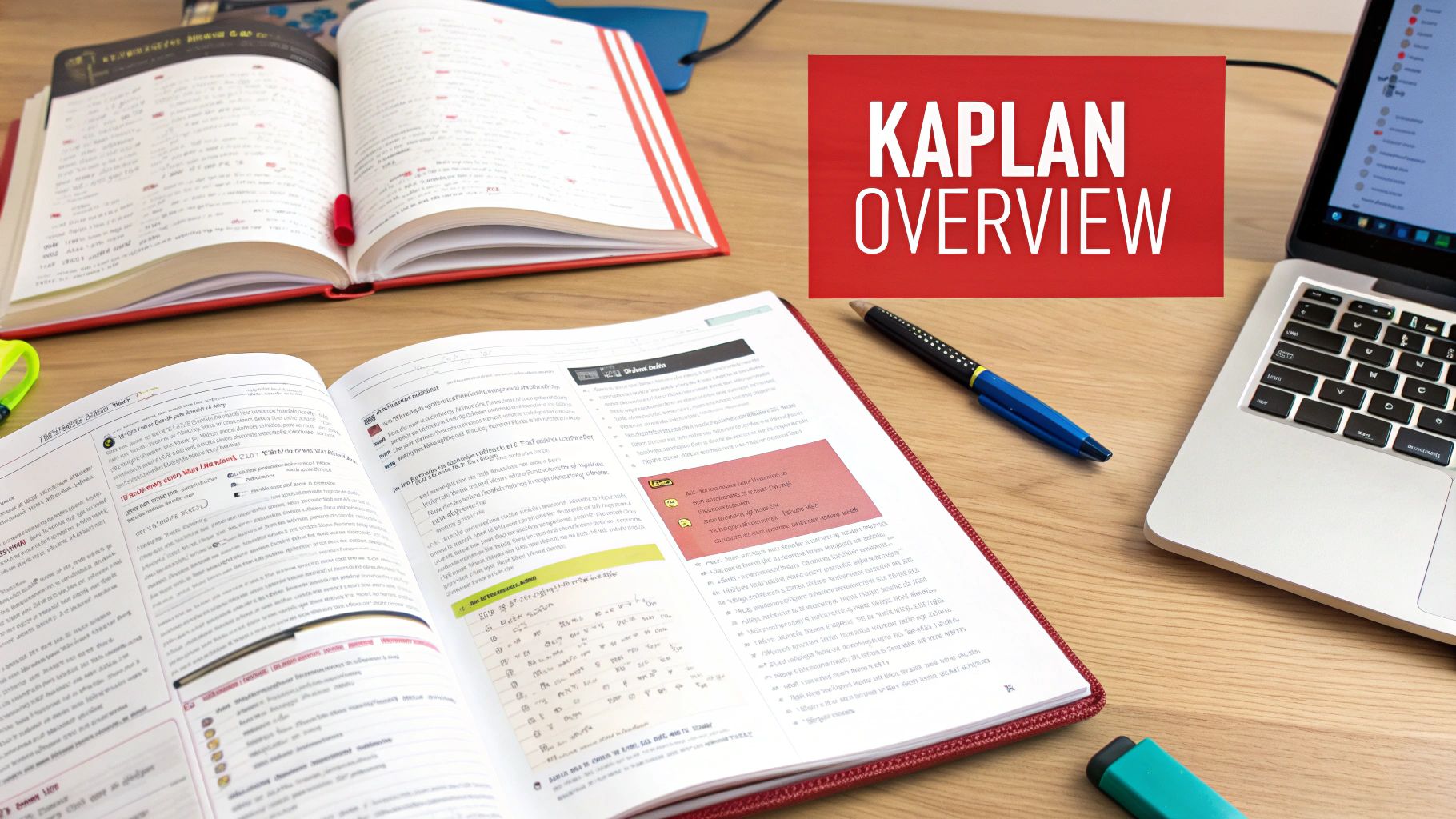
This exhaustive approach makes the Kaplan books a perfect fit for a specific kind of pre-med. If it’s been a couple of years since you took your science prerequisites, or if you know you have some serious knowledge gaps, these books are your best starting point. They function almost like a full curriculum, rebuilding your foundational knowledge from the ground up with crystal-clear explanations.
The demand for resources like this isn't slowing down. The global test-preparation market is expected to grow by about USD 16.3 billion between 2024 and 2028. This is largely driven by the popularity of blended learning, where comprehensive books like Kaplan's are paired with powerful online tools. You can get a better sense of these market dynamics in this detailed industry report.
Strengths of the Kaplan Approach
Kaplan’s real power is in its meticulous detail and logical structure. Each book is broken down into chapters that build on one another, creating a coherent path through the material. The writing is direct and clear, focused on helping you actually understand the concepts, not just memorize them.
For instance, the Kaplan Biochemistry book is legendary for its ability to distill complex metabolic pathways into diagrams and summaries you can actually digest. It doesn't just show you the Krebs cycle; it walks you through every step, explains the enzymes, and connects it all back to cellular respiration. The Physics and Math book is another standout, excelling at breaking down intimidating formulas with step-by-step example problems.
Another huge plus is the integration with Kaplan's online platform. When you buy the books, you also unlock:
- Three full-length practice tests: These are absolutely essential for building the stamina you need for test day.
- An extensive Question Bank (Qbank): This lets you build custom quizzes to hammer away at your weak spots.
- Video lessons: Perfect for when you're stuck on a tough concept and need to see it explained differently.
This mix of detailed books and solid online resources creates a powerful, self-contained study system.
Potential Drawbacks and Ideal User
While the thoroughness is Kaplan's biggest strength, it can also be a weakness for some. The sheer amount of information can feel like a tidal wave, especially if you already have a strong content base and just need to work on strategy. This is where you have to be honest with yourself.
The Kaplan set is not for a quick, high-yield review. It's an immersive, deep dive into the content, best for students who need to rebuild or reinforce their scientific knowledge from the ground up.
If you just finished your prereqs with solid grades, you might find all the detail is overkill. In that situation, you’d probably be better off with a resource that focuses more on practice passages and test-taking strategy. The key is to see Kaplan's detail as a feature, not a flaw—but only if it matches what you truly need.
How to Integrate Kaplan Books Effectively
To really get your money's worth from the Kaplan set, you need a plan. Don't just read the books from cover to cover and call it a day. Instead, use them as the foundation for active, engaged learning.
Here’s a workflow I recommend to my students:
- Read a chapter: Really focus on understanding the core concepts.
- Do the end-of-chapter questions: These are great for checking if you actually absorbed what you just read.
- Hit the Qbank: Create a targeted quiz on that same topic to practice applying your knowledge in an MCAT-style format.
- Review your mistakes: This is the most important step. Dig into why you got questions wrong and go back to the book to patch up those knowledge gaps.
For students working with Ace Med Boards, Kaplan books are the perfect content backbone. Your tutor can act as your guide, helping you pinpoint the highest-yield topics in each dense chapter. We'll assign specific Qbank sections to make sure you're turning that passive reading into active, score-boosting practice, so you never get lost in the weeds.
Analyzing The Princeton Review MCAT Prep Books
Where Kaplan sets out to build your content knowledge brick by brick, The Princeton Review (TPR) works from an entirely different blueprint. Their philosophy isn't about drowning you in exhaustive detail; it's about teaching you how to think like the MCAT. This makes their book set a game-changer for students who already have a decent science foundation but can't seem to translate that knowledge into points on complex, passage-based questions.
If Kaplan is the textbook, The Princeton Review is the strategy guide. That’s the single most important distinction to make when you're deciding between the two. TPR's materials are engineered to sharpen the critical reasoning and test-taking efficiency that often separate a good score from a great one.
The Strategy-First Approach
The real power of The Princeton Review's books is in their direct, actionable strategies. They don't just dump information on a page; they frame it in the context of the exam itself. For instance, instead of listing every last detail of a biological pathway, they’ll pinpoint the specific angles the MCAT loves to test and show you how to spot the clues hidden in a passage.
You'll feel this approach most in their science books. While they cover all the necessary content, the emphasis is relentlessly on application. You'll find fewer dense, encyclopedic chapters and far more streamlined explanations paired with immediate practice drills.
This makes the TPR set perfect for a specific type of student:
- You feel pretty confident in what you learned in your premed courses.
- You get bogged down in dense experimental passages and struggle to find the main idea.
- You constantly run out of time on practice sections because you're overthinking or getting lost in the weeds.
If that sounds like you, TPR's intense focus on efficiency and reasoning is likely to give you a bigger score bump than yet another round of pure content review.
Standout Books in the Set
While the entire collection is strategy-driven, two books really showcase TPR’s unique value: the CARS Workout and the Psychology and Sociology Review.
The CARS book does an incredible job of demystifying a section that feels frustratingly subjective to many students. TPR gives you a repeatable, systematic process for dissecting dense passages, identifying the author's tone, and sniffing out trap answers. They train you to actively engage with the text instead of just passively reading it—a skill that is absolutely non-negotiable for CARS.
The Princeton Review's greatest contribution is teaching students to treat the MCAT as a reasoning test, not just a knowledge test. It excels at simplifying complex passages and showing you where to focus your attention for maximum points.
Their Psychology and Sociology book is also a fan favorite, praised for its clarity and smart organization. It takes a massive amount of terminology and presents it in a structured, memorable way. This is a huge advantage for a section that's less about complex problem-solving and more about knowing precise definitions and how they apply to specific scenarios.
A Visual Comparison: TPR vs. Kaplan
| Feature | The Princeton Review (TPR) | Kaplan |
|---|---|---|
| Primary Goal | Master test-taking strategy and passage-based reasoning. | Build a comprehensive and exhaustive content foundation. |
| Ideal User | Solid science knowledge, needs to improve application. | Needs a complete content refresh or has significant knowledge gaps. |
| Book Style | More concise, with integrated drills and strategy tips. | Detailed, in-depth explanations that read like a textbook. |
| Visual Aids | Clear, functional diagrams focused on core concepts. | Abundant, highly detailed diagrams and full-color illustrations. |
| Practice Questions | Often focus on mimicking tricky MCAT-style reasoning. | Tend to be more content-focused and direct. |
Integrating TPR into Your Study Plan
To get the most out of the TPR books, you have to use them actively. Don't just read the strategy tips—apply them immediately to the end-of-chapter drills and the online practice materials that come with the set. A common mistake is treating these books like traditional textbooks, which completely misses their core purpose.
For students working with Ace Med Boards, The Princeton Review books provide an excellent framework for our strategy sessions. We can use TPR's methods as a launchpad, then customize them to fit your specific thought process. Your tutor will work with you to internalize their passage-mapping techniques until they become a natural, automatic part of your approach on test day.
Comparing Exam Krackers And The Berkeley Review
Once you move past the big, all-in-one sets like Kaplan and Princeton Review, you enter the world of specialized, high-octane MCAT resources. This is where you find the heavy hitters: Exam Krackers (EK) and The Berkeley Review (TBR). Think of these not as your primary textbook but as specialized training equipment.
Choosing between them isn't about picking the "better" one. It's a strategic decision based on your study style, your current scoring level, and how much time you have. Get this choice right, and you can supercharge your prep. Get it wrong, and you're staring down the barrel of frustration and burnout.

EK is built for speed and surgical precision. TBR is designed for absolute mastery through sheer force and depth. Let's break down where each one shines.
Exam Krackers: The High-Yield Sprinter
The entire philosophy behind Exam Krackers is "less is more." They operate on the principle that you don't need to memorize every obscure detail. You just need to master the highest-yield information that shows up again and again on the MCAT.
The tone is colorful, engaging, and sometimes a little quirky—a welcome break from the dry, dense writing you find in other prep books. But the real genius of the EK system is its signature "30-Minute Exams." These are short, topical quizzes at the end of each chapter that force you to immediately apply what you just learned, all under the clock. It’s an incredible tool for building mental agility and quick recall.
EK is probably the right move for you if:
- Your study time is limited and you need to squeeze maximum value out of every hour.
- You already have a decent grasp of the content and need a fast-paced, focused review.
- You learn best by doing, not just reading. The constant practice keeps you sharp.
Simply put, EK builds speed and confidence. It's the perfect tool for hammering home core concepts and quickly plugging knowledge gaps without getting lost in the weeds.
The Berkeley Review: The Deep-Dive Marathoner
If Exam Krackers is the sprinter, The Berkeley Review is the ultramarathoner who trains in the mountains. TBR has a legendary—and, let's be honest, slightly terrifying—reputation for having the most in-depth content and the hardest practice passages on the market.
These books are not for the faint of heart. They are engineered for one purpose: to help students who are already scoring high break into the 99th percentile. The science books, especially for General Chemistry, Organic Chemistry, and Physics, go incredibly deep. They cover concepts with a level of detail that makes even Kaplan look like a summary. The passages are notoriously difficult, often requiring multiple layers of reasoning and a PhD-level understanding of experimental data.
The Berkeley Review isn’t really a content review tool. It’s a performance enhancement tool. The goal is to train so hard that the real MCAT feels easy by comparison.
This makes TBR the ideal weapon for a very specific type of student: the high-achiever who is already scoring well but needs to grind their way into the elite 520+ range. If you feel like other practice materials just aren't challenging you anymore, TBR will give you the heavy lifting you need to level up.
Head-To-Head: The Critical Differences
The key to choosing correctly is understanding the core mission of each resource. They were built for totally different jobs.
| Feature | Exam Krackers (EK) | The Berkeley Review (TBR) |
|---|---|---|
| Core Philosophy | High-yield, efficient, and concise. | Unmatched depth and difficulty for elite scores. |
| Ideal Student | Needs a fast, focused review; short on time. | A high-scorer aiming for the 99th percentile. |
| Practice Style | Short, frequent "30-Minute Exams" for speed. | Long, complex passages harder than the real test. |
| Content Focus | Covers what’s most likely to appear on the MCAT. | Covers everything, including low-yield topics. |
| Primary Use Case | A supplement for reinforcing content and timed practice. | Advanced practice to sharpen reasoning for the hardest questions. |
How to Use EK And TBR In Your Prep
Almost nobody uses EK or TBR as their only resource. They are most effective when layered on top of a foundational study plan that includes a comprehensive set like Kaplan or TPR and, of course, all official AAMC materials.
For students working with an Ace Med Boards tutor, we often use these strategically. If a student is wrestling with a specific topic like electrochemistry, we'll assign the EK chapter and its 30-minute exam as a targeted workout. For our most advanced students aiming for top scores, we’ll strategically assign TBR passages to make sure they're ready for absolutely anything the MCAT can throw at them on test day.
Why AAMC Official Materials Are Non-Negotiable
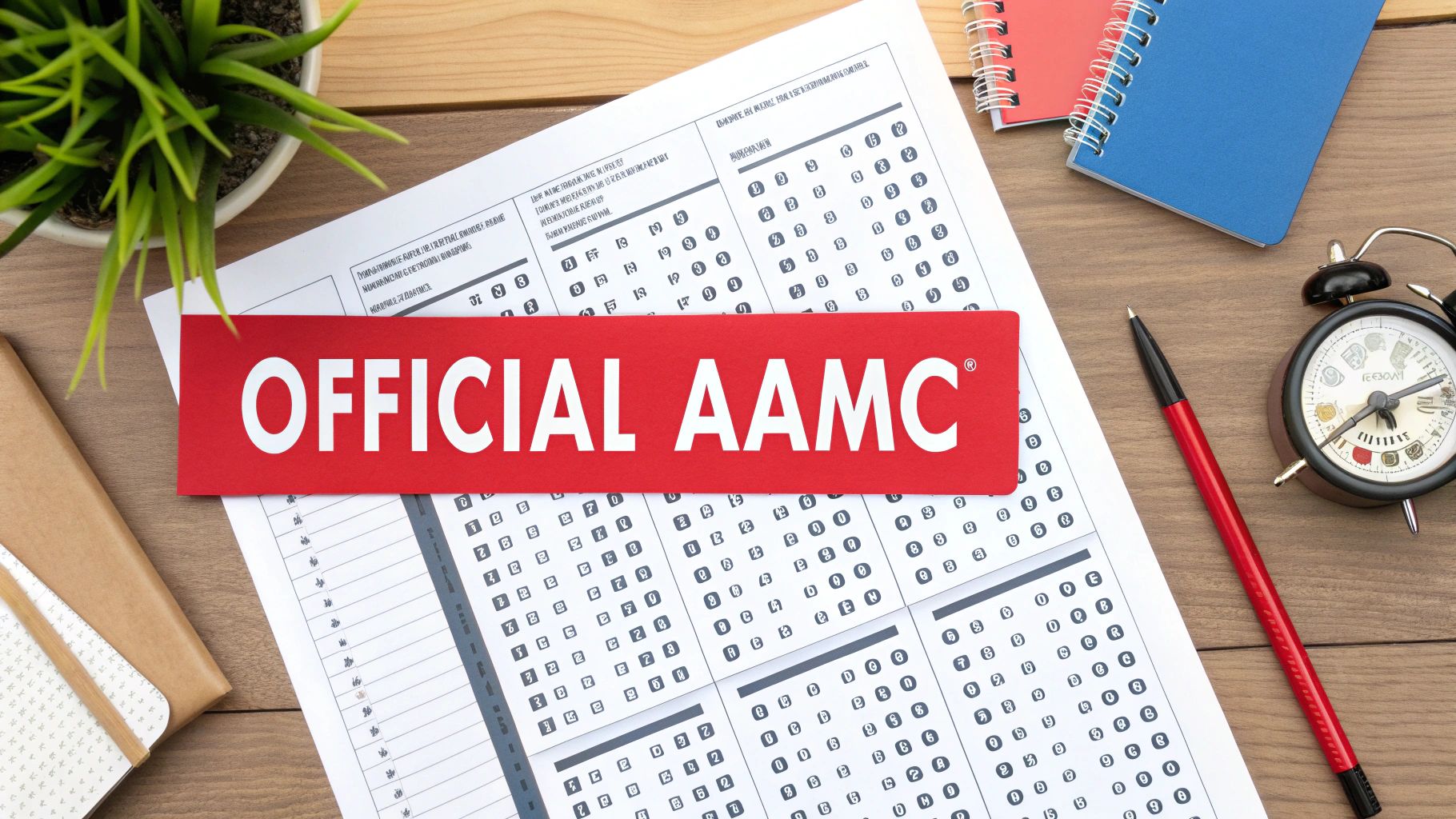
Let's cut to the chase. While every prep company puts its own spin on MCAT content, every single successful study plan converges on one essential resource: the official materials from the Association of American Medical Colleges (AAMC).
Think of it this way: Kaplan, The Princeton Review, and the others teach you the science. The AAMC materials teach you how to take the MCAT. These resources are absolutely non-negotiable because they come straight from the test-makers themselves. This is your only direct line into the specific logic, question phrasing, and passage style you’ll face on exam day. No third-party resource can ever perfectly replicate it.
The entire prep industry knows this. While physical books are still a foundation, much of their business now revolves around digital question banks and practice exams, following the AAMC's lead. This just underscores how critical practice-based learning has become.
Understanding the AAMC Bundle Components
The AAMC bundle isn't just a random pile of practice questions. Each component serves a very distinct, strategic purpose in your prep. Knowing their roles is the key to using them effectively and not wasting them.
- Full-Length Practice Exams: These are the gold standard, plain and simple. They give you the most accurate prediction of your real score and are essential for building the mental stamina you'll need.
- Section Banks (B/B, C/P, P/S): This is where the AAMC puts its hardest, most convoluted passage-based questions. They are designed to hammer your critical reasoning skills, not just your content knowledge.
- Question Packs (QPs): These are sets of more direct, content-focused questions. They are perfect for drilling down on specific knowledge gaps and making sure you've got the basics covered.
A huge mistake students make is mixing these up. Using the Section Banks for simple content review is like trying to learn basic grammar by reading dense philosophy—it's inefficient, frustrating, and a complete waste of a valuable resource.
Strategic Use of AAMC Materials
Timing is everything. You want to integrate AAMC materials when they'll have the most impact. The Question Packs are best used during your content review phase to confirm you’ve actually mastered the fundamentals from your prep books.
The Section Banks are your endgame training. Save them for the final 4-6 weeks of your prep to sharpen your ability to dissect complex experimental passages. This is how you learn to think exactly like the test-makers.
This is the critical transition from just knowing the material to mastering the exam itself. For a detailed breakdown of how these official tests stack up and the ideal timeline for using them, check out our guide on the best MCAT practice tests.
Finally, space out the full-length exams during the last one or two months of your study plan. Take them under strict, timed conditions to get a true measure of your progress. Then, meticulously review every single question—right or wrong—to get inside the AAMC's head. This final phase of any quality review of MCAT books and resources is what turns a good score into a great one.
How to Build a Custom MCAT Study Plan
Knowing which MCAT books are best is only half the battle. The real magic happens when you know how to weave them into a study plan that actually works for you. A great plan isn't just a calendar with chapters assigned to dates; it's a strategic framework that layers different resources to build your content foundation, sharpen your critical reasoning, and peak right on test day.
The goal here is synergy. You'll start with a comprehensive book set for your main content review, then layer in specialized resources to attack your weaknesses, and finally, use the official AAMC materials as the ultimate benchmark. This approach ensures you’re building a complete skillset, not just passively reading chapters.
The Traditional Student Framework
This is the classic scenario: a student dedicating a summer break, about three months, to full-time MCAT prep. This timeline is tight, but it’s more than enough time if you’re disciplined and methodical. Success here comes down to a phased approach.
Phase 1: Content Mastery (Weeks 1-6): This is where you live in a comprehensive set like Kaplan or The Princeton Review. Your days should be dedicated to reading chapters, working through the end-of-chapter problems, and making flashcards for the highest-yield concepts. The objective is simple: build a rock-solid foundation across every single subject.
Phase 2: Targeted Practice (Weeks 7-9): Now it's time to shift gears and start layering in tougher practice. This is the perfect window to introduce Exam Krackers' 30-Minute Exams to boost your speed or dig into targeted passages from The Berkeley Review to hone your reasoning in your weak areas. You'll also start mixing in the AAMC Question Packs to get a feel for how the test-makers phrase things.
Phase 3: AAMC Immersion (Weeks 10-12): The final stretch is all about simulating the real deal. Your focus narrows almost exclusively to the AAMC Section Banks and full-length practice tests. Your third-party books become reference tools—you only crack them open to quickly review a concept you missed on a practice exam.
This structure logically progresses from learning the material to mastering its application under the pressure of the clock.
The Non-Traditional Student Framework
Non-traditional students are often juggling studying with a full-time job, family, or other major commitments. This requires a longer, more flexible timeline. A six-month plan is ideal because it allows for deep, meaningful learning without leading to burnout.
For the non-traditional student, consistency trumps intensity. The key is making steady, measurable progress every single week, even if it's just for a few hours. This approach prevents the huge knowledge gaps that can form when you study sporadically.
The plan should follow a similar three-phase structure, just with extended timelines for each phase. A well-structured MCAT study schedule for a 6-month timeline is a fantastic resource, as it breaks down how to integrate content review and practice in a way that doesn’t feel overwhelming. The entire model is built for sustainability, making sure you arrive on test day prepared, not completely exhausted.
To help visualize how this works, here is a sample framework for a 3-month plan that integrates various book types. A 6-month plan would simply extend the duration of each phase.
Sample 3-Month Study Plan Integrating MCAT Books
| Phase (Duration) | Primary Focus | Recommended Book Integration | AAMC Material Usage |
|---|---|---|---|
| Phase 1 (Weeks 1-6) | Content Foundation & Mastery | Use Kaplan or Princeton Review as your core. Complete all chapters and practice questions. | Light usage of Question Packs for topics you've covered, mainly to see AAMC style. |
| Phase 2 (Weeks 7-9) | Weakness Targeting & Passage Practice | Use Exam Krackers for speed and The Berkeley Review for deep passage analysis in weak subjects. | Heavy use of Question Packs to reinforce content. Start with one full-length practice test. |
| Phase 3 (Weeks 10-12) | AAMC Logic & Test Simulation | Core books are for reference only. | Focus entirely on Section Banks and remaining Full-Length Practice Tests. Review every question. |
This table shows how resources are layered. You don't just finish one and start another; you strategically integrate them as your needs evolve from building knowledge to mastering test-taking strategy.
The MCAT Retaker Framework
As a retaker, you have one massive advantage: you already know your enemy. Your study plan shouldn't be a repeat of your first attempt. Instead, it needs to be a surgical strike on the specific content areas and question types that tripped you up.
- Dissect Your Score Report: Before you do anything else, meticulously analyze your old score report. Did experimental C/P passages sink you? Was it P/S terminology? This data is your new roadmap.
- Targeted Content Review: Don't re-read every book cover-to-cover. Use a detailed set like Kaplan to dive deep only into your weakest topics. If metabolism was a problem, immerse yourself in the biochemistry book but just skim the subjects you already aced.
- Intensive, Specialized Practice: This is your new primary weapon. If passage-based reasoning was the issue, The Berkeley Review's notoriously difficult passages are your new best friend. If you needed more speed, Exam Krackers is the tool for the job. You should be spending 80% of your time on practice and only 20% on content review.
- Master AAMC Logic: Redo every single AAMC question and practice test. This time, your review has to be obsessive. Focus not just on why the right answer is right, but more importantly, why every single wrong answer is wrong. This is how you internalize the test-makers' logic and stop falling for their traps.
Your Top MCAT Book Questions Answered
Picking the right MCAT books can feel like its own high-stakes exam. I get a ton of questions from pre-meds trying to sort through the noise, so let's tackle the most common ones head-on. My goal is to give you clear, practical answers so you can build your study arsenal with confidence.
How Many Book Sets Do I Really Need?
For the vast majority of students, one comprehensive book set is plenty for your content review. The real key isn't quantity; it's choosing the right set for your learning style—whether that’s Kaplan for its sheer depth or The Princeton Review for its strategic approach.
Instead of drowning in multiple complete sets, think smart. A much better strategy is to supplement your primary set with specialized resources. For example, you could pair your main Kaplan books with Exam Krackers for targeted speed drills or, more importantly, with the official AAMC materials for realistic practice. This keeps you from getting overwhelmed while still shoring up your specific weaknesses.
Should I Splurge on the Newest Editions?
Yes. It's almost always worth it. The AAMC tweaks the MCAT from time to time, and publishers update their books to match these changes. This ensures the content you're studying is as relevant and high-yield as possible.
Newer editions usually have better explanations, corrected errors from previous versions, and practice questions that more accurately reflect the current exam's style. You might save a few bucks on an old, used set, but you run the serious risk of studying outdated information. That's a huge gamble you don't want to take.
Your MCAT prep is a major investment in your medical career. Spending a little extra for the most current and accurate books is one of the highest-return decisions you can make in this entire process.
Can I Succeed with Just Books and No Course?
Absolutely. Plenty of students crush the MCAT using only books and the official AAMC practice materials. Going the self-study route demands serious discipline and organization, but it's a completely viable—and much more affordable—path to a top score.
Success here really comes down to creating a solid plan and sticking to it. If you find yourself hitting a wall in a specific subject or struggling with test strategy, you can always get targeted help, like hiring a tutor, without committing thousands to a full course.
While our focus here is on the MCAT, students curious about the broader world of publishing might find expert answers in this resource on general book translation FAQs.
Feeling like you need a personalized game plan to cut through the confusion? The expert tutors at Ace Med Boards can help you choose the perfect MCAT books for your specific needs and build a custom schedule that turns your hard work into a top score. Start with a free consultation today at https://acemedboards.com.

