Let's be blunt: your residency letters of recommendation are far more than just a box to check. They are powerful, personal endorsements that give program directors a real sense of your clinical skills, character, and work ethic. In a sea of high-achieving applicants, a truly compelling LoR can be the one thing that makes you stand out.
Why Your LoRs Can Make or Break Your Match
Think of your residency application as a story. Your USMLE scores and transcripts are the hard data, the plot points. But your letters of recommendation? They're the character development, written by the mentors who know you best.
Program directors are digging for the qualitative details that a multiple-choice exam can't possibly measure. They want proof of your clinical reasoning, your ability to work within a team, and your professionalism under pressure. A vivid, detailed letter transforms you from just another name on a spreadsheet into a memorable, three-dimensional candidate.
Imagine this very real scenario: two applicants are neck-and-neck for a single spot in a competitive surgery program. They have identical, stellar stats. One has a generic letter from the department chair. The other has a powerhouse letter from an attending who describes, in detail, how their quick thinking and calm demeanor during a complex procedure directly improved patient care.
That specific story is the tiebreaker. Every time.
The Decisive Impact on Your Application
This isn't just anecdotal. The NRMP Director Survey consistently ranks Letters of Recommendation as the second most critical factor in residency applications, sitting right behind USMLE Step scores.
For U.S. medical graduates, who saw a 94.2% match rate in the last cycle, strong LoRs are often the key differentiator in hyper-competitive fields. With 47,208 applicants duking it out in the last Match—including a huge number of IMGs—those with weak or generic letters simply fade into the background.
You can get a deeper look at what programs are looking for in our guide to letters of recommendation for residency programs.

What Programs Are Really Looking For
Program directors are reading hundreds, if not thousands, of applications. They’re using LoRs to screen for specific traits that are essential for success in their program.
- Clinical Competence: Can you actually apply what you know in a real-world setting?
- Work Ethic: Are you reliable, diligent, and willing to go the extra mile when no one is watching?
- Teachability: How do you respond to feedback? Do you seek it out and actively use it to get better?
- Interpersonal Skills: How well do you play with others? Can you collaborate effectively with attendings, residents, nurses, and the entire care team?
A great letter doesn't just say a candidate is "hardworking." It describes the time they stayed late to comfort a distressed patient's family or voluntarily took the lead on a challenging case presentation. Specificity is what makes an LoR truly advocate for you.
Understanding this is your first step. Your goal isn't just to collect letters; it's to strategically curate a set of compelling endorsements that paint a complete and convincing picture of who you are as a future resident. Every letter should add a unique dimension to your application, creating a chorus of support that is impossible for program directors to ignore.
Choosing the Right Advocates for Your Application
Picking your letter writers is one of the most critical decisions you'll make for your residency application. This isn't just about collecting signatures from the biggest names in medicine. It’s about strategically choosing advocates who can speak to your abilities with genuine, detailed insight. Your goal is to assemble a team of writers who have truly seen you in action and believe in your potential as a future resident.
A powerful letter of recommendation comes from a place of direct observation. Think back to the attendings, mentors, and faculty who watched you work up a patient, present on rounds, or navigate a tough clinical scenario. These are the people who can provide the specific, compelling anecdotes that program directors are actually looking for.
Quality Over Prestige
It's tempting to chase a letter from a well-known department chair or a world-renowned researcher. But a generic, impersonal letter from a big name you barely know is far less effective than a glowing, detailed letter from a junior attending who supervised you closely for a month.
Program directors can spot a form letter a mile away. A powerful letter is filled with specific examples of your performance, highlighting moments that demonstrate your clinical reasoning, compassion, and work ethic.
Let's look at two scenarios:
- Scenario A: You get a letter from the department chair you met once. The letter states you are a "hardworking student with a bright future."
- Scenario B: You get a letter from a fellow who supervised you closely. They describe the time you correctly identified a subtle EKG finding, leading to a timely and critical intervention for a patient.
Which one tells a better story? The second letter provides tangible proof of your skills. It makes you memorable and demonstrates your competence in a way no generic praise ever could. This is the kind of advocacy that lands you an interview.
Building Your Letter Portfolio
Think of your letters as a balanced portfolio, where each one highlights a different facet of your candidacy. You're aiming for a mix of writers who can offer diverse perspectives on your abilities. Typically, you'll need three to four strong letters.
A solid portfolio might include:
- Specialty-Specific Attendings: At least two letters should come from physicians within your chosen specialty. These are non-negotiable; they confirm your commitment and aptitude for the field.
- A Clinical Mentor: This could be an attending from a core rotation who has seen you grow over time. They can speak to your development, teachability, and professionalism.
- A Department or Chair's Letter: For some specialties, this is a requirement. Even when it isn't, a supportive letter from a department leader who knows you can add significant weight.
This combination creates a comprehensive picture, showing program directors that you excel specifically within their field while also being a well-rounded and respected student across different clinical environments. The experiences you gain during your core rotations are fundamental for building these relationships. To learn more, explore our detailed guides on how to succeed during your medical student clerkships.
Who Knows You Best
As you brainstorm potential writers, ask yourself these crucial questions:
- Did they directly observe my clinical work? This is the most important factor. Someone who has seen you interact with patients and colleagues can write with authority.
- Can they write a strong letter? When you ask, use this exact wording: "Would you be able to write a strong letter of recommendation for me?" Their response will tell you everything you need to know. Any hesitation is a red flag.
- Do they know me well enough to provide specific examples? A great letter writer will recall specific moments where you shined. They can talk about your presentations, patient interactions, or diagnostic skills with concrete detail.
- Are they generally supportive of students? Some attendings are known for being tough graders or brief writers. Seek out those who have a reputation for being invested in medical education and student success.
Choosing the right people is about finding true advocates. It's a process of identifying the mentors who have not only taught you but have also witnessed your best work. Their authentic, detailed testimony will become one of the most influential components of your residency application, turning your on-paper qualifications into a compelling narrative of a future physician they would be excited to train.
How to Ask for a Letter That Gets Results
The way you ask for your residency letters of recommendation can make or break the final product. A thoughtful, organized request doesn't just make it easier for an attending to say "yes"—it empowers them to write a powerful, personalized letter that truly champions your application. Your goal is to turn what could be a burden for them into a straightforward, even enjoyable, process.
Timing is everything. You need to ask for your letter at least four to six weeks before you need it submitted. This shows you respect their incredibly busy schedule and gives them enough time to write something meaningful. Ask too early, and your request might get buried and forgotten. Ask too late, and you risk getting a rushed, generic letter or even a polite "no."
Crafting the Perfect Email Request
While asking in person is a great touch, the reality is that email is often the most practical way to make the initial request. Your email should be short, professional, and get straight to the point. Clearly state why you're asking them specifically and make it incredibly easy for them to agree.
A simple, effective email usually follows this flow:
- A Clear Subject Line: Something like "Letter of Recommendation Request – [Your Name]" is perfect.
- A Polite Opening: Briefly remind them who you are (if needed) and mention something specific you valued about working with them.
- The Direct Ask: Get right to it. State that you're applying for residency in [Specialty] and ask if they would feel comfortable writing a strong letter of recommendation on your behalf. Using the word "strong" is key—it gives them an out if they don't feel they can endorse you enthusiastically.
- Offer of Support: Immediately mention that you will provide a comprehensive packet of materials to make the process as easy as possible for them.
For a deeper look at getting your message just right, check out this guide on how to send the perfect email to get the response you want. Getting this first step right sets a positive tone for the whole process.
The LoR Packet Your Writer Will Appreciate
Once they've agreed, it's time to send them a well-organized "LoR Packet." This is your chance to arm them with everything they need to write a detailed, compelling, and personal letter. Don't make them dig through old emails or search for your records. Hand it all to them on a silver platter.
Your LoR Packet is more than just a CV. It's a curated collection of documents designed to remind your writer of your strengths, goals, and specific accomplishments under their supervision. It’s your best tool for ensuring your letter is packed with personal, impactful details.
A great packet should always include these items:
- Your CV: Make sure it's polished and completely up-to-date.
- Your Personal Statement: Give them the latest draft so they can see your story and career goals.
- Your ERAS ID and AAMC ID: This is critical for them to upload the letter correctly.
- A Professional Headshot: A photo is a simple way to help them put a face to the name, especially if it's been a few months since you worked together.
- A "Memory Jogger" Summary: This is the most important part. Write a brief paragraph or a few bullet points reminding them of your time together. Mention a specific patient you discussed, a case you presented, or a skill you demonstrated that you were proud of.
For example, you could write to your surgery clerkship director: "I especially valued our time working on the complex appendectomy with Mrs. Smith, where I was able to practice my suturing skills and present the post-op plan during rounds." This kind of specific detail gives them concrete material to work with, turning a generic compliment into a powerful anecdote.
Thinking about who to ask can be tough, but most applicants pull from a similar hierarchy of potential writers.
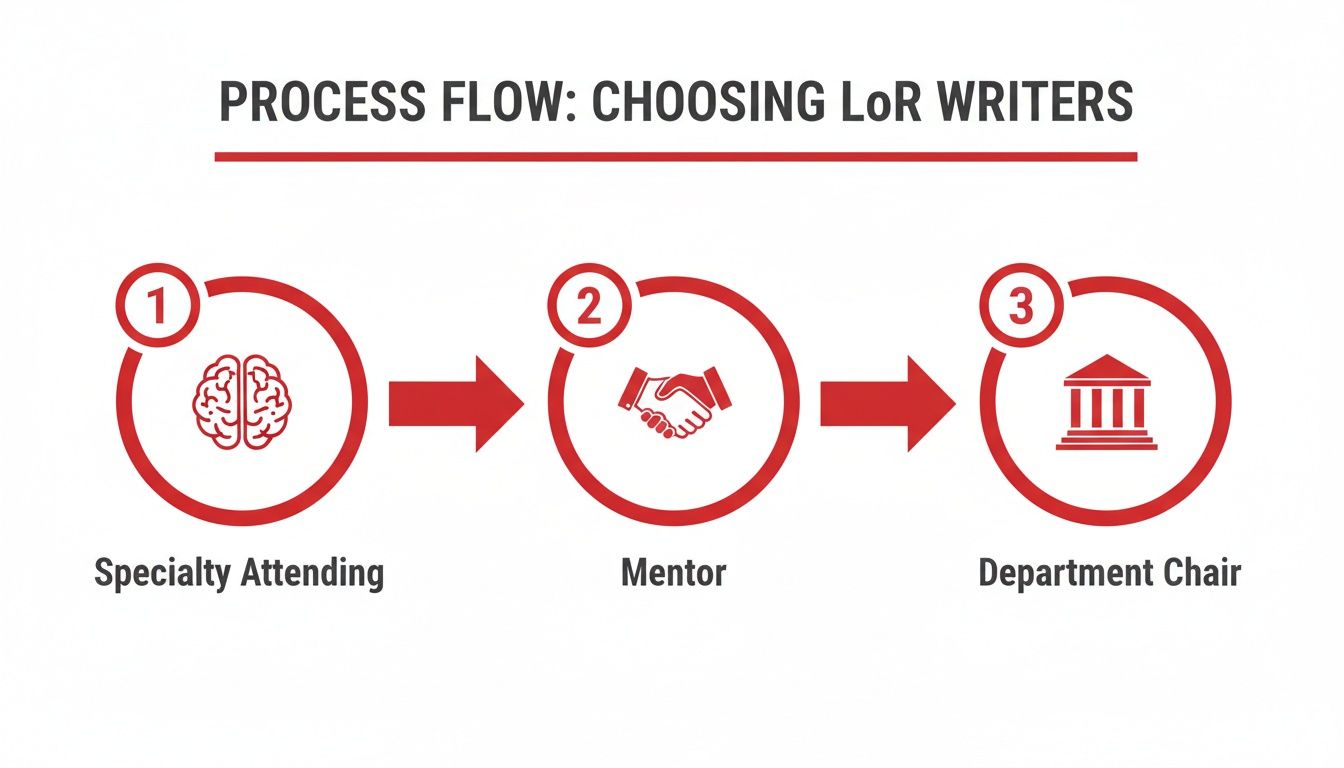
This simple breakdown shows the common sources for LoRs—from attendings in your chosen field to mentors and department chairs who know you in a different capacity. Each person offers a unique perspective. By giving every writer a fantastic LoR packet, you ensure that every letter is as strong as it can possibly be. To get a better feel for the final product you're aiming for, it can be helpful to review a sample letter of recommendation for residency.
A Different Game: LoR Strategy for IMGs and Re-applicants
If you're an International Medical Graduate (IMG) or a re-applicant, the standard playbook for residency letters of recommendation just doesn't apply. You're navigating a unique set of challenges, and your LoR strategy needs to be deliberate, targeted, and frankly, a lot smarter.
Your letters have to do more than just sing your praises; they need to proactively answer the questions and doubts program directors might have about your file.
For IMGs, one factor towers above all others: United States Clinical Experience (USCE). It’s a non-negotiable. A glowing letter from a world-renowned professor in your home country is a great honor, but it carries a fraction of the weight of a letter from a US-based attending who saw you work on American soil.
Program directors need proof. Proof that you get the US healthcare system, that you can connect with American patients, and that you'll slide right into a US-based clinical team without a hitch.
A US-based letter of recommendation is your proof of concept. It tells program directors that a physician practicing in their own system has vetted you and found you ready for the rigors of a US residency program. It is the single most powerful tool an IMG has to level the playing field.
For IMGs, US-Based LoRs Are Your Ticket In
Think of letters from your USCE as your entry ticket. Without them, it's incredibly tough to even get your application looked at seriously. They provide crucial context that an international letter simply can't, speaking directly to your hands-on skills in the exact environment you're trying to join.
The data doesn't lie. While IMGs did secure 4,718 internal medicine spots and 1,427 in family medicine in a recent match, that success is almost always built on a foundation of compelling US-based LoRs.
Just look at the match rates: non-US IMGs matched at 58.3%. That number jumps to 70.1% for US citizen IMGs, who more frequently have access to USCE. That's not a small gap. For more insights, check out the latest residency match statistics on acemedboards.com.
So, how do you get these game-changing letters? You have to prioritize meaningful US clinical experience.
- Hands-on Clerkships: This is the gold standard. You get direct patient care responsibility, which leads to the most detailed and impactful letters.
- Sub-internships (Sub-Is): An incredible opportunity to function like an intern. A strong performance here can yield a truly powerful evaluation.
- Observerships: They're less ideal because they aren't hands-on. However, they can still be a way to build a relationship with a US physician who can attest to your knowledge and professionalism.
A huge part of this is knowing which programs are even open to IMGs. For more on that, check out our guide on finding IMG-friendly residency programs.
For Re-applicants, It’s All About the Comeback Story
If you're re-applying, your mission is crystal clear: show growth. You have to prove you've spent the past year becoming a stronger, more compelling candidate, and your LoRs are the primary way to tell that story.
Sending the same letters you used last year is a red flag. It signals stagnation. You absolutely need new letters that reflect new experiences.
So, what does that look like?
- Get a New Gig, Fast. After an unsuccessful match, the clock starts ticking. Immediately start looking for a clinical fellowship, a research position, or even a medical assistant role in a busy clinic. The goal is to get back in the game.
- Shine in Your New Role. Your objective is to blow away a new set of attendings. These are the people who will write fresh, current letters about your improved skills and relentless dedication.
- Circle Back (Carefully). Had a really strong relationship with a letter writer from last cycle? It might be okay to ask for an update. But you must arm them with new ammunition—give them a clear summary of everything you've accomplished over the past year so they have new material to add.
For instance, maybe you spent the year as a research coordinator. A new letter from your Principal Investigator can highlight your project management skills, analytical thinking, and commitment to academic medicine.
This isn't just about getting new letters; it's about crafting a narrative of resilience and proactive improvement. Every program director wants to see that. Your new set of letters is proof that you didn't just wait around—you invested in yourself and came back stronger.
Navigating Specialty-Specific Letter Requirements

Submitting a generic set of residency letters of recommendation across different specialties is a recipe for a thin interview season. Some fields have their own distinct expectations and even standardized formats that aren't just suggestions—they're essential. Learning these unwritten (and sometimes very clearly written) rules is a huge part of the game.
Take many competitive surgical subspecialties, for instance. A letter from the department chair often carries serious weight. These letters can act as a standardized benchmark for all applicants from one institution, giving program directors a trusted point of comparison. Failing to include one when it's the norm can make your application look incomplete or like you couldn't secure the department's endorsement.
This means you have to be strategic from the get-go. Planning your fourth-year rotations and away rotations with these letter requirements in mind is non-negotiable. If you're aiming for a surgical subspecialty, make sure you schedule a rotation that gives you meaningful facetime with the department chair or a well-respected senior faculty member who can write for you.
The SLOE: A Must-Have for Emergency Medicine
When it comes to Emergency Medicine (EM), there is one letter to rule them all: the Standardized Letter of Evaluation (SLOE). This isn't just another letter; it's the single most important evaluation tool used by EM program directors. Submitting an EM application without a SLOE (or ideally, a few of them) is the fastest way to get your file moved to the bottom of the pile.
The SLOE is a unique, competency-based evaluation that forces the writer to compare you directly against other medical students they’ve worked with. It’s brutally honest and incredibly detailed, moving far beyond the usual generic praise.
The real power of the SLOE lies in its standardization. It makes evaluators rank applicants in specific domains, like medical knowledge and patient care, giving programs a clear, comparative data point for every candidate. A "top 1/3" ranking on a SLOE from a respected institution speaks volumes.
The SLOE includes sections on:
- Qualifications for EM: A direct assessment of your commitment and suitability for the specialty.
- Comparative Ranking: The heart of the SLOE, where you are ranked against your peers (e.g., top 10%, top 1/3, middle 1/3).
- Global Assessment: A final summary of your overall potential as a future emergency physician.
Securing Your High-Impact Evaluations
To get these powerful, specialty-specific letters, you absolutely must be proactive. For EM applicants, this means prioritizing EM rotations—both at your home institution and as away rotations—to collect at least two, preferably three, SLOEs. Away rotations are particularly valuable because they prove you can adapt and excel in a totally new clinical environment.
For surgical fields, get to know the key figures in the department early. Look for research opportunities or seek mentorship from the program director or chair. These relationships, built over time, are what lead to the kind of detailed, personalized letters that make a real difference.
Ultimately, proper planning and a clear understanding of what each specialty values will ensure your letters of recommendation actively strengthen your application, not just check a box. As you pull these complex materials together, reviewing an ERAS application sample can give you valuable context on how all the pieces should fit.
Critical LoR Mistakes That Weaken Your Application
You’ve done the hard work, secured great rotations, and built solid relationships. But even the most stellar applicants can torpedo their own chances with a few preventable LoR mistakes. Think of this final stage as defense—avoiding unforced errors that raise red flags for program directors is just as critical as getting strong letters in the first place.
One of the most common—and most damaging—mistakes is failing to waive your right to see your letters. I know it feels weird to sign away your right to see what someone wrote about you, but you absolutely must waive this right.
Not waiving it signals a lack of confidence in your letter writer and makes programs question whether the praise is genuine. It’s an immediate signal that the letter might not be a candid, unbiased assessment, and it can cast a shadow over your entire application.
Sending Mismatched or Outdated Letters
Submitting a generic or irrelevant letter is another huge misstep. Program directors are laser-focused on finding candidates who are truly committed to their specialty. Imagine sending a glowing, beautifully detailed letter from a family medicine attending to a competitive orthopedic surgery program. While it might be a great letter, it says nothing about your surgical skills or interest, making it practically useless. Worse, it suggests a lack of focus.
Outdated letters are just as bad. A letter from a rotation you did two years ago is far less powerful than one from an experience within the last 6-12 months. Medicine moves fast, and so have you. Programs want to know who you are as a candidate now, not who you were as an M2.
The gold standard is simple: your letters need to be recent, specialty-specific, and ideally based on U.S. clinical experience. This is especially vital for the 34% of applicants in the last NRMP cycle who were IMGs, as these letters offer direct proof of your ability to adapt and perform in the U.S. clinical environment. You can dive deeper into how this impacts match rates for IMGs on shemmassianconsulting.com.
Overlooking the Small Details
Finally, don’t let simple administrative slip-ups undermine all your hard work. These are the kinds of mistakes that are entirely preventable, yet they can signal carelessness to a detail-oriented program director.
Once your writers agree, the ball is in your court. Meticulously check these things in ERAS:
- Correct Uploads: Gently follow up to confirm your writer uploaded the correct letter to your ERAS account. It’s not unheard of for a busy attending to accidentally upload a letter meant for another student. A quick, polite check can save you a world of trouble.
- Proper Assignment: Before you hit submit, double- and triple-check that you have assigned the correct letters to each specific program. You’ll want that stellar neurosurgery letter going to neurosurgery programs and a strong internal medicine letter heading to your preliminary year applications.
- Complete Application: Make sure all your letters are successfully uploaded before you certify and submit. Program coordinators won’t chase down your missing documents; an application marked "incomplete" often gets passed over without a second glance.
Managing these final details is your responsibility. By staying on top of it, you ensure your carefully chosen letters present a flawless and compelling case for your candidacy.
Common Questions About Residency Letters of Recommendation
Getting your LoRs in order can feel like a high-stakes puzzle. Let's clear up some of the most common questions and concerns that come up during this critical phase of your application.
How Many Letters Do I Actually Need for Residency?
Most residency programs ask for three to four letters. While ERAS lets you upload more, you can only assign a maximum of four letters to any one program.
Always, always double-check the specific requirements on each program's website, as this can vary. A smart move is to secure at least four strong letters. This gives you the flexibility to mix and match, sending the most relevant letters to each program based on their focus or who the letter writer is.
Should I Waive My Right to See My Letters?
Yes. Do it. Without hesitation.
Waiving your right to see your letters is a universal signal to program directors that you have total confidence in your letter writers. It tells them the assessment they're reading is candid, honest, and confidential.
Not waiving this right is a major red flag. It immediately suggests you might be worried about what the letter says. A confidential letter simply carries far more weight and credibility in the evaluation process.
What Happens if My Letter Writer Misses the Deadline?
This is exactly why you start the process early and keep the lines of communication open. Attendings have incredibly demanding schedules, and a friendly follow-up is not just acceptable—it's often appreciated.
If the deadline is getting close (about two weeks out), it’s perfectly fine to send a polite, gentle reminder. In the email, re-attach your helpful LoR packet and briefly mention the upcoming submission timeline. This simple step can prevent a last-minute scramble and ensure your application is ready to go on time.
Navigating the complexities of residency applications requires a solid strategy. At Ace Med Boards, we provide expert guidance and one-on-one tutoring to help you build a competitive application and excel on your board exams. Explore how our services can support your journey.

