Welcome to the definitive guide on crafting a residency letter of intent that gets you noticed. As you navigate the final, crucial stages of the residency match, the Letter of Intent (LOI) stands out as a powerful tool to signal your genuine interest in a specific program. Unlike your personal statement, the LOI is a targeted, persuasive document sent post-interview to your top-choice residency, affirming they are your #1 pick and why. A well-executed letter can be the final touch that moves your application from the "maybe" pile to the "must-have" list, demonstrating commitment and a deep understanding of why you are a perfect fit.
This article breaks down the art and science behind this critical communication. We provide a complete residency letter of intent example for seven distinct applicant scenarios, from highlighting clinical competency to addressing the unique needs of an International Medical Graduate (IMG). Each example is accompanied by a deep strategic analysis, offering a behind-the-scenes look at its structure and impact. You'll learn not just what to write, but why specific tactics work, with actionable takeaways on structure, tone, timing, and personalization.
The goal is to move beyond generic templates and help you articulate your unique value proposition. For general advice on enhancing the clarity and overall impact of your application writing, consider these practical tips to make your essay sound better. By the end of this guide, you'll have a clear roadmap to transform a standard letter into a compelling final argument for your candidacy, helping you secure a spot in your dream program. We will explore examples focusing on:
- Clinical Competency
- Board Exam Excellence
- Specialty-Specific Passion and Fit
- IMG/FMG U.S. Integration
- Re-Match and Career Reinvention
- Research and Academic Achievement
- Holistic Multifaceted Strengths
1. The Clinical Competency-Based Residency Letter of Intent
The Clinical Competency-Based Letter of Intent is a powerful strategic tool for applicants whose strengths shine brightest in a clinical setting. Instead of solely focusing on board exam scores or research publications, this letter highlights your practical, hands-on abilities and readiness for the day-to-day responsibilities of a resident. It effectively bridges the gap between theoretical knowledge tested on exams like USMLE/COMLEX and the real-world application of that knowledge in patient care.
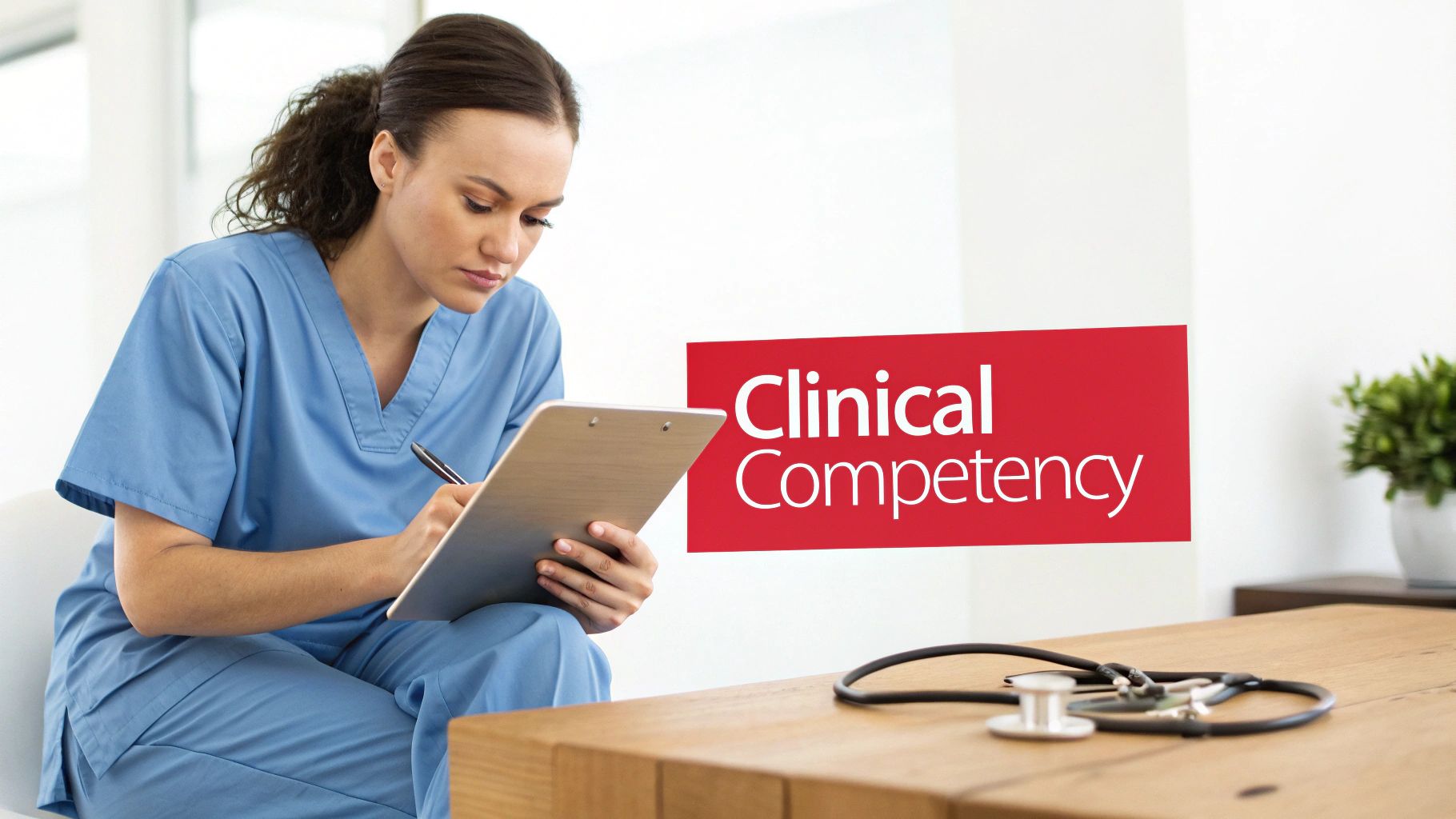
This approach is ideal for candidates who excelled during their third and fourth-year clinical rotations, received strong evaluations from preceptors, and can articulate specific instances of their clinical acumen. It allows you to build a compelling narrative around your proven ability to manage patients, perform procedures, and contribute meaningfully to a clinical team.
How This Approach Works
This letter of intent uses a "show, don't tell" method. You provide concrete examples from your clinical experiences that demonstrate your suitability for the residency program. Instead of simply stating you have "strong diagnostic skills," you describe a specific patient case where you developed a compelling differential diagnosis that guided the team’s workup. You can learn more about how to effectively articulate your thought process by understanding what is differential diagnosis.
The goal is to paint a vivid picture for the program director of you functioning as a capable and competent intern on their service. This is your chance to connect your USMLE Step 2 CS/COMLEX PE performance and strong shelf exam scores directly to patient outcomes and teamwork.
Successful Implementation Examples
- Surgery Applicant: An applicant matching into General Surgery might dedicate a paragraph to a complex case, such as an acute appendectomy they assisted on. They could detail their role in the preoperative workup, their specific actions during the surgery (e.g., "I was responsible for maintaining a clear surgical field and performing the initial closure"), and their contribution to the postoperative management plan.
- Pediatrics Applicant: A Pediatrics applicant could highlight their experience on a busy inpatient service, describing a time they calmed a distressed child to perform a necessary exam or built rapport with a hesitant family to explain a treatment plan. This demonstrates not just clinical knowledge but also the essential soft skills required for the specialty.
- Internal Medicine Applicant: For an Internal Medicine residency letter of intent example, an applicant could describe a challenging diagnostic case. They might outline the patient's presentation, list the key differential diagnoses they considered, and explain how they used specific physical exam findings and lab results to narrow the possibilities, ultimately contributing to the final diagnosis.
Actionable Tips for Your Letter
- Quantify Your Experience: Use specific metrics when possible. Mention high marks on clinical evaluations (e.g., "honors in my surgery rotation") or strong performance on relevant shelf exams.
- Connect to Program Values: Explicitly link your clinical example to something specific about the program you are writing to. For instance, "My experience managing diverse patient populations at a community clinic has prepared me to contribute to your program's mission of serving the city’s underserved."
- Focus on Relevant Skills: Tailor your examples to the specialty. A future radiologist might discuss how they identified a subtle but critical finding on an imaging study, while an aspiring emergency medicine physician would focus on their ability to perform under pressure.
- Seek Expert Review: Have a mentor or faculty advisor in your chosen specialty review the letter. They can ensure your clinical descriptions are accurate, professional, and impactful.
2. The Board Exam Excellence-Focused Residency Letter of Intent
The Board Exam Excellence-Focused Letter of Intent is tailored for applicants with outstanding USMLE or COMLEX scores. This strategic approach frames exceptional exam performance as a direct indicator of a strong foundational knowledge base, a high capacity for learning, and the discipline required to succeed in a rigorous residency program. It is particularly effective for candidates in competitive specialties, International Medical Graduates (IMGs), or anyone whose application is significantly strengthened by their board scores.

This letter allows you to translate a numerical score into a compelling narrative about your readiness for residency. Instead of letting the numbers stand alone, you provide context, linking your academic achievement to your potential as a future clinician and team member. It effectively tells the program director that your ability to master complex material on an exam will translate directly to your ability to master clinical challenges on the wards.
How This Approach Works
This letter of intent highlights your scores as evidence of your commitment and intellectual horsepower. You don't just state the score; you briefly explain what that achievement represents, such as a disciplined study methodology or a deep understanding of core scientific principles relevant to the specialty. The goal is to position yourself as a candidate who has already proven they can handle the steep learning curve of residency.
By framing your scores strategically, you demonstrate self-directed learning skills and an ability to perform under pressure, both of which are critical for residents. This residency letter of intent example is your opportunity to show that your high scores are not just a number but a reflection of the dedicated and knowledgeable physician you aim to be. You can see how scores correlate with competitiveness by reviewing the average Step 2 scores by specialty.
Successful Implementation Examples
- IMG Applicant: An International Medical Graduate applying to a competitive specialty like Dermatology could use their exceptional USMLE Step 1 and Step 2 scores (e.g., 260+) to demonstrate they possess a knowledge base on par with, or exceeding, top US applicants, helping to overcome potential biases.
- Osteopathic Applicant: A DO student with COMLEX scores in the 95th percentile for Level 1 and 2 can highlight this achievement to showcase their mastery of osteopathic principles and general medical knowledge, making a strong case for their inclusion in historically MD-heavy programs.
- Re-applicant: A candidate who did not match previously can use a significantly improved Step 3 score as concrete proof of their continued learning and dedication. They can frame it as, "My 245 on Step 3 reflects a year of dedicated clinical work and study, strengthening the foundation I am eager to bring to your program."
Actionable Tips for Your Letter
- Be Specific but Humble: State your scores or percentile clearly if they are a genuine strength. Frame this not as arrogance but as evidence of your hard work (e.g., "Achieving a 255 on Step 2 CK was a result of a structured study plan that I believe has prepared me for the academic rigor of your program.").
- Connect Scores to Specialty: Link your performance to the program's focus. For an Anesthesiology applicant, you might mention how your strong grasp of pharmacology, demonstrated by your exam scores, prepares you for complex medication management.
- Acknowledge the Discipline: Briefly mention the dedication it took to achieve your scores. This shows self-awareness and a strong work ethic, qualities every program director values.
- Avoid Overemphasis: Your scores are a key selling point in this letter, but they shouldn't be the only point. Integrate this strength into a broader narrative about why you are a great fit for their specific program.
3. The Specialty-Specific Passion and Fit Residency Letter of Intent
The Specialty-Specific Passion and Fit Letter of Intent is a narrative-driven approach designed to showcase an applicant's deep, authentic commitment to their chosen field. It moves beyond listing accomplishments to tell a compelling story about why you chose this specialty. This letter connects personal values, transformative clinical experiences, and academic achievements to demonstrate that you are not just a qualified applicant, but the right applicant for this specific program and field.
This style is perfect for candidates who have a powerful story behind their specialty choice and want to differentiate themselves from others with similar stats. It allows you to articulate a thoughtful, deliberate career plan, showing the program director you are a mature, self-aware individual who has carefully considered their future.
How This Approach Works
This letter of intent weaves a narrative that proves your commitment is both genuine and well-researched. You start by identifying a pivotal moment or core value that drew you to the specialty and then support that claim with concrete evidence from your medical school journey. Instead of just saying you are passionate about obstetrics, you describe how a specific research project on maternal health outcomes combined with your honors performance on the OB/GYN shelf exam confirmed your dedication.
The goal is to convince the program that your interest is not fleeting but is a core part of your professional identity. By linking your personal story to specific skills and program features, you create a powerful argument for your unique fit. This demonstrates a level of introspection that program directors find highly valuable in potential residents.
Successful Implementation Examples
- Pediatrics Applicant: An applicant could begin by describing a transformative experience working with a chronically ill child, highlighting their commitment to long-term patient advocacy. They could then connect this to their volunteer work with a pediatric non-profit and their strong performance on the pediatrics rotation, showing a consistent pattern of interest and excellence.
- Emergency Medicine Applicant: A candidate for Emergency Medicine might focus on their passion for acute care decision-making, illustrated by a specific case from their EM rotation in an underserved community. They could discuss how this experience solidified their desire to work with diverse, high-acuity patient populations, a mission that aligns perfectly with the program's urban setting.
- OB/GYN Applicant: For an OB/GYN residency letter of intent example, an applicant could link their undergraduate research in maternal-fetal medicine to their clinical success. They might mention how a specific mentor in the field guided their development and how their high shelf exam score reflects a true aptitude and passion for women's health.
Actionable Tips for Your Letter
- Anchor Your Narrative: Use a specific, anonymized clinical moment or personal experience as the central theme that catalyzed your interest in the specialty.
- Align with Specialty Values: Explicitly connect your personal values to the core tenets of the specialty. For example, link a love for continuity of care to family medicine or a passion for complex problem-solving to internal medicine. You can learn more about how to evaluate these factors and how to choose a medical specialty to strengthen this connection.
- Balance Story and Substance: Ensure your personal narrative comprises no more than 30-40% of the letter. The rest should be dedicated to substantive credentials like relevant coursework, research, and clinical performance.
- Demonstrate Authenticity: Avoid generic statements like "I have always been passionate about…" Instead, show it through your unique experiences and reflections. Authenticity is key to making this approach successful.
4. The IMG/FMG Residency Letter of Intent with U.S. Integration Focus
The IMG/FMG Residency Letter of Intent is a critical communication tool for international and foreign medical graduates. This letter is strategically crafted to bridge any perceived gaps between a non-U.S. medical education and the expectations of American residency programs. Its purpose is to directly address potential program director concerns, such as clinical readiness, cultural assimilation, and communication skills, while proactively highlighting the unique strengths and resilience an IMG/FMG candidate brings.
This approach is essential for applicants who have navigated the complex pathway of ECFMG certification and are ready to prove their value. It allows you to build a powerful narrative around your high USMLE/COMLEX scores, U.S. clinical experiences (USCE), and deep commitment to practicing medicine within the U.S. healthcare system. It transforms your international background from a potential question mark into a demonstrated asset.
How This Approach Works
This letter of intent directly confronts and reframes the IMG/FMG narrative. Instead of letting a program director wonder about your training, you provide a clear, confident explanation of how your journey has prepared you for their specific program. You use your USMLE scores as objective proof of medical knowledge equivalence and your U.S. clinical rotations as evidence of your practical integration and adaptability.
The goal is to present yourself not just as a qualified candidate, but as a candidate who has already taken concrete steps to understand and succeed in the American medical environment. It’s about showing you have gone the extra mile to align your skills with U.S. standards, making you a low-risk, high-reward addition to the residency cohort.
Successful Implementation Examples
- Internal Medicine Applicant (IMG): An applicant from India with exceptional USMLE Step 1 and 2 scores could open the letter by stating these scores, immediately establishing a strong academic foundation. They would then detail a three-month sub-internship at a U.S. hospital, describing how they managed patients with chronic conditions common in the U.S., like diabetes and hypertension, using standard U.S. protocols and EMR systems.
- Family Medicine Applicant (FMG): An FMG from a Caribbean medical school might highlight their USCE in a rural community clinic. They could describe their experience working with diverse patient populations and managing continuity of care, directly aligning their skills with the program’s mission. Mentioning specific U.S.-based mentors by name further solidifies their integration. You can find programs that value this experience by researching a list of IMG friendly residency programs.
- Neurology Applicant (IMG): An IMG with prior specialty training abroad could frame that experience as an advanced starting point. They might describe how their international neurology training provided a unique perspective on rare neurological disorders and then explain how their U.S. observerships helped them adapt that knowledge to the U.S. system, focusing on evidence-based guidelines and patient-centered communication.
Actionable Tips for Your Letter
- Lead with Your Strengths: Place your strong USMLE/COMLEX scores and ECFMG certification status in the first paragraph. These are key metrics that immediately establish your competitiveness.
- Quantify U.S. Clinical Experience: Be specific about your USCE. State the duration (e.g., "12 weeks of hands-on U.S. clinical electives"), the specialty, and the type of experience (sub-internship vs. observership).
- Demonstrate Cultural Competency: Weave in examples that show you understand the nuances of the U.S. healthcare system, such as patient-physician communication styles, teamwork dynamics, and the importance of patient autonomy.
- Frame Your Background as an Advantage: Position your diverse medical training as a benefit. Perhaps it gave you exposure to different pathologies or taught you to be resourceful in low-resource settings, skills that build resilience.
5. The Re-Match and Career Reinvention Residency Letter of Intent
The Re-Match and Career Reinvention Letter of Intent is a critical tool for applicants navigating the residency match for a second time or pivoting to a new specialty. This letter directly and maturely addresses the unique circumstances of a re-applicant. Its purpose is to reframe past challenges, such as not matching, as valuable learning experiences that have produced a more resilient, focused, and capable candidate.
This approach is specifically for candidates who did not match in a previous cycle or those making a significant specialty change. It strategically showcases growth, self-awareness, and a renewed, well-reasoned commitment. By proactively addressing potential red flags, you transform them into compelling evidence of your dedication and suitability for the program.
How This Approach Works
This letter of intent requires a delicate balance of honesty, confidence, and strategy. You must acknowledge your previous application cycle without making excuses, then immediately pivot to demonstrating concrete improvements. The core message is not "I failed before," but rather, "I have since become an even stronger applicant, and here is the evidence."
The goal is to provide a compelling narrative of growth that assures the program director of your commitment and capability. You are not just re-applying; you are presenting a new, upgraded version of your candidacy, complete with new experiences, improved scores, and a deeper understanding of your career goals. For those navigating this path, understanding the process is key; you can find a complete guide for unmatched medical students to help prepare.
Successful Implementation Examples
- Emergency Medicine Re-Applicant: A candidate who didn't match in EM could open by acknowledging the competitive nature of the last cycle. They would then detail specific actions taken to strengthen their application, such as, "Since last year, I raised my USMLE Step 3 score by 20 points, co-authored a publication on trauma resuscitation, and worked as a medical scribe in a high-volume emergency department to further hone my clinical efficiency."
- Career Changer (Surgery to Internal Medicine): An applicant shifting from a surgical path could explain their rationale thoughtfully. They might write, "While my surgical training was invaluable, my subsequent clinical work in an internal medicine clinic revealed my passion for longitudinal patient relationships and complex diagnostic challenges. To confirm this commitment, I completed two additional internal medicine sub-internships, receiving honors in both."
- Addressing Interview Weaknesses: An applicant who identified interview skills as a weak point could state, "Reflecting on the last cycle, I recognized a need to better articulate my clinical reasoning. I have since completed a 'mock interview' program with faculty, which has significantly improved my ability to communicate my thought process, an essential skill for an effective intern."
Actionable Tips for Your Letter
- Acknowledge and Advance: Openly state your re-applicant or career-change status in a single, confident sentence. Immediately follow with a summary of what you have done since.
- Be Specific About Improvements: Quantify your growth. Mention new board scores, specific research projects, new leadership roles, or additional clinical rotations.
- Show, Don't Just Tell, Commitment: If changing specialties, your new experiences must align with that field. Vague statements are less convincing than detailing new, relevant letters of recommendation or specialty-specific volunteer work.
- Adopt a Confident Tone: Use phrases like "strengthened my application" or "solidified my commitment." Avoid language that sounds apologetic, desperate, or defensive. Your tone should be optimistic and professional.
6. Research and Academic Achievement-Focused Residency Letter of Intent
The Research and Academic Achievement-Focused Letter of Intent is a strategic document designed for applicants whose primary strengths are scholarly productivity, publications, and academic success. This letter prominently features your research background to signal your potential as a future academic physician, a valuable asset for research-intensive residency programs and competitive specialties. It effectively showcases your intellectual curiosity and commitment to advancing medicine beyond clinical practice.

This approach is best suited for candidates applying to academic medical centers or specialties where research is highly valued, such as dermatology, surgical subspecialties, or internal medicine pathways with a research track. It allows you to build a narrative that demonstrates not only your clinical readiness but also your capacity to contribute to the academic mission of the institution.
How This Approach Works
This letter of intent positions your research experience as a core component of your medical training and future career goals. Instead of treating research as a secondary activity, you frame it as an experience that has deepened your clinical understanding and problem-solving skills. The goal is to show the program director that you are not just a competent clinician, but a physician-scientist in the making.
You connect your scholarly work directly to the program’s own research strengths or the work of specific faculty members. This demonstrates genuine interest and shows you have done your homework, making your letter highly personalized and impactful. This type of residency letter of intent example proves you are prepared for the rigors of an academic environment.
Successful Implementation Examples
- Academic Surgery Applicant: An applicant with multiple peer-reviewed publications and national conference presentations can dedicate a paragraph to their primary research project. They could describe how their investigation into surgical outcomes for a specific procedure has informed their clinical approach and solidified their long-term goal of pursuing a career in academic surgery.
- Dermatology Applicant: A candidate with a strong research background in psoriasis management could highlight their publication in a high-impact dermatology journal. They might mention working with a prominent dermatologist, linking that mentorship to their desire to join a program with similar faculty expertise and research opportunities.
- Internal Medicine Applicant: An applicant with health services research and policy publications can explain how this work has given them a unique perspective on patient care and systems-based practice. They can connect this experience to the program’s commitment to health equity or its specialized tracks in health policy.
Actionable Tips for Your Letter
- Quantify Your Achievements: Start by stating your key accomplishments clearly. For example, "My commitment to academic medicine is demonstrated by my four peer-reviewed publications and two national conference presentations."
- Connect Research to Clinical Skills: Explicitly state how your research enhanced your patient care abilities. For instance, "My research on novel therapeutics has sharpened my critical appraisal skills, allowing me to better evaluate evidence-based treatment options for my patients."
- Name Your Mentors: Mentioning well-known mentors or collaborators can lend credibility to your work and show you are integrated into the academic community.
- Align with the Program: Reference specific faculty, labs, or research initiatives at the program that align with your interests. This shows you envision a future at that specific institution.
7. The Holistic Multifaceted Achievement Residency Letter of Intent
The Holistic Multifaceted Achievement Letter of Intent is designed for the well-rounded applicant who excels across multiple domains. Instead of focusing on a single standout area like research or clinical grades, this letter weaves together diverse strengths-such as strong board scores, leadership roles, scholarly work, and community service-into a cohesive and compelling narrative. It presents you as a complete candidate, demonstrating that your qualifications are not just a list of achievements but interconnected components of a future physician-leader.
This approach is perfect for applicants who have strong, but not necessarily chart-topping, metrics in several areas. It allows you to build a powerful story that showcases your versatility, commitment, and potential to contribute to a residency program on multiple fronts. It tells the program director that you are more than your USMLE score; you are a future colleague with a proven track record of excellence in clinical care, scholarship, and leadership.
How This Approach Works
This letter of intent is an exercise in strategic storytelling. The goal is to connect your disparate achievements to an overarching theme or career goal. You might frame your experiences around a central narrative, such as a commitment to addressing health disparities, which is supported by your clinical work in underserved areas, your research on the topic, and your leadership in a relevant student organization.
The key is to show, not just tell, how these different facets of your application are mutually reinforcing. Your clinical excellence informs your research questions, your leadership skills help you implement community projects, and your high board scores provide the foundational knowledge for it all. This comprehensive self-presentation helps a program director envision you as a dynamic and impactful resident.
Successful Implementation Examples
- Primary Care Applicant: A candidate applying to a Family Medicine program could structure their letter around themes of community engagement and patient advocacy. They might connect their volunteer work at a local clinic, a research project on preventative care, and their leadership role in a primary care interest group to demonstrate a long-standing, multifaceted commitment to the field.
- Internal Medicine Applicant: For an Internal Medicine residency letter of intent example, a candidate could highlight their identity as a "physician-scientist-educator." They would dedicate short paragraphs to their strong shelf exam scores (clinical competence), a co-authored publication (scholarly activity), and their experience mentoring junior medical students (education).
- OB/GYN Applicant: An applicant for Obstetrics and Gynecology could frame their narrative around women's health advocacy. This would allow them to integrate their clinical honors in the OB/GYN rotation, their leadership in a women's health student group, and volunteer experience at a domestic violence shelter into a powerful, unified story.
Actionable Tips for Your Letter
- Organize Around Themes: Structure your letter around 2-3 core themes (e.g., "Commitment to Service," "Scholarly Inquiry," "Clinical Leadership") rather than creating a laundry list of accomplishments.
- Use Topic Sentences: Start paragraphs with clear topic sentences to guide the reader through the different dimensions of your profile. For example, "Beyond my clinical training, I have sought to advance patient care through scholarly research."
- Be Specific but Concise: Include key metrics like board scores, publication counts, or volunteer hours, but avoid getting bogged down in detail. Dedicate just 1-2 sentences to each major achievement.
- Create a Unifying Narrative: Explicitly connect your achievements to your career goals and the program's values. State how your unique combination of skills makes you an ideal fit for their specific program.
- Ensure Coherence: Ask multiple mentors and advisors to review the letter. Their feedback is crucial to ensure your narrative is coherent and compelling, not scattered and disjointed.
7-Point Comparison of Residency Letters of Intent
| Template | Implementation Complexity 🔄 | Resource Requirements ⚡ | Expected Outcomes ⭐📊 | Ideal Use Cases 💡 | Key Advantages ⭐ | Primary Limitations |
|---|---|---|---|---|---|---|
| Clinical Competency-Based Residency Letter of Intent | Moderate–High — detailed case and procedure documentation | Clinical evaluations, shelf metrics, mentor review | Demonstrates hands-on readiness and clinical reasoning | 3rd‑year students with strong rotations; clinically competitive specialties | Shows direct clinical competence and procedural skills | Needs substantial US clinical evidence; risk of long length |
| Board Exam Excellence-Focused Residency Letter of Intent | Low–Moderate — compile scores and study narrative | Exam transcripts, percentiles, documented study methods | Conveys objective medical knowledge and discipline | High scorers, IMGs with limited clinical exposure, academic programs | Quantifiable, easily verifiable measure of competency | May underplay clinical/situational skills; can seem one‑dimensional |
| Specialty-Specific Passion and Fit Residency Letter of Intent | Moderate — craft authentic narrative linked to experiences | Specialty rotations, mentorships, concise anecdotes | Creates memorable fit and motivation alignment | Applicants with genuine, deep interest in a single specialty | Differentiates similar applicants via authentic commitment | Requires authenticity and good writing; may limit flexibility |
| IMG/FMG Residency Letter of Intent with U.S. Integration Focus | High — document equivalency and U.S. integration explicitly | USMLE/COMLEX scores, U.S. rotations, LORs, credential docs | Mitigates credential concerns and shows US readiness | International/foreign grads seeking U.S. residency, competitive IMG applicants | Proactively addresses bias; highlights adaptation to U.S. system | Time‑intensive documentation; may unintentionally emphasize outsider status |
| Re-Match and Career Reinvention Residency Letter of Intent | Moderate–High — balance honesty with evidence of growth | Improved scores, new rotations/research, strong current LORs | Demonstrates resilience, maturity, and concrete improvements | Unmatched applicants, specialty changers, re‑applicants | Frames setbacks as growth; shows renewed readiness | Some PD bias may persist; must show genuine, verifiable progress |
| Research and Academic Achievement-Focused Residency Letter of Intent | Moderate — document publications, metrics, and mentorship | CV with pubs, conference presentations, mentor endorsements | Signals academic potential and scholarly productivity | Applicants targeting academic medical centers or research-heavy programs | Differentiates for academia; provides quantifiable impact metrics | May underemphasize clinical skills; research metrics vary by field |
| Holistic Multifaceted Achievement Residency Letter of Intent | High — integrate multiple domains coherently | Broad documentation (scores, clinical, research, leadership), strong editing | Presents a well‑rounded, multidimensional candidate profile | Well‑rounded applicants lacking a single standout achievement | Comprehensive portrait appealing to holistic‑review programs | Risk of diluting focus; requires excellent synthesis to avoid lengthiness |
Finalizing Your Strategy: Key Takeaways and Next Steps
You've explored a comprehensive array of residency letter of intent examples, each designed to highlight a unique applicant strength. From the clinical prowess demonstrated in the competency-based letter to the resilience showcased in the re-match narrative, the core principle remains constant: a successful LOI is a work of strategic, personalized communication. It’s your final, direct appeal to your number one program, transforming your application from a static file into a dynamic, compelling story.
Remember that your letter of intent is not merely a restatement of your CV. It is a persuasive argument. It connects the dots for the program director, explicitly stating why their specific program is the only place for you and, just as importantly, why you are the ideal candidate they have been searching for. The examples provided serve as blueprints, not scripts. The most impactful letters will always be those that are deeply authentic and meticulously tailored.
Synthesizing the Core Principles
Across all the examples, from the IMG/FMG letter focusing on U.S. integration to the research-heavy academic letter, several universal truths emerge. Mastering these will elevate your letter from good to unforgettable.
- Specificity is Your Superpower: Vague compliments about a program being "excellent" or "well-regarded" are meaningless. You must reference specific faculty, unique rotations, distinct research opportunities, or community outreach programs that directly align with your career goals. This proves you have done your homework and are genuinely invested.
- Show, Don't Just Tell: Instead of saying you are a "hard worker," reference a specific clinical experience or research project that demonstrates your work ethic. Instead of claiming to be a "team player," describe a time you collaborated with an interdisciplinary team to improve patient outcomes. Evidence-based claims are far more convincing.
- The "Why Us, Why You" Formula: Your letter must answer two fundamental questions. Why is this specific program your unequivocal top choice? And why are your unique skills, experiences, and personal attributes a perfect fit for their mission, culture, and patient population? Both halves of this equation must be addressed with equal conviction.
Your Actionable Checklist Before Sending
Before you click "send," perform one final, rigorous review. This is your last chance to make an impression, so precision is paramount.
- Proofread, Then Proofread Again: Read your letter out loud to catch awkward phrasing. Use a grammar checker like Grammarly. Then, ask a trusted mentor or advisor to read it for clarity, tone, and any typos you may have missed. A single error can undermine your message of meticulousness.
- Confirm the Recipient: Double-check the name and title of the program director and the program coordinator. Sending a letter to the wrong person or with a misspelled name is a critical, and entirely avoidable, mistake.
- Check Your Tone: Your writing should be confident but not arrogant, enthusiastic but not desperate, and professional yet personal. It's a delicate balance, but crucial for making a positive impression.
- Re-evaluate Your "Why": Read your letter one last time. Does it clearly and powerfully articulate why this program is your perfect match? If the reasoning could apply to any other program, you need to dig deeper and add more specific details.
Your journey through medical school and the residency application process has been a marathon of dedication and hard work. The residency letter of intent is the final sprint. By leveraging the strategies and insights from each residency letter of intent example in this guide, you can craft a document that solidifies your position and leaves a lasting, positive impact on your top-choice program. This is your moment to advocate for yourself with clarity and conviction.
A powerful residency letter of intent is often built upon a foundation of strong metrics, including board scores. If you're looking to elevate your academic profile to make your application as competitive as possible, consider the personalized tutoring and strategic guidance offered by Ace Med Boards. Our expert-led approach can help you master the material needed to achieve standout USMLE or COMLEX scores, strengthening a key component of your overall candidacy. Visit Ace Med Boards to learn how we can help you build an application that commands attention.

