
The road to medical school is a marathon, not a sprint, and your pre‑med courses are the absolute bedrock of your application. It’s a huge mistake to see them as just another checklist. Instead, think of them as the fundamental training that sharpens your scientific reasoning, hones your critical thinking, and builds the problem-solving muscles you'll need to conquer the MCAT and thrive in the intense med school environment.
Why Your Pre Med Courses Are More Than Just a Checklist

Treating your pre-med coursework like a simple to-do list is one of the most common pitfalls I see. A better way to frame it is like building a house. Your core science classes—biology, chemistry, and physics—are the foundation, the support beams, and the electrical wiring. If that structure isn't solid, anything you try to build on top, whether it’s a great MCAT score or impressive clinical hours, will be shaky at best.
This curriculum was designed with a purpose: to get you ready for the intellectual gauntlet ahead. Every single lab report hones your analytical skills. Every complex chemical reaction you solve prepares you for pharmacology. Every physics problem builds the logic you'll need to truly understand human physiology. Approaching these classes strategically can transform your application from just "qualified" to genuinely compelling.
Standing Out in a Competitive Field
The admissions landscape is unbelievably competitive, which makes a rock-solid academic foundation completely non-negotiable. Just look at the 2024-2025 cycle: 81,859 students applied to U.S. MD-granting medical schools, but only 34,888 actually matriculated.
That’s a success rate of just 42.6% overall, and the average MD program only accepts a tiny 4.23% of its applicants. These numbers tell a critical story: simply completing the required pre-med courses isn't nearly enough. You have to excel in them and then thoughtfully choose recommended courses that prove you're ready for the challenge.
Your transcript tells a story. It should narrate a journey of intellectual curiosity, academic resilience, and a genuine passion for the scientific principles that govern medicine. Admissions committees look for this narrative in your course selection and performance.
Required vs Recommended Pre Med Courses at a Glance
To get you started, it’s helpful to see the difference between the absolute must-haves and the courses that give you a serious strategic edge. While every medical school has its own unique prerequisites, there’s a core set of classes that are pretty much universal. Knowing what medical schools look for in an applicant will help you make much smarter choices from day one.
Here’s a quick breakdown to give you a bird's-eye view of the landscape before we dive deeper into each subject.
| Course Category | Required Courses (with Lab) | Highly Recommended Courses |
|---|---|---|
| Biology | General Biology I & II | Genetics, Microbiology, Physiology |
| Chemistry | General Chemistry I & II, Organic Chemistry I & II | Biochemistry (often a de facto requirement) |
| Physics | General Physics I & II | N/A |
| Math & English | Calculus and/or Statistics, English/Writing | Advanced Statistics, Medical Ethics |
| Social Sciences | N/A (but tested on MCAT) | Psychology, Sociology |
Use this table as your starting point. Think of the "Required" column as your non-negotiables and the "Highly Recommended" column as your opportunity to build a narrative that truly stands out.
Building Your Foundation with Core Science Requirements

Think of your pre-med journey like building a house. These core science requirements—biology, chemistry, and physics—are the concrete foundation. They aren't just arbitrary hurdles to clear; they are the essential building blocks that will support every single concept you learn in medical school and throughout your career.
Mastering these subjects is non-negotiable. This is where you learn the language of medicine and develop the scientific intuition every great physician needs. Nailing these foundational pre med courses is the first real test that proves you have the academic horsepower to succeed.
And the competition is real. In fall 2025, the number of U.S. biomedical undergrads hit nearly 642,500, a 3.7% jump from 2024. That growth far outpaced the 1.2% increase in overall undergrad enrollment, signaling that the pre-med path is more popular than ever. In a crowded field, a rock-solid science foundation is what makes you stand out.
General Biology: The Blueprint of Life
Your first cornerstone is a full year of general biology, complete with a lab. This typically adds up to eight semester hours. But this isn't just about memorizing the parts of a cell. It’s about grasping the intricate systems that govern life itself, from the smallest molecule to a complete organism.
Think of it as learning the body's operating manual. You'll dive deep into:
- Cellular and Molecular Biology: Understanding how cells work, talk to each other, and divide is fundamental to grasping everything from cancer to infections.
- Genetics and Evolution: You’ll explore how traits are passed down and how a tiny mutation can lead to disease—a concept at the heart of modern medicine.
- Physiology and Anatomy: This gives you the big-picture view of how organ systems work together, setting the stage for your advanced courses in med school.
The lab component is where theory clicks into place. You’ll get hands-on experience with microscopy, dissection, and experimental design—practical skills that translate directly to clinical research and diagnostics.
Chemistry: The Language of the Body
Next up is the chemistry gauntlet: a full year of general chemistry and a full year of organic chemistry, both with labs. This sequence, usually sixteen semester hours total, is often the most demanding part of the pre-med curriculum. It's where many students discover if they truly have the resilience for a medical career.
General chemistry lays down the rules for how atoms and molecules behave. Organic chemistry then zooms in on carbon-based compounds—the literal building blocks of every living thing.
For a physician, chemistry isn’t some abstract science. It’s the language of pharmacology, explaining exactly how a drug binds to a receptor. It’s the key to decoding metabolic disorders and designing life-saving treatments.
There’s a reason these courses are structured this way. The principles from gen chem are directly applied in o-chem, which in turn provides the foundation for biochemistry—one of the most critical subjects you'll face on the MCAT.
Physics: The Mechanics of Human Health
The final piece of the core science puzzle is a year of physics with a lab, typically eight semester hours. Many pre-meds wonder how physics fits in, but it's far more relevant than you might think. Physics explains the fundamental principles that govern the human body and the incredible technology we use to diagnose and treat it.
Just think about these real-world applications:
- Fluid Dynamics: This is cardiology 101. It explains blood pressure, circulation, and the mechanics of a beating heart.
- Optics: This is the science behind ophthalmology, from how the eye focuses light to how we design corrective lenses.
- Electricity and Magnetism: These principles are the magic behind every ECG, EEG, and MRI machine you will ever use in your career.
Physics labs are less about the specific content and more about honing your problem-solving skills. You learn to isolate variables, analyze data, and apply mathematical models to real-world situations—a thought process you'll use every single day as a doctor. To see how all these pieces fit into the bigger picture, check out our complete guide on the prerequisites for medical school.
Gaining an Edge with Recommended Courses
Once you’ve locked in your core science requirements, it’s time to think strategically. If the required courses are the sturdy foundation of your pre-med house, then the recommended courses are the custom features that make it stand out. They’re the advanced wiring, the reinforced frame, and the thoughtful design that signal you’re ready for the complexities of modern medicine.
Taking these extra classes does more than just pad your transcript. It tells admissions committees a powerful story about your intellectual curiosity and your proactive approach to learning. It shows them you're not just checking boxes; you're intentionally building the knowledge base needed to excel from day one of medical school.
Biochemistry: The Unwritten Requirement
Let's be crystal clear: while some medical schools might list it as "recommended," you should treat Biochemistry as an absolute requirement. This course is the critical bridge connecting the abstract principles of organic chemistry with the tangible reality of human biology. Without a doubt, it’s one of the most important pre med courses you will take.
So, why is it so essential? Biochemistry is the study of the chemical processes happening inside living things. It’s the "how" behind everything—from your body turning a meal into energy to the way DNA replicates itself. A solid grasp of these concepts isn't just helpful for medical school; it's foundational to understanding pharmacology, pathology, and countless other medical disciplines.
Think of it this way: General Chemistry taught you the alphabet. Organic Chemistry taught you the words. Biochemistry teaches you how to read the book of life. Without it, you’re missing the entire plot.
On top of that, a huge portion of the MCAT's Biological and Biochemical Foundations of Living Systems section is pure biochemistry. Students who skip this course often find themselves at a major disadvantage, forced to cram incredibly complex topics under pressure. To give yourself the best possible shot, you need a solid plan to study for the MCAT with confidence.
Strategic Science Electives
Beyond biochemistry, a few other science electives can give you a significant head start. These courses dive into practical knowledge that will show up again and again during your first year of medical school, making that notoriously difficult transition feel much smoother.
- Genetics: This isn't just about Punnett squares. This course moves into the world of molecular genetics, gene expression, and hereditary diseases. You’ll gain a deep understanding of the genetic basis of illness, which is a cornerstone of 21st-century medicine.
- Microbiology: Here, you'll get up close and personal with bacteria, viruses, fungi, and parasites. This knowledge is directly applicable to infectious disease, one of the most critical fields in all of medicine.
- Physiology: While you touch on this in general biology, a dedicated human physiology course explores the mechanical, physical, and biochemical functions of the body in much greater detail. It provides a blueprint for understanding how organ systems work when healthy and how they fail in disease.
Taking one or two of these advanced science classes proves you're ready and able to handle upper-level coursework—a key indicator of your potential to succeed in a demanding medical school curriculum.
The Humanities: The Heart of Medicine
Finally, being a great pre-med isn't just about mastering the hard sciences. Medicine is, at its core, a human endeavor. Admissions committees want to see that you understand the person, not just the patient. Courses in the social sciences are invaluable for developing this perspective.
Psychology and Sociology are particularly high-yield choices. Not only are they directly tested on the MCAT's Psychological, Social, and Biological Foundations of Behavior section, but they also provide crucial frameworks for understanding patient behavior, the social determinants of health, and the doctor-patient relationship. You could even consider pursuing an online psychology degree to broaden your scientific understanding and enhance your critical thinking skills.
These courses equip you with the empathy and cultural competence needed to treat diverse patient populations effectively. By thoughtfully selecting these recommended courses, you craft a transcript that tells a compelling story of a well-rounded, thoughtful, and fully prepared future physician.
Your Four-Year Pre Med Course Roadmap
Trying to piece together a long list of required and recommended courses into a logical four-year plan can feel like solving a monstrous puzzle. The trick is all about strategic sequencing—arranging your classes to build knowledge step-by-step, ensuring you're primed and ready for the MCAT at exactly the right moment.
Think of it like training for a marathon. You start with foundational endurance work before ever attempting the high-intensity, specialized training. Get the order wrong, and you risk burnout and a poor performance on race day—or in this case, on your MCAT exam.
This roadmap offers a sample timeline for a traditional student, but you can easily adapt it for your own pre-med journey.
Sample Four-Year Pre Med Course Timeline
Here’s a look at how a typical four-year pre-med schedule might be structured. This plan is designed to balance the tough core requirements with MCAT prep and electives that will strengthen your application.
| Academic Year | Fall Semester | Spring Semester |
|---|---|---|
| Year One | General Biology I w/ Lab | General Biology II w/ Lab |
| General Chemistry I w/ Lab | General Chemistry II w/ Lab | |
| Year Two | Organic Chemistry I w/ Lab | Organic Chemistry II w/ Lab |
| Physics I w/ Lab | Physics II w/ Lab | |
| Year Three | Biochemistry | Psychology or Sociology |
| Upper-Level Biology Elective | Upper-Level Science Elective | |
| Year Four | Genetics or Physiology | Microbiology or Immunology |
| Humanities/Social Science Elective | Capstone or Advanced Research |
This table is just a template, of course. Your actual schedule will depend on your major, your school's specific requirements, and your own academic interests.
Year One: Laying The Foundation
Your freshman year is all about building a rock-solid scientific base. This is where you dig into the core principles that every other science course will depend on. The goal is to truly master the fundamentals without overloading yourself while you're still adjusting to the demands of college.
A typical first-year schedule would include:
- Fall Semester: General Biology I with Lab & General Chemistry I with Lab
- Spring Semester: General Biology II with Lab & General Chemistry II with Lab
You'll be taking these alongside your university's required English and writing courses. This balanced approach is smart—it prevents science burnout and helps you hone the communication skills that are critical for any physician.
Year Two: The Rigor Intensifies
Sophomore year is often the make-or-break year. You'll be tackling two notoriously difficult subjects at the same time: Organic Chemistry and Physics. Nailing these courses signals to admissions committees that you can handle a demanding academic load, much like the one you'll face in medical school.
The plan for year two usually looks something like this:
- Fall Semester: Organic Chemistry I with Lab & Physics I with Lab
- Spring Semester: Organic Chemistry II with Lab & Physics II with Lab
Juggling these two lab-heavy courses demands excellent time management. It's absolutely essential to create a detailed study schedule to stay on top of the material. You can find some great advice on how to plan your study schedule to keep from falling behind.
Year Three: MCAT Prep and Specialization
Junior year is pivotal. This is when you'll likely sit for the MCAT, so your coursework needs to be chosen with that in mind. You have to make sure you've covered all the necessary content before your test date. This is the year to take Biochemistry—arguably the single most important course for MCAT success.
By the spring of your junior year, you want to have all the core science prerequisites and biochemistry completed. This timing is intentional. It allows you to study for and take the MCAT with all that foundational knowledge fresh in your mind, setting you up for your best possible score.
This is also the perfect time to start layering in highly recommended courses like Psychology or Sociology, which are also tested on the MCAT.
This visual shows how you can strategically layer your courses to build expertise over time.
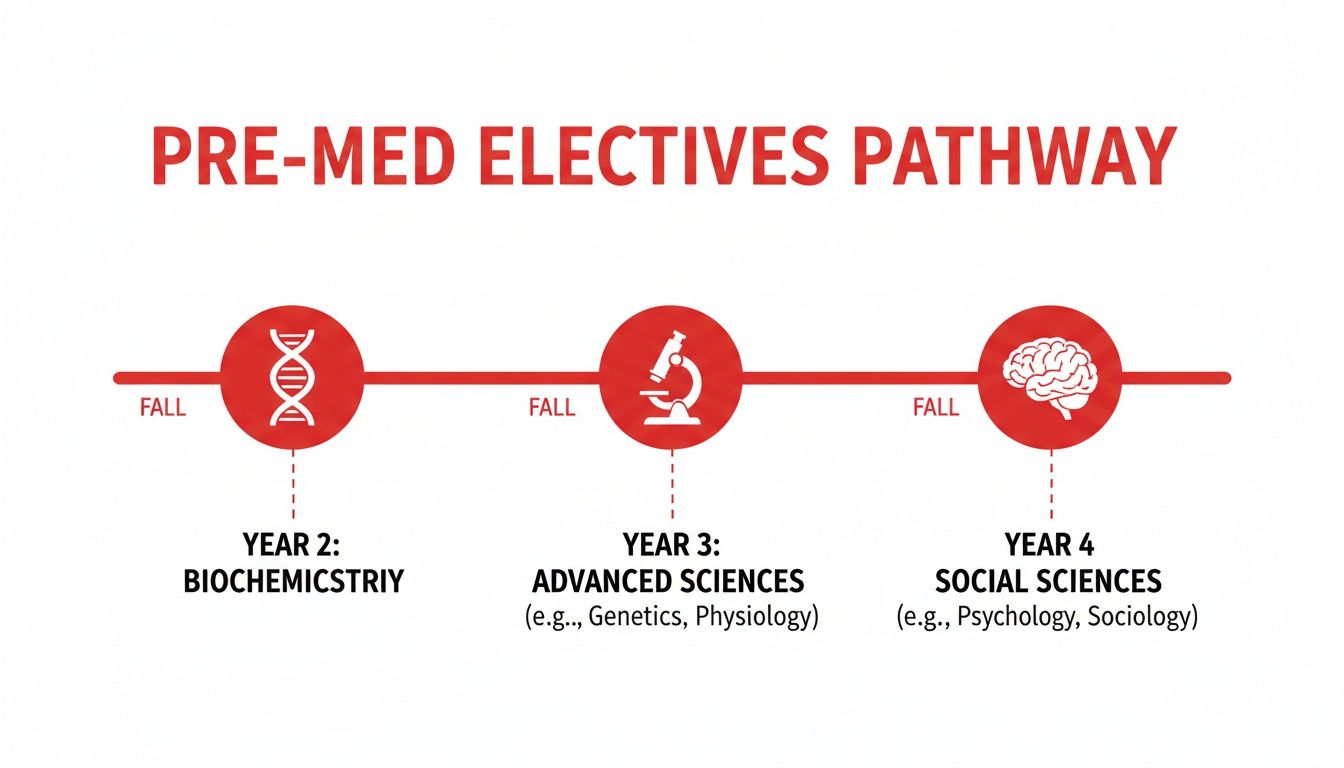
This progression ensures you master foundational biochemistry before moving on to advanced sciences and social sciences, creating a well-rounded academic profile for your applications.
Year Four: Rounding Out Your Application
With the MCAT behind you, senior year is all about adding depth to your application and showcasing your intellectual curiosity. This is the perfect time to take advanced science electives like Genetics, Physiology, or Microbiology.
These courses don't just strengthen your med school application; they also give you a huge head start for your first year of medical school. Think of it as getting a sneak peek at the material you'll soon be diving into.
A well-structured plan, backed by strong advising, is a powerful formula for success. It’s no coincidence that top pre-med colleges like Johns Hopkins see 70% of their alumni matriculate into medical school, a figure that dwarfs the 40% national average. This is largely due to exceptional mentoring. This roadmap aims to give you that same level of strategic planning, helping you build a compelling application no matter where you go to school.
Finding Your Own Path to Medical School
Let's be clear: there’s no single, one-size-fits-all road to medical school. It's not a rigid highway with only one entrance. Think of it more like a network of routes designed for people from all walks of life. Admissions committees know this and, frankly, they appreciate it. Not everyone is a traditional student who follows a straight four-year plan.
What truly matters is proving you're academically ready for the grind and that you have a genuine, deep-seated commitment to medicine. Your unique background—whether you're changing careers, coming from another country, or piecing your prerequisites together—is a strength. It brings a perspective that medicine desperately needs. The trick is to navigate your specific situation with a smart, deliberate strategy.
For the Career Changers: Post-Bacc vs. DIY
If you're making the leap from another career, your biggest hurdle is convincing an admissions committee that you can handle the intense science curriculum after being out of the classroom. You've got two main options to build that compelling academic record: a formal post-baccalaureate (post-bacc) program or a do-it-yourself (DIY) approach.
Structured Post-Bacc Programs: These are perfect for career changers who need to knock out most, if not all, of the core science prerequisites. They offer a concentrated curriculum, built-in advising, and a cohort of peers in the same boat—an invaluable support system.
DIY Coursework: If you only have a few gaps to fill in your transcript, taking individual pre med courses at a local four-year university gives you more flexibility. Just know that this path demands a ton of self-discipline and careful planning to make sure you're taking the right classes at the right places.
No matter which route you choose, the goal is identical: earn excellent grades and show without a doubt that you are ready for the academic marathon ahead.
A Note for International Applicants
Applying to U.S. medical schools as an international student comes with a unique set of challenges, especially when it comes to your prerequisite courses. Most adcoms simply aren't familiar with international grading systems and curricula, which can put you at a disadvantage right from the start.
The single most effective strategy is to complete all your core science prerequisites at an accredited four-year university in the United States or Canada. Doing this removes any question about the rigor of your coursework and puts you on a level playing field with domestic applicants.
Taking your core sciences stateside proves you can thrive in the same academic environment as your American peers. It’s also your best chance to build relationships with U.S. faculty who can write the strong, impactful letters of recommendation that admissions committees value so highly.
The Deal with Community College and Online Courses
So, where do community college and online courses fit into the pre-med picture? While they offer flexibility and can save you money, you have to be strategic about how you use them. Admissions committees view them differently.
Community College Credits: These are generally fine for introductory-level courses or for ticking off some general humanities requirements. However, medical schools strongly prefer to see your core science prerequisites—especially the heavy hitters like Organic Chemistry and Physics—completed at a four-year institution. It's all about demonstrating you can handle the academic pace and rigor of a university.
Online Courses and Labs: While the acceptance of online lectures has grown, in-person labs are still the gold standard. There’s just no substitute for hands-on lab experience; it’s where you develop essential practical skills. If you absolutely have to take a science course online, make sure it's from a highly reputable university. Then, you'll need to overcompensate with other hands-on experiences, like research or extensive clinical experience for pre-med students, to prove your capabilities. Always, always check the specific policies of the medical schools on your list, as their views on online credits can vary a lot.
Weaving Your Courses Into Your Application Story
Your transcript is a crucial piece of your medical school application, but on its own, it’s just a list of classes and grades. Strong grades are the price of admission, sure. But the story you build with your pre med courses, MCAT score, and personal experiences is what truly sets you apart and earns you a seat.
Think of your transcript as the black-and-white factual record of your academic journey. Your personal statement and interviews are where you add the color. This is your chance to explain the "why" behind your choices and connect the dots for the admissions committee.
This is where you graduate from simply listing accomplishments to demonstrating genuine insight. A high grade in organic chemistry proves you can handle tough material, and that's great. But explaining how that class sparked your interest in pharmacology during a research project? That shows you’re already thinking like a future physician.
Articulating Your Academic Path
The goal is to weave your coursework into a narrative that showcases your unique motivations. Don’t just state what you did; reflect on what you learned and how it solidified your decision to pursue medicine.
For instance, talking about a specific case study from a medical ethics class can powerfully illustrate your commitment to patient-centered care. It proves you’ve thought deeply about the human side of medicine, not just the scientific puzzles.
Your application needs to answer one core question for the admissions committee: Why do your academic choices make you uniquely suited to become a compassionate and competent doctor? Every single course, from biochemistry to sociology, can be a piece of that puzzle.
Aligning Your Transcript with Core Competencies
Ultimately, medical schools are hunting for evidence of specific core competencies, and your academic record is a primary source. Before you hit submit, look at your transcript with a critical eye.
Ask yourself:
- Scientific Inquiry: How do your advanced science electives demonstrate a genuine curiosity that goes beyond the bare minimum requirements?
- Cultural Competence: What story do your humanities or social science courses tell about your understanding of diverse patient populations?
- Critical Thinking: Can you articulate how a brutal physics or genetics course sharpened your problem-solving skills in a tangible way?
By thoughtfully linking your academic record to these competencies, you transform your transcript from a simple list of pre med courses into powerful proof of your readiness. It shows you have not only the required knowledge but also the intellectual curiosity and personal qualities to become an exceptional physician.
Frequently Asked Questions About Pre Med Courses
Figuring out the specifics of your pre-med courses is guaranteed to bring up a lot of questions. Every student's path is a bit different, and getting the details right can make a huge difference in how you map out your next few years. Let’s tackle some of the most common questions head-on.
Can I Take Pre Med Courses at a Community College?
This is a big one. While it might seem like a smart way to save some money, taking your core science prerequisites at a community college is something you need to think through carefully. In general, medical schools want to see those foundational courses—like organic chemistry and physics—completed at a four-year university.
It’s not about being snobbish; it's about proving you can handle the intense academic pace and rigor you’ll face in medical school. While some introductory courses might be okay, you absolutely have to check the specific policies of every single school you plan on applying to.
Key Takeaway: Make it a priority to take your toughest science prerequisites at a four-year institution. It sends a powerful signal to admissions committees that you’re ready for the demanding curriculum ahead.
What Is the Best Major for a Pre Med Student?
Let's clear this up right now: there is no single "best" major for pre-meds. This is one of the most common myths out there. In reality, admissions committees love seeing applicants from diverse academic backgrounds, whether that’s humanities, social sciences, or engineering.
What really matters is that you choose a major you're genuinely passionate about and can excel in. A high GPA in a subject you love is far more impressive than a mediocre GPA in a traditional science major you had to drag yourself through. On top of that, you just need to make sure you successfully complete all the required pre-med courses.
Staying healthy is key to getting through the pre-med grind. Look for ways to save on essentials by exploring options like Chemist Direct student discounts to help manage your well-being without breaking the bank.
How Do AP or IB Credits Affect Pre Med Requirements?
This is a notoriously tricky area that trips up a lot of students. Your undergraduate college might be happy to grant you credit for high scores on AP or IB exams, but most medical schools will not accept them to fulfill core science requirements.
If you use an AP credit to place out of an introductory course like General Biology I, the expectation is that you’ll take a higher-level course in that same department. For instance, you might take an upper-level genetics or cell biology course. This shows you've mastered the subject at a true collegiate level.
- Rule of Thumb: Never just assume your AP/IB credit will satisfy a medical school prerequisite.
- Action Step: You must check the admissions websites for every single school on your list. Their policies are often very specific.
- Best Practice: When in doubt, just take the introductory science course at your university. It's the safest bet.
At Ace Med Boards, we know that mapping out your pre-med journey can feel overwhelming. Our expert advisors are here to help you build the perfect academic strategy, from course selection to MCAT prep, ensuring your application tells a powerful and compelling story. Schedule your free consultation today!

