
Before you even think about opening a calendar to create a daily or weekly schedule, you need to lay the groundwork. Building an effective study plan starts with a strategic foundation: assessing your goals, understanding your time constraints, and knowing what resources you have to work with.
Getting this right from the start ensures every hour you spend studying is purposeful and directly aligned with hitting your target score. It's the difference between studying hard and studying smart.
Building Your Strategic Foundation
A great study schedule is far more than a to-do list; it’s a personalized roadmap built on self-awareness and careful planning. Jumping straight into a calendar without this prep work is like trying to build a house without a blueprint. Sure, you might make some progress, but it will be inefficient, unstable, and almost certainly lead to burnout.
The students who truly crush their exams are the ones who invest time upfront to define their objectives, get brutally honest about their limitations, and organize their tools. This phase transforms your schedule from a rigid set of rules into a dynamic, responsive guide for your entire prep journey.
Let's break down the essential phases of building this foundation.
| Phase | Objective | Key Activities | Timeline |
|---|---|---|---|
| 1. Goal Setting | Define a clear, measurable target score and establish a starting point. | Set a specific target score. Take a full-length diagnostic exam. | Day 1-2 |
| 2. Time Inventory | Realistically assess your available study hours. | Block out all non-negotiable commitments on a weekly calendar. | Day 3 |
| 3. Resource Audit | Catalog all study materials you plan to use. | List all Qbanks, content review books, videos, and flashcard decks. | Day 4 |
| 4. Strategic Outline | Create a high-level plan mapping topics to your timeline. | Prioritize subjects based on diagnostic results and exam weight. | Day 5-7 |
By the end of this week-long process, you won't just have a schedule; you'll have a strategy.
Establish Your Target Score and Baseline
First things first: what does success look like for you? Your target score—whether for the USMLE, COMLEX, or MCAT—is your North Star. It sets the intensity and duration of your entire preparation. Before getting lost in the details, it's critical to start by understanding why goals are important for directing your energy.
Once you have a target, you need a starting point. This means taking a full-length diagnostic exam under timed conditions. This is non-negotiable. The goal here isn't to get a great score; it's to collect data.
Key Takeaway: Your diagnostic score is not a judgment—it is a baseline. It gives you an objective snapshot of your current knowledge, highlighting your strengths and, more importantly, pinpointing your exact areas of weakness.
This raw data is pure gold. A score of 210 on an NBME with obvious weaknesses in cardiology and pharmacology tells you exactly where to focus your initial content review. If you skip this, you're essentially studying blind, potentially wasting weeks on subjects you've already mastered.
Conduct an Honest Time Inventory
One of the biggest traps students fall into is creating a fantasy schedule. They map out ambitious 10-hour study days without accounting for classes, clinical rotations, meals, exercise, or just the simple, human need for downtime. This is a recipe for failure.
You have to conduct a brutally honest time inventory. Open up a weekly calendar and block out all of your non-negotiable commitments first:
- Scheduled classes and mandatory lectures
- Clinical duties and travel time
- Work or volunteer hours
- Family commitments and social events
- Protected time for sleep, meals, and exercise
Whatever is left is your true, available study time. Seeing this laid out visually is often a reality check. If you only have 25 hours available per week, you can't follow a plan built for someone with 50. Acknowledging your genuine capacity from day one prevents the guilt and stress that comes from constantly falling behind an impossible schedule.
Compile Your Resource Arsenal
Finally, you need to know what tools you're bringing to the fight. Before you can plan what to study each day, you need a master list of all your resources. Take an hour and catalog everything you intend to use.
For instance, your list might look something like this:
- Qbanks: UWorld, AMBOSS, COMQUEST
- Content Review: First Aid, Pathoma, Boards and Beyond videos
- Flashcards: AnKing deck for Anki
- Practice Exams: All available NBME self-assessments, UWSAs
Having this "resource arsenal" ready allows you to assign specific materials to specific study blocks. Instead of a vague task like "Study Cardiology," your schedule will have a concrete, actionable item: "Watch Boards and Beyond cardiology videos (Ch 1-3) and complete 20 related UWorld questions." This level of detail eliminates ambiguity and makes it infinitely easier to stay on track.
For more insights on making every study session count, check out our guide on how to study effectively as a medical student.
Mapping Your Master Study Timeline
Okay, you’ve got your goals and resources sorted. Now it's time to build the actual roadmap. This master timeline is your bird's-eye view for the entire prep period, turning what feels like an overwhelming mountain of content into manageable chunks. It’s all about preventing that last-minute panic.
Whether you have six months or just six intense weeks, the core idea is the same. You need distinct phases for learning new material, drilling practice questions, and pulling it all together. This structure is your best defense against burnout, making sure that when the final weeks arrive, you’re refining your knowledge, not cramming it for the first time.
The process is pretty straightforward: you start by figuring out your baseline, gather your resources, and then build the schedule itself.
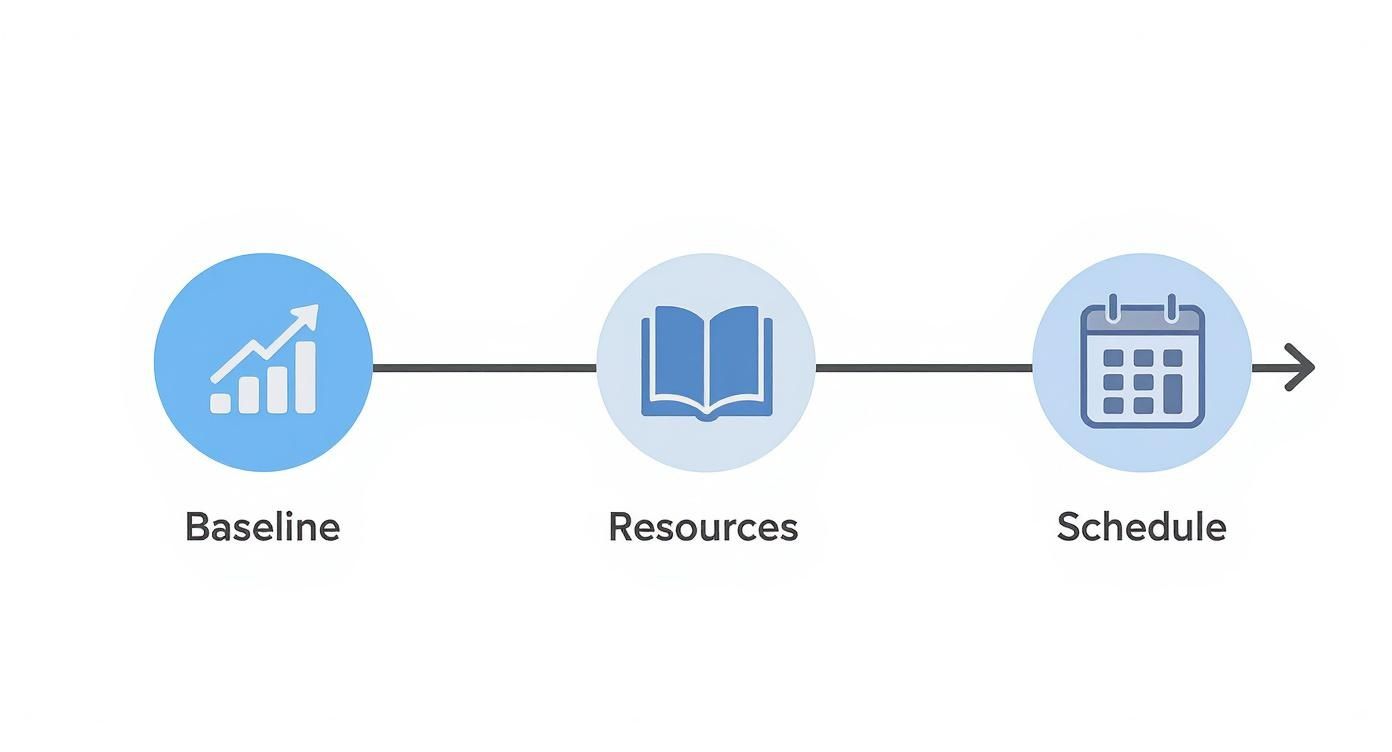
Each step logically flows into the next, transforming your high-level goals into a concrete, day-by-day plan you can actually follow.
Divide Your Timeline into Phases
A smart study period isn’t just one long, monotonous grind. Think of it as a series of sprints, each with a different objective. Breaking your timeline into three main phases brings much-needed structure and clarity, letting you focus your energy where it matters most at each stage. Your master timeline is really just a detailed action plan; getting good at how to create an action plan is a skill that will help you translate study goals into real progress.
Here’s a common three-phase structure that works wonders:
- Phase 1: Content Review (First 40-50% of your time): This is where you build your foundation. You'll be systematically going through high-yield resources like First Aid, Pathoma, and Boards & Beyond. Supplement this with some light, topic-focused practice questions to make sure the concepts are sticking.
- Phase 2: Qbank Deep-Dive (Next 30-40% of your time): Now, the game changes. The focus shifts hard from passive learning to active recall. Your days should revolve around doing—and meticulously reviewing—blocks of questions from a Qbank like UWorld. Any content review you do now should be targeted, zeroing in only on concepts you get wrong.
- Phase 3: Simulation & Final Review (Final 10-20% of your time): The home stretch is all about building stamina and integrating everything you've learned. This phase is dominated by full-length practice exams (NBMEs, UWSAs) and a final, rapid-fire review of high-yield facts, formulas, and any weak areas you've identified.
Allocate Time Strategically
Let's be real: not all topics are created equal on these exams. Your study plan needs to reflect that. You should prioritize based on two things: how heavily the topic is tested and how weak you are in it. Use your diagnostic exam to pinpoint your biggest knowledge gaps.
At the same time, look up the content distribution for your specific exam. For USMLE Step 1, pathology and physiology are huge. Your timeline needs to mirror this, dedicating a bigger chunk of your Phase 1 time to these heavyweight subjects.
Pro Tip: Don't just block out "Cardiology" for an entire week. That's too vague. Get granular. Assign specific days to cardiac physiology, then pathology, then pharmacology. This makes the work feel less overwhelming and your progress much more tangible.
Create a Concrete Timeline Template
Let's put this into practice with a sample 12-week USMLE Step 1 timeline. Many students are finding that shorter, more focused prep periods yield better results. It’s a trend we see elsewhere, too—for example, 63% of students now opt for study abroad programs that are 8 weeks or less, showing a clear preference for condensed, high-impact learning.
Here’s what a 12-week schedule might look like:
| Weeks | Phase | Primary Focus | Key Activities |
|---|---|---|---|
| 1-6 | Content Review | Build a strong knowledge foundation. | System-by-system review with videos and review books. Daily sets of 20-40 tutor-mode Qbank questions. |
| 7-10 | Qbank Deep-Dive | Active learning and identifying weaknesses. | Do 80-120 Qbank questions daily in timed blocks. Thoroughly review all questions. Take one full-length practice exam per week. |
| 11-12 | Final Simulation | Build test day stamina and do a rapid review. | Take two full-length practice exams per week. Rapidly review First Aid, your Qbank incorrects, and personal notes. |
This kind of structure gives you a clear, progressive path. You start broad with content and then systematically narrow your focus to question strategy and exam simulation. The goal is to have you peaking at exactly the right moment: exam day.
Designing Your Daily and Weekly Routines
Your master timeline is the bird's-eye view of your entire prep journey, but the real work happens on the ground level—in your daily and weekly routines. This is where you translate those big-picture goals into concrete, repeatable actions that build serious momentum.
A well-designed routine becomes second nature. It frees up precious mental energy that you'd otherwise waste just deciding what to do next. Instead of battling decision fatigue every single morning, you just execute a plan you already built for maximum focus and retention. This is how you build a study schedule that actually works, day in and day out.
Structuring Your Study Blocks
The backbone of any solid routine is the study block. But simply scribbling "Study" on your calendar is a recipe for procrastination. Effective study blocks are built around specific techniques that fight off mental fatigue and push you toward deep, meaningful learning.
One of the most effective methods I've seen students use is the Pomodoro Technique. It’s simple: you study in focused, timed bursts—usually 25 minutes—followed by a short 5-minute break. After four of these "Pomodoros," you take a longer break, maybe 15-30 minutes. This rhythm helps you stay laser-focused and prevents the burnout that inevitably comes from trying to power through multi-hour cram sessions.
Another powerful approach is time blocking. Forget simple to-do lists; with this method, you assign every single task to a specific time slot on your calendar. A typical day might look something like this:
- 8:00 AM – 10:00 AM: Cardiology Pathoma Review (2 Pomodoros)
- 10:00 AM – 11:00 AM: UWorld Cardiology Block (20 questions)
- 11:00 AM – 12:00 PM: Review Qbank Block
- 12:00 PM – 1:00 PM: Lunch (and get away from your desk!)
This level of detail kills ambiguity and gives you a clear, actionable roadmap for your day. For a deeper dive into these kinds of strategies, our guide on med student time management tips has a ton of practical advice for making every hour count.
Weaving in Active Learning
Here’s the single biggest mistake I see students make: they spend way too much time on passive review, like rereading textbooks or rewatching lecture videos. It feels productive, but true retention comes from active learning, where you force your brain to actually retrieve and apply information.
Your daily routine must be built around active learning. This means for every chunk of content you review, there needs to be an accompanying active task.
Key Insight: Don't just consume information; wrestle with it. Passive learning feels comfortable, but active recall is what forges the strong neural pathways you'll need to rely on come exam day.
For example, after you watch a video on renal physiology, your very next block should be doing practice questions on that exact topic. This immediately puts your understanding to the test and helps lock in those concepts.
- Practice Questions: This is the absolute cornerstone of active learning for any medical exam.
- Flashcards (Anki): There’s no better tool for spaced repetition of high-yield facts. Make it a non-negotiable daily habit.
- Concept Mapping: Actually drawing out the connections between different ideas is a game-changer for integrating complex systems.
When you prioritize these activities, you transform yourself from a passive sponge into an active participant in your own education.
Building a Sample Weekly Schedule
Okay, let's pull these daily blocks together into a weekly structure that makes sense. A balanced week ensures you’re hitting new material, reinforcing old concepts, and simulating real exam conditions—all while building in critical downtime to keep burnout at bay.
Your schedule has to fit your life. There's no one-size-fits-all template that works for everyone.
Here’s a sample weekly template you could adapt, especially for that intense "Qbank Deep-Dive" phase of your prep:
| Day | Morning Session (3-4 hours) | Afternoon Session (3-4 hours) | Evening (1-2 hours) |
|---|---|---|---|
| Mon | 2 Qbank Blocks (Timed) | Detailed Review of Blocks | Anki Review |
| Tue | 2 Qbank Blocks (Timed) | Detailed Review of Blocks | Targeted Content Review |
| Wed | 2 Qbank Blocks (Timed) | Detailed Review of Blocks | Anki Review |
| Thu | 2 Qbank Blocks (Timed) | Detailed Review of Blocks | Targeted Content Review |
| Fri | 2 Qbank Blocks (Timed) | Detailed Review of Blocks | Anki Review |
| Sat | Full-Length Practice Exam | Light Review of Incorrects | Complete Rest |
| Sun | Deep Review of Practice Exam | Plan for the Week Ahead | Complete Rest |
See the rhythm here? Weekdays are for high-intensity, focused work. The weekend is for assessing your performance, deep review, and—just as importantly—recovery. When you apply a structure like this consistently, you’re not just learning facts; you’re building the skills and stamina you need to crush your exam.
Using Qbanks and Practice Exams Strategically
Let's be blunt: practice questions are the absolute lifeblood of your exam prep. You can read every page of First Aid and watch every Sketchy video twice, but true learning—the kind that gets you points on test day—happens when you force your brain to retrieve and apply knowledge under pressure.
This is where your question bank (Qbank) and full-length practice exams become the most valuable tools in your arsenal.
But here’s the catch: their power isn't unlocked by just mindlessly clicking through questions. It comes from weaving them into your study schedule from day one. Waiting until you feel "ready" to start a Qbank is one of the biggest and most common mistakes I see students make. The questions are the learning tool, not just the final exam.

Integrating Qbanks Into Your Daily Plan
Your Qbank—whether it's UWorld, AMBOSS, or another platform—needs to be a daily ritual, not an afterthought.
During your initial content review phase, use it in "tutor mode." Just finished watching videos on cardiac pharmacology? Great. Immediately fire up a block of 20 questions on that specific topic. This immediate application forces you to grapple with the concepts, cementing the information far more effectively than passive review ever could.
Once you hit your dedicated study period, the Qbank becomes the main event. Your days should now revolve around completing and reviewing timed, random blocks of questions. This is critical. It simulates real exam conditions and trains your brain to rapidly switch between subjects, a skill that separates good scores from great ones.
Key Takeaway: Treat every single Qbank block like a mini-exam. The magic happens in the review. Meticulously go over every question—right, wrong, and flagged. The explanations are a goldmine of high-yield info, often clarifying tiny details you missed in your first pass.
The Art of Meticulous Question Review
Doing the questions is only half the battle. The real learning, the score-boosting insights, comes from the review. A proper, deep review of a 40-question block can, and often should, take 2-3 times as long as it took to complete the block. Yes, it's a huge time sink, but the return on investment is massive.
Here’s how you should break down every single question:
- For incorrect answers: Why did I miss this? Was it a pure knowledge gap? Did I misread the question stem? Or was it just a silly mistake? Write down the core concept you were missing.
- For correct answers: Why did I get this right? Force yourself to explain the reasoning out loud. You need to be sure you didn't just get lucky. Then, review the explanations for the other answer choices to understand precisely why they were wrong. This is an incredible hack—you learn three or four concepts for the price of one question.
This detailed review process feeds directly back into your schedule. If you’re consistently bombing questions on vasculitides, that’s your brain screaming at you to schedule a targeted review session on that topic.
Scheduling Full-Length Practice Exams
Full-length practice exams, like the NBME self-assessments or UWSAs, serve two non-negotiable purposes: they benchmark your progress and build your test-day stamina. These aren't just for learning; they are full-dress rehearsals.
You need to schedule them and take them under brutally realistic conditions.
- Timing is Key: Plan to take a practice exam every 1-2 weeks during your dedicated study period. This cadence gives you enough time to learn from your mistakes and see if your new strategies are working before the next assessment.
- Simulate Test Day: Find a quiet spot. No interruptions. No extra breaks. Adhere strictly to the allotted time for each block and each break. This is how you build the mental and physical endurance needed to stay sharp for an eight-hour exam.
Your performance on these exams gives you the hard data you need to adjust your plan. A score plateau might signal it's time to change up your study methods, while a dip in a specific subject tells you exactly where to focus your energy for the next week. To help choose the right assessments, it's worth exploring the different types of USMLE practice tests available.
By using Qbanks and practice exams as dynamic planning tools, you transform your prep from a passive slog into an active, data-driven strategy for success.
Tracking Progress and Adapting Your Plan
A study schedule isn't something you carve in stone on day one. Think of it more like a GPS for your exam prep—it gives you the best route based on what you know now, but it has to be able to recalculate when you hit a detour or unexpected traffic. The real power of a good schedule is its flexibility.
Sticking to a failing plan out of stubbornness is a fast track to burnout and a score plateau. The goal isn't just to follow the schedule you made; it's to constantly refine it into the sharpest tool you have for hitting your target score. That means you have to build in regular progress checks from the very beginning.
Conducting Your Weekly Check-In
Your most powerful tool for this is the weekly check-in. This should be a non-negotiable, 30-minute meeting with yourself every Sunday to honestly assess what’s working, what isn’t, and how to adjust for the week ahead. Without this feedback loop, you’re just studying blind and hoping your initial strategy was perfect.
During this check-in, you need to look at cold, hard data. How you feel about your productivity can be misleading. The numbers don't lie.
- Qbank Performance: Are your block scores trending up? What's your overall percentage, and how does it compare to the average? More importantly, which specific subjects are consistently dragging your scores down?
- Practice Exam Results: A full-length exam is your most accurate data point. Don't just look at the three-digit score. Dig into your performance by section and discipline. Did your score in Biochemistry actually jump after that week of focused review, or did it stagnate?
- Pacing and Time Management: Were you constantly running out of time on your practice blocks this week? Catching timing issues early gives you weeks to fix your pacing strategy instead of panicking right before the exam.
This weekly review lets you be proactive. If you see your pharmacology scores are flatlining for two weeks straight, you can immediately pivot. Maybe you dedicate extra review sessions to it or try a different resource for that topic in the upcoming week.
To make your weekly review more structured, use a checklist to guide your analysis. This ensures you're looking at the right data and turning your insights into concrete actions.
Weekly Progress Review Checklist
| Metric to Review | What to Look For | Action to Take |
|---|---|---|
| QBank Percentages | Trends over the last 2-3 weeks. Are scores increasing, flat, or decreasing? Identify the bottom 2-3 subjects. | If scores are flat, switch study method (e.g., from video review to Qbank-first). Schedule dedicated review blocks for weak subjects. |
| Practice Exam Score | Overall score trend. Performance breakdown by system/discipline. | If score plateaued, increase active learning (e.g., teaching concepts aloud). If it dropped, analyze for burnout or knowledge gaps. |
| Incorrect Questions | Recurring themes. Are mistakes from knowledge gaps, misreading the question, or running out of time? | Create focused flashcards for knowledge gaps. Slow down and read the last sentence of the stem first for misreading errors. |
| Schedule Adherence | Did you complete >80% of planned tasks? Which tasks were consistently missed? | If you're falling behind, your schedule is too ambitious. Reduce daily tasks or build in a "catch-up" block mid-week. |
| Time Management | Are you finishing blocks with time to spare or rushing through the last few questions? | If rushing, do timed "tutor mode" blocks focusing on the first 10 questions. If finishing too early, you may be rushing and need to slow down. |
This checklist turns a vague "how did I do?" into a strategic assessment. It forces you to connect your performance data directly to changes in your schedule for the next week.
Overcoming Common Hurdles
Every single student hits roadblocks. The difference between those who succeed and those who falter is how they respond. If you plan for these challenges, they become manageable bumps in the road instead of catastrophic derailments.
A score plateau is one of the most frustrating things you'll experience. You're putting in the hours, but your practice scores just won't budge. This is almost always a sign that your current study method has hit its limit of effectiveness for you.
Key Insight: A score plateau doesn't mean you've hit your potential. It means you need to change your approach. If you've just been doing content review, it's time to switch to 80% practice questions. If you're just passively clicking through questions, you need to start making detailed notes on every single incorrect.
Falling behind schedule is another common fear. Life happens. An unexpected family event, a rough clinical week, or just getting sick can throw your perfect plan into disarray. The key is to have a "flex day" built into every week or two. This day acts as a buffer, letting you catch up on missed tasks without having to scrap your entire schedule. Don't see it as a failure; see it as your plan's built-in resilience kicking in. This kind of flexibility is becoming more common in educational planning. In fact, among U.S. students, 76% now intend to study abroad, a trend supported by more flexible academic scheduling. You can find out more about the rising demand for international study and program flexibility.
Got Questions? Let's Troubleshoot Your Study Schedule
Even the best-laid plans run into trouble. It’s completely normal to have questions pop up as you get into the rhythm of your exam prep. Thinking through these common hurdles ahead of time will help you stay cool and adjust on the fly without losing momentum.
Think of this section as your toolkit for making your schedule resilient. A great plan isn't rigid; it's designed to bend without breaking.
How Many Practice Questions Should I Do Every Day?
This is probably the number one question I get, and the honest answer is: it depends on what phase of your prep you're in. There’s no single magic number, but there are smart guidelines that work.
Early on, during your content review, your goal is comprehension, not volume. Aim for 20-40 questions a day. Do them in "tutor mode" and make sure they're targeted to the specific system you just covered. This is all about making new knowledge stick immediately.
When you shift into your dedicated study period—what I call the "Qbank Deep-Dive"—the game changes. Now it's about volume and building stamina. You should be aiming for 80-120 questions a day, usually split into two or three timed, random blocks. This is how you start recognizing patterns and build the mental endurance you'll need on exam day.
Key Insight: The number of questions you review is far more important than the number you do. Meticulously breaking down an 80-question day is way more valuable than just clicking through 160 questions with a shallow review. Quality over quantity, always.
What Happens If I Fall Behind Schedule?
First, take a deep breath. It happens to literally everyone. A brutal rotation, a family emergency, or just getting sick can throw a wrench in your perfect plan. The key is not to panic and ditch the schedule entirely.
Your first line of defense should be a built-in flex day. I always tell students to build one day (or even just a half-day) into their weekly schedule as a buffer. This is your dedicated time to catch up on missed tasks without messing up the flow of the next week.
If you fall more than a day or two behind, don't just try to cram everything into the remaining days. That's a fast track to burnout. Instead, look at your schedule and make a strategic cut. Maybe you condense the review for a topic you already feel strong in to free up time for a weaker area you missed. It’s about making a smart sacrifice, not a frantic one.
How Am I Supposed to Stay Motivated for Months on End?
Let's be real: motivation is a feeling, and feelings are fickle. You can't rely on it to get you through a marathon like board prep. You need to build habits and systems that work even when you don't feel like it.
Here are a few strategies that actually work:
- Track Your Progress: Nothing is more motivating than seeing your Qbank percentages slowly tick upward. That data is tangible proof that your hard work is paying off.
- Focus on the System, Not the Goal: Your goal is a great score, but your system is what you do today. Just focus on executing today’s plan. The goal takes care of itself when you stack enough consistent, well-executed days together.
- Schedule Real, Guilt-Free Breaks: Burnout is the ultimate motivation killer. Your schedule must include protected time off every single week where you are forbidden from even thinking about the exam. This isn't a luxury; it's a non-negotiable part of a plan that will actually get you to the finish line.
Feeling overwhelmed trying to build the perfect schedule? Ace Med Boards specializes in creating personalized study plans and providing one-on-one tutoring to help you conquer your medical board exams. Get expert guidance to build a schedule that fits your life and maximizes your score. Book a free consultation today.

