
The annual release of medical school rankings often creates a frenzy among pre-meds, with many equating a top-tier number with their entire future success. While these lists offer a snapshot of institutional prestige and research funding, they don't tell the whole story about curriculum, culture, or your personal fit. Relying solely on a single ranking can lead you to overlook programs where you would truly thrive.
This guide demystifies the process, breaking down the 7 most influential ranking systems and data sources. We'll explore their unique methodologies, reveal what they're best used for, and show you how to synthesize their data to build a balanced, strategic, and realistic school list. Our goal is to help you move beyond the hype and use medical school rankings as one tool among many, not as the final word on your future.
You will learn how to interpret data from sources like U.S. News, AAMC's MSAR, and specialized rankings like the Blue Ridge Institute for Medical Research. We'll provide a transparent look at what metrics each platform prioritizes, from NIH funding to student selectivity and faculty reputation. Each entry includes direct links and screenshots to help you navigate these resources efficiently.
Ultimately, this comprehensive listicle will show you how to create a school application strategy that aligns with your specific career goals, whether in primary care, academic research, or a competitive specialty. We'll equip you to find the program where you will not just get in, but truly excel.
1. U.S. News & World Report – Best Medical Schools
When people talk about medical school rankings, they are most often referring to the annual list published by U.S. News & World Report. For decades, this platform has served as the default starting point for applicants, advisors, and even the schools themselves. It is the most widely recognized and influential ranking system in the United States, making it an essential resource for any pre-med student to understand.
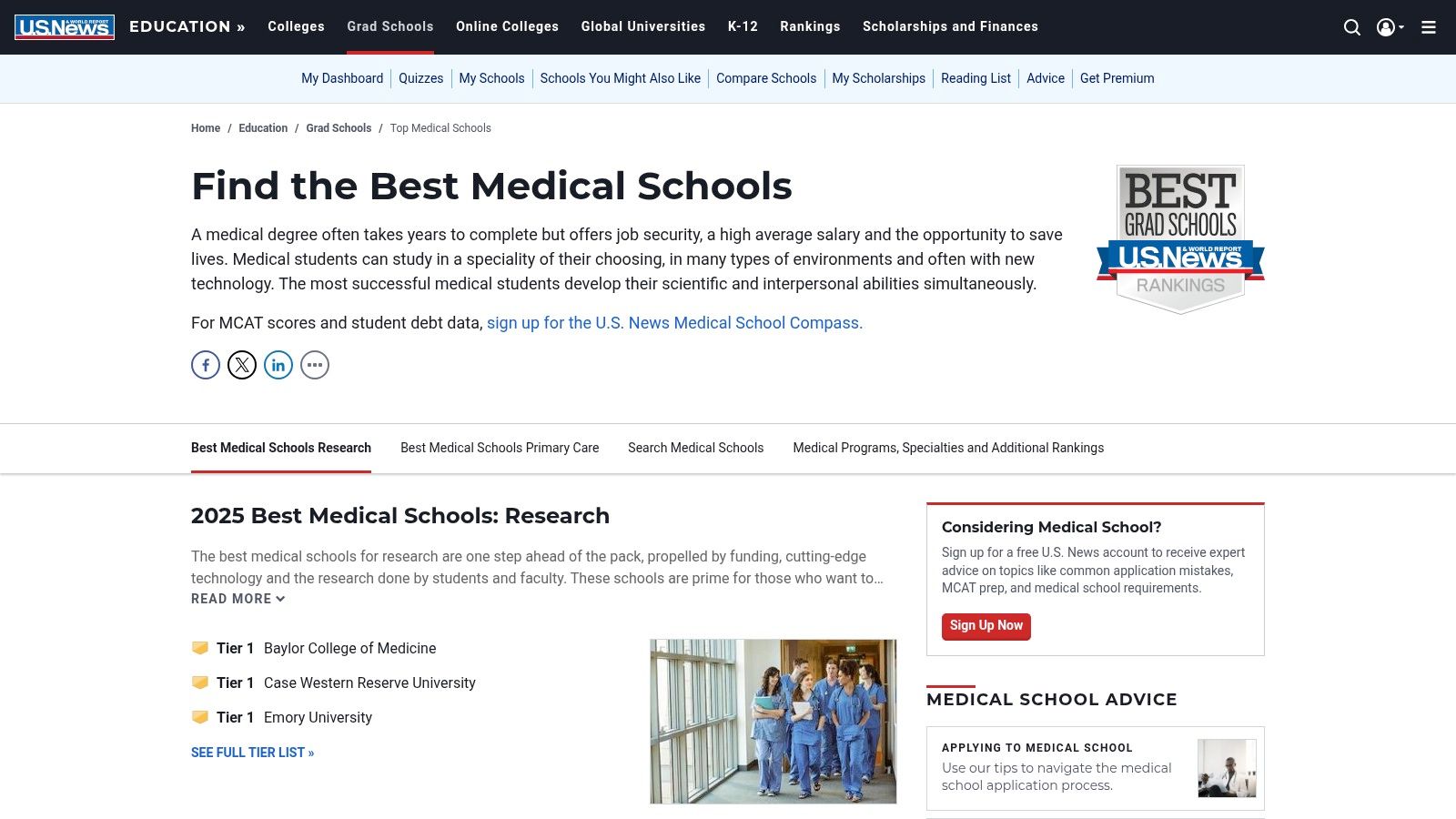
The platform's primary strength lies in its well-established methodology and its dual-list approach, which separates schools into two main categories: Research and Primary Care. This distinction is crucial because it helps you align your career aspirations with the right institutions. A school excelling in NIH-funded research might not be the top choice for a student dedicated to rural family medicine, and U.S. News makes this differentiation clear.
Key Features and How to Use Them
The free version of the site provides high-level tiered rankings, which group schools together rather than assigning a strict numerical rank. This helps mitigate the perception of minor statistical differences. You can quickly view the top schools in major categories and even see rankings for specific specialties like pediatrics, surgery, or internal medicine.
For those wanting a deeper dive, the paid Medical School Compass unlocks the full dataset. This subscription-based tool is where the real granular analysis happens.
- Filter and Sort: Compare schools side-by-side based on criteria that matter most to you, such as median MCAT scores, average GPA, acceptance rates, and faculty-to-student ratios.
- Outcome Data: Access information on residency director scores and research activity, giving you a clearer picture of a school's reputation and output.
- Build Your List: Use the filters to create a personalized list of target, reach, and safety schools based on your academic profile.
Pro Tip: Start with the free lists to get a broad overview of the landscape. If you're building a competitive application strategy, consider the Medical School Compass a worthwhile investment for its detailed, sortable data. This data can be a critical component of your overall application, which you can learn more about by exploring the essentials of how to get into medical school.
| Feature | Free Access | Paid (Medical School Compass) |
|---|---|---|
| Main Rankings | Tiered lists for Research & Primary Care | Full, sortable numerical rankings and underlying data |
| School Profiles | Basic data (tuition, enrollment) | Detailed stats (MCAT/GPA medians, acceptance rates) |
| Comparison Tools | Limited | Advanced filters to compare schools on multiple metrics |
| Specialty Rankings | Top schools listed | More extensive lists and data points |
Website: https://www.usnews.com/best-graduate-schools/top-medical-schools
2. AAMC MSAR (Medical School Admission Requirements)
While not a ranking system itself, the AAMC's Medical School Admission Requirements (MSAR) is arguably the most critical data-driven tool for building a realistic school list. It is the official guide published by the Association of American Medical Colleges, the very same organization that administers the MCAT and runs the AMCAS application service. This makes its data the undisputed primary source for admissions statistics for all accredited M.D. programs in the U.S. and Canada.
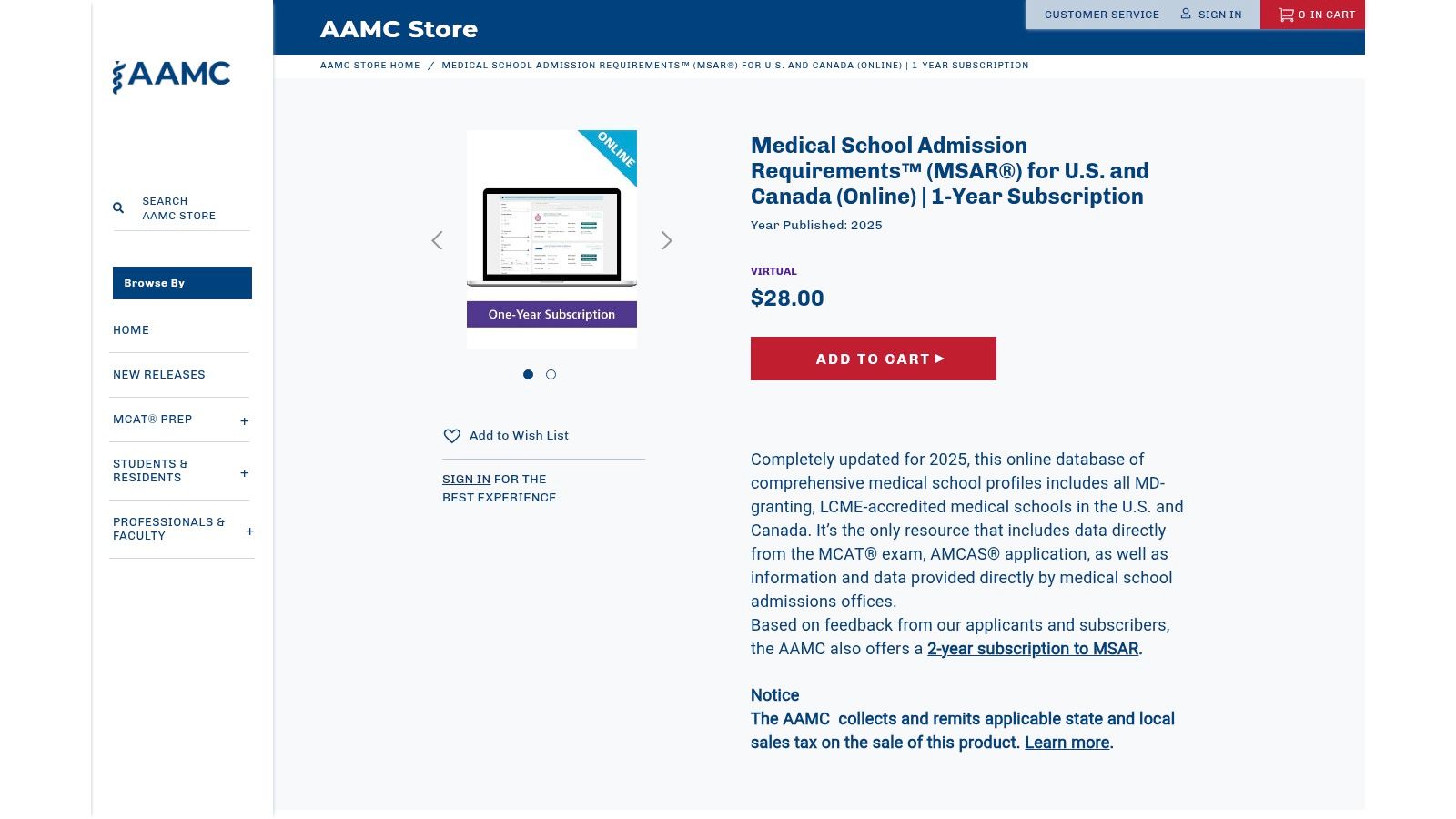
The platform's unparalleled strength is its authority and granularity. Where ranking sites provide an overview of a school's prestige, MSAR provides the raw, unfiltered data on who actually gets in. It allows you to move beyond the simple question of "Is this a good school?" to the far more important question: "Am I a competitive applicant at this school?" It's the essential tool for grounding your aspirations in statistical reality, helping you strategically classify schools as reach, target, or safety.
Key Features and How to Use Them
The MSAR is an online subscription-based database that provides incredibly detailed profiles for each medical school. While a limited preview is available, the full subscription is necessary to access the most valuable data that will shape your application strategy. Access is granted for one year upon purchase, and AAMC Financial Aid Program (FAP) recipients may receive complimentary access.
This is where you can translate your academic profile into a concrete list of potential schools.
- MCAT and GPA Data: View detailed matriculant data, including median scores and GPA ranges from the 10th to 90th percentile. This allows you to see exactly where your stats fall among recently accepted students.
- Filter and Compare: The platform allows you to sort and compare schools based on numerous criteria, including in-state vs. out-of-state acceptance rates, required coursework, application deadlines, and interview formats.
- Mission and Curriculum Insights: Go beyond the numbers to understand a school's mission, special programs (like M.D./Ph.D.), and educational approach to find the best institutional fit.
Pro Tip: Use MSAR alongside a ranking list like U.S. News. First, identify schools that align with your career goals using the rankings. Then, dive into MSAR to validate whether your academic profile is competitive for those specific institutions. This two-step process is the key to building an effective and realistic school list. Knowing where your MCAT score stands is the first step, so understanding what is a good MCAT score is crucial.
| Feature | Free Access | Paid (Full Subscription) |
|---|---|---|
| School Profiles | Limited preview with basic info | Full access to all data points for every school |
| Admissions Data | Not available | Detailed MCAT/GPA ranges, in/out-of-state data, acceptance rates |
| Comparison Tools | None | Advanced filtering, sorting, and comparison features |
| Curriculum Info | Basic overview | In-depth details on prerequisites, special programs, and deadlines |
3. Times Higher Education (THE) – World University Rankings by Subject: Clinical & Health
While most pre-meds focus on domestic lists, the Times Higher Education (THE) World University Rankings offer a crucial international perspective on medical school rankings. Specifically, their "Clinical & Health" subject ranking provides a global benchmark, helping you see how U.S. institutions stack up against the best in the world. This is particularly valuable for applicants interested in global health, international research collaborations, or a career with a worldwide scope.
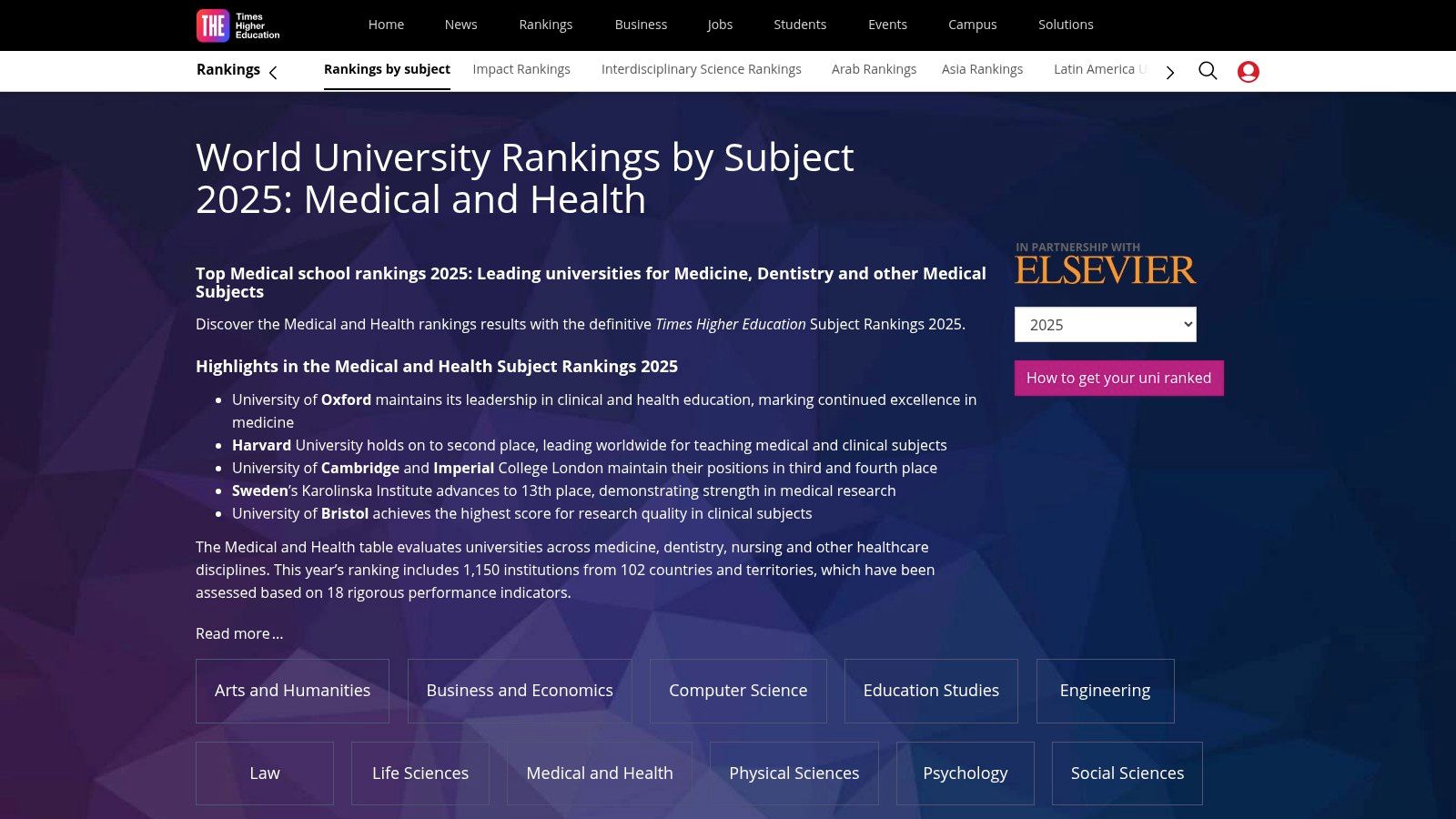
The primary strength of THE's methodology is its broad, research-centric view. It moves beyond U.S.-specific metrics like MCAT scores and acceptance rates, instead focusing on pillars like teaching environment, research volume and reputation, citation impact, and international outlook. This gives you a different lens through which to evaluate a school’s academic influence and global standing, which is often a strong indicator of its research prowess and faculty prestige.
Key Features and How to Use Them
The THE rankings are completely free to access and offer interactive tables that allow for high-level sorting and comparison. Unlike U.S. News, which gates its most granular data, THE provides its full dataset and methodology upfront, promoting transparency.
- Global Benchmarking: Use the main table to compare a U.S. school you are considering to its international peers in the UK, Canada, or Asia. This can reveal strengths in research output that domestic rankings might not highlight as prominently.
- Methodology Deep Dive: Explore the 18 performance indicators used in the ranking. This helps you understand what drives a school's position, whether it is its industry income, international student ratio, or research publication volume.
- Sort by Indicator: The interactive table allows you to re-rank the list based on specific pillars. For instance, you can sort exclusively by "Citations" to identify institutions with the highest research impact or by "International Outlook" if a global environment is your priority.
Pro Tip: Use the THE rankings not as an admissions tool, but as a reputational one. If you're torn between two U.S. schools that are similarly ranked by U.S. News, check their global THE ranking. A significantly higher international standing could point to stronger research opportunities and a more prestigious faculty.
| Feature | Pros | Cons |
|---|---|---|
| Perspective | Offers a unique global context for U.S. schools | Not designed for U.S. admissions; lacks MCAT/GPA data |
| Methodology | Transparent and heavily weighted toward research and academic impact | Can be difficult to separate a medical school from its parent university |
| Accessibility | Fully free and interactive | Metrics are academic-focused, not applicant-focused |
| Usefulness | Excellent for evaluating research prestige and international reputation | Less practical for building a school list based on admissions stats |
4. QS World University Rankings by Subject – Medicine
While most U.S.-based applicants focus on domestic lists, the QS World University Rankings offers a valuable global perspective on medical education. Its dedicated "Medicine" subject table is a powerful tool for understanding how U.S. medical schools are perceived on an international stage, especially regarding academic and employer reputation. This global context is particularly useful for applicants interested in international research collaborations, global health careers, or simply benchmarking top U.S. programs against their worldwide peers.
The primary strength of the QS ranking is its unique methodology, which balances objective data with reputational metrics. It blends academic reputation surveys, employer reputation surveys, research citations per paper, and the H-index (a measure of research productivity and impact). This approach provides a holistic view that goes beyond pure statistics, capturing the prestige and influence a medical school commands globally.
Key Features and How to Use Them
The QS rankings are entirely free to access, though creating an optional account allows you to save shortlists and compare institutions more easily. The platform is designed to provide a high-level overview of institutional strength in the field of medicine.
- Global Benchmarking: Use the list to see where top-tier U.S. schools like Harvard, Stanford, and Johns Hopkins stand in comparison to international powerhouses like Oxford, Cambridge, and the Karolinska Institute.
- Reputation Insights: Pay attention to the Academic Reputation and Employer Reputation scores. These metrics, based on global surveys, offer a unique glimpse into how academics and employers worldwide perceive a school's graduates and research output.
- Research Impact Analysis: The Citations and H-index scores are excellent proxies for a school’s research influence. If you are a research-focused applicant, these indicators can help you identify institutions with a high-impact global footprint.
Pro Tip: Use the QS rankings as a complementary resource, not a primary decision-making tool for U.S. admissions. Its strength lies in assessing a school's international brand and research reputation. Cross-reference schools of interest here with data from MSAR and U.S. News for a complete picture.
| Feature | Free Access | Paid Access |
|---|---|---|
| Main Rankings | Full, sortable numerical rankings for Medicine | None |
| School Profiles | Basic data and individual scores for each methodological indicator | None |
| Comparison Tools | Basic comparison feature available with a free account | None |
| Methodology | Detailed breakdown of scoring (reputation, citations, H-index) is provided | None |
Website: https://www.topuniversities.com/subject-rankings
5. ShanghaiRanking – Global Ranking of Academic Subjects (GRAS): Medical Sciences
For applicants prioritizing a career in academic medicine or biomedical research, understanding a school's global research impact is critical. The ShanghaiRanking’s Global Ranking of Academic Subjects (GRAS) provides a powerful, data-driven perspective on institutional research prowess, making it a unique tool in the landscape of medical school rankings. Unlike platforms focused on student inputs or admissions, ShanghaiRanking is laser-focused on objective, quantitative measures of research output and influence.
The platform’s core strength is its rigorous, transparent methodology. It evaluates institutions based on indicators like the number of papers published in top-tier journals, citation impact, international collaboration, and the number of faculty who have won significant awards. This makes it an excellent proxy for identifying institutions that are true powerhouses in specific fields of medical research, such as Clinical Medicine, Public Health, or Pharmacy.
Key Features and How to Use Them
ShanghaiRanking is a completely free resource, offering downloadable lists and clear scoring breakdowns. Its utility comes from its granular focus on academic subjects, allowing you to see which universities (and by extension, their affiliated medical schools) lead the world in the research area you care about most.
This focus on objective data provides a different lens through which to view potential schools, moving beyond reputation to measurable academic impact.
- Subject-Specific Analysis: Don't just look at the overall medical school list. Dive into specific subjects like "Clinical Medicine" or "Biological Sciences" to find universities with world-class departments in your area of interest.
- Identify Research Hubs: Use the rankings to identify institutions with a high concentration of influential researchers. A high rank indicates a robust research ecosystem with ample opportunities for mentorship and publication.
- Global Benchmarking: For applicants considering international programs or those who want to join a globally recognized research community, this ranking provides an essential cross-country comparison of academic output.
Pro Tip: Use ShanghaiRanking not as a primary application list builder, but as a secondary tool to validate the research claims of schools you are already considering. If a school promotes its "world-class cancer research," check its standing in the relevant ShanghaiRanking subject list to see how its output measures up globally.
| Feature | Free Access | Paid Access |
|---|---|---|
| Main Rankings | Full, sortable lists for multiple medical science subjects (e.g., Clinical Medicine) | N/A |
| University Profiles | Scores broken down by indicator (publications, citations, awards) | N/A |
| Comparison Tools | Compare institutions across different academic subjects and countries | N/A |
| Data Accessibility | Downloadable lists and clear methodology | N/A |
Website: https://www.shanghairanking.com/rankings/gras/2023/subject/clinical-medicine
6. Blue Ridge Institute for Medical Research (BRIMR) – NIH Funding Rankings
For applicants prioritizing a career in academic medicine or biomedical research, the Blue Ridge Institute for Medical Research (BRIMR) offers one of the most objective and data-driven medical school rankings available. Instead of relying on subjective surveys or admissions statistics, BRIMR provides a straightforward ranking of U.S. medical schools based on one key metric: total National Institutes of Health (NIH) funding awarded. This makes it an invaluable resource for gauging an institution's research intensity and influence.
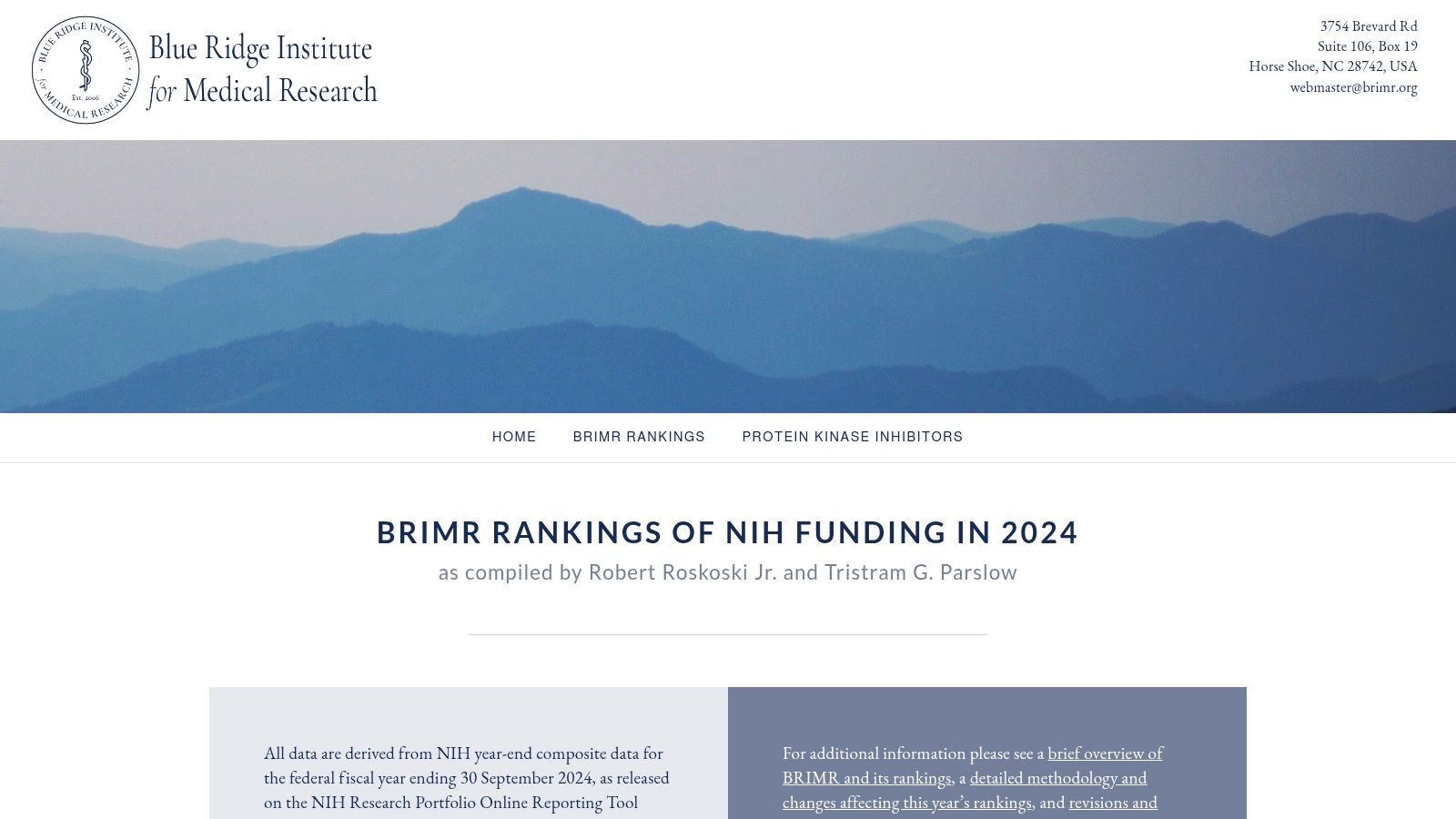
The platform's strength is its pure, unadulterated focus on research dollars. This data serves as a direct proxy for the scale of a school's research enterprise, its ability to attract top scientific talent, and the opportunities available for students to engage in cutting-edge investigation. While not a measure of educational quality, it provides a clear picture of which institutions are leading the nation's biomedical discovery efforts.
Key Features and How to Use Them
The BRIMR website is a no-frills, public-access database presenting its findings in clear, sortable tables. Its primary value comes from its granularity, allowing you to move beyond the overall institutional ranking and examine the strength of individual departments. The entire dataset is available for free, making it a highly accessible tool for all applicants.
- Department-Level Rankings: Go beyond the overall school rank to see which institutions lead in specific fields like neuroscience, pharmacology, or internal medicine. This is crucial for aligning your research interests with a school's strengths.
- Historical Data: Track a school's funding trajectory over many years (data is available from 2001). This can reveal trends, such as which institutions are rapidly growing their research programs.
- Principal Investigator (PI) Lists: See the top-funded researchers at each institution, helping you identify potential mentors and labs that align with your scientific passions.
Pro Tip: Use BRIMR in conjunction with broader rankings like U.S. News. A school might have a strong overall research rank, but BRIMR can reveal if its strengths are concentrated in departments that don't match your interests. This nuanced view is critical for finding the right research fit.
| Feature | Free Access | Paid Access |
|---|---|---|
| Main Rankings | Full, sortable tables of schools by NIH funding | Not applicable |
| Departmental Data | Complete rankings for all clinical & basic science departments | Not applicable |
| Historical Rankings | Multi-year data and PI lists available | Not applicable |
| Methodology | Transparent documentation provided | Not applicable |
Website: https://brimr.org/brimr-rankings-of-nih-funding-in-2024/
7. The Princeton Review – Medical School Rankings and School Finder
While most platforms focus on institutional reputation or research output, The Princeton Review offers a different and highly valuable perspective on medical school rankings. Instead of a single hierarchical list, it publishes thematic, category-based rankings derived directly from student and administrator surveys. This applicant-centric approach prioritizes student experience and institutional culture, helping you find a school that aligns with your personal and academic needs, not just its numerical rank.
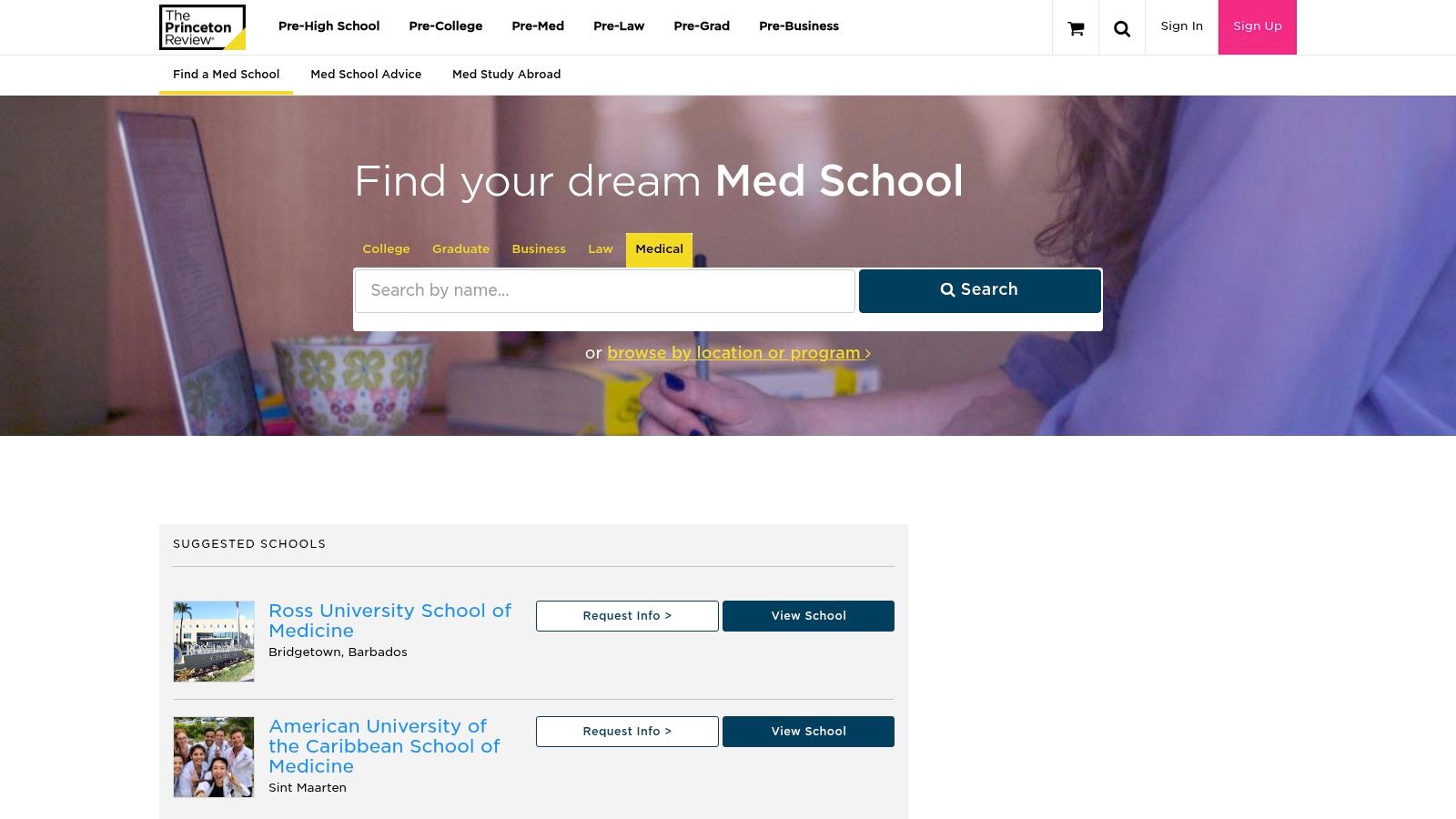
The platform's main strength is its focus on "fit." The rankings answer practical questions that applicants often have: Which schools offer the best hands-on training? Which have the most competitive student body? This qualitative data provides a crucial layer of insight that complements the quantitative metrics found on other sites. It's an excellent resource for looking beyond the numbers and understanding the day-to-day reality of attending a particular institution.
Key Features and How to Use Them
The Princeton Review's website is more than just lists; it's a comprehensive med-school hub with search tools and admissions advice. All of its rankings and school profile information are available for free, with paid services offered separately for test prep and admissions consulting.
- Thematic "Best For" Rankings: Explore unique lists like "Best for Research Opportunities" or "Students Study the Most." Use these to identify schools that match your preferred learning environment and career goals.
- School Finder Tool: The platform includes a powerful search tool that allows you to filter medical schools by state, MCAT score, GPA, and tuition. This helps you quickly narrow down the vast number of programs to a manageable list.
- Detailed School Profiles: Each profile provides a snapshot of the school's admissions criteria, student life, and academic environment, often including direct quotes and feedback from current students.
Pro Tip: Use The Princeton Review in conjunction with MSAR and U.S. News. After building a preliminary list based on stats, use these thematic rankings to refine your choices based on culture and student experience. This helps you understand what medical schools look for beyond just high scores.
| Feature | Free Access | Paid (Optional Services) |
|---|---|---|
| Main Rankings | Thematic "Best For" lists based on student surveys | Not applicable for rankings |
| School Profiles | Detailed profiles with student feedback and admissions data | Separate admissions consulting and application review |
| Comparison Tools | School Finder tool with filters for MCAT, GPA, location, and tuition | Not applicable |
| Admissions Content | Free articles and advice on the application process | MCAT prep courses and private tutoring |
Website: https://www.princetonreview.com/med-school-rankings
7-Source Comparison of Medical School Rankings
| Source | Complexity 🔄 | Resources ⚡ | Expected outcomes 📊 | Ideal use cases 💡 | Key advantages ⭐ |
|---|---|---|---|---|---|
| U.S. News & World Report – Best Medical Schools | Medium — tiered methodology with optional paid analytics | Free high-level; Medical School Compass subscription for full filters/analytics | National comparability and reputation signal | Quick applicant/advisor comparisons; media references | Widely recognized; tiering reduces single-rank noise |
| AAMC MSAR (Medical School Admission Requirements) | Low — structured school profiles and sortable data | Free preview; subscription required for complete datasets (FAP may qualify) | Accurate admissions-fit data (MCAT/GPA, prerequisites, deadlines) | Building realistic target lists and application strategy | Authoritative primary admissions source; trusted by advisors |
| Times Higher Education – Clinical & Health | High — multi-indicator international methodology | Free interactive tables; annual updates | Research- and teaching-focused global benchmarking | Comparing U.S. programs in an international research/teaching context | Internationally respected; research-centric perspective |
| QS World University Rankings – Medicine | Medium — reputation surveys combined with citation metrics | Free viewing; optional account features for shortlists | Reputation and research-reputation comparisons worldwide | Global reputation benchmarking and employer-facing insights | Widely used internationally; medicine-specific focus |
| ShanghaiRanking – GRAS: Medical Sciences | High — quantitative, research-output and citation emphasis | Free access; downloadable subject lists | Strong proxy for institutional research impact and visibility | Applicants prioritizing research-intensive environments | Highly quantitative; excellent for research benchmarking |
| Blue Ridge Institute for Medical Research – NIH Funding | Low — straightforward funding totals and rankings | Free public tables with historical/departmental breakdowns | Clear measure of research funding scale and departmental strength | Benchmarking NIH funding and research portfolio size | Objective, data-driven funding indicator; granular by department |
| The Princeton Review – Medical School Rankings & Finder | Low–Medium — survey-based thematic lists and filters | Free browsing; optional paid prep/advising | Insights on student experience, fit and culture | Finding schools by student experience, support, and learning style | Applicant-focused categories; practical admissions resources |
From Rankings to Residency: Your Next Steps to a Competitive Application
Navigating the complex world of medical school rankings can feel overwhelming, but as we've explored, these lists are powerful tools when used correctly. Moving beyond the prestige of a single number is the key. The most effective applicants understand that a holistic approach, leveraging multiple resources, is essential for building a strategic and successful application strategy.
From the research-heavy metrics of the U.S. News & World Report to the granular NIH funding data from BRIMR, each tool offers a unique lens. The AAMC's MSAR provides the raw, non-ranked data you need to ground your expectations, while global lists like QS and Times Higher Education broaden your perspective. The goal is not to find the single "best" school but to identify the best-fit institutions for your specific academic profile, career goals, and personal values.
Synthesizing Data into a Cohesive Strategy
Your journey doesn't end with a list of schools. The real work begins as you translate this information into a compelling application. Here’s how to move from analysis to action:
- Create a Tiered School List: Use the data from the tools discussed to build a balanced list. Aim for 15-25 schools categorized into 'reach,' 'target,' and 'safer' tiers based on your MCAT, GPA, and experiences compared to their median accepted student profiles. This diversified approach maximizes your chances of acceptance.
- Align with Institutional Mission: Look beyond the numbers. Does a school’s mission focus on primary care in underserved communities or cutting-edge biomedical research? Use the insights from your research to tailor your secondary essays, demonstrating a genuine and specific interest in their program. Vague praise is easily dismissed; specific connections are memorable.
- Identify Your Unique Value Proposition: What makes you stand out? Perhaps it's your unique research experience, a long-term commitment to a specific community, or a non-traditional path to medicine. Frame your application narrative around this value, ensuring it shines through in your personal statement and activities section.
From Applicant to Resident: A Forward-Thinking Approach
Remember that your medical school application is just the first step in a long and rewarding journey. The choices you make now will directly impact your future residency applications. As you progress through medical school, you will need to document your achievements, research, and clinical experiences meticulously.
Developing a strong curriculum vitae early is a critical skill. As you transition to competitive residency applications, preparing a comprehensive CV is essential. You can find useful curriculum vitae for students examples to help you structure your accomplishments effectively and present a professional profile to residency program directors. This forward-thinking mindset sets top candidates apart.
Ultimately, medical school rankings are a starting point, not a finish line. They provide a map, but you must chart your own course. Your success hinges on transforming your potential into a quantifiable and compelling narrative that admissions committees can't ignore. Focus on building an undeniable academic foundation, cultivate unique experiences that reflect your passions, and articulate your story with confidence. This is how you turn a list of schools into a list of acceptances.
Ready to build the academic foundation that top medical schools demand? Ace Med Boards offers personalized, one-on-one tutoring for the MCAT, USMLE, and COMLEX exams to ensure your scores reflect your true potential. Transform your application from competitive to compelling by visiting Ace Med Boards to schedule your free consultation today.

