The national medical school acceptance rate is notoriously low, with most MD programs admitting only about 4-5% of applicants. For every 100 students who apply, fewer than five will get that coveted acceptance letter. This makes the journey to becoming a physician one of the most competitive academic paths you can choose.
What the Medical School Acceptance Rate Really Means
Think of the med school acceptance rate like the odds of getting into an exclusive, sold-out concert. Thousands of hopefuls are vying for a very limited number of spots, and only a tiny fraction will actually get in. That single percentage you see is just the total number of accepted students divided by the total number of applicants for a given year.
While it gives you a quick snapshot of how competitive things are, it’s just a starting point, not your destiny. This number doesn't tell the whole story because it lumps every single school—from top-tier private research giants to your local state university—into one big national average. The reality on the ground is far more nuanced, with acceptance rates varying wildly from one school to another.
Demystifying the National Average
To give you a clearer picture, let's look at some key numbers that define the competitive landscape for U.S. medical schools.
National Medical School Acceptance Rate Snapshot
| Metric | Statistic | What This Means for Applicants |
|---|---|---|
| Overall MD Acceptance Rate | ~4.2% | Competition is fierce. For every 100 applicants, only about 4 will be accepted to an MD program. |
| Top-Tier Program Rate | < 1.5% | Elite schools are a statistical long shot for almost everyone. A flawless application is just the entry ticket. |
| Average Matriculant GPA | 3.77 | You need near-perfect grades. This is the average for students who actually enroll, not just apply. |
| Average Matriculant MCAT | 511.9 | A high MCAT score is non-negotiable. This score places you in the top 15-20% of all test-takers. |
These numbers aren't meant to scare you, but to ground you in the reality of what it takes. A strong application isn't just a suggestion; it's a requirement to even be in the running.
This infographic really helps visualize just how much the applicant pool narrows down at each stage, especially when you're aiming for the most elite institutions.
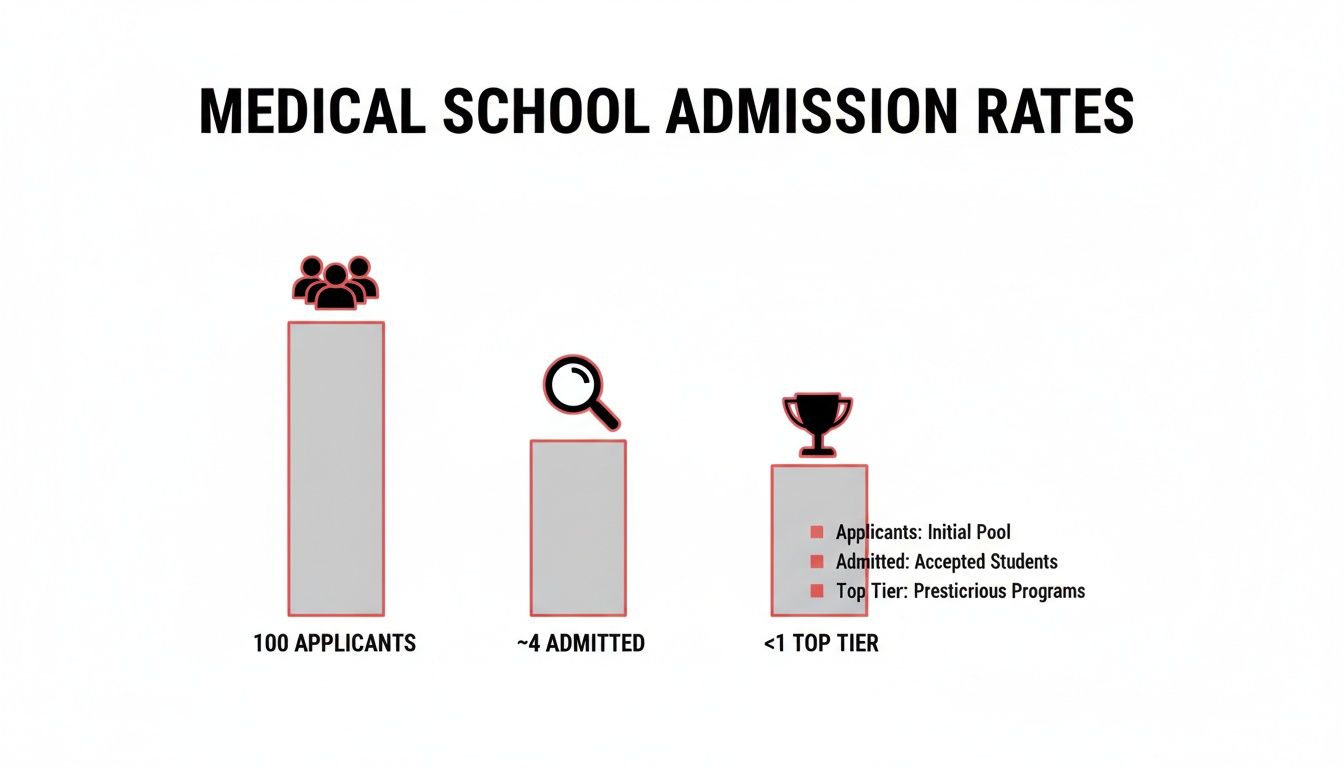
As you can see, the funnel is incredibly steep. This just reinforces how critical it is to build a strong, well-rounded application from day one.
A Tool for Strategy, Not Fear
Instead of letting that low acceptance rate intimidate you, use it as a strategic tool. Understanding these numbers is the key to building a realistic and targeted application plan. It forces you to get honest and ask some critical questions:
- Does my academic profile actually align with my target schools' averages?
- Am I applying to a smart mix of "reach," "target," and "safer" schools?
- Have I considered both MD and DO programs to give myself more options?
Answering these questions is the first step in shifting your mindset from one of fear to one of confidence. Deciding where and how many schools to apply to is a huge part of this strategy, and doing it right can make all the difference. For more guidance, check out our guide on how many med schools you should apply to to maximize your chances.
This data-driven approach allows you to channel your energy where it counts, focusing on schools where you are a genuinely competitive candidate.
Mastering the Metrics: Your GPA and MCAT Score
When an admissions committee is staring at a mountain of thousands of applications, they need a quick, reliable way to make the first cut. That's where your Grade Point Average (GPA) and Medical College Admission Test (MCAT) score come in. Think of them as the gatekeepers of your application. Strong numbers get you through the door for a serious look, while weaker ones might land your file in the "maybe later" pile before anyone even reads your personal statement.
These two numbers are the universal language of academic capability in the med school world. A high GPA tells a story of consistency and hard work over several years of demanding coursework. A killer MCAT score proves you've got the scientific reasoning and critical thinking chops needed to survive—and thrive—in medical school. Together, they form the quantitative backbone of your entire application.

Unpacking Your GPA: The Two Numbers That Matter
Here’s something many premeds don't realize at first: medical schools don't just look at one GPA. They care about two distinct figures, and each one tells a very different story about your academic journey.
Your cumulative GPA (cGPA) is exactly what it sounds like—the average of every single grade from all your undergraduate courses. It’s the big-picture view of your overall academic performance and work ethic.
But then there's the science GPA (sGPA), sometimes called the BCPM GPA. This one is calculated only from your Biology, Chemistry, Physics, and Math courses. Admissions committees put this number under a microscope because it’s the single best predictor of how you'll handle the brutal, science-heavy curriculum of medical school.
Key Takeaway: While both GPAs are crucial, a strong sGPA is non-negotiable. It’s your direct signal to admissions committees that you have what it takes to master the core scientific curriculum they're about to throw at you.
For instance, an applicant with a 3.8 cGPA but a 3.5 sGPA might raise a red flag. It could suggest they padded their overall GPA with easier, non-science courses. On the flip side, someone with a 3.6 cGPA but a stellar 3.9 sGPA looks fantastic. They've demonstrated exceptional strength exactly where it counts most, making them a very compelling candidate. If you're looking to shore up your academic record, it's worth exploring some effective college study strategies to boost your grades.
The MCAT: Your Great Equalizer
The MCAT is a beast—a nearly eight-hour standardized exam that tests everything from problem-solving and critical analysis to your deep knowledge of scientific concepts. Because it's standardized, it's the one tool admissions committees have to compare applicants from wildly different undergraduate schools and majors on a truly level playing field.
The test is scored on a scale from 472 to 528, with the national average sitting right around 500. But for students who actually get accepted to MD programs, the average MCAT score is much higher, around 512. A 512 puts you in the 83rd percentile, which really drives home just how competitive this process is.
A fantastic MCAT score can completely change the game for an applicant. Here’s how:
- It can offset a lower GPA. A high score can prove you’ve matured academically and mastered the material, even if your grades from freshman year don't reflect it.
- It confirms a high GPA. If your grades are already excellent, a matching MCAT score reinforces that you're the real deal—a consistently high-performing academic.
- It opens doors at top-tier schools. Want to be a serious contender at the most elite programs? You'll likely need a score above 517 just to get past their initial screening filters.
Getting a top score is all about smart, strategic preparation. To figure out what number you should be aiming for, it helps to understand what constitutes a good MCAT score for the specific schools on your list. A structured study plan that ruthlessly targets your weak spots is the only way to maximize your potential and give your entire application a massive boost.
Building an Application That Tells a Story

Let’s be honest. A high GPA and a killer MCAT score will get your foot in the door, but they won't carry you across the finish line. In a sea of applicants who all have stellar metrics, what makes you memorable? It’s your story.
Admissions committees aren’t just looking for high-achievers on paper; they’re trying to find future physicians. They want to see the person behind the numbers.
Think of your application less like a resume and more like a mosaic. Every piece—your clinical hours, your time in the lab, your volunteer work, even your personal hobbies—adds color and texture. The goal is to assemble these pieces into a compelling narrative that shows an admissions committee exactly who you are and why you’re a perfect fit for a career in medicine.
This narrative is your chance to answer the one question every admissions officer is asking: "So what? Why you?"
Beyond Checking the Boxes
One of the biggest traps applicants fall into is "box-checking"—collecting hours in different activities without any real passion driving them. Admissions committees see right through this. Trust me. They are far more impressed by a deep, long-term commitment to one or two meaningful activities than a shallow dip into a dozen.
Meaningful experiences are the ones that challenge you, force you to grow, and give you a real glimpse into the human side of medicine.
- Clinical Experience: Shadowing a doctor is a great start, but the real learning happens in active roles. Being an EMT, medical scribe, or hospice volunteer puts you on the front lines, forcing you to interact with patients and truly understand the day-to-day realities of healthcare.
- Research: You don’t need to be a first author on a groundbreaking paper. What you do need is to show intellectual curiosity and an appreciation for evidence-based medicine. Participating in research demonstrates that you can think critically and want to contribute to the field.
- Volunteering: Your volunteer work is a window into your values. Whether you’re serving meals at a soup kitchen, tutoring underserved kids, or building houses, it shows a commitment to service—a quality that is non-negotiable for a physician.
The key is to find opportunities that genuinely resonate with you. When you’re passionate about what you’re doing, it shines through in your essays and interviews, making your story feel authentic and powerful.
Meaningful conversations made me recognize that a humanistic perspective is needed to address the human side of cancer. A career in academic medicine is where I can compassionately guide cancer patients through challenging conversations and actively address cancer as a clinician, researcher, and educator.
This reflection from a current medical student is a perfect example. It shows how personal experiences directly forged their commitment to medicine. That’s the kind of insight that turns a simple list of activities into a story that sticks.
Weaving Your Experiences into a Narrative
Once you have these meaningful experiences, the real work begins: weaving them into a powerful story for your personal statement and secondary essays. Your narrative needs a central theme that ties everything together. Maybe it’s a passion for serving rural communities, a drive to understand a disease that affected a loved one, or an interest in how technology can improve patient care.
For instance, an applicant could connect their experience volunteering at a free clinic (where they saw health disparities firsthand) with their research on diabetes (understanding the science) and their time as a medical interpreter (breaking down communication barriers). This creates a cohesive story about a deep-seated commitment to equitable healthcare.
Your personal statement is the heart of this narrative. It’s where you finally get to articulate your "why." Crafting a powerful essay is a make-or-break step, and looking at a strong sample personal statement for medical school can give you invaluable ideas on how to structure your own story effectively.
Show, Don’t Just Tell
The most effective applications bring your experiences to life with specific, vivid anecdotes. Don’t just tell the committee you learned about compassion during your time as a scribe. Instead, describe a specific patient interaction that changed your entire perspective.
- Instead of: "I learned about teamwork in the ER."
- Try this: "During a chaotic trauma case, I learned to anticipate the surgeon's needs, handing her instruments before she even had to ask and communicating vital sign changes to the nurse. We worked as one seamless unit, and in that moment, I understood what it truly meant to be part of a team saving a patient's life."
This is how you transform your application from a flat list of accomplishments into a memorable portrait of a thoughtful, compassionate, and dedicated future physician. It's this kind of storytelling that will grab an admissions committee's attention and dramatically boost your odds.
Choosing Your Path: MD vs DO and State School Strategy

Where you apply is just as critical as your grades and experiences. Seriously. Building a smart school list is one of the most powerful tools you have to boost your odds of getting in. This means looking beyond the big names and really digging into the details of different medical pathways and what certain schools are looking for.
Two of the biggest strategic forks in the road are choosing between MD and DO programs and understanding the massive advantage of applying to your in-state public universities. Getting these two decisions right can completely change your personal acceptance rate.
MD vs DO: A Tale of Two Philosophies
In the United States, there are two main paths to becoming a physician: Allopathic (MD) and Osteopathic (DO). Both routes produce fully licensed doctors with the same rights and responsibilities, but they come from different histories and philosophies that shape their training and admissions process.
Allopathic (MD) programs are what most people picture when they think of medical school. They follow a more traditional, evidence-based approach focused on diagnosing and treating diseases, often with medication and surgery.
Osteopathic (DO) programs, on the other hand, embrace a more holistic philosophy. They put a strong emphasis on treating the whole person—mind, body, and spirit—and focus on how the musculoskeletal system impacts overall health. On top of all the standard medical training, DO students learn Osteopathic Manipulative Treatment (OMT), a hands-on method for diagnosis and treatment.
While both MDs and DOs are fully qualified physicians, DO schools often have slightly higher acceptance rates and may place a greater emphasis on an applicant's commitment to primary care and underserved communities, offering a viable and excellent path for many students.
Let's break down the key differences so you can see how they might influence your application strategy.
MD vs DO Programs At a Glance
The choice between an MD and a DO path often comes down to personal philosophy and application competitiveness. This table lays out the core differences to help you decide where to focus your energy.
| Factor | MD Programs (Allopathic) | DO Programs (Osteopathic) |
|---|---|---|
| Core Philosophy | Primarily focused on diagnosing and treating specific diseases and conditions. | Holistic approach, emphasizing the mind-body-spirit connection and musculoskeletal health. |
| Median GPA | ~3.77 | ~3.62 |
| Median MCAT | ~512 | ~506 |
| Special Training | None beyond the standard medical curriculum. | Osteopathic Manipulative Treatment (OMT) is a core part of the curriculum. |
| Acceptance Rate | Generally lower; the overall MD rate is around 4.2%. | Generally higher; the overall DO rate is around 7.6%. |
| Residency Match | Matches into all specialties at a very high rate. | Matches into all specialties, with a strong emphasis on primary care fields like family medicine and pediatrics. |
For a lot of applicants, applying to both MD and DO schools is a fantastic strategy. It opens up more doors and significantly increases your overall chance of getting that acceptance letter.
The In-State Advantage: A Crucial Strategy
One of the most overlooked—yet most powerful—factors in medical school admissions is your state of residency. Public, state-funded medical schools have a primary mission: to train doctors who will serve the people of that state. Because of this, they show a huge preference for applicants from their own backyard.
This isn't just a small bump; it's a game-changer.
Just look at the numbers. The University of Washington School of Medicine has an in-state acceptance rate of 7.5%, but for out-of-state applicants, it drops to a staggering 0.6%. At the University of North Carolina, it's a similar story: in-state applicants are accepted at a rate of 14.8%, while out-of-staters face a brutal 1.6% chance.
What this means for you is simple. An applicant with a solid-but-not-perfect profile might be a strong contender at their public in-state school but have almost no shot at a similar public school one state over. Your strategy should be built around your in-state institutions. Make them a priority, learn their mission inside and out, and tailor your application to show them exactly why you’re the perfect person to serve your home state’s community.
How Your Background and Diversity Shape Admissions
Let's talk about something that gets lost in the frenzy over GPA and MCAT scores: your actual story. Admissions committees aren’t just looking for high-scoring robots. They’re building a class of future doctors who can connect with and care for an incredibly diverse patient population. This is the heart of holistic review—a process where they look beyond the numbers to see the whole person.
This means your unique background, your life experiences, and your personal identity aren't just extra details; they are central to your application. Your journey gives context to your achievements. Sure, a great GPA is impressive. But that same GPA becomes extraordinary when it was earned while working two jobs, caring for a sick family member, or being the first person in your family to even dream of college.
The Power of Context in a Holistic Review
Context is everything. Adcoms want to understand the road you’ve traveled. They're searching for qualities like resilience, empathy, and cultural humility—traits that are forged in the fires of life, not just learned in a classroom.
Certain experiences can provide powerful context and paint a much richer picture of who you are:
- Socioeconomic Status: Coming from a low-income background or navigating financial hardship isn't a disadvantage to hide. It's proof of your resilience and gives you a unique understanding of the systemic barriers that many patients face in healthcare.
- First-Generation Status: If you're the first in your family to attend college or pursue a professional degree, you've shown incredible grit and the ability to navigate complex, unfamiliar systems on your own.
- Underserved Communities: Growing up or working in medically underserved areas—whether rural or urban—provides a firsthand look at health disparities. It demonstrates a real, lived commitment to service that can't be faked.
- A Non-Traditional Path: Did you overcome significant personal adversity? Or maybe you had a whole other career in the arts or humanities before finding medicine? These unique life experiences bring a valuable and distinct perspective that enriches a medical school class.
These elements aren't "bonus points." They are fundamental to showing that you have the human qualities needed to become a truly compassionate and effective physician.
What the Numbers Say About Acceptance Rates by Demographic
Medical schools are actively working to build classes that mirror the diversity of the United States. This isn't just about fairness; it's about better medicine. A diverse physician workforce has been shown to lead to better patient outcomes, period.
A holistic review aims to build a cohort of students with varied perspectives. The goal is to train physicians who can understand and effectively treat patients from every walk of life, ultimately improving health equity for all communities.
Still, the data shows we have a long way to go. A recent AAMC analysis highlights some persistent gaps. For instance, White and Asian applicants have seen acceptance rates hover around 50–51% in recent cycles. In sharp contrast, the acceptance rate for Black or African American applicants was significantly lower at approximately 35.9%. This nearly 15-percentage-point gap underscores the systemic inequities that still exist in medical school admissions. You can dig deeper into how these rates vary across different groups to get a clearer picture of the landscape.
Turning Your Journey into Your Greatest Asset
The key is to frame your personal story not as a list of challenges, but as the source of your strength and unique perspective. Your experiences have shaped you and given you insights that other, more traditional applicants simply won't have.
Don't just list your experiences; connect the dots for the admissions committee in your personal statement and secondary essays. Show them how your background has prepared you to serve a diverse patient population. Explain why your journey has fueled your desire to practice medicine. When you do that, you transform your application from a flat file of stats into the compelling, three-dimensional story of a physician-in-the-making.
Turn Your Application Into an Acceptance
Knowing the stats is one thing, and building your application is another. But real success comes from execution. This is where we connect the dots and turn all your hard work into an actual acceptance letter.
A winning application really comes down to three things: strong metrics, a compelling narrative, and a smart school selection strategy. Nail all three, and you’ll find the medical school acceptance rate starts to shift in your favor.
Think of it like this: your GPA and MCAT scores are your ticket to the game. Your personal story is what makes the coaches remember you. And your school list? That determines if you’re even playing in the right league. If you drop the ball on any one of these, it can seriously undermine the others. The goal is to show an admissions committee you're not just another qualified name on a spreadsheet, but a future colleague they genuinely want on their campus.
Executing Your Strategy for Success
Let's break down how to put this knowledge into action and optimize each part of your application.
First, your numbers have to be competitive. If your MCAT score is the weak link, dedicated prep is non-negotiable. This means getting beyond just flipping through review books and actively attacking your weaknesses.
- Personalized MCAT Prep: A one-size-fits-all study plan just doesn't work for most people. You need to pinpoint your specific problem areas—whether it’s timing on the CARS section or getting bogged down in biochemistry concepts—and find resources that offer focused guidance. Expert tutoring can give you the targeted strategies needed to turn a decent score into a great one.
- GPA Contextualization: If your GPA isn’t perfect, your story has to pick up the slack. Show them an upward trend, crush a post-bacc program, or use your essays to honestly discuss the challenges you overcame.
Next, you need a story that actually connects with someone. This is more than just listing off your experiences; it's about weaving them together into a narrative that feels authentic and cohesive.
An application without a clear, compelling story is just a collection of data points. Admissions consulting can help you find the powerful theme that connects your experiences, transforming a list of activities into a memorable portrait of a future physician.
Finally, your school selection has to be strategic. Applying to the right schools is just as important as having a strong application. Don't waste time and money applying to programs where your profile is a statistical long shot from the start.
Your Final Checklist for an Acceptance
This is your action plan. Follow these steps to make sure you’ve done everything possible to turn your application into an acceptance.
- Finalize Your School List: Use the MSAR database to build a balanced list of reach, target, and safer schools based on your metrics. Always prioritize your in-state public universities and think about applying to both MD and DO programs to widen your net.
- Perfect Your Narrative: Get feedback on your personal statement and secondary essays from several people you trust. Make sure your story is clear, consistent, and directly answers the big question: "Why do I want to be a doctor?"
- Submit Applications Early: The timeline is not a suggestion. Submit your primary application as early as you can, and try to get your secondary applications turned around within two weeks of receiving them. Rolling admissions heavily favors those who get in the queue first.
- Prepare for Interviews: Practice, practice, practice. Run through common interview questions and do mock interviews with advisors, mentors, or friends. Your ability to connect in person and communicate your passion is the final piece of the puzzle.
Frequently Asked Questions
Navigating the med school application process is full of complexities and tough questions. Below, I’ll tackle some of the most common queries that come up for pre-meds.
When Is a Medical School Application Considered Late?
While there's no single cutoff date, you want to give yourself every possible advantage with rolling admissions. Submitting your primary application in June or early July is the sweet spot.
But the real deadline that matters is for your secondary applications. An application isn't truly complete until the secondary is in. Aim to turn those around within two weeks of receiving them, and definitely no later than the end of August. Once you hit September, you’re putting yourself at a serious disadvantage.
Can I Get into Medical School with a Low GPA?
Yes, it's possible, but you have to be strategic. The single best way to counterbalance a lower GPA is with a stellar MCAT score. A high score proves you have the academic horsepower for med school, even if your transcript has some blemishes.
A strong upward trend in your grades also tells a powerful story, showing admissions committees you found your footing and improved over time. Excelling in a post-baccalaureate or master's program is another great way to prove you're ready for the academic rigor ahead.
Your story becomes paramount. Frame your unique experiences, resilience, and passion for medicine to give context to your academic record.
How Many Medical Schools Should I Apply To?
There's no magic number, but most successful applicants build a balanced list of 15 to 25 schools. Just spraying applications everywhere isn't a strategy.
A smart list should include a mix of:
- Reach Schools: Programs where your stats are a little below the average matriculant.
- Target Schools: Schools where your GPA and MCAT fit right in with their averages.
- Safer Schools: Institutions where your numbers are comfortably above the average.
Always, always prioritize your in-state public universities. They typically offer the best odds for residents. And since getting accepted is also about being able to afford it, start planning your finances early. It's never too soon to explore guides on grants to help pay off student loans.
Does It Matter If I Take a Gap Year?
Taking a gap year (or even two) is becoming the norm, and it often makes an application much stronger. It’s a golden opportunity to get more meaningful clinical experience, dive into research, or pursue other activities that show your commitment to medicine.
Admissions committees love to see this. Applicants who have taken gap years often come across as more mature and focused. The key is to be intentional with your time off—make it count.
Navigating the high-stakes world of medical school admissions requires a plan and expert guidance. At Ace Med Boards, we provide personalized admissions consulting to help you craft a compelling application that stands out. From MCAT prep to interview coaching, we're here to help you turn your dream into an acceptance letter. Start your journey with a free consultation at https://acemedboards.com.

