
Medical school prerequisites are the specific courses admissions committees expect you to have under your belt before you apply. These aren't just suggestions; they're the non-negotiable science classes—biology, chemistry, physics, and biochemistry—that create the academic foundation for your entire medical career.
Building Your Foundation for Medical School

It’s easy to see these pre-reqs as just a series of boxes to check off, but that’s missing the point. Think of them as learning the essential vocabulary for the language of medicine. Medical schools choose these courses intentionally because they build the scientific reasoning and critical thinking skills you'll need to survive—and thrive.
These classes are your primary training ground for the MCAT and the demanding curriculum that’s waiting for you.
When you master these subjects, you’re sending a clear signal to admissions committees that you have the academic horsepower to handle complex medical concepts. It’s far less about memorizing random facts and much more about learning how to think like a scientist and, one day, a physician.
The Core Science Requirements
While the exact requirements can differ a bit from one school to another, there's a standard set of courses that forms the core of nearly every medical school's checklist. Your undergraduate advisor is a great resource for mapping this out, but you should absolutely plan on completing the following, almost always with a lab component.
Here’s a look at what you’ll need to knock out.
Standard Medical School Prerequisite Checklist
The table below breaks down the usual suspects when it comes to science prerequisites. Think of this as your starting point for planning your undergraduate schedule.
| Subject | Typical Semesters or Courses | Credit Hours (Approx.) | Lab Requirement |
|---|---|---|---|
| General Biology | 2 semesters (Introductory Biology I & II) | 8 hours | Required |
| General Chemistry | 2 semesters (Introductory Chemistry I & II) | 8 hours | Required |
| Organic Chemistry | 2 semesters (Organic Chemistry I & II) | 8 hours | Required |
| Biochemistry | 1 semester (sometimes 2 are recommended) | 3-4 hours | Varies |
| General Physics | 2 semesters (Introductory Physics I & II) | 8 hours | Required |
Remember, these are the minimums. Excelling in these courses is what truly matters.
The goal here isn’t just to get a grade and move on; it’s about building a deep, interconnected understanding of how biological systems work. A strong performance in these classes has a direct link to a higher MCAT score and a much smoother transition into your first year of medical school.
Beyond the Hard Sciences
Admissions committees aren't just looking for science robots. They want to see well-rounded candidates with sharp communication skills. That’s why most schools also require a handful of courses in the humanities and mathematics. To see how these requirements fit into the bigger picture, check out our complete guide on the prerequisites for medical school.
Here are some of the other common requirements you’ll see:
- English or Writing-Intensive Courses: Plan on taking two semesters to really polish your written communication.
- Mathematics: Usually, one semester of calculus and one of statistics are either required or very strongly recommended.
- Psychology and Sociology: These behavioral sciences are more important than ever. They’re crucial for understanding the social determinants of health and are tested on the MCAT.
For students exploring different educational systems, especially in the UK, alternative paths exist. For instance, an Access to Higher Education Diploma for Health Professionals can provide a solid, comprehensive foundation. Ultimately, every course you take is another tool you're adding to your future clinical toolkit.
Why Your GPA and MCAT Score Matter Most
While checking off your med school pre reqs is the first step, how you perform in them—and on one monster exam—is what truly defines your application's power. Your Grade Point Average (GPA) and Medical College Admission Test (MCAT) score are, without a doubt, the two most important numbers in the admissions game. They’re the primary gatekeepers that help committees sift through thousands of applications.
Think of it like a qualifying lap in a race. It doesn't matter how skilled you are behind the wheel; if you don't post a fast enough time, you won't even make it to the starting grid. In the same way, a strong GPA and MCAT score are your ticket to being taken seriously. They prove you have the academic horsepower to thrive in the demanding, high-speed world of medical school.
Decoding Your GPA: The Story of Your Academic Journey
Admissions committees don't just glance at a single number. They dig into your academic record from a few different angles, which is why you'll hear about a couple of different GPAs.
- Overall GPA: This is the big picture—a complete average of every grade you've earned in college. It shows your general academic consistency and work ethic.
- Science GPA (BCPM): This is where the magnifying glass comes out. It’s a focused average of your grades in Biology, Chemistry, Physics, and Math. This number is a direct signal of your ability to handle the core subjects of medicine.
A high BCPM GPA is non-negotiable. It tells the admissions committee you didn't just survive the foundational sciences; you excelled in them. An upward trend is also incredibly powerful. If your grades improved over time, it tells a story of resilience, maturity, and growth. To get the full picture of what adcoms are looking for, check out our guide on what medical schools look for in applicants.
The MCAT: The Great Equalizer
The MCAT is a standardized beast of an exam designed to level the playing field. It allows schools to compare an applicant from a small liberal arts college with one from a massive state university. The test isn't just about regurgitating facts from your prerequisite courses; it’s built to test your critical thinking, problem-solving, and analytical reasoning skills.
This is why your prerequisite courses are so much more than just boxes to check—they are your training ground for the MCAT. Every concept you master in biology, every mechanism you learn in organic chemistry, and every formula in physics translates directly to points on this exam. When you start seeing these classes as MCAT prep instead of just requirements, the whole game changes.
Strong performance in your med school pre reqs is the single best predictor of MCAT success. Every lab, lecture, and late-night study session is an investment in the most important exam of your pre-med career.
The data doesn't lie. The national average MCAT score for matriculants (students who actually got in and started medical school) is around 511.7, with an average GPA of 3.77. Sure, some schools might accept averages around 501, but the top-tier programs like NYU are looking for a jaw-dropping 522, putting you in the top 1% of all test-takers.
Ultimately, your GPA tells the long-term story of your academic discipline, while your MCAT score provides a snapshot of your scientific reasoning at a specific moment in time. Nailing both is the most direct path to securing interviews and, finally, that acceptance letter. They are the undeniable cornerstones of a competitive application.
Choosing Courses That Create a Competitive Edge
Nailing your core science med school pre reqs is just the price of admission. If you want to transform your application from just "qualified" to "compelling," you need to go beyond the basics. Think of your foundational sciences as the engine of your application; these recommended courses are the advanced navigation and communication systems that actually guide you to your destination.
Admissions committees aren't just looking for a science whiz—they're looking for a future physician. That means they want to see intellectual curiosity, empathy, and the ability to think critically about the human side of medicine. Choosing the right electives is one of the most powerful ways to tell that story.
Crafting a Well-Rounded Academic Profile
Your course selection is a signal. It should show a genuine interest in the real-world complexities of health and human behavior. These classes do more than just prepare you for the MCAT's evolving content—they build the essential skills you'll need for patient care.
Here are the key areas that make a real difference:
- Writing-Intensive Humanities: Don't underestimate the power of courses in English, philosophy, or ethics. They are invaluable for sharpening your ability to build a logical argument and communicate with clarity. You'll use these skills every single day, whether you're writing patient notes, publishing research, or explaining a tough diagnosis to a family.
- Behavioral Sciences: In today's medical landscape, understanding the social determinants of health is non-negotiable. Taking Psychology and Sociology is no longer just a good idea; it's practically a necessity. These subjects offer deep insights into patient behavior and the societal factors that shape health outcomes—a massive component of the MCAT.
- Statistics: While Calculus definitely builds problem-solving skills, Statistics is arguably far more practical for a future doctor. Understanding statistical analysis is absolutely critical for interpreting clinical research, practicing evidence-based medicine, and contributing to the scientific community.
Taking these subjects shows you get it: medicine is both a science and an art. It proves you've thought deeply about the patient experience, not just the biological mechanisms of their disease.
An applicant who has only taken the bare-minimum science courses might seem capable. But one who has explored psychology, ethics, and public health appears prepared. This signals a maturity and a holistic understanding of what it truly means to be a doctor.
Demonstrating Advanced Scientific Aptitude
While the humanities show your breadth, taking upper-level science courses demonstrates your depth and passion. Excelling in these classes proves you can handle the academic rigor of medical school and are genuinely driven by scientific inquiry. For a detailed look at how to build a strong pre-med curriculum, explore our guide on essential pre-med courses.
Consider adding one or two of these heavy-hitters to your schedule:
- Genetics: This course takes you far beyond basic biology and into the fundamental code of life. It’s a topic that's central to countless medical advancements and disease processes.
- Immunology: Understanding the body's intricate defense systems is critical in nearly every single field of medicine, from infectious disease to oncology.
- Human Anatomy & Physiology: Sure, this is often part of the core curriculum. But taking a more advanced version—especially one with a cadaver lab—provides an unparalleled advantage and directly prepares you for your first year of med school.
By thoughtfully selecting these advanced science and humanities courses, you do more than just check off your med school pre reqs. You build a compelling narrative that showcases your intellectual curiosity, your commitment to patient-centered care, and your readiness for the challenges ahead. This strategic approach is what creates a competitive edge and helps your application truly stand out.
Building Your Four Year Pre Med Timeline
Getting into med school is less about being a genius and more about being a brilliant project manager. Seriously. Just winging your med school pre reqs is like trying to build a house without a blueprint—you'll have all the parts, but nothing will line up when it counts. A smart, well-paced timeline is your secret weapon, ensuring you take courses in the right order, build on what you've learned, and hit MCAT season ready to dominate.
Think of it this way: you wouldn't take Organic Chemistry before General Chemistry, right? Your pre-med path is full of those kinds of dependencies. Mapping it all out transforms a potentially chaotic four years into a manageable, step-by-step process. It's the best way to lower your stress and raise your chances.
Here's a look at how a typical pre-med course progression unfolds, breaking down the core sciences from the advanced stuff you'll layer on top later.
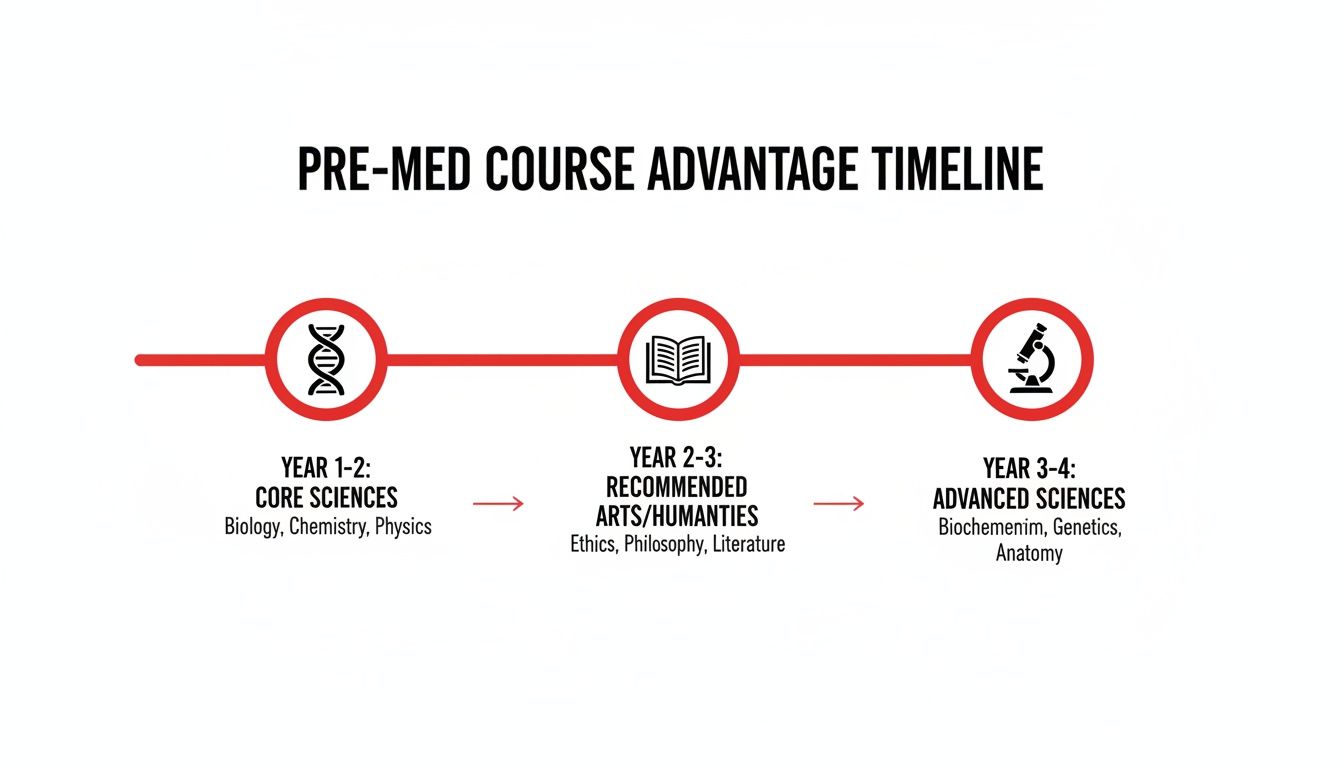
As you can see, the first two years are all about laying that strong science foundation. This is what sets you up for success on the MCAT and allows you to tackle more interesting upper-level electives as a junior and senior.
A Sample Plan for Traditional Students
If you're on the standard four-year college track, the game plan is pretty straightforward: get all your required prerequisite courses done by the end of your junior year. This timing is absolutely critical. It lets you take the MCAT in the spring of that year, giving you plenty of time to get your scores back and build a strategic school list before applications open in June. Nailing down your study schedule is a huge part of this, and you can learn more about when you should start studying for the MCAT in our detailed guide.
Here’s a common way to break it down semester by semester:
- Year 1 (Freshman): This is all about the fundamentals. You'll want to knock out General Biology I & II and General Chemistry I & II, both with their labs. This is also a perfect time to get your first English or writing-intensive course out of the way.
- Year 2 (Sophomore): Now you build on that base. It's time for Organic Chemistry I & II with labs, plus Physics I & II with labs. Many students also take their introductory Psychology and Sociology courses this year, as they are tested on the MCAT.
- Year 3 (Junior): This is your make-or-break year. You'll take your one-semester Biochemistry course in the fall—it's the last major piece of the MCAT puzzle. The spring semester then becomes your dedicated, all-in MCAT study season, aiming for an April or May test date.
- Year 4 (Senior): With the MCAT and your primary applications submitted, this year is about finishing strong. You'll be busy with secondary applications and hopefully, interviews. It's also the perfect time to take advanced science electives like Genetics or Immunology that look great to admissions committees.
Timelines for Non-Traditional Students
What if you're a career-changer or just decided on medicine later in your college journey? No problem. Your timeline will be more compressed, but it’s completely manageable with the right plan. You're generally looking at two main options: a formal post-baccalaureate (post-bacc) program or a do-it-yourself (DIY) approach.
A formal post-bacc program is fantastic for its structure, dedicated advising, and the support of a peer group going through the exact same thing. On the other hand, a DIY plan at a local university can offer more flexibility and might be easier on your wallet.
Either way, the required coursework doesn't change. You still need to complete all the core science prerequisites. Most people find a two-year plan is the most realistic, as it prevents total burnout and gives you a better shot at earning a stellar GPA.
Sample Pre Med Timeline Comparison
To give you a clearer picture, here’s a table that shows how the journey might look for a traditional undergrad versus a non-traditional student in a two-year post-bacc program.
| Milestone | Traditional Student (Typical Path) | Non-Traditional Student (2-Year Path) |
|---|---|---|
| Year 1 | Gen Bio I & II, Gen Chem I & II | Gen Bio I & II, Gen Chem I & II, Physics I & II |
| Year 2 | Org Chem I & II, Physics I & II | Org Chem I & II, Biochemistry, MCAT Prep |
| Application Year | Summer after Junior Year | Summer after Year 2 of Post-Bacc |
| MCAT Timing | Spring of Junior Year | Spring of Post-Bacc Year 2 |
As you can see, the non-traditional path packs more science into the first year to stay on track. Both paths, however, strategically position the MCAT after all the core content has been covered.
Whether you're starting as a freshman or coming back to school years later, your success hinges on creating a thoughtful, realistic roadmap. This timeline is your guide through all the required med school pre reqs and keeps you moving steadily toward that white coat.
Navigating MD Versus DO Program Requirements
When you're mapping out your med school pre reqs, it's a huge mistake to assume every program wants the exact same coursework. One of the most important distinctions to understand is the difference between Allopathic (MD) and Osteopathic (DO) schools. While both paths lead you to becoming a licensed physician, their prerequisites can have subtle but critical differences that reflect their unique educational philosophies.
A common myth I hear all the time is that DO program requirements are somehow "easier." That’s just not true. They are simply different, often tailored to support a holistic view of the patient right from the start. This might mean more flexibility in some areas but specific recommendations in others, like Anatomy, Physiology, or even extra humanities courses to build a better understanding of the human experience.
Applying without the right courses for a specific program type is one of the fastest ways to get your application automatically filtered out before a real person even lays eyes on it. This is why targeted research is absolutely non-negotiable.
Unpacking the Core Differences
At the end of the day, both MD and DO programs build on the same scientific foundation. You'll need a full year of biology, general chemistry, organic chemistry, and physics—all with their corresponding labs. A semester of biochemistry has also become a standard across the board. The real divergence starts to show up in the recommended, and sometimes required, upper-level science courses.
Some DO schools will recommend or even require coursework that many MD programs only list as optional. This often includes:
- Anatomy and Physiology: Central to osteopathic manipulative medicine (OMM), many DO programs value a strong, early grasp of the human body's structure and function.
- Genetics: While it's a great idea for any pre-med, some DO schools specifically call it out.
- Additional Humanities: Courses in ethics, philosophy, or sociology directly align with the osteopathic focus on treating the whole person, not just the symptoms.
The key takeaway is this: DO school requirements are not a watered-down version of MD prerequisites. They are simply customized for an educational model that weaves a holistic and patient-centered philosophy into the curriculum from day one.
Research Is Your Best Medicine
Let's look at the brutal math of medical school admissions. The overall acceptance rate hovers around a tough 41-44%. But when you drill down into a specific school like Western Michigan University, the picture gets even clearer: 4,302 applications came in for just 86 spots. That’s a razor-thin 2% acceptance rate. The academic bar is incredibly high for everyone, and your prerequisite coursework is the first hurdle.
In this high-stakes game, you can't afford to guess. You have to verify the specific requirements for every single school on your list. Your best friends here are the Medical School Admission Requirements (MSAR) for MD schools and the Choose DO Explorer for Osteopathic programs. These are the official sources, and they'll save you from making a critical mistake. To dig deeper into the differences in board exams, you should also check out our complete comparison guide on the COMLEX versus the USMLE for DO students.
Ultimately, proactive and meticulous research isn't just a good idea—it's essential. By carefully aligning your academic plan with the specific med school pre reqs of your target MD and DO programs, you save yourself an incredible amount of time, money, and stress. It’s the single best way to ensure your application is perfectly positioned for success.
Your Actionable Pre-Med Checklist

Alright, it's time to shift from planning to doing. We've covered a ton of ground on med school pre reqs, timelines, and strategy. Now, let’s pull it all together into a clear, actionable mission plan.
Think of this as your personal toolkit for taking confident control of the journey ahead. In my experience, meticulous organization is what separates the successful applicants from everyone else. This checklist is your roadmap to make sure you don't miss a single critical step.
Phase 1: Foundational Planning
The first phase is all about building a solid, informed strategy. Getting this right from the start saves an immense amount of stress and prevents costly mistakes down the line. Trust me on this.
Research Target Schools: Before you even think about planning a single course, you need to identify 10-15 potential medical schools. Use the MSAR (for MD) and the Choose DO Explorer (for DO) to dig into their specific prerequisite courses, average GPAs, and MCAT scores. Document everything.
Create a Course Tracker: This is non-negotiable. Build a detailed spreadsheet listing every single prerequisite from your target schools. You'll want columns for the course name, credit hours, lab requirement, the semester you plan to take it, and your final grade. This document will become your academic command center.
Meet Your Pre-Health Advisor: Schedule a meeting with your university's pre-health or pre-med advisor as soon as you can. Bring your research and your draft course tracker. Their job is to provide expert feedback and validate your plan, and they can often spot potential scheduling conflicts you might have missed.
Phase 2: Strategic Execution
With your plan validated, the focus now shifts to executing it with precision. This phase is where you juggle academics, testing, and the crucial experiences that build a compelling profile.
Map Your Timeline: Use that course tracker to create a semester-by-semester schedule. You need to be smart about how you sequence your courses, ensuring all the key MCAT-related prerequisites are wrapped up by the end of your junior year (or your second post-bacc year).
Schedule Your MCAT: Plan to take the MCAT in the spring of your application year—usually April or May of junior year. This timing is critical because it ensures you get your scores back before primary applications are due in June.
Integrate Experiences: Strategically weave your extracurriculars into your schedule. Don’t treat them as an afterthought. Plan dedicated blocks of time for clinical volunteering, physician shadowing, and research, just like you would for a class.
Don’t just check boxes—connect them. Every clinical hour should inform your understanding of what you learned in sociology. Every research project should deepen your grasp of biochemistry. This integrated approach is what builds the compelling narrative that admissions committees are really looking for.
Phase 3: Wellness and Sustainability
Finally, remember this journey is a marathon, not a sprint. The demanding nature of the pre-med path can easily lead to significant stress. Understanding and preventing academic burnout is absolutely essential for your long-term success.
Build in time for rest, hobbies, and social connections. Your well-being is a critical, and often overlooked, component of a strong application. A rested, motivated applicant performs far better in interviews and writes much more authentic personal statements. Follow these steps methodically, and you’ll be in a great position.
Frequently Asked Questions About Med School Pre Reqs
Trying to figure out the specifics of med school pre reqs can feel like you're putting together a puzzle with a few pieces missing. Most pre-meds hit the same roadblocks and have the same questions about AP credits, a bad grade, or when to schedule the MCAT. Let's clear up these common gray areas so you can avoid simple but costly application mistakes.
Getting these details right matters. Admissions committees are looking for a consistent, rigorous academic record. Even small slip-ups can raise unnecessary red flags about your ability to handle the intense curriculum ahead.
Can I Use AP or Community College Credits for Pre Reqs?
This is one of the most common—and trickiest—questions we get. While your undergraduate university probably gave you credit for your AP scores, most medical schools will not accept them for your core science prerequisites. A few might make an exception, but only if you immediately follow it up with advanced coursework in that same subject (like taking Genetics after using an AP Bio credit).
Credits from a community college are viewed just as cautiously. Admissions committees want to see that you can thrive in the demanding academic environment of a four-year university, especially when it comes to the foundational science courses.
The safest bet, by far, is to take all your core science med school pre reqs at your primary four-year university. Don't leave it to chance—always double-check the specific policies for every single school on your target list.
What Should I Do If I Get a C in a Prerequisite?
First, don't panic. A single 'C' is not going to kill your application, but you absolutely have to address it with a clear strategy. You could retake the course, but remember that the American Medical College Application Service (AMCAS) will average both grades into your GPA. It doesn't replace the old one.
A much more powerful approach is to show a strong, undeniable upward trend. Let's say you got a 'C' in General Chemistry I. The best response is to follow that up with 'A' grades in General Chemistry II, Organic Chemistry, and especially Biochemistry. This proves to the admissions committee that you're resilient, you've mastered the material, and you can excel in even more difficult courses.
When Is the Best Time to Take the MCAT?
Timing your MCAT is a critical piece of the application puzzle. The ideal window is right after you’ve finished the key prerequisite courses that the exam covers heavily. This means you need two semesters of biology, general chemistry, organic chemistry, physics, and—this is a big one—at least one semester of biochemistry under your belt.
For most traditional students, this sweet spot is during the spring of their junior year, usually in April or May. This timing allows you to get your score back well before the primary application cycle opens in early June. That gives you the data you need to build a smart, realistic school list based on your actual performance.
At Ace Med Boards, we specialize in turning confusion into confidence. From MCAT prep to navigating complex application strategies, our expert tutors provide the personalized guidance you need to stand out. Start your journey with a free consultation and see how we can help you achieve your medical school dreams. Visit us at https://acemedboards.com to learn more.

