An effective MCAT prep course online is far more than just a collection of videos and practice questions. It’s a structured, digital program designed to give you specialized content review, thousands of practice problems, and the strategic guidance you need to truly master the exam. The best ones offer flexibility, personalized feedback, and brutally realistic practice that molds to your unique learning style and schedule.
Navigating the Maze of Online MCAT Prep Courses

Choosing an online MCAT prep course can feel like standing at a crossroads with a dozen signs pointing in different directions. Every provider promises top scores and revolutionary methods, so how do you cut through the noise and find the one that actually works for you?
The massive shift to digital learning isn't just a fleeting trend; it’s a fundamental change in how students tackle high-stakes exams. This explosion in popularity is backed by some serious numbers. The global online test prep market is on track to hit $29.7 billion by 2033, which tells you just how much students are demanding flexible and powerful study solutions. You can dig into the specifics in this market growth analysis on htfmarketinsights.com.
For you, this growth is a huge advantage. It means more choices, better tools, and a powerful mix of convenience and learning tech that old-school methods just can't compete with.
Understanding Your Options
Before you get lost comparing features, you need to understand the three main formats available. Think of them like different training styles for a marathon—each has its own structure, intensity, and level of support.
H3: Self-Paced Courses
This is the "gym membership" model. You get the keys to a world-class facility packed with all the equipment (video libraries, question banks) and training manuals you could ever need. You decide when to show up, what to work on, and how hard to push. It's the ultimate in flexibility, but it demands serious self-discipline.
H3: Live Online Classes
Think of this as joining a scheduled fitness class with a live instructor. You follow a set curriculum on a fixed schedule, interact with classmates, and get real-time guidance and answers to your questions. This format provides the structure and accountability that many students need to stay on track.
H3: Private Tutoring
This is the equivalent of hiring a personal trainer. You get completely customized, one-on-one attention laser-focused on your specific strengths, weaknesses, and score goals. It’s the most direct path to fixing your problem areas.
The "best" MCAT prep course isn't a one-size-fits-all solution. It's the one that perfectly matches your discipline, learning style, budget, and score ambition. Your mission is to find that sweet spot between structure and freedom.
To give you a clearer picture, let's break down how these three formats stack up against each other.
Quick Comparison of Online MCAT Prep Course Formats
Here’s a quick overview to help you see the major differences at a glance.
| Format Type | Best For | Typical Structure | Cost Range |
|---|---|---|---|
| Self-Paced | Disciplined, independent learners who need maximum flexibility. | Video libraries, question banks, and practice exams on demand. | $ – $$ |
| Live Online | Students who thrive with structure, accountability, and peer interaction. | Scheduled virtual classes, homework, and instructor-led sessions. | $$ – $$$ |
| Private Tutoring | Individuals needing personalized attention and targeted strategy. | One-on-one sessions customized to address specific weaknesses. | $$$ – $$$$ |
Each path can lead to a great MCAT score, but choosing the right one for your personality and needs is the first critical step in your prep journey.
Decoding Different Online MCAT Course Formats

Once you've decided to go with an mcat prep course online, the next step is pulling back the curtain to see what you actually get. The format you choose is a huge deal because it dictates your entire study experience.
Each one is built on a different learning philosophy, so finding the right match for your study habits and personality is critical. Let’s break down the three main options to see how they really work and which one might be right for you.
Self-Paced Courses: The Ultimate Flexibility
Imagine being handed the keys to a massive, fully-stocked library dedicated solely to the MCAT. That’s a self-paced course in a nutshell. You’re the architect of your own study plan, with total control over what you learn and when you learn it.
This format is a lifesaver for students who are already great at managing their own time or need to squeeze MCAT prep around a packed schedule—think full-time jobs or a heavy course load.
The core components usually include:
- Video Libraries: A massive collection of on-demand lectures covering every single AAMC topic.
- Question Banks (Q-banks): Thousands of practice questions, often with smart algorithms that zero in on your weak spots.
- Full-Length Practice Exams: These are essential for building the stamina and strategy you need on test day.
- Digital Textbooks and Notes: All your review materials in a searchable, interactive format.
The big catch? This freedom comes with a ton of responsibility. You have to be your own motivator, your own strategist, and your own taskmaster. Without someone else holding you accountable, it can be tough to stay on track.
Live Online Classes: Structured Learning in a Virtual Classroom
If a self-paced course is a library, a live online class is like a virtual university seminar. You get the structure and rhythm of a traditional classroom but with the convenience of logging in from anywhere. You attend scheduled classes taught by an expert instructor in real time.
This format is perfect for students who need that routine and accountability to stay disciplined. The fixed schedule makes sure you cover everything methodically, and you get the huge benefit of interacting with your instructor and classmates. If you're weighing different providers, our breakdown of the best MCAT prep courses can show you how the top live online options compare.
The real value of a live online class isn't just the information presented; it's the direct access to an expert who can clarify complex topics and provide immediate, personalized feedback on your questions.
These kinds of engaging, interactive formats are taking over the test prep world. Top companies are weaving in adaptive tech and AI-powered tools to help students pinpoint their knowledge gaps and stay engaged.
One-on-One Tutoring: Your Personal MCAT Coach
One-on-one tutoring is the most targeted, personalized form of MCAT prep out there. Think of your tutor as a personal trainer for your brain. They start with a deep dive into your strengths and weaknesses, then build a completely custom study plan to attack your specific problem areas.
This white-glove approach is ideal for students who:
- Are shooting for a 90th+ percentile score and need to perfect their strategy.
- Have major content gaps they need to fill efficiently.
- Are retaking the MCAT and need to break through old plateaus.
- Struggle with things like test anxiety or pacing.
Tutoring sessions are all about active problem-solving. You’re not just listening to a lecture; you're working through tough passages, dissecting questions, and mastering the logic of the exam with an expert guiding you at every turn. While it's the biggest financial investment, that focused attention can lead to massive score improvements by getting right to the source of your errors.
Your Checklist for Evaluating MCAT Prep Courses
Choosing an mcat prep course online feels like a high-stakes decision—because it is. You're flooded with flashy marketing, big promises, and a dozen different options all claiming to be the best. So, how do you cut through the noise and find a course that actually works?
It comes down to looking past the price tag and inspecting what really drives score increases. Think of it like test-driving a car; you need to pop the hood and check the engine, not just admire the paint job. This checklist will show you exactly what to look for, from content quality to instructor expertise, so you can make a choice that fits your goals and learning style.
Content Quality and AAMC Alignment
This is the big one. The single most important factor is how well the course material mirrors the actual MCAT. The exam isn't a trivia contest; it’s about applying scientific principles and critical reasoning skills in the specific way the AAMC tests them.
Your top priority is making sure the course is 100% aligned with the AAMC content outline. Any course that wastes your time on obscure, low-yield topics that rarely show up on the real exam is doing you a massive disservice. Your time is your most valuable resource. Don't let a poorly designed curriculum waste it.
Here are the non-negotiables:
- Representative Questions: Do the practice questions feel like the real deal? They should mimic the style, length, and passage-based complexity of official AAMC material. If it’s just a bunch of simple recall questions, run the other way.
- High-Yield Focus: The best courses are obsessed with efficiency. They hammer home the most frequently tested concepts so your effort is concentrated where it will have the biggest impact on your score.
- Clear Explanations: Getting a question wrong is only useful if the explanation teaches you something. A great explanation breaks down the science, the logic, and the test-taking strategy. It should clarify why the right answer is right and, just as importantly, why the wrong answers are tempting but ultimately flawed.
Instructor Expertise and Teaching Style
A fantastic instructor can make even the most brutal topic—looking at you, metabolic pathways—finally click. In an online course, their ability to engage, clarify, and motivate is even more critical. You're not just buying access to information; you're investing in expert guidance.
Don't settle for someone just reading off a script. You need a true educator who is passionate about the material and has a knack for breaking down complex ideas into simple, digestible pieces.
A great instructor doesn’t just teach you what to know; they teach you how to think like the test-maker. This shift in perspective is often the key that unlocks a top-tier score.
Take full advantage of any free trials or sample lectures. Watch how the instructor handles questions, how they explain a complicated process, and whether they can keep the energy up. Does their teaching style resonate with you? This is a personal call, but finding the right fit can make all the difference.
Practice Test Realism and Analytics
Practice tests are your MCAT dress rehearsals. They’re where you build stamina, nail down your pacing, and expose your weaknesses under the pressure of the clock. But here's the catch: their value is directly tied to how accurately they simulate the real exam.
A top-notch course will deliver:
- A Realistic Interface: The platform should look and feel exactly like the software you'll use on test day. No surprises.
- Accurate Scoring: The score you get on a practice test should be a reliable predictor of how you'd do on an official AAMC exam.
- In-Depth Analytics: This is where the magic happens. After each test, you need a detailed performance breakdown. This data is absolute gold. It shouldn't just tell you what you got wrong, but why. Are you consistently missing questions on a specific content area? Are you running out of time on CARS passages? The analytics must answer these questions clearly.
The whole point is to use this data to make your studying smarter. The insights from just one practice test can shape your study plan for the next two weeks, helping you turn those weak spots into strengths.
Calculating the Real Cost and ROI of Your Prep
An mcat prep course online is a big financial decision, and it’s easy to get sticker shock when you see prices stretching from a few hundred to several thousand dollars. But looking at this as just another expense is a mistake. The best way to think about it is as an investment in your future medical career—one with a very real Return on Investment (ROI).
The price tag isn’t just for video lectures and practice questions. It’s for buying back your most valuable asset: time. A well-designed course saves you hundreds of hours you’d otherwise spend trying to stitch together a study plan from random resources, guessing what’s high-yield, and struggling to find realistic practice.
Breaking Down the Price Points
The cost of an online MCAT course usually falls into a few tiers based on the level of support and resources you get. Looking at general pricing information for educational platforms can give you a good feel for the market and what different service levels typically include.
- Budget-Friendly (Under $1,500): These are usually self-paced platforms or subscriptions focused heavily on question banks. They give you the core materials but expect you to be the sole driver of your study plan.
- Mid-Range ($1,500 – $2,500): This is the sweet spot for most comprehensive, self-paced courses. You’ll get a full suite of videos, advanced analytics to track your progress, and multiple full-length practice exams.
- Premium ($2,500+): This category is where you’ll find live online classes and specialized programs with high-score guarantees. The higher price reflects the added cost of live instruction from expert educators.
For example, a major player like Blueprint MCAT offers a self-paced course from $1,700 to $2,400. If you want their live online option, the price climbs to between $2,600 and $3,500. Their specialized 515+ course, which promises a high score, runs $3,500 and comes with intensive live instruction. Students who commit to these structured programs often see big gains, with some providers reporting an average 15-point increase in MCAT scores. You can check out Blueprint's course details and score increase data on their site.
Calculating Your True Return on Investment
The ROI of an MCAT prep course isn't just about the money. It's about the doors that a higher score opens. A few extra points on the MCAT can be the very thing that gets your application noticed by your dream medical school, potentially saving you the massive cost and stress of a reapplication cycle.
Think about it this way: a 5-point increase could be the difference between being a competitive applicant and a highly sought-after one. This can lead to more interviews and a much better shot at acceptance, which is the ultimate return. For a detailed breakdown of how different course features impact your score, check out our guide to MCAT course pricing and value.
The true ROI of an MCAT prep course is measured in opportunity. It's the score that gets you an interview, the time saved from inefficient studying, and the confidence gained from a structured, expert-led plan.
Score Increase Guarantees and Hidden Fees
Many companies will flash a "score increase guarantee," but you absolutely have to read the fine print. These guarantees often come with strict rules, like completing 100% of the coursework or attending every single class. They might offer a refund or a free course repeat, but the conditions can be incredibly hard to meet.
Always check for hidden costs, too. Does the price include all the official AAMC practice materials, or will you need to buy those separately? Are there extra fees for extending your access if you need more time? A transparent company will lay out every potential cost upfront. Making a smart financial choice means understanding the total investment required to hit your goal score.
Building Your Study Plan Around an Online Course
Signing up for a top-tier MCAT prep course online is a fantastic first step, but let’s be real—it’s only half the battle. Think of it like buying professional-grade gym equipment; the gear itself doesn't build the muscle. Real progress comes from integrating that equipment into a smart, consistent workout plan. The exact same principle applies here. Your score jump depends entirely on how effectively you build a study schedule around your course.
A great plan gives you structure, prevents burnout, and makes sure you cover every single topic without getting lost. Without one, you risk drifting aimlessly through content, wasting precious time on low-yield topics, or, worst of all, cramming frantically in the final weeks. The key is to match your timeline to your life’s demands.
This visual maps out the typical journey from investing in a course to achieving your target score.
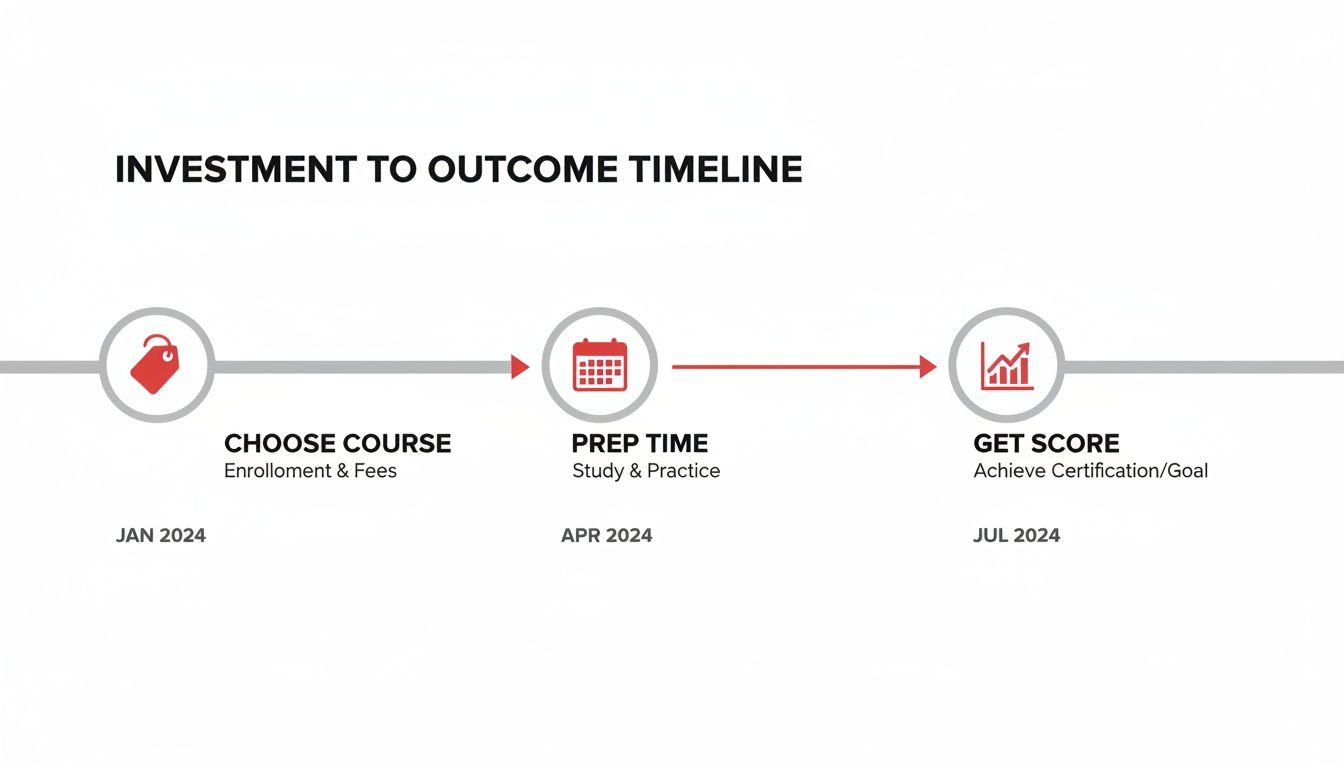
As you can see, the investment in a quality course is what fuels the prep time needed to hit your goal. It’s all about turning those resources into real, tangible results.
The 3-Month Intensive Sprint
This timeline is built for students who can dedicate themselves to MCAT prep full-time. We're talking treating it like a 40+ hour per week job. It's an aggressive, high-intensity approach that requires serious discipline and focus.
- Phase 1 (Weeks 1-4): Content Foundation. Your primary goal is to get through all the core science content. This is where your course's video library and digital textbooks become your best friends. You'll spend most of your days absorbing information and using end-of-chapter questions to lock it in.
- Phase 2 (Weeks 5-9): Practice and Refinement. Now, you shift from just learning to actually applying the knowledge. This phase is all about grinding through your course’s Q-bank and taking one or two full-length practice exams every week. Use the detailed analytics to find your weak spots and patch them up.
- Phase 3 (Weeks 10-12): AAMC Material and Final Review. In the home stretch, you’ll focus almost exclusively on official AAMC practice exams and materials. The goal here is to perfect your timing, nail down your strategy, and build the mental endurance you need for test day.
The 6-Month Balanced Marathon
For students juggling classes, a job, or other commitments, this balanced approach is far more sustainable. It allows for a deeper, more gradual understanding of the material without completely sacrificing your sanity.
This timeline usually involves 15-20 hours of focused study per week. To keep everything on track, it helps to implement some effective time management strategies for students. For a detailed, day-by-day breakdown, you can check out our comprehensive 6-month MCAT study schedule for a practical template.
The marathon approach isn't about studying less; it's about studying smarter over a longer period. It allows concepts to marinate, moving information from short-term memory to long-term mastery.
No matter which timeline you choose, your study plan will generally follow a few key phases. Here’s a quick breakdown of what that looks like.
Sample MCAT Study Plan Phases
| Study Phase | Duration (Example for 6-Month Plan) | Primary Focus | Key Course Features to Use |
|---|---|---|---|
| Phase 1: Content Foundation | Months 1-3 | Comprehensive review of all MCAT science subjects. | Video lectures, digital textbooks, drills |
| Phase 2: Active Practice | Months 4-5 | Applying knowledge with practice questions. | Question banks (Q-banks), analytics |
| Phase 3: Full-Length Simulation | Month 6 | Building stamina and refining test-day strategy. | Full-length practice exams, AAMC materials |
| Phase 4: Final Review | Final 2 Weeks | Targeting weak areas and reviewing high-yield topics. | Analytics reports, review notes, flashcards |
This structure ensures you build a solid foundation before diving into intense practice, which is crucial for a high score.
The 1-Year Deliberate Path
This extended timeline is perfect for non-traditional students, anyone who has been out of school for a while, or those who simply need a thorough content review from the ground up. It provides the breathing room to rebuild a strong scientific foundation without feeling rushed.
- Months 1-6: Foundational Content Review. This phase is slow and methodical. You'll work through every single subject, maybe even supplementing your course with foundational textbooks. The goal is deep comprehension, not speed.
- Months 7-10: Focused Practice. With your content base secure, you’ll transition to active practice using your course's Q-bank, turning passive knowledge into active recall.
- Months 11-12: Full-Length Exams and Strategy. The final two months are all about simulating test-day conditions with full-length practice exams and fine-tuning your strategic approach to the test itself.
Taking Your Next Steps with Confidence
You’ve done the hard work of digging through the different formats, weighing the costs, and figuring out what a real study plan looks like. Now it’s time to close the research tabs and actually get started. The path to a top-tier MCAT score starts with one clear, confident decision, and you now have everything you need to make it.
Let's circle back to the most important takeaway from this entire guide: the best MCAT prep course online is never the one with the slickest marketing or the scariest price tag. It's the one that feels like it was built just for you—your learning style, your chaotic schedule, and your unique academic weak spots. Your job was to find that fit, and now you’re ready.
From Information to Action
Getting started doesn't have to feel like a giant leap off a cliff. Momentum is built with small, manageable steps. Think about locking in your plan with one of these simple actions:
- Take a Diagnostic Exam: Get a real baseline score. You need to know where you're starting from.
- Sign Up for a Free Trial: Test-drive a platform. Get a feel for the user interface and teaching style before you commit.
- Outline Your Study Timeline: Open your calendar and physically block out your study hours. Make it real.
Each of these small wins builds the foundation for the marathon ahead. They turn abstract ideas into a concrete plan. But the single most powerful step you can take is getting personalized advice from someone who has been through this before.
Choosing your prep strategy is one of the most critical decisions you'll make on your path to medical school. Don't make it alone. Personalized guidance can illuminate the best path forward, saving you time and preventing costly mistakes.
Book Your Free Consultation
Stop wondering if you’re making the right call. Get a clear, expert opinion that is 100% focused on you.
At Ace Med Boards, we know every student's journey is different. That’s why we offer a free, no-obligation consultation to talk through your score goals, timeline, and academic background. No strings attached.
In this session, we’ll help you map out a strategy that plays to your strengths and directly attacks your weaknesses. You'll walk away with a clear action plan, feeling confident and ready to tackle your MCAT prep head-on.
Book your free consultation with an Ace Med Boards advisor today and take the first real step toward crushing your MCAT score goal.
Your Top Questions About Online MCAT Prep
After digging through all the course formats, costs, and study plans, you’re probably left with a few lingering questions. These are the practical, bottom-line queries that often make or break the final decision. Getting clear, honest answers is the last step before you can move forward with total confidence in your choice of an MCAT prep course online.
Let's tackle the most common questions we hear from students right before they commit.
How Much Can My Score Realistically Improve?
This is the million-dollar question. The honest answer? It depends, but a massive jump is absolutely within reach. While you'll see some companies advertise an average score increase of 10-15 points, that number is shaped by your starting score, how long you study, and the quality of the prep material itself. A student starting at a 495 has a lot more runway for growth than someone already hitting 515.
Think of those score increase guarantees less like a magic promise and more like a company's vote of confidence in their own program. They usually come with strict completion requirements, so treat them as a tool to keep you disciplined, not just a safety net. The real value comes from grinding it out—consistently using the course's tools to turn your weaknesses into strengths, one point at a time.
Are the Most Expensive MCAT Courses Actually Worth It?
A higher price tag usually means more personalized support, like live classes or one-on-one tutoring. If you’re someone who needs that accountability—that direct line to an expert who can dissect your specific mistakes in real-time—then a premium live online course can be a game-changing investment. You aren't just paying for content; you're paying for structured guidance that forces you to stay on track.
But "expensive" doesn't automatically mean "better." A top-tier self-paced course can deliver the exact same results for a disciplined, self-motivated student. The key is to match the features to your learning style. If you need a personal coach, dedicated tutoring is worth every penny. If you just need a library of killer resources to execute your own plan, a more affordable option is the smarter move.
The right investment is the one that solves your biggest prep challenge. For some, that’s a lack of structure; for others, it's a specific content gap. Pay for the solution you actually need.
Can I Succeed with Only Free Online Resources?
Theoretically, yes—but it's an incredibly tough and risky path. You can find a mountain of free information online, from Khan Academy videos to Reddit forums. The problem isn't a lack of information; it’s the total absence of a structured, efficient system.
Trying to stitch together a DIY curriculum from free resources is like building a car from scratch using parts you found from a dozen different junkyards. You'll waste countless hours just trying to organize the material, figure out what’s actually high-yield, and vet the quality of everything you find.
A professional MCAT prep course online gives you three things most free resources can't:
- A Proven Curriculum: An expertly designed roadmap that makes sure you cover everything you need to know, in the right order.
- High-Quality Practice: Thousands of questions and realistic exams engineered to mimic the AAMC's unique style.
- Advanced Analytics: Data that pinpoints your exact weaknesses, so you can stop guessing and start studying smarter, not just harder.
While a DIY approach might save you money upfront, a structured course saves you something far more valuable: time. It gives you the strategic guidance you need to truly maximize your score.
Feeling overwhelmed is normal, but you don't have to figure this out alone. At Ace Med Boards, our advisors specialize in creating personalized MCAT prep strategies. We’ll help you analyze your diagnostic scores, understand your learning style, and choose the most effective path toward your goal.
Book your free consultation today and get the expert clarity you need to start your MCAT journey with confidence.

