
An MCAT prep course is essentially a structured training program built to get pre-med students ready for the massive challenge that is the Medical College Admission Test. Think of it as a complete toolkit: expert instruction, a focused review of every exam section, and piles of practice materials, all designed to push your score as high as it can go.
Why a Prep Course Is Your Strategic Advantage
Let's be honest: tackling the MCAT can feel like training for a marathon without a map. The sheer amount of content—from dense biochemistry pathways to subtle psychological theories—is staggering. And the test itself? It's a seven-and-a-half-hour beast that tests your endurance just as much as your critical thinking.
While you could go it alone with self-study, a quality MCAT prep course acts as your personal coaching team. It gives you a proven training plan, strategic guidance, and the accountability you need to not just finish the race, but to cross the finish line with a score that opens doors.
The MCAT isn't just another test; it's the gatekeeper to medical school. A great score can make you a top applicant at your dream programs, while a weak one can put your ambitions on hold. A structured course turns that overwhelming mountain into a series of manageable, strategic steps.
The Value of Structure and Expertise
The real magic of a prep course is its framework. Instead of constantly worrying about what to study next or how to split your time, you get a clear roadmap. This structure is crucial for building momentum and making sure you cover all the high-yield topics without getting bogged down in the weeds.
Here’s what that guided approach really gives you:
- Expert-Curated Content: Instructors have already done the heavy lifting, boiling down mountains of information into the must-know, high-yield concepts. This saves you hundreds of hours of guesswork.
- Proven Strategies: You’ll learn battle-tested techniques for breaking down intimidating science passages, making sense of complex data, and mastering the notoriously tricky CARS section.
- Realistic Practice: High-quality practice exams that mimic the real AAMC test are non-negotiable. They build your mental stamina and get you comfortable with the unique pacing and pressure of test day.
There's a reason this industry has grown so much—it gets results. The global market for exam prep hit USD 71.64 billion in 2023 and is on track to reach USD 116.58 billion by 2032, with North America leading the charge. More importantly, the data consistently shows students in good programs see average score jumps of 10-15 points. That's a leap that can completely change your medical school acceptance odds. For a deeper dive into these trends, check out this detailed report on the exam prep market.
A great course doesn't just teach you what to know; it teaches you how to think like the MCAT. It’s about developing the critical reasoning skills needed to analyze complex scenarios under pressure, which is precisely what medical schools are looking for in future physicians.
At the end of the day, picking the right MCAT prep course is an investment in your future. You're not just buying books and videos; you're buying into a system designed for success. By giving you a clear plan, expert coaching, and targeted practice, a course empowers you to walk into the testing center with confidence and a true strategic advantage.
If you’re just starting out and want to explore some supplementary materials, we’ve put together a ton of helpful information in our comprehensive MCAT prep resources.
Comparing the Different MCAT Prep Course Formats
Picking the right MCAT prep course is a lot like choosing the right training gear for a marathon. What works perfectly for one runner might be a terrible fit for another. Your goal is to find the structure that clicks with your unique learning style, schedule, and budget, setting you up for a personal best on test day.
The world of MCAT prep has grown far beyond just sitting in a classroom. Today, you can choose anything from a totally self-directed online program to a highly structured, instructor-led class. Let’s break down the most common formats to help you find your perfect match.
Live Online Courses
Live online courses hit the sweet spot for many students. They give you the structure and accountability of a traditional classroom but with the convenience of learning from absolutely anywhere. You’ll log in at scheduled times for live lectures, interact with your instructor through chat, and even work on problems with a group.
This format is a fantastic fit if you're someone who needs a set schedule to stay on task but can't commit to a daily commute. If an instructor keeping you on track sounds good, but getting to a physical location doesn't, a live online course is a strong contender.
In-Person Classroom Courses
This is the classic, old-school approach. You show up to a physical classroom on a fixed schedule, learning right alongside a group of your peers. The biggest draw here is the direct, face-to-face time with instructors and the shared energy of a learning environment.
Students who need that extra push of accountability and really get a lot out of in-person discussions tend to do well in this model. It’s a great choice if you learn best by asking questions the moment they pop into your head and find motivation in being part of a team.
Self-Paced Online Programs
For the ultimate in flexibility, self-paced online programs are king. These courses hand you the keys to a massive library of pre-recorded video lectures, question banks, practice exams, and study guides that you can access whenever you want. You are in complete control of the pace.
This format is built for the highly disciplined, self-motivated student. If you’re juggling a full-time job, a heavy class schedule, or other major life commitments, the freedom to study at 2 AM or during your lunch break is a total game-changer. You can learn more about this approach in our guide to the best online MCAT prep courses.
One-on-One Tutoring
Personalized tutoring offers the most targeted approach you can get. Instead of a one-size-fits-all curriculum, you work directly with an expert who designs every single session around your specific weaknesses and goals. Think of it less as a comprehensive course and more as a strategic weapon in your study arsenal.
A private tutor is like a specialist for your MCAT prep. While a full course gives you a general health plan, a tutor performs precision surgery on the exact areas—like cracking CARS passages or mastering physics formulas—that are holding your score back.
Tutoring is a powerful option for students hitting a score plateau, struggling with certain topics, or shooting for a 90th+ percentile score. It’s also incredibly effective when paired with a self-paced program, giving you both broad content coverage and focused, expert guidance where you need it most.
This decision tree gives you a quick visual of how your personal needs can point you toward the right prep style.
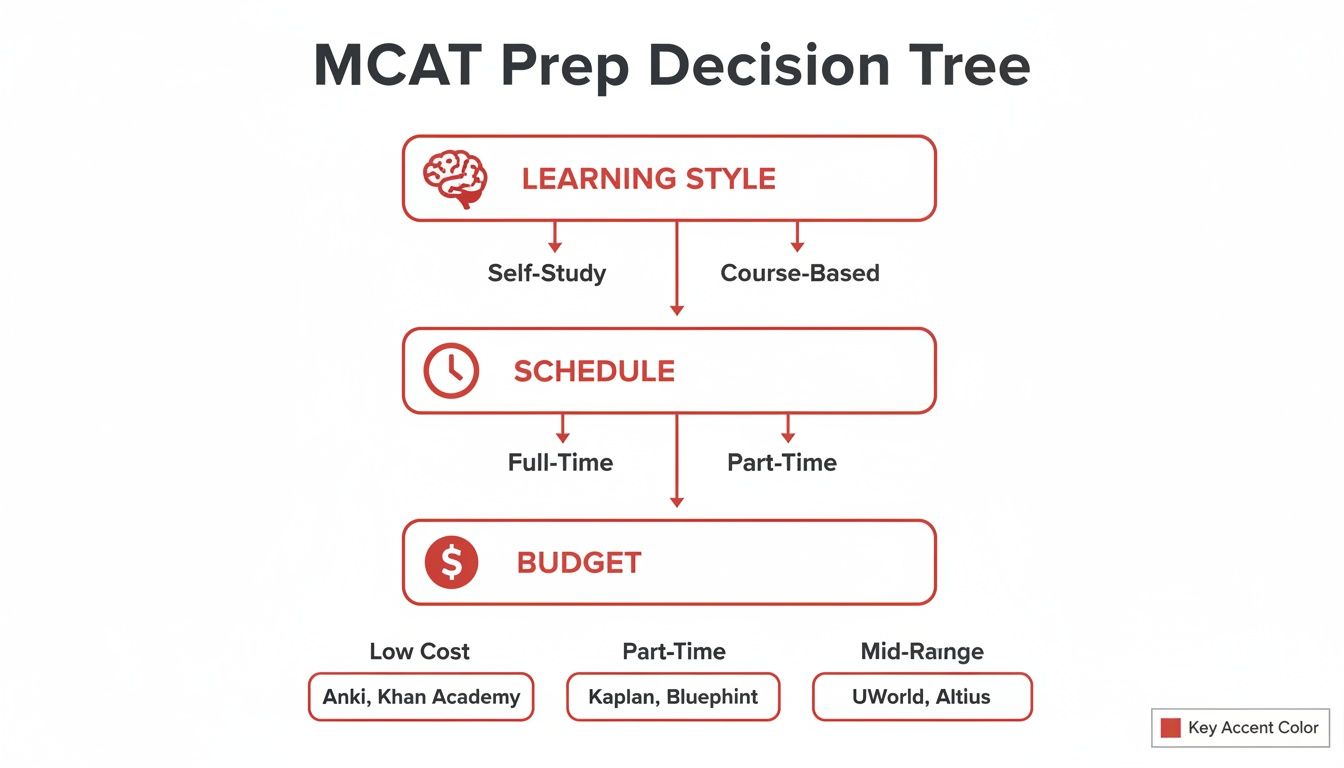
As you can see, there’s no single "best" path for everyone. The right choice is where your learning preferences, schedule, and budget all meet.
To help you compare these options side-by-side, we’ve put together a detailed breakdown of each format.
MCAT Prep Course Format Comparison
Here's a quick look at the most common MCAT prep formats, helping you see at a glance which one might be the best fit for your learning style, schedule, and budget.
| Format Type | Best For | Typical Price Range | Pros | Cons |
|---|---|---|---|---|
| Live Online | Students who need structure and instructor access but require location flexibility. | $2,500 – $3,500 | Interactive, scheduled, convenient, high accountability. | Less flexible than self-paced, potential for technical issues. |
| In-Person | Students who thrive in traditional classroom settings and need direct, face-to-face accountability. | $2,700 – $4,000 | High interaction, peer support, distraction-free environment. | Requires commuting, least flexible schedule, often most expensive. |
| Self-Paced | Students who are highly disciplined and need maximum control over their study schedule. | $1,500 – $2,500 | Highly flexible, cost-effective, allows focus on weak areas. | Requires strong self-motivation, no direct instructor interaction. |
| One-on-One Tutoring | Students who need to target specific weaknesses, break a score plateau, or desire personalized strategy. | Varies ($100-$300/hr) | Completely personalized, targets weaknesses, flexible scheduling. | Can be expensive, not a complete curriculum on its own. |
Ultimately, choosing a format is a personal decision. Think honestly about how you learn best and what your life demands right now. The right prep course feels less like a chore and more like a powerful tool that’s perfectly designed to help you succeed.
Evaluating What Makes a High-Quality MCAT Course
Once you’ve settled on a course format, the real work begins. Let’s be honest, many programs look the same on the surface, with flashy websites and bold promises. The key is to look past the marketing hype and scrutinize the core components that actually drive score improvements.
Think of it like inspecting a car before you buy it. The paint job might look great, but you need to pop the hood and check the engine, the transmission, and the safety features. A truly high-quality MCAT prep course is built on a foundation of proven, high-impact resources.
The first—and most critical—thing to examine is the quality of the practice materials. The MCAT is a unique beast, and your success hinges on practicing with questions that perfectly mimic the AAMC's style of reasoning and passage complexity. Generic science questions just won't cut it.
The Foundation: AAMC-Style Practice
A top-tier course will offer a massive bank of practice questions specifically engineered to mirror the real MCAT. This means passages that force you to use critical analysis, interpret data, and connect concepts across different scientific disciplines. Quantity is nice, but quality is everything.
Look for a program that gives you:
- Thousands of AAMC-style questions with detailed, step-by-step answer explanations that actually teach you the underlying logic.
- The ability to create customized quizzes, letting you target specific subjects or question types where you’re struggling.
- Realistic full-length practice exams that replicate the timing, interface, and grueling difficulty of the actual test day.
The realism of these practice exams cannot be overstated. Taking a full-length test is as much about building mental stamina as it is about assessing your knowledge. A course that offers a large volume of high-fidelity exams gives you the essential exposure you need to perform under pressure. For more on this, our breakdown of the best MCAT practice tests can help you identify top-quality resources.
Expert Instructors and Advanced Analytics
Beyond the materials themselves, the quality of instruction and feedback is what separates an average course from an exceptional one. Who is actually teaching the material? Are they just reading from a script, or are they top-percentile scorers who are also trained, effective educators?
A great instructor doesn’t just know the content; they know how to deconstruct it. They can explain a complex metabolic pathway or a dense physics concept in a way that clicks, using analogies and strategies that make it stick.
This expertise is crucial. The best programs hire instructors who not only achieved elite scores (often 95th percentile or higher) but also have a proven track record of helping students succeed.
Just as important are the analytics a course provides. A modern MCAT prep course should function like your own personal data analyst, tracking your performance and identifying your precise weaknesses. The best platforms use adaptive learning technology to pinpoint the exact topics holding you back and then serve you targeted drills to shore up those gaps. This ensures your study time is always focused where it will have the biggest impact.
Score Guarantees and Student Support
Finally, take a hard look at the guarantees and support systems in place. Many companies offer a "score increase guarantee," but you have to read the fine print. Does it require you to complete 100% of the work to qualify? Is the guarantee for a higher score, or do you get your money back? A transparent, reasonable policy is a sign of a company that stands behind its product.
Strong student support is another key indicator of quality. Can you easily get help if you're stuck on a concept or have a technical issue? Look for courses that offer office hours, email support from instructors, or active student forums. This support network can be invaluable for staying motivated and overcoming hurdles during your prep.
How to Build Your Personalized MCAT Study Plan

Signing up for a top-tier MCAT prep course is a fantastic move, but it's only half the equation. Think of your course as a state-of-the-art gym loaded with elite equipment. To actually build muscle, you still need a workout plan—a structured schedule telling you which exercises to do, how often, and when to rest.
That's exactly what a personalized study plan does for your MCAT prep.
Without a plan, even the best resources feel chaotic. You risk spending way too much time on subjects you already know or, even worse, completely neglecting critical high-yield topics. A solid schedule is your roadmap, ensuring you use your prep course materials strategically to build knowledge, skills, and stamina step-by-step.
Start with a Diagnostic Baseline
Before you can map out your journey, you have to know your starting point. The very first thing you should do is take a full-length, AAMC-style diagnostic exam. This isn't about getting a great score; it's about gathering raw, honest data.
Your diagnostic results will instantly reveal your initial strengths and, more importantly, your specific areas of weakness. This baseline score becomes your anchor, allowing you to set a realistic target score and accurately measure your progress over time.
A diagnostic exam is your prep GPS. It shows you exactly where you are, where you want to go (your target score), and helps chart the most efficient route, highlighting all the areas that need the most attention.
Once your baseline is set, you can start structuring your timeline. Most students find they need between 300 and 350 hours of dedicated study, which usually breaks down to a three- to six-month commitment.
The Three Phases of MCAT Preparation
A successful study plan always moves through three distinct phases, each with a very specific goal. Your MCAT prep course materials are designed to align perfectly with this structure, giving you the right content and practice at every single stage.
- Phase 1 Foundational Content Review (Weeks 1-6): This is all about building your knowledge base. You'll dive into your course’s video lectures, textbooks, and content modules to systematically review the core science concepts tested on the exam. The goal here is pure comprehension, not speed.
- Phase 2 Targeted Practice and Application (Weeks 7-12): Now, the focus shifts from just learning the material to actively using it. You’ll spend most of your time grinding through thousands of practice questions and passages. This phase is about learning to think like the MCAT and applying what you know to complex, AAMC-style problems.
- Phase 3 Full-Length Exam Simulation (Final 4-6 Weeks): The home stretch is all about building endurance and sharpening your test-day strategy. You should be taking one full-length practice exam every week under realistic conditions. The days in between are for meticulously reviewing every single question—right and wrong—to patch up any lingering weaknesses.
Creating Your Weekly Schedule
Consistency is the engine of progress. A great weekly schedule balances intense study sessions with the downtime you absolutely need to prevent burnout. Here’s a sample structure you can adapt to fit your life:
- Monday & Tuesday: Focus on two different science sections (e.g., Biology/Biochemistry and Chemistry/Physics). Split your time between content review and practice questions.
- Wednesday: Dedicate the entire day to CARS practice. Use any extra time to review tough topics from the previous days.
- Thursday & Friday: Cover the remaining sections (like Psychology/Sociology) and revisit another science topic that needs work.
- Saturday: Full-Length Practice Exam Day. Simulate test conditions as closely as you possibly can—no distractions, timed sections, and scheduled breaks.
- Sunday: Rest and Review. Spend a few hours analyzing your practice exam results, but make sure to take a big chunk of the day completely off. You've earned it.
To get every edge they can, some students look into strategies like incorporating nootropic supplements for enhanced cognitive performance, hoping to sharpen their thinking and memory during these demanding study blocks.
This kind of structured approach is more important than ever. The U.S. test preparation market is expected to grow by a massive USD 18.4 billion between 2024 and 2029, with online tools now accounting for 40% of all revenue. The data is clear: structured prep works. While only 30% of average scorers get a medical school interview without a course, that number skyrockets to 70% for students who complete one.
For more detailed templates and ideas, check out our guide on creating an effective MCAT study schedule. Your personalized plan is the bridge that connects your prep course to your target score.
How Personalized Tutoring Can Sharpen Your Prep
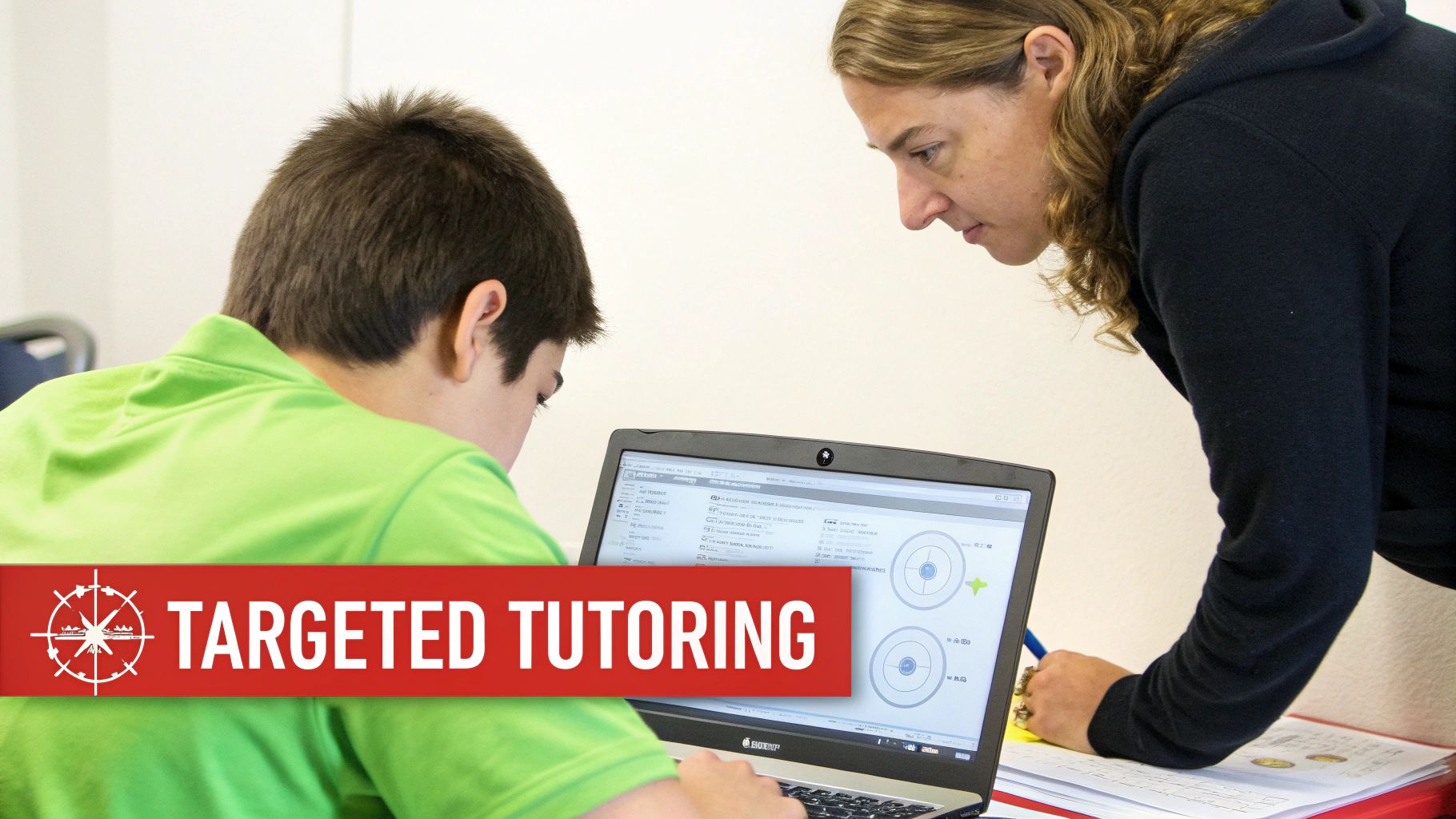
A comprehensive MCAT prep course is fantastic for building your core knowledge. It gives you the curriculum, the practice materials, and the structure you need to cover a massive amount of content. But a lot of students hit a wall—that frustrating point where their score just stops climbing, no matter how many more hours they put in.
This is exactly where personalized tutoring comes in. While a course is built for hundreds or thousands of students, a tutor focuses on an audience of one: you. They can dig in and diagnose the real reason you’re stuck, whether it's a tiny misunderstanding of a biochemistry pathway or a bad habit you’ve developed for breaking down CARS passages.
Think of it like this: a prep course is a group fitness class that makes everyone stronger overall. A private tutor is the personal trainer who watches your specific form, corrects your technique, and designs exercises to fix your unique weaknesses. That targeted approach is often what it takes to squeeze out those last few, game-changing points.
Going Beyond the Standard Curriculum
Big prep courses are great at teaching the what—the content. They’re not always equipped to teach the how—the advanced, personalized strategy needed to excel. A one-on-one tutor, especially an expert who has crushed the MCAT themselves, offers insights that a standard curriculum just can't touch.
This is especially true for the trickiest parts of the exam. A tutor can help you:
- Finally Master the CARS Section: By walking through passages with you, a tutor can see your thought process in real-time, pinpoint flawed reasoning, and help you build a better method for analysis.
- Develop Custom Pacing Strategies: Are certain question types eating up all your time? A tutor can help you identify these time sinks and build a personal timing strategy to maximize your score on test day.
- Connect Disparate Concepts: The MCAT loves to mix biology, chemistry, and physics. Tutors can show you how to forge those interdisciplinary links, a skill that's incredibly hard to learn from a textbook alone.
The real power of tutoring is diagnostic. An experienced tutor can spot weaknesses you didn't even know you had. They provide the exact fix needed to turn those chronic weak points into reliable strengths.
The Best of Both Worlds: Course + Tutor
The most effective strategy isn't about choosing one over the other; it's about combining them. Use your MCAT prep course for its massive content library and full-length practice exams. Then, bring your toughest questions and problem areas to your tutor. This creates a powerful feedback loop: you learn the material in your course and perfect your application with your tutor.
This kind of specialized support is becoming more important than ever. The LSAT/MCAT prep segment is a huge force in the test prep market, which is projected to grow at a CAGR of 19.20% through 2033. This reflects the high stakes for the 85,000+ students in the US who take the test each year and need structured prep to succeed. While big companies report average score increases of 12 points, personalized tutoring is what helps push that number even higher. You can find more details in recent test preparation market research.
In the end, tutoring fills the gaps a standardized course simply can't. It delivers the focused, expert guidance needed to smash through a score plateau and turn a good MCAT score into a great one. If you're looking for that kind of targeted support, learn more about how our best MCAT tutoring services can fit into your study plan.
Got Questions About MCAT Prep Courses? We’ve Got Answers.
Even after you've sorted through all the formats, features, and study plans, a few practical questions probably still linger. It's completely normal. Committing to an MCAT prep course is a big decision, and you want to be sure you're making the right call.
Think of this section as the final checklist before you dive in. We’re tackling the most common questions pre-meds ask about cost, timing, and whether it's all really worth it. Let's clear up any last-minute uncertainties so you can move forward with confidence.
How Much Does an MCAT Prep Course Typically Cost?
The price tag on MCAT prep can swing pretty wildly, and it really comes down to the format and how much personal support you want. It helps to think about the options in a few different tiers.
On the most budget-friendly end, you have self-paced online courses. These typically run from $1,500 to $2,500 and are perfect for self-starters who need total flexibility to fit studying into a packed schedule.
The next tier up includes live online or traditional in-person classes, which usually fall between $2,500 and $4,000. You're paying for the live instruction and the accountability that comes with a structured, interactive classroom environment.
At the premium level, you’ll find intensive bootcamps or all-inclusive packages that bundle in a significant amount of private tutoring. These high-touch options can easily top $6,000. When you're comparing, look past the sticker price. Check how long you get access, how many full-length practice tests are included, and if there are any score guarantees.
When Is the Best Time to Start Studying for the MCAT?
For most students, the sweet spot for MCAT prep is three to six months before your test date. This window lets you put in a solid 15-25 hours a week without turning your life completely upside down.
A shorter, more intense three-month plan can work, but only if you have very few other commitments—think studying over a summer break. It demands serious focus and discipline.
On the other hand, a longer five- to six-month timeline is much more realistic if you’re juggling a full-time job or a tough course load. Spreading it out helps prevent burnout, gives you a buffer for when life happens, and allows for a steadier, less frantic pace. Honestly, starting early is one of the smartest moves you can make.
The goal isn't just to cram facts; it's to build deep, connected understanding and sharp critical reasoning skills. A longer study period gives concepts time to marinate, allowing you to see how ideas from biology, chemistry, and physics all link together—which is exactly what the MCAT tests.
Is an MCAT Prep Course Really Worth the Investment?
For the vast majority of aspiring doctors, the answer is a firm yes. While you can study on your own, a quality MCAT prep course provides structure, expertly designed content, and realistic practice that is incredibly difficult and time-consuming to piece together yourself.
The data backs this up. Students who go through a structured course often see their scores jump by 10-15 points. A leap like that can be the deciding factor between a rejection letter and an acceptance, completely changing your medical school admission odds.
When you think about the financial and emotional toll of having to retake the exam or reapply to med school a year later, investing in a course that gets you to your goal score the first time around is often the more economical choice in the long run.
Should I Combine a Prep Course with a Private Tutor?
Pairing a comprehensive prep course with one-on-one tutoring is one of the most powerful strategies out there for hitting your peak score. This hybrid approach lets you get the best of both worlds.
Here’s how to think about it:
- The Prep Course is your foundation. It delivers the entire curriculum, covers all the science, and gives you a massive library of practice questions and exams.
- The Private Tutor is your precision tool. A great tutor can diagnose exactly where you're struggling, whether it’s breaking down dense CARS passages or finally mastering tricky organic chemistry reactions, and then build a plan to fix it.
This combination is how students smash through frustrating score plateaus. The course provides the core knowledge, and the tutor refines your application of it with personalized feedback and advanced strategies that a standardized program just can’t offer. It ensures no weakness gets left behind.
What Is Considered a Good MCAT Score?
"Good" is a relative term here—it all depends on which medical schools are on your list. The average score for everyone who takes the MCAT is around a 501, but frankly, that’s not the number you should be focused on for admissions.
The number that matters is the average for students who actually get accepted into U.S. MD programs, which is much higher—typically around 512. For the most competitive, top-tier schools, that average can soar to 518 or more.
Generally speaking, a score of 510 or above will make you a competitive applicant at a wide range of medical schools. Your first step should be to look up the average MCAT scores for your dream schools. That will give you a clear, realistic target to aim for.
Ready to stop wondering and start improving? An Ace Med Boards tutor can create a personalized plan that integrates with any MCAT prep course, targeting your weaknesses to help you achieve your dream score. Schedule your free consultation today!

