
Let's clear up one of the biggest myths about the MCAT right away: there is no official passing score. It’s not like a final exam where you hit a certain number and you’re “in.” Instead, medical schools use your score as a tool to see how you stack up against a national pool of highly motivated applicants.
Think of it less as a pass/fail test and more as a measure of your readiness for the rigors of medical school. Admissions committees are looking at your critical thinking, problem-solving, and scientific knowledge, and your score gives them a standardized way to compare you to thousands of other aspiring doctors.
The Truth About a "Passing" MCAT Score
Because the MCAT is a comparative tool, what’s considered a “good” score is completely relative. It all comes down to where you’re applying. A student targeting a top-tier, research-heavy university is going to need a much different score than someone applying to a regional DO program.
This is why chasing some universal "passing" number is a waste of energy. Each medical school has its own expectations, which are usually based on the average scores of the students they’ve accepted in previous years.
Why Context Is Everything
Your goal isn't to hit a magic number but to achieve a score that makes you a competitive applicant at the specific schools on your list. A score that might be considered average for one program could be a standout number for another.
This strategic mindset is far more powerful than aiming for a vague, non-existent benchmark.
The idea of a single MCAT passing score is a myth. Success is about hitting a score that is competitive for your target schools, all within the context of your complete application.
Understanding the Competitive Benchmarks
While there’s no official pass/fail line, we do have data that shows us what it takes to be competitive. The average MCAT score for all test-takers from May 2024 through April 2025 was 500.7.
But here's the number that really matters: for students who actually matriculated (enrolled) in medical school during the 2021-2022 academic year, the average score was a much higher 511.9.
That 11-point gap tells you everything you need to know about how competitive this process is. For a deeper look at what separates a good score from a truly elite one, check out our guide on what constitutes a perfect MCAT score.
Furthermore, data shows that students who entered medical school with scores between 510-513 had an incredible 98% advancement rate from their first to their second year. This is a big reason why schools value scores in this range—it’s a strong predictor of success in their programs. You can explore more data on the link between MCAT scores and medical school success on ama-assn.org.
To make this easier to visualize, here's a quick breakdown of what different score ranges generally mean for your application.
Quick Guide to MCAT Score Competitiveness
This table provides a snapshot of how different MCAT score tiers are generally perceived by admissions committees. Use it as a starting point to understand where you might stand.
| Score Range | Percentile (Approx.) | Level of Competitiveness |
|---|---|---|
| 518-528 | 95th-100th | Highly Competitive: Puts you in the running for any top-tier MD program. |
| 514-517 | 88th-94th | Very Competitive: A strong score for most mid-to-high-tier MD programs. |
| 510-513 | 74th-87th | Competitive: Solid footing for most MD programs and very strong for DO programs. |
| 506-509 | 58th-73rd | Moderately Competitive: A good range for many DO programs and some MD programs. |
| 502-505 | 42nd-57th | Less Competitive: May be sufficient for some DO programs, but less so for MD. |
| Below 502 | Below 42nd | Not Competitive: Unlikely to be considered by most US medical schools. |
Remember, these are general guidelines. Your GPA, extracurriculars, and personal statement all play a crucial role alongside your MCAT score.
How MCAT Scores and Percentiles Work
Diving into the numbers behind the MCAT can feel a little intimidating, but the scoring system is actually pretty straightforward once you get the hang of it. The exam is broken down into four distinct sections, and your performance on each is scored on a scale from 118 (the lowest) to 132 (the highest).
These four section scores are then simply added together to give you a total score, which will land somewhere between 472 and 528. But what does a number like 510 or 520 actually mean for your medical school application? That's where percentiles come in—they're the key to understanding how you stack up.
Understanding Percentiles: A Simple Analogy
Think of your MCAT score like your finish time in a marathon. Let's say you score a 515. That’s your specific time—a solid number, but it doesn't mean much on its own without some context.
Now, imagine you’re told that your finish time was faster than 91% of all the other runners in the race. Suddenly, that number has real meaning. You were in the top 9% of competitors. That’s exactly what a percentile does for your MCAT score. It tells you—and the admissions committees—what percentage of other test-takers you outperformed.
A percentile rank is the key to understanding your MCAT score's competitiveness. It contextualizes your raw number by comparing your performance against every other student who took the exam.
This infographic lays out some key benchmarks to help you visualize where different scores fall on the competitive spectrum.
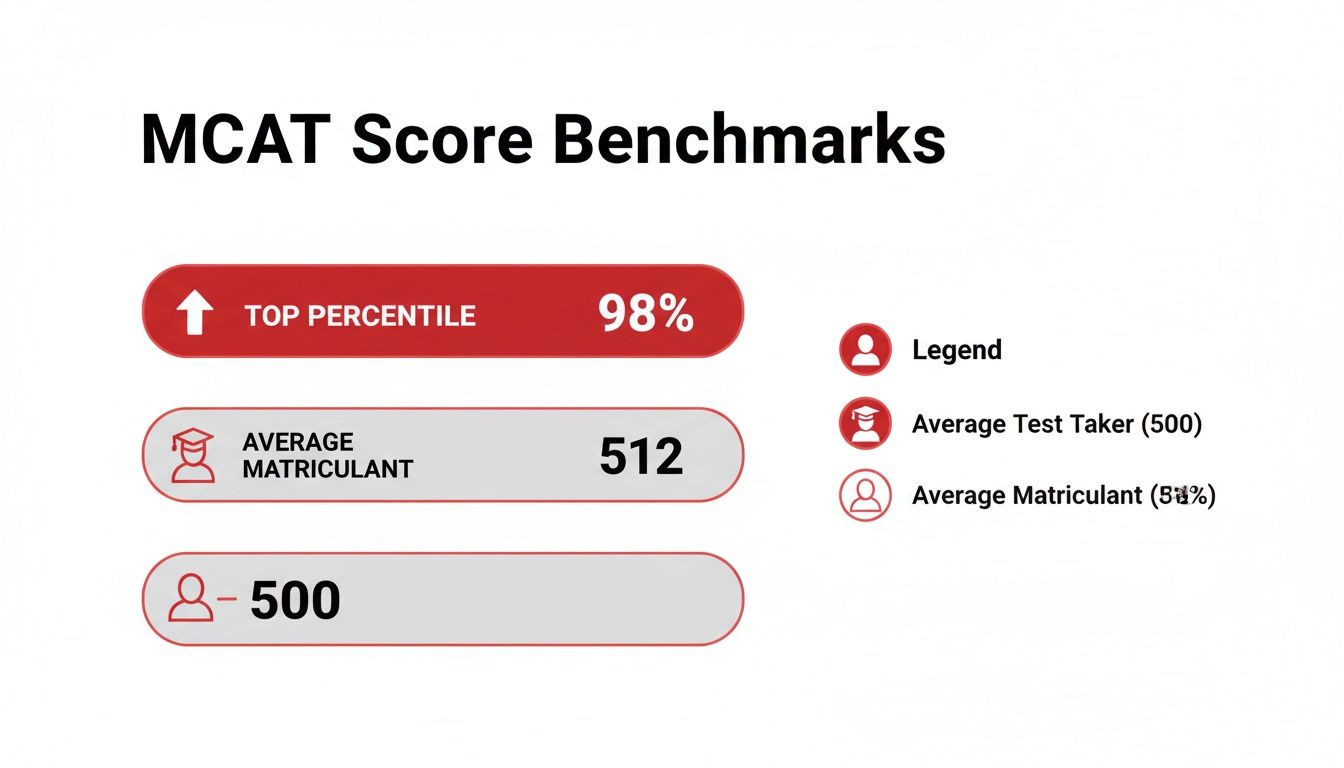
As you can see, there’s a significant gap between the average score of all test-takers (500) and the average score of students who actually get into medical school (512). This really highlights the level of performance needed to be a competitive applicant.
MCAT Score to Percentile Conversion
To give you a clearer picture, this table breaks down how specific scores translate into percentile ranks based on the latest data from the AAMC. It's a quick reference to see where you stand.
| Total MCAT Score | Percentile Rank | What This Means |
|---|---|---|
| 524 – 528 | 100% | You scored better than virtually every other test-taker. This is the top tier. |
| 520 | 97% | An elite score placing you in the top 3% of all applicants. |
| 515 | 90% | You performed better than 90% of test-takers. A highly competitive score. |
| 512 | 83% | The average score for matriculants—a strong benchmark for MD programs. |
| 508 | 72% | A competitive score, particularly strong for many DO programs and some MDs. |
| 502 | 51% | An average score, placing you right in the middle of the pack. |
| 495 | 31% | This score places you in the bottom third of test-takers. |
This data underscores just how competitive the application landscape is. Even a few points can make a huge difference in your percentile ranking.
Why You Need to Use Recent Percentile Data
It's important to know that percentiles aren't set in stone. The AAMC recalculates them every year based on how the most recent group of students performed. That’s why just knowing your score isn’t enough; you have to check it against the most current percentile data to get an accurate picture of your standing.
This is why understanding the full MCAT score range and its corresponding percentiles is so critical for building a realistic and strategic school list.
Putting It All Together for Your Application
So, what does this all mean when an admissions officer looks at your file? They don't just see the number "512." They see "83rd percentile," which immediately tells them you're in the top 17% of a very driven and intelligent group of applicants.
Here’s a general breakdown of how different percentile tiers are often viewed:
- 90th Percentile and Above (515+): This is considered an elite score. It makes you a highly competitive candidate for almost any medical school in the country, including the most prestigious research institutions.
- 75th-89th Percentile (Approx. 509-514): This is a very competitive range. Scores here are strong enough for most MD programs and are exceptionally strong for DO programs.
- 50th-74th Percentile (Approx. 501-508): This is a moderately competitive range. Applicants in this tier are often strong candidates for DO programs and can be competitive for some in-state MD programs, especially if paired with a high GPA.
Ultimately, your score and percentile are the first pieces of the puzzle. They give admissions committees a quick, standardized way to gauge your academic readiness before they take a deeper look at the rest of your application.
How to Define Your Personal Target Score
Alright, let’s get down to brass tacks. Moving from a general understanding of MCAT scores to building your personal strategy is the single most important step in this whole process. There’s no such thing as a universal "mcat passing score." Your ideal score is a specific, calculated target that’s completely unique to your academic profile and the med schools you’re aiming for.
Think of it like setting a GPS destination. You wouldn't just type "a good place to go" into the map and hope for the best, right? You'd enter a specific address. Your target MCAT score needs to be just as precise—a number you calculate based on your dream schools, your GPA, and the overall strength of your application.

Research Your Dream Schools with MSAR
Your most powerful tool for this mission is the MSAR (Medical School Admission Requirements) database, provided by the AAMC. This isn't just another resource; it's the official source of data for U.S. and Canadian medical schools. It’s where you’ll find the cold, hard numbers you need to set a realistic goal.
MSAR gives you a detailed profile for every single school, including the median and range of MCAT scores and GPAs for their most recently accepted class. This isn’t a suggestion—it’s a data-driven blueprint of what it actually takes to get an acceptance letter.
When you dive into MSAR, zero in on these key metrics for each school on your list:
- Median Total MCAT Score: This is the 50th percentile—the dead center. Half the accepted students scored above this, and half scored below. This number should be the foundation of your target.
- MCAT Score Range (10th-90th Percentile): This shows you the spread of scores for the bulk of matriculants. Aiming for the higher end of this range is how you go from being "in the running" to being a truly competitive applicant.
- Median GPA: Your GPA and MCAT score are a team. MSAR data shows you exactly how these two numbers are balanced for students who actually got in.
Balance Your Application with Your GPA
Your GPA is the other half of this academic equation. Admissions committees look at your GPA and MCAT score together to gauge your academic horsepower. A stellar GPA can sometimes give you a bit of a cushion for a slightly lower MCAT, while a fantastic MCAT score can help balance out a GPA that’s not quite perfect.
Let's look at a couple of scenarios:
- High GPA (3.8+): If your GPA is already well above a school's median, you might be a strong contender with an MCAT score that’s right at or even a little below their median.
- Lower GPA (Below 3.5): If your GPA is below a school’s median, you’ll need an MCAT score that is significantly above their median to prove your academic chops and rebalance your application.
Your personal target score isn't just about what a school's average is; it's about the score you need to be competitive, given your specific GPA and the rest of your application.
Imagine your application is a scale. If your GPA is a lighter weight on one side, your MCAT score needs to be a heavier one on the other side to bring things into balance. Getting familiar with the average MCAT score for all matriculants is a great starting point for this analysis.
Create a Tiered School List
Once you’ve dug into the MSAR data for a few schools and taken a hard look at your GPA, you can build a strategic, balanced school list. This is crucial—it stops you from only applying to schools that are a long shot or, just as bad, underestimating your own potential.
Your list should have a healthy mix of three tiers of schools:
- Reach Schools: These are your dream programs, where your stats fall at or below their 25th percentile. Getting in is a challenge, but it’s definitely not impossible if the rest of your application shines.
- Target Schools: This is the heart of your list. Your GPA and target MCAT score align closely with the median stats for their accepted students. You’re a solid, competitive applicant here.
- Safer Schools: For these schools, your stats are at or above their 75th percentile. Assuming the rest of your application is strong, you have a very good chance of getting an acceptance.
By creating a tiered list, you’re not just wishing—you’re strategizing. This approach is both ambitious and grounded in reality, ensuring you apply intelligently and maximize your chances of success.
How Medical Schools Actually Use Your Score
From the moment your MCAT score lands in an admissions committee’s inbox, it holds real weight—but it doesn’t tell the whole story. Schools won’t see a single number and immediately decide your fate. Instead, they slot that score into a much larger picture of who you are and what you can become.
It’s rarely about a hard cutoff. Think of your application as a mosaic: your MCAT score is one vibrant tile, but admissions officers piece together dozens of tiles before they see the full image.
The MCAT As A Screening Tool
Let’s face it—medical schools sift through tens of thousands of applications every cycle. MCAT scores and GPAs act as a quick filter to identify candidates who have already mastered the foundational science.
A slightly lower score doesn’t automatically shut the door. Yet, hitting a competitive score threshold often means your file moves past that first stack and lands on a real person’s desk. In other words, a strong MCAT performance opens the door to your full story—your personal statement, experiences, and letters.
Holistic Review: The Bigger Picture
Once you clear the initial screen, your MCAT score joins forces with every other piece of your application. Committees aim to assemble a diverse, capable class—numbers alone can’t capture passion, leadership, or resilience.
To see how these elements fit together, check out what medical schools look for beyond test scores. A holistic review typically includes:
- Academic Record: GPA, course rigor, and any upward trends
- Personal Statement: Your journey, motivations, and unique perspective
- Letters of Recommendation: Third-party insights into your character and work ethic
- Extracurriculars: Research, clinical volunteering, and community involvement
Here, your MCAT score answers one core question: Can this applicant handle the academic demands of our curriculum? A strong score gives a confident “yes,” letting the rest of your application shine through.
The Importance Of A Balanced Score Profile
Admissions committees don’t just glance at your total MCAT number—they drill into each of the four sections. A uniform performance often looks better than a lopsided one, even if the totals match.
For instance, a 515 split as 128 / 129 / 129 / 129 feels more reassuring than 515 with 132 / 124 / 130 / 129. A dip in a section like CARS can raise doubts about your ability to tackle dense, complex texts—a key skill in med school.
A consistent showing across all MCAT sections signals well-rounded academic strength and readiness for diverse challenges.
How Your Score And GPA Work Together
Your MCAT and GPA are a tag team that paints your academic portrait. When one number dips slightly below a school’s average, the other can step up and balance the scales.
- A high MCAT score can offset a modest GPA, showing you’ve mastered scientific thinking.
- A strong GPA can cushion a score that sits right at a school’s median, proving sustained effort and discipline.
At the end of the day, your MCAT score unlocks the interview invite. But don’t stop there—your interview performance is the final hurdle. For actionable pointers, explore these medical school interview tips. A well-rounded application plus a polished interview is the winning formula for that coveted acceptance letter.
What to Expect from Practice Tests vs the Real Exam
It’s the question that keeps almost every pre-med student up at night: are my practice scores a real preview of how I’ll do on test day? This anxiety is completely normal, and for good reason. Understanding the crucial differences between your prep materials and the official exam is the key to building a study strategy you can trust and walking into the testing center with confidence.
Think of your MCAT prep like training for a marathon. Your practice tests are your training runs—some days you’re on flat, easy pavement, while other days you’re tackling steep, challenging hills. The real MCAT is the actual marathon, complete with race-day nerves, a sterile environment, and the immense pressure of the final performance.

AAMC Official Practice Exams: The Gold Standard
When it comes to predicting your score, nothing comes close to the official practice materials from the Association of American Medical Colleges (AAMC). These exams are built by the very same people who design the real MCAT, often using retired questions and the exact same scoring algorithm.
For that reason, the AAMC full-length practice tests are the most accurate predictor of your potential score. They perfectly replicate the question style, difficulty level, and even the user interface you'll see on test day. The scores you get on these exams, especially in the last few weeks of your prep, should be your primary benchmark.
The Role of Third-Party Practice Tests
So, where do materials from companies like Kaplan, Princeton Review, or Blueprint fit in? They serve a different, but equally important, purpose. These tests are often designed to be slightly harder than the actual MCAT. Their main job isn't perfect score prediction; it's about building your skills and stamina.
Use third-party tests to:
- Drill Content Knowledge: They are fantastic for exposing and strengthening your weaker content areas.
- Build Pacing and Endurance: The MCAT is a beast of a test. These exams help you build the mental stamina needed for an almost eight-hour exam.
- Test Out Strategies: You can experiment with different passage analysis techniques and question-solving approaches without "wasting" a precious AAMC exam.
To get a better handle on which materials might work best for you, checking out a detailed comparison of the best MCAT practice tests can give you some valuable direction.
Don’t panic if your scores on third-party exams are lower than your goal. Use them as diagnostic tools to find your weaknesses, not as a definitive measure of your potential. Your AAMC practice scores are a much more reliable indicator.
Overcoming the Test-Day Drop
The "test-day drop" is a real phenomenon where a student's official score comes in lower than their practice exam average. This isn't because they suddenly forgot everything; it's almost always caused by anxiety. The unfamiliar room, the strict proctors, and the high stakes can create a pressure cooker that tanks performance.
Managing this stress is a skill you have to practice, just like any CARS passage or biochemistry pathway. Your goal is to make test day feel as routine and predictable as possible.
Here are a few strategies to build that mental resilience:
- Simulate Test Conditions Perfectly: Take every single full-length practice test under strict, official conditions. That means no extra breaks, no phone in sight, and starting at the same time as your real exam.
- Practice Mindfulness and Breathing: It sounds simple, but a few deep-breathing exercises can work wonders to calm your nervous system when you feel anxiety creeping in during the test.
- Develop Positive Self-Talk: Negative thought loops can completely derail your focus. Learning how to reframe your thoughts is a powerful skill. For more on this, look into mastering your mindset with cognitive therapy tools.
By treating your practice exams as serious dress rehearsals, you build the mental fortitude needed to make sure the score you earn is the one you deserve.
When to Consider Retaking the MCAT
Making the call to retake the MCAT is a major crossroads on your pre-med journey. It’s not just about chasing a higher number; this is a strategic choice that demands a hard look at your time, your finances, and the overall strength of your application. There's no one-size-fits-all answer here, but a structured approach can help you decide what’s right for your future.
First thing's first: take a deep breath. Almost every applicant walks out of that testing center feeling like they bombed it. Don't jump to conclusions. Wait for your official score to land. When it does, your first move is to objectively compare it to the target score you set based on your dream schools and your GPA.
Assessing Your Score and Circumstances
The first question to ask is simple: how big is the gap? If you’re just one or two points shy of your target, a retake might not be worth it, especially if the rest of your application is stellar. But if your score is five or more points below the median for your target schools, a retake becomes a very serious consideration.
Next, you need to do a post-mortem on your test day experience. Did something go genuinely wrong?
- Were you seriously ill or dealing with a personal emergency?
- Did you have a severe panic attack that completely derailed your focus?
- Were there major technical issues at the testing center?
If you can pinpoint a specific, unusual event that clearly tanked your performance, you can build a strong case for a retake. It helps show admissions committees that your score might not be a true reflection of what you're capable of. On the other hand, if the test just felt difficult but otherwise normal, it's time to analyze your preparation more deeply.
Strategic Retake Planning
Heads up: a retake without a new game plan is just a recipe for the same result. Simply "studying more" is not a strategy. You have to diagnose exactly what went wrong and build a targeted plan to fix it. This means diving deep into your score report and being brutally honest with yourself about your study habits.
A successful MCAT retake isn't about putting in more hours; it's about putting in smarter, more focused hours. Pinpoint your weaknesses, overhaul your strategy, and execute a plan designed for significant improvement.
Medical schools will see all of your attempts, though most will zero in on your highest score. A significant jump on a second try can show resilience and determination—two qualities they love to see in future doctors. But a tiny increase, or worse, a drop, can raise red flags about your judgment and academic horsepower.
Remember, your ultimate goal is to become a physician, and that involves passing a whole series of high-stakes licensing exams. Strong performance is the expectation. Just look at the USMLE Step 1 pass rates for US and Canadian MD candidates: 91% passed in 2022 and 90% in 2023. Those numbers, based on over 24,000 test-takers in 2022 alone, show how critical it is to master standardized medical tests. You can dig into more of this information on the official USMLE performance data page.
If you decide to go for it, make sure you give yourself enough time to prepare effectively—that means at least three months of dedicated, strategic study. This isn't just about re-reading content. It's about mastering test-taking strategy, nailing your time management, and building the mental endurance to perform at your absolute peak when it counts.
Your MCAT Score Questions, Answered
Once you start digging into the MCAT, a bunch of practical questions pop up. Let's tackle some of the most common ones that pre-meds worry about so you can get back to strategizing.
What Is the Lowest MCAT Score Accepted into Medical School?
Officially, there's no hard cutoff. Realistically, though, scores below 500 are a tough sell for most U.S. MD programs. While an incredible life story or groundbreaking research might get an application with a high-490s score a second look, you can't count on being the exception.
Your best friend here is the AAMC's MSAR database. It gives you the cold, hard data on the score ranges for the schools you’re actually interested in, providing a much more useful benchmark than any generic number.
How Long Is My MCAT Score Valid?
Most medical schools consider MCAT scores valid for up to three years. For example, if you're applying during the 2025 admissions cycle, a score from an exam taken back in 2022 would probably be the oldest one they'd accept.
But this isn't a universal rule. Some schools have slightly different policies, so it's absolutely critical to check the admissions website for every single school on your list. Don't let a simple technicality derail your application.
A high MCAT score is a powerful asset, but it is not a golden ticket. It opens the door for a serious review of your application, but the final decision depends on the strength of your entire profile.
Does a High MCAT Score Guarantee Admission?
Absolutely not. A stellar MCAT score doesn't guarantee you an acceptance letter any more than a perfect first date guarantees a wedding.
Admissions committees use a "holistic review," which means they look at everything: your GPA, extracurriculars, volunteering, personal essays, and how you carry yourself in an interview. A great score gets your foot in the door and ensures your application gets a serious, thorough look. But it has to be part of a complete, compelling story to seal the deal.
Feeling stuck on your MCAT prep or unsure how to build a winning application? The expert tutors at Ace Med Boards offer personalized guidance to help you crush your target score and stand out from the crowd. Schedule your free consultation today!

