
Your grades and board scores are the backbone of your residency application, but your letters of recommendation (LoRs)? They're the heart. In a sea of high-achieving applicants who look nearly identical on paper, these letters are what make you a real person to a program director.
Think of them as your advocates in the room, telling your story when you can't. They’re non-negotiable.
Why Your Residency Letters of Recommendation Matter So Much

Your ERAS application is a collection of data points—USMLE scores, clerkship grades, maybe a publication or two. While crucial, these numbers paint an incomplete picture. Program directors are sifting through thousands of files, and a powerful LoR is what makes them stop and really look at yours.
A great letter does more than just list your accomplishments. It provides a respected, third-party validation of the things a transcript can't show:
- Clinical Acumen: How you think on your feet, develop a differential, and apply knowledge at the bedside.
- Work Ethic: Your reliability, dedication, and willingness to go the extra mile for patients and the team.
- Interpersonal Skills: How you connect with patients, collaborate with nurses and residents, and—importantly—how you handle feedback.
- Teachability: Your genuine curiosity and hunger to learn and grow.
The Deciding Factor in a Competitive Match
In the world of residency applications, these narrative endorsements are a primary tool for differentiation. The NRMP Program Director Survey consistently ranks LoRs as one of the most important factors, right behind board scores.
Consider the numbers for the 2025 Match: 47,208 applicants vied for just over 40,000 spots. In that kind of environment, a compelling letter is a massive advantage.
A generic, lukewarm letter can silently sabotage an otherwise stellar application. On the flip side, a detailed, enthusiastic letter from a respected attending can elevate a good candidate to a must-interview applicant.
The Stakes for US Grads vs. IMGs
While every applicant needs strong letters, their strategic importance can vary. For U.S. medical graduates, LoRs often serve to confirm and amplify an established academic record, adding personality and nuance.
For International Medical Graduates (IMGs), the stakes are even higher. A powerful letter from a U.S. attending is the single most effective way to validate your clinical skills within the American healthcare system. It reassures program directors that you can thrive in their clinical environment. For the 16,052 IMGs in the last match who achieved a 60.8% match rate, strong U.S.-based letters were paramount.
Ultimately, these letters are about building trust. And trust is everything. A program director needs to feel confident that you’re not just a high-scorer, but also a competent, reliable, and collegial future resident they'd want on their team at 3 a.m.
To better understand this, it's helpful to see what makes a letter truly stand out.
The best letters give program directors exactly what they're looking for: concrete proof of your abilities and character. This table breaks down what separates a forgettable letter from a game-changing one.
Anatomy of a Powerful Residency LoR
| Component | Why It Matters | What to Look For |
|---|---|---|
| Specific Anecdotes | Provides concrete evidence of your skills, moving beyond generic praise. | "On her rotation, she astutely identified a subtle EKG change that led to an urgent cath lab activation for a STEMI." |
| Enthusiastic Language | Conveys genuine excitement and confidence in you as a candidate. | Words like "outstanding," "exceptional," "one of the best," and "without reservation." |
| Direct Comparison | Puts your performance in context against your peers, a key metric for PDs. | "She is in the top 10% of all students I have worked with in my 15-year career." |
| Assessment of "Soft Skills" | Highlights your teamwork, communication, and professionalism—critical for residency success. | Mention of your rapport with patients, collaboration with the team, and response to feedback. |
| Clear Endorsement | Explicitly states the writer's strong support for your application to their specialty. | "I give her my highest and unreserved recommendation for a residency in Internal Medicine." |
A letter that includes these elements tells a compelling story. It transforms you from a set of statistics into a future colleague they can't wait to meet. Along with these letters, residency applications also hinge on other key narrative pieces, like crafting powerful personal statements.
As we dive deeper into https://acemedboards.com/what-do-programs-look-at-for-eras/, keep in mind that your letter writers are vouching for these exact qualities. Your job is to make it easy for them to do so enthusiastically.
Choosing Your Letter Writers Strategically

Picking your letter writers is one of the highest-stakes decisions you'll make in the residency application process. This goes way beyond just asking the attendings who gave you Honors. Think of it as building your personal advocacy team—each person should offer a unique, powerful perspective on why you'd be a great resident.
Your goal is to get endorsements that are packed with detail, personal anecdotes, and genuine excitement. A generic letter from a big-name department chair who barely remembers you is almost always less effective than a glowing one from a junior attending who can vividly recall your clinical reasoning on a tough case.
Decoding the Unofficial Hierarchy
Let's be honest: not all letter writers are viewed equally by program directors. Understanding this unspoken pecking order is crucial for assembling a strong set of letters of recommendation for your residency application.
- Department Chair/Program Director: A letter from the top, especially in your chosen specialty, carries a lot of weight. It signals that the institution is behind you and often speaks to your overall potential. This is a huge plus if you knocked your clerkship out of the park.
- Well-Known Faculty/Researcher: If you have serious research experience or you're aiming for top-tier academic programs, a letter from a respected name in the field can be a game-changer. Their reputation alone can make your application jump out of the pile.
- Your Primary Clinical Mentor: This is often your most valuable letter. The attending who worked with you day in and day out—the one who saw your growth, pushed you, and gave you real feedback—is the person who can write the most compelling and personal endorsement.
The trick is to find the right mix. Ideally, you want a combination that includes at least one senior faculty member and one or two attendings who can speak with passion about your skills on the wards.
Gauging Enthusiasm and Authenticity
The single most important ingredient in a powerful letter is the writer's genuine belief in you. A lukewarm letter, even from a famous physician, can be the kiss of death for an application. So, how can you tell if someone will be a true champion for you?
Think back on your interactions. Did they go out of their way to create teaching moments for you? Did they trust you with more patient responsibility over time? Did they offer specific, positive feedback or talk about your future in medicine? These are all green flags.
When you make the request, watch their reaction closely. Any hesitation, or a comment like, "I'm not sure I know you well enough to write a strong letter," is your signal to thank them for their time and find someone else. An honest "no" is infinitely better than a weak "yes."
The gold standard is to get three to four letters from U.S. attendings in your specialty. Program directors are looking for strong endorsements filled with specifics about your clinical skills and readiness for residency. Letters written within the last year are best, especially from faculty who can comment on your professionalism—a trait that test scores simply can't measure.
Specialty-Specific Letter Considerations
The strategy changes depending on your chosen field. Different specialties have their own unwritten rules and expectations for letters of recommendation residency applicants need to follow.
For ultra-competitive surgical subspecialties, a letter from the department chair is often seen as a mandatory ticket to the game. For Emergency Medicine, the Standardized Letter of Evaluation (SLOE) is not just expected; it's the most important part of your application.
Do your homework. A fantastic letter from a community preceptor where you did an acting internship might be perfect for community-based family medicine programs but less impactful for a university IM program. Tailoring your letter writers to your target programs shows you've thought seriously about your career path. You can learn more about making these rotations count in our guide to excelling in medical student clerkships.
Making the Ask: Perfecting Your Timing and Approach
How you ask for a letter of recommendation for residency is just as important as who you ask. A thoughtful, organized, and respectful request not only improves your chances of getting a "yes" but also directly influences the quality of the letter you receive. It’s all about making the process as seamless as possible for your busy attendings.
Think of this as a professional collaboration, not just a simple request. You’re giving your chosen advocate the exact tools they need to champion your application effectively. A rushed, disorganized ask often leads to a generic, less impactful letter.
The Ideal Timeline for Your Request
Timing is everything. Ask too early, and your request might get lost in a crowded inbox. Ask too late, and you risk a hastily written letter or even a polite "no." It's a sign of disrespect for their time.
The sweet spot? Ask four to six weeks before you need the letter uploaded to ERAS. This window shows foresight and acknowledges the attending's demanding schedule, which is already packed with clinical duties, research, and administrative tasks.
Giving them this much lead time allows them to:
- Carve out a dedicated block of time to reflect on your performance.
- Carefully review the materials you've provided.
- Draft a thoughtful, detailed, and personalized letter that truly highlights your strengths.
A hurried request forces your writer to fall back on templates and vague praise. Ample time, on the other hand, empowers them to craft a compelling narrative full of specific, memorable examples of you at your best.
Building Your LoR "Power Packet"
Never, ever approach a letter writer empty-handed. Your goal is to eliminate any friction and make it incredibly easy for them to write a stellar letter. The best way to do this is by preparing a comprehensive "LoR Power Packet," either as a single, organized PDF or a clean email with attachments.
This packet should contain everything they need to recall your best moments and align their letter with the story you’re telling in your application.
Your packet is more than just a collection of documents; it's a strategic tool. It subtly guides your writer, reminding them of specific instances where you excelled and framing your accomplishments in the context of your career goals.
Your packet should always include these core components:
- Your Updated CV: This gives them a complete overview of your academic and extracurricular achievements.
- Your Personal Statement Draft: This is crucial. It provides insight into your story, your passion for the specialty, and your long-term goals, allowing them to echo key themes in their letter.
- The ERAS Letter Request Form: Be sure to include the PDF generated from the ERAS portal. This contains the unique Letter ID number they will need for the upload.
- A Clear Deadline: Explicitly state the date you would like the letter uploaded. A good rule of thumb is to set this deadline about a week before your actual application submission date to build in a buffer.
Guiding Your Writer with Talking Points
Perhaps the most impactful part of your packet is a brief "talking points" document. This is your chance to gently jog the writer's memory about specific interactions and accomplishments they witnessed. Don't be shy here; busy attendings work with dozens of students and may not recall the specifics without a prompt.
Structure these talking points with clear headings. For example:
Patient Case Example: "You may recall the challenging case of the patient with undifferentiated shock in the ICU. I was the student who suggested we look for signs of adrenal insufficiency, which turned out to be the correct diagnosis."
Presentation or Project: "I wanted to thank you again for your mentorship on my M&M conference presentation about post-operative delirium. Your feedback was invaluable."
Observed Skill: "I particularly valued learning from you how to deliver difficult news to families with compassion and clarity."
These specific, positive reminders are the raw material for the anecdotes that make a letter truly powerful and personal. For more ideas on what makes a letter stand out, you can explore a sample letter of recommendation for residency to see these principles in action.
Finally, remember that the source of these letters matters immensely. Always aim for recent LoRs—ideally from within the last year—written by attendings, not residents, to ensure they carry maximum weight with program directors. The COVID-19 pandemic, for instance, suspended away rotations and made securing these prime letters incredibly difficult. This forced many, especially IMGs, to rely on less impactful alternatives, highlighting why a well-timed and well-prepared request is more critical than ever.
Navigating LoRs as an International Medical Graduate
For International Medical Graduates (IMGs), your letters of recommendation for residency are more than just a box to check—they are arguably the most powerful part of your entire application. While your board scores prove your medical knowledge, it's the letters from U.S. physicians that convince program directors you can thrive in the American healthcare system.
Think of it this way: a powerful LoR acts as a trusted translator. It takes your incredible skills and experience and frames them in a context that U.S. program directors immediately understand and respect. Letters from your home country, while valuable, simply don't bridge that gap.
Why U.S. Clinical Experience is Non-Negotiable
This is precisely why getting high-quality U.S. Clinical Experience (USCE) is the critical first step. You need to give U.S. attendings a chance to see you in action so they can write a detailed, credible, and personal letter.
Your best bets for gaining this experience are:
- Observerships: A good starting point for learning the system and making connections, but they're hands-off, which limits what an attending can write about you.
- Externships/Hands-On Rotations: This is the gold standard. Actively participating in patient care gives attendings a front-row seat to your clinical reasoning, work ethic, and communication skills—the raw material for a fantastic LoR.
- Research Positions: A research role, whether paid or volunteer, can lead to a strong letter from a principal investigator. This is especially potent for applicants targeting academic or research-heavy programs.
Bottom line? Pour your energy into securing hands-on rotations. That's where you'll make the impression that gets you the letters that get you interviews.
How to Overcome Bias and Guide Your Letter Writers
Let’s be honest: even with stellar USCE, you might run into implicit biases. Some attendings just aren't as familiar with the IMG journey. Your job is to make it incredibly easy for them to write a phenomenal letter that bypasses any preconceived notions and focuses on what truly matters.
When you hand over your "LoR Power Packet," you need to strategically guide them. Frame your accomplishments using the language of the ACGME Core Competencies—a framework every single program director in the U.S. knows and values.
Instead of a generic reminder about a patient, try this:
Patient Care: "During my time on the service, I took primary responsibility for Mr. Smith, a complex patient with DKA. I was commended for developing a comprehensive daily care plan that I presented on rounds, which demonstrated my ability to manage multifaceted clinical scenarios."
Interpersonal and Communication Skills: "You mentioned that my effort to sit down with Ms. Jones's family to explain her prognosis in simple, compassionate terms was a key factor in building their trust during a difficult time."
This approach grounds your performance in a language that resonates with American medical education, leaving no room for cultural misinterpretation. You're not just telling them what you did; you're showing them how it aligns with their core values.
The Stark Difference: U.S. vs. Home-Country Letters
The source of an IMG's letters often directly correlates with their match success. The numbers don't lie: U.S. IMGs have a 67.8% match rate compared to 58% for non-U.S. IMGs, and a huge part of that disparity comes down to the origin of their LoRs. A shocking 79.98% of IMG LoRs are missing authors who are U.S. physicians.
One recent analysis showed that IMGs with fewer clinical letters from U.S. specialists in their desired field received significantly fewer interview invitations. You can dig deeper into the data by checking out this five-year analysis of residency match statistics for IMGs.
Program directors simply view these letters through completely different lenses. To understand their perspective, let's break down how a U.S.-based LoR stacks up against one from your home country.
Impact of LoR Origin for IMG Applicants
Here’s a clear breakdown of how residency programs typically perceive these two types of letters:
| Feature | U.S.-Based LoR | Home-Country LoR |
|---|---|---|
| Credibility | High; from a known system with verifiable standards. | Variable; writer and institution are often unknown to the PD. |
| Relevance | High; directly assesses skills in the U.S. clinical environment. | Low; skills may not be transferable or assessed by U.S. standards. |
| Language & Format | Follows expected norms (e.g., direct comparisons, specialty-specific praise). | May have cultural or linguistic differences that weaken its impact. |
| Overall Impact | Strong; significantly boosts an IMG's chances of an interview. | Minimal; often viewed as supplementary or a character reference at best. |
While a great letter from a mentor back home can serve as your fourth letter, it's a supplement, not a substitute. Your first three must come from U.S. attendings who have worked with you directly. Making this your top priority is the most important strategic decision you'll make in this process. To help narrow your focus, check out our guide on IMG-friendly residency programs.
Managing Your Letters Within the ERAS System
Once you've gotten the "yes" from your letter writers, the next hurdle is the Electronic Residency Application Service (ERAS) portal. This isn't just about clicking buttons and uploading files; how you manage your letters inside ERAS is a strategic part of your application. Getting it right ensures the right letters get to the right programs.
Navigating this system is where simple, avoidable mistakes can happen—the kind that can unfortunately weaken an otherwise strong application. For IMG applicants, this is just one piece of a much larger puzzle that starts with securing U.S. clinical experience and carefully choosing who will write for you.
This visual breaks down the essential flow for IMGs aiming to secure powerful letters.
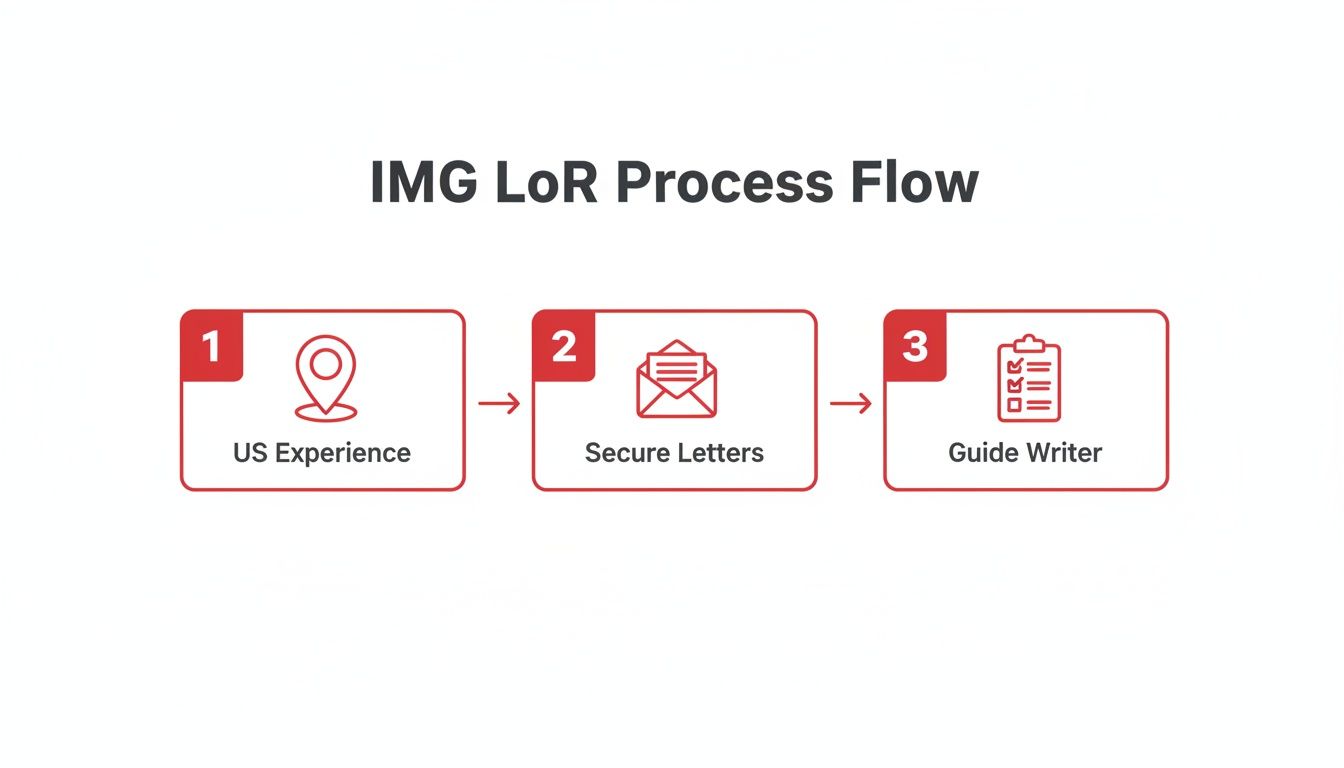
As you can see, getting a strong letter is a multi-stage effort that begins long before you even log into ERAS.
Creating and Confirming Your LoR Requests
Inside the ERAS portal, you’ll generate a unique Letter Request Form for each writer. This form contains the most critical piece of the puzzle: the Letter ID. This ID is the digital handshake that connects your writer’s uploaded letter directly to your application file.
When you create this request, you have to finalize the author's details and decide on waiving your right to view the letter. Triple-check everything here—especially the writer's name and title—because you can't edit this information after you finalize the request.
Always waive your right to view your letters of recommendation. It might feel a bit scary, but this is non-negotiable. Program directors see confidential letters as far more credible and honest. Not waiving this right is a huge red flag that screams a lack of confidence in what your writers will say.
Assigning Letters to Programs Strategically
ERAS gives you a powerful tool: you can upload multiple letters and assign up to four to each individual program you apply to. This is where you can really customize your application. You absolutely should not send the exact same four letters to every single program.
Think critically about each program and tailor your letter assignments.
- Applying to a top-tier academic university? You'll want to assign the letters from your department chair, a well-known researcher in your specialty, and your strongest clinical attendings from that institution.
- Targeting a community-based program focused on hands-on training? Your three strongest clinical letters are the priority here. Maybe you'll include one from a community preceptor who can speak directly to your patient rapport and practical skills.
- Did you do an away rotation at a program? It's a no-brainer. Make sure you assign the letter from that institution's faculty. It shows genuine interest and gives them an inside look.
This small step of customizing your letter assignments shows programs you’ve done your homework and are a thoughtful, serious applicant. As you prepare all your documents, knowing how to combine PDF files for your application packet can be a real time-saver.
Following Up and Expressing Gratitude
After you've sent your writers their packet and the Letter Request Form, give them some breathing room. But as your submission deadline gets closer, a gentle follow-up is perfectly fine. A single, polite email about two weeks before you plan to submit is all it takes.
Frame it as a helpful check-in, not a nagging reminder. Something simple like, "I'm finalizing my application and just wanted to gently follow up on my letter request. Please let me know if you need anything else from me," is professional and gets the job done. You can also track the upload status of each letter right inside the ERAS portal.
The moment a letter is uploaded, send an immediate thank-you email. For an extra touch that leaves a lasting positive impression, follow up with a handwritten thank-you note. This small gesture helps maintain a professional relationship that could benefit you for years to come. Staying organized is everything, and a solid grasp of the ERAS application timeline will help you manage all these moving parts without breaking a sweat.
Common Questions About Residency Letters of Recommendation
The process of getting your residency letters of recommendation is filled with little uncertainties. Even with a perfect plan, tricky situations and specific questions always seem to pop up. Let's tackle some of the most common ones I hear from students to help you navigate these moments like a pro.
What if a Writer Asks Me to Write My Own Letter?
First, don't panic. This happens way more often than you'd think, and it's almost always a sign that your attending is incredibly busy, not that they don't support you. Honestly, you should see this as a golden opportunity to make sure your best qualities get the spotlight they deserve.
Your job is to draft a professional, detailed letter in the third person. The key is to avoid vague praise and ground every point in a concrete example.
- Weak: "She is a dedicated medical student."
- Strong: "During her rotation, she consistently arrived before rounds to pre-round on her patients, review their overnight vitals, and formulate a daily plan. This demonstrated a dedication that went well beyond expectations."
A pro-tip is to reference the AAMC's Core Entrustable Professional Activities (EPAs) to frame your skills. This uses language program directors instantly recognize and respect. When you send it back to the attending, just be sure to label it as a "draft for your review and edits." This respects their final say while giving them fantastic, easy-to-use material to work with.
How Many Letters Do I Really Need?
Most residency programs ask for three letters but allow you to submit up to four through ERAS. My advice? Always aim to secure four strong letters. Think of that fourth letter as your strategic advantage and a crucial safety net.
Having a fourth letter gives you flexibility. Applying to an academic powerhouse? You could send two clinical letters and one from your research mentor. For a community-based program, three stellar clinical letters might be a better fit. That extra letter also protects you if one writer is running behind schedule, which can and does happen. Just be sure to double-check the specific requirements for every single program you apply to.
Can I Use a Letter From a Non-Physician or a Resident?
Your core three letters—the ones that form the foundation of your application—absolutely must come from attending physicians who have directly supervised you in a clinical setting. Program directors see these as the gold standard, and they carry the most weight by far.
However, a letter from a Ph.D. research mentor can be a powerful supplement, especially for research-heavy specialties or academic programs. This is the perfect use for your fourth letter slot. You can assign it strategically to the programs where you know it will make the biggest impact.
A letter from a resident or fellow is generally a no-go. While they probably know your day-to-day performance better than anyone, program directors just don't see their evaluations as being as authoritative as those from experienced attendings. The only real exception is if their feedback is formally incorporated into a departmental letter, like a SLOE.
When Should I Follow Up With a Letter Writer?
This is a delicate balance. You need to be patient, but a polite follow-up is perfectly acceptable and often necessary. If your letter hasn't been uploaded and it's about two to three weeks before your submission deadline, it's time to send a gentle reminder.
Keep the email short, professional, and respectful. Something simple works best: "I hope you're having a good week. I am planning to certify my ERAS application soon and just wanted to gently follow up on my letter request. Please let me know if you need any additional information from me."
This approach works as a helpful nudge without sounding pushy. As soon as that letter is uploaded, shoot them an immediate thank-you email. Follow that up with a handwritten note—it’s a small touch that leaves a lasting, professional impression.
Navigating the complexities of residency applications, from securing stellar letters to acing your board exams, requires a solid strategy. Ace Med Boards offers personalized tutoring and admissions consulting to help you build a standout application and achieve your match goals. Start with a free consultation today.

