
Strong letters of recommendation are, without a doubt, the single most important narrative element of your entire residency application. Your scores and grades prove you can handle the academics. But it's your letters that reveal your character, your hands-on clinical skills, and whether you'd be a great future colleague.
A truly compelling letter can take an application that's just "good" and make it unforgettable.
Why Residency Letters of Recommendation Are Your Most Powerful Asset

Picture a program director sorting through hundreds of files. Most applicants look pretty similar on paper—good USMLE scores, solid grades. So what makes one application jump from the "maybe" pile to the "must-interview" list? More often than not, it's the story told within a powerful letter of recommendation.
These letters offer a personal endorsement that no other part of your application can. They are a window into your real-world performance, giving a trusted attending's perspective on the qualities that never show up on a transcript.
The Narrative That Scores Cannot Tell
Your CV might list your accomplishments, but a great letter illustrates them. It can transform a line item like "volunteered at a clinic" into a memorable story about your compassion and sharp diagnostic skills with a challenging patient. Program directors lean heavily on these narratives to size up the critical, intangible traits that define a great resident.
They're looking for evidence of your:
- Clinical Acumen: How you actually apply knowledge to take care of real people.
- Teachability: Your ability to take feedback on board and actively improve.
- Professionalism and Teamwork: How you interact and collaborate with nurses, fellow residents, and faculty.
- Work Ethic: Your grit, dedication, and reliability when you’re on the floor during a long shift.
Standing Out in a Competitive Field
The data absolutely backs this up. According to the NRMP Program Director Survey, letters of recommendation are the second most important factor they consider, right behind USMLE scores. In the incredibly competitive 2025 ERAS cycle, with a staggering 49,048 total applicants—including 18,500 International Medical Graduates (IMGs)—all fighting for limited spots, a standout letter is what will set you apart.
A letter of recommendation is the closest a program director can get to having worked with you before offering an interview. It's their trusted inside look at your potential.
For IMGs or anyone re-applying, the stakes are even higher. A glowing letter from a U.S. physician directly validates your clinical skills and your ability to adapt to the American healthcare system, tackling a program's potential concerns head-on. Understanding what programs look at for ERAS is the first step, and your letters are how you bring that profile to life.
Ultimately, these endorsements humanize your application, making you far more than just a set of numbers.
Strategically Choosing Your Letter Writers for Maximum Impact
Picking your letter writers for residency isn't just a box to check off your list—it's one of the most strategic things you'll do all application season. The goal isn't just to get three or four letters; it's to assemble a portfolio of endorsements that tells a compelling, multi-faceted story about who you are as a future resident. Think of each letter writer as offering a unique angle on your candidacy.
A classic mistake is chasing the biggest name in the department, thinking their title alone will do the heavy lifting. While a letter from a Department Chair definitely carries some weight, it can sometimes lack the personal, detailed anecdotes that program directors are really looking for. The sweet spot is a mix of seniority and specific, firsthand observation of your skills.
Assembling Your Team of Advocates
To build a truly powerful application, you need to understand what each type of letter writer brings to the table. They aren't all created equal, and their impact depends entirely on who they are and what they can genuinely speak to about you.
Here's a quick breakdown of who you should be thinking about:
- Clinical Faculty/Attending Physicians: These are the foundation of your application. They’ve seen you on the front lines—on the wards, in the clinic, managing patients, and working with the team. Their letters provide the concrete, story-driven evidence of your clinical reasoning, work ethic, and bedside manner that PDs need to see.
- Department Chair or Program Director: A letter from a department leader is a major signal. It tells programs you made a strong impression at an institutional level and are considered one of the top candidates from your school. This is especially powerful if it comes from the clerkship director in your chosen specialty.
- Research Mentor (MD or PhD): If you're aiming for an academic program or a research-heavy specialty, a letter from your Principal Investigator (PI) is non-negotiable. This person can vouch for your critical thinking, your persistence in solving tough problems, and your dedication to research—qualities that are almost impossible to judge from a clinical rotation alone.
Having a mix of these writers gives program directors a 360-degree view. An attending vouches for your patient care, a research mentor highlights your academic chops, and a Chair gives an institutional stamp of approval. Together, they create a much more credible and compelling narrative.
It’s All About the Relationship
Beyond a writer's title, the single most important factor is the quality of your professional relationship. A lukewarm, generic letter from a famous physician is far less effective than a glowing, detailed letter from a junior faculty member who genuinely knows you and your work.
Before you ask anyone, ask yourself these questions:
- Did they work with me directly and for a significant amount of time? They need enough material to write a great letter. A single afternoon rounding together just won't cut it. The time you invest during your medical student clerkships is where you build these critical relationships.
- Was I at my absolute best when I worked with them? Be honest. You want letters from rotations where you crushed it, actively participated, and got great feedback.
- Do they know my specific career goals? A writer who knows you're all-in on academic surgery can frame their letter very differently than one who thinks you're still undecided.
When you make the ask, pay close attention to their reaction. An enthusiastic "Yes, I'd be delighted to write a strong letter for you!" is a great sign. But if you get hesitation or a vague, "I'm very busy, but I can try to write something," that's a major red flag. It’s better to have no letter at all than a weak or generic one.
Aligning Your Writers With Your Specialty
You have to be strategic about matching your letter writers to your target specialty. If you’re applying to Emergency Medicine, a Standardized Letter of Evaluation (SLOE) is an absolute must—it's the gold standard. For competitive surgical subspecialties, a letter from the Department Chair is often considered an unwritten rule.
The numbers don't lie. In the 2025 residency match, a staggering 47,208 certified applicants competed for 43,237 positions. According to NRMP surveys, letters of recommendation were ranked the #2 factor for differentiating between candidates. This is especially true for IMGs, who secured a huge number of spots in Internal Medicine (4,718 matches) and Family Medicine (1,427 matches), where strong letters from U.S. faculty are non-negotiable. You can dig deeper into residency admissions data on Blueprint Prep's blog.
This data proves you can't just wing it. You need a plan.
Choosing Your Ideal Residency Letter Writers
This table helps you strategically select a diverse and powerful group of letter writers by outlining who to ask, what unique value they provide, and when they are most effective.
| Letter Writer Type | Primary Value Proposition | Best For Which Applicants | Key Action Item |
|---|---|---|---|
| Specialty Clinical Attending | Provides detailed, specific anecdotes about your clinical skills and passion for the field. This is the most important letter type. | Everyone. You need at least two from your chosen specialty. | Identify attendings on your core and sub-I rotations where you performed exceptionally well. |
| Department Chair / PD | Lends prestige and institutional validation to your application. Signals you are a top-tier candidate from your school. | Applicants to competitive specialties (e.g., Surgery, Dermatology, Orthopedics). | Schedule a meeting to discuss your career goals and formally request their support. |
| Research Mentor | Highlights academic and critical thinking skills. Demonstrates commitment to scholarly activity. | Applicants to academic programs, PSTPs, or research-heavy specialties. | Ensure they can speak not just to your project, but to your intellectual curiosity and potential. |
| Out-of-Specialty Attending | Shows you are a well-rounded clinician with strong foundational skills (e.g., an IM letter for a Radiology applicant). | Dual-applying candidates or those in fields where broad clinical skills are valued. | Choose someone who can write a strong, personal letter about your core clinical abilities. |
Ultimately, choosing your letter writers is your first major strategic move in the application process. By curating a diverse group of advocates who know you well and can speak to different facets of your abilities, you create a powerful, unified message that will make program directors take notice.
How to Ask for a Letter of Recommendation
Knowing who to ask is a huge part of the battle, but how you ask is where you can really set yourself up for success. The way you approach your attendings can directly influence the quality of the letter they write. Your goal is to make it incredibly easy for them to say "yes" and then write a glowing, specific letter. Think of it as transforming a potential chore for them into a streamlined opportunity to advocate for you.
When you're ready to make the ask, confidence and clarity are your best friends. That first interaction sets the tone. For some extra help on that front, check out these tips on how to start a conversation with confidence.
The entire process boils down to three key stages: building the relationship, making the actual request, and then handing them a perfect packet of information.
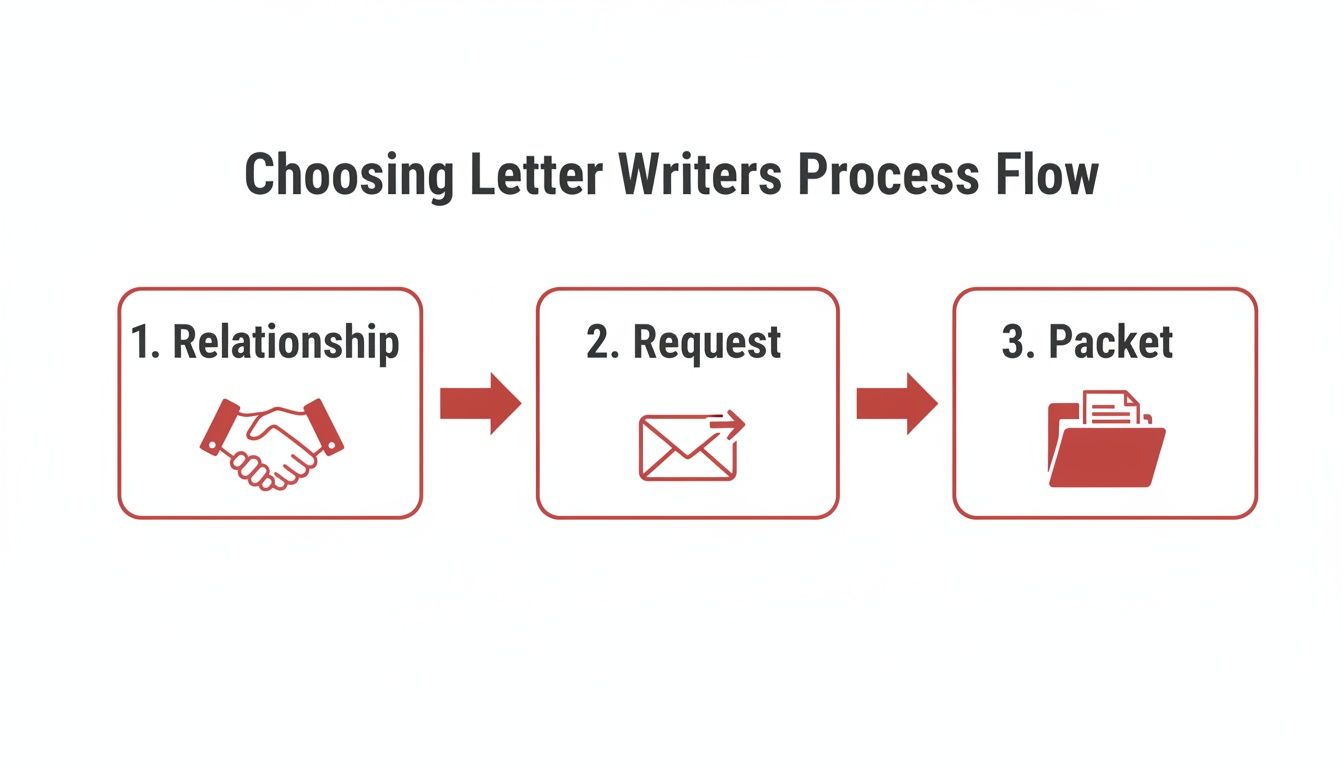
This workflow is your roadmap. It starts with laying the groundwork and finishes with you equipping your writer with everything they need to champion your application.
Timing and Phrasing Your Request
Timing is everything here. The sweet spot to ask for a letter is near the end of your rotation or research block. Why? Because your stellar performance is still fresh in their mind. If you wait months, you're forcing them to rely on fuzzy memories, and that's the fast track to a generic, unhelpful letter.
As a rule of thumb, give them at least four to six weeks of lead time before the letter needs to be in ERAS. This is just professional courtesy. It respects their insane schedules and gives them the space to write something thoughtful instead of rushing it.
Whenever possible, make the request in person. It’s far more personal and lets you read their body language. Be direct, be polite, but most importantly, give them an easy way out.
The phrasing you use is critical. Don't just ask, "Will you write me a letter of recommendation?" Instead, try this: "Do you feel you know me well enough to write a strong letter of recommendation for my residency application?"
This question is a game-changer. It shows you respect their time and that you're seeking a genuinely supportive letter, not just a checked box. If they hesitate or give you a lukewarm "yes" to that question, it’s your cue to politely thank them and move on.
Crafting the Perfect Email Request
After you've secured a "yes" in person, follow up immediately with a professional email. This email is your organizational hub—it confirms the request and puts everything your writer needs in one convenient place.
Make sure your email includes:
- A Clear Subject Line: Keep it simple, like "Letter of Recommendation Request – [Your Name] – [Specialty]."
- A Polite Reminder: A quick sentence mentioning your recent conversation where they agreed to write the letter.
- A Firm Deadline: State the exact date you need the letter uploaded. A specific date is always better than a vague "in a few weeks."
- Your "LOR Packet": Attach all your documents as a single, organized PDF file.
Assembling Your LOR Packet
This packet is your secret weapon. It's a curated collection of documents designed to make writing a stellar, personalized letter as effortless as possible for your attending. The more work you do upfront, the stronger your final letter will be.
Here's what your packet must contain:
- Your Updated CV: This provides the 10,000-foot view of your accomplishments, research, and activities.
- Your Personal Statement Draft: This is non-negotiable. It tells them your story, your "why" for the specialty, and your career goals. It gives them the narrative to frame their letter around.
- The ERAS Letter Request Form: This is the PDF you generate from ERAS that contains the unique Letter ID they need for the upload. Don't forget this!
- A Bullet Point Summary: This is arguably the most crucial piece. It's a one-page cheat sheet with specific reminders of your time working together.
Think of the bullet point summary as a way to gently guide the letter's content. You're not writing it for them, but you're jogging their memory about specific moments where you shined. For a closer look at what makes a letter truly stand out to program directors, our guide on the core components of a letter of recommendation for residency is a great resource.
Examples of Effective Bullet Points
Your goal here is to turn vague praise into concrete evidence. Don't just say you were a team player; remind them of a specific instance where you proved it.
| Instead of This (Generic) | Use This (Specific & Actionable) |
|---|---|
| "Good clinical skills" | "Demonstrated strong clinical reasoning by correctly diagnosing a complex case of vasculitis in the clinic and presenting a comprehensive management plan." |
| "Worked well with the team" | "Proactively communicated with nursing staff and consulted physical therapy, leading to a smoother and faster discharge for the patient in room 302." |
| "Showed initiative" | "Volunteered to stay late to help admit a new patient, completing the H&P and placing orders efficiently to help the on-call resident." |
| "Good presentation skills" | "Delivered a well-researched morning report on new anticoagulation guidelines that was praised for its clarity and practical application for the team." |
When you provide a packet this thorough, you're doing the heavy lifting. You're making it easy for your writer to fill their letter with the powerful, specific anecdotes that program directors absolutely love to see. This simple act of preparation can elevate a good letter into an exceptional one.
Getting Your Letters Into ERAS and Playing by the Rules
Alright, you’ve lined up your letter writers and feel confident they’ll come through with glowing recommendations. Now comes the administrative hurdle: getting those letters into the Electronic Residency Application Service (ERAS).
This part of the process is less about relationship-building and more about careful, detail-oriented execution. While ERAS streamlines the submission process, its specific workflow can catch you off guard if you're not prepared. Let's break down how the system works and cover the specialty-specific rules you absolutely cannot ignore.
Think of ERAS as the secure courier for your letters. You never touch them yourself. Instead, your letter writers upload their confidential assessments directly, a system designed to ensure total authenticity.
The ERAS LoR Portal: A Quick Walkthrough
The LoR Portal is your command center for managing your letters. The process itself isn't complicated, but a simple mistake—like a typo in an email address—can cause major headaches and delays. Pay close attention here.
Here’s the basic flow:
- Create an Entry for Each Writer: In your ERAS account, you'll add the name, title, department, and contact info for every person writing you a letter. Double-check this information for accuracy.
- Generate the Letter Request Form: Once you save a writer's info, ERAS generates a unique PDF called the "Letter Request Form." This form contains a personalized Letter ID that is tied directly to your profile.
- Deliver the Form to Your Writer: This PDF is a critical piece of your LoR Packet. Your writer needs the info on this form to upload their letter to the correct destination—your application.
- Assign Letters to Programs: After a writer uploads their letter, it will appear in your portal. You can then assign up to four letters to each individual residency program you apply to, giving you the flexibility to customize your application for different programs.
Managing this for three or four (or more) letters requires you to be organized. To understand how this fits into the bigger picture, mapping it out on a comprehensive ERAS residency timeline will help you stay ahead of every deadline.
The Waiver: Why There's Only One Right Answer
As you generate each Letter Request Form, ERAS will present you with a crucial choice: do you waive your right to see your letters of recommendation?
This might feel like a choice, but in the world of residency applications, it isn't.
You must always, without exception, waive your right.
Waiving your right signals to program directors that you have complete faith in your letter writer and the integrity of their assessment. It transforms the letter from a simple reference into a confidential, candid evaluation from one physician to another. Failing to waive this right is one of the biggest red flags you can raise. It screams, "I don't trust what this person will say about me," and instantly devalues the letter.
A waived letter is a trusted professional assessment. An unwaived letter is a document you've pre-approved. Program directors know the difference, and it dramatically impacts how they view your application.
Understanding Specialty-Specific Letter Requirements
While most specialties are happy with the standard three-to-four-letter format, many of the most competitive fields have their own "gold standard" letters. These aren't just recommendations; they are highly structured, standardized evaluations that carry enormous weight.
Applying to these specialties without their required standardized letter is often an application-killer. These forms allow program directors to compare applicants from different schools using a common yardstick, asking specific questions that rank you directly against your peers.
The SLOE for Emergency Medicine
If you're applying to Emergency Medicine (EM), the Standardized Letter of Evaluation (SLOE) is the most important document in your entire application. It is not optional.
A SLOE is a detailed evaluation completed by EM faculty after you complete an EM clerkship or sub-internship. You should plan on submitting at least two of them. The SLOE gives programs a comparative assessment of your:
- Clinical knowledge and decision-making
- Bedside manner and communication skills
- A direct ranking against other students they've evaluated
Other Key Standardized Letters
EM set the standard with the SLOE, but other competitive fields have followed suit with their own versions. If you're applying to one of these, you need to know the rules.
| Specialty | Standardized Letter Name | Key Details |
|---|---|---|
| Orthopedic Surgery | Orthopaedic Surgery Standardized Letter of Recommendation (O-SLOE) | Expected from both your home and away rotations, this form assesses your suitability for a surgically demanding residency. |
| Otolaryngology | Standardized Letter of Recommendation (eSLOR) | This mandatory electronic form provides a granular evaluation of skills and characteristics crucial for an ENT resident. |
| Plastic Surgery | Plastic Surgery Standardized Letter of Recommendation (PS-SLOR) | Used to evaluate candidates for integrated plastic surgery, focusing on academic strength and potential technical skill. |
Forgetting to secure these specialty-specific letters will likely get your application filtered out before a human even sees it. Do your homework early in your fourth year. Check the websites of your target programs and specialty organizations to confirm their exact requirements. A little proactive planning here is critical to successfully navigating the residency application maze.
Troubleshooting Common LOR Problems
Even with the best-laid plans, things can go sideways with your letters of recommendation. It happens every single year. A writer goes silent, a key mentor takes an unexpected leave of absence, or you just get that sinking feeling that a promised letter might be… lukewarm.
These moments are stressful, no doubt. But they are almost always fixable with a calm, professional, and proactive approach. Your first instinct might be to panic—that’s normal—but a strategic response will serve you far better than a frantic one. Let's walk through the most common snags and how to handle them.
The Slow or Unresponsive Letter Writer
This is probably the #1 source of anxiety for applicants. You sent your packet weeks ago, the ERAS deadline is looming, and one of your most important letters is still marked as "Not Uploaded." The urge to send five emails in a row is strong, but trust me, that’s a bad move. It can come across as unprofessional or even annoying.
Usually, a single, gentle nudge is all it takes. Your first follow-up should be framed as a polite, helpful reminder, not a demand.
A simple, professional email like this works perfectly:
Subject: Following Up – Letter of Recommendation for [Your Name]
Dear Dr. [Writer's Name],
I hope this email finds you well. I’m writing to follow up on my request for a letter of recommendation for my residency application. The ERAS deadline is approaching on [Date], and I just wanted to gently remind you and see if there is any additional information I can provide that would be helpful for you.
Thank you again for your incredible support.
Best regards,
[Your Name]
Send this about two weeks before the deadline. If you get radio silence, a second, slightly more direct email about a week later is appropriate. If you're down to the wire—just a few days out—a brief, polite phone call to their office administrator is your next step. Just ask if they can confirm the doctor received your emails.
When You Suspect a Letter Might Be Weak
This is a delicate one. Sometimes an attending agrees to write a letter, but their response feels unenthusiastic or generic. If you’ve already asked and they’ve said yes, trying to back out is awkward and can burn a bridge.
Here’s the thing: a generic, uninspired letter can hurt your application more than not having that specific letter at all.
Your best move here is to secure a stronger letter as a backup. Immediately reach out to another faculty member who knows you well and can write a truly powerful endorsement. This gives you options. When it comes time to assign letters in ERAS, you can simply assign the stronger one and choose not to use the letter you're worried about. You don’t need to tell the original writer you didn't use it.
To get a clear idea of what a truly impactful letter looks like, it helps to see an example. Reviewing a sample residency letter of recommendation can give you a benchmark for the kind of quality you should be aiming for.
Securing US Letters as an IMG
For International Medical Graduates, this isn't just a suggestion—it's a critical, non-negotiable requirement. Program directors absolutely rely on recent letters from U.S. physicians to validate your clinical skills and confirm you're ready for the American healthcare system.
- Prioritize US Clinical Experience (USCE): This is your golden ticket. Hands-on rotations, sub-internships, or externships are the primary way to build the relationships you need for strong letters.
- Leverage Research Opportunities: A research fellowship or position at a U.S. institution is another fantastic route. A letter from a PI who can speak to your diligence, critical thinking, and work ethic is incredibly valuable.
- Be Proactive and Start Early: You can't get these experiences overnight. The goal is to spend enough quality time with a U.S. faculty member for them to write a detailed, personal, and glowing letter about you.
A Writer Suddenly Becomes Unavailable
Life happens. A mentor might have a family emergency, go on an unexpected medical leave, or just become completely unreachable. It's incredibly stressful, but it’s not the end of the road for your application.
This is exactly why you should always cultivate more professional relationships than the three or four you strictly need for your application. Immediately pivot to your backup list.
Reach out to another attending you worked closely with. Briefly and professionally explain the situation (e.g., "Unfortunately, Dr. Smith has gone on an unexpected leave and is no longer able to submit my letter."). Acknowledge the short timeline and ask if they would be able to write a strong letter for you. Most faculty understand that these things happen and will step up to help if they can.
Common Questions About Residency LORs, Answered
Let's cut through the noise. When it comes to letters of recommendation, every applicant has a million questions. Here are the straight answers to the ones I hear the most.
How Many Letters Do I Actually Need for Residency?
Most programs ask for three to four letters. Here’s my advice: secure four excellent letters. This gives you strategic flexibility. You can then pick and choose, submitting the most relevant three or four to each program you're targeting.
That said, never assume. Always, always double-check the specific requirements on each program's website or in ERAS. One of the most common mistakes I see is applicants using a one-size-fits-all approach. For competitive specialties, submitting four strong letters isn't just a suggestion—it's the expectation.
Should I Waive My Right to See My Letters?
Yes. Always waive your right. There's no gray area here.
When you waive your right, you're telling program directors the letter is candid, authentic, and unfiltered. It's a confidential assessment from one professional to another. Not waiving that right is a massive red flag. It can make you look insecure about what your letter writer might say or like you're trying to control the process. Just waive it. It’s the standard, and every program expects it.
Waiving your right signals trust and confidence. It elevates the letter from a simple reference to a confidential, professional assessment between colleagues, which carries far more weight with program directors.
How Recent Do My Letters Need to Be?
Your letters need to be fresh. The sweet spot is within the last 12 months of when you submit your application.
Program directors want to know who you are as a clinician now, not who you were two years ago. Your skills, your professionalism, your clinical reasoning—they've all evolved. Letters from your M1 or M2 years are almost never useful. The only real exception is a letter from a long-term research mentor who has worked with you for years and can speak to your dedication and growth over time. Your focus should be squarely on getting powerful letters from your third- and fourth-year clinical rotations and sub-internships.
Can I Use a Letter From a Non-Physician?
You can, but you have to be smart about it. A letter from a PhD who mentored your research, for example, can be a fantastic addition, especially if you’re aiming for a research-heavy academic program.
This kind of letter is great for highlighting your critical thinking, your persistence, and your grasp of the scientific process. But—and this is a big but—it should be your fourth letter. It's an additional endorsement, not a substitute for a core clinical letter from a physician who has seen you work with patients. The foundation of your application must be built on letters from physicians who have directly supervised your clinical work.
Trying to get every piece of the residency match puzzle right can feel like a full-time job. If you need personalized guidance on your application, board prep, or interview strategy, Ace Med Boards offers one-on-one advising to help you stand out. Find out how we can help you on your journey at https://acemedboards.com.

