
A stellar letter of recommendation for residency can be the one thing that truly sets you apart from a stack of equally qualified candidates. Think about it: your USMLE scores and grades get your foot in the door, but it's these letters that tell the real story. They offer a window into your clinical skills, your grit, and your character in a way no data sheet ever could. A great letter doesn't just list what you've done; it paints a picture of the resident you're going to become.
The True Impact of Your Residency Recommendation Letters

The residency match is a fiercely competitive process. Program directors are buried under thousands of applications that, on paper, start to look the same. Your LORs are your secret weapon—the qualitative tiebreaker that can lift your application from the "maybe" pile straight to the "must-interview" list.
Why Letters Carry So Much Weight
Put yourself in a program director's shoes for a second. They aren't just filling a spot; they're choosing a future colleague they'll work with side-by-side for years. They need to know:
- Can this applicant actually handle the intense demands of residency?
- How do they function as part of a team?
- Are they coachable and open to feedback when things get tough?
Your transcript can't answer those questions, but a detailed, personal account from a respected attending physician can. This isn't just an opinion; it's backed by data. The NRMP Director Survey consistently ranks letters of recommendation as one of the most critical factors in their selection process. You can discover more insights about the weight of LORs and see exactly how they stack up.
Beyond a Simple Endorsement
A truly powerful letter goes far beyond generic phrases like "hardworking" or "has good clinical skills." It tells a story. Instead of a vague compliment, a standout letter might describe a specific case where your sharp differential diagnosis directly led to a better patient outcome.
The best letters are not just summaries; they are stories. They paint a vivid picture of a candidate's potential, showcasing moments where they demonstrated exceptional skill, compassion, or resilience under pressure.
These specific anecdotes are what make your application stick in a program director's mind. They provide concrete evidence of your abilities and give them the confidence they need to invite you for an interview. This is your chance to make sure your application speaks volumes.
Choosing the Right Advocates for Your Application

Securing a powerful letter of recommendation for residency is a process that starts long before you actually ask for one. The real work lies in strategically choosing writers who can be genuine advocates for your career—people who can offer specific, compelling proof of your skills, not just confirm you showed up for a rotation.
It's tempting to chase the biggest name you can find, like a department chair. But a generic letter from a big-name attending who barely knows you is far less effective than a glowing, detailed letter from an assistant professor who worked with you closely for a month. Your goal isn't just a signature; it's a story. You need recommenders who saw you grow and can speak to what makes you unique.
Who Should Be on Your Shortlist
As you think about potential writers, look beyond their titles. The most important factor is finding people who have seen you in action and can vouch for the core competencies program directors are desperately looking for.
Here’s a quick mental checklist to run through:
- Direct Observation: Has this person actually worked with you on multiple occasions? They need to have seen your clinical reasoning, your bedside manner, and your ability to function as part of a team.
- Specialty Alignment: This is a big one. You absolutely need at least one or two letters from physicians within the specialty you're applying to. For many programs, this is non-negotiable.
- Genuine Enthusiasm: Think back on your rotations. Did you connect with a particular attending? If you got the sense they genuinely enjoyed working with you, that's a great sign. A writer who is excited about your future will pour that energy into their letter.
For certain specialties, the requirements are even more specific. If you're going into Emergency Medicine, for example, you'll need a Standardized Letter of Evaluation (SLOE). This isn't your standard LOR; it's a unique format that carries enormous weight. Knowing these nuances is critical, and it's something you should be learning about during your medical student clerkships.
The Power of Diverse Perspectives
Your final group of letters should work together to paint a complete, well-rounded picture of who you are. Avoid getting three letters from attendings who all saw you do the exact same thing. Instead, try to showcase different sides of your abilities.
A strong application often includes a mix of letters: one from a senior faculty member who can speak to your academic potential, one from an attending who witnessed your outstanding clinical skills on a core rotation, and one from a research mentor who can vouch for your intellectual curiosity and dedication.
For instance, a letter from a demanding inpatient rotation can highlight your efficiency and grace under pressure. In contrast, a letter from an outpatient clinic might focus on your communication skills and ability to build rapport with patients. This kind of diversity provides a much more convincing and holistic view of your potential as a resident.
The residency match gets more competitive every year, with thousands of applicants fighting for the same spots. Every single part of your application needs to be optimized to help you stand out. Choosing the right letter writers is your first—and most critical—step in that process.
How to Confidently Ask for Your LOR
Asking a busy attending for a letter of recommendation can feel pretty nerve-wracking. We've all been there. But shifting your mindset from "asking for a favor" to "making it easy for them to help you" changes the entire dynamic. The goal is to be so professional and prepared that they can't help but say "yes" and write you a killer letter.
First things first: respect their time. The absolute golden rule is to make your request at least 4-6 weeks before your deadline. This isn't just a suggestion; it's the professional standard. Giving them this much lead time ensures they can fit it into their packed schedule without rushing, which directly translates to a more thoughtful and detailed letter for you.
Crafting the Perfect Request
When you're ready to pop the question, a short and polite email is usually the best way to go. It gives the physician a chance to check their calendar and consider your request without feeling put on the spot. Your email needs to be direct, respectful, and—this is key—give them a graceful way out if they don't feel they can write you a strong letter.
Here's the basic anatomy of that initial email:
- A clear subject line: Keep it simple. "Letter of Recommendation Request – [Your Name]" is perfect.
- A quick reminder: Briefly reintroduce yourself and mention the rotation or project you worked on together. "I'm the student who worked with you on the cardiology service this past July…"
- The direct ask: Clearly state what you're asking for. "I am applying for residency in Emergency Medicine and would be honored if you would be willing to write a strong letter of recommendation for me."
- An easy out: This is crucial for ensuring you only get supportive letters. Add a sentence like, "I would be very grateful if you feel you know me well enough to write a supportive letter, but I completely understand if your schedule or our time together doesn't permit it."
- What comes next: Let them know you're prepared. Mention that if they agree, you'll follow up with a comprehensive packet containing all the necessary information.
This approach shows you're organized and considerate, making a great impression right from the start.
Assembling Your LOR Packet
Once an attending agrees, your job is to make their job as easy as possible. Don't just fire off your CV and call it a day. You need to assemble what I call an LOR Packet—a single, organized digital folder that gives them everything they need to write a personalized, detailed letter. This is the step that separates a generic LOR from a truly exceptional one.
A well-organized packet is your opportunity to guide the narrative. By reminding your recommender of specific interactions and achievements, you are helping them write a more vivid and impactful letter that showcases your unique strengths.
Your packet should be a neat digital folder or a single combined PDF containing these key items:
- Your CV: Make sure it's polished, proofread, and completely up-to-date.
- Your Personal Statement: Even a final draft is fine. This gives them crucial context about your story, your "why," and your career goals.
- ERAS Information: Include your AAMC ID and the ERAS Letter Request Form so they can upload it directly without any hassle.
- A One-Page Summary (Your Secret Weapon): This is where you really shine. Create a brief document that jogs their memory. Remind them of specific cases you presented, a memorable patient interaction you shared, or any positive feedback they gave you. This provides them with concrete, personal examples to pull from.
By doing this "heavy lifting" for them, you turn a potentially time-consuming task into a straightforward process. If you want to see what a standout final product looks like, checking out a sample residency letter of recommendation can give you a clear target to aim for. This level of preparation is what ensures your letter is specific, compelling, and truly memorable.
Using ERAS to Strategically Assign Your Letters
So you’ve collected your letters. Now what? Many applicants make the mistake of thinking a one-size-fits-all approach is good enough. But the ERAS platform gives you granular control over which letters go to which programs—a feature savvy applicants use to their advantage.
Think of it this way: you wouldn't send the same cover letter to a research-heavy academic institution and a hands-on community hospital. Your LORs deserve the same customized approach. You can highlight your research mentor for academic programs while showcasing a strong clinical attending's letter for community hospitals that value hands-on skills. This transforms your LORs from a passive requirement into an active marketing tool.
Managing Your Letters in MyERAS
First things first, get comfortable with the MyERAS dashboard. You’ll find a dedicated section for "Letters of Recommendation" under "Documents." This is your command center.
Here's the basic workflow:
- You'll need to generate a unique Letter Request Form for each recommender.
- They use this form to upload their letter directly to the system.
- Once uploaded, you can assign these letters to the specific programs you're applying to.
Crucially, always waive your right to see the letter. Program directors give significantly more weight to confidential letters. An unwaved letter is often a red flag, suggesting you might have influenced its content.
As letters arrive, you'll see them populate in your MyERAS account. Keep an eye on the status icons. A green checkmark means it's uploaded and ready to be assigned. A red warning icon signals an issue, like a missing signature, that you need to follow up on immediately.
Placing the right letter in the right program signals that you've done your homework and genuinely understand each program’s priorities. It’s a subtle but powerful way to show you’re a good fit.
Tailoring Letters By Program Type
The real strategy comes into play when you start assigning letters. You wouldn't lead with a letter from your basic science research PI when applying to a rural, primary-care-focused community program. It just doesn't align with their mission.
This is where you match your recommenders to the program type. The goal is to paint a picture of yourself that resonates with what that specific program values most.
Strategic LOR Assignment by Program Type
This table breaks down how you can tailor your LOR submissions for maximum impact based on the type of residency program.
| Program Type | Primary LOR Focus | Secondary LOR Focus | Example Recommender |
|---|---|---|---|
| Academic/University | Research Mentors | Department Chairs | Oncology Researcher |
| Community Hospital | Clinical Attendings | USCE Preceptors | Community Internist |
| University-Affiliated | Mixed Research & Clinical | Program Directors | Hospitalist & Lab PI |
This strategic differentiation can have a real impact on how competitive your application is. A well-placed letter from a community internist raving about your clinical acumen will mean far more to a community program director than a letter from a Nobel laureate you spent a summer doing bench research with.
The LOR Request Decision Tree
Feeling unsure about when or how to ask? This simple decision tree can help visualize the process and make sure you have all your ducks in a row before reaching out.
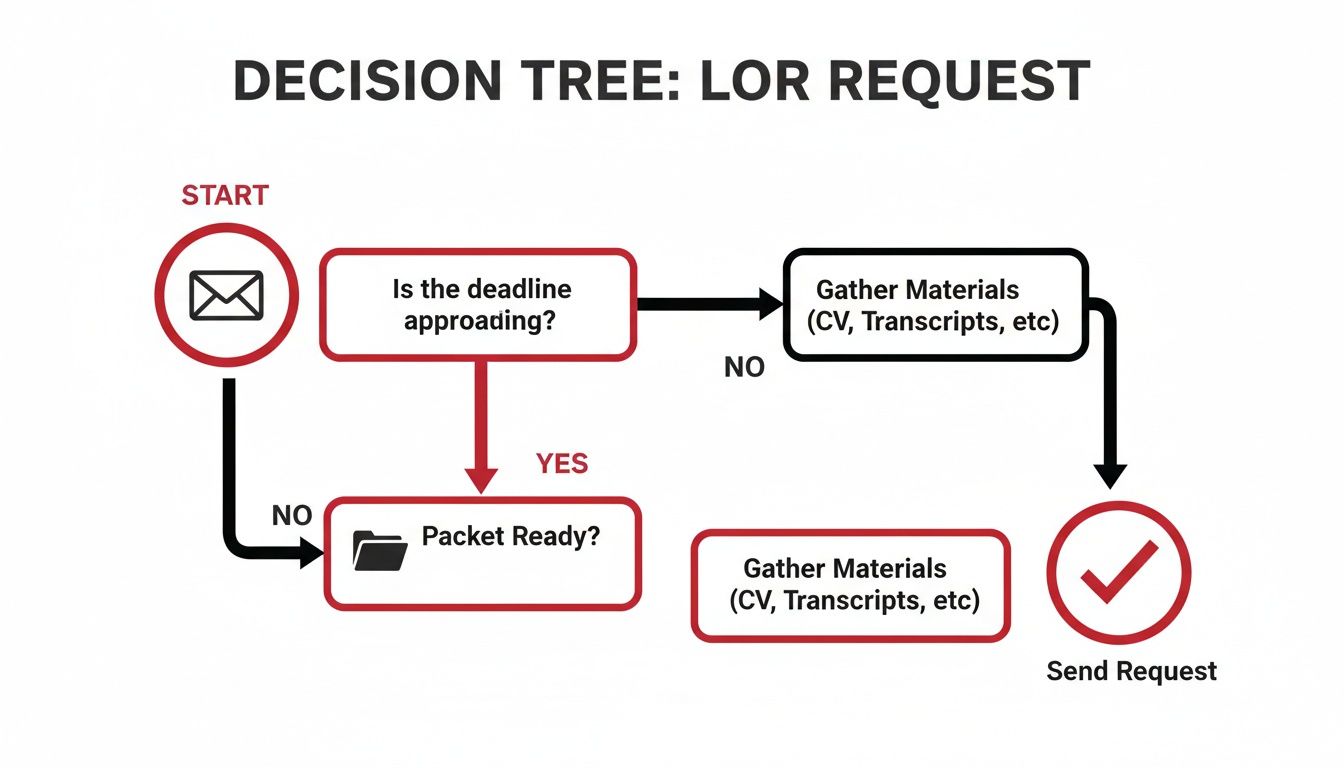
As you can see, the key is preparation. Having your packet ready before you ask ensures a smooth process and shows your recommenders that you respect their time.
Next Steps And Common Pitfalls
Before you hit that final submit button on ERAS, triple-check everything. One of the most common mistakes is failing to tailor your letter assignments. Sending the exact same 3-4 letters to every single program is a missed opportunity.
Another frequent oversight is not confirming the waiver status is intact or ignoring the upload status icons in MyERAS, which can lead to last-minute panic.
And don't forget the human element. Keep in touch with your recommenders. A polite reminder email two weeks before the deadline is perfectly acceptable and can prevent delays. They are busy clinicians and researchers; your application is your top priority, but it's one of many for them.
Putting together a strong set of LORs is just one piece of the puzzle. Make sure the rest of your application is just as polished by checking out our comprehensive guide on ERAS application strategy and CV optimization.
Special Considerations for International Medical Graduates
For International Medical Graduates, a letter of recommendation for residency carries a different weight. It’s not just a supporting document—it's your validation. It’s the proof a program director needs that your clinical skills, honed in another country, will translate seamlessly to the high-stakes US healthcare system.
Frankly, your application is facing an uphill battle without it.
The numbers don't lie. In 2025, the overall match rate for all IMGs was just 60.8%. That figure is a world away from the 93.7% match rate US medical graduates saw in 2023. This gap is precisely why every piece of your application, especially your LORs, has to be stellar. You’re not just applying; you’re bridging a credibility gap.
The Non-Negotiable Value of USCE Letters
Imagine you're a program director. Your job is to predict how a candidate will perform in your hospital. Letters from distinguished professors in your home country are great, but they don’t provide the context needed to make that prediction. Directors need an evaluation from a US-based physician who gets the workflow, the communication style, and the expectations of an American residency program.
This makes US Clinical Experience (USCE) a non-negotiable. It’s the single most important part of building a successful IMG application. These hands-on rotations are your only real shot at getting the powerful, US-based letters that put you on a level playing field.
A letter from a US attending physician acts as a bridge of credibility. It tells a program director, 'I have worked with this candidate in a US clinical setting, and they have what it takes to succeed here.' This endorsement is invaluable.
Securing Your US-Based Endorsements
Finding quality USCE can be tough, but several pathways exist. Your mission is to secure opportunities that involve direct patient contact and meaningful time with attending physicians who can actually get to know you.
Here are the best ways to get that experience:
- Externships and Hands-On Rotations: This is the gold standard. You function like a US medical student—taking histories, performing physicals, presenting cases, and contributing to the team.
- Observerships: While you're more on the sidelines, a well-structured observership with an attending who is willing to teach and engage with you can absolutely lead to a strong LOR.
- Research Positions: A role as a research fellow or assistant, particularly one with clinical exposure, can connect you with prominent faculty. These individuals can become powerful advocates for your application.
Once you’re in these roles, your goal is to be unforgettable—for all the right reasons. Show up early. Stay late. Ask smart questions. Make yourself an indispensable part of the team. This is your live audition for a game-changing letter.
Navigating Letters from Your Home Country
What if you only have one or two letters from US physicians? While the overwhelming focus must be on your USCE letters, recommendations from your home country can play a supporting role.
Think of them as testaments to your foundational knowledge and work ethic. They can add depth, but they should never be the main event. Your US letters need to be front and center.
To give your application the best chance, be strategic. Target programs known for being open to international graduates. Our guide to IMG-friendly residency programs is a fantastic resource for building your list and making sure your hard-earned letters land where they’ll have the most impact. At the end of the day, a strong set of US-based LORs is your most powerful tool in the match.
Common Questions About Residency LORs Answered
Navigating the nuances of your letters of recommendation for residency always brings up a ton of questions. Getting the details right is a huge deal, since small missteps can unintentionally send the wrong message to program directors. Let's clear up some of the most common points of confusion.
Should I Waive My Right to See My Letter?
Yes. Absolutely, one hundred percent. You must waive your right to view your letters.
When you don't waive this right, it's a massive red flag for program directors. It suggests either you don't trust what your attending will write about you, or worse, that you might have tried to influence the letter's content.
Confidential letters are just seen as more credible and honest. Waiving your right is a standard, non-negotiable part of the process to make sure your LORs are taken seriously by every single program.
How Many Letters of Recommendation Do I Really Need?
Most residency programs ask for three letters, but ERAS lets you upload and assign up to four. The smart move here is to get four strong letters. This gives you a strategic edge, letting you customize which letters you send to different programs.
Having that fourth letter is all about flexibility. You can send your research-heavy letter to academic programs and a killer clinical letter to community-based ones, playing to your strengths for each audience.
Just remember, quality always beats quantity. Three phenomenal letters will do more for you than four so-so ones. Aim for four, but don't ever sacrifice quality just to hit that number.
What if an Attending Asks Me to Write the Letter Myself?
First off, don't panic. This happens more often than you'd think, especially with busy attendings. See it as an opportunity to make sure your best moments get the spotlight. The trick is to handle it professionally and ethically.
Draft an objective, detailed letter that focuses on specific examples of your performance. A great way to structure this is using something like the STAR method (Situation, Task, Action, Result) to talk about a memorable patient case or how you contributed to the team.
When you hand it over, don't say, "Here's the letter I wrote." Instead, frame it as a "collection of reminders" or a "starting point" for them to build on. This saves them a ton of time while ensuring the final letter is packed with the kind of concrete details that will make your application pop.
How Recent Should My Letters Be?
Your letters need to be fresh. Ideally, they should come from clinical or research experiences you've had in the last 12-18 months. Program directors want to see who you are now as a professional, not who you were two years ago.
The most powerful letters almost always come from your third and fourth-year clinical rotations. You should really avoid using letters from your preclinical years unless it's from a significant, long-term research mentor whose work is directly tied to your chosen specialty.
Navigating the residency match is a marathon, not a sprint, and every piece of your application needs a solid strategy behind it. If you're looking for personalized guidance to make your entire profile shine, Ace Med Boards offers expert consulting to help you cross the finish line. Learn how our advisors can help you build a competitive application and secure your ideal residency spot.

