
Here's the truth: the secret to reading faster isn't some superhuman trick. It’s about methodically breaking the bad habits you’ve held onto since elementary school—like that little voice in your head—and learning to process information far more efficiently. This isn't about passively letting your eyes drift across a page; it’s about actively engaging with the text.
Why You Read Slower Than You Think
Let’s be honest, most of us read far slower than we could. This has nothing to do with intelligence. It’s the direct result of deeply ingrained habits we were taught as kids and simply never unlearned. We were all taught to read one word at a time, sounding everything out in our heads.
That internal voice, known as subvocalization, is the single biggest bottleneck slowing you down. It was essential when you were learning to read, but now it forces you to read at the speed of speech, not the speed of thought. Your brain can process information exponentially faster than your mouth can say it.
The Myth of Speed Versus Comprehension
A common fear I hear is that reading faster must mean understanding less. That’s a complete myth.
In fact, slow, plodding reading often hurts comprehension. It gives your mind too much empty space to wander off, get bored, and start thinking about your to-do list or what you’re having for dinner.
True speed reading isn't about skimming or skipping content. It’s about increasing your cognitive efficiency to absorb the same information in less time, often with greater focus and retention.
Learning to read faster and understand more is really about becoming a more engaged, efficient reader. Often, slow reading and poor comprehension are just symptoms of a lack of focus and an inability to shut out interruptions. To get a better handle on that, it's worth exploring some effective strategies to stay focused and beat distractions.
Before we dive into the techniques, it's helpful to see where the friction comes from. Many of us are stuck with reading habits that feel natural but are actually holding us back.
Foundational Reading Habits to Change Today
| Common Slow Reading Habit | Effective Faster Reading Technique | Why It Works |
|---|---|---|
| Reading word-by-word | Chunking (reading groups of words) | Your brain processes ideas, not individual words. Grouping words into meaningful phrases matches how your brain naturally thinks. |
| Subvocalization (sounding words out in your head) | Visual Pacing (using a finger or pacer) | Forces your eyes to move faster than your internal voice can keep up, breaking the habit of "hearing" every word. |
| Passive reading | Active Engagement (previewing & questioning) | Primes your brain for the information, creating a mental framework that improves both speed and comprehension. |
| Constant rereading (regression) | Pacing and Trusting Your Brain | Builds confidence and trains your brain to absorb information on the first pass, cutting out wasted time and effort. |
This table gives you a snapshot of the mental shifts we're going to make. By replacing these outdated habits with proven techniques, you'll see a dramatic improvement in both your speed and your ability to retain what you read.
Your Current Reading Speed Benchmark
So, how slow is "slow"? Research shows the global average for adult silent reading of non-fiction is about 238 words per minute (wpm). Fiction is a little faster at 260 wpm. For college students, the average hovers between 250–300 wpm.
These numbers aren't a judgment—they're just a starting line. This guide is designed to give you a system to leave those averages in the dust.
Mastering the Mechanics of Efficient Reading
To really learn how to read faster and understand more, we have to move beyond theory and get practical. It's about rebuilding the physical habits you use to read—retraining your eyes and learning to manage that inner voice that dictates your pace.
Let's start by tackling the biggest mechanical hurdles that are probably keeping you stuck at your current speed.

The first habit we need to address is subvocalization. This is that little voice in your head that silently "says" every single word as you read. It's a leftover from when you first learned to read out loud, and it's a massive bottleneck. It effectively caps your reading speed at your speaking speed, which is far slower than what your brain can actually process.
Taming Your Inner Monologue
Now, the goal isn't to eliminate subvocalization completely. For dense, complex scientific texts, it can actually be a useful tool for comprehension. The key is to control it, so it doesn't hold you back when you're reading less challenging material.
So, how do you do it? You need to give that inner voice something else to do.
Here are a few surprisingly effective tricks:
- Chew Gum or Hum Quietly: This simple physical act engages the parts of your brain and muscles involved in speech. By giving them another job, you make it much harder for them to simultaneously "say" the words you're reading.
- Count in Your Head: Silently looping "1, 2, 3, 4" while you read can effectively drown out the words on the page. It feels weird and distracting at first, but with practice, it just becomes background noise that frees up your eyes to move faster.
- Use a Pacer: This is, hands down, the most powerful tool in your arsenal. Using your finger, a pen, or even the cursor on your screen to trace under each line forces your eyes to maintain a steady, quick rhythm. Your inner voice simply can't keep up, and you’ll find you naturally stop subvocalizing.
The core principle is simple: your eyes must lead, and your mind must follow. When you force your eyes to move at a consistent, swift pace, you break the connection between seeing a word and needing to "hear" it.
This technique is a game-changer for timed, high-stakes exams where every second counts. For a notoriously dense section like the MCAT CARS, pacing helps you maintain momentum and avoid getting bogged down. You can find more targeted strategies on how to improve your CARS score on the MCAT that build on these same principles of efficiency.
Learning to See in Chunks, Not Words
Once you start quieting that inner monologue, the next step is to change how your eyes physically take in information. Most of us read one… word… at… a… time. Instead, you need to train yourself to see groups of words—or chunks—as single units.
Think about it: your brain processes ideas, not individual words. This method simply aligns your reading mechanics with how your brain already works.
Start small. Consciously try to see two words at once with each glance. Once that feels comfortable, push yourself to see three, then four or five words in a single eye fixation. You'll be amazed at how quickly your brain can grab the meaning from phrases like "in the middle of" or "due to the fact that" without needing to process each word.
This practice directly combats inefficient saccadic eye movements—the jerky little jumps your eyes make from one word to the next. By taking in wider chunks, you dramatically reduce the number of jumps per line, which saves a ton of time and mental energy.
Expanding Your Vision and Kicking the Rereading Habit
To get good at chunking, you have to start using your peripheral vision. Instead of laser-focusing on the word directly in front of you, soften your gaze and become aware of the words on either side of it.
Here’s a practical drill to build this skill:
- Take a book and draw two light vertical lines down a page, about an inch in from each margin.
- Start reading, but force your eyes to only fixate on the words between those two lines.
- Use your peripheral vision to pick up the words at the beginning and end of each line without looking directly at them.
This feels awkward at first, but it trains your brain to trust its ability to capture information from a much wider field of view. It also helps you fight another huge time-waster: regression, the habit of constantly jumping back to reread words or sentences you just read.
Again, using a pacer is the best antidote here. By keeping your finger or pen moving forward at a steady clip, you create a psychological barrier that discourages your eyes from jumping backward. You train yourself to trust that you got it the first time—and more often than not, you did. These mechanical adjustments are the foundation for building real speed.
Building a Framework for Deep Comprehension

Simply blazing through a chapter means nothing if the information goes in one ear and out the other. Now we shift from the physical tricks of reading faster to the mental strategies that actually make knowledge stick. This is where you learn to build a mental framework before you even read the first full sentence, giving new information a place to land.
This approach transforms reading from a passive chore into an active conversation with the text. For med students staring down a mountain of dense material, this isn't just a helpful tip—it’s a survival strategy. It's the difference between merely recognizing the term "renin-angiotensin-aldosterone system" and truly understanding its role in a complex case of hypertension.
Start with a Strategic Preview
Before you even think about diving into a chapter, take one or two minutes for a quick reconnaissance mission. This isn’t about reading for detail; it’s about creating a mental map of the terrain ahead. This previewing phase acts like a primer, giving your brain the scaffolding it needs to organize what you're about to learn.
Think of it like looking at a city map before you start exploring. You get a sense of the major landmarks and how the streets connect, so you aren't completely lost when you turn a corner. For anyone serious about getting more out of their reading time, exploring ways to improve reading comprehension skills is a crucial next step.
So, what does this look like in practice? When you crack open a textbook or a journal article, your initial scan should zero in on these elements:
- Headings and Subheadings: These are the signposts the author left for you. Read every single one to get the logical flow of the chapter.
- Introductions and Summaries: Authors almost always put their main points right at the beginning and end. Hit these first to grab the core message.
- Visual Aids: Glance at all diagrams, charts, and tables. Their captions often distill a complex process into one digestible takeaway.
- Bolded Terms: Your eyes should jump to these key vocabulary words. You don't need to know the definitions yet—just seeing them primes your brain to pay attention when they pop up later.
This quick flyover might feel like you're not really reading, but it’s one of the most powerful things you can do. It provides the context you need to keep from getting bogged down in the details.
Turn Headings into Questions
Okay, you've got your mental map. Now it's time to spark your curiosity. This next move shifts you from a passive surveyor to an active participant. The easiest and most effective way to do this is by turning every single heading and subheading into a question.
If a heading says, "The Role of Angiotensin II in Blood Pressure Regulation," your brain should immediately start firing off questions:
- What exactly is Angiotensin II?
- How does it regulate blood pressure?
- What happens when that regulation fails?
This tiny mental habit changes everything. You’re no longer just passively receiving information; you're actively hunting for answers. Your reading session becomes a mission to find specific information, which skyrockets your focus and retention. To really get this, you need to grasp the difference between active and passive learning. You can dive deeper into this with our guide on the critical differences between active and passive learning in medical school.
This simple but disciplined approach of previewing and questioning before every reading session is what separates the efficient learners from those who waste hours rereading the same material with little to show for it. It's not just about reading faster; it's about understanding more deeply with every single pass.
Advanced Techniques for Long-Term Retention
Reading faster and understanding a complex topic in the moment is a huge win. But for a medical student, that's only half the battle.
The real test is pulling that information out of your brain during an exam weeks or even months later. This is where we need to build a bridge between short-term comprehension and long-term, durable knowledge.
To do this, you have to move beyond passive review. Highlighting and rereading your notes might feel productive, but the research is clear: it's a surprisingly ineffective way to build lasting memory. Real retention comes from actively pulling information out of your brain, not just passively shoving it in.
The Power of Active Recall
Active Recall is the simple act of deliberately retrieving information from memory. Instead of rereading a chapter on pharmacology, you force yourself to answer the question: "What are the mechanisms of action for beta-blockers?" This small shift from recognition to retrieval is profoundly powerful.
Each time you successfully recall a piece of information, you strengthen its neural pathway. It’s the mental equivalent of lifting weights—the struggle is what builds the muscle.
Passive review creates the illusion of mastery because the information feels familiar. Active recall, on the other hand, provides an honest and accurate assessment of what you actually know, exposing your knowledge gaps so you can fill them.
This technique is the foundation for creating durable, long-term memory. If you're looking for more ways to lock in what you've learned, our guide on how to improve memory retention offers specific strategies that build on this core principle.
So, how do you actually put this into practice? After reading a section of your textbook, try one of these methods:
- The Brain Dump: Close the book and, without looking, speak or write out the main points of what you just read in your own words.
- Question Yourself: Go back through the material and turn headings, key concepts, and bolded terms into questions. Then, set the material aside and try to answer them from memory.
- Smarter Flashcards: Instead of just putting a term on one side and a definition on the other, frame it as a question. This forces you to retrieve the answer rather than just passively recognizing the pair.
Spaced Repetition: The Ultimate Weapon Against Forgetting
If active recall tells you how to study, Spaced Repetition tells you when. This evidence-based technique is your ultimate weapon against the Ebbinghaus forgetting curve—that natural, depressing decay of memory over time.
The concept is simple but brilliant: you review information at increasing intervals. You might review a new concept one day after learning it, then three days later, then a week later, and so on. This strategic timing interrupts the forgetting process at the precise moment it’s most effective to do so.
Each time you successfully recall the information, the review interval gets longer. This process essentially tells your brain, "Hey, this is important. Move it from short-term to long-term storage."
A Practical Example Using Anki
For medical students, the most powerful tool for combining Active Recall and Spaced Repetition is a flashcard program called Anki. It’s a game-changer because it automates the entire spacing schedule for you.
Let’s see how you'd turn a dense pharmacology chapter into a high-yield Anki deck.
Original Text: "Loop diuretics, such as furosemide, act by inhibiting the Na-K-2Cl symporter in the thick ascending limb of the loop of Henle. This action reduces the reabsorption of NaCl and diminishes the lumen-positive potential that drives the reabsorption of divalent cations like Ca2+ and Mg2+."
Instead of just highlighting this beast of a sentence, you would create several targeted, active recall-style flashcards:
- Card 1 (Mechanism): What is the precise mechanism of action for loop diuretics?
- Card 2 (Location): Where in the nephron do loop diuretics exert their primary effect?
- Card 3 (Electrolytes): How do loop diuretics affect the reabsorption of Ca2+ and Mg2+?
You then review these cards daily. Anki's algorithm will show you the cards you struggle with more often and push the ones you know well further into the future. This transforms passive reading into an active, efficient, and unforgettable learning experience. It ensures you're spending your valuable time on the material that needs it most, cementing your knowledge for exam day and beyond.
Your 4-Week Reading Efficiency Training Plan
Knowing the theory is one thing, but actually changing how you read takes a concrete plan. You can’t just decide to read faster; you have to build the habits piece by piece. This is your roadmap to making these skills second nature, designed to fit into an already packed med student schedule.
The idea here is simple: layer one new skill per week. We'll start with the mechanics and then move to the cognitive strategies. This gradual approach prevents the burnout that happens when you try to change everything at once. Think of it as a progressive workout for your eyes and brain.
The entire process is built on a simple but powerful learning cycle: read the material, actively recall what you just read, and then repeat to lock it in.
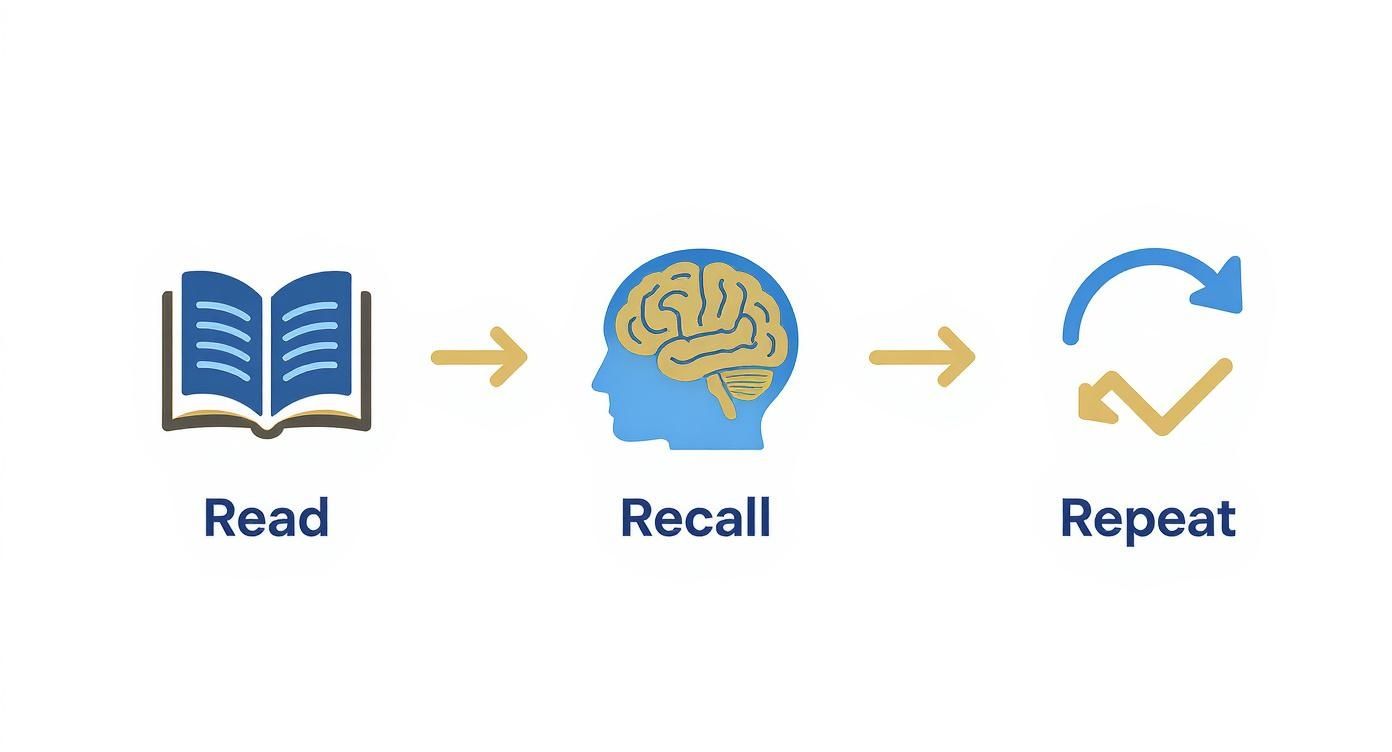
This Read-Recall-Repeat model is what moves information from your fleeting short-term memory into long-term, usable knowledge.
Here’s a week-by-week schedule to put these techniques into practice systematically. Just 15-20 minutes of focused daily practice is all it takes to start seeing real results.
4-Week Reading Efficiency Training Schedule
| Week | Primary Focus | Daily Practice (15-20 mins) | Measurement Goal |
|---|---|---|---|
| 1 | Baseline & Pacing | Use a physical pacer (finger, pen) for all reading. This is non-negotiable. | Measure your starting WPM. Aim for a 10-15% increase in WPM by the end of the week. |
| 2 | Word Chunking | Continue using your pacer, but now consciously try to see groups of 3-5 words at a time. | Aim for another 15-20% WPM increase over last week's speed, maintaining comprehension. |
| 3 | Strategic Previewing | Before each reading session, perform a one-minute preview: scan headings, intros, and summaries. | Focus on maintaining the new speed while improving comprehension. You should feel more "grounded" in the text. |
| 4 | Effective WPM | Practice adjusting your pace for different text difficulties. Quiz yourself after reading to calculate effective WPM. | Calculate your effective WPM (WPM x Comprehension %). Aim for 85% comprehension or higher. |
This training schedule is designed to build momentum. By the end of the four weeks, these techniques won't feel like a chore; they'll simply be how you read.
A Deeper Dive Into Each Week
Week 1: Get Your Baseline and Master Pacing
Your first goal is straightforward: use a pacer for everything you read. Your finger, a pen, a cursor—it doesn't matter. Just force your eyes to follow its steady movement. This is the single fastest way to break the habits of subvocalization and regression.
At the beginning of the week, find your baseline. Grab a textbook, set a timer for five minutes, and read like you normally would. Count the words and divide by five to get your starting words per minute (WPM).
Then, for the rest of the week, commit to that 15-20 minutes of daily paced reading. At the end of the week, test yourself again on a similar text. You'll almost certainly see a jump.
Week 2: Integrate Word Chunking
Now that pacing feels more natural, it’s time to widen your vision. Keep using the pacer, but consciously try to see words in groups of 3-5 with each glance, instead of just one at a time.
Focus your daily sessions on this. Look at the middle of a short phrase and let your peripheral vision grab the words on either side. It feels weird at first, but your brain is wired to adapt.
The key is to trust your brain. It can pull meaning from phrases much faster than you think. You don't need to consciously "see" every single letter of every single word to understand the sentence.
This is the skill that truly unlocks speed. Research shows that with the right practice, students can increase reading speed by 40–50% while keeping or even improving comprehension. For example, some studies found students’ average speed jumped from 115 WPM to 161 WPM after training. You can dig into the full research on speed reading efficacy to see the data for yourself.
Week 3: Practice Strategic Previewing
With the mechanics down, we add a powerful cognitive layer. Before you read anything—whether for practice or for class—you’re going to do a one-minute preview.
Quickly scan the text for:
- Headings and subheadings to see the structure.
- Introductions and summaries to get the main point.
- Bolded terms and diagrams to spot the key concepts.
This creates a mental skeleton of the material. It primes your brain for the information, making it much easier to hang the details on that framework as you read at speed.
Week 4: Calculate Effective WPM and Adjust Your Pace
In the final week, you start measuring what actually matters: effective reading speed. This is your WPM multiplied by your comprehension score.
After a reading session, give yourself a quick 3-5 question quiz on the material. If you blaze through a passage at 400 WPM but only answer 75% of the questions correctly, your effective speed is 300 WPM. That's your true number.
This week is also about learning to be a flexible reader. When you hit a dense, complex physiology chapter, slow down intentionally. When you're reading a more narrative section, push your speed. True reading efficiency isn't about maintaining one flat-out speed; it's about knowing when to hit the gas and when to tap the brakes.
Frequently Asked Questions About Reading Faster
https://www.youtube.com/embed/I_GWxFNpZ3I
Even with a solid game plan, you're bound to have questions as you start rewiring years of old reading habits. It's completely normal. Let's tackle some of the most common ones I hear from students to give you some clarity and confidence.
Can I Really Stop Subvocalizing Completely
The short answer is no—and you shouldn’t want to. Completely silencing your inner voice isn't the goal, especially when you're digging into dense, technical material where that voice is actually a comprehension tool.
The real aim here is control. For lighter reading or when you're just trying to get the gist of a chapter, you want to learn to quiet that voice down to pick up the pace. Think of it less like an off switch and more like a volume dial you can adjust based on the complexity of the text.
How Long Until I See Real Improvement
If you're consistent with daily practice—just 15-20 minutes is enough—most students feel a noticeable difference within two to three weeks. You'll probably see your paced reading speed jump up pretty quickly.
That said, making huge, lasting gains—like doubling your effective reading speed while keeping your comprehension high—often takes a few months of dedicated effort. Be patient with yourself. You're undoing a lifetime of ingrained habits.
Are Speed Reading Apps and Software Effective
They can be, but they are only one piece of the puzzle. Think of apps as the gym for your eyes. They’re great for mechanical drills, like training your eyes to move faster or reducing how long you fixate on a single spot.
But they are not a magic bullet. Real mastery comes from combining those mechanical drills with the cognitive strategies we've talked about, like active recall and previewing. Software alone can't teach you the deep comprehension skills you need for boards or complex textbooks. Lasting improvement is always a blend of mechanical practice and smarter thinking.
Navigating the sheer volume of information in medical school requires more than just speed. Ace Med Boards offers personalized tutoring to help you build the deep comprehension and retention strategies needed to excel on your USMLE, COMLEX, and Shelf exams. Start with a free consultation and learn to study smarter, not just harder.

