
Let's get straight to it: a good MCAT score is one that makes you a competitive applicant at the medical schools you’re actually applying to. While the "right" number is different for everyone, a score above 510 generally puts you in a very strong position for most MD programs, landing you in the top tier of applicants across the country.
What Is a Good MCAT Score
Think of your MCAT score like a key. The score itself is one of the most important cuts on that key, and it determines which medical school doors you can unlock. A higher score simply opens more doors, especially those leading to the most selective institutions.
But to really understand this key, you have to know how it's made. The MCAT isn't just one single number. It’s a composite score built from four distinct sections:
- Chemical and Physical Foundations of Biological Systems (Chem/Phys)
- Critical Analysis and Reasoning Skills (CARS)
- Biological and Biochemical Foundations of Living Systems (Bio/Biochem)
- Psychological, Social, and Biological Foundations of Behavior (Psych/Soc)
Each of these sections is scored on a scale from 118 to 132. Add those four scores up, and you get your total MCAT score, which can range from a low of 472 to a perfect 528. For a deeper dive into the numbers, you can explore our comprehensive guide on the MCAT score range.
Understanding Percentiles and Averages
While the raw score is what you see first, its true power comes from the percentile rank. Your percentile tells you how you stacked up against every other person who took the test. Scoring in the 85th percentile, for example, means you performed better than 85% of your peers. That context is what admissions committees really care about.
To help you visualize where you stand, here’s a breakdown of the general score tiers and what they mean for your application's competitiveness.
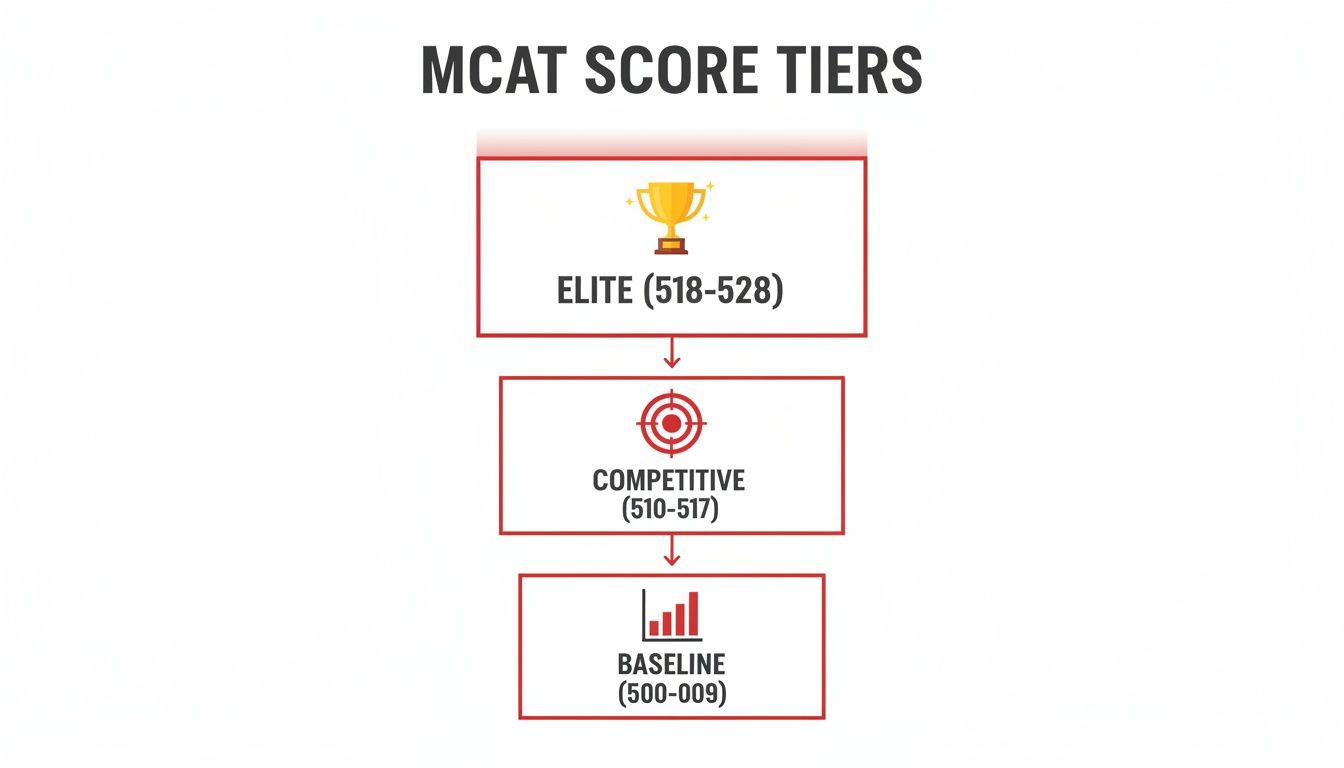
This shows that a "good" score isn't a single number but a range that aligns with different levels of medical school selectivity.
MCAT Score Tiers At a Glance
The table below offers a quick look at what different MCAT score ranges typically signify in the competitive world of medical school admissions.
| Score Range | Percentile (Approx.) | General Competitiveness Level |
|---|---|---|
| 518-528 | 95th-100th | Elite: Highly competitive for top-tier MD programs. |
| 510-517 | 80th-94th | Competitive: Strong candidate for most MD and DO programs. |
| 500-509 | 50th-79th | Baseline: Competitive for many DO programs and some MD programs. |
| Below 500 | Below 50th | Below Average: May need a retake or a very strong holistic application. |
This provides a solid starting point, but remember that your GPA and other application components play a huge role, too.
Why "Good" Is a Moving Target
Ultimately, what's considered a "good" MCAT score is relative. It depends entirely on your specific goals and the schools you're aiming for. A score that’s fantastic for a Doctor of Osteopathic Medicine (DO) program might be below the median for a top-tier Doctor of Medicine (MD) program.
Your target score shouldn't be based on a generic average. It needs to be based on the specific matriculant data of the schools on your list. A "good" score is one that meets or, even better, exceeds the average for accepted students at your dream schools.
That's why defining your ideal MCAT score starts with research. Look up the median accepted scores for the schools you want to attend. That number becomes your real-world target—a goal that's both ambitious and grounded in reality.
Why Matriculant Data Is the Real Benchmark

If you want to define a truly good MCAT score, you have to look past the general averages. It’s a common mistake. Pre-meds see the average score for all test-takers and set that as their goal, but that's like a marathon runner aiming for the average pace of everyone who starts the race, not just those who actually finish it.
The single most important number for you is the average score of matriculants—the students who not only got accepted but actually enrolled in medical school. This is the group you're trying to join. Their stats are your real benchmark for success, cutting through all the noise to give you a realistic target.
Applicants Versus Matriculants
The difference between an "applicant" and a "matriculant" is everything. An applicant is anyone who fills out an application. A matriculant is an applicant who succeeds. The gap between their average MCAT scores tells you everything you need to know about how competitive this process is.
Students who successfully matriculate into medical school have significantly higher MCAT scores than the average applicant. For MD programs, the average matriculant score is around a 511.9, while the average for all applicants is closer to 506.5. That 511.9 puts a typical matriculant in the 81st to 83rd percentile, showing you just how high the bar is set. You can get more insights on how MCAT scores and percentiles work at joinleland.com.
This isn't a minor statistical blip; it's a clear message from admissions committees. Aiming for the applicant average might get your application reviewed, but aiming for the matriculant average is what gets you a seat in the class.
Raising the Bar for Top-Tier Schools
While a 512 is a fantastic target for most MD programs, the goalposts move dramatically if you're aiming for the nation's most prestigious medical schools. For those top-tier institutions, a "good" MCAT score enters a whole new territory.
At top-20 research-focused medical schools, the median MCAT score for matriculants often climbs into the 520s. This isn't just competitive; it's the academic elite. A score in this range puts you in the 98th percentile or higher, signaling to adcoms that you have truly exceptional critical thinking and academic abilities.
Aiming for the average matriculant score of 512 makes you a strong candidate. Aiming for a 520+ makes you a standout applicant, capable of competing for a spot at the most selective programs in the country.
This reality highlights how critical it is to match your MCAT goals to your school list. A "one-size-fits-all" score target just doesn’t work. The right score for you depends entirely on where you dream of getting your white coat.
Putting It All Together for Your Strategy
Understanding matriculant data completely changes how you should prepare for the MCAT. Instead of just asking, "What's a good score?" you should be asking, "What was the average score for accepted students at the schools I want to attend?"
Here’s how to put this into practice:
- Create a Dream School List: Start by identifying 5-10 schools you would be thrilled to attend.
- Research Their Stats: Go to their admissions websites and look up the median MCAT score for their most recent entering class. Most schools are transparent with this data.
- Set Your Target: Your goal should be to meet or, even better, exceed the median score of your top-choice schools.
This data-driven approach takes the guesswork out of setting your goal. Of course, remember the MCAT is just one piece of a much larger puzzle. To see how your score fits into the bigger picture, check out our guide on what medical schools look for in an applicant. By focusing on matriculant data, you’re not just studying for a test—you're strategically positioning yourself for an acceptance letter.
How Section Scores Shape Your Application Story
Your total MCAT score is the headline number, but admissions committees always read the fine print. They dig into your performance across the four individual sections to get a complete picture of your academic strengths and weaknesses.
Think of it this way: your total score is the final grade in a course, but your section scores are the individual assignments that got you there. A high total score is fantastic, but a lopsided breakdown can tell a story you didn't intend. Your performance in Chem/Phys, CARS, Bio/Biochem, and Psych/Soc each signal different skills, and a balanced report shows you have the well-rounded foundation medical schools are looking for.

Why a Balanced Score Is Critical
A seriously uneven score distribution can raise red flags for an adcom. Let's say an applicant has a stellar 515 total score but pulled a 122 in the CARS section. While the overall number is competitive, that low CARS score might suggest a potential struggle with the dense reading and critical reasoning that medical school—and clinical practice—demands.
On the flip side, a sky-high CARS score paired with lower science scores could signal strong reasoning skills but a shaky grasp of foundational science. Neither scenario is ideal. The goal is to show you're capable across the board.
Here’s a quick breakdown of what each section tells an admissions committee:
- Chem/Phys & Bio/Biochem: These sections are your proof of mastery over the core scientific principles that form the bedrock of medicine. A strong showing here tells them you’re ready for the rigorous science curriculum ahead.
- CARS (Critical Analysis and Reasoning Skills): This is often seen as a proxy for your ability to think critically, dissect arguments, and process new information from complex texts. These are vital skills for everything from diagnosing patients to understanding the latest medical literature.
- Psych/Soc (Psychological, Social, and Biological Foundations of Behavior): A high score here shows you understand the non-biological factors that impact health, signaling that you're prepared for a more holistic, patient-centered approach to medicine.
Decoding the Averages
Understanding the average performance on each section helps you see where you stand. The numbers reveal some important nuances. For example, the Psych/Soc section has the highest average score at 125.9, while the notoriously tricky CARS section, which relies more on reasoning than pure content recall, has the lowest average at 124.6. You can discover more insights about MCAT statistics on bestcolleges.com.
This data helps explain why a low score in one area, especially an outlier like CARS, can stick out like a sore thumb.
A truly good MCAT score isn't just a high number; it's a balanced one. Admissions committees look for consistency because it predicts a student’s ability to handle the diverse and demanding curriculum of medical school without significant gaps in their knowledge or skills.
Using Section Scores for Improvement
Your section scores are more than just a grade; they're a powerful diagnostic tool. After taking any practice test or the real deal, it's time to play detective with your performance.
- Pinpoint the section (or sections) where you're consistently scoring lower.
- Drill down into those sections. Are specific content areas or question types tripping you up?
- Tweak your study plan to dedicate more time and targeted resources to turning those weaknesses into strengths.
When you start looking at your section scores this way, you shift from just hoping for a better outcome to strategically building a stronger, more balanced profile for your application.
Setting a Realistic Target Score for Your Goals
Your ideal MCAT score isn't some universal number you can just pull from a chart. Think of it as a deeply personal target, one that has to make sense with your unique academic story. Your application is like a puzzle—your GPA, research, clinical hours, and personal statement are all critical pieces. The MCAT score is that final, central piece that needs to fit perfectly to create a compelling picture for admissions committees.
Setting this target requires an honest self-assessment. The real goal is to find that sweet spot between ambitious and achievable, ensuring your score strengthens your overall narrative instead of creating a disconnect. A good MCAT score for you is one that aligns seamlessly with your goals and the rest of your application.
Aligning Your Score with Your Academic Profile
The single biggest factor to consider when setting your MCAT target is your GPA. Admissions committees almost always look at these two numbers together to gauge your academic readiness. They act like a balancing scale; if one side is a little light, the other needs to be heavier to compensate.
For instance, an applicant with a near-perfect 4.0 GPA might be a very competitive candidate for many MD programs with a score around 512. But what if your GPA is closer to a 3.5? You'd likely need a much higher score—maybe a 517 or above—to prove to adcoms that your academic potential is stronger than your transcript might suggest. That higher MCAT score becomes powerful, recent evidence of your ability to handle the rigors of medical school.
The lower your GPA, the higher your MCAT score needs to be. This isn't about erasing your past academic performance, but about providing compelling, current evidence of your capabilities.
This dynamic relationship is absolutely critical. You aren't just chasing a number; you are methodically building a case for your candidacy. While you can't go back in time and change your GPA, you have direct control over your MCAT performance right now.
Setting Benchmarks Based on School Tiers
Your target score also needs to be calibrated to the schools on your list. The definition of a "competitive" score changes dramatically depending on whether you're aiming for a top-20 research university, your state's public MD program, or a respected DO school.
Here are some general benchmarks to help guide your goal-setting:
- Top-Tier MD Programs (e.g., Ivy League, Top 20): If your sights are set on the most selective institutions, your target really needs to be 518 or higher. The median scores for students who actually get into these schools are often in the 520s, so aiming for this elite range is essential.
- Competitive MD Programs: For most allopathic (MD) schools, a score in the 512-517 range will make you a strong and competitive applicant. This puts you right in line with the national average for matriculants, which is around 512.
- DO (Osteopathic) Programs: For many excellent DO programs, a target score between 504-508 is a realistic and competitive goal. The average score for students starting at DO schools is around 504.77.
Recommended MCAT Target Scores by Applicant Profile
To make this more concrete, you can use the table below to set a realistic MCAT score goal based on your GPA and the type of medical programs you're targeting.
| Applicant Profile & Program Goal | GPA Range | Suggested Target MCAT Score |
|---|---|---|
| Highly Competitive MD Programs | 3.8 – 4.0 | 518+ |
| Standard MD Programs | 3.6 – 3.8 | 512 – 517 |
| Applicant with lower GPA for MD | 3.4 – 3.6 | 515+ |
| Competitive DO Programs | 3.5+ | 506 – 510 |
| Standard DO Programs | 3.3 – 3.5 | 504 – 508 |
Remember, these are guidelines, not rigid rules. Every applicant's journey is different. The key is to use this data to create a personalized blueprint for success, making sure your MCAT goal is perfectly aligned with the rest of your application story. While aiming high is great, you can learn more about what is a perfect MCAT score and how to approach that goal strategically. This thoughtful planning is what turns a daunting exam into a manageable, focused objective.
Building a Study Plan That Actually Works

Knowing your target score is just the starting line. The real race is won by the person with the best map—and for the MCAT, that map is your study plan. A thoughtful, well-structured plan is the single most powerful tool you have. It turns an intimidating score goal into a series of achievable daily and weekly steps, guiding you through the mountain of material without letting you get lost or burned out.
The best plans aren't rigid, minute-by-minute schedules. Instead, they're built in phases that adapt as your skills grow. Most successful students follow a 3-6 month timeline that moves through three distinct stages, ensuring you build a rock-solid foundation before you ever attempt to run the full marathon.
Phase 1: The Content Mastery Foundation
The first phase is all about the knowledge base. Lasting anywhere from 1-3 months, your mission here is to systematically work through every high-yield topic the AAMC expects you to know. Think of this as laying the concrete for a skyscraper. If you rush this part or leave gaps, everything you build on top will be shaky.
But just reading textbooks is a classic trap. Passive review feels productive, but it’s the enemy of real retention. You have to get active with the material.
- Active Recall: After a chapter, close the book. On a blank page, write down everything you remember. This simple act forces your brain to retrieve information, which is far more powerful for memory than just re-reading.
- The Feynman Technique: Grab a whiteboard and try to explain a tough concept, like enzyme kinetics, in the simplest terms possible. Pretend you're teaching it to a high schooler. You'll instantly see where your own understanding is fuzzy.
- Spaced Repetition: Use tools like Anki to quiz yourself on flashcards. The software shows you concepts at the exact moment you're about to forget them, which is scientifically proven to lock them into your long-term memory.
Phase 2: Applying Knowledge with Practice
Once you have a decent handle on the content, it's time to learn how to use it. Phase two, which typically takes 1-2 months, is all about practice questions. This is where you transition from knowing facts to applying them to solve the complex, multi-layered problems the MCAT is famous for.
This stage is about quality, not just quantity. Don't mindlessly grind through thousands of questions. The real magic happens in the review. Meticulously analyze every question you get wrong—and even the ones you guessed right! Keep a "mistake journal" to spot patterns. Are you always missing questions on redox reactions? Do you misread graphs under pressure? This is where the big score jumps happen.
So many students treat practice questions like a test of what they know. That's a huge mistake. Instead, see them as a diagnostic tool to learn what you don't know. Every wrong answer is a gift—a clear signpost pointing to where you can gain more points.
Phase 3: Building Endurance and Strategy
Your final month of prep is all about stamina and test-day execution. This is where you take full-length, timed practice exams under the most realistic conditions you can create. The MCAT is a grueling 7.5-hour beast. You wouldn't run a marathon without doing long training runs, and you can't conquer this test without building the mental endurance to perform at your peak for the entire time.
Plan to take at least 5-8 full-length practice tests, scheduling one per week in the final stretch. The days after each test are just as important—use them for an intensive review of your performance. Analyze your pacing, pinpoint the sections that drain your energy the most, and figure out your strategy for using breaks to recharge. This is what solidifies your knowledge and ensures you walk in on test day ready to execute.
For a more detailed blueprint, our guide on crafting the perfect MCAT study schedule offers an excellent framework to get you started.
Beyond just the books and practice tests, don’t forget to sharpen your most important tool: your brain. Exploring some natural ways to improve focus and concentration can make a huge difference during those long study sessions. This kind of methodical, phased approach is exactly how you turn a target number into a good MCAT score.
When to Consider Retaking the Exam
Getting an MCAT score that misses the mark can feel like a gut punch. But before you jump back into the study grind, it's critical to take a breath and approach the decision to retake with a clear head, not an emotional reaction. A retake isn't always the right move.
Think of it this way: committing to another round of prep is a massive investment of time, energy, and money. You have to be sure it's going to pay off.
The first step is a brutally honest self-assessment. Think back on your preparation. Did you genuinely give it your all? If you were already studying full-time and followed a rigorous plan, a massive score jump might not be realistic. But if your first attempt was sabotaged by a lack of time, personal issues, or just a bad study method, a retake could make a world of difference.
Identifying a Clear Path to Improvement
Deciding to retake the MCAT without a concrete plan is like hoping for a different result while doing the same thing over again. It rarely works. To make a retake worthwhile in the eyes of an admissions committee, you need to be aiming for a meaningful score increase—generally 3-5 points or more.
Ask yourself these critical questions:
- What was the real problem? Was it a specific content gap? Poor time management? Test-day anxiety that threw you off your game? A flawed study strategy?
- How, specifically, will you fix it? Your new plan has to target that weakness directly. For example, if CARS tanked your score, your new schedule should be built around daily practice passages and proven critical reasoning strategies.
- Do you honestly have the time? Can you realistically carve out another 300+ hours for focused, high-quality studying without letting the other parts of your application suffer?
A retake only makes sense if you can clearly explain why your score was low and present a detailed, actionable plan to fix it. Admissions committees want to see growth and resilience, not just another number on a page.
How Admissions Committees View Multiple Scores
There's no hiding previous scores—admissions committees will see all of your MCAT attempts. While every school's policy is a little different, most will focus on your highest score.
A significant jump between attempts can actually be a huge positive. It shows dedication, maturity, and the ability to overcome an academic hurdle. On the flip side, taking the test multiple times with little or no improvement can raise a red flag about your preparation or self-awareness.
The goal of a retake is simple: replace a score that undersells your potential with one that truly reflects what you're capable of. If you’re trying to figure out your next steps, our guide on how to improve your MCAT score offers a detailed roadmap for turning this setback into a successful comeback.
Ultimately, a strategic, well-planned retake can be one of the most powerful moves you make to strengthen your application and achieve a truly good MCAT score.
Your Top MCAT Score Questions, Answered
Let's cut through the noise. When you're deep in the med school application trenches, specific questions about your MCAT score can keep you up at night. Here are some quick, no-nonsense answers to the most common ones we hear from pre-meds.
How Long Is My MCAT Score Valid?
Think of your MCAT score as having a shelf life. For the vast majority of medical schools, a score is considered current for two to three years. Why? Admissions committees want to see a recent snapshot of your scientific knowledge and critical reasoning skills, not what you knew years ago.
While this two-to-three-year window is a reliable rule of thumb, it's not set in stone across the board. A few programs might have slightly different policies. The smartest move you can make is to double-check the admissions websites for every single school on your list. If your score is creeping past the three-year mark, you'll almost certainly need to retake the exam to be competitive.
Do Medical Schools See All My MCAT Attempts?
Yes, they see everything. There’s no hiding a previous attempt. When you apply, admissions committees get a full report detailing every time you’ve sat for the MCAT, including the date and the complete score breakdown for each test.
This complete transparency is exactly why you should never retake the MCAT on a whim. While some schools might only focus on your highest score, many others look at the trend. A significant jump between attempts can tell a powerful story of your grit and determination. It shows you can identify a weakness, work hard, and overcome it.
A strong upward trend in your MCAT scores can demonstrate growth and perseverance. However, multiple attempts with little to no improvement can raise questions about your preparation and self-assessment. Make every attempt count.
Can a High MCAT Score Make Up for a Low GPA?
A killer MCAT score can definitely help offset a less-than-perfect GPA, but it's not a magic eraser. Remember, admissions committees practice holistic review, meaning they weigh every piece of your application to build a complete picture of who you are.
A stellar MCAT performance is a powerful signal. It tells them you have the raw intellectual horsepower and foundational science knowledge to handle the rigors of medical school, which can ease their concerns about a lower GPA.
That said, a great score doesn't just wipe your transcript clean. If your GPA is a weak spot, you need a plan to address it. That might mean crushing some post-baccalaureate science courses, thoughtfully explaining any extenuating circumstances in your personal statement, or showcasing other incredible strengths, like deep research or clinical experience. Ultimately, a high MCAT score is one of your best tools for proving you're ready for the challenge.
If you're aiming for a score that opens doors, personalized guidance can make all the difference. At Ace Med Boards, we provide one-on-one tutoring to help you master the MCAT and build a competitive application. Learn more about our MCAT prep programs.

