Seeing "FAIL" on your USMLE Step 1 score report feels like a punch to the gut. It's disorienting, and your first instinct might be to panic. But the next 48 hours aren't for panic—they're for taking a few controlled, deliberate steps that will set you up for a successful comeback.
Right now, your only goals are to absorb the shock, let the right person at your school know what happened, and start gathering the information you'll need for a solid plan.
Navigating the First 48 Hours After a Failed Step 1

The moment that word appears on your screen, the world can feel like it’s tilting. Before you do anything else, just breathe. Acknowledge the anger, the fear, and the disappointment. Let yourself feel it without letting those emotions dictate your next move.
This result is a single data point. It is not a reflection of your worth or your potential to be an incredible physician. It's simply a problem that needs a strategic solution.
Your first official action is a big one, and you should take it within a day or two: contact your medical school. Don't wait for them to find out and contact you. Getting ahead of it shows maturity and proves you're ready to tackle this head-on.
Who to Contact and What to Say
The right person is usually the Dean of Student Affairs, a trusted academic advisor, or a faculty mentor assigned to your class. If you're not sure, the Office of Student Affairs is always the correct place to start.
An email is often the best way to reach out. It gives you time to get your thoughts straight and creates a paper trail. Keep it simple and direct.
Here’s a no-nonsense template you can adapt:
Dear Dr. [Advisor's Name],
I’m writing to let you know that I received my USMLE Step 1 score today, and unfortunately, I did not pass. While I'm very disappointed, I am fully committed to figuring out what went wrong and creating a plan to succeed on the retake. I'd like to schedule a meeting with you as soon as possible to discuss the school's policies and the next steps. Please let me know what time works best for you.
Thank you,
[Your Name]
This email does three critical things: it informs the school officially, it shows you're taking ownership, and it gets the ball rolling on getting the guidance you need.
Gather Information, Don't Make Decisions
Your mission in these first 48 hours is information gathering, not life-altering decisions. Resist the urge to spiral into thoughts about changing your specialty or questioning your entire career path. The focus right now needs to be purely logistical.
Before you meet with your advisor, do a little recon. Find your school’s student handbook or academic policies online. You’re looking for answers to a few key questions:
- What is the school's official policy for a failed USMLE Step 1 attempt?
- Does the school require a specific remediation program or offer academic support?
- How is this going to impact my clinical rotation schedule?
- What's the process and timeline for scheduling a retake?
Having these answers gives you context for your meeting and empowers you to ask better, more specific questions. And remember, this initial period is also about managing the immense stress of the situation. If you’ve dealt with test anxiety before, now is the time to acknowledge its potential role. You can find valuable strategies in our detailed guide on how to overcome test anxiety, which will be incredibly useful as you prepare to take the exam again.
Pinpointing Exactly What Went Wrong
If you just failed Step 1, the absolute worst thing you can do is dive right back into the same study routine. Following the same map will lead you to the same destination, and that’s a place you don't want to be again.
Before you even think about reopening a book, your first job is to become a detective. You need to conduct a thorough and brutally honest investigation into why you failed. This isn't about beating yourself up; it's about gathering the intel you need to build a bulletproof plan for next time.
The goal here is to get specific. Vague feelings like "I guess I didn't know enough" are useless. What you need is a concrete diagnosis, something like, "My grasp of renal physiology is shaky, and my timing falls apart on the last two blocks of a full-length exam." That's something you can fix.
Deconstruct Your Performance Report
Your USMLE score report is your first clue. Even though it's just "Pass/Fail" now, that performance graphic is gold. It shows you exactly where you stand across different subjects and physician tasks.
Don't just give it a quick look. Print it out, grab a highlighter, and really dig in.
- Spot the Low-Hanging Fruit: Where are the bars shortest? Which ones are shifted furthest to the left? These are your biggest weaknesses. Maybe it was a specific system like Cardiovascular, or a foundational science like Pharmacology that tripped you up.
- Search for Patterns: Look for connections. If you were weak in both Pathology and Pathophysiology, that points to a core misunderstanding of how diseases work. If Pharmacology and Biochemistry were both low, you might have an issue with memorizing intricate pathways and drug interactions.
This analysis gives you a starting point. These weak areas are now your #1 priority. They must be the focus of your new study plan.
An Honest Look at Your Study Methods
Now it's time to turn the magnifying glass from what you studied to how you studied. This is where you have to be brutally honest with yourself, because nine times out of ten, the method is the real problem. Passive learning is a trap, and it’s incredibly easy to fall into.
Grab a notebook and answer these questions. Don't just think about them—write the answers down.
- Were you actually learning from your QBank? A common mistake is just blasting through questions to meet a daily quota. Did you spend more time reviewing the explanations for a 40-question block than you spent answering them? If not, you weren't truly learning.
- How did you use First Aid? Did you treat it like a workbook, actively annotating it and connecting concepts from your Qbank back to the pages? Or did you just passively highlight and re-read, hoping the information would seep in through osmosis?
- Did you simulate the real thing? Taking full-length practice exams under strict, timed conditions is non-negotiable. If you dodged them, or took them untimed with your notes open, you never built the mental stamina needed for an 8-hour exam.
The difference between passing and failing often isn't the resources you use. It's the intensity and honesty you bring to them. Re-reading the same books or doing the same questions is pointless unless you fundamentally change how you learn from them.
Was It Knowledge Gaps or Something Else?
Sometimes, a failed attempt isn't just about the science. You have to consider if other factors came into play and sabotaged your performance on test day.
Think about these common culprits.
| Factor | Questions to Ask Yourself | Potential Solution |
|---|---|---|
| Test-Taking Anxiety | Did you feel your heart pounding? Did your mind go blank on questions you knew cold the day before? | Start practicing mindfulness or deep-breathing exercises. Seek counseling. Desensitize yourself by doing more timed blocks. |
| Burnout/Fatigue | Were you running on fumes on test day? Had you sacrificed sleep, exercise, and decent meals for weeks? | Build a balanced schedule. Protect your time for rest and recovery—it’s just as important as studying. |
| A Flawed Game Plan | Did you run out of time on sections? Did you waste minutes agonizing over questions you should have skipped? | Develop a clear test-day strategy. Know when to flag, when to skip, and when to make an educated guess and move on. |
Answering these questions gives you the final pieces of your diagnosis. You might find it was a perfect storm—a content gap in endocrinology made worse by poor time management fueled by anxiety. The clearer your diagnosis, the more targeted and effective your plan for the retake will be. A great way to test new strategies and build endurance is to incorporate a variety of USMLE practice exams into your new schedule.
Designing Your Step 1 Retake Study Plan
So, you've done the hard work of diagnosing why you didn't pass. Now it's time to shift from analysis to action. Building a new study plan isn't about brute-forcing more hours—it's about working smarter. This is your "dedicated period 2.0," a chance to ditch what didn't work and build a targeted, structured approach that actually moves the needle.
First thing's first: throw out your old schedule. Seriously. It led you here, and trying it again is a recipe for the same result. The foundation of your new plan has to be built directly on the weaknesses you just identified from your self-assessment and the performance feedback on your official score report.
This framework is a great way to visualize how to organize your self-analysis into concrete pillars for your new study plan.
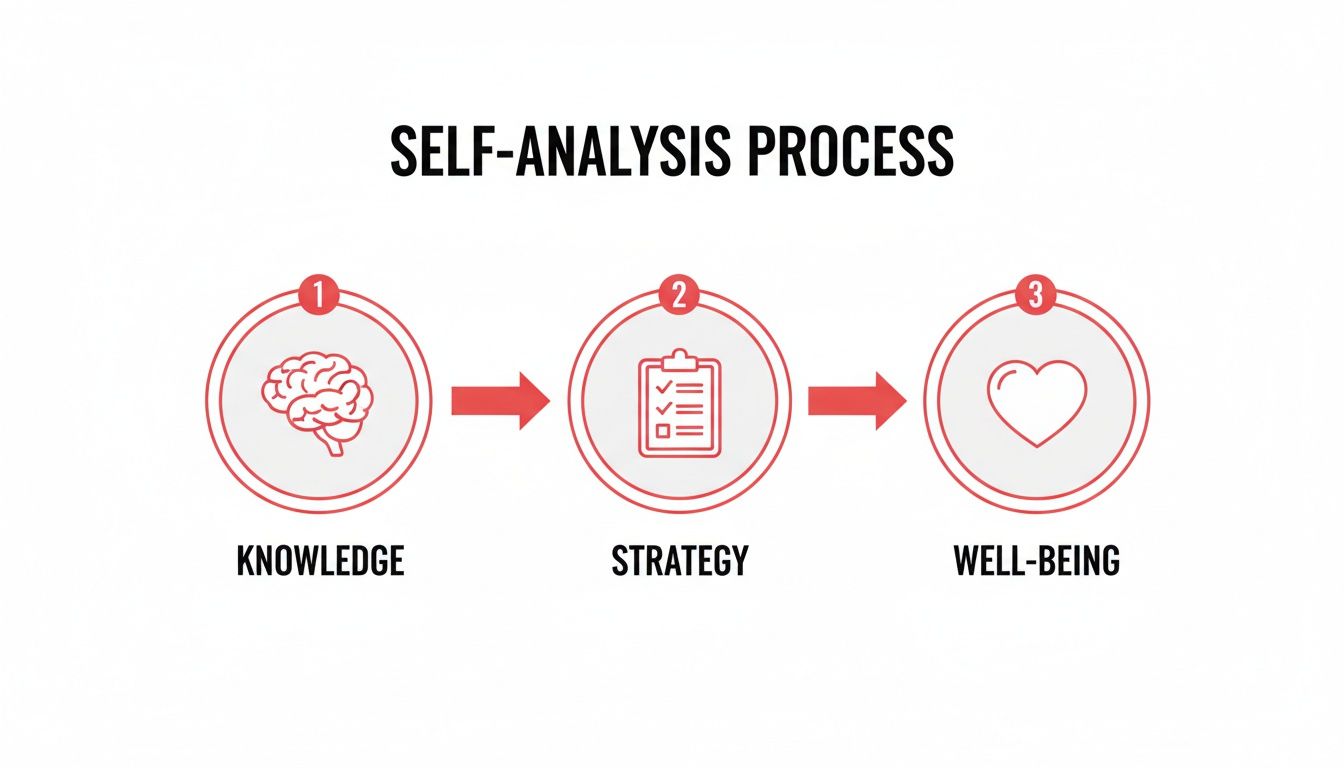
As you can see, a successful retake hinges on balancing your knowledge gaps, your test-taking strategy, and your personal well-being. Neglect one, and the other two will suffer.
From Passive Review To Active Recall
The single biggest trap students fall into is passive learning. Re-reading First Aid or re-watching videos feels productive, but it’s a shortcut to poor retention. Your new schedule absolutely must be built around active recall—forcing your brain to pull information out, not just recognize it on a page.
Here’s how you make that critical shift:
- Lead with Questions: Your QBank (like UWorld) is now the heart of your curriculum. Instead of reading a chapter and then doing questions, flip the script. Do a block of questions first to pinpoint exactly what you don't know. Then, dive into resources like First Aid or Pathoma to fix those specific gaps.
- Teach the Walls: After reviewing a concept, close the book and explain it out loud as if you were teaching a classmate. Can't explain it simply? You don't know it well enough yet. This technique is brutally effective at exposing fuzzy understanding.
- Build Your Own Tools: Stop relying solely on pre-made flashcard decks. The physical act of creating your own Anki cards from your incorrect QBank answers forces you to process, synthesize, and rephrase the information. That process is the learning.
Structuring Your Dedicated Period 2.0
A typical retake study block runs somewhere between six to ten weeks. This is the sweet spot—enough time to rebuild your foundation without dragging things out to the point of burnout. Your schedule needs to be realistic and, most importantly, sustainable. That means scheduling your downtime is just as important as scheduling your study blocks.
Below is a sample framework to get you started. The key is to customize it based on your personal weak spots, loading them into the "Primary Focus" slots in the early weeks when your mind is freshest.
This table provides a high-level look at how you might structure an 8-week retake period, balancing new learning with consistent review and assessment.
Sample 8-Week Retake Study Block
| Week | Primary Focus (e.g., Weakest Subjects) | Secondary Focus (e.g., System-Based Review) | Daily QBank Goal | Weekly Assessment |
|---|---|---|---|---|
| Weeks 1-2 | Biochemistry, Pharmacology | Cardiology, Pulmonology | 40-80 Timed Qs | Review incorrects, identify patterns |
| Weeks 3-4 | Pathology, Microbiology | Renal, GI | 80 Timed Qs | Subject-specific NBME practice test |
| Weeks 5-6 | Physiology, Anatomy | Endocrine, Repro | 80 Timed Qs | Full-length NBME or UWSIM1 |
| Weeks 7-8 | Mixed Review of All Subjects | High-Yield Rapid Review | 80-120 Timed Qs | UWSIM2, Free 120, final review |
This kind of structure ensures you hammer your weak areas hard from the get-go while spiraling back to review other material consistently. Notice the weekly assessments—these are non-negotiable. They are your progress reports, telling you what's working and what needs to change.
A well-designed plan is your roadmap. It eliminates the daily paralysis of "What should I study today?" and replaces it with a clear, intentional process. In the long run, consistency beats intensity every single time.
Knowing When To Get Expert Help
Sometimes, self-diagnosing and self-correcting just aren't enough. If you're struggling with accountability, have deep and persistent content gaps, or just feel completely overwhelmed trying to build a new plan from scratch, bringing in a professional can be a game-changer. One-on-one tutoring offers a level of personalized feedback that no book or video ever will.
A great tutor can help you:
- Dig deep into your QBank performance data to spot subtle error patterns you might miss.
- Craft a truly customized study schedule that targets your specific weaknesses from day one.
- Teach you high-yield test-taking strategies for everything from time management to dissecting tricky question stems.
- Provide the external structure and accountability that is often essential to staying on track.
Going down this road alone is incredibly daunting, but a structured, intelligent plan makes all the difference. For a more detailed look at structuring your comeback, check out our complete USMLE retake strategy guide for second attempts, which dives deeper into timelines and resource management. The goal is to build a plan that not only closes your knowledge gaps but also rebuilds the confidence you need to walk into that testing center and succeed.
Addressing the Impact on Your Residency Application
Let's be honest: one of the first thoughts after seeing a failing Step 1 score is, "How much did this just hurt my residency chances?" It's a completely valid fear, and it’s important to face it head-on. The good news is that a single failure is not an automatic application killer, but you have to be strategic about how you handle it.
Your USMLE transcript is a permanent record. Every attempt—pass or fail—is listed, and this entire document goes out to every single program you apply to via the Electronic Residency Application Service (ERAS). There’s no hiding it, so don't even think about trying. Your only move is to own it, fix it, and frame it as a story of resilience.
This has become a more common reality for students. When the exam switched to pass/fail in 2022, the first-time pass rates took an unexpected hit. For U.S. MD students, the rate dropped from 95% in 2021 down to 91% in 2022. The overall rate for all takers fell even more, from 88% to 82%. This isn't just a statistic; it means more of your peers are in the same boat, and programs are seeing this more often.
How It Shows Up in Your MSPE
Your Medical Student Performance Evaluation (MSPE), or "Dean's Letter," is your school’s official summary of you as a student. They are required to report your complete USMLE history, which includes noting any failed attempts.
But the MSPE is more than just data; it includes a narrative. This is where your proactivity pays off. The Dean of Student Affairs or your advisor will work with you, and a strong retake score, coupled with your mature handling of the situation, gives them something positive to write about.
A comment in your MSPE might read something like this:
"After an initial unsuccessful attempt, [Your Name] undertook a dedicated period of study, successfully passed the USMLE Step 1 on [Date], and has since excelled in their clinical rotations."
This phrasing gets straight to the point but immediately pivots to your comeback and your strong performance afterward.
Crafting Your Narrative for Interviews
If an interviewer brings it up—and they just might—your response can be a make-or-break moment. This is your chance to show self-awareness, grit, and maturity. A weak response sounds defensive or is full of excuses. A powerful one is honest, reflective, and focuses on growth.
Here’s a simple framework for your answer:
- Acknowledge It Directly: Start clean. "Yes, it's true I didn't pass Step 1 on my first try." No excuses.
- Explain What You Learned: Show them you diagnosed the problem. "I realized my study strategy was too passive. I was reading and highlighting but not truly testing my understanding of pathophysiology."
- Detail Your Corrective Actions: Be specific about what you did to fix it. "I completely changed my approach. I built a new schedule around active learning, focused on dissecting QBank explanations, and met with a faculty mentor to target my weak areas."
- Connect It to Your Strengths: Frame the whole experience as a net positive. "Honestly, that experience taught me how to critically assess my own weaknesses and build a plan to overcome a major obstacle. I know that's a skill I'll need every day as a resident."
The goal isn't to dwell on the failure. It's to pivot quickly to the solution and what you gained from the process. Program directors want residents who are resilient and coachable. A well-told story about a failed USMLE Step 1 can demonstrate those qualities more powerfully than a perfect record ever could.
Managing Academic and Application Timelines
A failed Step 1 exam almost always means a delay. Most medical schools won't let you start core clinical rotations without a passing score. This can push your timeline back by months, potentially delaying your graduation and shifting your residency application into the next year's cycle.
While that delay can feel devastating at first, it's also an opportunity. Use that extra time to strengthen the rest of your application. Can you get involved in a research project? Can you get more hands-on clinical experience? Is there a leadership role you can take on?
To figure out where to focus, check out our guide on what programs look at for ERAS. This can help you pinpoint areas to build up. By using this unexpected time strategically, you can create a far more compelling and well-rounded profile for when you do apply.
Building Resilience and Protecting Your Mental Health

Let's be honest: the academic strategy for a Step 1 retake is only half the battle. The other half is an absolute mental marathon, and ignoring your well-being is the fastest way to sabotage your own comeback.
Seeing a failed USMLE Step 1 score can unleash a powerful wave of shame, anxiety, and full-blown imposter syndrome. If you let those feelings run the show, they can be far more damaging than any knowledge gap.
Protecting your mental health isn't a "nice-to-have"—it's a non-negotiable part of your new study plan.
The very first thing you need to do is give yourself permission to feel the disappointment without letting it define you. This is a huge setback, and it's completely normal to feel angry, frustrated, or embarrassed. Acknowledging those feelings is a lot healthier than trying to shove them down.
Cultivating a Robust Support System
Isolating yourself is one of the most common—and most dangerous—reactions to news like this. Now is the time to lean on your support system, not push it away. This isn’t about broadcasting your score to the world; it’s about being strategic about who you let into your inner circle.
Your support network should have a few key players:
- A Faculty Mentor or Advisor: This is your institutional guide. They can be a powerful advocate for you within the school and help you navigate the official process.
- Trusted Peers: Find one or two close friends in med school you can be completely honest with. Chances are, they either know someone who's been through this or can just be a good listening ear.
- Family and Friends Outside Medicine: Having people who love you for you, not for your test scores, is essential. They provide a much-needed escape from the med school bubble and help you regain perspective.
- Professional Help: Don't overlook your school's counseling and psychological services. These professionals are a confidential, invaluable resource trained to help students navigate this exact kind of stress.
You are not the first person to go through this, and you won't be the last. Historical data from six Midwestern med schools (1997-2002) showed that while only about 2.5% of their students failed Step 1 on the first try, the national average was much higher at 6.3%. This difficult experience is a known part of the medical education journey.
The Pillars of Cognitive Endurance
Your brain is the only tool you have to prepare for this exam. Just like an athlete conditions their body, you have to condition your brain. This all comes down to the non-negotiable basics of self-care.
When stress skyrockets, these fundamentals are usually the first things to go. But right now, they are what you need the most.
- Sleep: No excuses—aim for 7-8 hours of quality sleep a night. Sleep is when your brain actually consolidates memory. Sacrificing it for a few more frantic hours of studying is completely counterproductive.
- Nutrition: Your brain is an energy hog. Fuel it with whole foods, lean proteins, and complex carbs, not just a roller coaster of caffeine and sugar. Stable blood sugar equals stable focus.
- Exercise: Even just 20-30 minutes of moderate physical activity can dramatically cut stress hormones like cortisol and give you an endorphin boost. A walk, a run, a workout—it’s a high-yield investment in your mental clarity.
Your resilience is your greatest asset in this process. It's not about being invincible; it's about your ability to recover and adapt after a setback. Every act of self-care is an act of building that resilience.
Learning to reframe failure is a skill that will serve you for your entire career. The principles that help athletes bounce back are directly applicable here; you can explore strategies to Conquer Failure In Sport and turn this setback into an opportunity for growth.
This is also a prime time to recognize the signs of true mental exhaustion. It's critical to understand the difference between stress and burnout, and our guide on managing USMLE exam burnout can help. This journey isn't just about passing an exam; it's about learning the resilience that will sustain you as a physician for decades to come.
Answering Your Most Pressing Questions About a Failed Step 1
When that "Fail" result pops up, a thousand questions probably flood your mind. The uncertainty can feel paralyzing, but getting clear, direct answers is the first step toward regaining control.
Let's cut through the noise and tackle the biggest questions I hear from students in your exact position.
How Does This Affect Matching Into a Competitive Specialty?
Let’s be direct: a failed Step 1 attempt makes a tough road even tougher for specialties like dermatology, neurosurgery, or orthopedics. Program directors will see the attempt on your transcript, so it’s not something you can hide.
But is it an automatic disqualifier? No. It just means your comeback strategy has to be flawless.
This is where you prove your resilience. You'll need to channel this setback into motivation for a stellar Step 2 CK score, honor your clinical clerkships, secure glowing letters of recommendation, and get involved in meaningful research. You have to build a narrative of growth.
It’s also critical that you own it. You need to be prepared to address the failure maturely in your application and interviews—framing it as a formative experience that taught you grit and forced you to overhaul your study habits. Working with an advisor to craft this story is non-negotiable.
How Soon Should I Retake The Exam?
The single biggest mistake I see students make is rushing into a retake. I get it—you want to put this behind you as quickly as possible. But that’s a recipe for a second failure.
Most schools have policies on this, but a solid plan almost always involves a 6- to 12-week dedicated study period.
This isn't just about re-reading First Aid. This is the time to do a deep, honest diagnostic of what went wrong, systematically fill your knowledge gaps, and rebuild your confidence. Your decision on a date should be made after you’ve diagnosed the problem, and always in consultation with your academic advisor. The goal is to retake it once and be done.
A failed Step 1 isn't a sprint to redemption; it's a marathon of meticulous preparation. Give yourself the time you need to guarantee a pass on the next attempt. Your future self will thank you.
Should I Change All My Study Resources?
Probably not. It’s rarely the resources themselves that are the problem; it’s how you were using them. Think about it—materials like UWorld and First Aid are the gold standard for a reason.
Instead of a total resource overhaul, let’s analyze your methods first.
- Were you passively reading First Aid? The right way is to use it as a scaffold, actively annotating it with insights you gain from your Qbank questions. It should be a living document, not a novel.
- Were you truly learning from your UWorld mistakes? This means spending more time dissecting the explanations than you did answering the question itself. It means creating detailed notes or Anki cards for every single concept you missed.
Now, this is a good time to be strategic about supplementing. If pathology was a disaster, adding Pathoma is a smart move. If micro and pharm were your downfall, Sketchy could be a game-changer. And honestly, investing in one-on-one tutoring is one of the most powerful things you can do for personalized feedback and accountability.
What Is the Maximum Number of Attempts?
The official USMLE program has a hard limit: you get four attempts for any Step exam. If you fail Step 1 a fourth time, you are permanently ineligible to continue. There are no exceptions to this rule.
It's also crucial to know that your medical school almost certainly has its own, stricter policies. Many institutions will move toward dismissal after a second or third failed attempt. You absolutely must sit down and review your school's academic standing policies. Treat this next attempt with the seriousness it deserves—your only goal is to pass.
Navigating a failed USMLE Step 1 is tough, but you don’t have to figure it all out on your own. The expert tutors at Ace Med Boards specialize in creating personalized comeback strategies that target your weaknesses and rebuild your test-taking confidence. Schedule a free consultation today to see how we can help you turn this setback into your success story.

