
Applying to medical school is a marathon, but for some high-achieving applicants, the Early Decision Program (EDP) offers a tempting shortcut. This path involves submitting one application to one dream school, with the promise of a binding decision by October 1st. Committing to an EDP is a high-stakes, high-reward strategy that can save significant time, money, and stress, but only if you are an exceptionally strong candidate for that specific institution.
The risk is substantial. If you apply ED and are rejected, you re-enter the regular application pool late, competing for seats at schools that have already begun filling their classes. This guide is designed to help you navigate the complex world of early decision medical schools and determine if this accelerated route is right for you. We will dissect the strategic pros and cons, detail exactly who should (and should not) consider applying ED, and provide a comprehensive roundup of the essential platforms and resources needed to craft a successful application.
This article provides a direct path to the information you need, complete with screenshots and links to each critical resource. You will learn how to:
- Assess your competitiveness for a binding program.
- Identify schools offering an Early Decision Program that align with your profile.
- Navigate deadlines and unique application requirements for top EDPs.
- Leverage expert advice to build a standout application.
Before you commit to a single school, this guide will provide the clarity and strategic insight necessary to make a confident, well-informed decision. Let's determine if this high-stakes path is your ideal route to a white coat.
1. Ace Med Boards
For pre-medical students aiming for one of the nation's highly competitive early decision medical schools, a flawless application is non-negotiable. Ace Med Boards distinguishes itself as a premier, one-on-one admissions consulting and exam preparation service designed to provide that critical edge. Its core strength lies in its personalized, high-touch approach, which moves beyond generic advice to build a comprehensive application strategy tailored to each student's unique profile.

Unlike larger, more formulaic services, Ace Med Boards pairs applicants with experienced physician advisors who provide direct mentorship through every stage of the admissions process. This encompasses everything from school selection and personal statement development to MCAT preparation and mock interviews, ensuring every component of an early decision application is optimized to impress admissions committees.
Key Strengths and Strategic Advantages
Ace Med Boards’ value proposition is built on targeted, results-driven support. The service excels in deconstructing the complex admissions landscape and translating it into actionable steps for applicants.
- Holistic Application Curation: The service focuses on creating a cohesive application narrative. Advisors work with students to strategically frame their experiences, from research and clinical hours to personal essays, ensuring they align perfectly with the mission and values of their target ED school.
- Elite MCAT Preparation: Recognizing the MCAT's pivotal role, especially for ED candidates, Ace Med Boards offers specialized tutoring that emphasizes high-yield content mastery and test-taking strategy. Tutors focus on question analysis and time management, with student testimonials frequently citing significant score increases.
- Interview Mastery: The platform provides intensive, school-specific interview coaching, including Multiple Mini Interview (MMI) and traditional formats. This preparation is crucial for ED applicants who must excel in their single, high-stakes interview.
- Flexible and Confidential Support: All sessions are conducted online, offering maximum flexibility to fit a busy pre-med schedule. The one-on-one format guarantees confidentiality, allowing students to openly discuss weaknesses and strategize improvements.
How to Maximize Ace Med Boards for Your ED Application
To leverage the service effectively, prospective applicants should start with the free initial consultation. This session is designed to assess your candidacy, identify areas for improvement, and create a customized roadmap for your application cycle.
Expert Tip: When working with your advisor, be transparent about your entire academic and extracurricular history. The more information they have, the better they can help you craft a compelling and authentic narrative that stands out to a specific early decision medical school admissions committee.
Beyond admissions, the platform's focus on exam strategy can serve you long after acceptance. Mastering high-yield learning techniques is essential for medical school coursework and board exams. To maximize retention and prepare for rigorous exams like the medical boards, learning how to create effective flashcards can be an invaluable strategy.
Access and Pricing
Ace Med Boards operates on a consultation-based model. Specific package rates are not listed publicly on their website, as all plans are customized to the student's needs.
- Website: https://acemedboards.com
- Pricing: Custom packages are created after a free initial consultation. You can book this directly on their site or contact them for a tailored quote.
- Availability: Services are fully online and available to students globally.
This personalized structure, while less transparent than fixed-price models, ensures applicants only pay for the services they truly need, making it a highly efficient investment for a successful ED application.
2. AAMC Students & Residents – Early Decision Program (EDP) hub
Before you even think about which specific early decision medical schools you might target, your first and most crucial stop should be the AAMC’s official Early Decision Program (EDP) hub. This isn't just another resource; it's the authoritative source, the rulebook for the entire EDP process. Think of it as the constitutional document for your early decision application.
The primary function of this platform is to provide the definitive policies and "traffic rules" that govern every AMCAS-participating school’s EDP. It’s the one place you can find the official, cycle-updated deadlines and regulations straight from the organization that manages the application service.
Why It's an Essential First Stop
The AAMC EDP hub stands out because it provides policy-level clarity that no third-party site can match. While other resources offer advice and school lists, the AAMC page explains the binding nature of the program, the single-school application rule, and the official key dates. This is where you confirm the non-negotiable deadlines for the entire process.
For instance, you'll find the universal dates that apply to most programs:
- Application Submission Deadline: August 1
- Decision Notification Date: October 1
It also clarifies what happens if you aren't accepted. The page explains that your application is automatically rolled into the regular decision pool, allowing you to apply to other medical schools. This is a critical piece of information for strategic planning.
How to Use This Resource Effectively
This website is free to access and should be your foundational reference. To get the most out of it, use the following approach:
- Read the Rules First: Before getting emotionally invested in a particular school, thoroughly read every section of the AAMC’s EDP page. Understand the commitment you are making.
- Confirm Timelines: Note the official AMCAS submission deadline for EDP applications. This is your master deadline, regardless of what individual schools might suggest.
- Understand the Consequences: Pay close attention to the section on what happens if you are accepted, rejected, or deferred. An EDP acceptance is a binding commitment, and this site lays out the official terms.
While the AAMC provides the rules, it doesn't offer personalized strategy. You won’t find school-by-school comparisons or advice on whether your profile is a good fit. Its purpose is purely informational, providing the official framework. After reviewing the AAMC rules, you'll be better prepared to research individual schools and refine your application strategy, including preparing for interviews. If you want to ace that crucial EDP interview, be sure to review common medical school interview questions to build your confidence.
- Website: AAMC Early Decision Program
- Pros: The most accurate, up-to-date policy information; direct from the official source.
- Cons: Lacks school-specific data and personalized strategic advice.
3. AAMC MSAR (Medical School Admission Requirements)
Once you’ve mastered the rules of the game with the AAMC’s EDP hub, your next stop is the Medical School Admission Requirements (MSAR) database. This is the AAMC’s official, comprehensive profile tool for every accredited MD program. If the EDP hub is the rulebook, MSAR is the detailed player-by-player scouting report you need to build your target list of early decision medical schools.
The primary function of MSAR is to provide searchable, verified, school-specific data. It's the central platform where you can filter schools to see who offers an Early Decision Program, check their specific deadlines, and, most importantly, analyze their admissions statistics to see if your profile is a competitive match for their EDP pool.
Why It's an Essential Research Tool
MSAR is unparalleled because it aggregates official data in one place, saving you from the tedious and often confusing process of hunting down information on individual school websites. You can directly compare programs side-by-side, evaluating everything from MCAT and GPA ranges for matriculants to residency restrictions and interview formats. This data is critical for making an informed, strategic choice for your single, binding application.
For instance, you can use MSAR to answer crucial questions like:
- Does this school favor in-state applicants for its EDP?
- Is my MCAT score within the median range of their last accepted class?
- What are their specific prerequisite course requirements?
This level of detail helps you move beyond a school's reputation and make a data-driven decision, which is essential when the stakes are as high as they are with an early decision application.
How to Use This Resource Effectively
While some basic school profiles are free, full access to the detailed data requires a one-year subscription (currently $28), though it is complimentary for Fee Assistance Program (FAP) recipients. The data-dense interface can feel overwhelming at first, but a structured approach makes it powerful.
- Filter for EDP: Start by using the search filters to display only schools that offer an Early Decision Program. This immediately narrows your focus.
- Profile Analysis: For each school on your shortlist, dive deep into the "Admissions" and "Matriculant Data" tabs. Compare your GPA and MCAT score to their 10th, 50th, and 90th percentile ranges. A strong EDP candidate should ideally be at or above the median (50th percentile).
- Check for Restrictions: Carefully review each school’s policies on in-state versus out-of-state applicants and any other specific EDP eligibility criteria. Some schools have a strong in-state preference that could put you at a disadvantage.
MSAR gives you the "what" and "who" of admissions data but not the "how." It won't tell you how to structure your application narrative or how to prepare for a high-stakes MCAT. For that, you need a targeted strategy. A solid plan, like an effective MCAT study schedule, is what translates your strong stats into a successful application.
- Website: AAMC Medical School Admission Requirements
- Pros: Centralized, verified data saves immense research time; allows for direct, data-driven school comparisons; complimentary access available via FAP.
- Cons: Full access requires a paid subscription; the data-rich interface can have a learning curve for new users.
4. AMCAS (American Medical College Application Service)
If the AAMC's EDP hub is the rulebook, the American Medical College Application Service (AMCAS) portal is the official playing field. This is where you actually execute your plan to apply to early decision medical schools. It’s the centralized platform where you will build your primary application, designate your single EDP choice, and submit it by the strict August 1 deadline.
The core purpose of AMCAS is to streamline the application process for both applicants and medical schools. For EDP candidates, its most critical function is the program type designation. This is where you formally commit to a single school’s early decision program, a choice that locks your application to that institution until a decision is rendered on or before October 1.
Why It's an Essential Application Hub
AMCAS is the non-negotiable gateway for applying to nearly all MD-granting schools in the United States. Its value lies in its standardization. You enter your coursework, experiences, letters of evaluation, and personal statement once, and the platform delivers it to your designated school. The site provides the official Applicant Guide, processing timelines, and status updates, ensuring you have the authoritative information needed to complete your submission correctly.
For early decision applicants, this standardization is crucial. The portal ensures your application meets universal requirements before being transmitted. It also lists all participating schools and their deadlines, serving as a final checkpoint. The platform is where you pay the submission fees, although a Fee Assistance Program (FAP) is available for eligible applicants.
How to Use This Resource Effectively
This website is the vehicle for your application, so meticulous use is required. Your entire EDP strategy culminates here.
- Start Early and Build Your Application: Do not wait until late July to begin. The "Work and Activities" section, for instance, functions like a detailed CV. To present your experiences compellingly, consider reviewing high-quality medical resume examples and templates for formatting ideas.
- Select "Early Decision Program" Correctly: When you add a medical school to your application, you must accurately select the "Early Decision Program" type. This is the official action that commits you to that school's binding process.
- Monitor Your Status: After submission, use the AMCAS portal to track your application's processing status, from receipt of transcripts to verification. Keeping a close eye on this ensures there are no preventable delays.
AMCAS is a purely transactional platform; it offers no strategic advice or feedback on your competitiveness. It simply executes your commands. Therefore, it's essential to have your strategy finalized before you hit submit. Using a comprehensive medical school application checklist can help ensure you've prepared every component to the highest standard before committing through AMCAS.
- Website: AMCAS (American Medical College Application Service)
- Pros: The single, official portal for almost all MD EDP applications; provides up-to-date processing timelines and status communications.
- Cons: Application fees can be substantial; offers no real-time feedback on your competitiveness, requiring external strategic planning.
5. MedSchoolCoach
After you've grasped the official rules from the AAMC and explored data-rich resources, you may be left with a critical question: "Is applying to early decision medical schools the right move for me specifically?" This is where a personalized advising service like MedSchoolCoach comes in. It transitions your research from general information to a tailored, strategic action plan.
MedSchoolCoach is a physician-led advising firm that offers one-on-one guidance to help you navigate the high-stakes EDP process. Their primary function is to provide an expert, objective assessment of your candidacy and help you decide if the significant commitment of an early decision application aligns with your profile and goals.
Why It's an Essential Strategic Stop
What sets MedSchoolCoach apart is its focus on individualized strategy. While other sites give you the data, their advisors (often physicians with admissions committee experience) help you interpret that data in the context of your unique application. They can analyze your MCAT score, GPA, research experience, and personal narrative to provide a frank assessment of your chances.
This is invaluable for the EDP, where a miscalculation can cost you an entire application cycle. An advisor can help you create a curated list of EDP schools where your profile is most competitive or, just as importantly, advise you against EDP if your application would be stronger in the regular decision pool.
How to Use This Resource Effectively
This is a premium, paid service, so you should use it strategically to maximize your investment. While browsing their site and blog is free, the core value comes from direct consultation.
- Book an Initial Consultation: Start with a one-time consultation to discuss your profile. Be prepared with your stats, a list of potential schools, and specific questions about whether EDP is a viable path for you.
- Evaluate Your Advisor Fit: The quality of your advice depends heavily on the advisor you work with. Do your due diligence, read reviews, and ensure the person you’re matched with has relevant experience.
- Use Their Expertise for a Pivot Plan: One of the biggest benefits is their ability to help you pivot. If they advise against EDP, they can immediately help you build a robust strategy for the regular cycle, a crucial step in understanding the entire process of how to get into medical school.
While MedSchoolCoach offers comprehensive packages covering personal statements and interview prep, their most significant contribution to your EDP journey is the upfront, personalized reality check. Their guidance can either give you the confidence to commit to an EDP application or save you from a potentially disastrous strategic error.
- Website: MedSchoolCoach Early Decision Medical School
- Pros: Practical, individualized recommendations on whether to pursue EDP; can rapidly help pivot to a non-EDP strategy if appropriate.
- Cons: Pricing for packages is not fully public and can be costly; quality and fit can vary by individual advisor, so due diligence is recommended.
6. The Princeton Review – Medical School Admissions (EDP explainer)
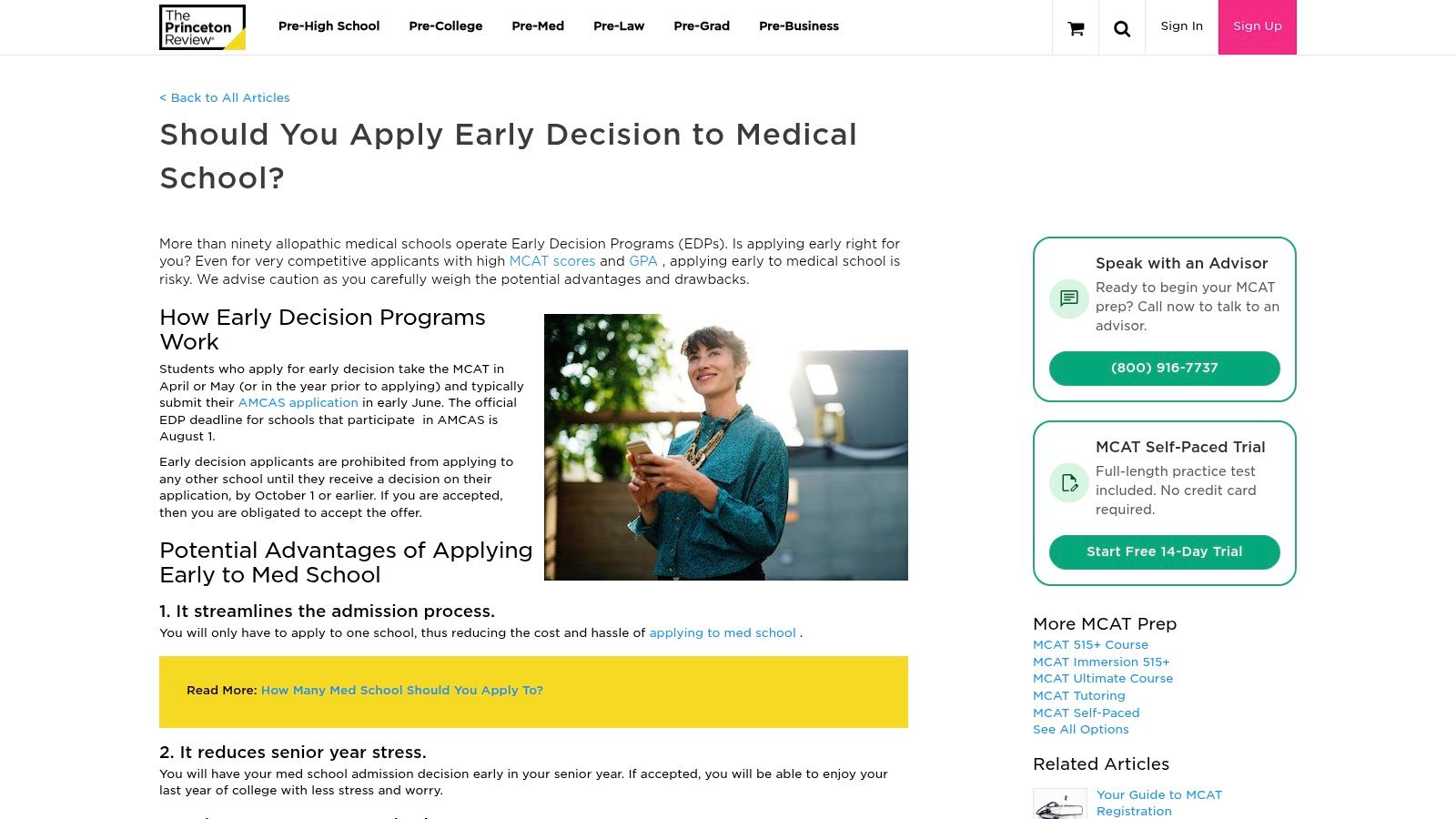
For applicants seeking a blend of free, high-level strategic advice and the option for paid, hands-on guidance, The Princeton Review's EDP explainer is an excellent resource. It functions as both an informative article and a gateway to their comprehensive medical school admissions counseling services. This dual role makes it a practical stop for students who are still deciding how much support they need.
The platform's main purpose is to contextualize the early decision process within a broader admissions strategy. It goes beyond just listing rules and instead focuses on the applicant profile, helping you determine if your stats, story, and school choice align with the high-stakes nature of applying to early decision medical schools.
Why It's an Essential Stop
The Princeton Review excels at framing the "why" behind an EDP application, not just the "how." While the AAMC provides the rules and MSAR gives you the data, this resource helps you analyze the benefits versus the significant risks. It’s designed to prompt self-reflection on whether you are truly the "ideal" EDP candidate that schools are looking for: someone with a strong, targeted application and a compelling reason for choosing one specific institution.
Its strength lies in connecting the EDP decision to other parts of your application, like your MCAT score and personal statement. It bridges the gap between raw data and narrative, which is crucial for a successful application. This is particularly valuable for applicants who feel confident in their metrics but need help articulating their commitment to a single school.
How to Use This Resource Effectively
This platform offers a clear path from information to action. Access to the online explainer is free, but personalized counseling comes at a cost, which typically requires a consultation to determine pricing.
- Use the Free Explainer for Self-Assessment: Read their guidance on the ideal EDP candidate. Honestly compare your profile against their description to gauge if this path is right for you.
- Evaluate the Pros and Cons: Pay close attention to their breakdown of risks. This section can help temper unrealistic expectations and ground your decision-making process.
- Consider a Consultation if Needed: If after reading the free content you feel you need personalized feedback, use their intake process to schedule a consultation. This can help you refine your application narrative, which is just as important as your grades and scores.
While the site offers strong general advice, remember that it's not a substitute for school-specific research. You will still need to visit individual school websites and MSAR for precise data. The guidance here is best used for strategic planning, including helping you understand how to write a powerful personal statement that clearly communicates your fit with your top-choice school.
- Website: The Princeton Review – Early Decision Programs
- Pros: Easy on-ramp for applicants who want both free guidance and purchasable services; large advisor network and established support infrastructure.
- Cons: Counseling pricing typically requires contacting sales and can be expensive; content is general and lacks school-specific cutoff nuances.
7. Student Doctor Network (SDN) – Forums
While official sources like the AAMC and MSAR provide the rules and data, Student Doctor Network (SDN) offers something equally valuable: the human element. This long-standing community forum is where you go for the unofficial, on-the-ground perspective on applying to early decision medical schools. It’s the digital equivalent of a campus coffee shop, filled with pre-meds, current students, and even physicians sharing firsthand experiences.
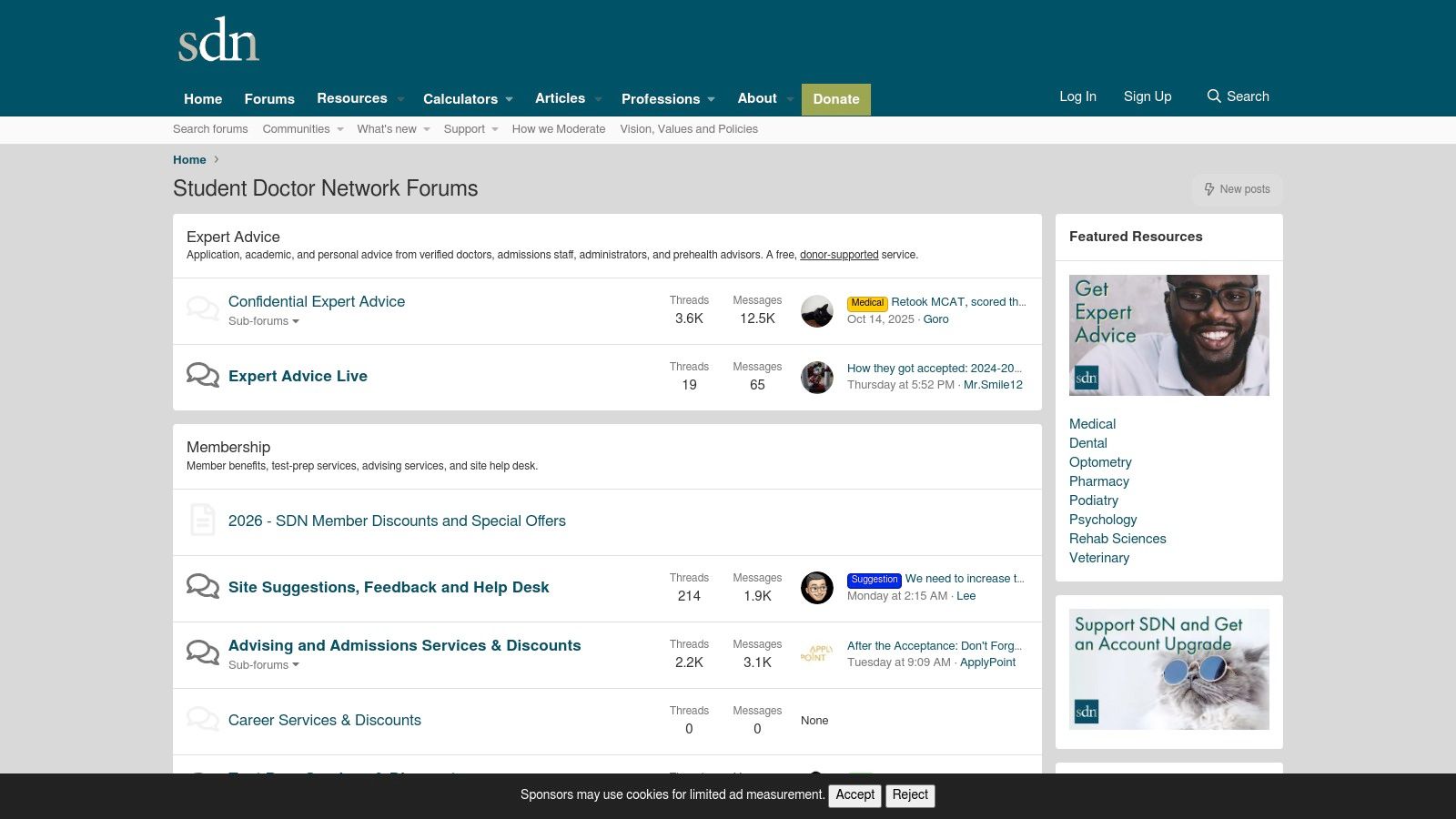
The primary function of SDN is to provide peer-to-peer insights and historical context that you simply can't find on official websites. Here, applicants candidly discuss the strategic trade-offs of the EDP, the nuances of school-specific expectations, and the real-world consequences of being released from an ED commitment on October 1.
Why It's an Essential Resource
SDN stands out because it uncovers the "unwritten rules" and common pitfalls of the EDP process. While a school’s website will give you its deadline, SDN threads will have students discussing how that school’s admissions committee actually treats ED applicants, what the interview experience was like, and how competitive the pool felt in previous cycles. This is where you can gauge the real-world implications of your decisions.
For example, you can find discussions that cover critical questions like:
- How challenging is it to get back into the regular application cycle if you're released on October 1?
- What are the signs that a school truly values its EDP applicants versus just using it to lock in high-stat candidates?
- Do certain schools require pre-application contact or approval, and what was that process like?
This anecdotal evidence provides a rich layer of qualitative data to supplement the quantitative stats from MSAR.
How to Use This Resource Effectively
This platform is completely free to access, but it requires a critical eye to use well. Treat it as a source of hypotheses, not facts, and always verify information with official sources.
- Search Strategically: Use the forum's search function with specific keywords like "[School Name] Early Decision 2024" or "EDP release October 1." This will help you find the most relevant threads.
- Filter by Recency: Pay attention to the dates on posts. Admissions processes change, so information from 2015 may no longer be relevant. Prioritize threads from the last 2-3 application cycles.
- Cross-Reference Everything: If you read on SDN that a particular school has an unspoken preference for in-state ED applicants, treat it as a lead. Then, go to the MSAR and the school's official website to look for data or policies that might support that claim.
SDN is not the place for official deadlines or policies. It’s a resource for strategic thinking, risk assessment, and peer support. Its greatest strength lies in preparing you for the practical realities of the EDP journey, from the initial application to navigating the outcome on October 1.
- Website: Student Doctor Network Forums
- Pros: Real-world, anecdotal insights from peers; highlights common pitfalls and nuances not found in official documents; free to access.
- Cons: Information is unofficial and can be outdated or inaccurate; requires careful verification against official sources.
Early Decision Medical School Resources — 7-Source Comparison
| Item | Implementation complexity 🔄 | Resource requirements ⚡ | Expected outcomes ⭐📊 | Ideal use cases 💡 | Key advantages |
|---|---|---|---|---|---|
| Ace Med Boards | Moderate 🔄 — 1:1 online onboarding and tailored study plan setup | High ⚡ — paid custom packages, regular tutoring time, stable internet | High ⭐📊 — reported measurable score gains (testimonials); not independently verified | Students needing targeted score boosts, exam strategy, or residency/admissions prep | Personalized 1:1 tutoring; flexible scheduling; high‑yield, case‑based approach; free initial consult |
| AAMC Students & Residents – EDP hub | Low 🔄 — policy reference and timelines | Low ⚡ — free official content, minimal time to read | High ⭐📊 — authoritative policy accuracy (EDP rules/deadlines) | Confirming EDP rules, deadlines, and formal implications before committing | Official source; cycle-updated rules; direct AAMC guidance |
| AAMC MSAR | Moderate 🔄 — searchable database; learning filters and comparison tools | Medium ⚡ — free basic profiles, paid subscription for detailed data; time to analyze | High ⭐📊 — verified school stats and historical admissions data for planning | Building and comparing EDP-appropriate school lists and doing school-by-school research | Centralized school data; side-by-side comparisons; FAP may grant access |
| AMCAS | Moderate 🔄 — application workflow with integrated EDP selection | Medium ⚡ — application fees (FAP may apply), documents, processing time | Essential ⭐📊 — official application submission and EDP selection; confirms timelines | Submitting primary MD applications and electing EDP for AMCAS schools | Single standardized application; up-to-date processing and fee information |
| MedSchoolCoach | Moderate 🔄 — scheduling 1:1 advising; variable advisor processes | High ⚡ — paid packages, advisor time, possible travel for interviews | Moderate–High ⭐📊 — individualized strategy and rapid pivots; outcome depends on advisor fit | Applicants deciding whether to pursue EDP who want expert, personalized advice | Physician-advisors with admissions experience; tailored recommendations; broader admissions services |
| The Princeton Review – Medical School Admissions (EDP explainer) | Low 🔄 — free explainer + optional paid counseling | Medium ⚡ — free guidance available; paid counseling packages vary | Moderate ⭐📊 — clear general guidance on EDP benefits/risks; less school-specific nuance | Applicants seeking an approachable overview and optional paid support | Accessible free explainer; national advisor network; integrated MCAT/pre-application services |
| Student Doctor Network (SDN) – Forums | Low 🔄 — browse and search community threads; asynchronous engagement | Low ⚡ — free, time-intensive to sift and verify posts | Variable ⭐📊 — practical anecdotal insights and timing details; not authoritative | Gathering real-world applicant experiences, pitfalls, and cycle anecdotes | Free firsthand reports; long-running threads; school‑specific community insights |
Final Verdict: Is an Early Decision Application Your Best Move?
Choosing to apply to medical school through a binding Early Decision Program (EDP) is one of the most significant strategic decisions in your entire pre-med journey. It's a high-stakes, high-reward pathway that demands absolute confidence, a stellar application, and an unwavering commitment to one specific institution. As we've explored, the EDP is not a shortcut for the average applicant; it is an accelerated track designed for candidates who are a near-perfect fit for their top-choice school.
For the right student, the benefits are immense. An acceptance by October 1st transforms a potentially year-long, stressful application cycle into a triumphant, two-month sprint. It saves time, money, and the emotional energy spent on secondary applications and multiple interviews. However, this path is paved with risk. A rejection or deferral from one of the early decision medical schools can place you at a significant disadvantage, forcing you to re-enter the regular applicant pool late in the game.
Synthesizing Your Strategy: From Information to Action
The tools and resources we've covered are your essential toolkit for making this critical choice. Your task now is to synthesize the information from each one to build a cohesive and personalized application strategy. Don't use these resources in isolation; they work best when used together to create a complete picture of your candidacy and the EDP landscape.
Here’s a practical workflow to guide your decision:
Foundation with AAMC & AMCAS: Start with the official sources. Use the AAMC’s EDP hub to confirm which schools offer the program and the AMCAS timeline to understand the critical deadlines. This is your non-negotiable first step to ensure you have accurate, up-to-date information directly from the governing bodies.
Deep Dive with MSAR: The Medical School Admission Requirements (MSAR) database is your objective reality check. Cross-reference your MCAT score and GPA directly against the median and 90th percentile stats of your target early decision medical school. If your numbers are not comfortably above the median for that specific institution, applying ED is an unnecessary and significant gamble.
Qualitative Insights from SDN: Once you've confirmed your stats are competitive, turn to Student Doctor Network (SDN) forums. Look for threads specific to your target school’s EDP. What do past applicants say about the process? Are there any unspoken preferences or red flags they mention? This is where you gain the nuanced, on-the-ground intelligence that statistics alone cannot provide.
Strategic Refinement with Expert Guides: Use resources from The Princeton Review and MedSchoolCoach to understand the strategic implications. Their explainers can help you articulate why you are a perfect fit for the school in your application essays. They help you move beyond the numbers and craft a compelling narrative that an admissions committee will remember.
The Deciding Factor: A Rigorous Self-Assessment
Ultimately, the decision to apply early boils down to a rigorous and honest self-assessment. Before you commit, you must be able to answer "yes" to all of the following questions with complete certainty:
- Are my stats exceptional? Not just good, but well above the average for my target school.
- Is this my undeniable #1 choice? Would I be thrilled to attend this school and immediately withdraw all other applications upon acceptance?
- Do I have a compelling reason? Can I clearly articulate why this specific school is the only place for me, citing specific programs, research opportunities, or faculty?
- Am I prepared for the outcome? Am I financially and emotionally ready to commit if accepted, and do I have a backup plan if I am deferred or rejected?
If there is any hesitation, any "what if" that gives you pause, the regular decision path is the wiser choice. The EDP is a powerful tool, but only when wielded by the right applicant for the right reasons. Forcing a fit where one doesn't exist is a recipe for disappointment. Applying to early decision medical schools is a strategic move that, when executed correctly, can set you on the fast track to your white coat. Make your choice with clarity, confidence, and a strategy grounded in data and self-awareness.
Navigating the complexities of an Early Decision application requires more than just good grades; it requires a flawless strategy. At Ace Med Boards, our admissions consultants specialize in helping you determine if the EDP is your best path forward and crafting an application that stands out. Schedule a free consultation with Ace Med Boards to ensure your high-stakes move is a winning one.

