
Embarking on the pre-med path is an ambitious and exciting journey, and it begins with a crucial first step: choosing the right undergraduate institution. The sheer volume of schools can be overwhelming, making it difficult to discern which ones offer the robust support, resources, and opportunities necessary for a successful medical school application. This guide is designed to cut through the noise, providing a strategic roadmap to identifying the best colleges for pre med that align with your specific academic and career goals.
We will explore a curated selection of powerful websites and platforms that simplify the college search process. These tools are invaluable for comparing institutions on key metrics like research opportunities, pre-med advising strength, and access to clinical experiences. Instead of spending countless hours navigating individual college websites, you can use these resources to efficiently filter and evaluate your options.
This article provides a detailed roundup of the most effective college search platforms, complete with screenshots and direct links for easy access. We'll show you exactly how to use each tool to find programs that not only have strong science curricula but also provide the comprehensive ecosystem needed to build a competitive medical school application. Let's find the perfect launchpad for your future in medicine.
1. Niche
Niche offers a user-friendly starting point for students beginning their search for top colleges for pre med. Its annually updated "Best Colleges with Pre‑Medicine Studies" ranking provides a quick, digestible overview of programs across the country, making it easy to build an initial list of schools to investigate further. The platform excels at combining hard data with qualitative feedback, giving you a well-rounded view of each institution.
The interface is clean and modern, designed for easy navigation. You can filter schools by location, cost, selectivity, and even test-optional policies, which is crucial in today's admissions landscape. This allows you to quickly narrow down a massive list of potential schools to those that realistically fit your academic profile and financial needs.
What Makes Niche Stand Out
Niche’s greatest strength lies in its extensive collection of student reviews and "report card" style grades for categories like academics, campus life, and value. While other sites provide statistics, Niche offers a ground-level perspective. You can read firsthand accounts about the quality of pre-med advising, the competitiveness of the student body, and the accessibility of research opportunities.
Pro Tip: Don't just look at the overall ranking. Dive into the "Students" section on a college's profile to read detailed reviews specifically mentioning the pre-med track or science departments. This is where you'll find authentic insights that statistics can't provide.
Key Features and Considerations
| Feature | Description |
|---|---|
| Pre-Med Rankings | Specific, updated list of "Best Colleges with Pre‑Medicine Studies". |
| Student Reviews | Extensive, unfiltered feedback from current and former students. |
| Advanced Filters | Sort by net price, location, SAT/ACT policy, and acceptance rate. |
| Net Price Calculator | Provides an estimate of what you might pay based on family income. |
One important consideration is that "pre-med" is typically an advisory track, not a formal major. Niche's list reflects this, so a school's inclusion may be based on the strength of its biology, chemistry, and other science departments. It’s a great tool for initial discovery, but you’ll want to pair it with direct research into each school’s specific pre-health advising resources. For a deeper dive into what makes a pre-med application strong, you can find valuable tips on how to prepare for medical school and build a competitive profile.
Website: https://www.niche.com/colleges/search/best-colleges-with-pre-medicine-studies/
2. College Board BigFuture
College Board BigFuture serves as an authoritative and foundational resource for students just beginning to explore colleges for pre med. Rather than presenting a simple ranking, it provides a comprehensive overview of the pre-medicine track, detailing the necessary coursework, potential career paths, and the academic rigor involved. This makes it an ideal starting point for high school students who need to understand what a pre-med journey truly entails before they start building a college list.
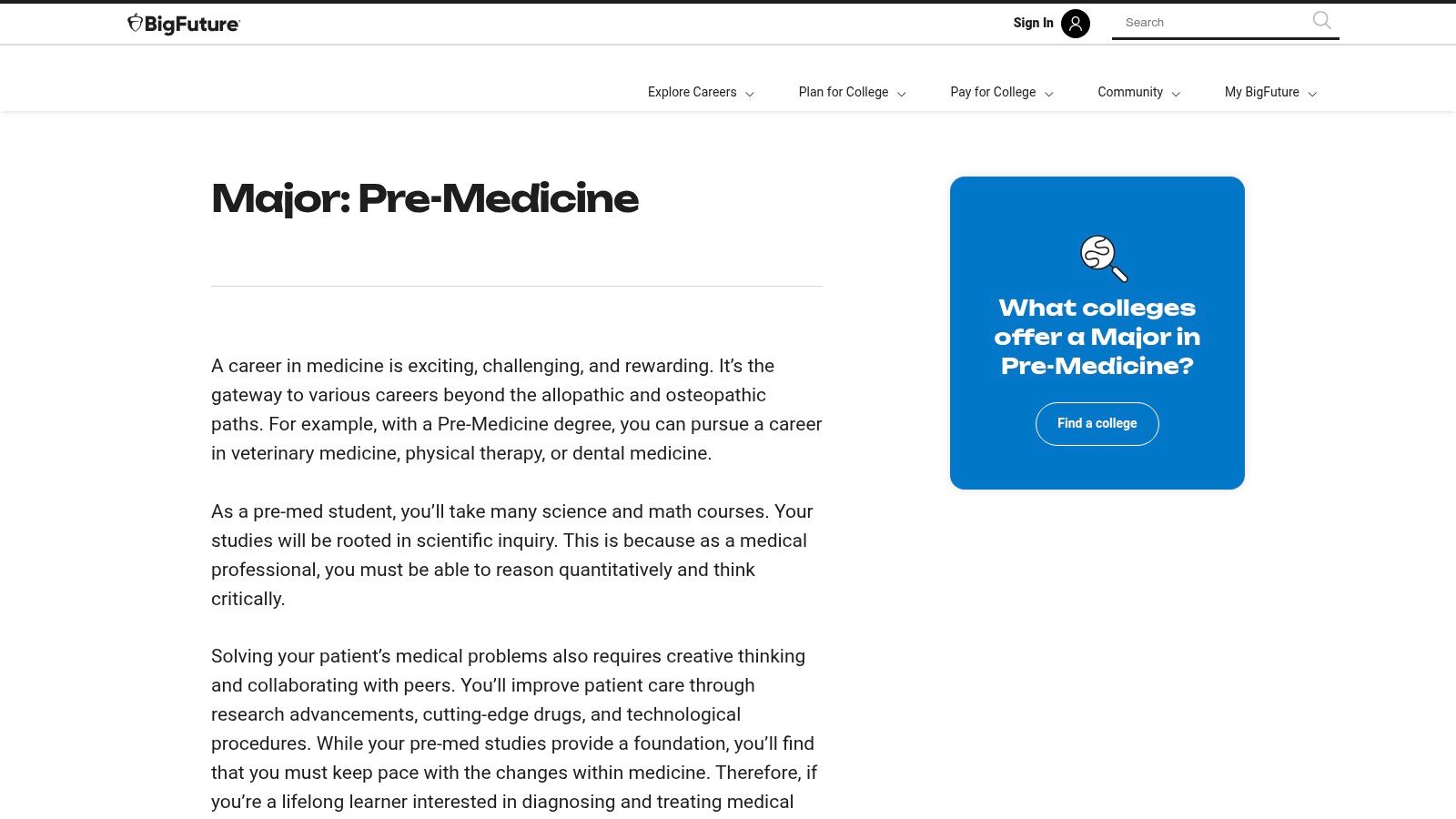
The platform seamlessly integrates this educational content with its powerful college search tools. After learning about the pre-med path, you can immediately search for schools offering strong related majors like biology, chemistry, or neuroscience, and filter them based on your academic profile and preferences. It connects the "what" with the "where," guiding you from initial curiosity to a tangible list of potential schools.
What Makes BigFuture Stand Out
BigFuture’s primary strength is its position as a trusted, data-driven entity. As the creator of the SAT and the CSS Profile, the College Board provides reliable information on admissions requirements, financial aid, and academic programs. Its platform is designed to be a one-stop shop, combining career exploration, college search, and financial aid planning into a cohesive, logical workflow.
Pro Tip: Use the "Major & Career Search" feature first to read the profile on Pre-Medicine. Then, click "Find Colleges" directly from that page. This will automatically filter schools that are strong in related sciences, giving you a curated list to start with.
Key Features and Considerations
| Feature | Description |
|---|---|
| Pre-Med Major Explainer | Detailed guide on coursework, skills, and career outcomes for the pre-med track. |
| Robust College Search | Search filters for majors, location, selectivity, and campus setting. |
| Financial Aid Planning | Integrated resources and direct links to colleges that use the CSS Profile. |
| Career Profiles | In-depth information on what it takes to become a physician and other health professionals. |
One key consideration is that BigFuture does not publish its own "best pre-med colleges" list. The onus is on you to use its tools to identify and compare institutions based on your own criteria. This makes it less of a quick-answer resource and more of a foundational research tool. To prepare for the academic demands of these programs, creating a solid MCAT study schedule early on is a critical step that will complement your college planning.
Website: https://bigfuture.collegeboard.org/explore-careers/majors/health-medicine/pre-medicine
3. CollegeVine
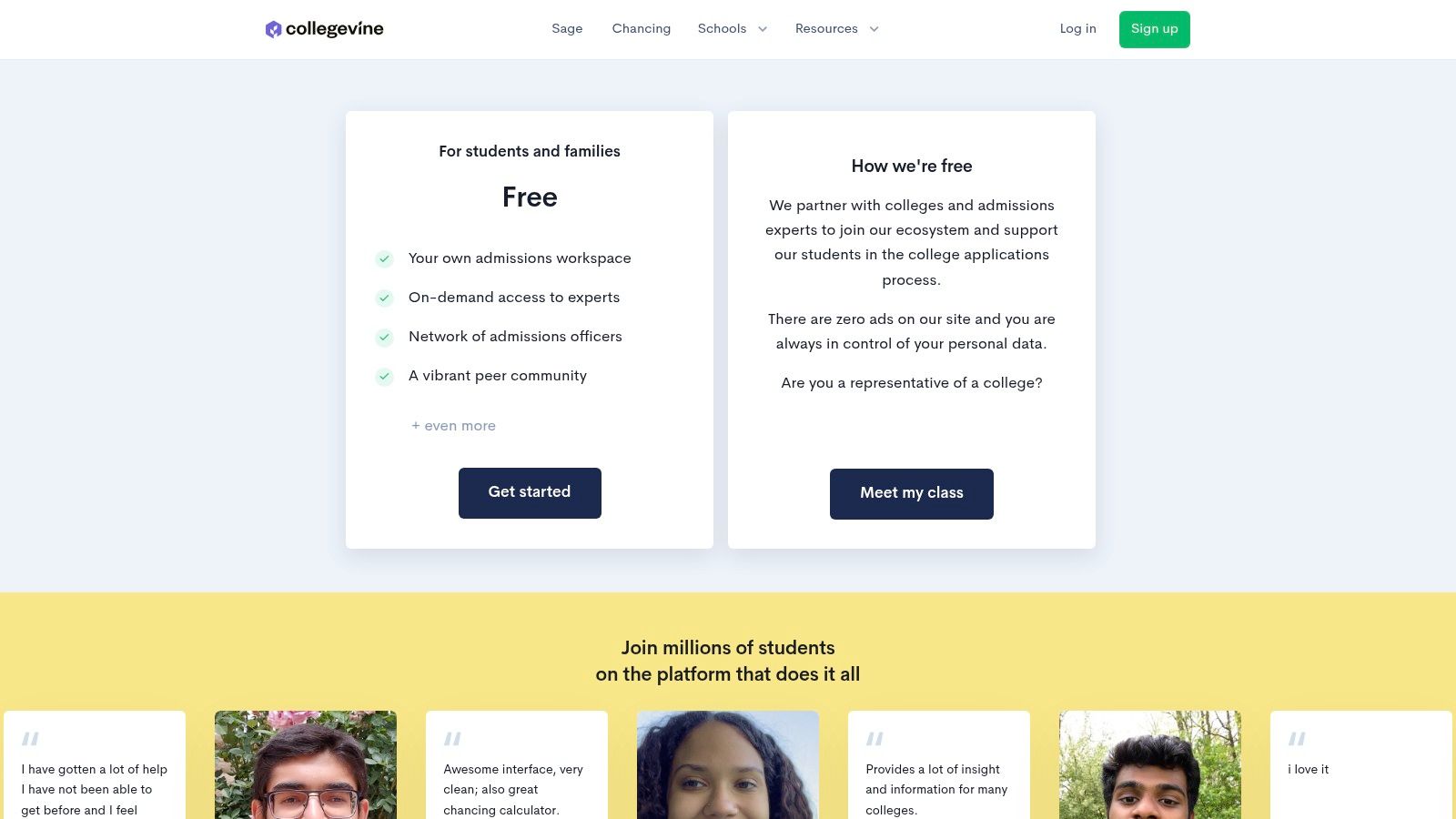
CollegeVine is a powerful, data-driven tool designed to help you strategically plan your pre-med college application journey. It moves beyond simple rankings by offering a personalized "chancing engine" that estimates your odds of admission to specific schools, including many top colleges for pre med. This platform is ideal for students who want a quantitative assessment of their profile to build a balanced and realistic school list.
The platform's core features are free, providing a sophisticated workspace to organize your applications, track deadlines, and compare institutions. By inputting your academic stats, extracurriculars, and other profile details, CollegeVine helps you understand which schools are a reach, a target, or a safety, which is invaluable for a competitive field like medicine.
What Makes CollegeVine Stand Out
CollegeVine’s primary differentiator is its free chancing engine. While other sites use basic GPA and test score metrics, CollegeVine's algorithm incorporates dozens of factors, including the rigor of your coursework, your demographic background, and the depth of your extracurricular activities. This provides a more nuanced and holistic estimate of your admission chances, helping you see how you stack up against other applicants.
Pro Tip: Use the chancing results as a guide, not a guarantee. Pay close attention to the "improvement tips" it provides. If it suggests strengthening your extracurriculars, focus on gaining more hands-on experience, such as seeking out meaningful clinical experience for pre-meds, which significantly boosts any medical school application.
Key Features and Considerations
| Feature | Description |
|---|---|
| Chancing Engine | Provides data-driven estimates of your admission chances at specific schools. |
| School List Builder | An interactive workspace to create and manage a balanced list of colleges. |
| Community & Livestreams | Active Q&A forums and live sessions with admissions experts and current students. |
| Paid Services | Optional, premium services like essay reviews and one-on-one counseling. |
It's important to remember that the chancing model is an estimation tool; its accuracy can vary by school and the completeness of your profile. While the core platform is free, the optional paid services have received mixed feedback regarding their value, so research them carefully before committing. Nonetheless, for building a strategic list of colleges for pre med and gaining a data-backed perspective on your competitiveness, CollegeVine is an exceptional free resource.
Website: https://www.collegevine.com/free
4. Common App
While not a college search tool itself, the Common App is the essential execution platform where your pre-med college search culminates in actual applications. It serves as the primary application hub for over 1,100 institutions, including many of the top colleges for pre med. By centralizing the application process, it allows you to manage deadlines, supplemental essays, and fee-waiver requests for multiple schools from a single, streamlined account.
The platform is designed to reduce the repetitive nature of applying to college, letting you focus on crafting a compelling narrative through your essays and activity descriptions. This is particularly useful for pre-med applicants who need to strategically highlight their research, clinical volunteering, and shadowing experiences to demonstrate their commitment to medicine.
What Makes Common App Stand Out
The Common App’s primary strength is its efficiency. Instead of re-entering your personal data, academic history, and extracurriculars for every school, you do it once. This streamlined process frees up valuable time to focus on school-specific supplemental essays, which are critical for showing genuine interest in a particular college’s pre-med program or research opportunities.
Pro Tip: Use the "Activities" section to your full advantage. Don't just list your pre-med experiences; use the description box to quantify your impact (e.g., "analyzed 50+ patient data sets," "assisted in over 100 hours of clinical care"). This is your chance to frame your application for the admissions committee.
Key Features and Considerations
| Feature | Description |
|---|---|
| Unified Application | Manages applications, deadlines, and school-specific supplements on one platform. |
| Fee-Waiver Guidance | Integrated pathways and resources to request fee waivers for eligible students. |
| Direct Admissions Program | Participating colleges may make proactive admission offers to qualified students. |
| Extensive Resources | Provides guides and support for paying for college and navigating the application process. |
A key consideration is that the Common App is not universal. Some prominent schools with strong pre-med tracks, like MIT, Georgetown, and the University of California system, use their own application portals. Therefore, you must confirm which application system each of your target schools uses. The Common App is an essential tool for organization, but it’s crucial to remember that each application still needs to be tailored to meet the specific medical school admissions requirements and expectations of the undergraduate institution.
Website: https://www.commonapp.org/
5. U.S. Department of Education – College Scorecard
For students prioritizing financial return on investment, the U.S. Department of Education’s College Scorecard is an indispensable, data-driven tool. It strips away marketing and focuses purely on objective outcomes, providing a clear picture of what a degree from a particular institution might mean for your future finances. This is especially critical for aspiring doctors who must plan for the substantial cost of medical school down the line.
The platform allows you to compare colleges based on hard data like average annual cost, graduation rates, and, most importantly, post-graduation earnings. You can drill down to see typical earnings and debt for specific fields of study, such as biology or chemistry, which are common majors for those seeking top colleges for pre med. This helps you evaluate whether a high-cost private university offers a tangible financial advantage over a more affordable state school.
What Makes the College Scorecard Stand Out
Unlike commercial college search sites, the College Scorecard provides unbiased, federally collected data. Its greatest strength is its focus on financial outcomes and student debt. For a pre-med student, this is not just about choosing a college; it’s about making a strategic financial decision for the next decade. Using this tool helps you identify schools that provide a strong science education without saddling you with excessive undergraduate debt before you even apply to medical school.
Pro Tip: Use the "Field of Study" search to compare the median earnings and debt levels for biology or chemistry graduates from different schools. A high median salary could indicate a strong alumni network and robust career services, which are valuable even if your goal is medical school.
Key Features and Considerations
| Feature | Description |
|---|---|
| Standardized Federal Data | Objective information on cost, graduation rates, debt, and earnings. |
| Field of Study Outcomes | Compare salary and debt data for specific majors like biology and chemistry. |
| Advanced Search Filters | Filter schools by degree type, location, size, and other key metrics. |
| Public API Access | Allows researchers and developers to conduct custom, in-depth analyses. |
The main consideration is that the College Scorecard lacks qualitative information. It won’t tell you about the quality of pre-med advising or the campus culture. Its data-heavy interface requires you to interpret the numbers and draw your own conclusions. You will need to use this resource in conjunction with others to build a complete profile of a school, but for a clear-eyed financial assessment, it is unparalleled. Strong quantitative data from this site can complement the narrative you build in your applications, as detailed in guides on how to write a compelling personal statement.
Website: https://collegescorecard.ed.gov/
6. Road2College (R2C Insights)
Road2College’s R2C Insights platform provides a crucial financial lens for students searching for colleges for pre med. Given the high cost of medical school, minimizing undergraduate debt is a strategic priority. This platform is designed specifically to help families understand and compare the actual costs of college by focusing on merit aid and net price, making it an invaluable tool for financially-savvy pre-meds.
The platform allows you to build and manage a college list while comparing financial aid offers that other students have received. This crowdsourced data provides a realistic baseline for what a school might offer, moving beyond the sticker price. For a pre-med student facing eight-plus years of higher education, this focus on affordability is not just helpful, it’s essential for long-term financial health.
What Makes Road2College Stand Out
The core strength of R2C Insights is its crowdsourced financial aid and merit scholarship data. While other sites offer net price calculators, Road2College aggregates thousands of real, anonymous award letters submitted by other families. This allows you to see what kind of merit aid students with similar academic profiles received at specific schools, offering a unique, data-driven glimpse into a college's generosity.
Pro Tip: Use the "Compare Offers" tool to see how schools on your list stack up against each other in terms of merit aid for students with your GPA and test scores. This can help you identify "financial safety" schools that are likely to offer significant aid.
Key Features and Considerations
| Feature | Description |
|---|---|
| Crowdsourced Offer Data | View and compare thousands of real, anonymized merit and financial aid offers. |
| Affordability Filters | Search for colleges based on their history of providing generous merit aid. |
| List Building Tools | Create and manage your college list with a focus on financial fit. |
| Community and Coaching | Access to a large private community and optional paid coaching for personalized advice. |
A key consideration is that the best features, particularly the detailed offer data, are behind a paid subscription. While there is a free tier, the premium access unlocks the most powerful comparison tools. Furthermore, since the data is crowdsourced, its completeness can vary by school and year, so it should be used as a directional guide rather than an exact prediction of your financial aid package.
Website: https://insights.road2college.com/
7. Appily
Appily offers a highly personalized and action-oriented approach for students searching for colleges for pre med. Instead of presenting a static ranking, it uses a free college-match quiz and list-builder to generate tailored recommendations based on your GPA, budget, and intended major. This makes it an excellent tool for organizing the entire application journey, from discovery to submission.
The platform is designed to be a comprehensive planner. It not only helps you find schools but also provides virtual tours, a scholarship search engine, and a detailed task manager broken down by grade level. This organizational focus is particularly helpful for pre-med students who must manage a complex list of academic requirements, extracurriculars, and application deadlines.
What Makes Appily Stand Out
Appily’s greatest advantage is its ability to demystify the college search by making it interactive and manageable. The side-by-side comparison tool allows you to directly evaluate key metrics like tuition, expected GPA, and acceptance rates for your top choices. Its “Direct Admission” feature, available with partner schools, can also provide a confidence boost by granting early, non-binding acceptance offers to qualified students.
Pro Tip: Use the grade-level task planner as soon as you start your high school journey. It helps you stay on track with pre-med course prerequisites, volunteer hours, and test prep, ensuring you build a strong profile long before application season begins.
Key Features and Considerations
| Feature | Description |
|---|---|
| Personalized List Maker | Creates a custom list of colleges based on your academic profile, finances, and major. |
| Side-by-Side Comparisons | Easily compare tuition, acceptance rates, and graduation rates for multiple schools at once. |
| Direct Admission | Potential for early, non-binding acceptance offers from a network of partner colleges. |
| Grade-Level Planner | Provides a checklist of tasks and milestones for each year of high school. |
A key consideration is that Appily is a discovery and organization tool, not a formal ranking system. The quality of its matches depends heavily on the accuracy of the information you provide. While it excels at uncovering affordable or lesser-known programs that are great for pre-med students, you should supplement its recommendations with in-depth research into each school's specific pre-health advising programs and research opportunities.
Website: https://www.appily.com/
Pre-Med College Resources: 7-Way Comparison
| Tool | Implementation complexity 🔄 | Resource requirements ⚡ | Expected outcomes 📊⭐ | Ideal use cases 💡 | Key advantages ⭐ |
|---|---|---|---|---|---|
| Niche | Low — browse rankings and profiles (🔄) | Low — web access and reading time (⚡) | Qualitative campus fit & recent pre‑med–oriented lists; limited outcome metrics (📊; ⭐⭐) | Fast initial school scanning and student‑experience checks | Consumer‑friendly summaries and many student reviews |
| College Board BigFuture | Low — guided explainers and search (🔄) | Low–Moderate — time to use planning tools (⚡) | Clear major expectations and college matches; planning + financial aid links (📊; ⭐⭐⭐) | First‑time planners learning pre‑med coursework and college fit | Authoritative guidance and integrated financial‑aid planning |
| CollegeVine | Moderate — create profile for chancing engine (🔄) | Low core use; optional paid services (⚡) | Data‑driven admission estimates and balanced lists (variable accuracy) (📊; ⭐⭐) | Applicants wanting chancing estimates and list‑building support | Free chancing engine using many profile factors; active community |
| Common App | Moderate — manage applications and supplements (🔄) | Moderate — time to complete essays & supplements (⚡) | Streamlined application submission to many schools; deadline management (📊; ⭐⭐⭐) | Execution phase to submit applications to multiple institutions | Single hub for most U.S. college applications; fee‑waiver support |
| U.S. Dept. of Education — College Scorecard | Low — data lookup; requires interpretation (🔄) | Low — web/API access and analysis time (⚡) | Objective cost, graduation, debt, and earnings metrics for ROI decisions (📊; ⭐⭐⭐) | Comparing affordability, outcomes, and field‑of‑study results | Federal standardized data and public API for custom analysis |
| Road2College (R2C Insights) | Moderate — dashboard + community tools (🔄) | Low free; premium features paid (⚡) | Actionable merit/aid comparison and affordability intelligence (📊; ⭐⭐) | Students prioritizing undergraduate cost and merit awards | Crowdsourced offer comparisons and focused affordability filters |
| Appily | Low — quiz, list maker, and comparisons (🔄) | Low — free core tools; modest time investment (⚡) | Personalized college matches, side‑by‑side comparisons, planner tools (📊; ⭐⭐) | Quick personalization, organizing milestones, finding affordable pre‑med paths | Free personalization, scholarship search, direct‑admit partners |
Your Next Steps: Building a Competitive Pre-Med Application
Navigating the path to medical school begins long before the MCAT. It starts with a single, crucial decision: choosing the right undergraduate institution. As we've explored, the "best" colleges for pre-med are not a one-size-fits-all list. The ideal school is one that aligns with your academic goals, personal learning style, and financial reality, while providing robust support systems for the rigorous journey ahead.
The tools we've detailed, from College Board's BigFuture to the data-rich College Scorecard, are your strategic assets in this search. They empower you to move beyond brand names and focus on the metrics that truly matter for an aspiring physician: strong pre-med advising, ample research opportunities, and a track record of medical school admissions success. Your mission is to use these platforms to build a balanced, well-researched college list that maximizes your potential.
Key Takeaways for Your College Search
Remember these core principles as you refine your list and prepare to apply:
- Look Beyond the Ivy League: A prestigious name is less important than a supportive environment. Focus on schools with dedicated pre-med advising, accessible research labs, and strong ties to local healthcare facilities for clinical exposure.
- Financial Fit is a Strategic Advantage: Minimizing undergraduate debt is a critical, long-term strategy. Tools like Road2College and the College Scorecard are invaluable for identifying institutions that offer generous financial aid, reducing financial stress and freeing you to focus on your pre-med coursework.
- Demonstrate Your Commitment Early: Your application narrative starts now. Medical school admissions committees want to see a consistent, demonstrated interest in medicine. This goes beyond grades and test scores.
Actionable Steps to Take Today
Transforming your research into a compelling application requires deliberate action. Here is your immediate checklist:
- Create a Master Spreadsheet: Use a spreadsheet to track key data points for your top 10-15 schools. Include columns for application deadlines, pre-med advisor contact information, specific research labs of interest, and required application components.
- Strategize Your High School Curriculum: Ensure your remaining high school courses challenge you, particularly in science and math. AP and IB courses can demonstrate your readiness for college-level rigor.
- Cultivate Mentor Relationships: Building strong relationships with teachers and counselors is non-negotiable. These individuals will not only guide you but will also write the letters of recommendation that bring your application to life. Beyond strong academic performance, understanding the various types of and securing powerful examples of recommendation letter types is essential for distinguishing your application.
- Engage in Meaningful Extracurriculars: Seek quality over quantity. Volunteer at a local clinic, shadow a physician, or participate in a science fair. Document what you learned from each experience and how it solidified your desire to pursue medicine.
Choosing the right college for pre-med is the foundational step in a long but incredibly rewarding journey. By leveraging the right tools, focusing on the factors that truly matter, and taking deliberate, strategic action, you can build a powerful application and set yourself on the path to earning that white coat. Your future in medicine starts with the smart, informed choices you make today.
The journey to becoming a physician is a marathon, not a sprint. While you focus on finding the perfect undergraduate fit, keep the end goal in sight. Ace Med Boards offers comprehensive, high-yield resources for every step of your medical education, from MCAT prep to USMLE and COMLEX board exams. Start building your foundation for success by exploring our proven study materials at Ace Med Boards today.

