So, what exactly is clinical experience? Think of it as your first real test drive of a career in medicine. It’s any time you spend in a healthcare setting where you are either directly observing or actively participating in patient care. This isn't just about checking a box on your application—it’s your chance to prove to yourself, and to admissions committees, that you truly understand what it means to be a doctor.
Why Clinical Experience Is Your Most Important Pre-Med Requirement
Let's be blunt: you wouldn't hire a chef who has only ever read cookbooks. The same exact logic applies to medical school admissions. Adcoms need to see that you’ve stepped out of the classroom and into the messy, complicated, and often challenging world of patient care. It’s here you’ll build the maturity, empathy, and clear-eyed understanding of the profession they’re looking for.
This is where you earn the right to answer the all-important question, "Why do you want to be a doctor?" with real stories instead of generic platitudes. Meaningful clinical experience shows you’ve witnessed the real highs and lows—the successful treatments, the tough diagnoses, the emotionally charged patient interactions—and you’ve come out the other side with your passion for medicine stronger than ever.
What Admissions Committees Truly Value
With only about 40% of applicants getting into medical school, every single piece of your application has to count. When adcoms look at your clinical hours, they’re looking for substance. While 74% don’t care if your role was paid or volunteer, what they do care about is what you actually did.
Recent data shows that 32% of admissions officers prioritize active, hands-on experience over just watching from the sidelines. Another 11% want to see long-term commitment, and 16% place a high value on serving underserved communities. If you want to dig deeper, you can learn more about what med schools are looking for in our detailed guide.
This data proves a critical point: Admissions committees are not just counting hours. They are evaluating the quality, consistency, and impact of your experiences to gauge your readiness for a life in medicine.
This single insight should guide your entire approach. Forget about scattering your time across a dozen short-term activities. Instead, focus on building a powerful narrative of sustained commitment and genuine engagement. The goal isn’t to have the longest list, but the most compelling story of your growth and dedication.
To help you strategize, the table below breaks down the essential components of clinical experience and what they mean for your application.
Clinical Experience At a Glance: Key Components for Your Application
This table provides a high-level summary of the critical aspects of clinical experience that pre-meds need to understand, covering the types, purpose, and quantity.
| Component | Description | Key Takeaway for Applicants |
|---|---|---|
| Type of Experience | The nature of your role, ranging from passive observation (shadowing) to active, hands-on care (EMT, CNA, medical assistant). | Prioritize active roles that involve direct patient interaction. This demonstrates your comfort and capability in a clinical setting far more than just watching. |
| Purpose of Experience | To confirm your career choice, develop core competencies like empathy and communication, and understand the healthcare system's realities. | Reflect deeply on each experience. Your goal is to show what you learned about medicine and yourself, not just list your duties on a resume. |
| Quantity of Hours | The total time invested. The consensus is that quality and consistency matter much more than the sheer volume of hours logged. | Aim for a minimum of 150 quality hours. However, be aware that many competitive applicants have 300-500+ hours of sustained, meaningful engagement. |
Ultimately, your clinical experience is the backbone of your medical school application. It’s the proof that you’ve done the hard work to understand the field you’re about to enter.
Decoding the Different Types of Clinical Experience
Not all clinical experience is created equal, and admissions committees know the difference. Let's think about it like learning to cook. Shadowing a chef is like watching a cooking show—you get the theory and see the technique, but your hands stay clean. Volunteering is like being tasked with chopping vegetables; you’re part of the process, but you're not calling the shots.
But being an EMT? That's like running your own food truck. You're making real-time decisions that directly impact the outcome.
Each path gives you a unique window into the world of medicine. Understanding these differences is absolutely critical for building an application that shows you've seen healthcare from multiple angles. This isn’t just about checking a box or collecting hours; it’s about collecting meaningful perspectives that prove your commitment to patients.
The infographic below breaks down what adcoms are really looking for in your clinical hours.
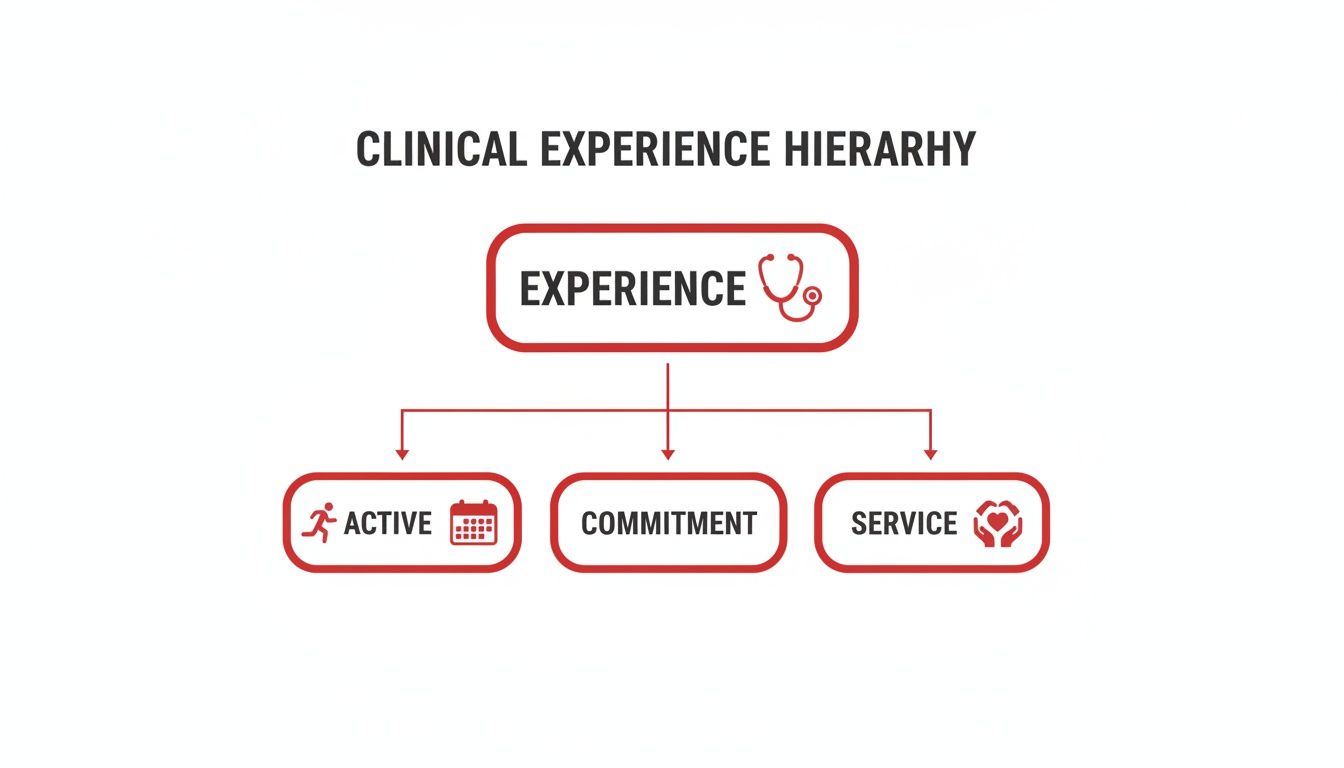
As you can see, while any experience is a good start, the real value lies in roles that are active, show long-term commitment, and are rooted in service to others.
Shadowing A Physician: The Observer’s View
Shadowing is often the first dip into the clinical waters for most pre-meds. It’s exactly what it sounds like: you follow a physician through their daily grind, from patient appointments to hospital rounds or even procedures. This is a passive role, which means you're there to watch and learn, not to get involved in patient care.
Think of it as getting a bird's-eye view of a specific specialty. You’ll witness the good, the bad, and the ugly of the physician-patient relationship, pick up medical jargon in context, and see the real-world challenges of a doctor's life.
- Pros: Great for exploring specialties, it’s relatively easy to set up, and it gives you a clear snapshot of a physician's day.
- Cons: It's entirely passive, so there’s no hands-on experience. This can make it difficult to write about in a compelling way beyond just saying, "I watched the doctor do X."
Hospital Volunteering: Distinguishing Clinical from Non-Clinical
Hopping on board as a hospital volunteer is a common and accessible route, but you have to be careful here. A classic pre-med mistake is logging hundreds of hours in a role that admissions committees won't even count as clinical.
Non-clinical volunteering includes tasks like working in the gift shop, delivering flowers, or filing paperwork. While these jobs are essential for the hospital to function, they aren't clinical because you have zero responsibility for patients.
Clinical volunteering, on the other hand, puts you right in the path of patients. This could mean:
- Transporting patients from their room to the radiology department.
- Taking food orders and helping deliver meal trays.
- Sitting with and comforting anxious families in the ER.
This kind of experience is where you start building your empathy and bedside manner. It proves you can compassionately interact with people who are often sick, scared, and vulnerable.
Medical Scribing: An Active Role in Documentation
Working as a medical scribe means you're in the room, right alongside the physician, documenting the entire patient visit in the electronic health record (EHR). This is a highly active role that throws you straight into the deep end of the diagnostic process.
You literally learn to think like a doctor—listening to a patient’s story, observing the physical exam, and charting the physician’s thought process as it happens. It’s a fast-paced gig that offers an incredible, unfiltered look at how a clinician synthesizes information to build a diagnosis and treatment plan.
Scribing is often seen as one of the highest-quality pre-med experiences because it puts you at the point of care, teaching you the language and logic of medicine from the inside out.
EMT and CNA Roles: Direct, Hands-On Patient Care
This is the top of the pyramid. Becoming an Emergency Medical Technician (EMT) or a Certified Nursing Assistant (CNA) is the gold standard of hands-on clinical experience for pre-med students. These roles require certification and put you on the front lines with direct responsibility for a patient's well-being.
As an EMT, you're responding to 911 calls, making critical assessments in the field, and providing life-saving care. As a CNA, you're helping patients with their most basic daily needs, taking vital signs, and acting as a crucial communication link between the patient and the rest of the medical team.
These experiences are game-changers. They test your ability to stay calm under pressure, force you to think on your feet, and give admissions committees undeniable proof that you can handle the immense responsibility of caring for another human being. Roles like these signal a level of commitment and maturity that sets you apart.
How Much Clinical Experience Is Actually Enough?
This is the question every pre-med obsesses over. Let's get one thing straight: there's no magic number that automatically punches your ticket to medical school. But admissions committees (adcoms) absolutely have expectations.
Think of it like training for a marathon. You wouldn't show up on race day after a single jog around the block. You have to log enough miles to prove you’re serious, that you understand the grind, and that you're physically and mentally prepared. Your clinical experience for pre med is your proof of training. It needs to tell a story of sustained, genuine commitment to understanding what patient care is really like.
Setting Your Minimum Baseline
To even be considered a credible applicant, you need to clear the unofficial "entry fee" of clinical hours. As a general rule, you should be aiming for a bare minimum of 150 hours of meaningful, patient-facing experience.
Anything less than that can raise a red flag. It might suggest to an admissions committee that you haven't done the necessary soul-searching to be 100% sure that medicine is the right path for you. Hitting this baseline shows you’ve stepped outside the classroom and have started building a real-world understanding of the healthcare environment. It’s your first step in proving you're truly dedicated.
Aiming for a Competitive Edge
Okay, so 150 hours might get your application looked at, but competitive applicants often blow past this number. For many top-tier medical schools, it’s not at all uncommon for accepted students to have logged 300-500+ hours. A number in this range signals a much deeper level of engagement and maturity.
But here’s the critical part: the real differentiator isn't the final number. It's the quality and consistency of those hours. A long-term commitment—a few hours every single week at the same one or two places—is infinitely more powerful than a dozen scattered, one-off shadowing gigs. Consistency demonstrates resilience, reliability, and your ability to become a trusted part of a healthcare team.
Key Takeaway: Quality will always trump quantity. Adcoms would much rather see 200 hours of dedicated, hands-on work as an EMT or hospice volunteer than 500 hours of disconnected, passive shadowing.
The data backs this up. While most successful applicants have at least 100-150 hours of solid clinical time, the majority report something closer to 200-500 hours. Interestingly, a survey of admissions offices revealed that 74% see paid roles like medical scribing as just as valuable as volunteering. The real preference is for active roles (32%) and sustained commitments over months, not weeks (11%). You can discover more insights about these crucial admissions statistics and see how they should shape your strategy.
What Your Hours Signal to Admissions
The number of hours you list on your AMCAS application creates an immediate, subconscious impression. Knowing what that impression is can help you set strategic goals.
We've put together a table to help you understand how adcoms might interpret your experience level at a glance.
Clinical Hour Benchmarks: Understanding Your Competitive Edge
This table breaks down clinical hour ranges and what they signal to admissions committees, helping students gauge their application's competitiveness.
| Hour Range | Applicant Tier | What This Signals to AdComs |
|---|---|---|
| 0-100 Hours | At-Risk | Suggests a lack of serious exploration or a late decision to pursue medicine. This is a significant weakness in an application. |
| 100-200 Hours | Meeting Minimums | Shows you've met the basic expectation. Your application is viable, but your experience won't be a major standout feature. |
| 200-400 Hours | Competitive | Demonstrates a strong, sustained interest in patient care. This range suggests you are dedicated, experienced, and have a solid foundation. |
| 400+ Hours | Highly Competitive | Signals an exceptional level of commitment. This is often achieved through roles like scribing, EMT, or CNA work over multiple years. |
Ultimately, your goal is to build a portfolio of high-quality clinical experiences that tells a compelling story about your passion, your resilience, and your readiness for the challenges of medical school. Use these benchmarks to guide your planning, but never forget to focus on the impact you made, not just the number on your timesheet.
Finding and Securing Meaningful Clinical Opportunities

Knowing you need clinical experience is the easy part. Actually finding it? That’s a whole different beast. Think of this process as your first real test in navigating the complex world of healthcare. It takes a solid mix of self-awareness, dedicated research, and a bit of professional grit to succeed.
Don’t look at this search as just another box to check. See it as the very beginning of your medical training. Every email you draft, every conversation you initiate, and even every rejection you receive is building the resilience and communication skills you’ll need every single day as a physician. The journey to find the right clinical experience for pre med students starts with one simple, but critical, step: looking inward.
Start With a Self Assessment
Before you blast out a dozen generic emails to every hospital in a 50-mile radius, hit pause. Take a moment to think about what actually gets you excited about medicine. Your genuine passion is what will make your experiences—and how you talk about them—truly compelling.
Ask yourself a few questions to get the ball rolling:
- Who do I want to work with? Are you pulled toward the energy of pediatrics, the wisdom of geriatrics, or the high stakes of emergency medicine? Maybe you feel a calling to serve underserved communities.
- What kind of setting is right for me? Do you see yourself thriving in the controlled chaos of an ER, or do you prefer the quieter, relationship-focused environment of a hospice facility?
- What skills do I really want to build? Is your goal to sharpen your patient communication, learn a specific technical skill, or just get a broad feel for a specialty?
Getting clear on these answers will help you focus your search. It ensures you find a role that doesn't just look good on paper but actually fuels your desire to become a doctor.
Strategize Your Search and Outreach
Once you have a better idea of what you’re looking for, it’s time to start the hunt. The key is to be methodical. Cast a wide net, but make sure it’s targeted. Don’t just focus on the biggest, most well-known hospital in your city; some of the most profound opportunities are tucked away in smaller, local clinics.
Your university is your biggest asset here. Start there.
- Hit Up Your Pre-Health Advising Office: This should be your first stop. Advisors often have lists of clinics, hospitals, and non-profits they already have relationships with. They can point you toward vetted opportunities perfect for students.
- Lean on Your Student Network: Talk to older students who are already in med school or have logged serious clinical hours. Their firsthand advice is gold, and they might even connect you directly with their old supervisors.
- Scout Out Local Facilities: Do your own research. Look up hospitals, private practices, community health clinics, and nursing homes in your area. Most have volunteer portals right on their websites.
Don’t be afraid to send a cold email. A polite, professional, and concise email explaining your passion and interest can often open doors that aren’t officially advertised.
For many pre-meds, becoming a Certified Nursing Assistant (CNA) is an incredible way to get hands-on experience. If that sounds interesting, you can find a great guide on how to become a CNA that breaks down the whole process.
Master the Art of Professional Communication
Okay, so you’ve found some promising leads. Now, your outreach has to be on point. Professionalism is non-negotiable. Remember, you’re presenting yourself as a future physician, and you only get one first impression.
When you email someone, keep it structured. Introduce yourself and your connection (e.g., "I am a sophomore pre-medical student at X University"). State exactly why you're interested in their specific clinic or facility. Finally, attach your resume and suggest a clear next step, like a quick phone call.
If you don’t get a response right away, it’s fine to send a polite follow-up after a week or two. Persistence is good, but always be respectful of their time. This whole process is a major part of your application journey. You can use our comprehensive medical school application checklist not just for the final submission, but to track your progress in locking down these crucial experiences along the way.
How to Write About Your Clinical Experience

You did it. You put in the hours, landed some great clinical experiences, and now you have something tangible to put on your application. That’s a huge win, but it’s only half the battle.
The real challenge? Learning how to talk about it. Admissions committees aren't looking for a laundry list of your duties. They want to see the human being behind the application—what you learned, how you grew, and why those moments in the clinic or hospital cemented your decision to pursue medicine.
This is where storytelling becomes your single most important skill. In a sea of qualified applicants, where med school acceptance rates hover around a competitive 40%, a powerful story makes you memorable. It’s what separates a forgettable application from one that gets put in the "yes" pile.
The Power of Reflection
Before you write a single word for your application, stop and think. This is the most critical step, and it's the one most pre-meds skip in their rush to get things done. Don't just recall what you did; dig deeper and ask yourself why it mattered.
- What specific patient interaction made you uncomfortable or challenged your assumptions?
- When did you see a simple act of kindness change a patient's entire demeanor?
- Was there a moment that filled you with a profound sense of empathy?
- How did you witness social determinants of health—like poverty or lack of transportation—affecting a patient's outcome?
Answering these questions is the difference between being a passive observer and an active, insightful learner. It shows maturity. For more on weaving these insights into your entire application, check out our guide on building a compelling medical school CV that tells your unique story.
From Simple Tasks to Powerful Insights
Let's be honest, a lot of clinical work involves routine tasks. But it's how you frame those tasks that demonstrates your potential. Many pre-meds make the classic mistake of simply listing their responsibilities, which is a surefire way to sound just like everyone else.
Before Reflection (The Boring Task List):
"As a hospital volunteer, my duties included transporting patients to different departments, restocking supply closets, and answering call bells."
This is accurate, but it's completely generic. It tells the adcom what you did, but absolutely nothing about who you are or what you took away from the experience.
After Reflection (The Insightful Narrative):
"Transporting a nervous elderly patient to her first MRI, I learned that a calm voice and a moment of reassurance could ease her fear more than any technical explanation. This taught me that empathy is a powerful clinical tool, capable of building the trust necessary for effective patient care."
See the difference? The "after" version tells a story. It showcases a core competency (empathy) and connects a simple, everyday task to a profound lesson about the practice of medicine.
Structuring Your Story with the STAR Method
The STAR method is a lifesaver for organizing your thoughts, whether for your AMCAS Work & Activities section, secondary essays, or interviews. It’s a simple framework that forces you to be clear, concise, and impactful.
Here's what it stands for:
- S – Situation: Briefly set the scene. Where were you? What was the general context?
- T – Task: What was your specific responsibility or the challenge at hand?
- A – Action: What, specifically, did you do? Describe the steps you took.
- R – Result: What was the outcome? More importantly, what did you learn about yourself, about patient care, or about the broader healthcare system?
The "Result" is where the magic really happens. This is your chance to explicitly connect your actions to the core competencies adcoms desperately want to see, like communication, critical thinking, empathy, and cultural humility.
Let's put it all together.
STAR Method Example: Scribing in a Busy Clinic
- Situation: I was scribing for a physician in a community clinic that served a high volume of patients, many with complex chronic conditions and limited health literacy.
- Task: My job was to accurately document the visit for a diabetic patient who was clearly overwhelmed and struggling to understand his new, multi-step insulin regimen.
- Action: While the physician focused on the medical details, I took the initiative to quickly organize the instructions into a simple, step-by-step checklist on a spare piece of paper. After the physician approved it, I walked the patient through how to use it.
- Result: The patient’s shoulders relaxed, and he left feeling much more confident. At his follow-up, his blood sugar levels had finally stabilized. The experience taught me that effective medicine isn’t just about the diagnosis; it’s about creative problem-solving to empower patients to manage their own health.
This method transforms a routine scribing duty into a powerful demonstration of your initiative and patient-centered mindset. To see how these small stories can fit into your larger narrative, get some expert tips on writing a compelling personal statement.
Frequently Asked Questions About Pre Med Clinical Experience
Let's be honest, figuring out what really counts as clinical experience can feel like navigating a maze. As medicine changes, so do the questions pre-meds are asking. Here are some straight-up answers to the questions we hear most often.
Does Virtual Shadowing Count Toward My Hours?
The short answer is: it’s complicated, but mostly no. While virtual shadowing exploded out of necessity, most admissions committees (adcoms) see it as a supplement, not a substitute for the real thing. It just doesn't capture the sensory details and raw human connection that are at the heart of patient care.
Think of it this way: virtual shadowing is like reading a fantastic travel blog. You get great information and a feel for the place, but it can’t ever replicate the sights, smells, and emotions of actually being there.
Use virtual opportunities to get a peek into specialties that are tough to access in person, like neurosurgery or pathology. But make sure the vast majority of your shadowing hours are spent physically present with a physician, seeing how they truly interact with patients.
Is Clinical Research Considered Clinical Experience?
This is a classic point of confusion, and the answer comes down to one thing: your specific role on the project.
If your research involves direct, meaningful interaction with patients—like consenting them for a trial, taking their medical history, or administering questionnaires—then yes, that time is absolutely valid clinical experience. You're engaging with patients and using critical communication skills.
However, if your role keeps you in the lab—running assays, crunching data, or working with tissue samples—that’s considered research experience. Don't get us wrong, both are incredibly valuable for your application. But they showcase different skills and need to be categorized correctly on your AMCAS application.
How Should I Discuss a Negative Clinical Experience?
First, know that having a tough experience is normal. Adcoms value maturity and self-awareness, and talking about a negative situation can be a powerful way to show you have both. The key is to frame it as a learning moment, not a complaint session. Never, ever blame a patient, a preceptor, or the facility.
Instead, turn the focus inward and reflect on what you learned:
- What did this difficult situation teach me? Maybe you saw firsthand the systemic barriers patients face or witnessed the heavy toll of physician burnout.
- How did it change my perspective? Perhaps it solidified your understanding of just how resilient patients have to be.
- How will this make me a better doctor? Show that you can find growth and meaning even in the most challenging circumstances.
Discussing a tough day thoughtfully proves you have a realistic, clear-eyed view of medicine’s complexities—a trait every future physician needs.
Can I Include Clinical Experiences from High School?
Generally, the answer is no. Admissions committees want to see experiences you’ve pursued during your college years. This demonstrates a mature, sustained commitment to medicine that has developed alongside your higher education. Activities from high school, while great for your personal growth, are usually seen as part of your early exploration phase.
The only real exception might be a significant, long-term commitment that continued directly into your college years. For example, if you became a certified EMT in high school and kept working shifts consistently as an undergraduate. Otherwise, keep your application focused on the experiences that highlight your dedication as a pre-medical university student.
Building a strong foundation of clinical experience is the first step, but excelling in medical school and on your board exams is the next. Ace Med Boards offers expert tutoring for the MCAT, USMLE, and COMLEX to ensure you're prepared for every stage of your journey. Get started with a free consultation today.

