
When you hear the term “average MCAT score,” the number that usually comes up is around 501. But let’s be honest—that number is pretty misleading on its own.
For any aspiring doctor, there’s a much more important figure to focus on: the average score for students who actually get accepted into medical school. And that number is quite a bit higher, landing closer to 512.
Decoding the Average MCAT Score

Understanding what an "average" MCAT score really means is less about a single number and more about knowing which benchmark actually applies to you. Think of it like a marathon. The average finish time for everyone who starts the race is one thing, but the average time for the elite runners who qualify for the Olympics is what you’d study if you were aiming for the top.
For pre-meds, the key is to look right past the general average and zero in on the matriculant average.
Why Matriculant Averages Matter More
A "matriculant" is a student who not only got accepted but actually enrolled in medical school. Their average score gives you a far more realistic target for your application. Scoring a 501 might put you at the 50th percentile of all test-takers, but it won't make your application stand out for most MD programs. It’s just not a competitive score.
To give you a better idea of what to aim for, here’s a quick breakdown of some key score benchmarks.
MCAT Score Benchmarks at a Glance
| Group | Average MCAT Score |
|---|---|
| All MCAT Test-Takers | 501.7 |
| All Medical School Applicants | 506.5 |
| Medical School Matriculants (Accepted) | 511.9 |
This table shows a clear trend: the scores get higher as you move from just taking the test to actually getting in.
The gap between the average test-taker and the average matriculant is huge, and it tells the real story about how competitive medical school admissions are. For the 2022-23 AMCAS cycle, the average for all applicants was 506.5, while the average for those who successfully enrolled was a powerful 511.9.
That 5.4-point difference is the competitive edge. It’s what separates an application that gets a second look from one that gets overlooked.
The real goal isn't to be average among all test-takers; it's to score higher than the average applicant. Focusing on that matriculant score of 512 sets a clear, competitive standard for your study plan.
This distinction should shape your entire approach to the MCAT. Instead of asking, "What's the average score?" the better question is, "What score do I need to be a strong candidate?" Shifting your perspective is the first step toward building an application that gets you accepted. We dive deeper into this in our guide to what makes a good MCAT score.
Understanding MCAT Scores and Percentiles
So you’ve got your MCAT score, or you’re figuring out what score to aim for. That big number is just the starting point. To really understand what it means for your med school application, you need to look beyond the number itself and focus on what it says about you compared to every other hopeful pre-med.
The total score ranges from 472 to 528, with each of the four sections—Chem/Phys, CARS, Bio/Biochem, and Psych/Soc—scored between 118 and 132. But these numbers don't tell the whole story. The real key to understanding your performance is the percentile rank.
Think of it like this: your raw score is the temperature, but the percentile is the "feels like" temperature. It gives you the on-the-ground reality of how you stack up against the competition. Your percentile tells you exactly what percentage of other test-takers you scored higher than.
Why Percentiles Matter More Than Raw Scores
Admissions committees are swimming in data, and they need a quick way to gauge an applicant's academic horsepower. A raw score of 515 sounds impressive, but knowing it puts you in the 90th percentile is what really makes an impact.
Why? Because it instantly tells them you performed better than 90 out of every 100 students who took the exam. That’s a powerful statement. It frames your score in the context of a highly competitive applicant pool, signaling that you have what it takes to handle the academic rigors of medical school.
The bottom line is that a high percentile proves you can handle advanced scientific material at a level superior to most other applicants. It transforms your score from an abstract number into a concrete measure of your competitiveness.
Breaking Down the Score Distribution
The MCAT is designed to follow a bell curve, meaning most students' scores cluster right around the middle. Very few people hit the absolute top or bottom of that 472-528 scale. The average score is designed to land squarely at the 50th percentile mark.
This is good news for you. It means that even a small improvement in your score can lead to a significant jump in your percentile rank, which can make a huge difference in how your application is viewed. If you want to get into the nitty-gritty, you can explore the full MCAT score range to see exactly where different scores fall on the curve.
Here's a quick look at what different percentile tiers generally mean for your application:
- 90th Percentile & Above (approx. 515+): This is elite territory. A score this high makes you a very strong candidate for most top-tier MD programs.
- 75th Percentile (approx. 509): This is a solid, competitive score. It puts you in a good position for many allopathic (MD) schools and makes you a strong applicant for most osteopathic (DO) programs.
- 50th Percentile (approx. 501): This is the median—the exact middle of the pack. While it shows you performed on par with the average test-taker, it's generally not considered competitive for most MD programs unless the rest of your application is truly exceptional.
What Counts as a Good MCAT Score, Really?
If you want to be a competitive medical school applicant, looking at the overall average MCAT score is a trap. It’s like training for a marathon by aiming for the average finish time of everyone who enters the race—including the people who walk. You don't want to be average; you want to be in the front of the pack.
To get a real sense of your target, you have to ignore the average score of all test-takers and laser-focus on the matriculant average. This is the average score of students who were actually accepted and enrolled in medical school.
The gap between these two numbers tells a huge story. The average score for every person who takes the MCAT is around a 501. But the average score for students who matriculate into allopathic (MD) schools? That jumps to 511.8.
That ten-point difference is where medical school dreams are made. Aiming for a 501 means you’re aiming to be in the middle of everyone who took the test, not in the group that actually gets in.
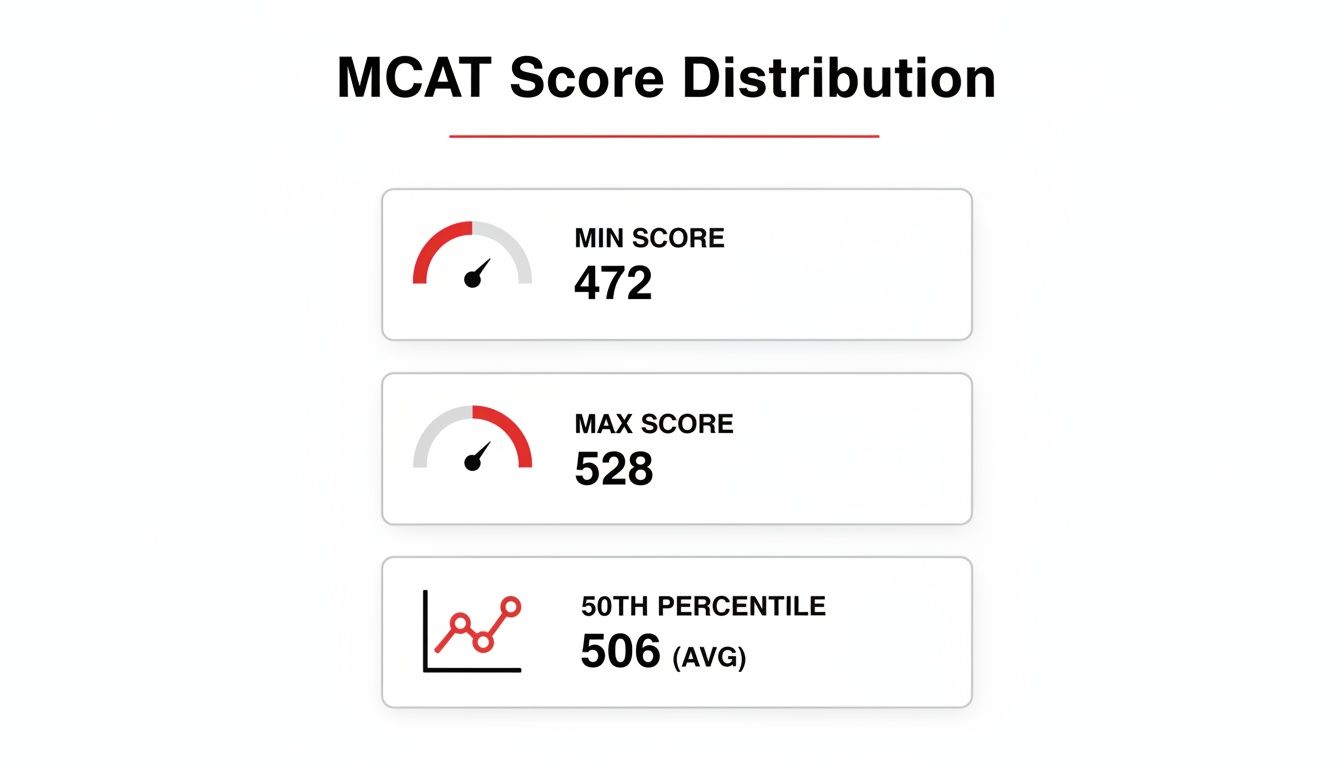
As you can see, that 50th percentile mark is just the mathematical midpoint. It's not your benchmark for a competitive application.
Why Your Target Score is a Moving Target
Over the last decade, the scores required to be competitive have been slowly but surely inching upwards. We call this "score creep," and it’s a real phenomenon, especially at top-tier schools.
Think about it this way: before the MCAT was updated in 2015, it was on a 45-point scale. Back then, the average for top programs was around 32-34. That’s equivalent to a 513-514 today. Now, those same elite schools often report matriculant averages in the 517-522 range.
What’s driving this? A fiercer, better-prepared applicant pool. This upward trend means that a score considered excellent just five years ago might only be considered competitive today. Your prep strategy has to account for this reality by aiming well above the general matriculant average.
MD vs. DO: Know Your Target
The right MCAT score for you also depends heavily on where you're applying. Both MD and DO programs will make you a fantastic physician, but their admissions standards are slightly different.
- Allopathic (MD) Programs: These schools are typically more competitive, with an average matriculant MCAT of 511-512.
- Osteopathic (DO) Programs: These programs often have a more holistic review process and slightly more flexible score ranges, with an average matriculant score closer to 504-506.
This context is everything. A score of 508, for instance, makes you a very strong applicant for many DO programs, but it might put you on the bubble for a good number of MD programs.
Average MCAT Scores for Top US Medical Schools
To give you a clearer picture of what it takes to get into a top-tier program, we've pulled together the average MCAT scores for matriculants at some of the most competitive medical schools in the country. This isn't meant to intimidate you, but to show you the level of preparation required for these institutions.
| Medical School | Average Matriculant MCAT Score | Average Matriculant GPA |
|---|---|---|
| Johns Hopkins University | 521 | 3.95 |
| NYU (Grossman) | 522 | 3.96 |
| Harvard Medical School | 520 | 3.90 |
| Stanford University | 518 | 3.89 |
| Perelman (UPenn) | 521 | 3.94 |
| Washington University in St. Louis | 521 | 3.93 |
As you can see, the competition is fierce at this level. While these numbers represent the absolute top of the scale, they underscore how critical a high MCAT score is for gaining admission to elite programs.
Of course, your MCAT is just one piece of a much larger puzzle. Admissions committees look at your score alongside your GPA, research, clinical experience, and personal story. Understanding the full picture of medical school admissions requirements helps you build the strongest application possible.
At the end of the day, your goal isn’t to hit the average score of everyone who sits for the exam. It’s to match the average of those who earn a white coat.
How Your Score Shapes Your Application Strategy
Your MCAT score is a huge piece of your medical school application, but it's crucial to remember that it never stands alone. Admissions committees use a holistic review process. This just means they look at everything—your GPA, research, clinical hours, volunteering, and personal essays—to build a complete picture of who you are as a candidate.
Think of your application as a team. Your GPA and MCAT score are the star players, the ones that grab the most attention right away. But your experiences, letters of recommendation, and personal statement? They're the skilled supporting players who are absolutely essential to winning the game. A stellar performance from one can help balance out a weaker performance from another.
For instance, an exceptional MCAT score can signal to adcoms that you have the raw academic horsepower to succeed, which can help offset a GPA that’s a little below their average. It proves you can handle the dense scientific material medical school throws at you, even if your first couple of years in undergrad were a little rocky.
Balancing a Low GPA with a High MCAT
Let's look at a common scenario with two applicants. Applicant A has a 3.5 GPA but scores a fantastic 518 on the MCAT. Applicant B, on the other hand, has a perfect 4.0 GPA but gets a 503.
While Applicant B's GPA is flawless, that lower MCAT score might raise a few eyebrows. It could create questions about their ability to handle the standardized testing format and intense pace of medical school exams.
Applicant A, however, proves with their high score that they have the aptitude. That lower GPA could be explained by a tough transition to college or a notoriously difficult major, which is something they can address in their application essays. In many cases, adcoms will view Applicant A more favorably because the MCAT is a direct, standardized comparison against a national pool of pre-meds.
An outstanding MCAT score doesn't erase a low GPA, but it can open doors that might have otherwise been closed. It forces an admissions committee to look closer at your story and consider the upward trend in your academic journey.
Using Your Score to Build a Smart School List
Your MCAT score is probably the most important tool you have for creating a realistic and strategic school list. A balanced list should always include a mix of “reach,” “target,” and “safety” schools, all based on how your stats stack up against their typical matriculant data. This is the best way to maximize your odds of getting an acceptance.
- Reach Schools: These are schools where your stats are slightly below their average matriculant scores. It's a stretch, but possible.
- Target Schools: Your stats line up pretty closely with their average matriculant scores. This is your sweet spot.
- Safety Schools: You're comfortably above their average matriculant scores. You have a very strong chance here.
Applying without this kind of strategic framework is like flying blind. A great score lets you aim high, but applying only to top-tier programs is a huge risk, even for the best applicants. By understanding how your score fits into the bigger picture, you can build a list that gives you the best possible shot at earning that white coat.
Figuring out the right number of schools is also key. You can learn more about how to decide how many med schools you should apply to in our detailed guide.
Crafting Your Plan to Surpass the Average

Alright, you know the numbers. Now for the important part: building a real strategy to push your score well past the average and into competitive territory. Let’s be clear—simply memorizing facts from a textbook won't get you there. The MCAT is designed to sink rote memorizers.
Success demands a smart, personalized, and data-driven study plan. It’s all about turning your specific weaknesses into your biggest strengths.
Your first move? Take a diagnostic test. Think of this as a medical workup for your MCAT skills. Before you can treat the problem, you have to get an accurate diagnosis. A full-length, timed exam under realistic conditions gives you an honest baseline. It shows you exactly where you stand and, more importantly, why you're missing certain questions.
This initial assessment gives you the raw data you need to build a truly effective study framework. It stops you from wasting precious time on subjects you’ve already mastered and forces you to confront the areas that are holding you back.
Building Your Personalized Study Framework
Once you have your diagnostic results, it's time to play detective and analyze the patterns. Don't just glance at the overall score. You need to dig deep into each of the four sections to pinpoint the exact gaps in your knowledge and skills.
Your analysis should answer a few key questions:
- Content Gaps: Are you consistently fumbling questions about a specific topic, like organic chemistry reactions or sociological theories?
- Question Type Issues: Do you crush the discrete, standalone problems but struggle to pull information from dense, passage-based questions?
- Pacing Problems: Are you constantly running out of time in one section, forcing you to guess on the last few questions and make careless errors?
Answering these questions is how you customize your prep. If endocrinology is a sore spot, you dedicate more time to it. If you’re struggling to interpret complex scientific passages, you make practicing that specific skill a priority. This targeted approach is infinitely more effective than a generic, one-size-fits-all study schedule.
A great study plan is a living document. It should evolve as you progress, constantly adapting to your changing needs based on your performance on practice questions and exams.
Simulating Test Day to Build Endurance
Here’s a hard truth: content knowledge alone isn’t enough to conquer the MCAT. You also need serious mental and physical endurance. This exam is a grueling 7.5-hour marathon that tests your focus just as much as your science knowledge.
The only way to prepare for that grind is by simulating the experience with full-length practice exams. Regularly.
Taking a full-length practice test every one to two weeks is non-negotiable. It helps you:
- Build Stamina: You’ll get used to the long hours and the intense concentration required. This dramatically reduces the risk of burnout on the actual test day.
- Refine Pacing: It teaches you how to manage the clock in each section, ensuring you have a real chance to answer every single question.
- Master the Format: You become comfortable with the digital interface and question styles, which cuts down on test-day anxiety and lets you focus completely on the content.
Moving from an average score to a competitive one is a methodical process. It takes a clear strategy, consistent practice, and the right guidance. For a deeper dive, our guide on how to improve your MCAT score offers more actionable steps to elevate your performance.
Your Top MCAT Score Questions, Answered
Alright, so we've waded through the averages, percentiles, and matriculant data. But let's be honest, the numbers are just the start. The real questions—the ones that keep you up at night—are the "what-ifs" that pop up once you get your score back.
Let's cut through the noise and tackle some of the most common dilemmas pre-meds face.
The big one is always about retaking the exam. It's a massive decision that costs time, money, and a whole lot of mental energy. There's no single right answer here; it all boils down to your specific situation and goals.
If your score is a clear mismatch for the schools on your list, a retake is probably a smart move. But if you're just chasing a point or two, the massive effort might not shift the needle on your application.
When Should I Retake the MCAT?
Deciding to sit for the MCAT again is a huge strategic choice, not something to do on a whim. A significant jump—we’re talking 5-10 points or more—can genuinely transform your application from a "maybe" to a "yes."
Before you even think about booking another test date, you need to get brutally honest with yourself about what went wrong the first time. Simply re-reading the same prep books and hoping for a different outcome is a recipe for disappointment.
A retake makes sense if you can check these boxes:
- You Have a Concrete Game Plan: You’ve pinpointed exactly where you struggled—was it content gaps in biochem? Pacing on CARS? Test day anxiety? You need to know the why before you can fix the what.
- Your Practice Scores Told a Different Story: If your official score was a shocking drop from your practice exam average, that might mean nerves or a bad test day got the best of you. You know you're capable of more.
- Your Score is the One Thing Holding You Back: If your GPA is solid, you have great clinical and research experience, but your MCAT score is the glaring weak spot, then improving it is the single most powerful thing you can do for your application.
One crucial thing to remember: medical schools see all of your scores. You need to show a clear, positive trend. A second score that’s the same or—even worse—lower can raise serious red flags. Only retake it when you're confident you can crush it.
How Many Times Is Too Many?
The AAMC has official limits on how many times you can take the test, but the unwritten rule for admissions committees is much stricter. Taking the MCAT more than three times starts to look like a problem.
It can make adcoms question your test-taking ability or your grasp of the fundamental science. The goal isn't to show persistence by taking it five times; it's to demonstrate mastery. Your aim should be to make every single attempt count.
Does a Low Section Score Matter?
Yes, it can. While admissions committees do look at your application holistically, they definitely notice imbalances in your section scores. A single section that's way out of line with the others can be a point of concern.
For example, a really low score in the Critical Analysis and Reasoning Skills (CARS) section might make them wonder if you'll be able to handle the incredibly dense reading required in medical school. Likewise, a low score in one of the science sections could cast doubt on your foundational knowledge.
Honestly, a balanced score profile is often seen as stronger than a slightly higher total score that's propped up by one section and dragged down by another. If you do have an imbalanced score, be ready to compensate with other parts of your application, like stellar grades in those specific science courses.
At Ace Med Boards, we know that getting a great MCAT score is one of the biggest hurdles on your path to medical school. Our expert tutors offer personalized, one-on-one coaching to help you pinpoint your weaknesses, create a winning study strategy, and truly master the material.
Ready to turn your score around? Start with a free consultation and see how we can help you get the score you deserve.

