Which document proves a COMLEX-USA score? Most applicants point to the score report sitting in their NBOME Portal, and that answer is wrong often enough to cost a week in application season. The NBOME-certified transcript is the official record. The portal report is a convenience copy. The COMLEX score request inside ERAS is a separate routing step, and it creates neither document.
Three organizations sit behind that paperwork. The National Board of Osteopathic Medical Examiners (NBOME) administers the Osteopathic Medical Licensing Examination of the United States (COMLEX-USA) and issues the transcript. The Association of American Medical Colleges (AAMC) runs the Electronic Residency Application Service (ERAS), where residency programs receive scores. The two systems are related but not interchangeable, and the gaps between them are where applicants lose time.
Key Takeaways
- Order only after release. A transcript is a snapshot of the record on the request date, so a pending result will not appear on a document already issued.
- Read the recipient's exact wording. If an office asks for a transcript, a printed portal report will not satisfy it; if it asks for a score report, confirm before ordering something more formal.
- Track ERAS requests per program. Submission inside MyERAS and delivery to a program are different events, and only the status report shows the second one.
- Keep every confirmation. A saved receipt with a date settles most questions faster than any explanation.
What a Certified COMLEX Transcript Shows and Who Needs It
A certified COMLEX-USA transcript is the official NBOME record of every COMLEX-USA examination a candidate has taken. It carries the numerical score and/or pass-fail status for each examination, along with the score-interpretation annotations that explain what those numbers mean. That definition matters because two other documents look similar and are not the same thing.
Residency programs typically receive COMLEX scores through a score request submitted inside ERAS, not by writing to NBOME. Whether a school office, licensing board, or individual program also needs the certified transcript itself is a question for that recipient, and the answer should be checked against current NBOME and AAMC instructions before any order goes in.
Three documents, three jobs
NBOME states that a certified transcript contains the scores and/or pass-fail status for all COMLEX-USA examinations taken, plus score-interpretation annotations or notes. A candidate can request it for personal delivery or authorize delivery to a third party through the NBOME account and the electronic transcript-request process. The same guidance is explicit that a score report viewed or printed from the portal does not substitute for an NBOME-certified transcript when a medical school, licensing authority, or residency-related process requires an official document (NBOME release of certified transcripts).
The three documents that get mixed up most often, and what each one is good for:
| Document | What It Contains | Official for Verification? | Best Use |
|---|---|---|---|
| NBOME-certified COMLEX-USA transcript | Scores and/or pass-fail status for every COMLEX-USA exam taken, plus score-interpretation notes | Yes, as the NBOME certified record | Official record requests |
| Score report viewed or printed from the NBOME Portal | Score and/or pass-fail status for an exam | No, not a substitute for a certified transcript | Personal review |
| Formative Performance Profile (Level 2-CE and Level 3) | Graphical comparison across COMLEX-USA blueprint domains | No, diagnostic only | Choosing study priorities |
Where the pass/fail line falls
Reporting format changes by examination level, and that difference trips people up. Level 1 is pass/fail after the 2022 transition, so a transcript cannot be used to infer a numeric Level 1 score or to reconstruct an exact percentage correct. Level 2-CE (Cognitive Evaluation) and Level 3 report a three-digit standard score alongside a pass/fail designation, measured against fixed minimum passing standards of 400 and 350 respectively (NBOME frequently asked questions).
The three-digit figure is psychometrically adjusted from the number of scored items answered correctly. It isn't a percentage correct and isn't an item count, unscored pretest questions don't contribute to it, and the percentage of examinees who pass isn't predetermined. Reading that number in context is its own skill, and the walkthrough on interpreting medical board exam scores handles the comparison questions that come next.
The Formative Performance Profile is the other document mistaken for the transcript. It appears with Level 2-CE and Level 3 reports as a graphical comparison across blueprint domains, and it is diagnostic only. NBOME's own advice is direct: use the transcript for verified outcomes and the profile for remediation priorities, and never convert a pass/fail Level 1 result into a numerical estimate.
Say a student prints a Level 2-CE score report from the portal and sends it to a dean's office that asked for COMLEX documentation. The office replies that it needs the certified transcript, because a printed report verifies nothing on its own. The fix is an order, not an appeal, and reading the request's exact wording first would have avoided it entirely.
How to Request Your Certified COMLEX Transcript
One rule governs the whole process, and it belongs before the first click: NBOME can process a transcript request only for scores that are available on the date the request is submitted. A pending result will not appear retroactively on a transcript that has already been issued (NBOME scoring and reporting). Most disappointing transcripts trace back to that sentence rather than to an error by anyone at NBOME.
Timing rule: the transcript is a photograph of your record on the day you order it. Nothing back-fills later.
The request, step by step
- Confirm every score you need has been released. Sign in to your NBOME account and check that each examination you intend to report shows a result. This single check prevents the most common reorder.
- Start from the NBOME account itself. The request is tied to the candidate file that holds your examination record, which is how NBOME matches the order to you.
- Open the electronic transcript-request option. Certified transcripts are issued through the account and an electronic request process, so third-party delivery runs through a form rather than a forwarded email.
- Choose the recipient deliberately. Personal delivery puts the document in your hands; a third-party request authorizes NBOME to send it elsewhere. The name and address entered here decide where it lands, and a certified transcript sent to the wrong office takes longer to fix than to check.
- Read the fee and processing time shown at submission. Both are revised between cycles, so the figure to rely on is the one displayed on the screen, not one remembered from a forum thread.
- Save the confirmation and note the date. That receipt is what you cite if a recipient later says nothing arrived.
The full sequence, from the timing rule to delivery, looks like this:
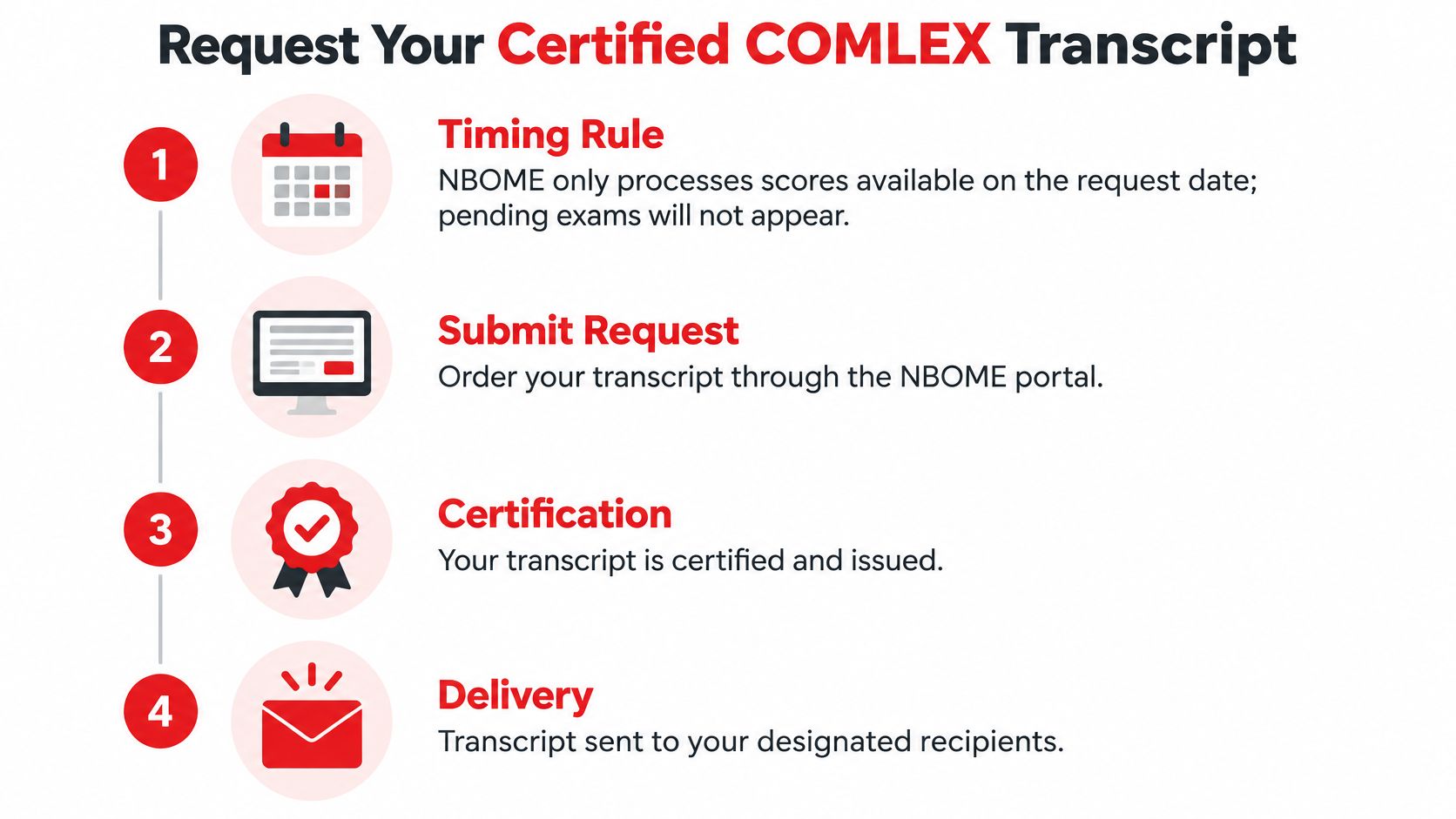
A complete request has three marks: a saved confirmation, a recipient you can name without checking, and a transcript that lists every released examination when it arrives. Requests routed through MyERAS follow a different path and carry their own tracking.
Sending Transcripts Through MyERAS and Who Receives Each Report
COMLEX-USA transcript handling is distinct from USMLE (United States Medical Licensing Examination) handling in the residency-application system. The AAMC states that COMLEX transcripts are not provided through the Federation of State Medical Boards (FSMB); instead, COMLEX score requests are submitted within MyERAS, the applicant-facing side of ERAS, and applicants can track each request by residency program in the COMLEX-USA Requests Status Report (COMLEX-USA Bulletin of Information 2025-2026).
Shifting from the portal to MyERAS keeps the two systems clean: NBOME holds the record, and ERAS holds the delivery.
The volume moving through that route isn't small. The American Association of Colleges of Osteopathic Medicine reported that 8,392 osteopathic medical students participated in the 2024 Main Residency Match (AACOM). Each of those files carries a score routing decision behind it.
Inside MyERAS
- Sign in to MyERAS. Score transmission starts from the application, not from NBOME.
- Find the COMLEX-USA score request section. This is a distinct request from anything involving USMLE records.
- Submit the request for the programs on your list. Nothing sends automatically, and a released score sits still until a request exists.
- Track status by program in the COMLEX-USA Requests Status Report. This is the only view that shows per-program delivery.
- Check each program's status well before its deadline. A pending line found in September is a fixable line; one found on deadline day isn't.
Who receives each report
NBOME's examination-reporting rules set recipients by training stage, which explains why a dean's office sometimes knows a score before a program does.
| Exam Level | Who Receives the Score Report | Reporting Format |
|---|---|---|
| Level 1 | Candidate and dean's office of the candidate's school | Pass/fail only |
| Level 2-CE | Candidate and dean's office of the candidate's school | Three-digit standard score plus pass/fail |
| Level 3 | Candidate, dean's office of the school of graduation, and an applicable program director, director of medical education, or designated GME official | Three-digit standard score plus pass/fail |
Graduate medical education (GME) refers to residency and fellowship training; a director of medical education (DME) is the official who oversees that training at a site. The practical trap sits in the table: a report reaching your dean's office does not confirm that a program received anything. The status report is the only place that question gets a real answer, and understanding what programs look for in an ERAS application puts that delivery in its proper place. Confirm current recipient rules in the bulletin of information before relying on them.
Fixing Delays, Missing Scores and Request Errors
Most transcript problems are paperwork problems, not academic ones. They surface in two ways: a coordinator emails that something is missing from a file, or a status line sits unchanged longer than expected. Neither usually says anything about the score itself.
Match the symptom to the fix before writing to anyone.
| Symptom | Likely Cause | Next Step |
|---|---|---|
| Recent exam missing from transcript | Request submitted before the score was available | Reorder after release; NBOME processes only scores available on the request date |
| Portal score report rejected by a school or program | Printed or viewed report is not a certified transcript | Request the NBOME-certified transcript |
| Program shows no COMLEX score | Request not submitted in MyERAS, or still pending | Check the COMLEX-USA Requests Status Report for that program |
| Level 1 result has no numeric score | Pass/fail-only reporting for Level 1 | Expected; use the pass/fail designation on the transcript |
| Report sent to the wrong recipient | Incorrect recipient entered at request | Contact NBOME promptly; confirm correction steps on its site |
| International applicant unsure which process applies | Country-specific steps differ from the standard NBOME and ERAS path | Confirm the process directly with NBOME before ordering |
What to fix first
Work in the order that protects deadlines. A request never submitted in MyERAS blocks a program from seeing anything, so it outranks a document that needs reissuing for an office already holding the rest of the file. A reorder for a missing result is routine once that result releases, but it isn't instant, which is why it should start the day the score posts rather than the week a reminder arrives.
Calm helps here more than urgency. Coordinators handle hundreds of files, and a short, dated query with the request date and your applicant ID is easier to answer than a long explanation of what might have gone wrong.
Timing around results varies by level, and the guide to COMLEX Level 3 score release covers what to expect before a Level 3 result can appear on any transcript at all. For applicants trained outside the standard U.S. osteopathic pathway, confirm the applicable recipient and process with NBOME directly before ordering, since pathway-specific rules sit outside a general walkthrough. Cost and turnaround details shift between cycles, so verify them at the point of ordering.
Sample Request Wording and Privacy Checks
A clear, dated message gets a faster answer than a general question, because it gives a coordinator something specific to look up. This template works for a program coordinator:
Hello, I am applying to [program name] through ERAS. I submitted my COMLEX-USA score request in MyERAS on [date]. Could you confirm whether the score has been received, and let me know if you need anything else from me to complete my file? Thank you, [name and applicant ID].
Short, dated, and answerable in one line. Keep a copy of what you sent and when, because that record is what protects you if the same question resurfaces months later.
Privacy checks before you submit
- Use only official sites. Sign in through NBOME and ERAS directly rather than following a link in an unsolicited email.
- Never share login details. No coordinator, advisor, or service needs your NBOME password to confirm delivery.
- Match your identifiers. The name and details on the request should match your application exactly, so the document can't be separated from your file.
- Authorize recipients deliberately. A certified transcript goes only to people you have named, and that list is yours to control.
- Don't treat a screenshot as proof. A printed portal report or an image of one proves nothing to a verifying office.
- Save every confirmation. Dates, recipients, and confirmations are the paper trail that answers later questions.
Handling your own records carefully is part of the same habit, and the guidance on data privacy for students covers the wider picture of what should and shouldn't leave your hands.
Final Transcript Checklist and Verification Notes
The decision at the end of all this is simple: is the official COMLEX record ready for every program on the list?
- Every needed exam released. No pending result is being counted on.
- Certified transcript ordered where required, with the recipient's exact wording reread first.
- COMLEX score request submitted in MyERAS for each program that needs it.
- Status checked per program in the COMLEX-USA Requests Status Report, not assumed from a dean's office copy.
- Scores read from the transcript for verified outcomes, with the Formative Performance Profile used only for study priorities.
Ace Med Boards offers one-on-one COMLEX-USA tutoring for Level 1, Level 2-CE, and Level 3, including work with students facing a plateau or returning after an unsuccessful attempt, described on the COMLEX tutoring service page. Tutoring supports exam preparation and doesn't process NBOME transcript requests or ERAS submissions. A free COMLEX consultation is available to discuss exam level and timeline. The ERAS application timeline is the natural companion for planning when each of these steps belongs.
Fees, processing times, and recipient rules are time-sensitive. The details here reflect NBOME and AAMC guidance available as of October 2026 and should be rechecked on the official sites before an order is placed. Sources consulted: NBOME pages on the release of certified transcripts, scoring and reporting, and frequently asked questions; the COMLEX-USA Bulletin of Information 2025-2026; AACOM reporting on the 2024 Main Residency Match.
Ace Med Boards provides one-on-one COMLEX-USA tutoring for Level 1, Level 2-CE, and Level 3, with sessions built around content review, clinical reasoning, question approach, and pacing, plus a free consultation to talk through exam level and timeline. Once the paperwork is settled and the exam itself is the next hurdle, that conversation is a sensible place to start. Visit Ace Med Boards to see how tutoring is structured and what fits your schedule.