You've booked COMLEX-USA Level 3, and your first practice block of COMLEX CDM cases has just handed you a set of lab results with the question "What is the next best step?" You've read the case twice, three options look defensible, and you can't tell whether clicking all three is thorough or fatal. Those cases, the Clinical Decision-Making (CDM) section of COMLEX-USA Level 3 from the National Board of Osteopathic Medical Examiners (NBOME), test whether you can make a sequence of patient-management decisions as information arrives rather than recall a single fact. They're answerable, and they're answerable with one repeatable method that you can rehearse until it's automatic.
The confusion is rarely about medicine. It's about format. Candidates lose points for selecting one option too many, for ordering a test that doesn't change the next step, or for writing two diagnoses into one answer box. Each of those is a learnable habit, and each is fixable in a few weeks of deliberate practice.
What COMLEX CDM Cases Test and How the Exam Presents Them
A CDM case works like a clinic handoff in stages. You get an opening presentation, choose which history, examination findings, laboratory studies, or imaging to obtain, and the case returns those results before it asks the next question. Diagnostic and management decisions, including medication, counseling, and follow-up, sit on the information that stage just gave you. The NBOME examination format page describes this as a sequential assessment of data acquisition, data interpretation, and treatment, and it sets the combined CDM time at up to 3.5 hours.
NBOME sources define the layout you should rehearse against. You will meet approximately 26 CDM cases, usually 2 to 4 questions each, or roughly 70 to 80 CDM questions. Those cases arrive in two sections of 13, with an authorized break between them, inside that combined maximum of up to 3.5 hours. Items are extended multiple-choice, where more than one option may be correct, or constructed short-answer.
Extended multiple-choice and short-answer do not share a selection rule. On an extended item, the correct set can be one option or several, so adding an extra choice is over-selection, not extra thoroughness. On a short-answer item, each box takes one answer. Two diagnoses typed into a single box fail the format even when both diagnoses are medically reasonable. Log those as technical slips. A wrong diagnosis, or a test that would not change the next step, belongs in a separate column as a reasoning error. Official NBOME rules decide which responses score. Your error log only tells you which habit to drill.
CDM sections sit beside single-best-answer blocks, and the habits do not transfer. The full examination pairs six sections of single-best-answer multiple-choice questions with the two CDM sections, and carries 420 multiple-choice questions plus the roughly 26 CDM cases, according to the NBOME description of examinations.
| COMLEX Level 3 CDM format at a glance | ||
|---|---|---|
| Component | Current value | What it means for practice |
| Total CDM cases | About 26 across the examination | Plan practice around whole cases, not single questions |
| Cases per section | 13 in each of two sections | Check your pace at the midpoint of each section |
| Questions per case | Usually 2 to 4 | Roughly 70 to 80 questions overall |
| Combined time | Up to 3.5 hours, including the authorized break between sections | Pace both sections inside that window |
| Question types | Extended multiple-choice (more than one option may be correct) and short-answer | Train over-selection and one-answer-per-box as separate skills |
| Testing-day structure | Set by the format in effect on your administration date | Match pacing drills to the day you will sit |
CDM cases are not USMLE Step 3 computer-based case simulations (CCS). CCS asks you to manage a simulated patient while the clock advances. CDM gives you a fixed scenario, a defined set of questions, and then moves the case forward in stages. CCS timing practice does not teach CDM selection rules, and CDM practice does not teach CCS timing.
Write your administration date at the top of the study plan before you build a schedule. Case layout and the length of the testing day depend on that date, and the current and planned Level 3 formats differ enough that pacing drills built for one can mislead you on the other.
Four Moves and the Scoring Habits That Cost Points
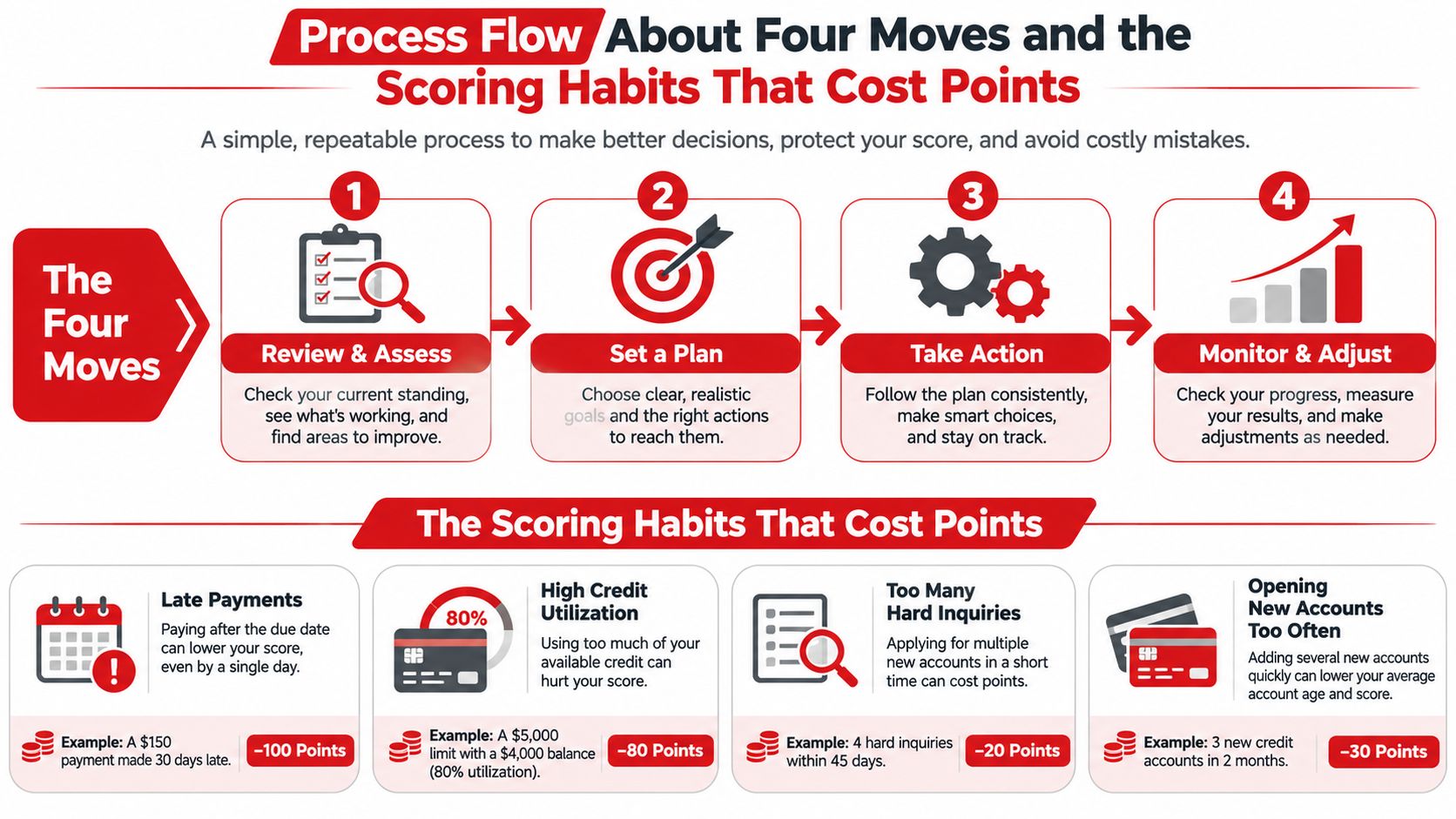
Stage 1 ends with a working diagnosis of pneumonia. Stage 2 then shows a normal chest film and a falling hemoglobin. The data changed. The method should not. A CDM case is a staged decision problem: each stage asks for one decision, and the NBOME CDM cases tutorial frames the section as sequential management rather than a stack of isolated questions. Use the same four moves, in the same order, at every stage.
Name the immediate threat and the decision context. Before you look at the options, decide whether the patient is stable and what this stage wants: data, an interpretation, or a management step. Candidates who skip this answer the previous stage's question with the current stage's choices.
Request only what could change management. For every history item, examination finding, or test, ask whether an abnormal result would change the next step. If it would not, the option gives points away. It is not thoroughness. An extra test that cannot redirect the case works like a second suitcase on a same-day trip: it feels prepared, and it only gets in the way.
Interpret into the most likely diagnosis plus the dangerous alternatives. The likely diagnosis drives treatment. The dangerous alternative drives urgency. A case that ends in management usually turns on whether you first excluded the problem that would kill the patient.
Select treatment, counseling, disposition, and follow-up in protective order. Stabilize first. Confirm when confirmation changes the next step. Then treat. Counseling and follow-up are scored answers, and a case will often test them directly.
Reread the case from the top at every new stage
New results can overturn a working diagnosis. They are written to do that. When stage 2 arrives, read the entire case again rather than only the new paragraph. A finding buried in the opening sentence often explains why the first impression was incomplete. The candidate who reads only the new data answers confidently and wrongly.
Treat the reread as a physical habit. Scroll to the top, read the presentation, then read the results, then answer. Fifteen seconds protects whole cases.
The scoring is asymmetric
Selecting too many options on an extended multiple-choice item can earn zero even when the correct options are included. An option that creates patient harm or unnecessary costly resource use can invalidate an otherwise appropriate response. In short-answer items, each response box should hold one precise answer, and multiple diagnoses in one box can receive no credit.
Under-selection costs you one item. Over-selection or an unsafe choice can wipe out an answer you otherwise had right. The rational strategy is defensive, not maximal. Check the official NBOME tutorial for how partial credit and selection rules work on the current item types rather than assuming a lenient scorer.
| Response types, scoring risks and the habit that prevents each loss | ||
|---|---|---|
| Response type | Scoring risk | Habit to build |
| Extended multiple-choice, correct and extra options selected | Selecting too many options can earn zero even when correct options are included | Select only options you can justify from the current stage |
| Extended multiple-choice, option that causes harm or excess cost | An option causing patient harm or unnecessary costly resource use can invalidate an otherwise appropriate response | Screen every option for safety before choosing |
| Short-answer box with two diagnoses | Multiple diagnoses in one box can receive no credit | Write one precise answer per box |
| Test ordered that does not change the next step | Unnecessary investigations dilute an otherwise sound response | Order only tests whose result would change management |
| Treatment chosen before diagnosis is confirmed where the case calls for stabilizing first | Out-of-sequence management can make the response inappropriate for the stage | Stabilize first, then confirm, then treat as the stage requires |
Pre-submission check, twenty seconds per item: Is every selected option justified by this stage and not a later one? Is any selected option capable of harming this patient or spending resources the case doesn't need? Does each answer box hold exactly one answer?
Keep an error log, not a percentage target
No published CDM percentage is worth chasing, so a study plan built around a number quoted in a forum has nothing solid to aim at. Log each miss by type instead. Split reasoning errors from technical slips. A reasoning error is a wrong threat, a test whose result never changes the next step, or treatment chosen before the stage has asked you to stabilize. A technical slip is over-selection on extended multiple-choice, or two diagnoses written in one short-answer box. Those counts show what to drill next week: content if the diagnosis was wrong, selection rules if the idea was right and the box or the extra option cost the point.
These selection and sequencing habits sit inside a broader set of test-taking strategies for board exams. On CDM items, the case-level rules above are the ones that decide whether a sound plan still scores.
Annotated Sample Cases With Model Answers and Rationales
The two cases below are original teaching material written to illustrate the sequence. They are not official NBOME items, not recalled exam content, and not copied from any question bank. Both are exam-focused simplifications, reviewed for teaching accuracy, and they don't replace clinical judgment in an actual patient encounter.
Case A, fatigue and exertional breathlessness
A 58-year-old office worker reports three months of fatigue and breathlessness after two flights of stairs. Vital signs are stable. Stage 1 asks you to choose two history items and one examination finding.
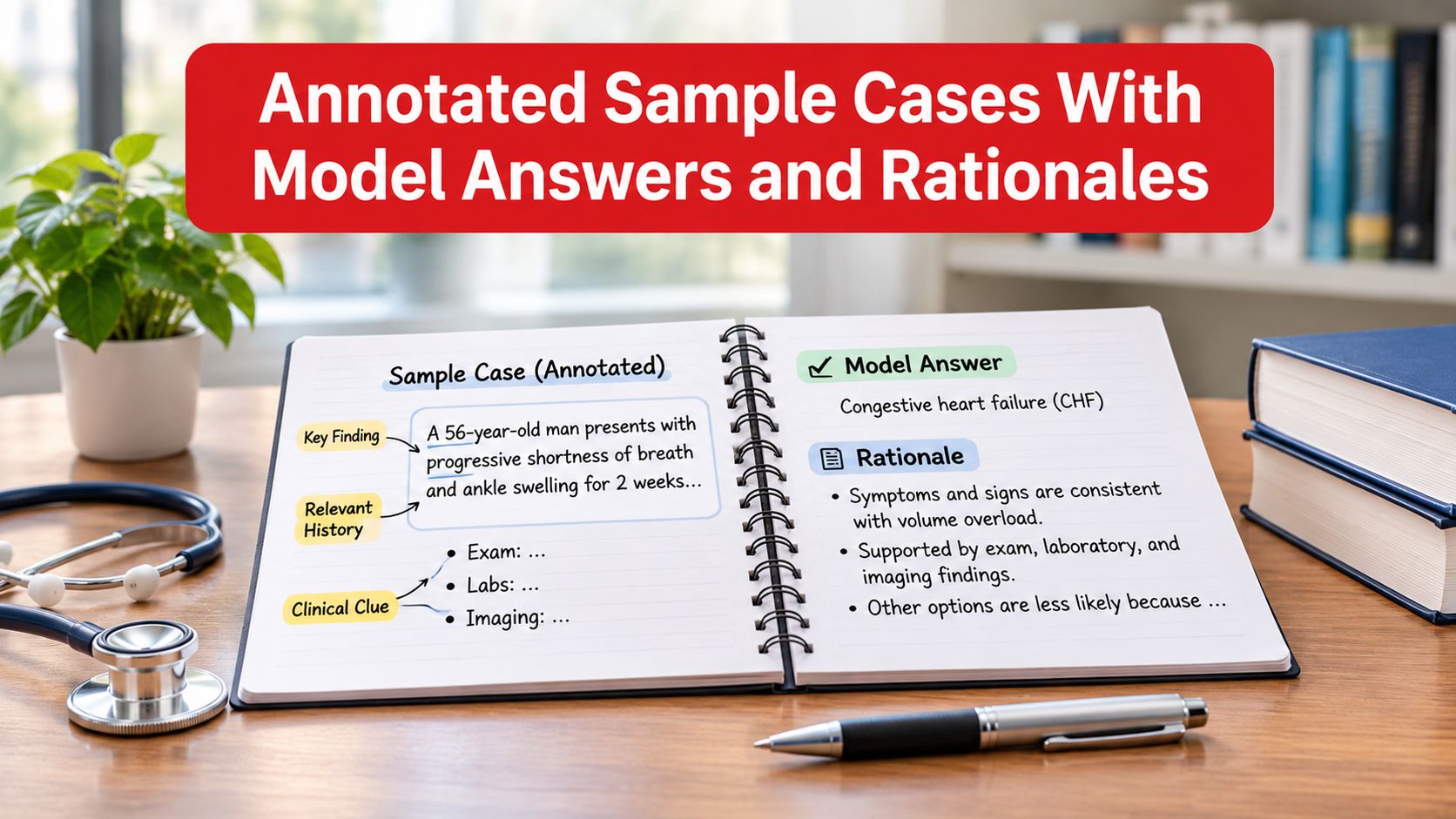
The learner's likely choice: six boxes, including a chest radiograph and a D-dimer "to be safe." Both feel responsible. Neither belongs in a stage that asks for history and examination, and neither would change the next decision at this point.
Model choice: two history items, one covering exercise tolerance with orthopnea or night-time breathlessness, and one covering blood loss, diet or menstrual history. One examination finding, conjunctival and palmar pallor with a cardiac examination for a murmur. Each answer is defensible because a positive result redirects the case: the first toward a cardiac workup, the second toward anemia evaluation.
Stage 2 results: low hemoglobin with low mean corpuscular volume and low ferritin. Model interpretation: iron-deficiency anemia as the working diagnosis, with blood loss from a gastrointestinal source named as the dangerous alternative that must be excluded. The revision is small but the case turns on it, because management now includes finding the source rather than only replacing iron.
Stage 3 asks for management, counseling and follow-up. The defensible sequence is to start replacement, evaluate for a source of loss, give clear return precautions, and define when labs get repeated. Replacement and source evaluation run in parallel here rather than one after the other, because neither delays the other.
Notice what the sample rewards: fewer selections, each tied to a decision. What it punishes is the instinct to cover every base, which is the single most common technical error on this section.
Case B, the one-answer box
Short-answer item: "State the single most likely diagnosis."
Strong answer: iron-deficiency anemia. Weaker answer: iron-deficiency anemia versus anemia of chronic disease. The second version feels intellectually honest and earns nothing, because the box is built for one entry and a scorer can't credit a split field. If the case wants a differential, it will ask for one in a way that gives you separate space. When it asks for a diagnosis, commit to the best single answer.
Working cases out loud, stage by stage, is how this sequence becomes automatic. The same approach used in case-based learning for clinical medicine transfers directly to timed CDM blocks, where you don't have time to invent a new method mid-case.
Audit Each Missed Answer Before You Practice Again
After a missed case, record what went wrong before moving to the next one. Rereading an explanation can clarify the answer, but an audit identifies the habit that needs practice. An interpretation error calls for a different fix than selecting too many options or entering more than one answer in a single-answer box.
Use a log with six fields: date, case identifier, stage, error class, the fact that would have changed your answer, and the drill to run. Classify each miss:
- Omitted data. A history item, examination finding, or test that could have changed management was missing from your response. Before reviewing the options, list the findings that would alter the next step, then check whether you sought them.
- Incorrect interpretation. You had the relevant data but reached the wrong diagnosis. Rewrite the interpretation in one sentence, then identify one dangerous alternative the findings make less likely.
- Unsafe intervention. You selected an option that could harm the patient, perhaps because it sounded more aggressive. Before choosing, screen each intervention for potential harm in the case.
- Unnecessary resource use. A test or treatment did not affect the next decision. For each proposed test, name the decision its result could change. If you cannot, reconsider selecting it.
- Imprecise short-answer construction. Your clinical idea was sound, but your entry did not fit the box. Rewrite it as one precise response when the prompt asks for a single answer.
Track results by decision type and clinical presentation, rather than by total questions correct. An overall score can hide a specific weakness: management may be strong while data acquisition needs more practice. Use the pattern in your log to choose the next drill.
The NBOME frequently asked questions page explains that the passing standard is criterion-referenced, not curved. Comparing your performance with a rumored cutoff therefore does not show what to work on. The NBOME examination blueprint gives the published Level 3 categories and clinical-presentation weights:
| Level 3 blueprint and clinical-presentation weights, per the NBOME examination blueprint | |
|---|---|
| Category | Stated weight |
| Osteopathic patient care and procedural skills | At least 40% |
| Application of osteopathic medical knowledge | 15% |
| Osteopathic principles, practice and manipulative treatment | 10% |
| Practice-based learning | 8% |
| Communication | 5% |
| Professionalism | 6% |
| Systems-based practice | 6% |
| Clinical presentation: musculoskeletal | 13% |
| Clinical presentation: community health and wellness | 12% |
| Clinical presentation: nervous system and mental health | 10% |
| Clinical presentation: gastrointestinal and nutritional | 10% |
| Clinical presentation: circulatory and hematologic | 10% |
| Clinical presentation: respiratory | 10% |
Treat the weights as a guide for distributing review, not as a prediction of which case will appear next. If circulatory and hematologic cases recur in your error log, add targeted practice there, then use the error class to decide whether to work on data gathering, interpretation, or selection. Reviewing how to analyze distractors in board questions can help you distinguish an option that changes the next decision from one that merely sounds plausible.
A Six-Week CDM Practice Schedule and Pacing Plan
Start with arithmetic, because pacing decisions get easier once the numbers are on paper. If the full 3.5 hours of CDM time were available for case work, 26 cases would average about 8 minutes per case, including all of its questions. Confirm the break rules on NBOME pages before you fix that pace, since authorized break time sits inside the testing day and not inside your case budget.
Pacing rule: check the clock at case 7 and case 13. If you're more than a few minutes behind at the midpoint, speed up on the next two cases rather than trying to recover in a single sprint.
Two calendars, two simulations
Candidates testing before the format change should rehearse two 13-case sections at the published timing, break included, because stamina across two CDM sections is part of the assessment. Candidates testing after the change face a different preparation problem: NBOME states in its 2025–2026 Bulletin of Information that effective January 2027, Level 3 transitions to a one-day, eight-hour examination. Fewer or restructured cases wouldn't make reasoning less consequential; they could make each case weigh more and leave less room to recover from an early pacing error.
So practice concentrated case blocks and a full-day endurance schedule once the specifications for your date apply, and be skeptical of unofficial summaries that blend the current and future formats into one description. Identify your administration date first, then choose the simulation that matches it.
| Six-week CDM practice schedule | |||
|---|---|---|---|
| Week | Focus | Timed work | Review |
| 1 | Blueprint map and the four-move method on single-stage cases | Two untimed cases | Start the error log |
| 2 | Multi-stage cases, one stage per sitting | Three cases, untimed then timed | Classify every miss by error class |
| 3 | Short-answer discipline | Four cases with one precise answer per box | Rewrite any answer that names two diagnoses |
| 4 | Timed blocks | Six cases at about 8 minutes each | Track accuracy by decision type and presentation |
| 5 | Full section simulation | One full 13-case section at the published timing | Audit pacing and fatigue in the last third |
| 6 | Consolidation and taper | Two mixed sets shorter than week 5 | Review the error log only |
Three rules keep the six weeks honest. Review the log after every session, not weekly, because a pattern spotted on Tuesday changes Thursday's drill. Add no new resources in the final week, since a fresh question bank in week 6 mostly produces anxiety. Schedule sessions on rest days as well as study days, so your simulation includes the fatigue you'll feel. A realistic full-section rehearsal, like the ones described in this guide to COMLEX Level 3 practice tests, is worth more than three comfortable untimed sets.
Confirm Your Exam Format and Attempt Rules Before Booking
The decision is simple and it comes before any study planning: confirm your administration date, check the format as published on NBOME pages on the day you read them, and match your practice design to that format. Rescheduling a test date is easier than rebuilding a study plan around the wrong structure.
Attempt rules deserve the same attention, because they change how much a single sitting matters. Candidates are limited to four scored attempts for each examination level and may not take a level more than four times within a 12-month period, with incomplete or voided attempts counting toward that annual limit, according to the NBOME eligibility and attempt policy. A candidate who has already passed generally may not retake an examination to improve the score, except where retaking a previously failed examination is permitted.
Those limits make readiness assessment and remediation planning the work after an unsuccessful attempt. The error log from earlier sessions is the starting point: sort it by error class, find the two classes that account for most misses, and build the next four weeks around those drills rather than rereading everything.
Worth naming plainly: the NBOME practice resources and official tutorial, plus third-party question banks and review textbooks, are the materials that carry the content. One-on-one tutoring sits beside those materials rather than replacing them, and it helps most when a candidate can already identify the pattern in their misses but can't break it alone. COMLEX tutoring at Ace Med Boards covers content review, clinical reasoning, question approach and pacing, and supports students preparing for Level 1, Level 2-CE and Level 3, including those facing a plateau or returning after an unsuccessful attempt. A free COMLEX consultation is available to talk through exam level and timeline before any commitment, and the COMLEX tutoring service page lists how sessions are structured.
Key Takeaways and Sources
- Work every case in the same four moves: name the threat and decision context, request only information that changes management, interpret into a likely diagnosis plus dangerous alternatives, then sequence treatment, counseling, disposition and follow-up.
- Over-selection is the expensive habit. Extra options can earn zero even when correct options are included, and a harmful or wasteful option can invalidate an otherwise good response.
- One precise answer per short-answer box. Two diagnoses in one field can receive no credit.
- Audit misses by error class, then track accuracy by decision type and presentation rather than total score.
- Confirm your test date and format on NBOME pages before building a schedule, since a one-day, eight-hour Level 3 format is scheduled to take effect in January 2027.
Sources (verify current versions as of November 2026): the NBOME COMLEX-USA examination format page; the NBOME Bulletin of Information 2025–2026; the NBOME Clinical Decision-Making cases tutorial; the NBOME frequently asked questions page; the NBOME description of examinations; and the NBOME eligibility and attempt policy. All format values, blueprint weights and attempt limits quoted above come from those NBOME documents and should be rechecked against the live pages before you finalize a test date.
If CDM cases are the part of Level 3 where your practice scores stall, Ace Med Boards offers one-on-one COMLEX tutoring that works through staged cases with you, from the first data-acquisition decision to the final follow-up choice, and rebuilds your pacing around your actual test date. Sessions cover content review, clinical reasoning, question approach and pacing for Level 1, Level 2-CE and Level 3, including candidates returning after an unsuccessful attempt. Start with a free consultation at Ace Med Boards to map your timeline and decide what the next six weeks should contain.