A failed clinical rotation isn't an automatic dismissal, and it doesn't end a medical career by itself. The next step depends on which component failed, the written standard in the syllabus, and the remedy named in the school's own promotion policy. Students who name that component first, get the grade basis in writing, and confirm deadlines before choosing remediation, a retake, or an appeal avoid the most costly early mistakes.
What to Do in the First Week
A national survey of internal medicine clerkship directors found that approximately 0.9% of students failed the internal medicine clerkship, fewer than 1 in 100, according to the national survey of internal medicine clerkship directors. That rarity is useful context, not reassurance to wait. The same source reports a University of Minnesota benchmark of 43 students who failed Medicine I or Medicine II among 2,852 students from 2002 through 2013, or 1.5%.
A failing grade should be read against the written syllabus cutoff before any conclusion about progression. A clerkship grade can combine preceptor evaluations, professionalism expectations, a written subject exam, and skills testing. Each piece points to a different remedy.
Subject exams include National Board of Medical Examiners (NBME) shelf exams and, for osteopathic students, National Board of Osteopathic Medical Examiners (NBOME) Complete Osteopathic Medical Achievement Test (COMAT) exams. Skills testing may use an objective structured clinical examination (OSCE). A low shelf score with passing bedside work is a different problem from passing knowledge testing with deficient presentations, attendance, or teamwork.
What Each Failed Rotation Component Requires First
| Component | Evidence to request | First question | Do not assume |
|---|---|---|---|
| Clinical evaluation | Narrative ratings and preceptor comments | Which competencies were marked deficient? | That one failure means dismissal everywhere |
| Professionalism | Attendance, communication, and conduct record | Is this a conduct citation or a clinical-skill gap? | That an appeal erases a documented lapse |
| Written subject exam | NBME shelf or COMAT score versus the school cutoff | Did clinical work pass while the exam failed? | That another exam attempt proves safe bedside care |
| OSCE or skills exam | Station checklist and missed critical actions | Which stations or required skills were missed? | A universal numeric passing score |
| More than one component | Full grade report and syllabus rule | Must the whole rotation be repeated? | One national progression pathway |
Four Actions for Week One
- Compare the grade notice with the syllabus cutoff. Check whether the recorded score, rating, or missed objective crosses the standard stated for that rotation.
- Request the record in writing. Ask for the final evaluation, component scores, and the exact unmet standard. A verbal summary isn't enough for an appeal deadline or a remediation plan.
- Start a dated log while details are fresh. List preceptors, sites, absences, late arrivals, missed required skills, midpoint feedback, and any change in supervision. Keep it factual and brief.
- Ask student affairs about scheduling. Confirm whether later rotations may continue while the decision is pending, or whether progression pauses until remediation is assigned.
Defensive reactions in the first meeting can make the record harder to repair. Guidance on how to receive constructive criticism without shutting down feedback can help a student separate painful wording from the specific behaviors that need evidence of change.
Practical rule: Don't argue the whole grade in the first week. Identify the failed component, the standard applied, and the evidence behind it.
Questions for the Advisor Meeting
The advisor meeting should produce written facts, not general reassurance. Bring the syllabus, the grade report, and a one-page timeline. Leave with named objectives, deadlines, attempt limits, and the office that owns each decision.
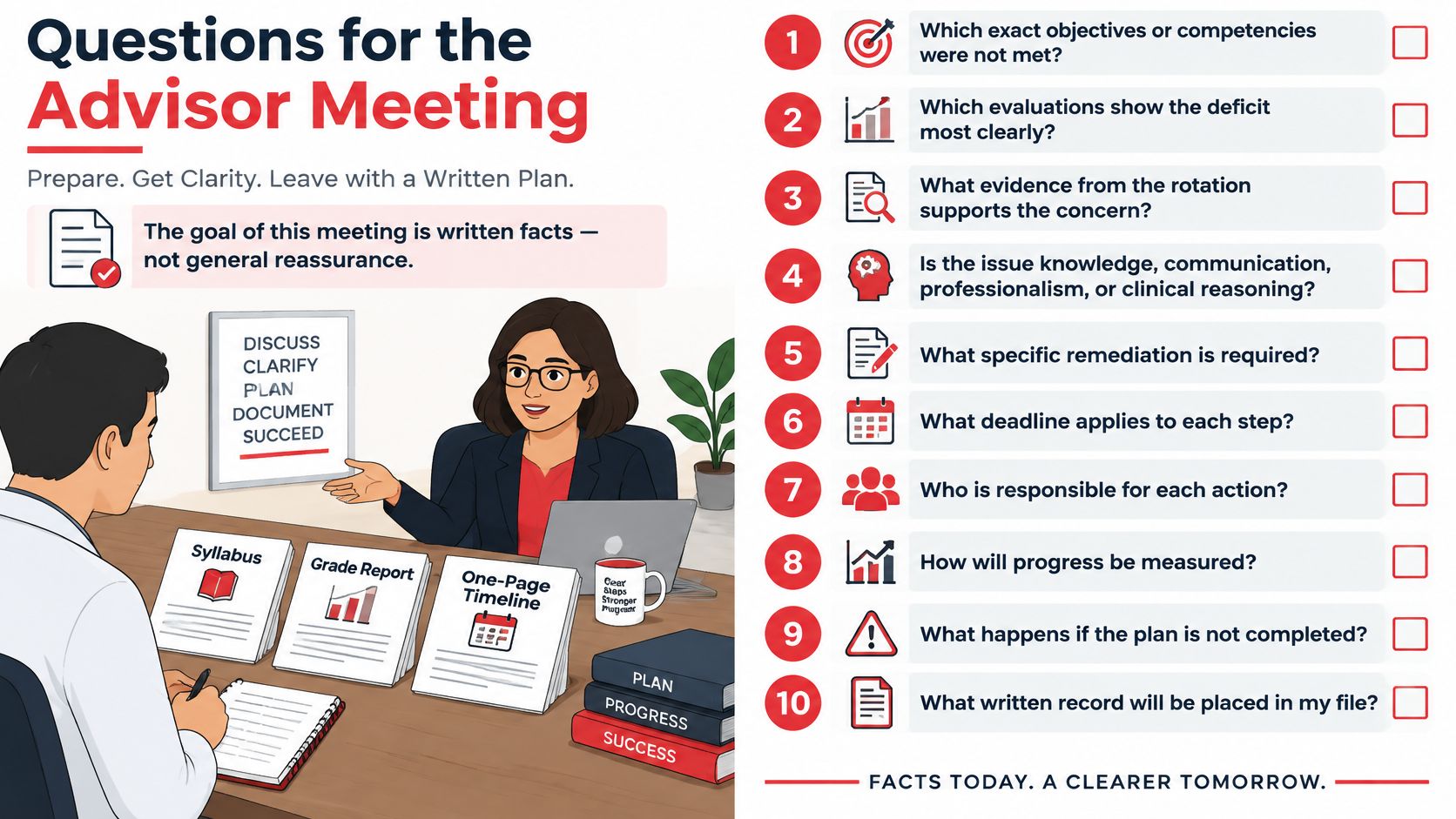
Ten Questions to Ask
- Which exact objectives or competencies were marked deficient?
- Is the failure clinical, professionalism-related, or examination-based?
- Is a make-up exam allowed, and what score is required?
- Is added ward time required, and for how many weeks?
- Can remediation happen during a scheduled vacation block?
- Are new rotations blocked until remediation is complete?
- How many attempts remain?
- Which committee reviews promotion, and when does it meet?
- What is the appeal deadline, and which office receives the appeal?
- How will the result appear on the transcript?
Local policy controls the answers. The Washington State University medical student promotion policy states that a student who fails a required rotation or sub-internship will normally be offered remediation, but the promotion committee may require a full course repeat when deficiencies span two or more competency domains. That example shows why a student shouldn't assume immediate dismissal, and also shouldn't assume a simple retake.
Students can map deficient objectives against the competency language used in evaluations. Background on ACGME core competencies and how programs describe them helps translate vague comments such as "needs stronger clinical reasoning" into observable tasks, such as presenting a prioritized differential and a complete plan.
Osteopathic, international, and visiting students should ask one additional question: which campus policy governs a rotation completed away from the home school? The home school may control promotion and transcript notation even when the away site wrote the evaluation. Visa status, housing, and limited away-rotation slots can also affect timing, so those constraints belong in the meeting notes.
Attention and organization difficulties sometimes sit underneath missed tasks or late notes, although they don't explain every failure. For students trying to describe those patterns clearly to an advisor, understanding ADHD types offers context on labels and limits. Any diagnosis or accommodation question still belongs with qualified campus professionals, not with a clerkship director alone.
First Email Template
Subject: Request for written basis of [rotation] grade. Dear Dr. [name], [Student name] completed [rotation] from [dates]. Please send the written evaluation and the standard applied, and suggest a meeting time before [appeal deadline]. Thank you, [name].
That email requests information. It doesn't argue the grade, accuse a preceptor, or promise improvement before the deficit is known. Save the sent message and any reply with the grade documents.
Remediation Retake and Appeal Paths
A first failed component and a second failure aren't handled the same way at most schools. In a survey reported by the national survey of 86 responding U.S. medical schools, clinical evaluations were required at 97% of responding schools and NBME subject examinations at 88%. The response after failure changed sharply when a student failed again.
How Schools Respond After One Failure and After Another
| School response | After a first failed component | After a second failure |
|---|---|---|
| Simple make-up | 55 of 86 schools, 64 percent | 16 of 86 schools, 18 percent |
| Additional ward time | 24 schools, 28 percent | 49 schools, 57 percent |
| Seven to twelve weeks of added work | 6 schools, 7 percent | 26 schools, 30 percent |
Those figures describe surveyed schools, not a promise for any individual student. They do explain why the second attempt should never be treated casually. More ward time can delay later clerkships, elective choices, and graduation planning.
Three Different Paths
- Remediation targets the missed objective. It might mean a make-up exam, added clinical time, observed presentations, a skills session, or a professionalism plan with specific check-ins.
- Retake repeats a component or the whole rotation. A full repeat gives more evidence of bedside change, but it can displace the next block and reduce schedule flexibility.
- Appeal challenges the process or the record. Examples include a missing evaluation, a cutoff applied incorrectly, or a required midpoint warning that never occurred.
An appeal shouldn't be used as a substitute for repairing a real skill gap. Some schools don't allow appeals based only on disagreement with academic judgment. Others limit appeals to procedural error, bias, or inaccurate records.
Ask for the written appeal process, then confirm three items in writing: the deadline, the receiving office, and the allowed grounds. A typical written appeal names the specific record in dispute, attaches supporting evidence, and asks for a written decision plus the next level of review. It stays calm, specific, and free of personal attacks on a preceptor.
Students should also ask whether the assigned remedy can occur during vacation, whether new rotations pause, and what happens if the remedy isn't passed. This article can't give a universal progression or dismissal rule because schools set those rules locally. A separate exam problem later, such as a licensing failure, follows different rules again, which is why guidance on a failed Step 2 CK attempt and its retake planning shouldn't be copied onto a clerkship grade.
An appeal challenges the record or the process. Remediation demonstrates the skill. Confusing those two jobs weakens both.
An Improvement Plan for the Real Deficit
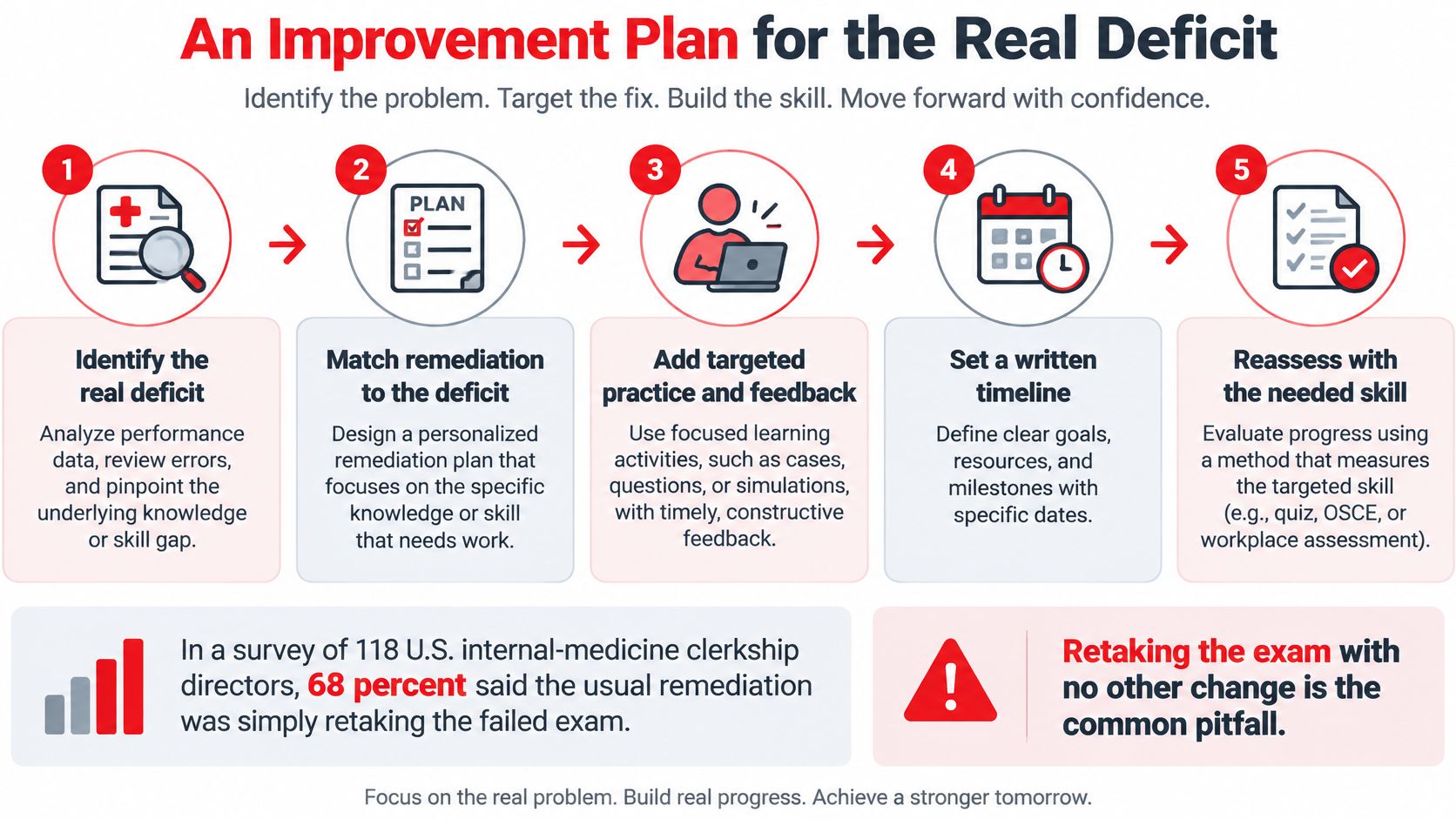
Retaking an exam with no other change is the common pitfall. A survey reported in Academic Medicine's survey of 118 U.S. internal medicine clerkship directors found that 68% of surveyed directors reported retaking a failed exam as the most common remediation approach. That can correct a score without showing safe bedside performance.
The fix starts with a diagnosis, not a repeat. A failed rotation usually has one dominant deficit, and each deficit responds to a different kind of practice.
Common Clerkship Deficits and the Practice That Matches Them
| Deficit | Practice target |
|---|---|
| Test-taking | Timed review of the missed question types |
| Differential diagnosis | A prioritized differential for each assigned patient |
| Oral presentation | An observed assessment and plan with feedback |
| Time management | A daily task list and one early checkpoint |
Read the table as a matching exercise. The left column is the diagnosis, the right column is the treatment, and pairing the wrong two is how students end up repeating the same failure.
Six Steps Before the Repeat
- Obtain the component scores. Separate the shelf or COMAT result from narrative ratings and OSCE checklists.
- Label the gap. Use plain categories: knowledge, reasoning, communication, professionalism, or workflow.
- Compare sources of evidence. Place the exam result beside observed encounters, presentations, notes, and attendance.
- Write one observable goal. Examples include a prioritized differential for every new patient or a complete assessment and plan without prompting.
- Use supervised practice with weekly feedback. Direct observation matters more for a bedside failure than another set of practice questions alone.
- Reassess with a similar task. Pair a comparable written measure with a comparable clinical task, not an easier substitute.
A four-week sketch can stay modest and specific. Across four weeks, a student might complete two timed blocks on missed topics, one observed presentation, and one task-list review with a resident each week. The resident review checks whether orders, follow-up labs, notes, and handoffs were completed on time.
Documentation habits belong in that practice when notes were part of the concern. Later, when applications describe clinical skills accurately, guidance on highlighting EHR proficiency on your resume can help a student name real documentation strengths without overstating them. During remediation, the immediate goal is simpler: complete notes that a supervisor can verify.
Question review fits an exam-only failure. Bedside observation fits weak histories, presentations, prioritization, or professionalism. Students comparing rotation expectations can review how medical school rotations are structured across core clerkships to see where shelf study ends and ward performance begins. Tutoring fits the written-exam component specifically: shelf exam sessions can cover clinical reasoning, question analysis, pacing, and the topics that need more attention, while a failed licensing exam calls for targeted remediation that identifies weak areas and adjusts study strategy before the next attempt.
Records Licensing Exams and Residency
Passing a repeat doesn't always erase the first attempt. The University of Texas Medical Branch archived medical school policy states that failure of a clinical experience is recorded as a failure and must be remediated to a pass, after which the transcript reads Pass/Fail with no grade higher than "pass". That's one archived school policy, not a national transcript rule.
Ask the registrar or dean's office how three items will appear: the original failure, the repeat, and the final outcome. Ask the same question about the Medical Student Performance Evaluation (MSPE). A transcript may show one notation while the MSPE narrative explains the clerkship outcome in different words.
Course Exams Are Not Licensing Exams
A subject-exam failure isn't a United States Medical Licensing Examination (USMLE) failure or an Osteopathic Medical Licensing Examination of the United States (COMLEX-USA) failure. NBME shelf exams and NBOME COMAT exams are course exams required by the school. USMLE Step 2 Clinical Knowledge and COMLEX-USA Level 2-CE are separate licensing exams with separate registration and reporting systems.
Students should check current attempt and score-report rules on the official USMLE and NBOME sites as of 2026, rather than relying on an older handbook or peer advice. Detailed exam format, fees, and reporting rules belong on those official pages and on linked exam guides. A clerkship office can explain the school cutoff, but it can't change licensing-body rules.
How Residency Applications May Show the Outcome
The Electronic Residency Application Service (ERAS) application and the MSPE may show the clerkship outcome, depending on school practice. Students preparing materials later can review what residency programs look at in an ERAS application to place a clerkship record beside exams, letters, and clinical grades. The explanation itself should stay short and factual.
A useful structure has three parts: what failed, what changed in study or supervision, and what evidence now shows the skill. For example, a shelf-only failure can be described through a changed question-review method and a passing retake. A presentation failure needs observed presentations, not only a better exam score.
A professionalism lapse shouldn't be minimized. Attendance, honesty, responsiveness, and respect for patients and staff require direct language and documented follow-through. Minimizing language such as "a scheduling mix-up" for repeated lateness creates a credibility problem larger than the original grade.
Support people can help during that explanation process, although the student still owns the record. Partners and family members sometimes need to set boundaries while offering reassurance so support doesn't turn into pressure to hide the outcome. One setback doesn't close a medical career, and no advisor or tutoring service can guarantee a later residency match.
Confirm the Written Policy Before You Repeat
One school may let a failed clerkship be remediated during a vacation block, while another sends the same grade to a promotion committee. The written policy at the named school controls which of those paths applies, so read it before repeating anything. Confirm the clerkship syllabus, the promotion rules, the failed objectives, the appeal deadline, and the faculty supervisor who will sign off on remediation. A plan without a named supervisor and a reassessment method is only a hope.
Four scheduling facts deserve written answers. Can remediation use a vacation block? Are new rotations blocked until the remedy is complete? How many attempts remain? And does a failed remedy lead to a repeated year, a leave of absence, or a committee review at that school?
Save each answer with the date and the name of the person who gave it. Policies change between catalog years, and the version that governs a student's case can differ from the one a classmate followed.
Support While the Plan Is Pending
Shame, poor sleep, anxiety, or hopelessness can block the practical work of reading evaluations and meeting deadlines. Confidential counseling through student affairs is an appropriate route, and it can be used without turning a remediation meeting into a therapy session. Anyone in the United States who is thinking about self-harm should call or text 988 for the Suicide and Crisis Lifeline.
Ask student affairs which support records stay confidential and which offices receive academic progress reports. That distinction matters. A student can use counseling, disability support, or academic coaching while keeping clerkship communications factual and professional.
Key Takeaways
- Name the failed component first: Clinical evaluation, professionalism, written exam, OSCE, or more than one component leads to different evidence and remedies.
- Save the paper trail: Keep the grade report, evaluations, syllabus, emails, and a dated log in one place.
- Confirm scheduling in writing: Vacation use, blocked rotations, attempt limits, and committee dates should never rest on memory.
- Separate exam failure from bedside failure: A passing retake doesn't prove presentations, prioritization, or professionalism have changed.
- Wait for local policy before predicting dismissal: Progression and dismissal rules are school-specific, and no national rule answers them.
If the failed component is a shelf, COMAT, or later licensing exam, one-on-one tutoring can sit alongside official practice questions and the school's assigned remedy. Ace Med Boards says it works with students who have low shelf exam or NBME shelf practice exam scores, or anxiety or test-taking issues, and the free audit is a diagnostic consultation that identifies weak areas rather than a full tutoring session. Because offerings change over time, ask Ace Med Boards which tutoring options currently fit the exam and the repeat schedule, including how sessions can work around clinical duties. Tutoring supports preparation; it does not guarantee a course grade, a licensing result, admission, or a residency match.
Rules for licensing exams and residency applications shift as well. Check the current USMLE, NBME, NBOME, Association of American Medical Colleges, and ERAS candidate pages directly for the rules that apply in 2026, since guidance found in an old forum post may already be out of date.