There's no universal NBME shelf exam score release day: schools often receive web-based Subject Exam results the calendar day after the testing window ends or the following day, although posting can take up to three business days. Student INSIGHTS access follows only after the school's selected posting delay.
If a classmate has a score and another student doesn't, has scoring been delayed? Not necessarily. The useful distinction is when NBME delivers results to the school versus when the school makes them available to students.
By Ace Med Boards Editorial Team
When Shelf Scores Reach Students
NBME stands for the National Board of Medical Examiners. Its Subject Exams are commonly called shelf exams in clerkship settings. For score-release purposes, the important date is usually the end of the school's testing window, not an individual student's exam date.
MyNBME Services Portal is the institutional portal through which the school receives results. INSIGHTS is NBME's platform for examinees to access performance reports through the MyNBME Examinee Portal. A result reaching the institutional portal and a student receiving an email are separate milestones.
The NBME Subject Exam Program Guide advises schools to begin checking approximately 24 hours after the testing window concludes and describes institutional posting as often occurring the next calendar day or the following day, with some administrations requiring up to three business days.
Typical web-based shelf score milestones
The reference point below is Day 0, the testing-window end date. These are planning milestones, not a promise that every school will release a report on the same schedule.
| Milestone | Typical timing | Who controls it |
|---|---|---|
| Testing window ends | Day 0, even if the student tested earlier in the window | School testing schedule |
| School begins checking MyNBME | About 24 hours after the window ends | School, following NBME advice |
| Scores posted to school portal | Often the next calendar day or the day after; up to three business days | NBME posting to MyNBME |
| Three-day examinee posting | Notification can start three calendar days after school posting; reports may appear about four calendar days after the window ends | School-selected setting |
| Six-day examinee posting | Longer delay before the student email; access may occur about seven calendar days after the window ends if school posting occurs the next day | School-selected setting |
| Manual faculty release | No fixed student date | Clerkship or medical education office |
NBME's INSIGHTS information for students describes the school-to-examinee release process and the institution-selected three- or six-calendar-day posting options. The table's earliest student-access estimates assume prompt institutional posting; later school receipt moves the student-access date later as well.
About seven calendar days isn't an absolute maximum. That estimate assumes that NBME posts to the school promptly and that the school uses scheduled rather than manual release. A student shouldn't use it as a universal overdue threshold.
Stage one is delivery to the school
The testing window may include students who finish on different dates. An early test appointment doesn't necessarily start a separate release clock for that student.
For example, suppose a student completes the exam before the rest of the clerkship group. The student may feel that the wait has already been lengthy, but institutional processing remains tied to the window's closure. Counting only from the personal test date can therefore make an ordinary release schedule look late.
Calendar days and business days also serve different purposes in this process. The institutional posting allowance includes business-day language, while the automated examinee-posting options use calendar days. Those clocks shouldn't be treated as interchangeable.
Stage two is student access
After institutional receipt, the school's release setting determines when examinees receive access. Faculty may also manage release manually, so a school can have results before a student receives a notification.
A useful analogy is a sealed packet: NBME delivers the packet to the school office, and the school determines when students may open it. Delivery and opening aren't the same event.
A local gradebook entry is another administrative step. Students should distinguish an NBME performance report from a completed clerkship grade, especially when the school combines examination performance with other assessments.
Practical rule: A missing email alone doesn't establish that NBME hasn't finished processing the exam.
Key takeaways
- Confirm the window end date. The individual appointment date may not be the relevant starting point.
- Identify the release setting. The clerkship office can confirm whether examinee access is scheduled or manually released.
- Check more than email. The institutional grade system and MyNBME Examinee Portal may provide different pieces of information.
- Use school policy as the decision point. A classmate's notification date isn't a reliable deadline.
These timing figures are time-sensitive and reflect the April 2026 NBME materials cited here. The school's current release policy and administration details control the practical timeline; the estimates shouldn't be treated as a school-specific guarantee.
Why One Class Sees Scores on Different Days
Has NBME delayed the result, or is the school following its normal policy? That's the question the clerkship office can help resolve. The most useful inquiry is whether results have reached the institution, not whether a student has received an email.
NBME's educator Subject Exam questions page distinguishes institutional posting from subsequent examinee access, including three- and six-day release settings. That distinction explains why students who take the same subject exam can receive notifications on different dates.
Missing shelf score or normal school timing
| What the student sees | More likely explanation | What to verify |
|---|---|---|
| The student tested, but the window is still open | Release follows the window end, not the personal test date | Clerkship testing-window end date |
| The window recently ended and the school has nothing | Institutional posting may still be underway | Whether MyNBME shows a school posting yet |
| The school has scores, but there's no email | The selected posting delay or manual release hasn't finished | Which examinee-posting setting the school uses |
| A classmate was notified, but the student wasn't | Different window, school, rotation, or release setting | The student's own window and gradebook |
| INSIGHTS is empty, but the gradebook shows a grade | The school and examinee systems update separately | Both the grade system and MyNBME Examinee Portal |
| No email arrives after the school's stated date | A missed notification or processing exception needs checking | Spam folder, then the clerkship or medical education office |
Compare the administration, not just the exam name
Two students saying “the medicine shelf” may not mean the same administrative circumstances. They may belong to different testing windows or institutions, even if their exam appointments were close together.
Manual release can introduce another difference. For example, a clerkship might communicate results after faculty review or a scheduled meeting. That's a possible local workflow to confirm, not evidence that someone has withheld a particular student's score because it was low.
A spam filter or account-access problem can also explain the absence of an email. For a non-standard administration, the school should confirm whether the ordinary web-based timetable applies.
Before the school's stated release window has passed, an absent report is generally an administrative timing issue, not evidence of a failing result.
The United States Medical Licensing Examination (USMLE) is a different examination program with a different reporting process. Its release expectations shouldn't be applied to a shelf.
For students organizing rotation requirements, the medical student clerkships guide provides related planning context. If a promotion, remediation, or residency-application deadline is approaching, the immediate question remains specific: Does MyNBME already show institutional results, and which release setting applies?
Who to Contact While You Are Waiting
The school is the first contact for release timing. Its staff can identify the testing window, check institutional receipt, and explain the local grade-posting process. A general inquiry to NBME can't substitute for those school-controlled details.
A practical contact order
- Check the clerkship syllabus or learning-management announcement. Locate the testing-window end date and any stated score or grade-release rule. Save the relevant announcement rather than relying on an informal estimate.
- Check the available systems. Review the school gradebook and MyNBME Examinee Portal, then check spam or junk folders for a notification.
- Email the clerkship coordinator or medical education office after the stated window passes. Ask whether institutional results have arrived, which release setting applies, and when the local grade will post.
- Escalate an institutional or access problem appropriately. NBME contact is most useful when the school confirms that expected institutional results remain absent beyond the applicable posting range, or when examinee portal access itself fails. Use the support route displayed within the official NBME portal or current official website rather than an unverified address.
- State any approaching academic deadline. Include the actual promotion, remediation, or application deadline so the education office can advise whether an interim status note is possible.
Sample email
The following template keeps the request factual without demanding immediate release or assuming an error.
Subject: Subject Exam result status for [clerkship name]
Hello [coordinator name],
The [exam name] was completed on [test date], and the published testing window ended on [window end date]. No examinee notification is visible.
Could the office confirm whether results have reached MyNBME, whether examinee release is scheduled or manual, and when the grade is expected in the school's system?
An upcoming [promotion/remediation/application] deadline is [date]. Guidance about any available interim documentation would be appreciated.
Thank you,
[student name and school identifier]
A short, complete inquiry gives staff something concrete to investigate. Repeated messages without the window date are less useful because they leave the central timing question unanswered.
Students taking osteopathic licensing examinations should keep those timelines separate. The COMLEX Level 3 score-release guide addresses a different examination and shouldn't be used to estimate NBME shelf posting.
Refreshing hourly or comparing notifications across schools won't establish whether a report is overdue. A saved school response is more useful, particularly when an academic deadline is involved. A delayed report is an administrative item to document, not a judgment of ability.
What the Examinee Reports Show
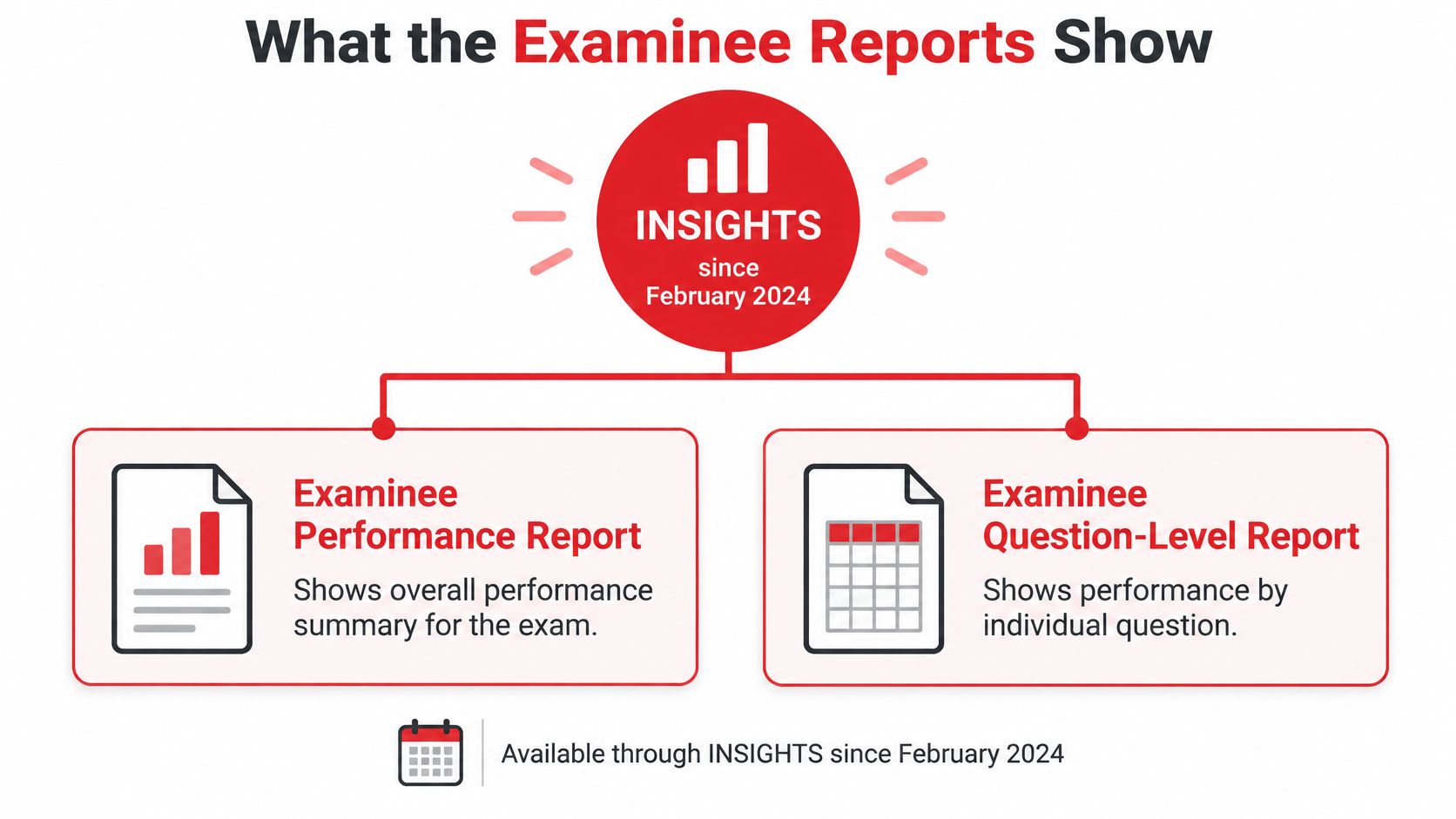
NBME's score-interpretation guidance describes examinee access to the Examinee Performance Report and Examinee Question-Level Report through INSIGHTS beginning in February 2024, along with Equated Percent Correct (EPC) reporting on a 0–100 scale. EPC is intended to represent the percentage of content mastered, not the raw percentage answered correctly on a particular form.
Overall performance and detailed feedback serve different purposes
The Examinee Performance Report provides the overall performance summary. The Examinee Question-Level Report provides more detailed feedback that can help identify content needing review.
Students should download the available reports after receiving access instructions. Keeping the original documents makes it easier to discuss performance with the clerkship director or academic advisor without relying on a remembered score.
The question-level report isn't a license to reconstruct live examination items. Review should focus on the assessed content and reasoning skills, not recalled wording, answer choices, or attempts to circulate questions.
EPC isn't a raw percentage or a percentile
Equating accounts for differences in difficulty among exam forms. Consequently, a student shouldn't reverse-engineer an exact number of correct answers from the reported EPC.
Consider an original scoring illustration, not an examination item: two students answer the same raw count correctly on forms of different difficulty. Their EPC values can differ because the reported metric adjusts for form difficulty rather than merely displaying the raw count.
| Term | What it answers |
|---|---|
| Raw percentage | What share of that form's questions was answered correctly? |
| EPC | What is the adjusted estimate of performance on the exam's content? |
| Percentile | How does performance compare with the applicable reference group? |
| Clerkship grade | How does the school apply its local assessment rules? |
A school may use EPC alongside local grading rules, percentile comparisons, or honors criteria. Those decisions shouldn't be inferred from the EPC label alone.
The medical board exam scores guide provides broader score-interpretation context, while shelf-specific percentile questions require the appropriate shelf reference and school policy. A single shelf result is educational feedback, not a prediction of a medical career.
These score-interpretation descriptions reflect the cited April 2026 NBME materials and remain time-sensitive. The current report instructions should take precedence if the report format changes.
How to Read the Result and Plan Next
Once both the examinee reports and the local grade are available, the useful task changes from tracking delivery to deciding what needs attention. A score audit keeps that decision grounded in documented performance rather than an emotional reaction to one number.
The NBME Clinical Science Score Interpretation Guide explains the adjusted scoring approach and the examinee reports available through INSIGHTS. The overall result and detailed feedback should be read together, not treated as competing accounts of performance.
A practical score audit
- Record the official result and local rule. Save the EPC, exam date, posted school grade, and applicable school pass or honors policy. If the school grade is pending, label it pending rather than calculating a substitute.
- Separate the overall result from content patterns. Identify the weakest review areas, then look for recurring problems in the student's own practice-question history. Distinguish knowledge gaps from difficulty interpreting the question or managing time.
- Build a focused review plan. Assign each priority topic a concrete action, such as targeted question-bank work, a concise concept review, and later retrieval practice. Use ordinary educational resources, not recalled exam content.
- Choose the response that matches the school's decision. Satisfactory performance, an unclear grade boundary, and required remediation call for different next steps.
Match the plan to the situation
| Situation | Appropriate next action |
|---|---|
| The school marks the result satisfactory | Maintain brief spaced review of weak topics while preparing for the next rotation |
| The result is near a local pass or honors boundary | Ask how the school applies that boundary before changing the study plan |
| Remediation is required | Obtain the written policy, required actions, and reassessment expectations |
| The score and grade appear inconsistent | Ask the clerkship office to explain the conversion or weighting |
For percentile questions, the separate shelf exam percentiles guide addresses that comparison without replacing the school's applicable reference. A percentile table shouldn't be used to invent a local passing threshold.
One low or failed shelf result doesn't, by itself, end a medical career. The immediate priorities are understanding the school's requirements and correcting identifiable learning problems.
One-on-one shelf tutoring, where offered, can complement official NBME feedback, a question bank, and independent study when pacing, clinical reasoning, or an unclear plan remains unresolved. The tutoring services overview provides a starting point for evaluating that option without treating tutoring as a replacement for school advising.
Ace Med Boards is not affiliated with or endorsed by NBME. Questions about official grades, promotion, remediation, and release timing belong with the responsible school office.
Decide Whether to Wait or Get Help
Has the school's stated release period passed, or is the score already available? That distinction determines the next step. NBME posting time and the school's release setting are separate parts of the process, so an expected wait is not automatically a delay.
A decision framework
- Wait while the published process is underway. Keep the school's announcement available and focus on current coursework. The NBME guidance cited above is time-sensitive, so check the current NBME pages before relying on any release timing.
- Contact the school after its stated date has passed. Ask the responsible office whether the score has posted and whether the school has set a revised release expectation. Keep its reply.
- Review independently when the weak areas and next steps are clear. Use the available feedback to focus your study; additional services are not required for every low result.
- Discuss structured support when the learning problem remains unclear. If pacing, clinical reasoning, or a remediation requirement is difficult to interpret, ask an advisor for guidance. Educational support may also help address study needs.
Once reporting is resolved, students can assess whether focused academic support would help. Ace Med Boards offers shelf exam tutoring information for students considering individual study plans and online sessions. Tutoring supports exam preparation; it does not provide or speed up score release.
Shelf and COMAT examinations are excluded from the ACE Progress Increase Guarantee. Choose tutoring based on the study support needed, not an expectation of a guaranteed shelf result.
Sources
- NBME Subject Exam Program Guide, institutional posting and testing-window guidance.
- NBME clinical-science score-interpretation guidance, examinee reporting and EPC interpretation.
- NBME INSIGHTS student information, access to examinee reports.
- NBME educator Subject Exam questions, institutional reporting and release questions.
Ace Med Boards' shelf preparation uses an individual study plan and focused online sessions that account for the student's rotation schedule. Sessions cover clinical reasoning, question analysis, pacing, and topics needing more attention. The free Board Score Audit reviews the latest assessment data, current resources, study schedule, exam date, and target outcome. Students who want help turning a returned result into a practical study plan can request a free consultation.