You've finished a demanding set of clinical rotations, but Step 2 Clinical Knowledge (CK) still feels difficult to define. You may be asking whether your patient-care experience is translating into exam performance, how much score buffer you need, and whether the 2026 testing-interface changes will disrupt your pacing.
The short answer is that Step 2 CK measures applied clinical decision-making, not simple recall, and preparation should combine clinical reasoning, timed questions, structured review, and realistic simulations. This guide explains the exam, eligibility, recent scoring changes, study timeline, error-log method, and test-day risk controls so you can build a preparation plan around your actual starting point.
Introduction to Step 2 USMLE CK Prep
A student beginning Step 2 CK often has a familiar problem. During rounds, the student can discuss a patient's differential diagnosis, but a question stem adds several distractions, changes one clinical detail, and asks for the next best step under time pressure. Knowing the medicine is only part of the task. The student must identify what the question is asking, separate decisive findings from background information, and commit to one action.
That is why Step 2 CK preparation should resemble supervised clinical reasoning. The exam focuses on applying clinical science to patient care, including health promotion and disease prevention, rather than testing basic-science facts in isolation. The official USMLE Step 2 CK content outline can help you organize review by patient-care task, clinical discipline, and disease process.
A useful plan has three layers:
- Foundation: Refresh the clinical concepts you repeatedly miss.
- Application: Complete original practice questions under timed conditions.
- Readiness: Use self-assessments, error trends, and full-length simulations to decide whether your performance is stable enough for test day.
The recent rise in the passing standard makes a narrow “just pass” strategy less comfortable, particularly for borderline examinees. At the same time, the 2026 interface changes make pacing practice more important. Your target should therefore be based on a defensible buffer, not on a single encouraging practice score.
Exam Purpose and Structure
Step 2 CK asks whether you can apply clinical science to supervised patient care. A patient may have a familiar condition, yet the question can ask for the diagnosis, the next test, treatment, counseling, or follow-up. The tested skills include diagnosis, management, prognosis, pharmacotherapy, clinical interventions, health maintenance, disease prevention, professionalism, and patient safety.
The exam format depends on your testing date. For examinations taken before May 7, 2026, USMLE describes one nine-hour session with eight 60-minute blocks, up to 318 items, at least 45 minutes of break time, and an optional 15-minute tutorial. These details appear on the official Step 2 CK examination page.
How to think about a block
A block is a timed group of decisions, not a specialty chapter. Internal Medicine, Surgery, Pediatrics, Obstetrics and Gynecology, Psychiatry, Family Medicine, preventive care, and patient-safety topics may appear in any sequence. Trying to predict the discipline wastes time. Treat each stem as the patient in front of you.
Use this sequence:
- Read the task first. Identify whether the question asks for a diagnosis, next test, treatment, counseling, or complication.
- Build the patient frame. Note age group, acuity, pregnancy status when relevant, immune status, and major risk factors.
- Find the decision-changing evidence. Separate findings that alter management from details that provide context.
- Choose the action for that moment. The best answer may be an immediate management step rather than the most definitive test or complete treatment plan.
- Move on after deciding. Mark uncertainty if needed, but do not let one difficult stem consume the block.
Practical rule: Treat every question as a clinical decision at a specific time point. “What should happen next?” asks for a different response than “What would confirm the diagnosis?”
The 2025 passing-score increase reduces the comfort of a narrow just-pass plan. Borderline performance needs a buffer because a few pacing errors can affect the final result. The 2026 interface changes add another risk: familiar content may feel slower while you adjust to the new screen and navigation. Practice should therefore combine clinical reasoning with interface rehearsal. Use the tutorial and breaks as planned recovery points, then adapt the plan if fatigue or timing begins to erode accuracy. The goal is a flexible routine that protects both time and judgment.
Timing Eligibility and Registration Process
Registration begins with identifying which organization handles your application and whether your medical-school category satisfies current eligibility rules. The 2026 Bulletin states that eligible examinees include U.S. or Canadian medical students or graduates from LCME- or CACMS-accredited schools, osteopathic students or graduates from COCA-accredited schools, and international medical students or graduates who meet ECFMG requirements through an eligible institution listed in the World Directory of Medical Schools. Review the official 2026 USMLE Bulletin before choosing a testing window because policies can change.
For the 2026 service transition, U.S. MD and DO students and graduates register through NBME, while eligible international graduates use the FSMB pathway and must still satisfy applicable ECFMG requirements. Confirm the current process in the Bulletin and any addendum rather than relying on older registration guides.
A practical scheduling sequence
First, confirm eligibility. Make sure your school category, graduation status, identification documents, and certification requirements align with the current application rules.
Next, choose a realistic window. Schedule after enough core clinical exposure to support applied reasoning, but leave room for dedicated review and score reporting requirements that affect your residency application timeline. Your school's policies may also limit when you can test.
Then, protect the study period. Work backward from the intended exam date. Reserve time for content repair, timed question practice, self-assessment, and a final reduction in workload. A date that looks convenient on a calendar may be poor if it leaves no recovery time after a demanding rotation.
Use the Step 2 CK timing guide as a planning aid, then verify your eligibility window, registration pathway, scheduling permit, and testing-center availability through the responsible official organizations.
Don't select a date solely because classmates are testing then. An IMG may need additional time to adapt to U.S. clinical conventions, while a retaker may benefit more from a score-report audit than from repeating a generic content review. Both choices are legitimate. The correct date is the one that matches your readiness evidence and administrative requirements.
Scoring Changes and Performance Targets
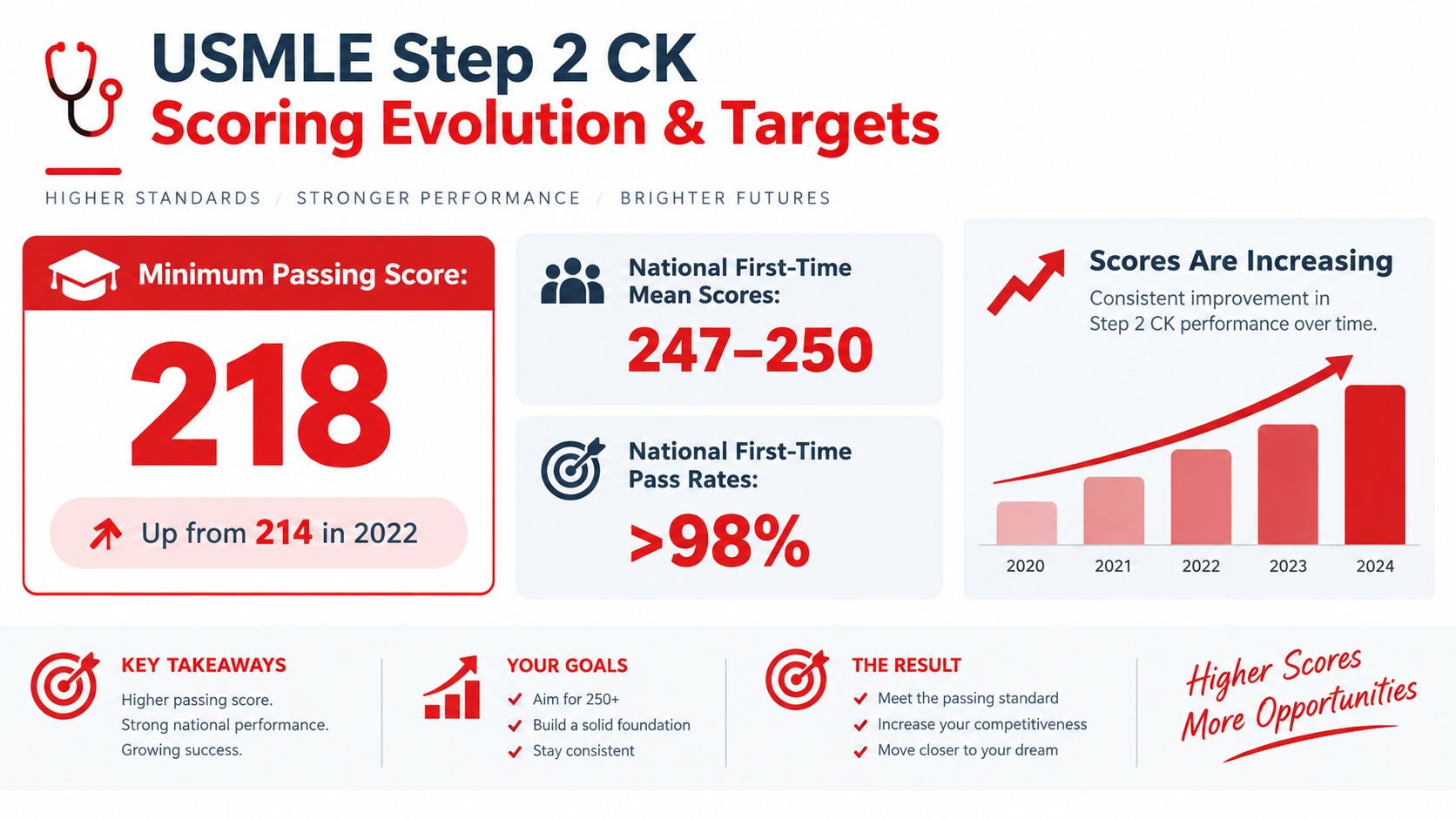
A practice score near the old passing line can create false confidence. For examinations taken on or after July 1, 2025, the minimum passing score is 218. The standard rose from 209 to 214 for exams on or after July 1, 2022, then increased by another four points, creating a nine-point total increase over three years. The official USMLE announcement on the 2025 passing-standard change explains the revised threshold and timing.
Passing is a floor, not a universal application target
Step 2 CK still reports a three-digit score. Passing answers one question: did your performance meet the examination standard? It does not establish whether the result fits a particular specialty, program, or applicant profile.
That distinction matters more when planning around the 2025 standard and the 2026 test-interface changes. A new interface can alter how quickly you read prompts, mark items, and return to uncertain questions. Treat your preparation buffer like extra fuel on a long trip. It protects against slower navigation, difficult blocks, and ordinary test-day variation rather than serving as unused surplus.
Percentiles also compress at higher score levels. Official interpretation guidance reports a score of 240 at about the 23rd percentile, meaning more than three-quarters of examinees scored at or below that level. Small score differences can therefore matter in a crowded applicant pool, although programs review more than one number.
Use a target audit:
- What is the minimum acceptable outcome? For current exams, the passing floor is 218.
- What buffer protects against an uneven test day? Base it on repeated practice performance, including interface-specific pacing, not optimism.
- What does your application require? Consider specialty competitiveness, IMG or retaker status, clinical history, letters, research, and timing.
- Is performance stable? One isolated score should not determine readiness.
The Step 2 CK passing-score guide can help separate the pass threshold from a preparation target. Set a score goal that supports your application while giving daily study decisions a clear purpose. As the interface changes, rehearse pacing and flagging habits until they require less conscious effort. The goal is controlled risk, not merely crossing the line.
High-yield Clinical Topics and Study Timeline
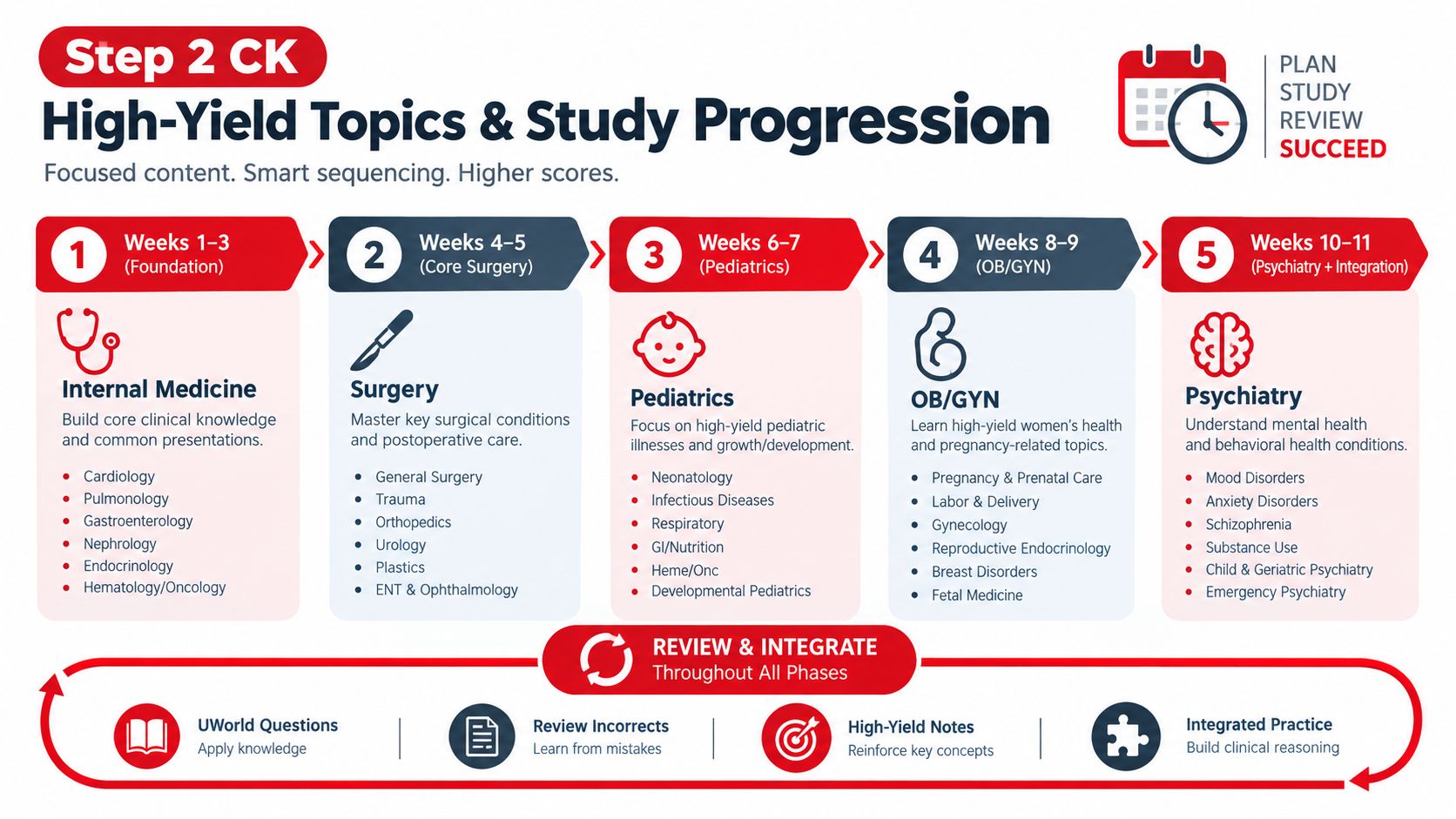
A student may recognize a diagnosis yet lose points by choosing the wrong next action or spending too long on one vignette. High-yield preparation therefore means repeated practice with common clinical decisions while maintaining coverage of less familiar material. Use the official Step 2 CK high-yield topics guide alongside the current USMLE content outline when building a schedule.
The recent passing-score increase makes a narrow pass-focused plan riskier. The 2026 interface changes add another variable: pacing, flagging, and screen-based navigation must be rehearsed rather than assumed. A scoring buffer works like extra fuel on a long trip. It protects against a difficult block, slower navigation, fatigue, and ordinary test-day variation. It should come from stable practice performance, not optimism.
A flexible preparation timeline
| Phase | Primary work | Readiness question |
|---|---|---|
| Early preparation | Review rotation-linked weaknesses and begin timed questions | Can you explain why the correct action is best? |
| Integrated review | Mix Internal Medicine, Surgery, Pediatrics, Obstetrics and Gynecology, Psychiatry, Family Medicine, and prevention | Can you shift between disciplines without losing the task? |
| Dedicated practice | Increase mixed timed sets and revisit the error log | Are the same mistakes recurring? |
| Final readiness | Use official self-assessment materials and simulation practice | Is performance stable across fatigue and unfamiliar topics? |
A student with recent clinical exposure may need a shorter review phase. An IMG, retaker, or learner returning after an academic gap may need more time to rebuild illness scripts and become comfortable with U.S. management conventions. Choose the timeline after a baseline assessment and an initial review of error-log patterns, not because it sounds standard.
A sample weekly rhythm
- Clinical review days: Study one major problem representation, then answer related questions.
- Mixed-question days: Combine organ systems and disciplines to practice switching tasks.
- Review sessions: Reconstruct missed questions before rereading every explanation.
- Application block: Complete one timed set and analyze pacing as well as accuracy.
- Recovery period: Protect sleep and a short, low-intensity review period so fatigue does not erase retention.
Cycle through major disciplines more than once. The first pass builds recognition. The second should require discrimination between similar diagnoses, testing strategies, treatment choices, and prevention recommendations. Keep biostatistics, ethics, communication, and patient safety in the schedule rather than postponing them until the final days. During each timed set, rehearse the 2026 interface habits, including flagging, review decisions, and moving on when a question threatens the block's pacing.
Practice Strategy and Question Review Workflow
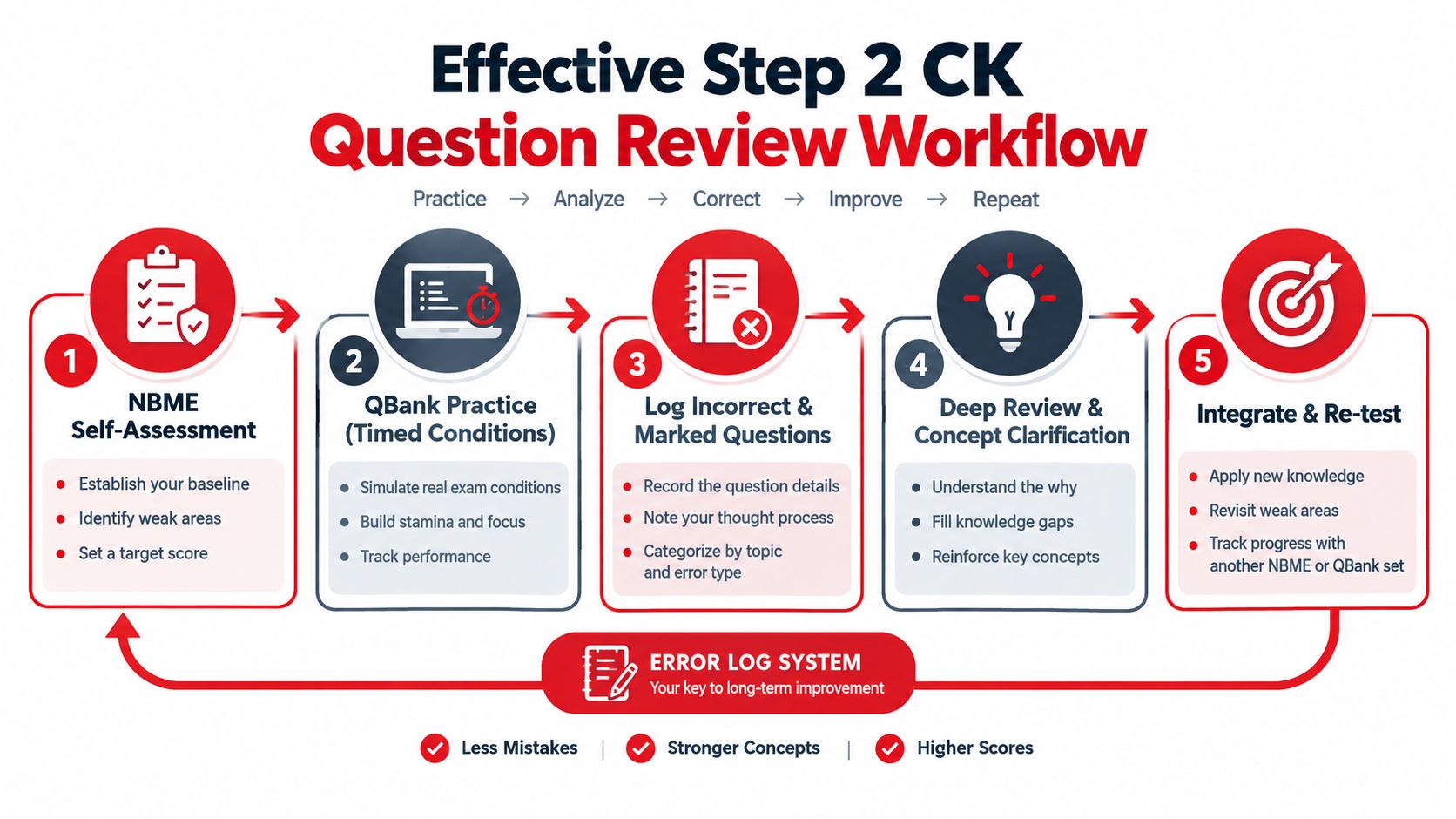
A student can finish a timed block with several incorrect answers and still learn little from it. The value comes from identifying the cause: a knowledge gap, faulty interpretation, unclear task recognition, poor pacing, or an avoidable execution error. Each cause needs a different correction, especially as the 2025 passing-score increase leaves less room for careless misses and the 2026 interface changes make block management more important.
Start with an official NBME self-assessment or other current official preparation material to establish a baseline. Review the pattern of errors before choosing a study timeline. A commercial question bank, such as UWorld, can serve as a practice resource, but its questions, explanations, and distinctive wording should not be copied into notes. Official sample questions and interactive tools can help you become familiar with approved formats and interfaces.
The vignette-decision worksheet
For every incorrect or uncertain question, record:
- Patient frame: Who is the patient, and how sick are they?
- Task: What decision does the question require?
- Decisive positives and negatives: Which two findings change the answer?
- Mechanism or illness script: What process connects those findings?
- Best answer: State it in your own words.
- Distractor autopsy: Explain why each tempting alternative is less appropriate now.
- Transfer rule: Write one rule that applies to another vignette.
Use this original example, not an official or recalled exam item:
A previously healthy adult develops fever, pleuritic chest discomfort, and shortness of breath after prolonged immobility. The patient is stable, oxygenation is reduced, and the question asks for the next diagnostic step. Your worksheet should identify the patient frame, name the task, use the risk context and physiologic finding as decisive evidence, then separate diagnostic confirmation from immediate stabilization or empiric treatment.
The goal is to name the decision before viewing the options. That habit works like labeling a map before choosing a route. It reduces the chance that an attractive distractor controls your reasoning.
Review standard: If you cannot explain why the best answer fits the patient's current stage, review of the question is incomplete.
Simulating the 2026 interface
For exams taken on or after May 7, 2026, Step 2 CK uses 16 30-minute blocks in a nine-hour session with up to 318 items, while remaining numerically scored. Shorter blocks can make fatigue feel more frequent, and the greater number of section transitions increases the need for deliberate pacing. Check the official 2026 USMLE Bulletin and Addendum materials for current delivery details.
Practice with short timed sets, mixed clinical content, and longer sessions that test recovery between blocks. Rehearse marking, deciding when to move on, using breaks, and re-entering the exam after a pause. These habits protect your scoring buffer by preventing one difficult item from consuming time needed elsewhere.
After each session, classify errors as knowledge, interpretation, decision, or execution. If you change a correct answer after noticing one unfamiliar detail, use a specific rule: change it only when a clear contradiction invalidates the original reasoning. Retest the same concept in an unseen context, then compare both accuracy and pacing.
Common Pitfalls and Test Day Tips
A polished study plan can still fail if test-day behavior is improvised. The most common preventable problems involve reading the task incorrectly, allowing one difficult item to consume too much time, and treating fatigue as a character flaw instead of a predictable cognitive constraint.
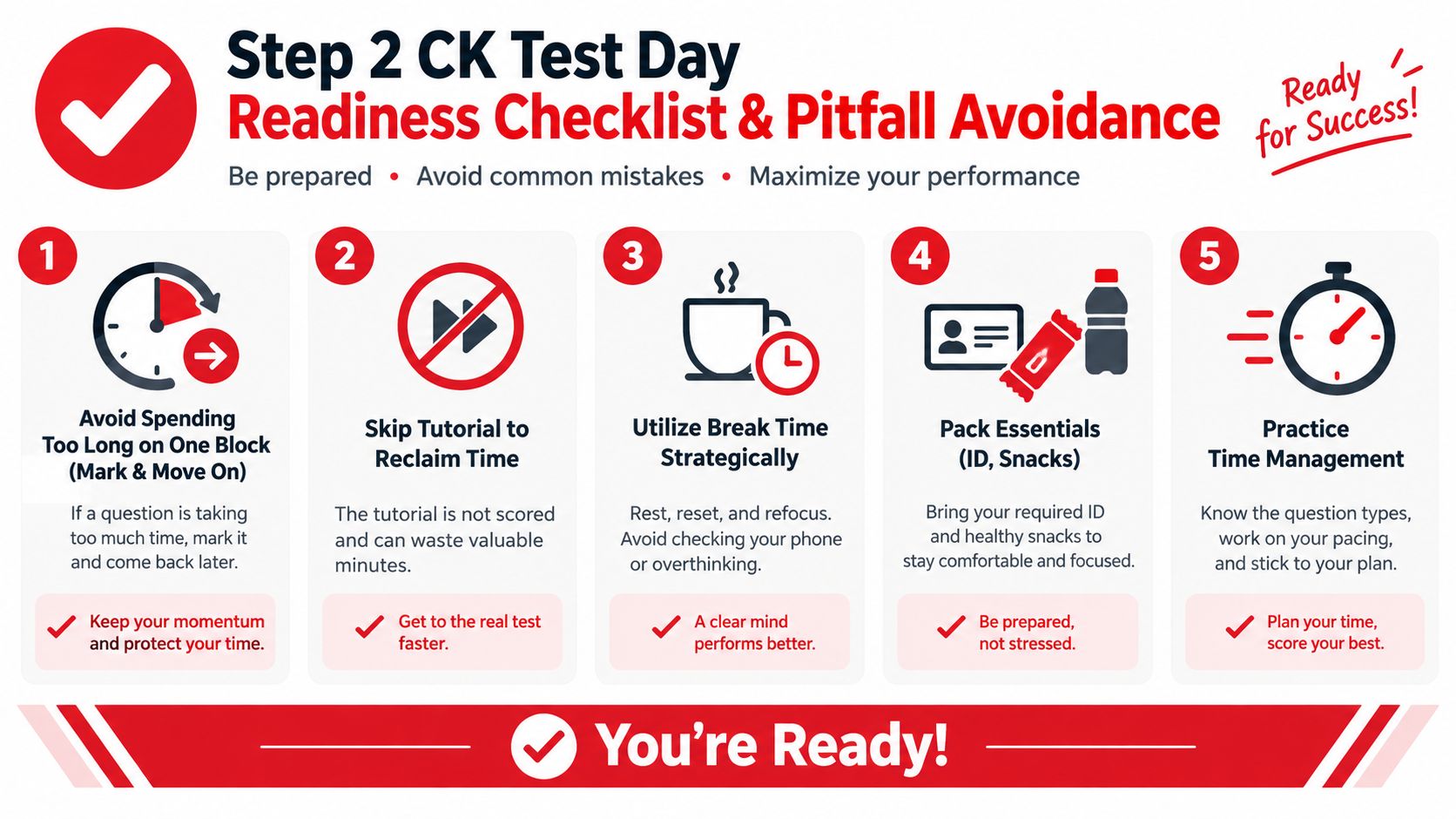
Use this checklist during your final simulations:
- Identify the task: Before reviewing options, decide whether the question asks for diagnosis, testing, treatment, prevention, or follow-up.
- Mark and move: If a question is consuming disproportionate attention, record your best answer, mark it, and continue.
- Plan breaks: Use the available break time for hydration, food, movement, and a deliberate reset rather than checking performance emotionally.
- Rehearse the interface: Practice with current official tools so navigation doesn't compete with clinical reasoning.
- Pack essentials: Confirm your identification and permitted test-day materials using the current Prometric and USMLE instructions.
Don't assume that skipping every break creates an advantage. A short reset can protect later decision quality, especially when several blocks remain. Likewise, don't skip official instructions automatically. Learn the interface beforehand, then use the tutorial and break bank according to the current rules for your exam date.
A final readiness check should cover more than knowledge:
| Area | Ready when you can say |
|---|---|
| Clinical reasoning | I identify the task before choosing an answer. |
| Pacing | I can recover after a difficult question. |
| Stamina | I can maintain a structured process late in a long session. |
| Logistics | My eligibility, permit, identification, and appointment details are confirmed. |
| Emotional control | One uncertain item doesn't determine the next decision. |
Boosting Results with Targeted Tutoring
One-on-one tutoring can complement self-study when the problem is difficult to diagnose independently. A tutor can review your error log, separate a knowledge gap from a task-reading error, and help you practice the same clinical decision across original vignettes. That work should reinforce official content outlines, NBME materials, and your own question-review system, not replace them.
Ace Med Boards offers USMLE Step 2 CK tutoring for learners who want individualized preparation. A session may reasonably focus on a stubborn clinical topic, a vignette-decision worksheet, timed pacing drills, or analysis of repeated errors. The value of the session depends on the quality of the diagnostic information you bring, including missed-question categories, self-assessment patterns, and examples of where your reasoning changed.
A labeled composite learner illustrates the process. The learner changes correct answers after noticing one unfamiliar detail. Review begins by requiring the learner to state the question task and two decisive findings before viewing the options. The learner changes an answer only when a specific contradiction appears, and later practice checks whether the same error recurs in an unseen block.
That approach is more useful than being told to “trust your first answer.” It creates a behavior that can be measured and refined without promising a particular score, pass result, admission, or residency match.
If you're asking how much average improvement Ace Med Boards students achieve or how long it takes, no verified Ace-specific average, study period, measured result, or student case has been provided. A responsible plan must begin with your baseline, available preparation time, prior attempts when applicable, and the type of errors affecting performance.
If your Step 2 CK preparation needs a clearer diagnosis, visit Ace Med Boards to learn about individualized tutoring built around clinical reasoning, error-log review, and pacing practice. You can use a free consultation to discuss your starting point and determine whether targeted support fits your study plan.