So, when do medical school interviews actually start? Let’s cut to the chase: the first wave of invitations typically lands in late August or early September. This guide will walk you through the entire interview season, which really heats up from September to January before winding down in early spring.
Think of this less as a simple calendar and more as your strategic playbook for turning an interview into an acceptance.
Your Guide to the Medical School Interview Season
Understanding the interview timeline is absolutely critical because of one major factor: rolling admissions. Most medical schools operate on a first-come, first-served basis.
Imagine a popular concert where the doors open and the best seats are snapped up immediately. The later you arrive, the fewer good spots are left. It's the same with med school interviews. Applicants who interview early are competing for a full class of open seats, giving them a significant statistical advantage.
This high-stakes season officially kicks off as summer wraps up. In the U.S. and Canada, interviews start rolling out from mid-August to early September. From there, it's a marathon that can stretch all the way into April of the next year.
The peak period, however, is from September through January. This is when schools send out the highest volume of invites—a staggering 70-80% of total interviews happen during these crucial months as admissions committees work to fill their classes.
What This Guide Covers
This guide is your playbook for mastering one of the most pivotal phases of your pre-med journey. We’re going to break down:
- Why timing is everything in the world of rolling admissions and what’s really at stake.
- The key timeline differences between MD and DO programs.
- What to expect when that long-awaited interview invitation finally hits your inbox.
- How to build a preparation plan that leaves nothing to chance.
By understanding the natural flow of the interview season, you can position yourself for the best possible outcome. A complete, polished application submitted early is your first move, as detailed in this comprehensive medical school application checklist.
The goal isn’t just to get an interview, but to get one when the most acceptances are still on the table. Let’s dive into how you can make that happen.
The Prime Interview Window: September to January
If the medical school application cycle is a marathon, then the stretch from September through January is where the race is truly won. This five-month period is the prime interview window—the time when admissions committees are working at full steam and the vast majority of interview invitations land in applicants' inboxes. The engine driving this intense season is rolling admissions, a system that heavily favors those who are prepared and apply early.
Think of it like trying to get a seat at a popular new restaurant. The first people to make reservations get their pick of the best tables and times. In the same way, applicants who land interviews in September or October are competing for a full class of open seats. As each month ticks by, more of those seats are filled, and the competition for what's left gets a whole lot tougher. Where you fall in this timeline can absolutely make or break your chances.
Why Early Interviews Matter Most
Getting your primary and secondary applications submitted on time is what sets the stage for an early interview. It's a direct cause-and-effect relationship: a strong application submitted in July is often among the first to be reviewed, putting you in the running for those highly sought-after interview slots in September.
This timeline gives you a bird's-eye view of how the entire interview season flows, clearly showing the peak activity from fall through early winter.
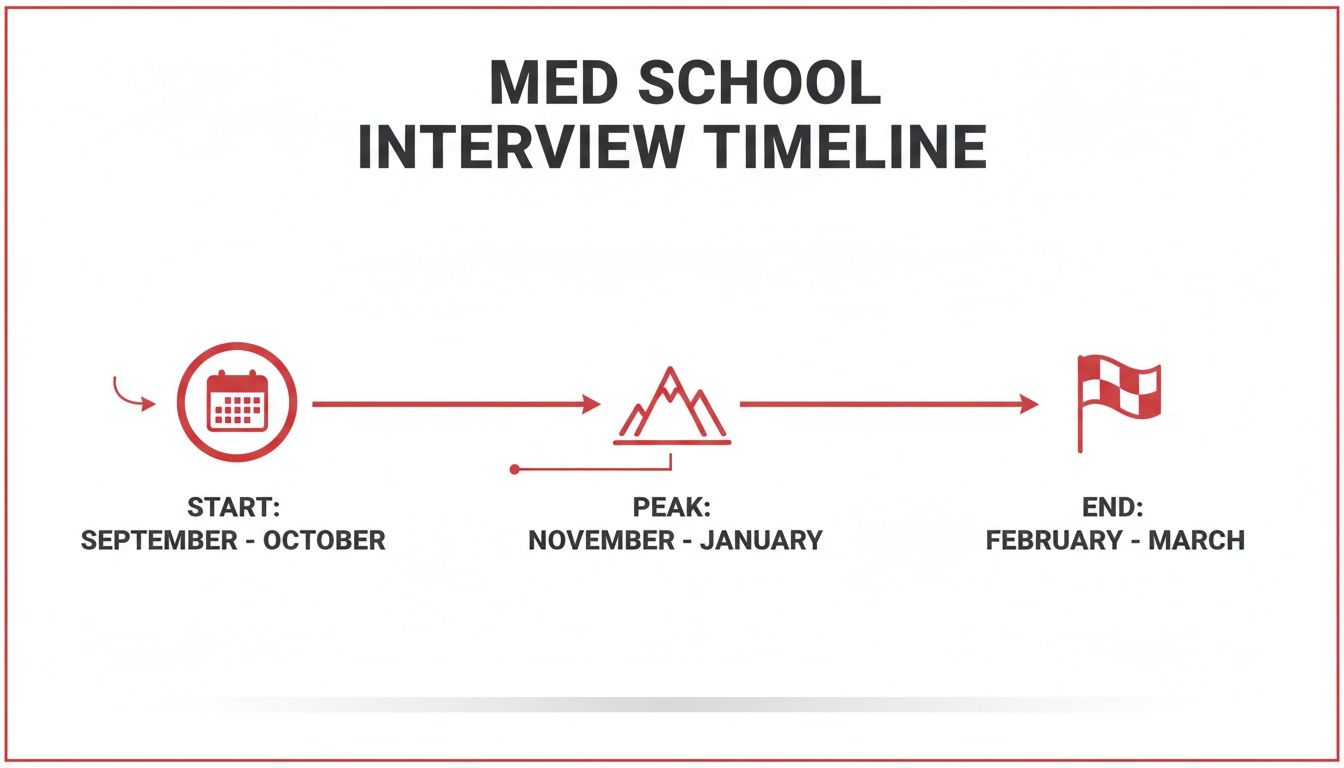
As you can see, while a few interviews might pop up in August, the volume really ramps up in the fall. This is the period you need to be ready for.
To give you a clearer picture of how everything fits together, here’s a month-by-month look at the entire cycle.
Medical School Application and Interview Timeline Breakdown
This table breaks down the key milestones of the medical school application and interview cycle. Use it to visualize the entire process, from submitting your application to (hopefully!) receiving an acceptance.
| Month | Primary Action for Applicants | Typical School Response |
|---|---|---|
| May-June | Submit primary application (AMCAS/AACOMAS). | Application verification begins. |
| July-August | Work on and submit secondary applications. | Schools send secondary applications; first interview invites may go out in late August. |
| September-October | Continue submitting secondaries; begin interview prep. | Peak interview invitation season begins. Schools actively review and send invites. |
| November-December | Attend interviews; send update letters if needed. | Peak interview season continues. Some of the first acceptance offers are sent. |
| January-February | Continue interviewing; waitlist updates may begin. | Interview season winds down; more acceptance and waitlist notifications are sent. |
| March-April | Final interviews are completed; make final school decisions. | Final decisions and waitlist offers are sent out. |
| April 30 | "Plan to Enroll" deadline for many MD schools. | Schools finalize their incoming classes from acceptances and waitlists. |
| May-July | Prepare for medical school! | Final waitlist movement occurs. |
This timeline underscores just how crucial the September to January window is. This is when the most action happens and when you have the best shot.
The strategic advantage of interviewing during these months is huge. This is true for MD programs in the US, DO programs, and even international schools in the UK and Australia that run on similar cycles. To see how all the pieces connect, it's worth reviewing the complete AMCAS application timeline to understand how each step feeds into this critical interview period.
A strong, early application doesn't just get you in the door; it gets you a better seat at the table. When you interview in the fall, you're being considered for a larger pool of acceptance offers before the class starts to fill up.
Data from the AAMC backs this up, confirming that the highest volume of interviews happens between September and January. Schools governed by AACOM follow a nearly identical pattern for osteopathic programs. Aiming for an interview in this window isn’t just a good idea—it’s a strategic move that can dramatically increase your odds of getting that acceptance letter.
Navigating the Late Season: February to April
Getting an interview invitation after the prime September-to-January window can feel a little strange, but let me be clear: it is far from a bad sign. Think of this late season, from February to April, as the final, strategic phase of a very complex puzzle. Admissions committees aren't just filling any open seats; they are meticulously hand-picking candidates to perfect their incoming class and build a rock-solid waitlist.
An interview invite this late in the game is a huge testament to the strength of your application. It means your file not only survived but genuinely stood out through months of intense review. The committee sees something special in you—a unique quality, experience, or perspective that could round out their class.
While the sheer volume of interviews definitely slows down during this period, the opportunities are incredibly real. The trick is to shift your mindset and understand the new dynamics at play.
Why Do Late Interviews Still Happen?
Schools continue interviewing into the spring for a few key strategic reasons. They're carefully shaping the final makeup of their class and bracing for the inevitable shifts that happen when admitted students start making their final decisions.
Here’s a peek behind the curtain at what’s really going on:
- Filling the Final Seats: There are almost always a few spots that remain open. Adcoms use these late interviews to find the absolute perfect candidates to complete the cohort.
- Building a Strong Waitlist: A robust waitlist is essential for any top program. They interview impressive applicants they would be genuinely excited to accept if a spot opens up down the line.
- Responding to Withdrawals: As accepted students commit to other schools, new interview slots can pop up unexpectedly.
A late interview means the admissions committee has flagged you as a high-potential candidate who would be an excellent addition to their program. This is a real opportunity, not a consolation prize.
Actionable Strategies for Late-Season Candidates
If an interview invitation lands in your inbox in February or later, your mission is to reaffirm your interest and show unwavering commitment. Your enthusiasm at this stage can be a powerful deciding factor. While interviews can stretch into March or even April for these late-cycle candidates, the season is definitely winding down. This final push is all tied to major deadlines, like the critical April 30th date when most applicants must commit to a single school. As you can learn from detailed medical school application timelines, the vast majority of seats—often 80-90%—are already filled, making every last opportunity that much more valuable.
To make the most of a late-season interview, here’s what you need to do:
- Respond Immediately and Enthusiastically: Confirm your attendance as soon as you possibly can. This signals that you are eager, organized, and ready to go.
- Send a Targeted Update: If the school accepts them, this is the perfect time to send a concise update letter. Highlight any significant new achievements since you submitted your secondary, like new research, a promotion at work, or a recent publication.
- Prepare with Precision: Dive back into your research on the school. Refresh your memory on their mission, unique programs, and any recent news. You need to tailor your answers to show exactly why you are the perfect fit for their program, especially at this late stage.
Ultimately, a late invitation is your chance to prove you are the right choice to complete their incoming class. Treat it with the exact same level of professionalism and intense preparation as you would an early-season interview, and you can absolutely turn it into an acceptance letter.
Decoding Your Interview Invitation
That glorious email finally lands in your inbox—an interview invitation! Take a moment. Breathe it in. This is a massive milestone, and you’ve earned it. Now, it’s time to shift gears from hopeful applicant to professional candidate. How you handle this next step matters just as much as the interview itself.

Think of the invitation as more than just a date and time; it's your logistics packet. Inside, you'll find critical details like the interview format, a link to the scheduling portal, and who to contact in the admissions office. Your first move? Respond promptly—ideally within 24-48 hours—to lock in your preferred time slot.
Responding quickly and professionally shows your enthusiasm and organizational skills—two qualities every admissions committee loves to see. Don't wait on this, because the best time slots always disappear fast.
Common Medical School Interview Formats
Once your interview is on the calendar, you need to know exactly what you're walking into. Medical schools use a few different styles to see how you think on your feet, and your preparation needs to match the format.
You'll almost certainly face one of these common setups:
- Traditional Interview: This is the classic one-on-one or panel conversation with faculty, current medical students, or admissions staff. The goal here is to get to know you—your journey, your motivation for medicine, and how you align with the school's mission.
- Multiple Mini Interview (MMI): The MMI is a whole different ballgame. It's a series of short, timed stations where you’ll tackle various scenarios. These stations are designed to test your ethical reasoning, communication skills, and problem-solving abilities in real-time. The best way to get comfortable with the rapid-fire structure is to practice with common MMI interview questions.
- Virtual Interview: Now a permanent fixture in the admissions cycle, virtual interviews can use either the traditional or MMI format over video conference. The real challenge here is mastering the tech so your personality can shine through without a glitch.
Preparing for the Logistics
Regardless of the format, getting the logistics right is non-negotiable. For virtual interviews, that means testing your camera, microphone, and internet connection days ahead of time. Make sure you have a quiet, well-lit space with a simple, professional background.
If you’re traveling for an in-person interview, plan your trip meticulously. Try to arrive in the city the day before to sidestep any travel-related stress. When you nail the format prep and handle the logistics flawlessly, you can pour all your energy into what really matters: showing the admissions committee exactly why you deserve a spot in their next class.
Building Your Strategic Interview Prep Plan
Success in a medical school interview isn’t something you can cram for. It’s the direct result of a smart, well-executed plan. Knowing when interviews start is step one, but the real edge comes from starting your prep long before an invitation ever hits your inbox.
Think of it like a surgeon preparing for a complex operation—the meticulous planning beforehand is what guarantees a flawless performance when it matters most.

Your prep journey should be mapped out in distinct phases, starting the moment you hit "submit" on your primary application. This approach breaks a massive task into manageable steps, building your confidence and competence over time.
Phase 1: Pre-Invitation Prep
This is the foundational stage, happening right when you're deep in writing secondary applications. Don't make the mistake of waiting for an invite to start thinking about your answers. The themes in those secondary essays often overlap with common interview questions, making this the perfect time to build your narrative.
Your main goals during this phase should be:
- Deep School Research: Go way beyond the homepage. Dive into each school’s specific mission, curriculum details, and unique research opportunities. You need to understand their values so you can articulate exactly why you're a perfect fit.
- Answer Outlining: Start drafting responses to the classics, like "Why medicine?" and "Tell me about yourself." Don’t aim for a script, but focus on creating compelling stories that showcase your key experiences and personal growth.
- Mastering the STAR Method: Practice structuring your answers using the Situation, Task, Action, Result (STAR) method. This framework is your best friend for keeping responses clear, concise, and impact-driven, preventing you from rambling.
Your interview preparation should be an ongoing process, not a last-minute scramble. The work you do during the secondary application phase lays the essential groundwork for a polished and authentic interview performance later on.
Phase 2: Post-Invitation Intensive Practice
Once that interview invitation arrives, it's go-time. This is when your preparation kicks into high gear, shifting from outlining concepts to polishing your delivery. The focus now is on simulating the real interview experience as closely as possible to build muscle memory and calm your nerves.
To make sure you're truly ready, you should dive into a complete interview preparation guide that covers all the critical details. Your key activities now should include:
- Mock Interviews: This is the single most important thing you can do. Practice with pre-med advisors, mentors, or even peers. For more targeted feedback, check out dedicated medical school interview tips that can help you fine-tune your approach.
- Verbal and Non-Verbal Polish: Record yourself answering questions. It might feel awkward, but you need to pay close attention to your pacing, tone, and body language. For virtual interviews, make sure you're making eye contact with the camera, not just staring at the screen.
- Question Brainstorming: This goes both ways. Prepare thoughtful, insightful questions to ask your interviewers. This isn’t just a formality; it demonstrates genuine interest and proves you’ve done your homework.
To help you organize this process, here's a timeline you can follow. It breaks down what to focus on and when, from the moment you submit your application to the day of the interview.
Interview Preparation Timeline and Action Plan
| Phase (Relative to Application Submission) | Recommended Preparation Activities | Expert Support Options |
|---|---|---|
| 0-2 Months (Secondary Application Phase) | – Research each school's mission, curriculum, and values. – Outline answers to common questions ("Why medicine?," "Tell me about yourself"). – Practice the STAR method for behavioral questions. | – Work with a pre-med advisor to align your narrative. – Review secondary essay prompts for interview theme clues. |
| 2-4 Months (Waiting for Invites) | – Refine your core stories and examples. – Begin light mock interview practice with peers. – Read up on current healthcare topics (e.g., policy, ethics). | – Get feedback on your answer outlines from mentors. – Attend workshops on interview skills. |
| Upon Receiving an Invitation (Intensive Prep) | – Schedule multiple formal mock interviews. – Conduct school-specific research for your interview. – Prepare 3-5 thoughtful questions to ask your interviewers. – Practice virtual interview etiquette and test your tech. | – Engage an interview coach for targeted, professional feedback. – Do a mock interview with a current student or alumnus from that specific school. |
| The Week Before the Interview | – Do one final mock interview. – Review your application (primary and secondary) one last time. – Plan your attire and travel/tech logistics. – Light review of notes; focus on rest and confidence. | – Final check-in with your advisor or coach. – Practice relaxation or mindfulness techniques. |
By breaking your preparation into these strategic phases, you can walk into your interview feeling prepared and confident, ready to show the admissions committee exactly who you are and why you belong at their school.
What to Do After Your Interview
You made it through the interview. The hard part is over, right? Well, sort of. The interview itself might be done, but the waiting game has just begun.
This post-interview period is a crucial final phase where your professionalism is still quietly being evaluated. Knowing what to expect—and what to do—can help you navigate this nerve-wracking time with confidence instead of anxiety.
Decision timelines can vary wildly between schools. Some programs might get back to you with an acceptance in just a few weeks. Others could leave you waiting for months. This is completely normal and often just depends on when you interviewed and whether the school uses a rolling admissions process.
Master Your Post-Interview Communication
The very first thing you should do after leaving your interview is send a thank-you note. It's a small gesture, but it reinforces your interest and speaks volumes about your professionalism. Aim to send a personalized email to each of your interviewers within 24-48 hours.
Keep your note concise and genuine. The key is to mention a specific point from your conversation that really resonated with you. This little detail makes your note memorable and shows you were actively engaged and truly listening, not just going through the motions.
A well-crafted thank-you note is more than just good manners; it's a final opportunity to express genuine enthusiasm for the program and leave a lasting positive impression on the admissions committee.
As the cycle progresses, a couple of other communication tools might come into play.
- Letter of Interest: If you haven't heard back for a while and the school is still a top contender, a brief, polite letter reiterating your strong interest can be a smart move.
- Letter of Intent: This one carries much more weight. You should only ever send this to one school—your absolute number one choice—formally stating that you will matriculate if they accept you. To get this right, check out our deep dive on writing effective letters of intent for medical school.
Managing the Wait and Staying Positive
Waiting for a final decision is arguably the hardest part of the entire application cycle. It’s absolutely essential to manage your anxiety and focus on what you can actually control.
Keep excelling in your classes, at your job, or in your volunteer activities. Don't let your life grind to a halt.
When medical school interviews start, the season feels like a marathon. Now, the finish line is finally in sight. Trust the incredible amount of work you’ve already put in, stay engaged with your current responsibilities, and always remember: no news is not necessarily bad news.
Your Top Medical School Interview Questions Answered
The interview timeline can feel like a black box, sparking a ton of questions and anxiety. Let's clear up some of the most common worries pre-meds have about the whole process.
How Early Can You Realistically Get an Interview?
While it’s incredibly rare, the absolute earliest interview invites can trickle out in late August. These are usually reserved for superstar applicants who hit “submit” the second the application portals opened and have the stats to back it up.
For most people, though, the interview season really kicks off in September. That’s when the floodgates open.
Does a Later Interview Date Hurt Your Chances?
Not necessarily, but it does change the game. Most medical schools use a rolling admissions process, which means interviewing earlier (think September to November) gives you a statistical edge because more seats are available.
Getting an interview in January or February is still a huge win, but you’re now competing for a much smaller number of remaining spots. The pressure is a bit higher.
Look at it this way: a late invite means your application was strong enough to stay in the running for months. Your job is to bring the same energy and preparation as you would for an early interview.
An interview invitation, no matter when it arrives, is a great sign. It means the admissions committee sees you as a competitive candidate they want to meet.
Do MD and DO Schools Have Different Interview Timelines?
For the most part, no. Both MD (allopathic) and DO (osteopathic) schools run on very similar timelines. They both rely on rolling admissions, so the bulk of interview activity for both happens between September and January.
You might find minor differences from one school to another, but you should plan for the same peak season regardless of which path you’re on. The strategy is universal: apply early to get your foot in the door when the most seats are open.
I Got an Invitation! How Fast Should I Respond?
As fast as humanly possible. Seriously. You should aim to reply within 24 hours.
The best interview slots are a limited resource, and they get snapped up quickly. A prompt, professional response shows you’re excited, organized, and respectful of the admissions office’s time—all qualities they love to see. Don’t wait on this.
From applications to board exams, every step of your medical journey requires a winning strategy. Ace Med Boards provides expert tutoring and admissions consulting to give you the competitive edge you need to succeed. Learn more about how we can help.