
The current magic number you need to pass the USMLE Step 2 CK is 214. But don't get too comfortable with that figure. Just hitting the minimum isn't the goal, and that number is about to change.
Think of the passing score as the starting line of a race, not the finish line. Simply crossing it means you’ve successfully completed the exam, but it doesn’t guarantee a spot in your dream residency program. The real goal is to finish far, far ahead of this baseline.
Decoding the Step 2 CK Passing Score

A Rising Bar: The Upcoming Score Change
The USMLE Management Committee doesn't just set the passing score and forget it. They regularly review and adjust the standard to reflect what's expected in modern medical practice. This is more important than ever now that Step 1 is pass/fail, which puts a massive spotlight on your Step 2 CK performance.
The committee recently announced a significant adjustment. While the score has been 214 for some time, it will be raised to 218 for any student taking the exam on or after July 1, 2025. This isn't just a random number bump; it's a clear signal that the standard for clinical competency is rising. You can read more about this Step 2 CK score adjustment and what it means for your prep strategy.
Key Takeaway: The passing threshold isn't set in stone. The upcoming jump from 214 to 218 is the USMLE's way of saying that future physicians need to demonstrate an even higher level of clinical knowledge right out of the gate. Your preparation needs to match that new expectation.
Here’s a quick summary to keep the numbers straight.
Step 2 CK Passing Score At a Glance
The table below breaks down the key details of the upcoming change to the Step 2 CK passing score.
| Metric | Score/Date |
|---|---|
| Current Passing Score | 214 |
| New Passing Score | 218 |
| Effective Date for New Score | July 1, 2025 |
This shift makes it absolutely critical to aim for a score well above the minimum. Simply passing is no longer enough; your three-digit Step 2 CK score is one of the most important objective data points residency programs will use to filter and evaluate your application. A strong score shows you're ready for the demands of residency and can unlock opportunities in more competitive specialties.
How Your Step 2 CK Score Is Actually Calculated
Ever look at your three-digit Step 2 CK score and wonder why it's not just a simple percentage of correct answers? It’s a great question, and the answer gets to the heart of how the USMLE ensures every single test-taker gets a fair shake, no matter which version of the exam they sit for on any given day.
Simply put, your score isn't a raw count of how many questions you got right. It's a scaled score.
Think of it like this: imagine comparing the finish times of two marathon runners who ran on different days. One ran on a cool, clear day, while the other battled uphill against a strong headwind. It wouldn’t be fair to compare their raw times directly, would it? You'd have to adjust for the difficulty of the conditions.
The USMLE does something very similar using a statistical process called equating. Not every Step 2 CK exam form is identical; some versions might have a slightly tougher mix of questions than others. Equating is the statistical magic that adjusts for these minor differences, ensuring your final score reflects your actual clinical knowledge, not just the luck of the draw on test day.
From Raw Score to Standardized Score
This process takes your raw number of correct answers and converts it into that familiar three-digit score. By standardizing the scores, residency programs can compare applicants on a truly level playing field. A score of 250 today represents the same level of mastery as a 250 from last year.
It's also important to remember that a small number of questions on your exam are experimental. These are unscored items the USMLE is testing for future exams. You won't know which ones they are, so you have to treat every single question as if it counts—because most of them do.
Key Insight: Your three-digit score isn’t just a tally of right answers. It’s a standardized measure of your competence, benchmarked against a consistent national standard. It shows how you perform on a statistically leveled field.
The USMLE provides performance data to help you see where your score falls in the bigger picture. This chart shows how scores are distributed across all test-takers, giving you a solid idea of national averages.
This data shows you the mean and standard deviation, which are crucial for context. For US MD seniors, the average score often hovers around 250. Understanding these numbers is key to interpreting your own performance and setting realistic goals. One of the best ways to gauge where you stand is by using high-quality practice USMLE exams that simulate the real thing and help you track your progress.
Making Sense of Your Score Report and Percentiles
When you finally get your Step 2 CK score report, it can feel like trying to decipher a secret code. You’ve got numbers, charts, and graphs staring back at you, but two pieces of data tell the real story: your three-digit score and your percentile rank. Getting a handle on what each one means is absolutely essential for your residency applications.
Think of your three-digit score as the raw measure of your performance on that specific exam form, adjusted for its difficulty. But the percentile rank is what gives that score context. It answers the crucial question: "How did I do compared to everyone else?"
For instance, you might score a 255. That number alone doesn't mean much. But if it places you in the 75th percentile, it means you scored higher than 75% of other students who took the exam. That’s a powerful distinction.
Why Percentiles Matter More Than Ever
Now that Step 1 is pass/fail, your Step 2 CK score and its corresponding percentile have become the single most important academic filter for residency programs. This is the data point program directors use to quickly sort through a mountain of applications and gauge a candidate's clinical knowledge against a national pool of their peers.
A high percentile sends a clear signal: you've demonstrated exceptional knowledge among a highly competitive group. It helps your application stand out. On the other hand, a lower percentile might make programs pause and question if you’re ready for the intense demands of residency.
Your percentile is your academic rank in a nationwide competition. It transforms your score from a simple number into a powerful statement about your competitiveness for a residency spot.
How to Interpret Your Performance Data
Your score report includes a graph—usually a bar chart—that visually plots your score against the distribution of recent test-takers. Don’t just glance at this; it's an incredibly useful tool. It gives you an immediate sense of where you stand and often breaks down your performance by subject area or physician task.
Here’s how to read it:
- Your Score: The black box on the chart pinpoints your exact three-digit score.
- Mean Score: A line indicates the average score for the comparison group (like first-time takers from the US/Canada).
- Standard Deviation: You'll often see a shaded area around the mean. This typically represents one standard deviation, where the bulk of scores land.
This visual breakdown shows you instantly if you’re hovering around the average, falling below it, or soaring above it. To get a more granular understanding of what these numbers mean for your application's strength, you can learn more about the latest USMLE Step 2 CK percentile data and its implications.
Ultimately, knowing how to read this report allows you to turn a confusing page of data into a clear narrative of your academic strengths for program directors.
Why Aiming Higher Than Passing Is Non-Negotiable
Getting over the minimum passing score on Step 2 CK is a huge relief, but it’s really just the starting line, not the finish. In the hyper-competitive world of residency matching, that three-digit number is far more than a simple pass—it's the key that opens, or slams shut, the doors to your future career.
Think of it this way: a passing score might get you into the lobby of the building, but a truly great score is what unlocks the penthouse suites.
With Step 1 now pass/fail, the weight on your Step 2 CK performance has absolutely skyrocketed. It’s now the single most important academic number that residency program directors use to sift through thousands of applications. This isn't just a hunch; it's the new reality of the Match.
The score report below shows the two pieces of the puzzle that matter most: your raw score and your percentile rank. Together, they paint the picture of where you stand.
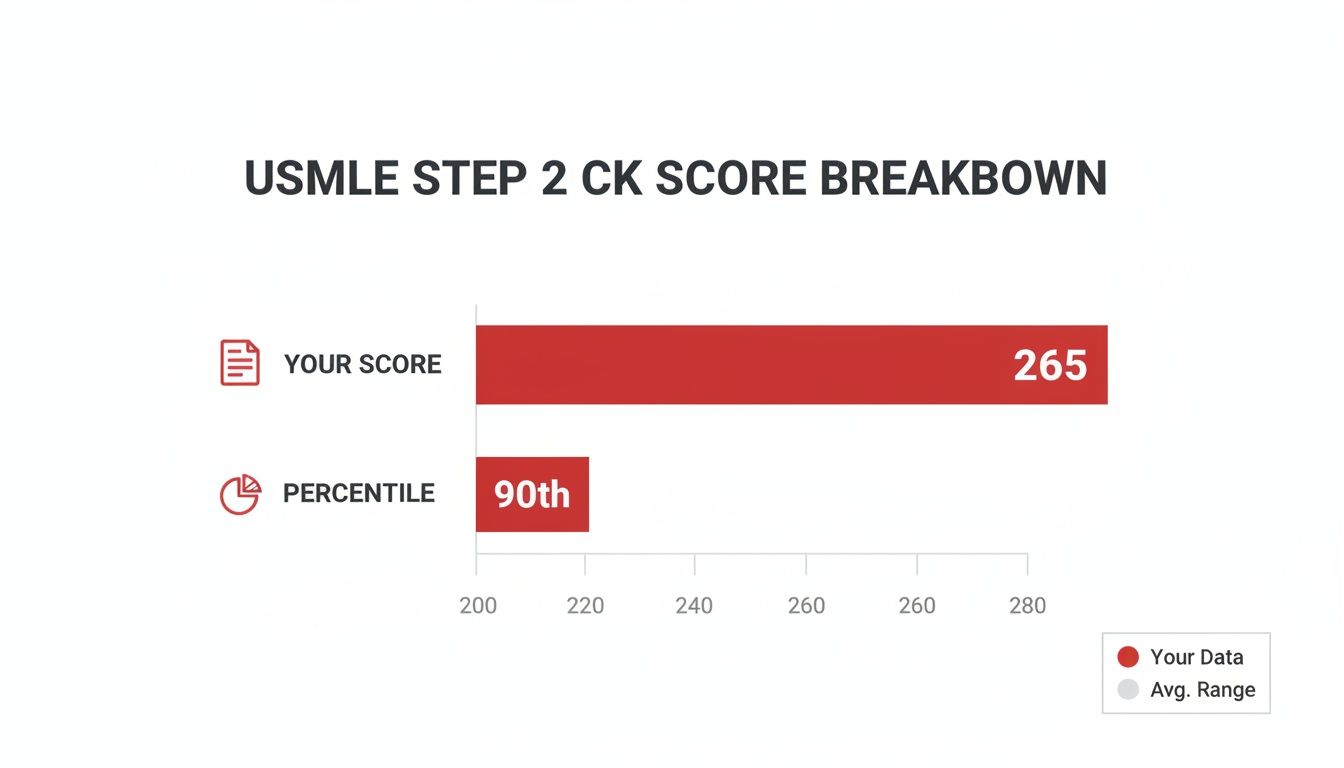
This visual drives home how your score translates directly into a percentile, telling programs exactly how you stack up against every other medical student in the country.
Your Score Is Your Specialty's Entry Ticket
Different medical specialties are like different levels in a video game—each one requires a higher score to get in. A score that’s considered solid for Family Medicine might not even get your application a second look for a specialty like Dermatology or Orthopedic Surgery. The expectations are worlds apart.
Residency programs are now giving Step 2 CK massive weight—up to 35% in the most competitive fields and a significant 20-25% everywhere else. It's no longer a secondary thought; it's a primary decision-maker. These numbers prove you need a tailored strategy, aiming not just to pass, but to land comfortably within the competitive range for your dream field.
Crucial Takeaway: A "good" score is completely relative. Your target shouldn't be the minimum passing number. It needs to be the average score of applicants who successfully matched into the specialty you want.
Setting a Specialty-Specific Target Score
To shift from a pass/fail mindset to a strategic one, you have to set a realistic yet ambitious target score. That process starts with research. The National Resident Matching Program (NRMP) publishes data every year that shows the average Step 2 CK scores for students who successfully matched into different specialties.
Here's a quick look at how wildly those scores can vary:
- Highly Competitive Specialties (e.g., Plastic Surgery, Dermatology): Average matched scores often soar into the 255-260+ range.
- Competitive Specialties (e.g., Emergency Medicine, General Surgery): Matched applicants are typically scoring in the 250s.
- Primary Care Specialties (e.g., Family Medicine, Pediatrics): Averages tend to fall in the 240s.
These numbers are your guideposts. They give you a clear sense of the competitive landscape you’re about to enter.
Average Step 2 CK Scores by Medical Specialty
To give you a more concrete idea, here’s a table comparing the average scores of matched US MD applicants across a range of specialties. Use this to find your field and see what the benchmark looks like.
| Specialty | Average Matched Score Range (US MD) |
|---|---|
| Dermatology | 255 – 265 |
| Orthopedic Surgery | 255 – 260 |
| Plastic Surgery | 255 – 260 |
| Otolaryngology (ENT) | 250 – 260 |
| General Surgery | 250 – 255 |
| Emergency Medicine | 245 – 255 |
| Anesthesiology | 245 – 255 |
| Internal Medicine | 245 – 250 |
| Pediatrics | 240 – 250 |
| Family Medicine | 235 – 245 |
| Psychiatry | 235 – 245 |
Seeing the data laid out like this makes it clear that your target score is entirely dependent on your career goals. A 240 is a great score for some fields but might be a screening filter for others.
For a deeper dive into what makes a score "good" for your specific goals, our guide can help you determine a good USMLE Step 2 score. Setting a clear, data-driven goal transforms your prep from a chore into a focused mission to lock down your future.
Creating Your Comeback Plan After a Low Score
Getting a Step 2 CK score that's lower than you hoped for—or even worse, a failing one—is a punch to the gut. There's no sugarcoating it. It feels like a massive setback, and it's deeply frustrating.
But let me be clear: this is a challenge you can absolutely overcome with the right strategy. This isn't about just re-reading textbooks or grinding through the same UWorld blocks again. It’s about a complete strategic reset.
Your first step? Give yourself a moment. A day or two to process the news, feel the frustration, and let it out. But then, you have to shift into action. Avoid falling into a cycle of panic or despair. Instead, you need to approach this like a diagnostic puzzle, the same way you would with a complex patient case. The goal is to figure out precisely what went wrong and build an evidence-based plan for a much stronger second attempt.
Deconstructing Your Performance
Your score report is the most important piece of data you have right now. Don't just glance at the three-digit number and toss it aside. You need to dissect the performance feedback inside.
The report breaks down how you did across different physician tasks and content areas, showing you exactly where you stood relative to other test-takers. This breakdown is your roadmap. Were you consistently weak in specific systems like cardiology or GI? Or did you struggle more with questions about diagnosis versus management? Spotting these patterns is the first, most critical step in creating a comeback plan that actually works.
A low score is not a reflection of your potential as a doctor. It's a data point. It tells you that your previous preparation strategy had holes. Your job now is to find those holes and fill them with focused, efficient work.
Building a Targeted Remediation Schedule
Once you've pinpointed your weak areas, your new study schedule has to be built around them. This is not the time for more passive review. Your plan must be active and laser-focused, pouring most of your energy into dragging up your lowest-performing subjects while still maintaining your strengths.
Here’s a structured way to think about it:
- Focus on High-Yield Weaknesses: Start with the subjects where you performed poorly and that make up a big chunk of the exam. A 10-point jump in a major area like internal medicine is worth far more than a 10-point jump in a minor one.
- Integrate New Resources: Let's be honest—if a particular resource didn't work for you the first time, forcing yourself to use it again probably won't change the outcome. Don't be afraid to switch things up. A different Qbank, a new review book, or a different video series might explain concepts in a way that finally makes them click.
- Seek Expert Guidance: This is where personalized support becomes a game-changer. Working one-on-one with a tutor who lives and breathes USMLE prep can help you understand those stubborn topics, refine your test-taking strategy, and—just as importantly—hold you accountable.
An expert tutor at Ace Med Boards can help you analyze your score report, find the root cause of your performance issues, and build a completely customized study plan. For a deeper dive into structuring your second attempt, our complete guide provides a detailed USMLE retake strategy. This journey is tough, no doubt about it, but with a smart plan and the right support, you can turn this setback into a powerful comeback story.
Building a Study Strategy to Surpass Your Goal Score

A truly effective study plan isn’t about scraping by with a passing score for Step 2 CK; it's about building the deep clinical knowledge that will make you a fantastic resident. This means shifting your mindset from defense to offense. Your third-year Shelf exams are the foundational building blocks for this success.
Think of each clerkship not just as a rotation but as a dedicated study block for a specific section of Step 2 CK. Mastering your Shelf exams builds the core knowledge you’ll need later, making your dedicated study period a review and refinement process rather than a frantic cramming session.
Integrating Core Study Resources
Your study schedule should be structured around two pillars: a high-quality question bank like UWorld and official NBME self-assessments. UWorld is your primary learning tool, helping you master concepts and recognize patterns through active recall.
NBME practice exams serve as crucial benchmarks. They simulate the real exam’s difficulty and scoring, providing the most accurate prediction of your performance. Taking one every few weeks helps you track progress, identify persistent weak areas, and adjust your plan accordingly.
A goal without a plan is just a wish. Your study schedule must be a living document, constantly informed by your performance on practice questions and self-assessments. It’s about being strategic, not just busy.
Refining Your Test-Taking Strategy
Beyond content mastery, top scores come from sharp test-taking skills. This involves learning how to dissect long clinical vignettes, eliminate distractors, and manage your time effectively across nine grueling hours.
Here’s how to build those skills:
- Timed Blocks: Complete all your UWorld blocks under timed conditions to build stamina and pacing.
- Analyze Errors: Go beyond just reading the explanation. Ask yourself why you got a question wrong—was it a knowledge gap, misreading the stem, or a reasoning error?
To maximize your study efficiency, especially when using digital resources, consider these helpful online course tips. For those aiming for a competitive edge, personalized coaching can turn a good score into one that impresses program directors. A dedicated tutor can help you craft a detailed USMLE Step 2 CK study plan that targets your specific needs.
Answering Your Top Step 2 CK Score Questions
Let's clear the air on some of the most common—and often stressful—questions students have about their Step 2 CK scores. Getting straight answers helps you build a solid strategy for test day and residency applications.
Can I Retake Step 2 CK if I Pass but Have a Low Score?
The short answer is no. The USMLE has a very firm policy here: once you pass a Step exam, that score is locked in. You can't retake it just to try for a better number.
This rule really raises the stakes for your first attempt. It means you have one shot to get the score you need, making thorough preparation absolutely critical. A "low pass" might feel like a relief, but it can still be a major roadblock for competitive specialties.
How Many Times Can I Take the Step 2 CK Exam?
You get a maximum of four attempts to pass the Step 2 CK exam. If you don't pass within those four tries, you become ineligible to take it again—or any other USMLE Step exam, for that matter.
This four-attempt limit puts a lot of pressure on each try. If you've had a setback, your comeback plan needs to be more than just re-reading First Aid. It's about digging deep to figure out why you didn't pass and fixing the root issues before you sit for the exam again.
According to the 2024 NRMP Program Director Survey, just passing isn't always the finish line. While most programs just want to see a pass, about a third of them are looking for a specific target score. This shows that the number on your report can definitely influence who offers you an interview.
Do Residency Programs See All My Attempts?
Yes, they see everything. Your complete USMLE transcript is sent to program directors, and it includes every single attempt you've made for all Step exams, both passing and failing scores.
A first-time pass is always the gold standard, no question. However, a significant score jump on a second attempt isn't a deal-breaker for everyone. It can show programs that you're resilient and determined—two qualities every good resident needs. But at the end of the day, your best strategy is to put all your effort into making your first attempt your only attempt.
If you're aiming for a score that opens doors to your dream residency, personal guidance can make all the difference. The expert tutors at Ace Med Boards specialize in creating customized study plans that target your weaknesses and build your confidence for exam day. Learn how one-on-one tutoring can help you achieve your goal score.